 Скачать презентацию IPv 6 For e Business Melbourne Workshop March
8a579073f8b226f703723a7d93ccb584.ppt
- Количество слайдов: 62



IPv 6 For e. Business Melbourne Workshop March 22, 2007 Tony Hill ISOC-AU IPv 6 SIG Mike Biber IPv 6 Forum Downunder Nurani Nimpuno APNIC Aus. Registry www. ipv 6. org. au IPv 6 for e. Business
IPv 6 for e. Business Workshop Agenda 1. Mapping and Awareness: This will describe the IPv 6 capabilities that Australian businesses can access right now, and what is needed for further IPv 6 deployment. 2. Enabling: This will discuss the Enabling Tools developed by this project, including business case scenarios, a Return On Investment evaluator, a transition checklist and an Easy Access Device. 3. Infrastructure: This session will cover underpinning infrastructure issues for IPv 6, the au. DA IPv 6 Registry Testbed and the Domain Name System under IPv 6. 4. IPv 6 Easy Access Demonstration: The IPv 6 Easy Access Device provides access to IPv 6 tunnelling even when your ISP supplies only IPv 4. It provides a simple, low-cost one-step solution to achieving IPv 6 connectivity for small to medium businesses. A demonstration of the device and its capabilities. Plus IP addressing issues from APNIC … potential exhaustion of the current IPv 4 space, and IPv 4 and IPv 6 address allocation in the Asia Pacific region 2 www. ipv 6. org. au IPv 6 for e. Business
IPv 6 e-B Mapping Presented by Tony Hill President Internet Society of Australia Chair ISOC-AU IPv 6 SIG 3 www. ipv 6. org. au IPv 6 for e. Business
Past IPv 6 Australian Activity • • • Launch of IPv 6 Forum Downunder Participation in IPv 6 Summits, Washington DC Formation of ISOC-AU IPv 6 SIG Member of the Asia Pacific IPv 6 Task Force Australian National ICT Industry Alliance – Endorsement of national discussion • Engagement with Australian Government • Tony Hill Keynote speaker at Global IPv 6 Summit 2005, Korea • First Australian IPv 6 Summit 2005, Canberra 4 www. ipv 6. org. au IPv 6 for e. Business
IPv 6 in 2006 for Australia • IPv 6 Forum Downunder/ISOC-AU co-branding • IPv 6 World Congress Meeting Feb 2006 • IPv 6 Readiness Survey – http: //www. ipv 6. org. au/survey. html • Second Australian IPv 6 Summit 2006, Canberra – http: //www. isoc-au. org. au/ipv 6 summit/ • IPv 6 for e-Business project commenced 2006 – http: //www. ipv 6. com. au • 2 nd Australian IPv 6 Summit 2006 – follow-up 5 www. ipv 6. org. au IPv 6 for e. Business
Key International IPv 6 Issues for Australia • Key Trading & Strategic Partners – Japan: developing since 1998, commercial IPv 6 offerings – South Korea: IT 839 mandating IPv 6 by 2010 – China: IPv 6 demonstration Projects by 2008 – USA: defence & government backbones IPv 6 by 2008 6 www. ipv 6. org. au IPv 6 for e. Business
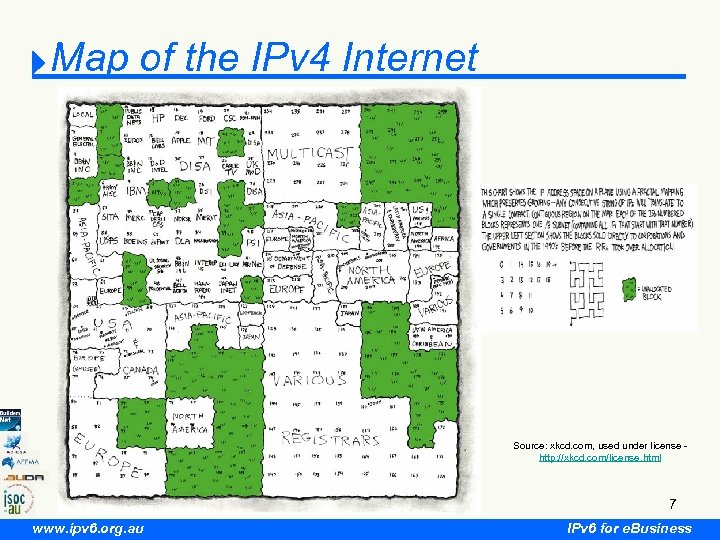
Map of the IPv 4 Internet Source: xkcd. com, used under license - http: //xkcd. com/license. html 7 www. ipv 6. org. au IPv 6 for e. Business
IPv 6 for e-Business Project • IPv 6 for e-Business is a project for documenting, developing business tools, raising awareness and assessing readiness for Internet Protocol version 6, to build Australian capacity to take advantage of future innovation, especially in the area of business-to-business supply chains. 8 www. ipv 6. org. au IPv 6 for e. Business
IPv 6 for e-Business Team • • • Kate Lance, (former) ED of ISOC-AU Narelle Clark, VP of ISOC-AU Mike Biber, IPv 6 Forum Tony Hill, President of ISOC-AU Holly Raiche, new ED of ISOC-AU 9 www. ipv 6. org. au IPv 6 for e. Business
IPv 6 for e-Business Project IPv 6 for e-Business has four aspects: • Mapping: to document Australian services, software and technologies currently taking advantage of IPv 6 as of July 2006 • Enabling: to develop integrated business models, checklists and tools to enable Australian businesses to easily adopt IPv 6 • Awareness: to provide information resources, documents and seminars to build broad awareness of IPv 6 opportunities • Infrastructure: to assess infrastructure support for applications with the IPv 6 -ready. au Registry testbed 10 www. ipv 6. org. au IPv 6 for e. Business
IPv 6 e-B Project Sponsors • Consortium • Endorsed • ITOL Supported 11 www. ipv 6. org. au IPv 6 for e. Business
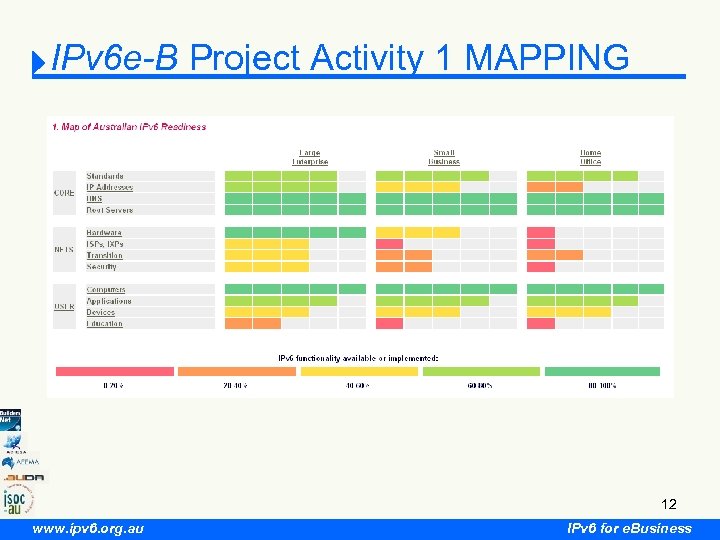
IPv 6 e-B Project Activity 1 MAPPING 12 www. ipv 6. org. au IPv 6 for e. Business
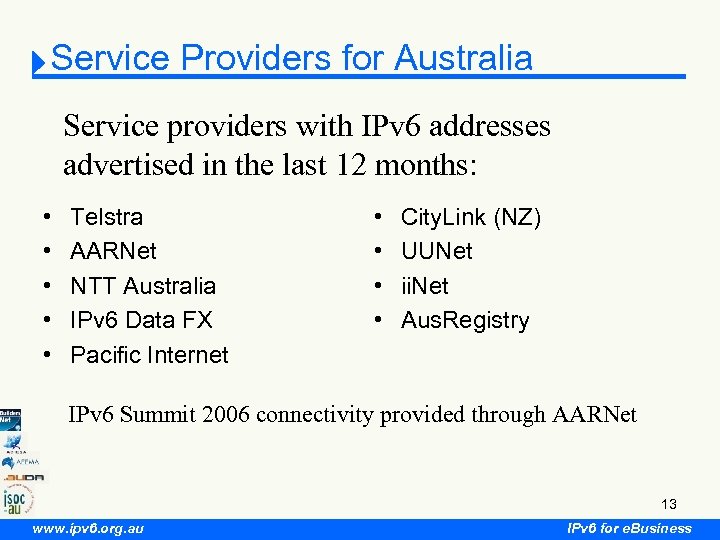
Service Providers for Australia Service providers with IPv 6 addresses advertised in the last 12 months: • • • Telstra AARNet NTT Australia IPv 6 Data FX Pacific Internet • • City. Link (NZ) UUNet ii. Net Aus. Registry IPv 6 Summit 2006 connectivity provided through AARNet 13 www. ipv 6. org. au IPv 6 for e. Business
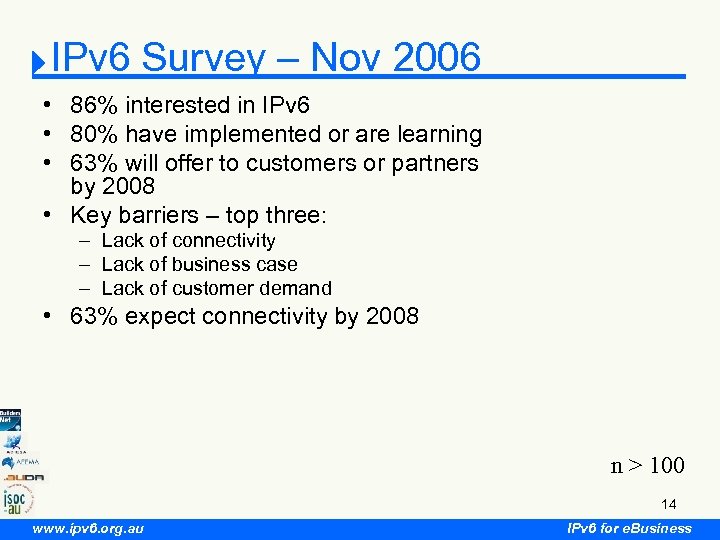
IPv 6 Survey – Nov 2006 • 86% interested in IPv 6 • 80% have implemented or are learning • 63% will offer to customers or partners by 2008 • Key barriers – top three: – Lack of connectivity – Lack of business case – Lack of customer demand • 63% expect connectivity by 2008 n > 100 14 www. ipv 6. org. au IPv 6 for e. Business
IPv 6 e-B IP Addressing Presented by Nurani Nimpuno/Gerard Ross APNIC 15 www. ipv 6. org. au IPv 6 for e. Business
IPv 6 e-B Project Activity Enabling Presented by Mike Biber Convener IPv 6 Forum Downunder 16 www. ipv 6. org. au IPv 6 for e. Business
IPv 6 e-B Project Activity 2 Enabling 1. Business Case Models 2. ROI Assessment Tools 3. Transition Checklists 4. Easy Access Device 17 www. ipv 6. org. au IPv 6 for e. Business
IPv 6 e-B Project Activity 2 Enabling 2. 1 Business Case Scenarios 1. 2. 3. 4. 5. 6. 7. The 'do nothing' case It's inevitable, may as well go with the flow Competitive differentiation Competitive protection Return on investment Known opportunities - understood and tangible Unknown opportunities - preparing fertile ground 18 www. ipv 6. org. au IPv 6 for e. Business
Business Case 1 – Do Nothing 2. 1 'Do nothing' case • All scenario studies should start with the 'do nothing' case. • IPv 6 was developed with a strong design goal of being backwards and forwards compatible. • In a broad sense, the only applications or network communications that will 'break' are the cases where they are deliberately designed to do so. • Applications specifically written for IPv 6 may not work as effectively or at all in an IPv 4 world. • One may not be disadvantaged in the short to medium term by not adopting IPv 6, however there will be increasing examples of functional benefits that will be denied to non-IPv 6 users. 19 www. ipv 6. org. au IPv 6 for e. Business
Business Case 2 – It’s Inevitable 2. 2 It's inevitable, may as well go with the flow • There is a certain inevitability to the IPv 6 juggernaut. Overseas government departments are being mandated to use or make provision for IPv 6 in reasonably short timeframes (Japan 2003, Switzerland 2005, Europe 2006, Korea 2006, USA 2008). Other countries such as China, Taiwan, the UK and Germany are actively integrating IPv 6 planning into their strategic IT scenarios. 20 www. ipv 6. org. au IPv 6 for e. Business
Business Case 3 - Differentiation 2. 3 Competitive differentiation • IPv 6 offers opportunities to differentiate service offering from competitive offerings. • At a superficial level, this might include straight connectivity options - IPv 6 web sites that are hidden from non-IPv 6 users. • More substantially, IPv 6 offers advantages in security, authentication, and enhanced trust relationships that may allow a tiered service offering based on a rich set of customer/consumer Quality of Service parameters. • The increased security and functionality afforded by IPv 6 can be parlayed in many different marketing messages. 21 www. ipv 6. org. au IPv 6 for e. Business
Business Case 4 - Protection 2. 4 Competitive protection • As competitors increase their use of IPv 6, others may be forced to comply to be seen to be compatible - this is the counter point to competitive differentiation. • There will be cases where B 2 B, Extranet, social networking or other loose collaborative interactions may demand IPv 6 compliance just to be allowed to participate. • It may be that non-IPv 6 authentication or access will not be acceptable. Microsoft's Windows Collaboration (also known as Windows Meeting Space) application in Windows Vista and Longhorn Server uses IPv 6, so you must have IPv 6 installed and enabled on your network adapter to use WMS. IPv 6 is installed and enabled by default in Windows Vista. • Staying competitive with our trading partners and neighbouring countries will increasingly dominate Australia's geo-strategic thinking. • Australian industry will not be able to sell into advanced markets as they will lack an intimate and comprehensive appreciation of IPv 6 networking. • We may also become the dumping ground for obsolete IPv 4 hardware and software applications. 22 www. ipv 6. org. au IPv 6 for e. Business
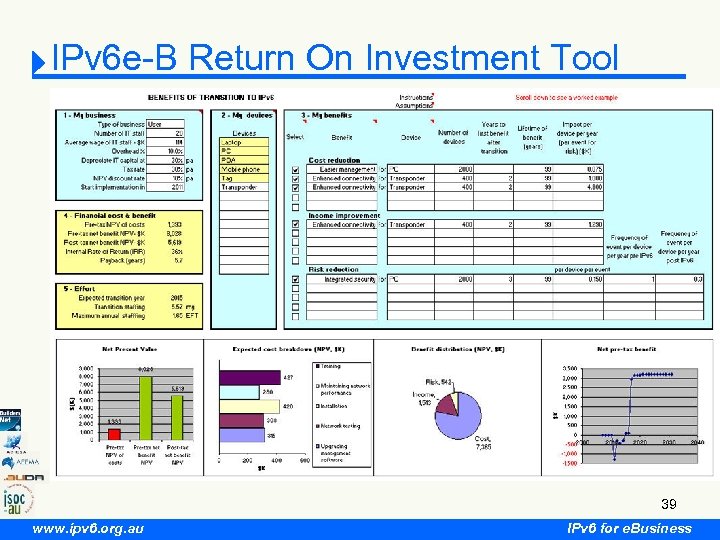
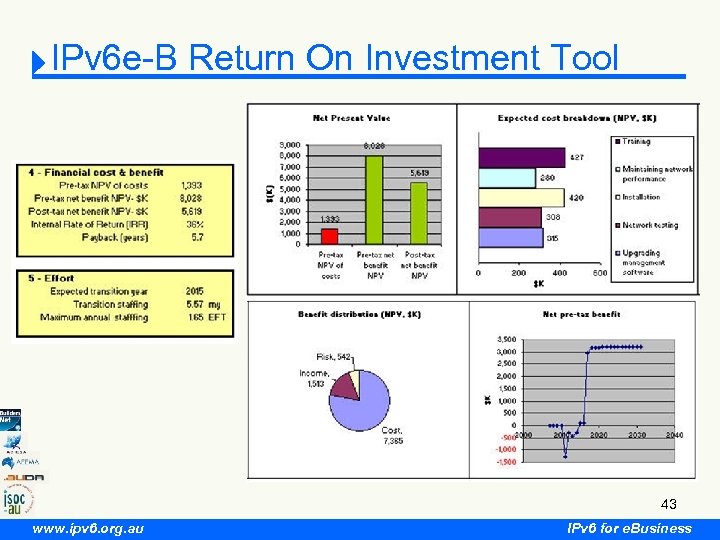
Business Case 5 - ROI 2. 5 Return on investment • The return on investment for IPv 6 adoption follows a similar profile to any other IT project. • The IPv 6 for e. Business project developed ROI tools based on an Excel spreadsheet that can be used to calculate the NPV (net present value), ROI (return on investment) and payback periods, typically over a 15 year period. 23 www. ipv 6. org. au IPv 6 for e. Business
Business Case 6 – Known Issues 2. 6 Known opportunities - understood and tangible • There are many cases where interoperability is a paramount requirement and current arrangements for addressability, security and compatibility need to be enhanced. • Disparate entities are thrown together for short and longer times and need to interoperate. – E. g. , emergency services respond to a natural disaster. The Fire, Police, Ambulance, rural fire authorities, SES, government departments, Utilities, Railways, Defence personnel and many others are thrown together with little opportunity for planning. – IPv 6 based networking is increasingly used internationally to allow interoperability between these services on an ad hoc basis. 24 www. ipv 6. org. au IPv 6 for e. Business
IPv 6 e-B IPv 6 Known Opportunities are supported by the protocol’s unique technical properties …explored in more detail on the ipv 6. org. au website and can be summarised as… 25 www. ipv 6. org. au IPv 6 for e. Business
IPv 6 - Unique Attributes 6. 1 Vastly increased address space – Extending the 4 billion IPv 4 address space to the 3. 4 x 10^38 IPv 6 address space allows many existing and new processes to receive addresses. – It has been said that in the future, any device worth more than $10 will have at least one IP address and be networked (source: Dr. Dean Economou, CENTIE 2002). Are we there yet? 26 www. ipv 6. org. au IPv 6 for e. Business
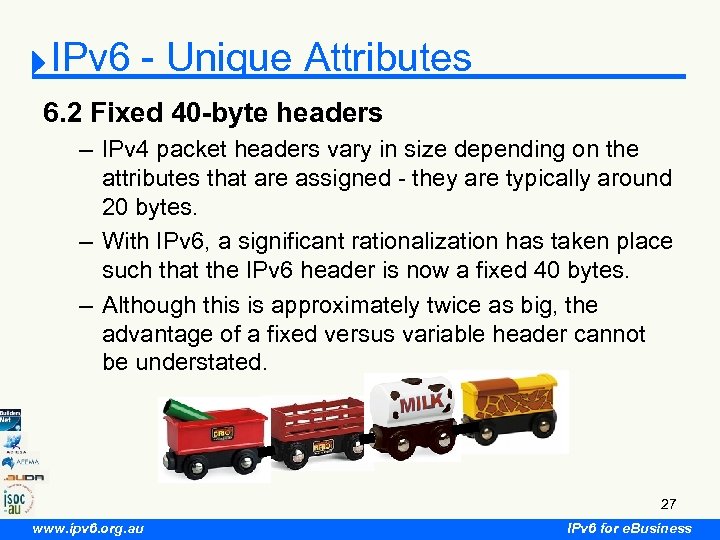
IPv 6 - Unique Attributes 6. 2 Fixed 40 -byte headers – IPv 4 packet headers vary in size depending on the attributes that are assigned - they are typically around 20 bytes. – With IPv 6, a significant rationalization has taken place such that the IPv 6 header is now a fixed 40 bytes. – Although this is approximately twice as big, the advantage of a fixed versus variable header cannot be understated. 27 www. ipv 6. org. au IPv 6 for e. Business
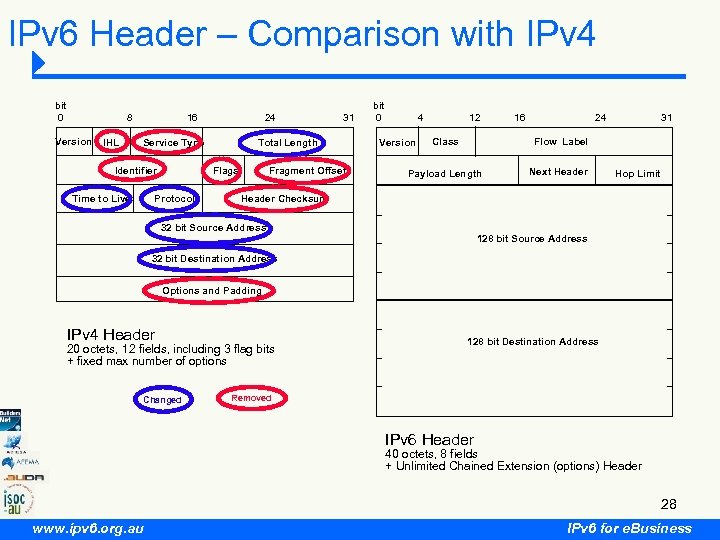
IPv 6 Header – Comparison with IPv 4 bit 0 8 Version IHL 16 24 Service Type Identifier Time to Live Total Length Flags Protocol 31 Fragment Offset bit 0 4 12 16 24 Class Flow Label Payload Length Next Header 31 Version Hop Limit Header Checksum 32 bit Source Address 128 bit Source Address 32 bit Destination Address Options and Padding IPv 4 Header 20 octets, 12 fields, including 3 flag bits + fixed max number of options Changed 128 bit Destination Address Removed IPv 6 Header 40 octets, 8 fields + Unlimited Chained Extension (options) Header 28 www. ipv 6. org. au IPv 6 for e. Business
IPv 6 - Unique Attributes 6. 3 Autoconfiguration – Autoconfiguration is the automatic configuration of devices without manual intervention, software configuration programs or jumpers, and devices should just "Plug and Play". – This process also includes duplicate address detection, multihoming and other useful network administration activity. 29 www. ipv 6. org. au IPv 6 for e. Business
IPv 6 - Unique Attributes 6. 4 Default IPsec Security – IPv 4 was developed at a time when Security was not uppermost as a concern. – Authenticating protocols such as IPsec were developed later and need to be retrofitted into IPv 4 protocol stacks. – Conforming standardsbased IPv 6 protocol stacks have IPsec as a mandatory requirement. 30 www. ipv 6. org. au IPv 6 for e. Business
IPv 6 - Unique Attributes 6. 9 Flow Label Qo. S – All of the Differentiated Services (Diff. Serv) and Integrated Services (Int. Serv) Quality of Service attributes from IPv 4 are carried over into IPv 6. – In addition, IPv 6 exclusively has a 20 -bit Flow Label field. – This field is being developed to provide a rich set of Quality of Service attributes for the growing IPv 6 world. 31 www. ipv 6. org. au IPv 6 for e. Business
IPv 6 - Unique Attributes 6. 5 End to end trust – Network Address Translation (NAT) has broken the end to end trust that was a hallmark of early IPv 4 services. – Authenticated IPv 4 Internet connections stop at these NAT gateways. – Authenticated IPsec IPv 6 sessions will route from end to end. 32 www. ipv 6. org. au IPv 6 for e. Business
IPv 6 - Unique Attributes 6. 6 Attribute Extension Headers – To conserve space in the IPv 6 packet header, a series of Extension Attribute packets have been defined. – This vastly speeds up the router packet forwarding rates and improves the efficiency of the communications sessions. 33 www. ipv 6. org. au IPv 6 for e. Business
IPv 6 – ‘Unique’ Attributes 6. 7 Anycasting – Anycasting was a unique attribute of IPv 6. – In IPv 4, only Unicast and Multicast addressing was originally supported. • But you can’t keep a good idea down… – Anycast addressing refers to a single source calling a predetermined list of Anycast destinations, but only one destination responds and participates in subsequent transmissions. 34 www. ipv 6. org. au IPv 6 for e. Business
IPv 6 - Unique Attributes 6. 8 Mobile. IPv 6 – When a device moves from its home network, its IP address and gateway address will be recognized as a foreign address in its new location and will be denied service. – To overcome this limitation, a process called Mobile. IP was developed in IPv 4. This consisted of the devices calling 'home' and telling the home network of its changing gateway environments (the foreign correspondent model). – In Mobile. IPv 6, a foreign correspondent server is continuously updated as to the network the device is in and which gateway to use to reach the travelling device. – This vastly improves performance and reliability, and reduces cost. 35 www. ipv 6. org. au IPv 6 for e. Business
Business Case 7 - Unknowns 2. 7 Unknown opportunities - preparing fertile ground – the Internet is now a mainstream activity Compared with only a short time ago, whole armies of engineers, entrepreneurs and programmers are dedicating their professional lives to exploiting the capabilities of the Next Generation IP. – New and innovative enhancements are being made every day to the Internet Protocol Suite. It can be anticipated that unforeseen and innovative applications will continuously come into being. Students being taught IPv 6 protocols today will continue to find opportunities to express themselves in new and challenging ways as they graduate into the workforce. – IPv 6 protocol suite is not a closed system. Using the open framework approach of Extended Attribute packets, IPv 6 is an extensible protocol that has no practical limits. – IPv 6 is uniquely positioned to support new and innovative applications such as Peer to Peer (P 2 P), Sensor Networking, GRID and Ambient Intelligence. – It is the platform both of the Future, and for today. 36 www. ipv 6. org. au IPv 6 for e. Business
IPv 6 e-B Project Activity 2 Enabling 1. Business Case Models 2. ROI Assessment Tools 3. Transition Issues 4. Easy Access Device 37 www. ipv 6. org. au IPv 6 for e. Business
IPv 6 e-B Project Activity 2 Enabling ROI Assessment Tools Return on Investment tools will assess three to fiveyear strategic needs under various scenarios. An Excel spreadsheet freely available from www. ipv 6. org. au This software will run in Excel 2003 and later (probably in earlier versions too). It also runs in Open. Office 2. 0 on Linux operating systems The Quality Improvement Company http: //www. thequalityimprovementcompany. com. au/ 38 www. ipv 6. org. au IPv 6 for e. Business
IPv 6 e-B Return On Investment Tool 39 www. ipv 6. org. au IPv 6 for e. Business
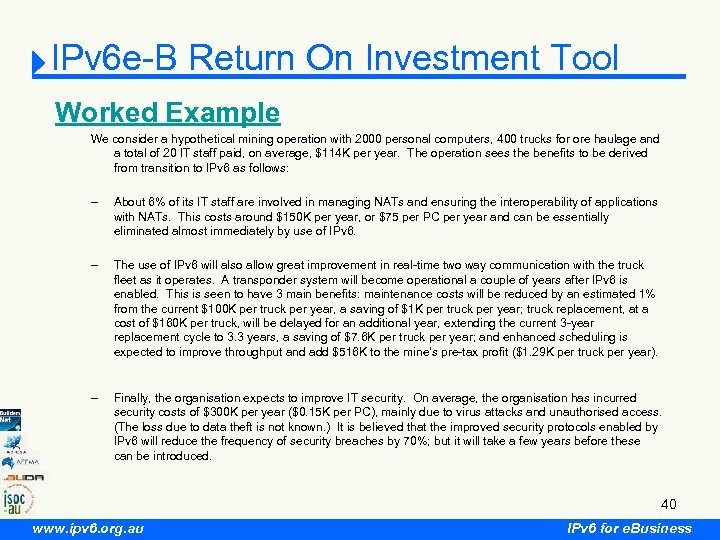
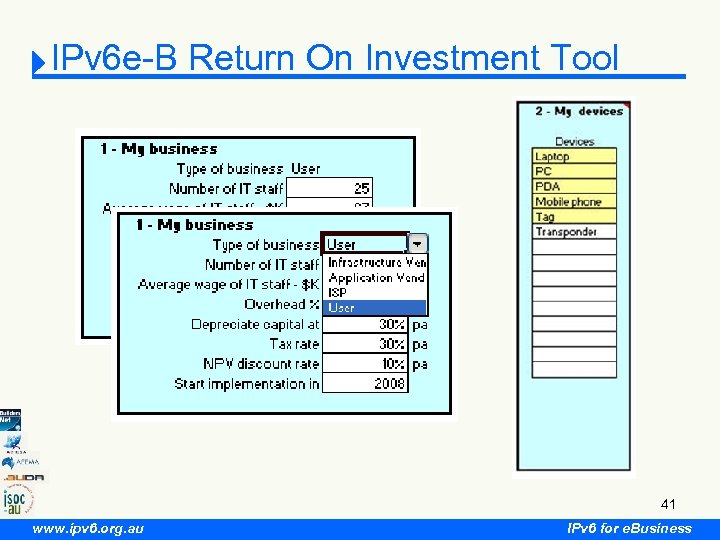
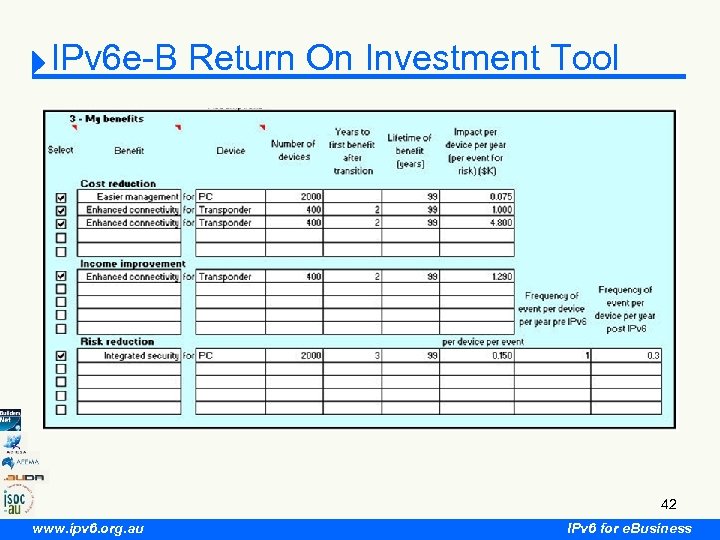
IPv 6 e-B Return On Investment Tool Worked Example We consider a hypothetical mining operation with 2000 personal computers, 400 trucks for ore haulage and a total of 20 IT staff paid, on average, $114 K per year. The operation sees the benefits to be derived from transition to IPv 6 as follows: – About 6% of its IT staff are involved in managing NATs and ensuring the interoperability of applications with NATs. This costs around $150 K per year, or $75 per PC per year and can be essentially eliminated almost immediately by use of IPv 6. – The use of IPv 6 will also allow great improvement in real-time two way communication with the truck fleet as it operates. A transponder system will become operational a couple of years after IPv 6 is enabled. This is seen to have 3 main benefits: maintenance costs will be reduced by an estimated 1% from the current $100 K per truck per year, a saving of $1 K per truck per year; truck replacement, at a cost of $160 K per truck, will be delayed for an additional year, extending the current 3 -year replacement cycle to 3. 3 years, a saving of $7. 6 K per truck per year; and enhanced scheduling is expected to improve throughput and add $516 K to the mine's pre-tax profit ($1. 29 K per truck per year). – Finally, the organisation expects to improve IT security. On average, the organisation has incurred security costs of $300 K per year ($0. 15 K per PC), mainly due to virus attacks and unauthorised access. (The loss due to data theft is not known. ) It is believed that the improved security protocols enabled by IPv 6 will reduce the frequency of security breaches by 70%; but it will take a few years before these can be introduced. 40 www. ipv 6. org. au IPv 6 for e. Business
IPv 6 e-B Return On Investment Tool 41 www. ipv 6. org. au IPv 6 for e. Business
IPv 6 e-B Return On Investment Tool 42 www. ipv 6. org. au IPv 6 for e. Business
IPv 6 e-B Return On Investment Tool 43 www. ipv 6. org. au IPv 6 for e. Business
IPv 6 e-B Project Activity 2 Enabling 2. 3 Transition Issues Organisations planning to test or deploy IPv 6 would usually follow the phases below to ensure a non-disruptive transition: • • Start off with a pilot project, testing IPv 6 on existing IPv 4 networks. Run separate IPv 4 and IPv 6 networks on the same infrastructure. Transition to networks with 'dual-stack' IPv 4 and IPv 6 devices. Finally move fully to IPv 6 networks, with legacy IPv 4 phased out over time. For each of these phases, most organisations will need to follow a similar series of steps: • • Assess business requirements, risks and benefits Survey existing network infrastructure Educate technical staff professionally Resource network and security infrastructure Phase-in and test IPv 6 -capable devices Inform and set policies for general staff Monitor and maintain procedures and infrastructure 44 www. ipv 6. org. au IPv 6 for e. Business
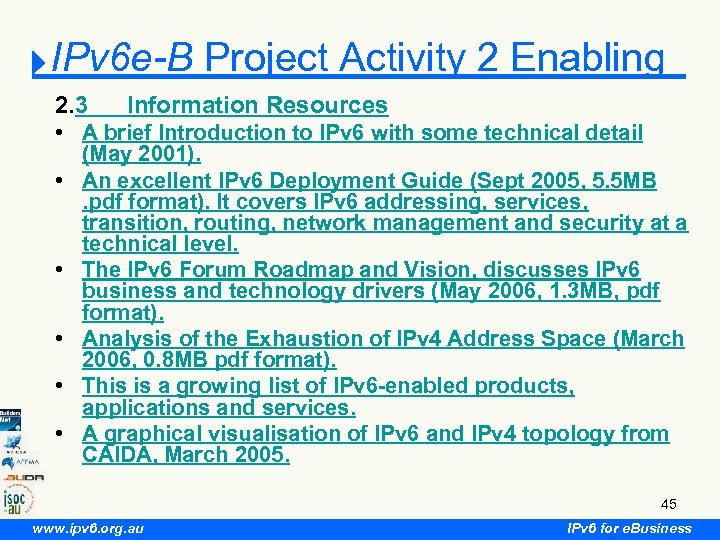
IPv 6 e-B Project Activity 2 Enabling 2. 3 Information Resources • A brief Introduction to IPv 6 with some technical detail (May 2001). • An excellent IPv 6 Deployment Guide (Sept 2005, 5. 5 MB. pdf format). It covers IPv 6 addressing, services, transition, routing, network management and security at a technical level. • The IPv 6 Forum Roadmap and Vision, discusses IPv 6 business and technology drivers (May 2006, 1. 3 MB, pdf format). • Analysis of the Exhaustion of IPv 4 Address Space (March 2006, 0. 8 MB pdf format). • This is a growing list of IPv 6 -enabled products, applications and services. • A graphical visualisation of IPv 6 and IPv 4 topology from CAIDA, March 2005. 45 www. ipv 6. org. au IPv 6 for e. Business
IPv 6 e-B Project Activity 2 Enabling 2. 3 IETF Guides to IPv 6 Deployment • Small Business and Home Office Networks • Large Enterprise Networks • Internet Service Provider Networks • Transition Techniques – The key RFCs are linked from the www. ipv 6. org. au website 46 www. ipv 6. org. au IPv 6 for e. Business
IPv 6 e-B Project Activity 3 AWARENESS Specific activities include: • Information: IPv 6 Basics, awareness website and resources, first phase • Promotion: publicity for website, brochures, seminars via the IPv 6 Summit 2006 • Seminars: presentations for business and SMEs in seven major cities • Updates: website and resources, second phase - progress, outcome of activities 47 www. ipv 6. org. au IPv 6 for e. Business
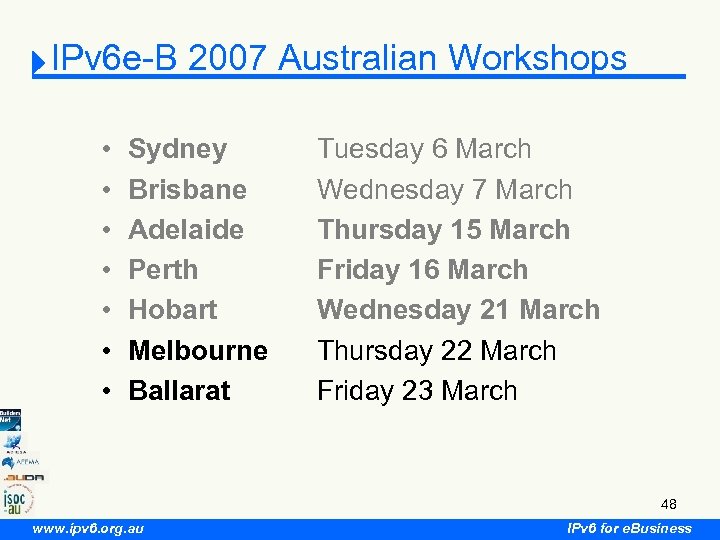
IPv 6 e-B 2007 Australian Workshops • • Sydney Brisbane Adelaide Perth Hobart Melbourne Ballarat Tuesday 6 March Wednesday 7 March Thursday 15 March Friday 16 March Wednesday 21 March Thursday 22 March Friday 23 March 48 www. ipv 6. org. au IPv 6 for e. Business
IPv 6 e-B Infrastructure Presented by Tony Hill President Internet Society of Australia Chair ISOC-AU IPv 6 SIG 49 www. ipv 6. org. au IPv 6 for e. Business
IPv 6 e-B INFRASTRUCTURE IPv 6 infrastructure is underpinned by a set of attributes that support: • • • Address Allocation DNS Operations Transition Support E-Commerce Security Keys …these are discussed in more detail on the ipv 6. org. au website 50 www. ipv 6. org. au IPv 6 for e. Business
IPv 6 e-B Project Activity 4 INFRASTRUCTURE Utilising the IPv 6 ready. au registry, the project assessed the status of infrastructure planning, development and the potential of Australian infrastructure to support development of test bed applications • • IPv 6 Infrastructure Directions: address allocation processes, DNS operations issues, IPv 6 connectivity availability, IPv 6 transition planning support, e-Commerce dimensions, and Security key infrastructure. IPv 6 Testbed Development: assessing readiness for applications such as RFID-based, remote sensing, Internet mobile phone address expansion, powerline delivery of network data, Wi. Max-enabled devices, voice and video over IP, desktop applications on mobile devices. 51 www. ipv 6. org. au IPv 6 for e. Business
IPv 6 e-B Transition Case Study Moving to IPv 6 for Aus. Registry Chris Wright Chief Technology Officer 52 www. ipv 6. org. au IPv 6 for e. Business
IPv 6 -e. B Aus. Registry Moving to IPv 6 • au. DA and Aus. Registry are working together to IPv 6 enable the. au DNS and its associated infrastructure • Aus. Registry identified the following perquisites to be able to IPv 6 enable the infrastructure: – IPv 6 enabled Network equipment (Cisco & F 5 equipment used) – IPv 6 enabled Operating Systems (Redhat Enterprise Linux) – IPv 6 transit provider (tunnelled via Telstra) – IPv 6 enable software (BIND, Java, in-house software) 53 www. ipv 6. org. au IPv 6 for e. Business
IPv 6 -e. B Aus. Registry What has been completed? • Registry has been modified to accept IPv 6 glue records for. au domains and publish them to the DNS (AAAA record support) • Aus. Registry obtained IPv 6 assignment from APNIC • IPv 6 enabled Registry Network infrastructure • Obtained IPv 6 transit • IPv 6 enabled DNS servers for. au 2 LDs (further testing of recursive server/resolver behaviour is required) 54 www. ipv 6. org. au IPv 6 for e. Business
IPv 6 -e. B Aus. Registry Outstanding Tasks • Complete research into resolver/recursive server behaviour in mixed IPv 4/IPv 6 environments • Pending results of above, publish IPv 6 records for Name Servers to the DNS • IPv 6 enable. au Who. Is • IPv 6 enable. au Registration System & associated interfaces (EPP & Websites) 55 www. ipv 6. org. au IPv 6 for e. Business
IPv 6 e-B Project Activity 2 Enabling Easy Access Device The easy access device provides infrastructure to allow IPv 6 connectivity with a 'tunnel terminator' for small businesses and home offices. It will allow straightforward, inexpensive IPv 6 connectivity, without time-consuming and technically complex site-by-site deployments, and will be implemented on an open standards device. 56 www. ipv 6. org. au IPv 6 for e. Business
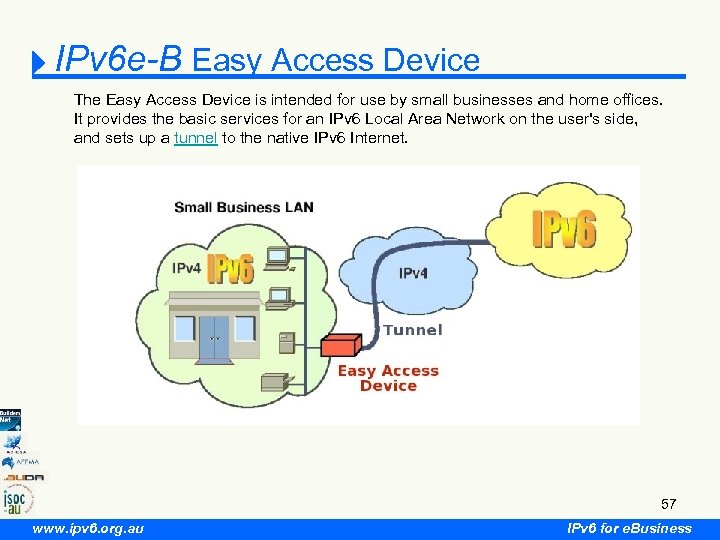
IPv 6 e-B Easy Access Device The Easy Access Device is intended for use by small businesses and home offices. It provides the basic services for an IPv 6 Local Area Network on the user's side, and sets up a tunnel to the native IPv 6 Internet. 57 www. ipv 6. org. au IPv 6 for e. Business
IPv 6 e-B Easy Access Device • The essential features of the device are: It is the access point for the IPv 6 tunnel It runs DHCP on the user's side to provide IPv 6 addresses It runs local DNS to provide lookups between Internet names and addresses It passes addresses in use to the upstream DNS where available It has IPv 4 and IPv 6 firewalls to provide security Its web pages are accessible via IPv 6 • The device runs on a generic small-sized personal computer running Ubuntu Linux, currently version 6. 06 LTS, kernel version 2. 6. 18. • It also runs iptables for firewall services. 58 www. ipv 6. org. au IPv 6 for e. Business
IPv 6 e-B Easy Access Device • Future steps in development of the device Add wireless facilities Add a variety of services Add a choice of Internet Service Providers 2007 Easy Access Device Testing Taking place through Builders. Net, with small and medium sized enterprises working in the construction industry, fundamentally connected into a broad range of businesses in the Australian economy. The Defence establishment through ADIESA will be invited to participate as well as other selected SMEs. By focusing initially on the needs of construction and Defence SMEs, the IPv 6 for e-Business project will gain greater understanding of adoption issues across a wide range of sectors. 59 www. ipv 6. org. au IPv 6 for e. Business
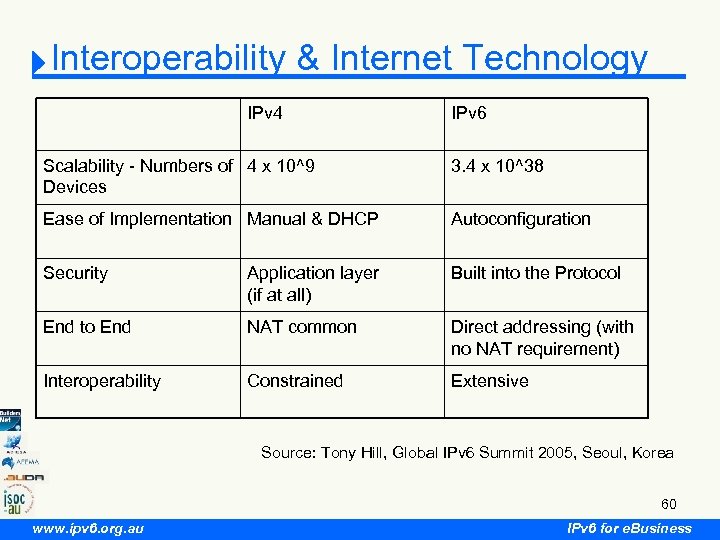
Interoperability & Internet Technology IPv 4 IPv 6 Scalability - Numbers of 4 x 10^9 Devices 3. 4 x 10^38 Ease of Implementation Manual & DHCP Autoconfiguration Security Application layer (if at all) Built into the Protocol End to End NAT common Direct addressing (with no NAT requirement) Interoperability Constrained Extensive Source: Tony Hill, Global IPv 6 Summit 2005, Seoul, Korea 60 www. ipv 6. org. au IPv 6 for e. Business
Business Value Points • • Massively increased address space Expansion of Internet interoperable capabilities Compliance with government mandates Ease of implementation Security inherent, rather than ad hoc Direct addressing of all devices Increased potential for remote sensing 61 www. ipv 6. org. au IPv 6 for e. Business
Expansion in Connected Devices • • • Interoperability between IPv 6 and RFID Explosion of Internet enabled mobile phones Potential of broadband over power lines Growth of Wi. Max Vo. IP Desktop applications as a mobiles, hand-held PCs and integrated devices give us a new TLA to ponder … IMS – IP Multimedia Subsystems 62 www. ipv 6. org. au IPv 6 for e. Business
Скачать презентацию IPv 6 For e Business Melbourne Workshop March
8a579073f8b226f703723a7d93ccb584.ppt