


 Скачать презентацию IPv 6 Address and Migration Challenges Peter J
8f89ccfea3d76c86137e5d7adc586e54.ppt
- Количество слайдов: 32
 IPv 6 Address and Migration Challenges Peter. J. Willis@bt. com
 Contents - IPv 6 Addresses § § § s. TLAs are too small. NLAs are too small. IPv 6 Address Hierarchies, which one? Commercial restraints caused by the address allocation rules. Alternative schemes. My crystal ball. © British Telecommunications plc 2001 2
 Contents § IPv 6 Deployment Challenges Cost modelling of migration. - Suggested strategy for migration - Where are the NGN applications? § Home Networks § Home gateways - Addressing & naming in context - Its about communications not architectures. - © British Telecommunications plc 2001 3
 Why is address structure important? Address structure is more than the total number of bits. § It is the address format & structure that defines the fundamental nature of a network. (Think of the close relationship between IPv 4 address structures & the Internet. ) § The structure can define the way you build networks. If you get the structure wrong it costs you money to build a network to make that address structure work. (Think of the cost of memory for all those IPv 4 routes. ) § © British Telecommunications plc 2001 4
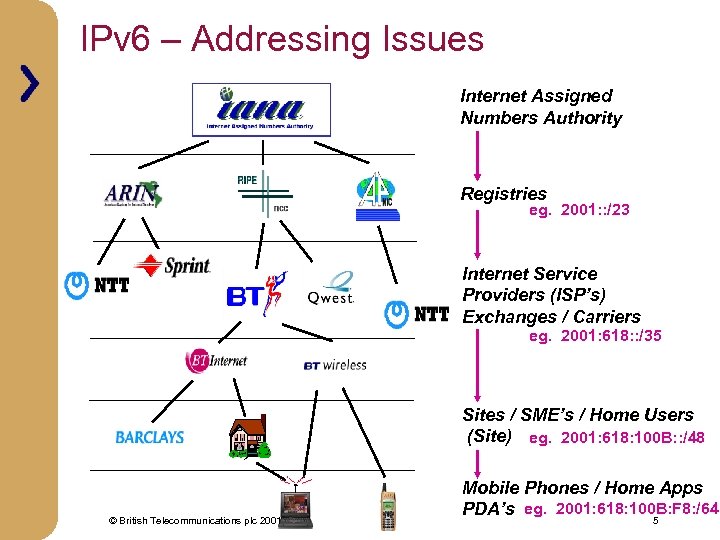 IPv 6 – Addressing Issues Internet Assigned Numbers Authority Registries eg. 2001: : /23 Internet Service Providers (ISP’s) Exchanges / Carriers eg. 2001: 618: : /35 Sites / SME’s / Home Users (Site) eg. 2001: 618: 100 B: : /48 © British Telecommunications plc 2001 Mobile Phones / Home Apps PDA’s eg. 2001: 618: 100 B: F 8: /64 5
 s. TLAs Are Too Small Currently IPv 6 network service providers (NSP) are using sub-TLAs during the bootstrap phase of IPv 6. § The s. TLA is a /35 § The first 13 bits after the /35 is the NLA (Next. Level Aggregation) Identifier. § This NLA space has to be used to address the customers & describe the NSP topology. If the customer is an ISP then they too have to use the NLA space. (Ripe-196) § © British Telecommunications plc 2001 6
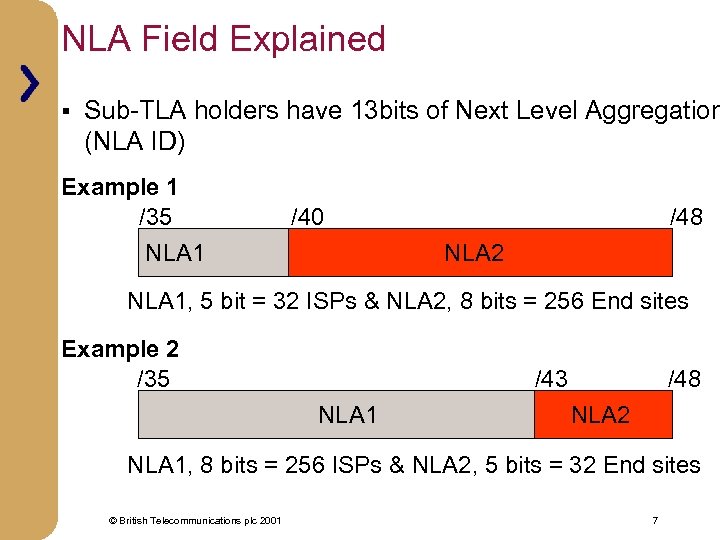 NLA Field Explained § Sub-TLA holders have 13 bits of Next Level Aggregation (NLA ID) Example 1 /35 NLA 1 /40 /48 NLA 2 NLA 1, 5 bit = 32 ISPs & NLA 2, 8 bits = 256 End sites Example 2 /35 /43 NLA 1 /48 NLA 2 NLA 1, 8 bits = 256 ISPs & NLA 2, 5 bits = 32 End sites © British Telecommunications plc 2001 7
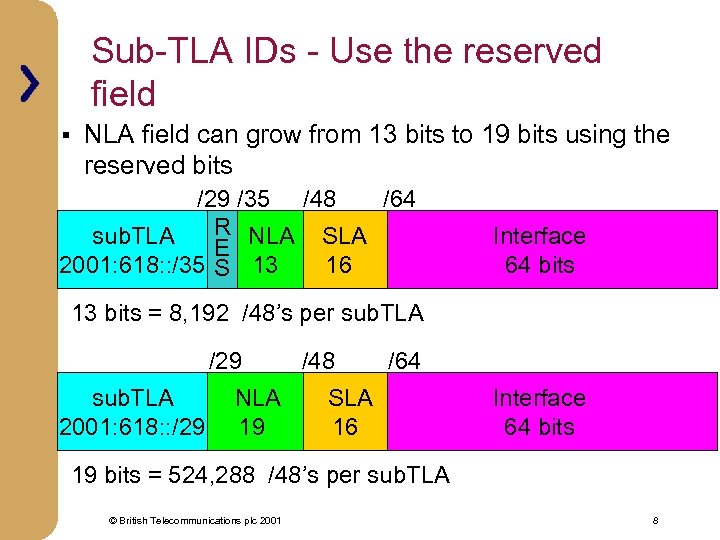 Sub-TLA IDs - Use the reserved field § NLA field can grow from 13 bits to 19 bits using the reserved bits /29 /35 /48 /64 R NLA SLA sub. TLA E 2001: 618: : /35 S 13 16 Interface 64 bits 13 bits = 8, 192 /48’s per sub. TLA /29 sub. TLA 2001: 618: : /29 NLA 19 /48 /64 SLA 16 Interface 64 bits 19 bits = 524, 288 /48’s per sub. TLA © British Telecommunications plc 2001 8
 Using the NLA Hierarchically In NGNs with billions of attached devices the only way networks will scale will be with a deep hierarchy. § To keep the routing table to a minimum size each layer of the hierarchy must do near perfect routing aggregation. § Lets explore some network hierarchies and see how many bits are required: § © British Telecommunications plc 2001 9
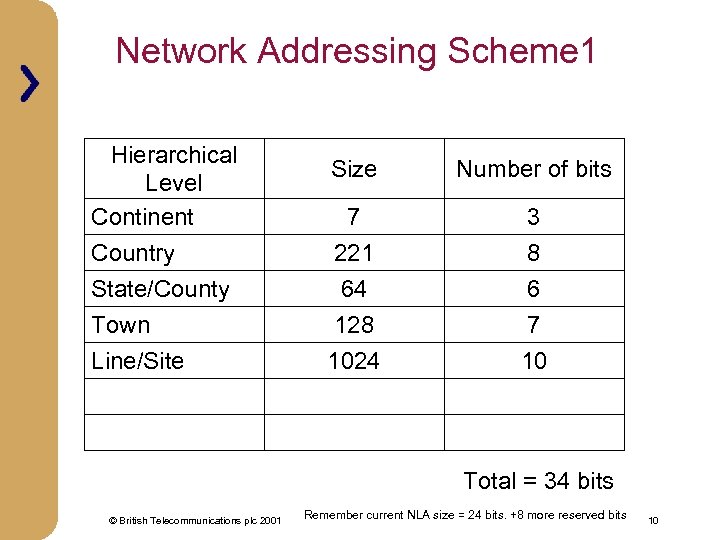 Network Addressing Scheme 1 Hierarchical Level Continent Country State/County Town Line/Site Size Number of bits 7 221 64 128 1024 3 8 6 7 10 Total = 34 bits © British Telecommunications plc 2001 Remember current NLA size = 24 bits. +8 more reserved bits 10
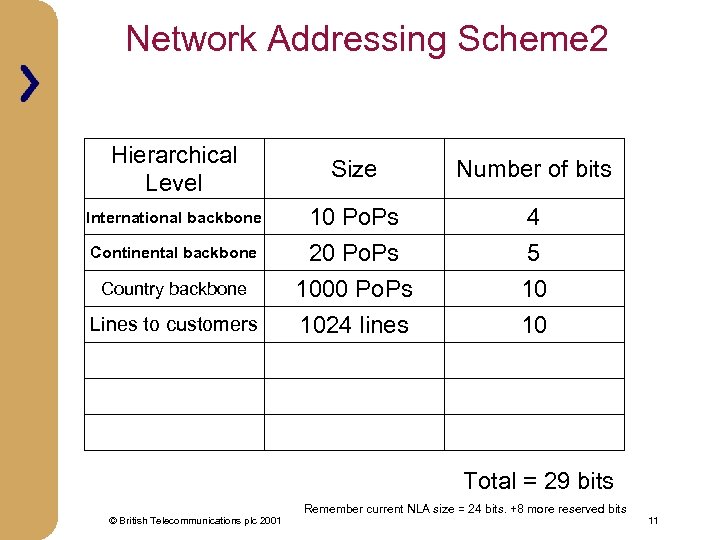 Network Addressing Scheme 2 Hierarchical Level International backbone Continental backbone Country backbone Lines to customers Size Number of bits 10 Po. Ps 20 Po. Ps 1000 Po. Ps 1024 lines 4 5 10 10 Total = 29 bits © British Telecommunications plc 2001 Remember current NLA size = 24 bits. +8 more reserved bits 11
 Network Addressing Scheme 3 and NLA Size Conclusion • Assume very efficient address allocation without any network hierarchy (not a recommended design!)then how many lines to customers could we have with a 24 bit NLA? 2^24 = 16 Million. • Using the Huitema-Durand method then 31 bits is required to address 30 Million homes. (See notes) • Simply a NLA of 24 bits is not big enough for a global network operator nor big enough for a UK operator aiming to reach every home. • A 34 bit NLA should be sufficient. © British Telecommunications plc 2001 12
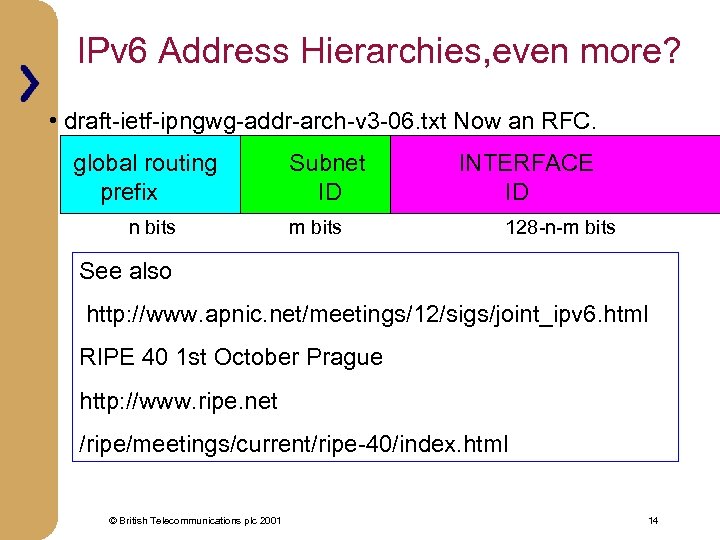 IPv 6 Address Hierarchies, even more? • draft-ietf-ipngwg-addr-arch-v 3 -06. txt Now an RFC. global routing prefix n bits Subnet ID m bits INTERFACE ID 128 -n-m bits See also http: //www. apnic. net/meetings/12/sigs/joint_ipv 6. html RIPE 40 1 st October Prague http: //www. ripe. net /ripe/meetings/current/ripe-40/index. html © British Telecommunications plc 2001 14
 Commercial restraints caused by the address allocation rules. The TLA/NLA/SLA structuring and address assignment rules drives a commercial model of customers dependent on Tier 2 ISPs dependent on Tier 1 ISPs. § This is not the way it works with 3 G! § Slow start rules provide unfair competitive advantage to established & large networks. § Address utilisation targets if set too high cause a flattening of network hierarchy which leads to higher engineering costs. § © British Telecommunications plc 2001 15
 Alternatives § draft-hain-ipv 6 -pi-addr-00. txt “An IPv 6 Provider-Independent Global Unicast Address Format”. The users IPv 6 address is derived from their latitude and longitude. § Increase the number of bits in the global routing prefix by reducing the number in the interface id. Then allow any ISP unqualified address space. § The ideal situation is that every ISP has enough address space to address everyone. © British Telecommunications plc 2001 16
 My Crystal Ball In the short term looking to see some improvement in the IPv 6 address structure and allocation rules in the current RIRs considerations. § In the long term I expect IPv 6. 1 which will make much better use of the 128 bit address space. § © British Telecommunications plc 2001 17
 IPv 6 Deployment Strategy: Cost Modelling of IPv 6 Migration Understanding the business case for deploying IPv 6 is the first key step. § Understanding the costs of IPv 6 is key and it is the costs that will form a significant obstacle. § Your IPv 6 deployment strategy should seek to minimise costs and maximise commercial advantages. § © British Telecommunications plc 2001 18
 IPv 6 Migration Costs Study § The study looked at the whole costs of migrating to IPv 6 for the following scenarios: A Big or Tier 1 ISP - A Big enterprise - A SME - A Dial-ISP - The study examined the costs of migrating now and migrating in 5 years time. § Extra maintenance costs included. § © British Telecommunications plc 2001 19
 IPv 6 Migration Costs Assumptions Attempted to include all costs, including new software, memory, hardware, OSS and desktop upgrades. § Extra maintenance costs assume the extra costs of running IPv 6 on an existing IPv 4 network. That is assuming a dual-stack scenario. § Once IPv 4 is phased out then extramaintenance costs no longer apply. § Application migration costs not included but allowed for with BITS s/w for legacy IPv 4 applications that could not be migrated. § © British Telecommunications plc 2001 20
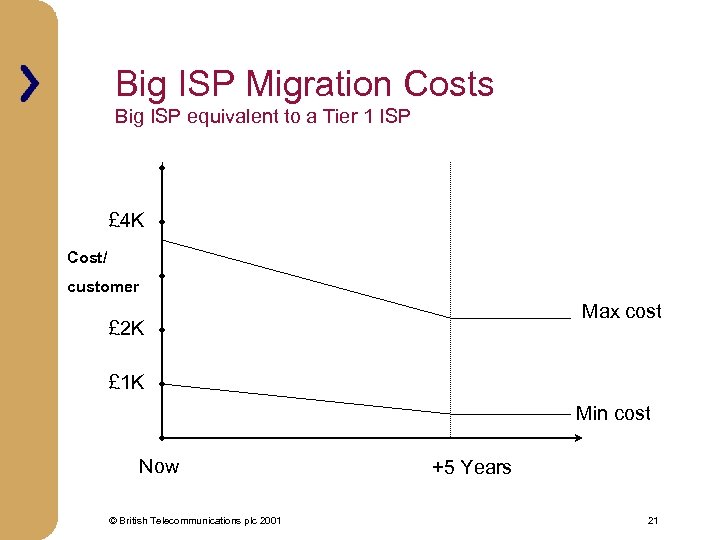 Big ISP Migration Costs Big ISP equivalent to a Tier 1 ISP £ 4 K Cost/ customer Max cost £ 2 K £ 1 K Min cost Now © British Telecommunications plc 2001 +5 Years 21
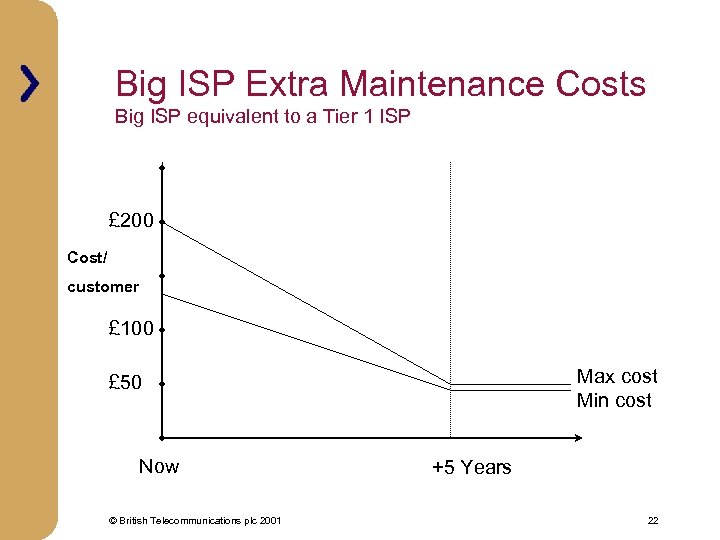 Big ISP Extra Maintenance Costs Big ISP equivalent to a Tier 1 ISP £ 200 Cost/ customer £ 100 Max cost Min cost £ 50 Now © British Telecommunications plc 2001 +5 Years 22
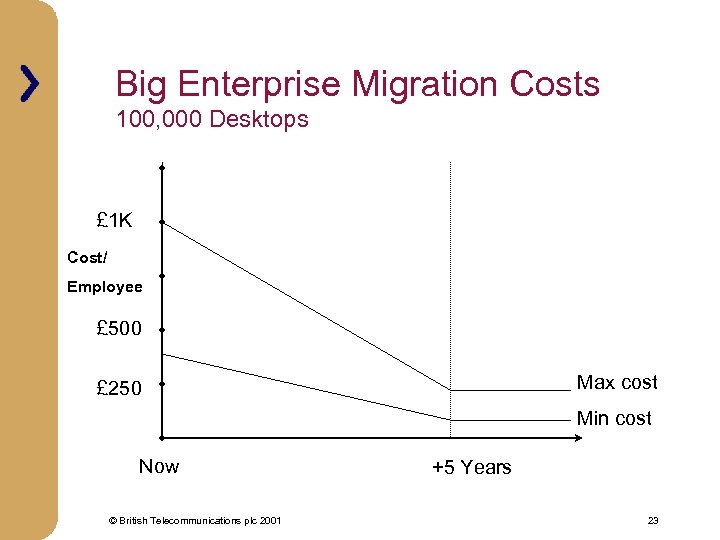 Big Enterprise Migration Costs 100, 000 Desktops £ 1 K Cost/ Employee £ 500 Max cost £ 250 Min cost Now © British Telecommunications plc 2001 +5 Years 23
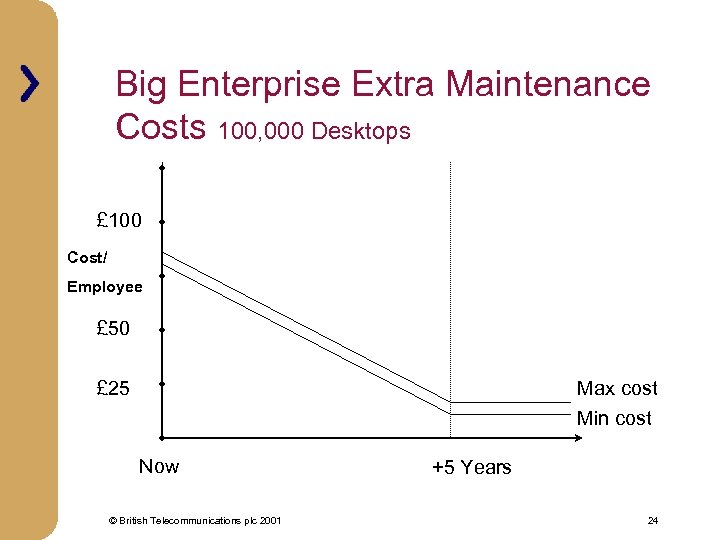 Big Enterprise Extra Maintenance Costs 100, 000 Desktops £ 100 Cost/ Employee £ 50 £ 25 Max cost Min cost Now © British Telecommunications plc 2001 +5 Years 24
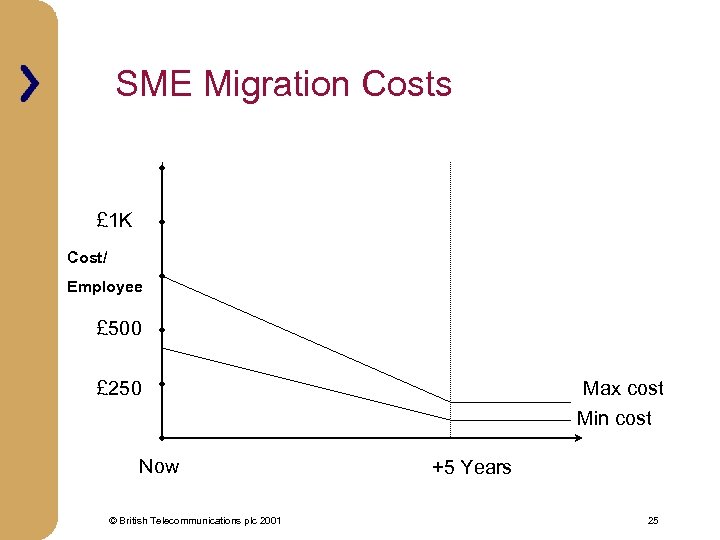 SME Migration Costs £ 1 K Cost/ Employee £ 500 £ 250 Now © British Telecommunications plc 2001 Max cost Min cost +5 Years 25
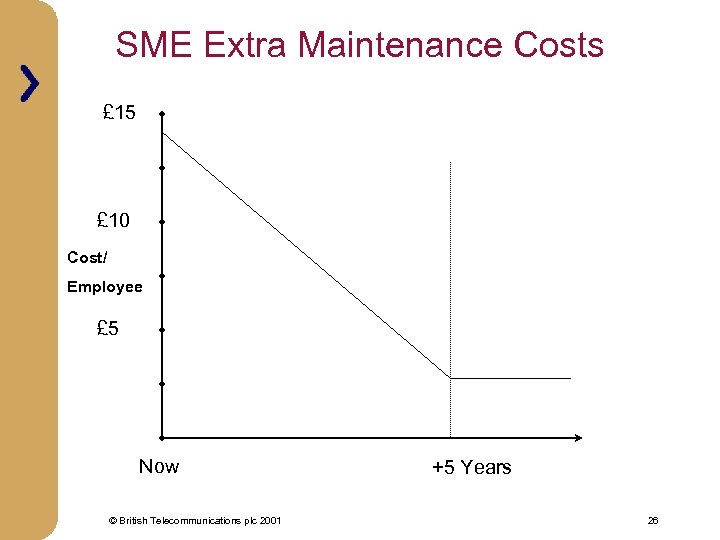 SME Extra Maintenance Costs £ 15 £ 10 Cost/ Employee £ 5 Now © British Telecommunications plc 2001 +5 Years 26
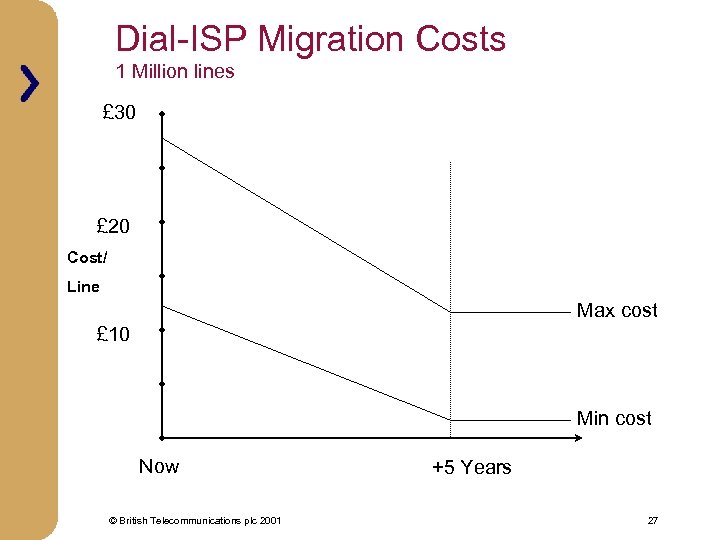 Dial-ISP Migration Costs 1 Million lines £ 30 £ 20 Cost/ Line Max cost £ 10 Min cost Now © British Telecommunications plc 2001 +5 Years 27
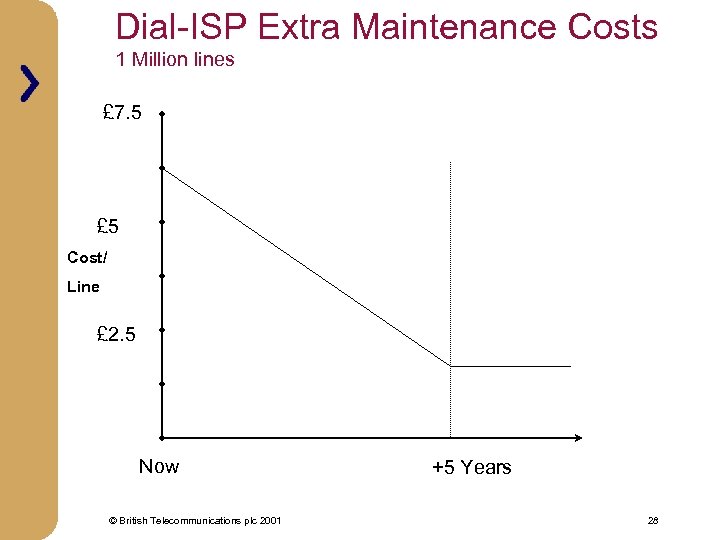 Dial-ISP Extra Maintenance Costs 1 Million lines £ 7. 5 £ 5 Cost/ Line £ 2. 5 Now © British Telecommunications plc 2001 +5 Years 28
 Recommendations § § § Do not upgrade to IPv 6 now but plan to do it in about 5 years time. Ensure as kit & software is churned or upgraded for operational reasons that it is upgraded to be IPv 6 capable. Start work on your IPv 6 upgrade strategy now. Waiting for the killer IPv 6 application or until your competition has upgraded to IPv 6 could be more expensive than a planned gradual upgrade in IPv 6 capability. Once IPv 6 is deployed shortening the life time of IPv 4 will reduce maintenance costs. © British Telecommunications plc 2001 29
 Where are the NGN applications? NGN is not the same as IPv 6. § What is stopping NGN applications being deployed in IPv 4? § If you have an application but can’t deploy it because of a lack of IPv 4 addresses or because IPv 6 not widely deployed we need to know! § © British Telecommunications plc 2001 30
 Home Networks and IPv 6 § § § When thinking about naming & addressing we need to consider the context of the communications. The residential/home gateway may be a better place to manage communications in & out of the house. The Internet’s end-to-end architecture may no longer be appropriate. Architectures develop as technology changes. “Meta networks” with “intelligent” translation of messages at the edge of network domains may now be more appropriate. SIP & NAT are examples. This gives security & control (no more d. DOS attacks). Given a “SIP” that works then global IP addresses are no longer needed - communications routed on names. (XML routing is another alternative tech. ) © British Telecommunications plc 2001 31
 Conclusion As an industry we need to make sure we don’t make the same “Class A, B, C” mistake we made with IPv 4. That is not thinking about the future. § If IPv 6 happens the costs of migrating to it can be mitigated by an IPv 6 upgrade strategy applied now. § Don’t become religious about architectural principles that were created in a different technological era. § © British Telecommunications plc 2001 32
 Thank you. Peter. J. Willis@bt. com