Скачать презентацию IPv 4 Unallocated Address Space Exhaustion Geoff Huston
5d9eb7566e985b39a6b98a87dca84ce2.ppt
- Количество слайдов: 40
 IPv 4 Unallocated Address Space Exhaustion Geoff Huston Chief Scientist APNIC 24, September 2007
 IPv 4
IPv 4
 IPv 4
IPv 4
 Current Status of IPv 4 n Lets look at some charts showing the current status of IPv 4 address space and recent address consumption rates
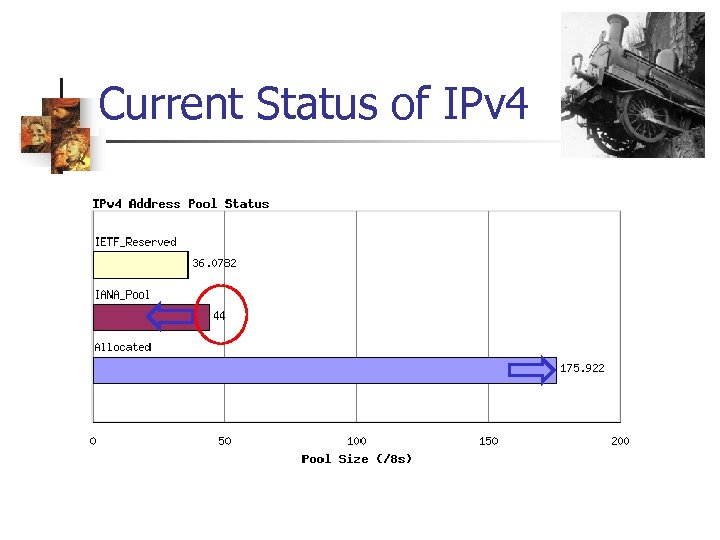 Current Status of IPv 4
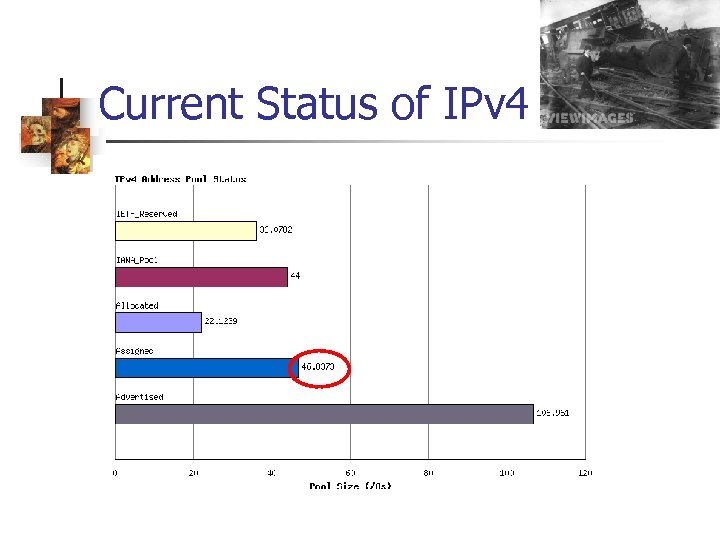 Current Status of IPv 4
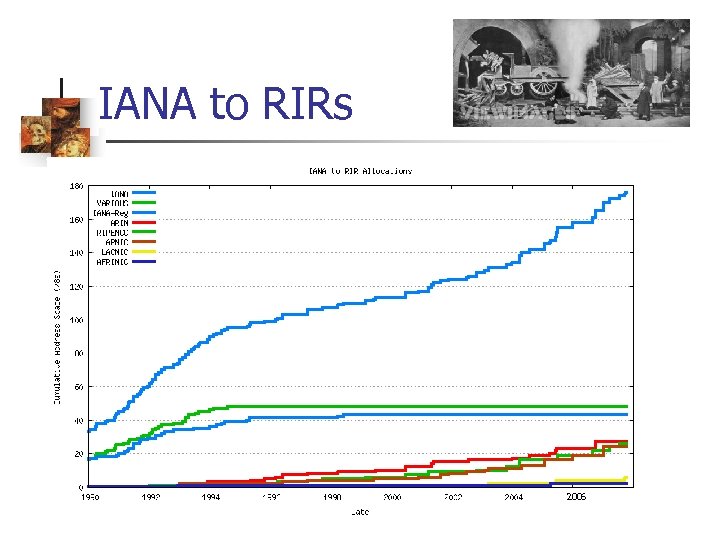 IANA to RIRs 2006
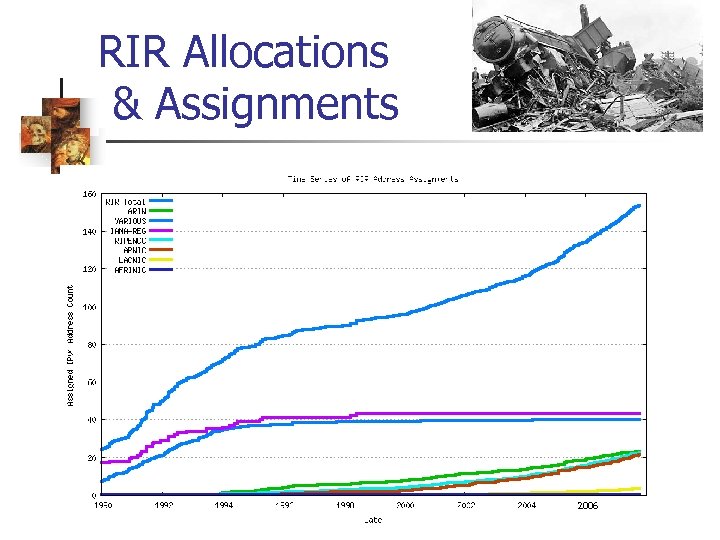 RIR Allocations & Assignments 2006
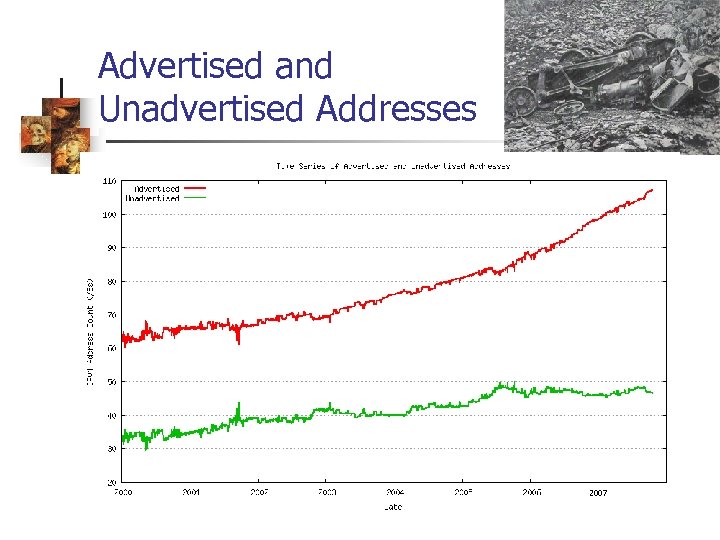 Advertised and Unadvertised Addresses 2007
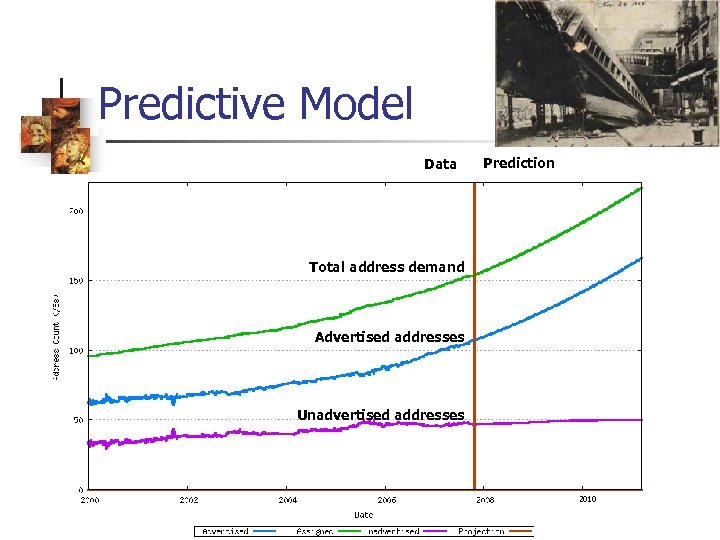 Predictive Model Data Prediction Total address demand Advertised addresses Unadvertised addresses 2010
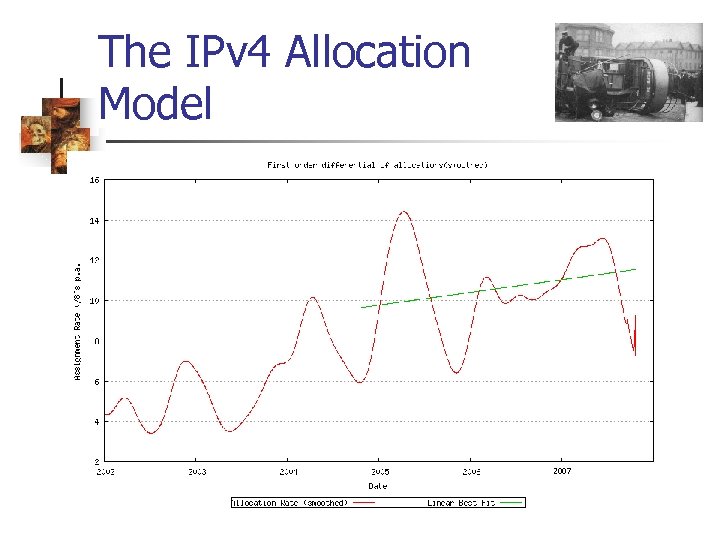 The IPv 4 Allocation Model 2007
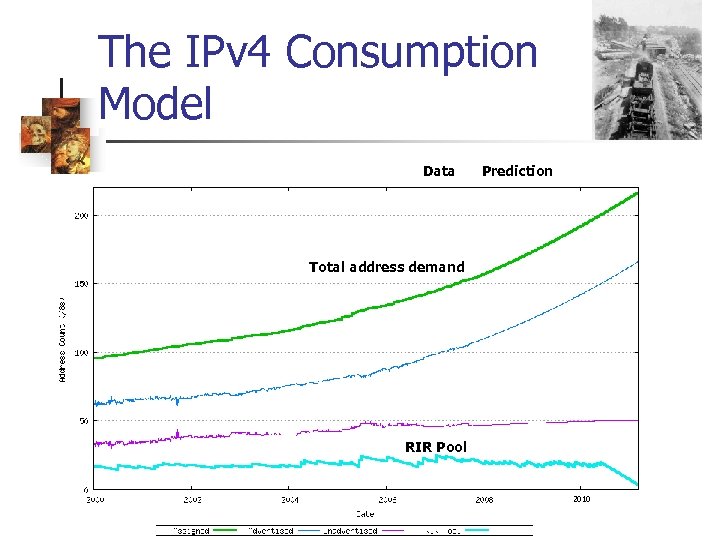 The IPv 4 Consumption Model Data Prediction Total address demand RIR Pool 2010
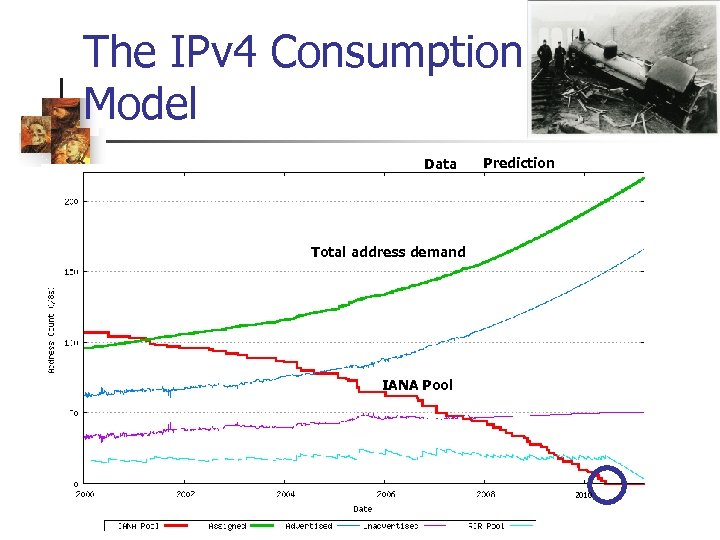 The IPv 4 Consumption Model Data Prediction Total address demand IANA Pool 2010
 So what? In this model, IANA allocates its last IPv 4 /8 to an RIR on the 22 nd May 2010 This is the model’s predicted exhaustion date as of the 22 nd October 2007. Tomorrow’s prediction will be different!
 IPv 4 Consumption Prediction n Assumptions n n n Tomorrow is a lot like today Trends visible in the recent past continue into the future This model assumes that there will be no panic, no change in policies, no change in the underlying demand dynamics, no disruptive externalities, no rationing, and no withholding or hoarding! n No, really!
 What then? n Some possible scenarios: n n Persist in IPv 4 networks using more NATs Address markets emerging for IPv 4 Routing fragmentation IPv 6 transition
 IPv 4 NATs Today n Today NATS are largely externalized costs for ISPs n n n Customers buy and operate NATS Applications are tuned to single-level NAT traversal Static public addresses typically attract a tariff premium in the retail market n For retail customers, IP addresses already have a market price!
 The “Just Add More NATs” Option n Demand for increasing NAT “intensity” n n Shift ISP infrastructure to private address realms Multi-level NAT deployments both at the customer edge and within the ISP network n n This poses issues in terms of application discovery and adaptation to NAT behaviours End cost for static public addresses may increase
 NAT Futures n NATs represent just more of the same n n n NATs are already extensively deployed today More intense use of NATs does not alter the network’s current architectural model How far can NATs scale? n n Not well known What are the critical resources here? n n NAT binding capacity and state maintenance NAT packet throughput Private address pool sizes Application complexity
 NAT Futures n Do we need to go a few steps further with NATs? n n n NAT + DNS ALG to allow bi-directional NAT behaviours ? NAT Signalling Protocol: Explicit application access to NAT binding functions ? In the escalating complexity curve, when does IPv 6 get to look like a long term cheaper outcome?
 The Other Option: IPv 6 n Transition to IPv 6 n n But IPv 6 is not backward compatible with IPv 4 on the wire So the plan is that we need to run some form of a “dual stack” transition process n Either dual stack in the host, or dual stack via protocol translating proxies
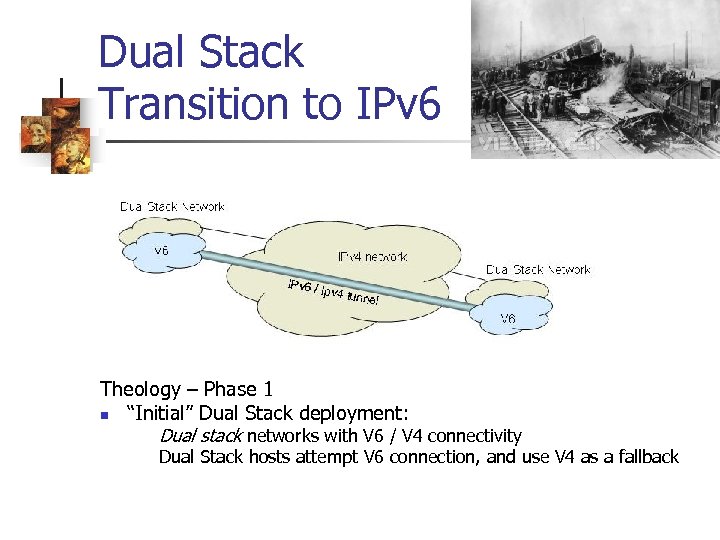 Dual Stack Transition to IPv 6 Theology – Phase 1 n “Initial” Dual Stack deployment: Dual stack networks with V 6 / V 4 connectivity Dual Stack hosts attempt V 6 connection, and use V 4 as a fallback
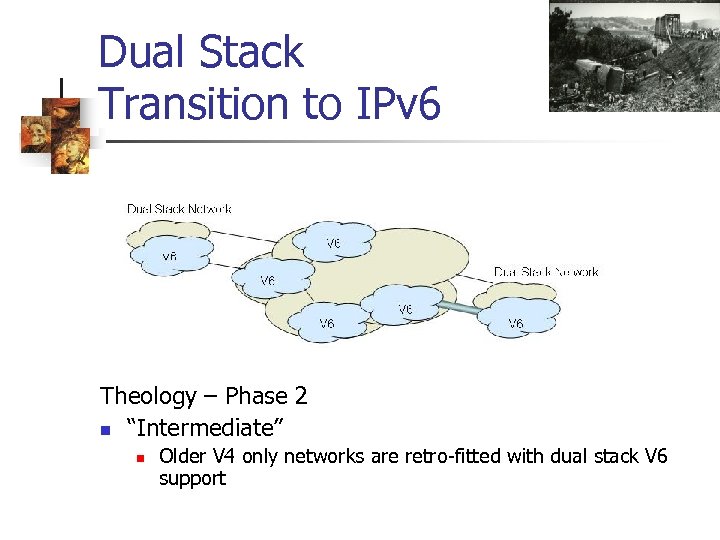 Dual Stack Transition to IPv 6 Theology – Phase 2 n “Intermediate” n Older V 4 only networks are retro-fitted with dual stack V 6 support
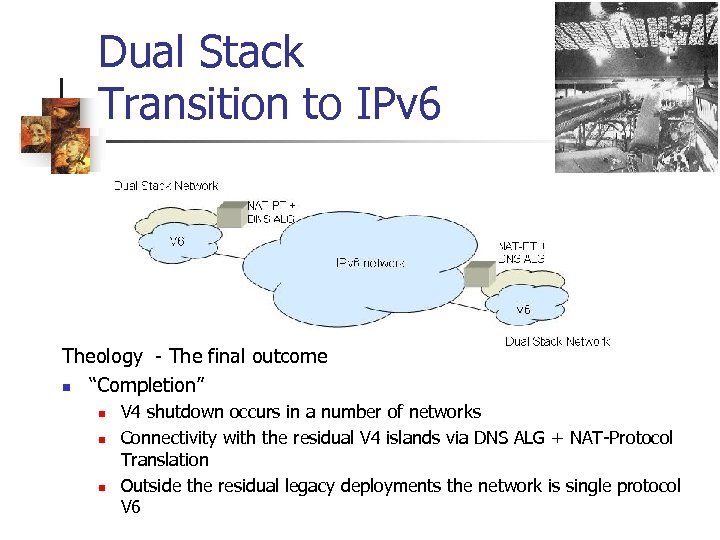 Dual Stack Transition to IPv 6 Theology - The final outcome n “Completion” n n n V 4 shutdown occurs in a number of networks Connectivity with the residual V 4 islands via DNS ALG + NAT-Protocol Translation Outside the residual legacy deployments the network is single protocol V 6
 Dual Stack Assumptions n n That we could drive the entire transition to IPv 6 while there were still ample IPv 4 addresses to sustain the entire network and its growth Transition would take some (optimistically) small number of years to complete Transition would be driven by individual local decisions to deploy dual stack support The entire transition would complete before the IPv 4 unallocated pool was exhausted
 Dual Stack n Dual Stack transition is not a binary proposition n n Dual Stack transition is an “and” proposition n Its not a case of IPv 4 today, IPv 6 tomorrow It’s a case of IPv 4 AND IPv 6 Double the fun and double the cost? But we don’t know for how long n So we need to stretch IPv 4 out to encompass tomorrow’s Internet, and the day after, and …
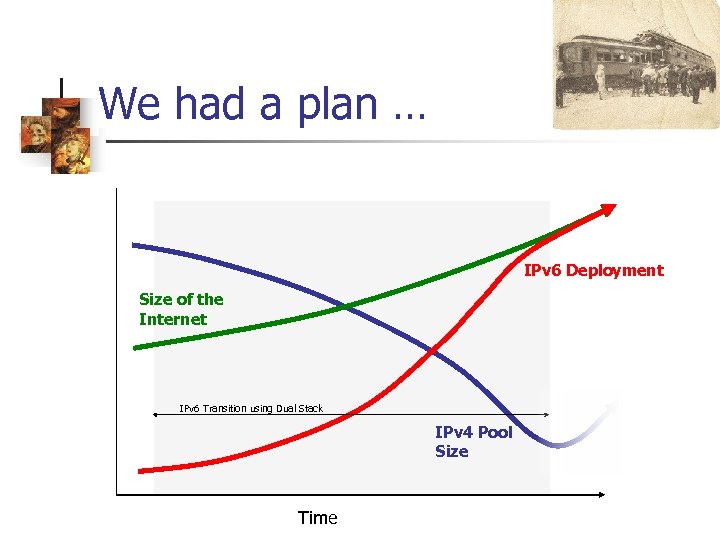 We had a plan … IPv 6 Deployment Size of the Internet IPv 6 Transition using Dual Stack IPv 4 Pool Size Time
 Oops! n We were meant to have completed the transition to IPv 6 BEFORE we completely exhausted the supply channels of IPv 4 addresses
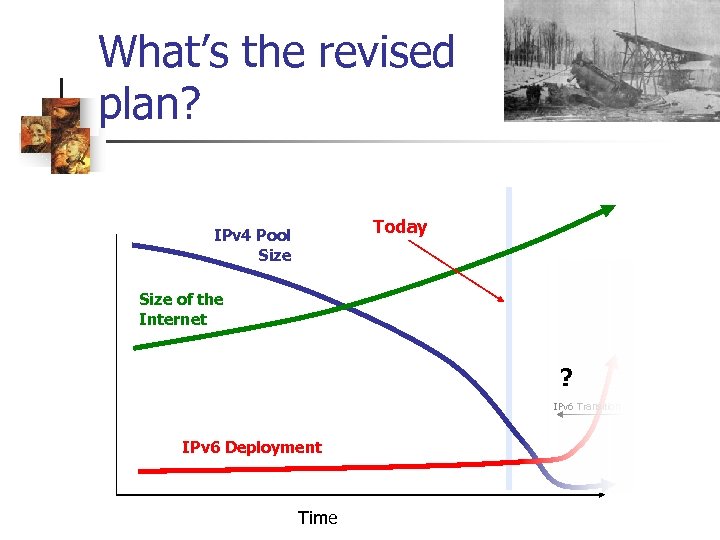 What’s the revised plan? Today IPv 4 Pool Size of the Internet ? IPv 6 Transition IPv 6 Deployment Time
 Implications n Whether its just IPv 4 NATs OR transition to IPv 6 … n IPv 4 addresses will continue to be in demand far beyond the date of exhaustion of the unallocated pool n n In the transition environment, all new and expanding network deployments will need IPv 4 service access and addresses for as long as we are in this dual track transition But the process is no longer directly controlled through today’s address allocation policies n n that IPv 4 address pool in the sky will run out! the mechanisms of management of the IPv 4 address distribution and registration function will necessarily change
 Making IPv 4 Last Longer n Its not the IPv 4 address pool that’s fully consumed n n n Its not that every IPv 4 address is committed and in use today – far from it! n n It’s the unallocated address pool that’s been consumed 20% of the address space is not advertised in global routing Advertised address pools appear to have end host utilization levels of around 5% - 20% So we could “buy” some deviant Second Life n But it won’t be life as we’ve known it!
 Making IPv 4 Last Longer n Some ideas I’ve observed so far: n n n n Encourage NAT deployment Larger Private Use Address Pool Policies of rationing the remaining IPv 4 space Undertake efforts of IPv 4 Reclamation Deregulate Address Transfers Facilitate Address Markets and/or n Encourage an accelerated IPv 6 Transition process
 Making IPv 4 Last Longer n n n n For how long? For what cumulative address demand? For what level of fairness of access? At what cost? For whom? To what end? What if we actually achieve what we set out to do? n n How would the Law of Unintended Consequences apply here? Would this negate the entire “IPv 6 is the solution” philosophy?
 What should we preserve? n The functionality and integrity of the Internet as a service platform n n Functionality of applications Viability of routing Capability to sustain continued growth Integrity of the network infrastructure
 What could be useful right now n Clear and coherent information about the situation and current choices n Understanding of the implications of various options n Appreciation of our limitations and strengths as a global deregulated industry attempting to preserve a single coherent networked outcome n Understanding of the larger audience and the broader context in which these processes are playing out n Some pragmatic workable approaches that allow a suitable degree of choice for players n Understanding that some transitions are not ‘natural’ for a deregulated industry. Some painful transitions were only undertaken in response to regulatory fiat n Think analogue to digital spectrum shift as a recent example
 Implications It is likely that there will be some disruptive aspects of this situation that will impact the entire industry the original transition plan is a business failure resolution of this failure is now going to be tough This will probably not be seamless nor costless And will probably involve various forms of regulatory intervention, no matter what direction we might take from here
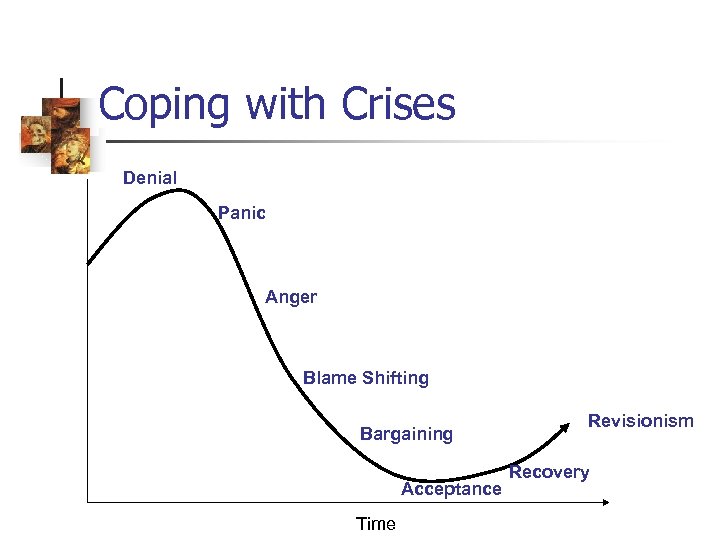 Coping with Crises Denial Panic Anger Blame Shifting Bargaining Acceptance Time Revisionism Recovery
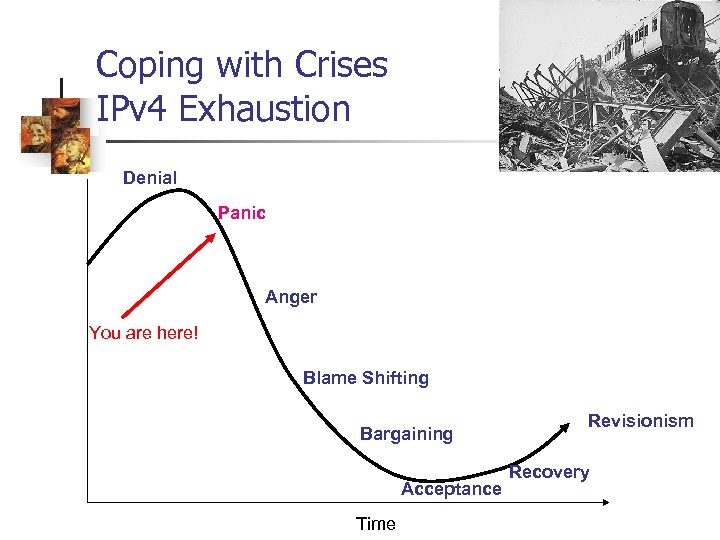 Coping with Crises IPv 4 Exhaustion Denial Panic Anger You are here! Blame Shifting Bargaining Acceptance Time Revisionism Recovery
 Thank You