


 Скачать презентацию IPR Matters in China Simon Cheetham and Sarah
b57dfbb4a88a9ea58df193fb0042a4cd.ppt
- Количество слайдов: 40
 IPR Matters in China Simon Cheetham and Sarah Turner
 The Helpdesk Initiative • Practical business focused advice • Protection Strategy • Enforcement Advice • ‘Know before you go’
 Significant EU – China Trade • 118 million suspect goods detained at EU borders in 2009, ⅔ originated from China • Does not include damages reported by European companies due to Chinese counterfeit goods put on the Chinese market • Or Chinese counterfeit goods on other non. European markets
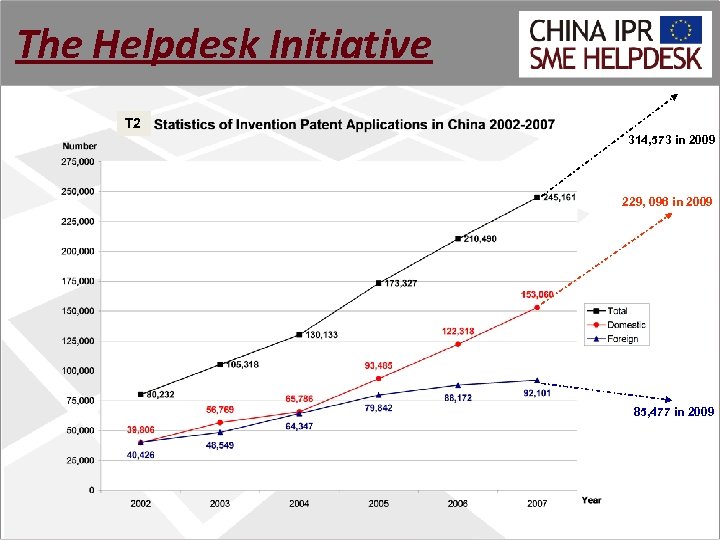 The Helpdesk Initiative T 2 314, 573 in 2009 229, 096 in 2009 85, 477 in 2009
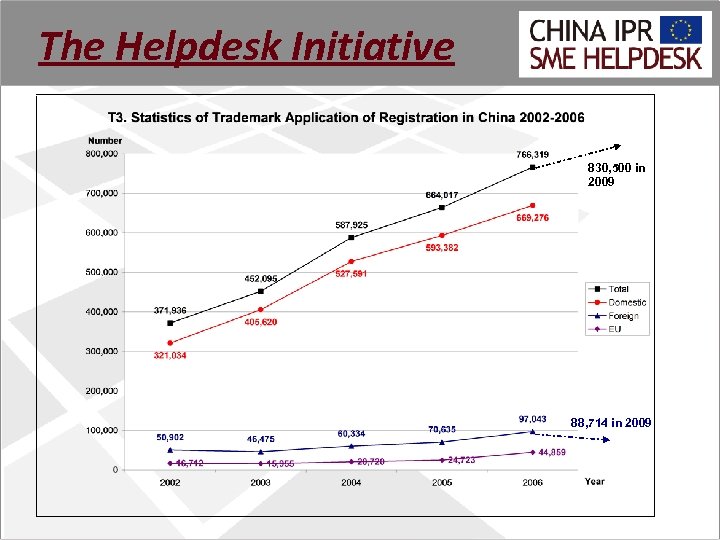 The Helpdesk Initiative 830, 500 in 2009 88, 714 in 2009
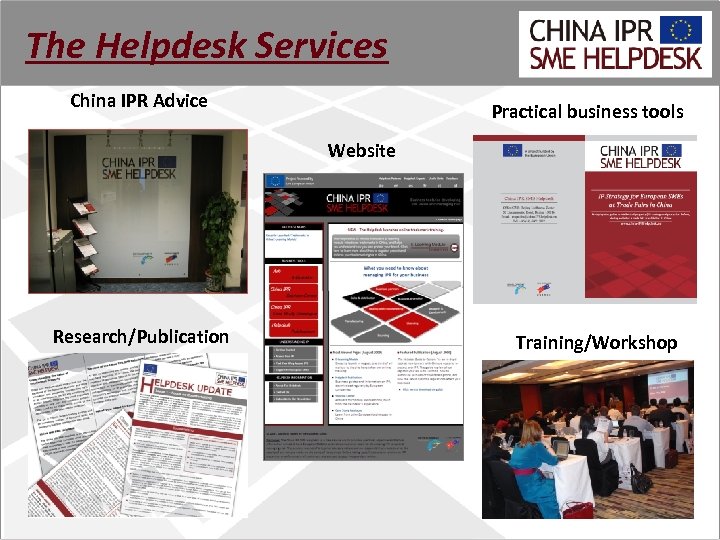 The Helpdesk Services China IPR Advice Practical business tools Website Research/Publication Training/Workshop
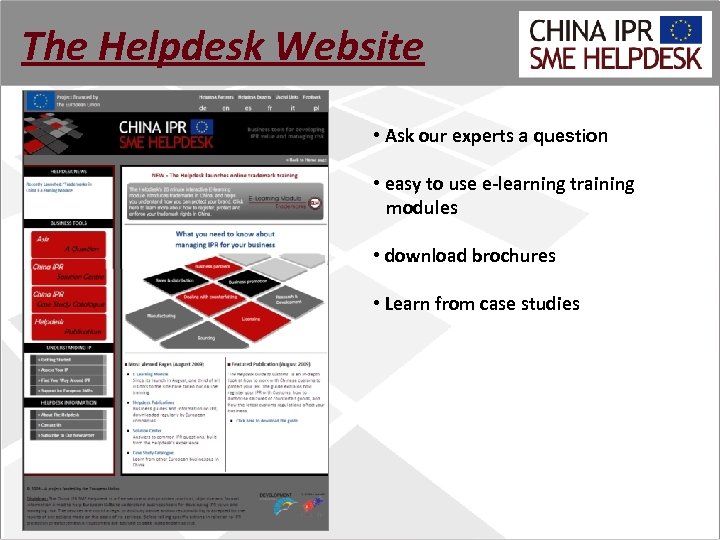 The Helpdesk Website • Ask our experts a question • easy to use e-learning training modules • download brochures • Learn from case studies
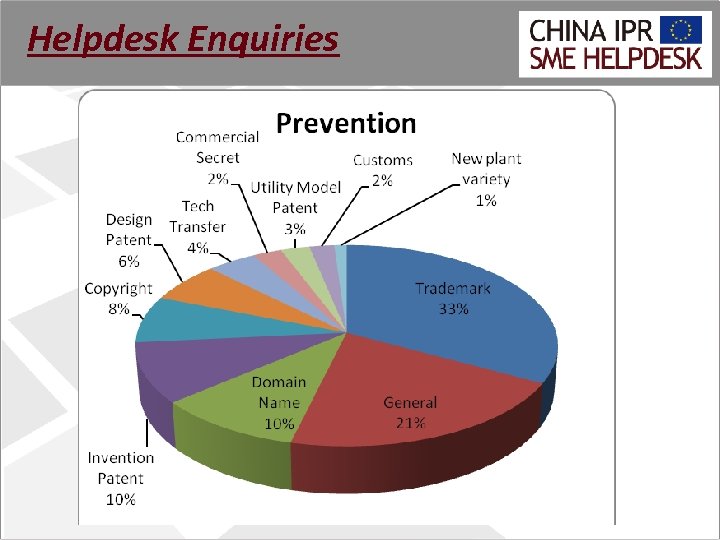 Helpdesk Enquiries
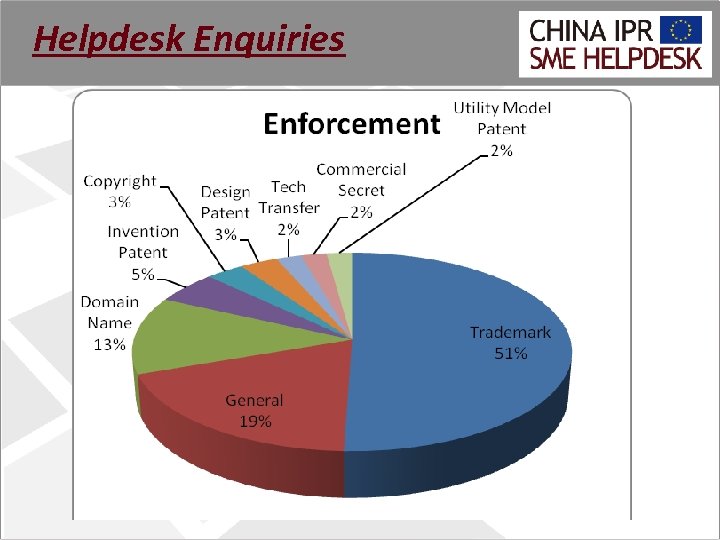 Helpdesk Enquiries
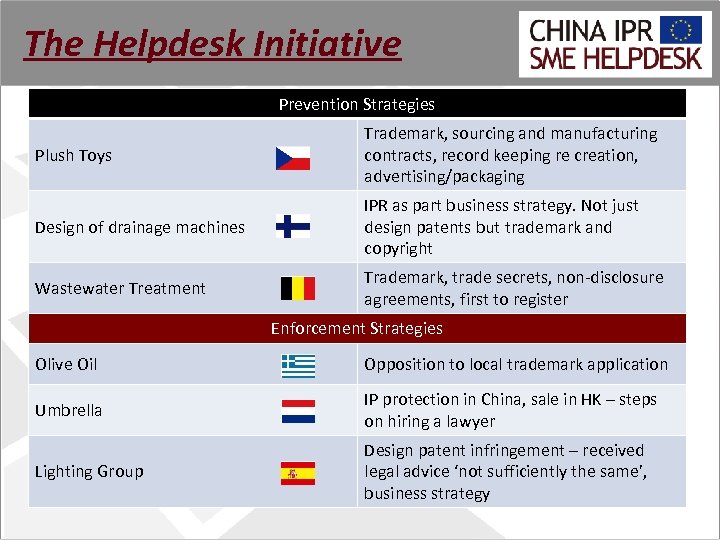 The Helpdesk Initiative Prevention Strategies Plush Toys Trademark, sourcing and manufacturing contracts, record keeping re creation, advertising/packaging Design of drainage machines IPR as part business strategy. Not just design patents but trademark and copyright Wastewater Treatment Trademark, trade secrets, non-disclosure agreements, first to register Enforcement Strategies Olive Oil Opposition to local trademark application Umbrella IP protection in China, sale in HK – steps on hiring a lawyer Lighting Group Design patent infringement – received legal advice ‘not sufficiently the same’, business strategy
 The landscape China – too big to ignore IP protection relatively new concept BUT legal system improved Chinese companies becoming substantial competitors • Foreign companies developing R&D presences in China • Chinese government stressed importance of R&D and IP • •
 Doing business in China • Understand the Chinese legal environment • Know to what extent patents, trade marks and trade secrets are protectable and enforceable • Understand the rules relating to technology transfer and how to limit the risks from such transfer • Understand the legal provisions in relation to IP created by employees or third party suppliers (JV partners, consultants etc) • Maintain the security of your technology and confidential information
 Patent protection • Third amendment to Patent Law (1 October 2009) • Monopoly right for a new design or invention or improvement to product or process • National right – Chinese patent only grants rights in China • European patents have no effect in China • Chinese patent law covers – Invention patents (20 years) – new technical solutions – Utility models (10 years) – technical but degree of invention not as high as for invention patents – Design patents (10 years) – new designs – shape, pattern or colour • First to file system (not first to invent) • Timescales for grant vary
 Requirements for patent protection • For invention patents and utility models • Invention must be new – absolute novelty test – do not market or make invention publicly available anywhere in the world before filing application – watch out for unpublished pending applications • Inventive over prior art • Of practical application • NB inventions made in China – confidentiality examination required beforeign application can be filed – failure →non patentability in China
 Design patents • New over the "prior design". Not new if identical to prior design • Prior design is any design known to public in China or abroad before filing date • Must be obviously different from prior design or combination of features of prior design i. e. creative • No conflict with other IPR • Not available for 2 D trade marks
 What rights do I get? • Once granted third parties stopped from making, using, importing or selling invention or design without permission • For a process patent third party cannot use process or use, import or sell products directly obtained from process without permission • Claims govern scope of protection • Application must be in Chinese so need careful translation (especially claims) • Consider parallel filing of utility model
 Employee inventions • Chinese employees invention law • Service inventions – employer must pay employee a "reward" and a "reasonable remuneration" on exploitation • Can deal with remuneration in company rules • BUT recommend terms in R&D personnel employment contracts setting out manner and amount of award and remuneration • In R&D agreements with Chinese companies consider who will pay possible rewards and remuneration
 Joint ownership • Many agreements between foreign companies and Chinese partners state resulting inventions will be "jointly owned" • If no agreement otherwise, law provides – each co-owner may use invention – each co-owner may grant non-exclusive licences (but royalties shared) – all other exploitation subject to other co-owner's consent
 Assignments and licences • Applications and patents may be assigned • Must register transfer • Assignment only takes effect on registration • Assignments from PRC company to a foreign party subject to authority approval • May also license patents
 Confidential information • What is protectable? • Contractual protection – employment contracts – NDA before information disclosed to third party • Statutory protection – must be a trade secret – not publicly known – has economic and practical value – owner taken reasonable measures to maintain secrecy • Practical tips for protection – Carefully mark "Confidential" – Keep in secure place – Consider splitting into parts
 Technology transfer • Most technology freely transferable • Some restricted and prohibited categories • Cannot limit Chinese party from using improvements • Ownership of new rights and improvements – General rule – person who makes improvement owns it – Otherwise agree (in writing) who will own any improvements
 Technology transfer Risk of technology/information leakage is real Enforcement of rights after leakage difficult Put in place systems to limit disclosure Track and monitor use of know how by employees and partners • Have an IP filing strategy to capture R&D generated • •
 Trade marks • What is a trade mark? Indication of origin • Registration foundation for protection • What can be registered? – – – • • words devices 3 D shapes colours must be "seen" First to file system Translation or transliteration of foreign brands Over 2 million trade marks registered Developing and clearing a new Chinese trade mark can be time consuming
 Requirements for TM registration • National (only in Chinese) or international procedure (may cover more than one country) • List products or services for which trade mark protected • Formal requirements • Substantive requirements – – Legality Non- functionality Distinctiveness No conflict with prior rights
 Maintenance and exploitation of trade marks • • If registered, due for renewal every 10 years Can be invalidated after registration Use it, don't lose it! Can license to third parties – exclusive – sole – non exclusive • Licensors should impose controls on quality in licences • File licence with CTMO • Can assign registration or application. Assignment must be recorded at CTMO
 Copyright • What is protectable? – ORIGINAL creative works, software, drawings etc • Arises as soon as an original work is created • No registration required but recordal can be used as evidence of ownership • Creator or employer of creator first owner • Author will own commissioned works unless contract states otherwise
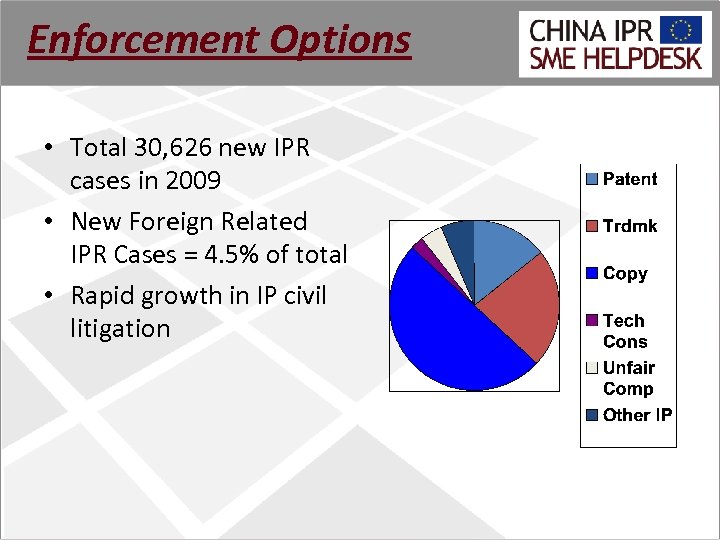 Enforcement Options • Total 30, 626 new IPR cases in 2009 • New Foreign Related IPR Cases = 4. 5% of total • Rapid growth in IP civil litigation
 Navigating the legal system • Mixture of laws • Civil proceedings – People's Courts – Supreme People's Court (Beijing) – Specialist IP panels (within courts in major municipalities) • Usually 3 judge panel – rely on judicial interpretations • No rule of binding precedent • Inquisitional system (but in practice rely on evidence submitted) • Hear cases which have a connection with the Court's geographical jurisdiction • Strong burden of proof on party asserting a fact
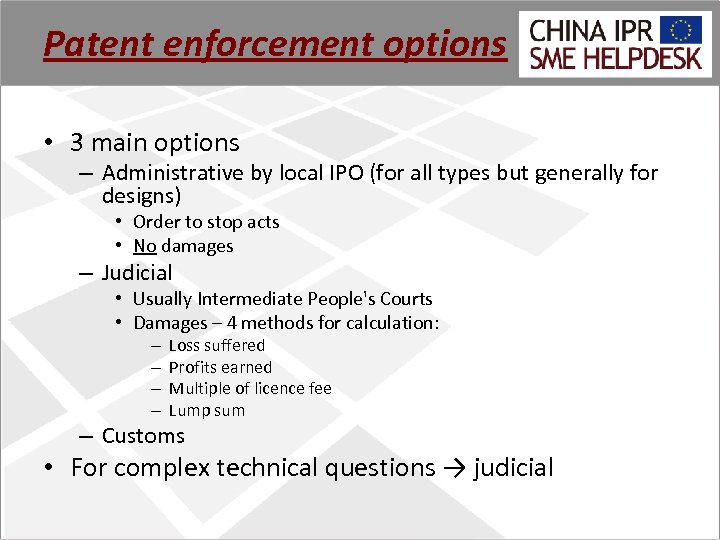 Patent enforcement options • 3 main options – Administrative by local IPO (for all types but generally for designs) • Order to stop acts • No damages – Judicial • Usually Intermediate People's Courts • Damages – 4 methods for calculation: – – Loss suffered Profits earned Multiple of licence fee Lump sum – Customs • For complex technical questions → judicial
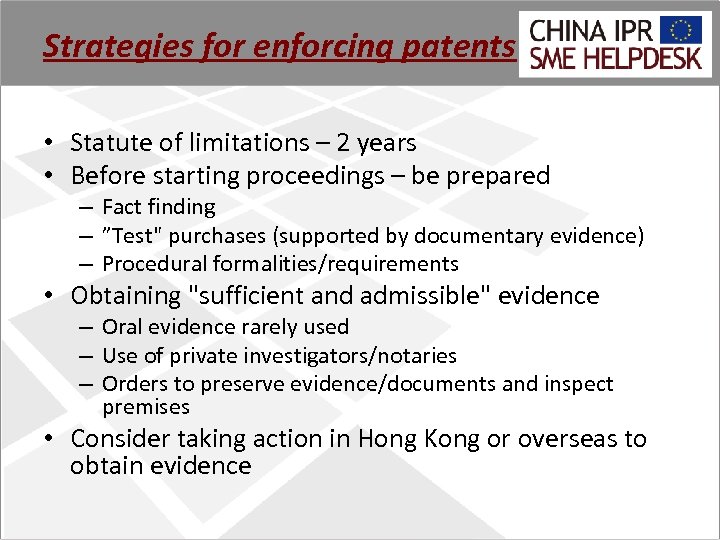 Strategies for enforcing patents • Statute of limitations – 2 years • Before starting proceedings – be prepared – Fact finding – ”Test" purchases (supported by documentary evidence) – Procedural formalities/requirements • Obtaining "sufficient and admissible" evidence – Oral evidence rarely used – Use of private investigators/notaries – Orders to preserve evidence/documents and inspect premises • Consider taking action in Hong Kong or overseas to obtain evidence
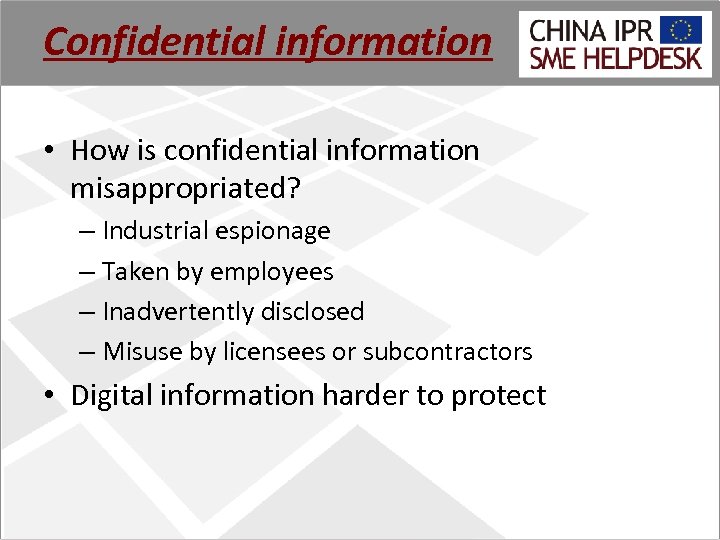 Confidential information • How is confidential information misappropriated? – Industrial espionage – Taken by employees – Inadvertently disclosed – Misuse by licensees or subcontractors • Digital information harder to protect
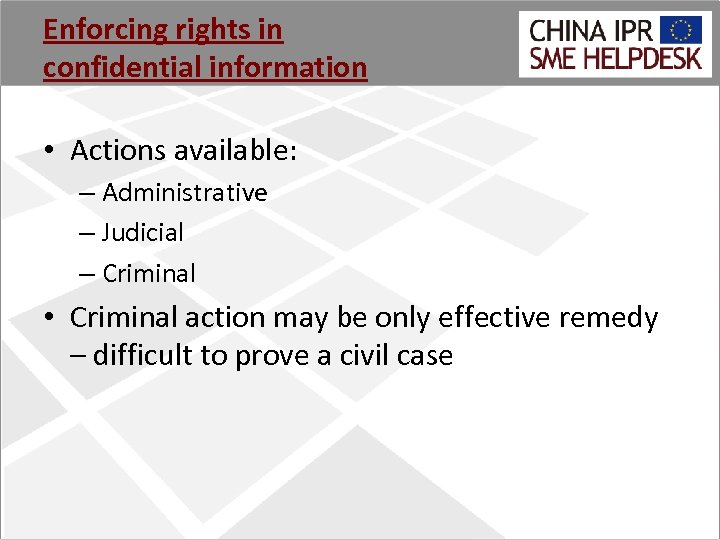 Enforcing rights in confidential information • Actions available: – Administrative – Judicial – Criminal • Criminal action may be only effective remedy – difficult to prove a civil case
 Practical tips • Build in protection and supervisory measures – Physical access controls – Terms in contracts acknowledging confidentiality – Remove copy functions – Deliver to named individuals who have signed NDAs – Limit and track disclosure of technology • Find the right partner – due diligence before agreement/disclosure
 Enforcing trade mark rights • Exclusive right to use identical or similar trade mark on same or similar goods or services • Lodging a complaint – Administration of Industry and Commerce - where infringement occurred • Include: – – Letter of complaint Registration certificate Certificate of identity of trade mark owner Evidence of infringement • Successful AIC raid – order to stop, destruction and/or fine • Administrative action common as simple procedure • BUT Court action also available – useful for injunction and damages and for small quantities
 Copyright infringement • Reproduction of substantial part of work or distributing copies without permission • Unauthorised use of software • Unauthorised translation • Judicial or administrative (NCAC) enforcement • Court action has the advantages of: – injunctions – preservation of evidence – damages
 Customs enforcement • Border protection of rights • Registration with customs optional • If IPR registered with GACC customs can temporarily suspend release of suspected infringing shipment and notify rights holder • Rights holder makes bond payment and applies for detention of goods • For patents shipper can pay counterbond for release of goods • Customs investigates – if determined to infringe →penalty and formal confiscation – if unable to determine – rights holder has 50 days to apply for injunction. If injunction granted shipment transferred to court
 Recent trends • Move away from strong enforcement of IP driven by desire to balance enforcement and economic development • Reflected in new legislation or proposed legislation • Rise in counterfeiting • Automatic licence for technology incorporated in a standard – draft rules
 Practical measures Have an IP strategy Pre-emptive action best Consistent control over confidential information Educate staff and partners on value of IP Restrict access to information/technology Police rights and partners – remember to include rights of inspection and controls in contracts • Consider Customs registrations to detect counterfeits • • •
 In Summary: • You don’t have to be an expert – there are plenty out there • Register rights – if you don’t own it you can’t protect it • You need to be the first to file IPR in China • Use a layered defence – don’t rely on one IPR • Use contracts & good business practices • Prevention better than cure • Be proactive
 Thank You For Your Attention! www. china-iprhelpdesk. eu Ask a China IPR Question: Email: enquiries@china-iprhelpdesk. eu Telephone : +86 (10) 6462 0892