 Скачать презентацию IPR in Business Use Harnessing IP for Strategic
8d3a55047d0b4bbb1fbc19f072a9ab91.ppt
- Количество слайдов: 26



IPR in Business Use Harnessing IP for Strategic Competitive Advantage IIMA July 2 -4, 2004 M • CAM © 2004 The Operating System for the Knowledge Economy
Why Are We Here? • • To understand the business problem To understand the user To understand the solution To understand the value © 2004 The Operating System for the Knowledge Economy
Patent 101 • Patents are legal property conveying a limited monopoly right to a real person or group of persons who may be entitled to that right in exchange for the disclosure of an invention that must be NOVEL, NON-OBVIOUS, and REDUCED TO PRACTICE © 2004 The Operating System for the Knowledge Economy
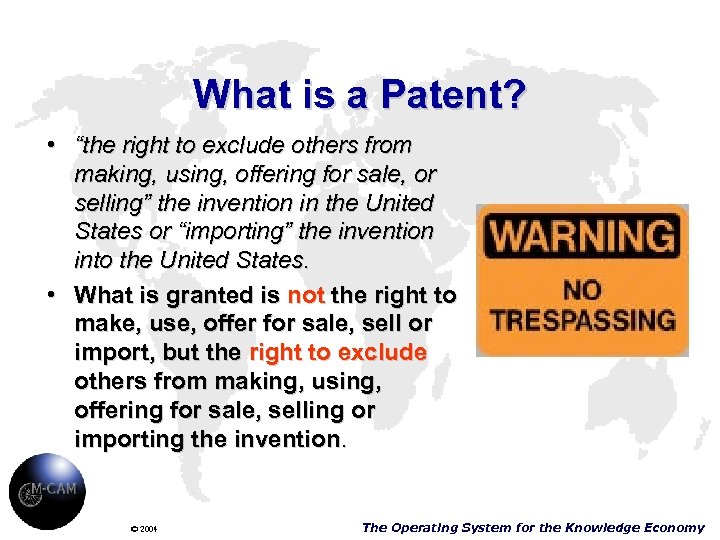
What is a Patent? • “the right to exclude others from making, using, offering for sale, or selling” the invention in the United States or “importing” the invention into the United States. • What is granted is not the right to make, use, offer for sale, sell or import, but the right to exclude others from making, using, offering for sale, selling or importing the invention. © 2004 The Operating System for the Knowledge Economy
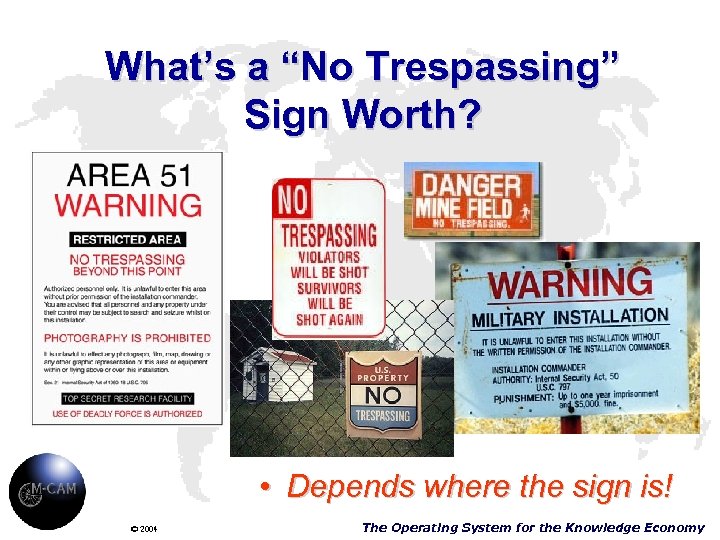
What’s a “No Trespassing” Sign Worth? • Depends where the sign is! © 2004 The Operating System for the Knowledge Economy
The Business Problem © 2004 The Operating System for the Knowledge Economy
The Business Problem • Patents are issued without adequate quality controls • Patents cost money to obtain, maintain and defend • Most patents never generate any ROI • Most businesses don’t know, much less understand what they own © 2004 The Operating System for the Knowledge Economy
The Pain Within – CEO & CFO • Corporate Awareness – Most corporations don’t have a consolidated accounting of the presence or quality of their patent holdings – Impairment Testing for Securities, Tax – Accountability for internal management • “Why to we keep patents that we’re not using? ” – “Are we holding a toxic wasteland? ” © 2004 The Operating System for the Knowledge Economy
The Pain Within – CTO & R&D • Build vs. Buy – No good way to know whether R&D will result in a proprietary or 3 rd party-owned interest • Qualify the “Road Already Traveled” – Chronicle the success and mistakes of others before repeating what others have done (if they’re not using key components, buy rather than replicate) © 2004 The Operating System for the Knowledge Economy
The Pain Within – M&A • Am I buying the right property for my business goal • Am I buying if from the right party • Am I paying for all of it or do I need 3 rd party property • Have I right-sized the value expectation • Am I buying something that will adversely effect what I already own © 2004 The Operating System for the Knowledge Economy
The Pain Within - Legal • Over 50% of patents reviewed by the Court of Appeals held invalid • Cost of litigation > $2, 000 with no recovery if found invalid • “Black-hole” cost center within organizations • Case only as good as your war chest © 2004 The Operating System for the Knowledge Economy
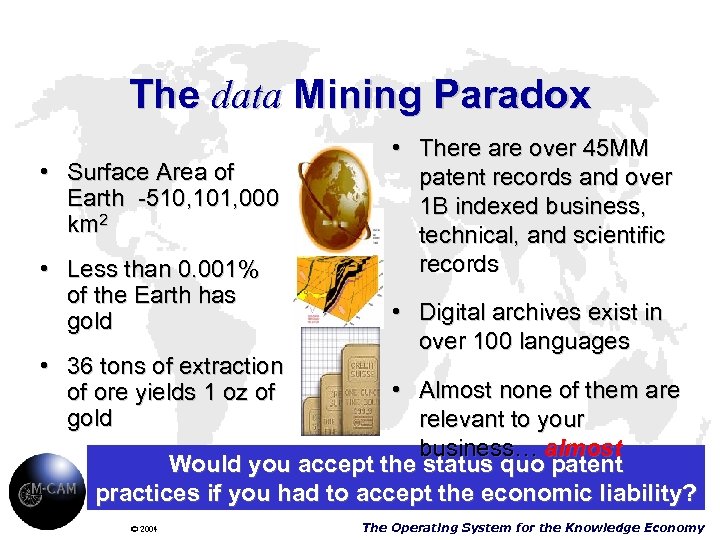
The data Mining Paradox • Surface Area of Earth -510, 101, 000 km 2 • Less than 0. 001% of the Earth has gold • 36 tons of extraction of ore yields 1 oz of gold • There are over 45 MM patent records and over 1 B indexed business, technical, and scientific records • Digital archives exist in over 100 languages • Almost none of them are relevant to your business… almost Would you accept the status quo patent practices if you had to accept the economic liability? © 2004 The Operating System for the Knowledge Economy
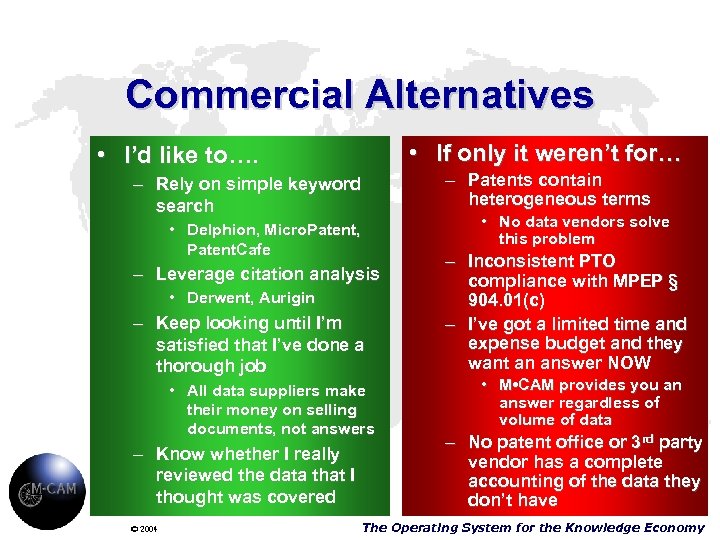
Commercial Alternatives • If only it weren’t for… • I’d like to…. – Patents contain heterogeneous terms – Rely on simple keyword search • No data vendors solve this problem • Delphion, Micro. Patent, Patent. Cafe – Leverage citation analysis • Derwent, Aurigin – Keep looking until I’m satisfied that I’ve done a thorough job • All data suppliers make their money on selling documents, not answers – Know whether I really reviewed the data that I thought was covered © 2004 – Inconsistent PTO compliance with MPEP § 904. 01(c) – I’ve got a limited time and expense budget and they want an answer NOW • M • CAM provides you an answer regardless of volume of data – No patent office or 3 rd party vendor has a complete accounting of the data they don’t have The Operating System for the Knowledge Economy
Patently Obvious • Volume of Disclosures – International focus on number, not quality of patents (viewed as litigation “insurance”), has increased volume of work at patent offices beyond production capacity – Disclosures Invention necessarily • Globalization of Information – Patent data and non-patent literature measured in the terabytes making human review impossible without the aid of machine intelligence – Examiners need to understand consequence for issuing redundant patents • Absence of Gold Standard – – – No established consensus on what is truly patentable No consensus on what constitutes adequate examination No process for monitoring concurrent innovation © 2004 The Operating System for the Knowledge Economy
. . . leading to. . . • Patents are often more liability than asset – Owners must not only defend but justify validity – Small to Medium-sized entities decreasing patenting activity • Statutory validity is even challenged – The odds of a court finding invalidity and even inequitable conduct rising at an alarming rate • Business, Government, Banking and Equity markets cannot place confidence in patent rights due to the high probability of successful challenge © 2004 The Operating System for the Knowledge Economy
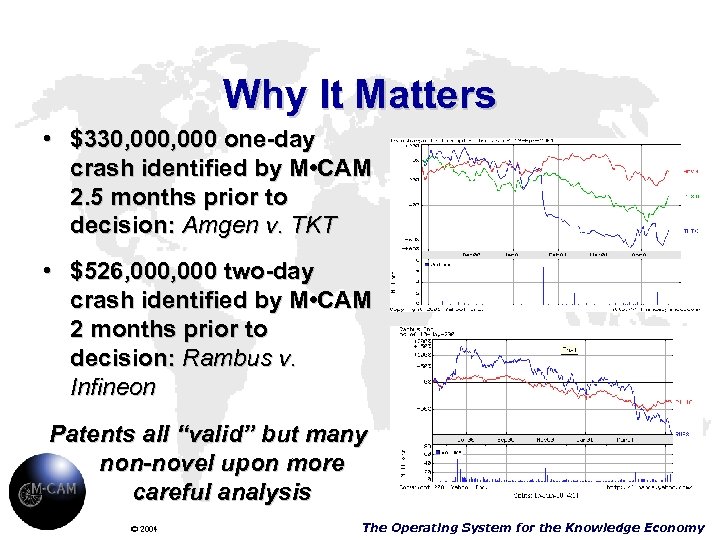
Why It Matters • $330, 000 one-day crash identified by M • CAM 2. 5 months prior to decision: Amgen v. TKT • $526, 000 two-day crash identified by M • CAM 2 months prior to decision: Rambus v. Infineon Patents all “valid” but many non-novel upon more careful analysis © 2004 The Operating System for the Knowledge Economy
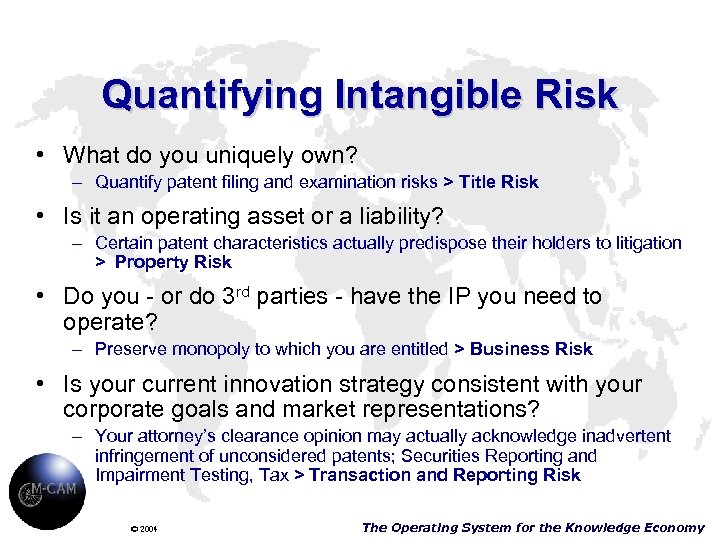
Quantifying Intangible Risk • What do you uniquely own? – Quantify patent filing and examination risks > Title Risk • Is it an operating asset or a liability? – Certain patent characteristics actually predispose their holders to litigation > Property Risk • Do you - or do 3 rd parties - have the IP you need to operate? – Preserve monopoly to which you are entitled > Business Risk • Is your current innovation strategy consistent with your corporate goals and market representations? – Your attorney’s clearance opinion may actually acknowledge inadvertent infringement of unconsidered patents; Securities Reporting and Impairment Testing, Tax > Transaction and Reporting Risk © 2004 The Operating System for the Knowledge Economy
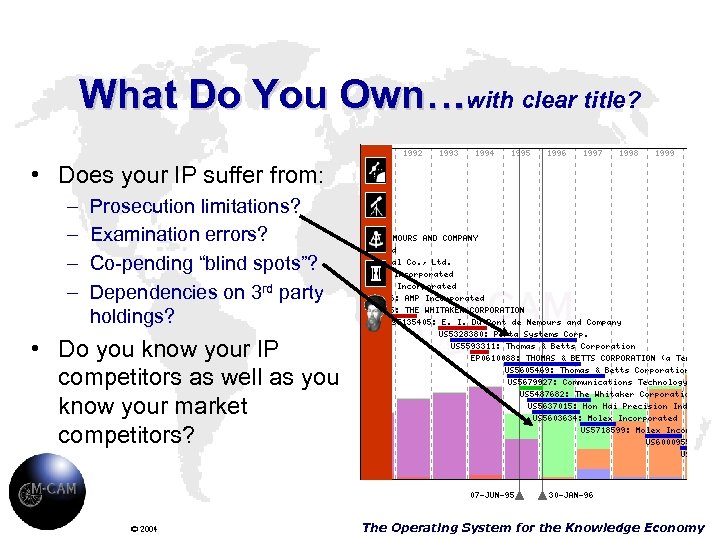
What Do You Own…with clear title? • Does your IP suffer from: – – Prosecution limitations? Examination errors? Co-pending “blind spots”? Dependencies on 3 rd party holdings? • Do you know your IP competitors as well as you know your market competitors? © 2004 The Operating System for the Knowledge Economy
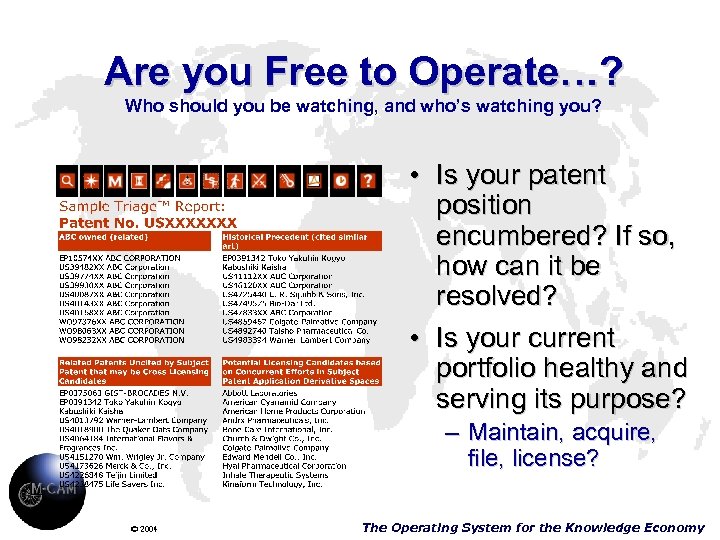
Are you Free to Operate…? Who should you be watching, and who’s watching you? • Is your patent position encumbered? If so, how can it be resolved? • Is your current portfolio healthy and serving its purpose? – Maintain, acquire, file, license? © 2004 The Operating System for the Knowledge Economy
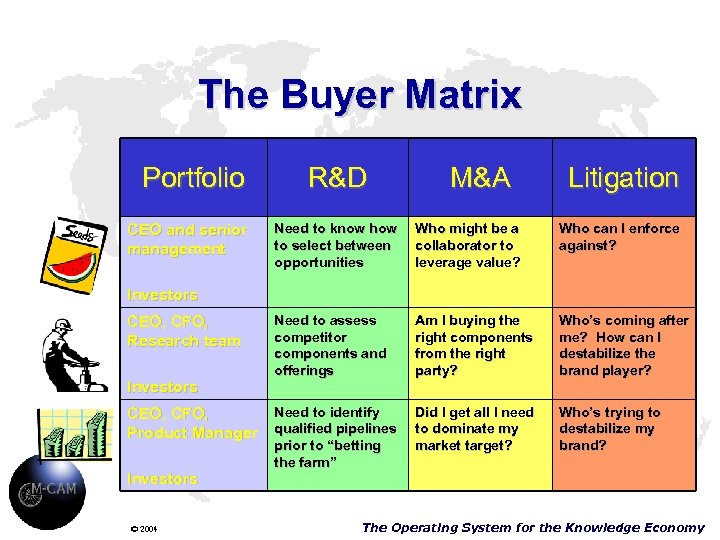
The Buyer Matrix Portfolio CEO and senior management R&D M&A Litigation Need to know how to select between opportunities Who might be a collaborator to leverage value? Who can I enforce against? Need to assess competitor components and offerings Am I buying the right components from the right party? Who’s coming after me? How can I destabilize the brand player? Need to identify qualified pipelines prior to “betting the farm” Did I get all I need to dominate my market target? Who’s trying to destabilize my brand? Investors CEO, CFO, Research team Investors CEO, CFO, Product Manager Investors © 2004 The Operating System for the Knowledge Economy
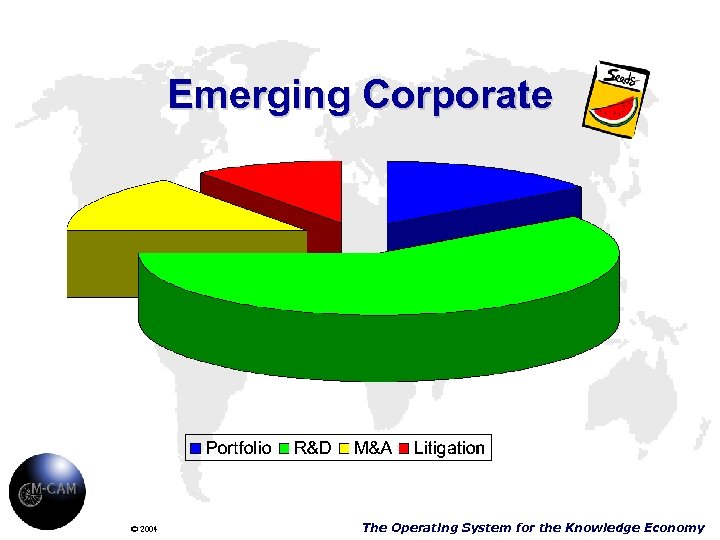
Emerging Corporate © 2004 The Operating System for the Knowledge Economy
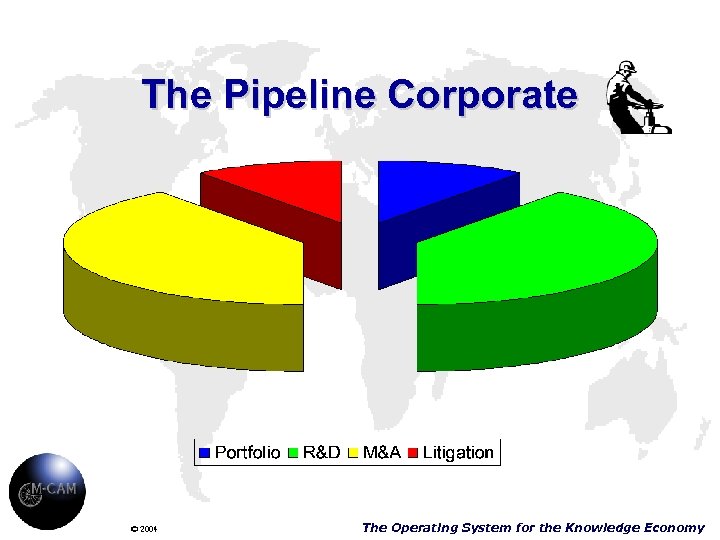
The Pipeline Corporate © 2004 The Operating System for the Knowledge Economy
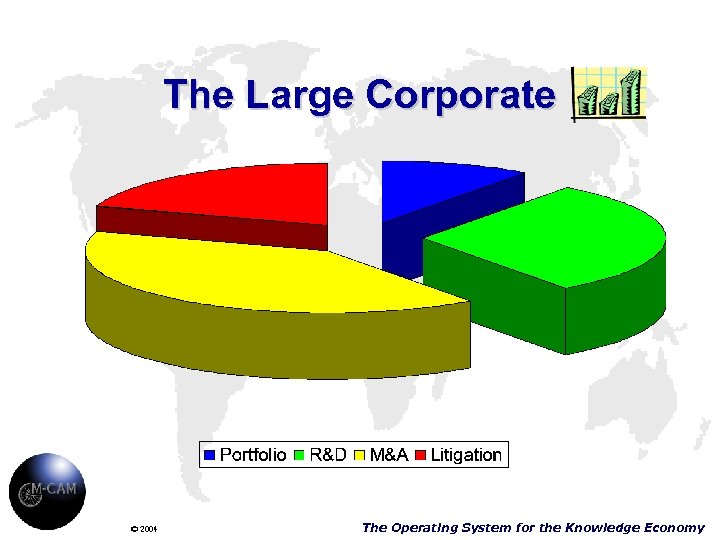
The Large Corporate © 2004 The Operating System for the Knowledge Economy
The Solution © 2004 The Operating System for the Knowledge Economy
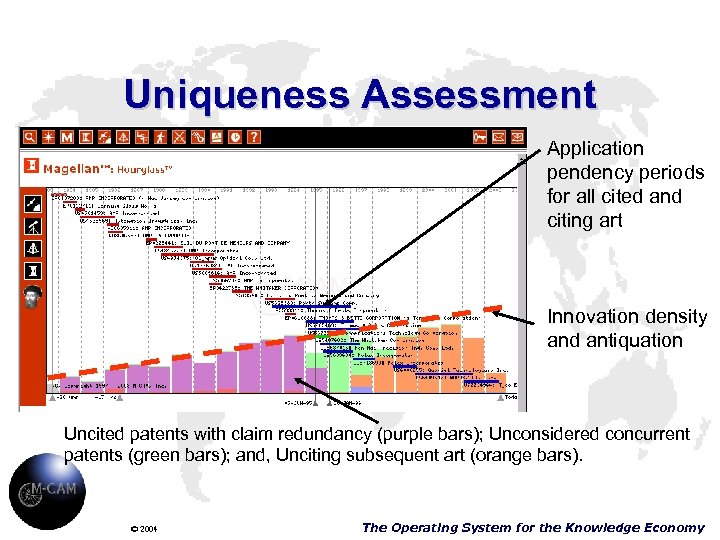
Uniqueness Assessment Application pendency periods for all cited and citing art Innovation density and antiquation Uncited patents with claim redundancy (purple bars); Unconsidered concurrent patents (green bars); and, Unciting subsequent art (orange bars). © 2004 The Operating System for the Knowledge Economy
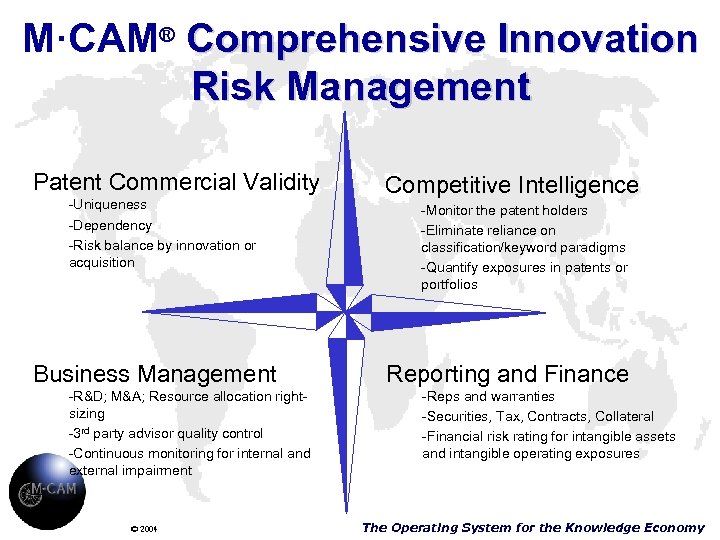
M·CAM® Comprehensive Innovation Risk Management Patent Commercial Validity -Uniqueness -Dependency -Risk balance by innovation or acquisition Business Management -R&D; M&A; Resource allocation rightsizing -3 rd party advisor quality control -Continuous monitoring for internal and external impairment © 2004 Competitive Intelligence -Monitor the patent holders -Eliminate reliance on classification/keyword paradigms -Quantify exposures in patents or portfolios Reporting and Finance -Reps and warranties -Securities, Tax, Contracts, Collateral -Financial risk rating for intangible assets and intangible operating exposures The Operating System for the Knowledge Economy
Скачать презентацию IPR in Business Use Harnessing IP for Strategic
8d3a55047d0b4bbb1fbc19f072a9ab91.ppt