


 Скачать презентацию IPPC Directive state of play and future developements
fe0f188cc07d7253b44653af5938daf0.ppt
- Количество слайдов: 14
 IPPC Directive state of play and future developements Alexandre Paquot European Commission Environment Directorate-General (Internet: http: //europa. eu. int/comm/environment/ippc/index. htm) alexandre. paquot@cec. eu. int
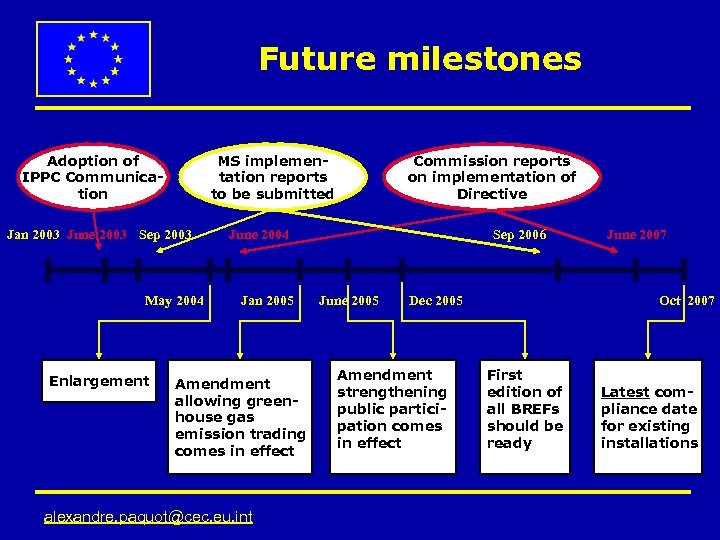 Future milestones Adoption of IPPC Communication MS implementation reports to be submitted Jan 2003 June 2003 Sep 2003 May 2004 Enlargement Commission reports on implementation of Directive June 2004 Jan 2005 Amendment allowing greenhouse gas emission trading comes in effect alexandre. paquot@cec. eu. int Sep 2006 June 2005 Dec 2005 Amendment strengthening public participation comes in effect June 2007 Oct 2007 First edition of all BREFs should be ready Latest compliance date for existing installations
 The first national reports (1) Some preliminary conclusions: • Directive has been adequately transposed in most Member States • Implementation has been slow in some of them, particularly in those without prior experience in integrated environmental permitting alexandre. paquot@cec. eu. int
 The first national reports (2) Problems common to several Member States: • Legal requirements on reconsideration and updating of permits • Disproportionate number of applications may have to be be filed immediately prior to the October 2007 deadline • No transboundary cooperation in permit procedures alexandre. paquot@cec. eu. int
 The first national reports (3) Views on IPPC: • Effective tool in combating pollution by industrial installations • Administrative simplification • Fosters dialogue between the authorities and industry • Flexibility allowed in the actual implementation • Wish for greater uniformity and technical coherence with other EU legislation alexandre. paquot@cec. eu. int
 June ’ 03 Communication on IPPC COM(2003) 354: http: //europa. eu. int/comm/environment/ippc/index. htm Why a Communication? l stress the importance of IPPC l insufficient progress l key interpretation issues l launch consultation alexandre. paquot@cec. eu. int
 Keys conclusions of consultation on the Communication 1. Concern about the October 2007 deadline 2. General support of the IPPC Directive – no call for radical changes 3. Unanimous call for guidance documents 4. Call for technical review for clarification of certain provision (in particular the scope) 5. Possibility to use emissions trading instruments (NL, UK, certain industries) / creating more incentives 6. Assess the coherence with other legislations 7. More “user-friendly” BREFs alexandre. paquot@cec. eu. int
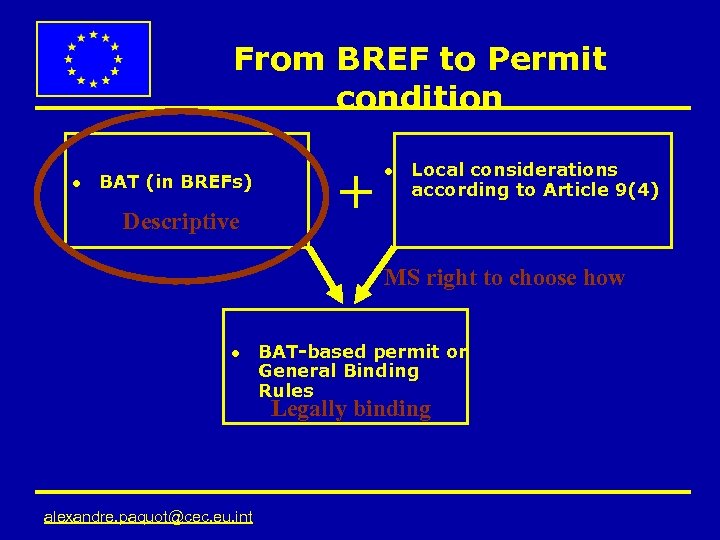 From BREF to Permit condition l BAT (in BREFs) Descriptive + l Local considerations according to Article 9(4) MS right to choose how l BAT-based permit or General Binding Rules Legally binding alexandre. paquot@cec. eu. int
 BAT Information Exchange l required by Directive (Art 16 paragraph 2) l purpose to support licensing authorities l l published BAT Reference Documents (BREFs) for each sector BREFs should be taken into account by the licensing authorities alexandre. paquot@cec. eu. int
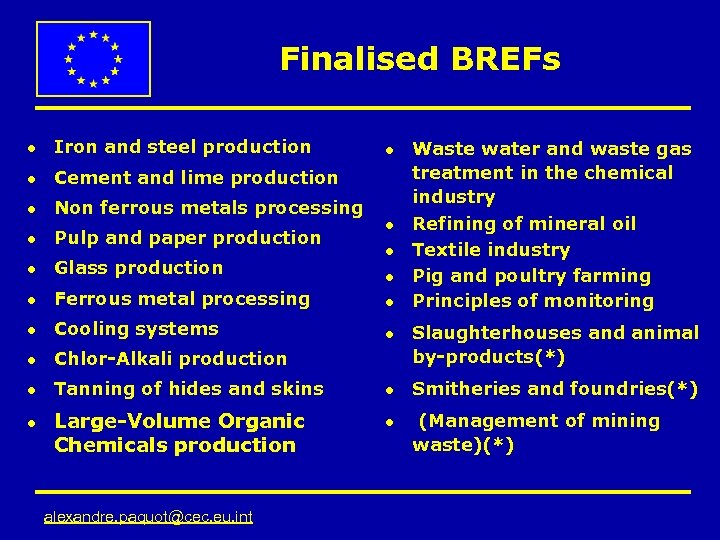 Finalised BREFs l Iron and steel production l Cement and lime production l Non ferrous metals processing l l l Pulp and paper production l Glass production l Ferrous metal processing l l Cooling systems l l Chlor-Alkali production l Tanning of hides and skins l Large-Volume Organic Chemicals production alexandre. paquot@cec. eu. int l l Waste water and waste gas treatment in the chemical industry Refining of mineral oil Textile industry Pig and poultry farming Principles of monitoring Slaughterhouses and animal by-products(*) Smitheries and foundries(*) (Management of mining waste)(*)
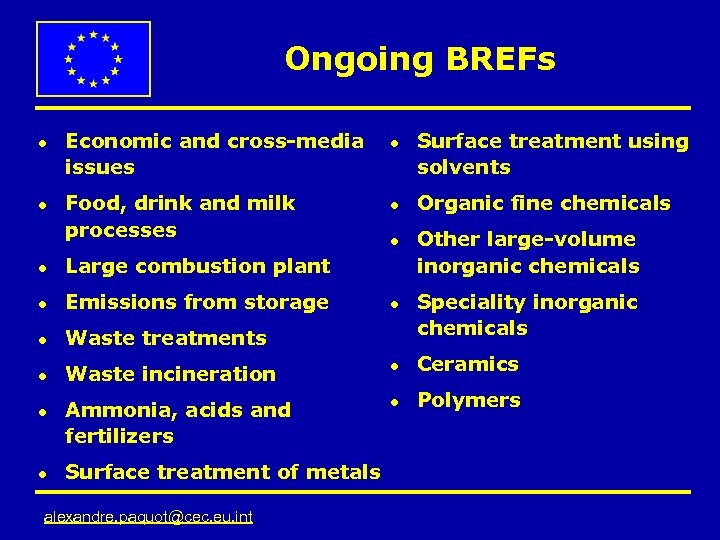 Ongoing BREFs l l Economic and cross-media issues Food, drink and milk processes l l l Surface treatment using solvents Organic fine chemicals Other large-volume inorganic chemicals l Large combustion plant l Emissions from storage l Waste treatments l Waste incineration l Ceramics Ammonia, acids and fertilizers l Polymers l l Surface treatment of metals alexandre. paquot@cec. eu. int l Speciality inorganic chemicals
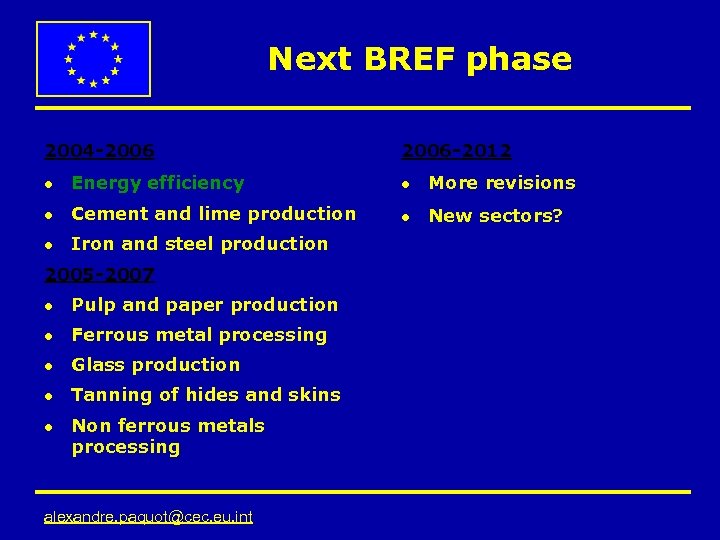 Next BREF phase 2004 -2006 -2012 l Energy efficiency l More revisions l Cement and lime production l New sectors? l Iron and steel production 2005 -2007 l Pulp and paper production l Ferrous metal processing l Glass production l Tanning of hides and skins l Non ferrous metals processing alexandre. paquot@cec. eu. int
 Concluding remarks (1) l l Flexible, goal-setting legislation = opportunity for environment + industry Heavily dependent on “good faith” (on behalf of industry operators and authorities) Complements other instruments (EQS-based, voluntary / market-based, economic instruments) High level of protection of the environment alexandre. paquot@cec. eu. int
 Concluding remarks (2) l l Integrated approach by industry operators and authorities Application of Best Available Techniques Provides framework for further and “better” regulation where necessary No short term review (2005) of the Directive alexandre. paquot@cec. eu. int