


 Скачать презентацию IPCC Projection AR 4 2007 The annual
3f40b363605273eeec2ff586d245563f.ppt
- Количество слайдов: 15
 IPCC Projection (AR 4, 2007) • The annual mean rainfall exhibits increasing trends in Bangladesh. Decadal rain anomalies are above long term averages since 1960 s. • Serious and recurring floods have taken place during 2002, 2003, and 2004. Cyclones originating from the Bay of Bengal have been noted to decrease since 1970 but the intensity has increased.
 IPCC Projection (AR 4, 2007) • Salt water from the Bay of Bengal is reported to have penetrated 100 km or more inland along tributary channels during the dry season. • The precipitation decline and droughts has resulted in the drying up of wetlands and severe degradation of ecosystems.
 Summary of Climate Change induced disasters • Increase of intensity and duration of floods, water logging, flash flood. • Increase of moisture stress (droughts) • Intensified storm surge, wave heights, erratic precipitation • Salinity intrusion (100 km inside the country during dry season) • Slow-onset impacts (salinization, dryness, ecosystem degradation etc) • Sea Level rise up to 69 cm.
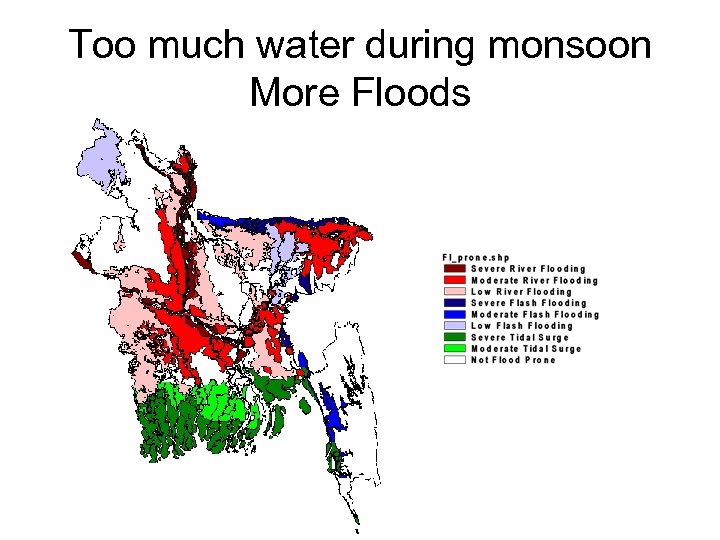 Too much water during monsoon More Floods
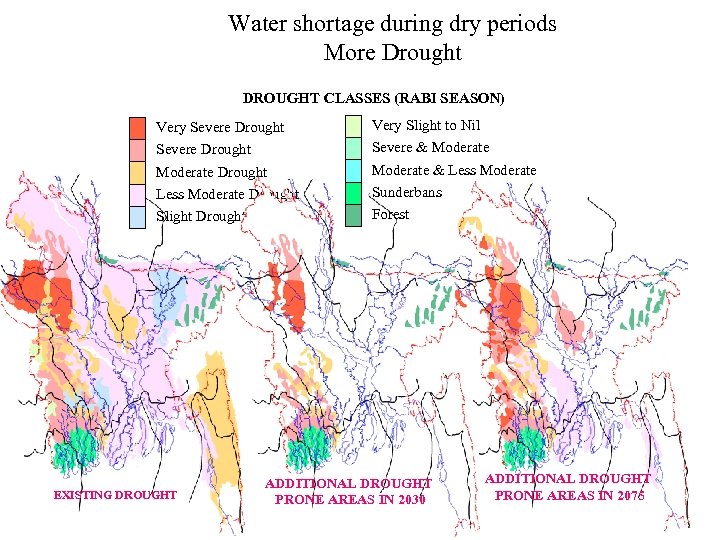 Water shortage during dry periods More Drought DROUGHT CLASSES (RABI SEASON) Very Severe Drought Moderate Drought Less Moderate Drought Slight Drought EXISTING DROUGHT Very Slight to Nil Severe & Moderate & Less Moderate Sunderbans Forest ADDITIONAL DROUGHT PRONE AREAS IN 2030 ADDITIONAL DROUGHT PRONE AREAS IN 2075
 PRECIS Simulation at BUET • Simulated for period of 1961 -1990 by Dr. Nazrul Islam, Physics department, BUET • Calibrated with observed rainfall and temperature data (1961 -1990) • Verification of model using 1991 -2007 data • Future scenarios will be generated.
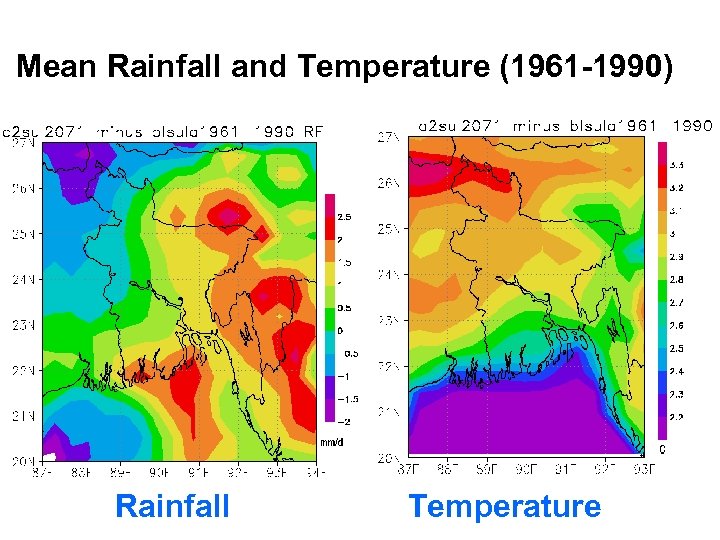 Mean Rainfall and Temperature (1961 -1990) Rainfall Temperature
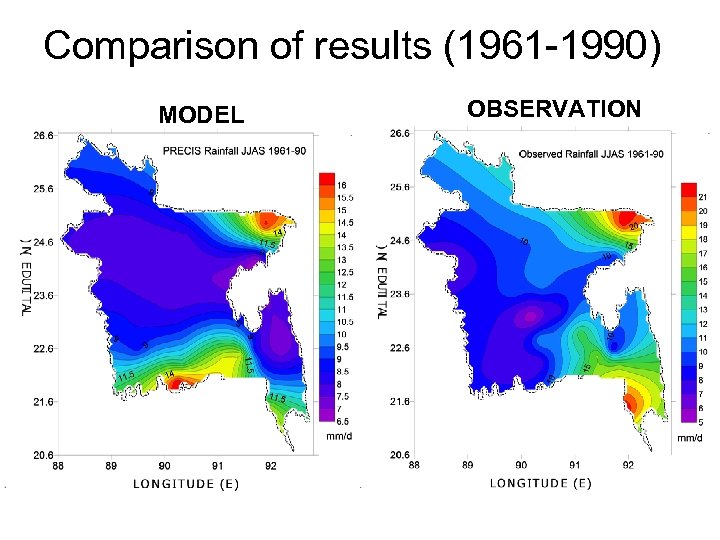 Comparison of results (1961 -1990) MODEL OBSERVATION
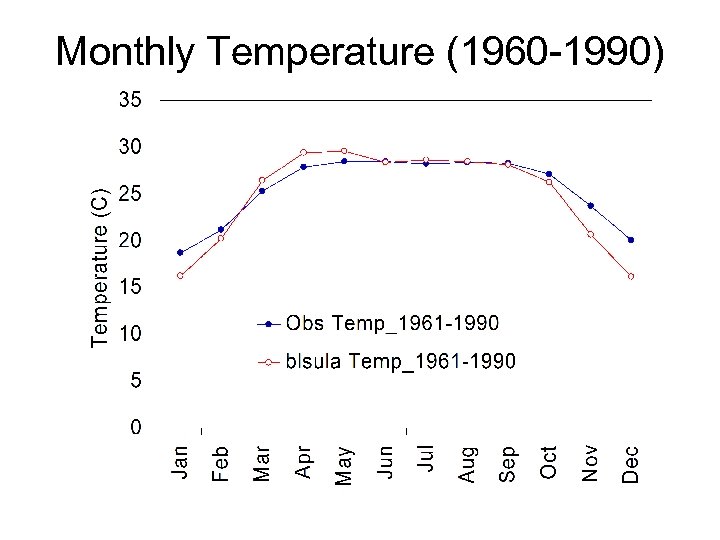 Monthly Temperature (1960 -1990)
 Plan of using PRECIS Component 1: knowledge Center – Creating knowledge base and database of climate change scenarios in regional scale. – Understanding and interpretation of model results. Building awareness of the people for future climate induced risks. – House of various climate models and outputs. – Training of Trainers (TOT) for building capacity of the organization through organizing regional and local workshops and seminars.
 Plan of using PRECIS • Component-2: Research – Use of PRECIS results for Agriculture, Fisheries and other sectors. – Forecasting of disasters such as flood and cyclone – Coupling of hydrological and climate models
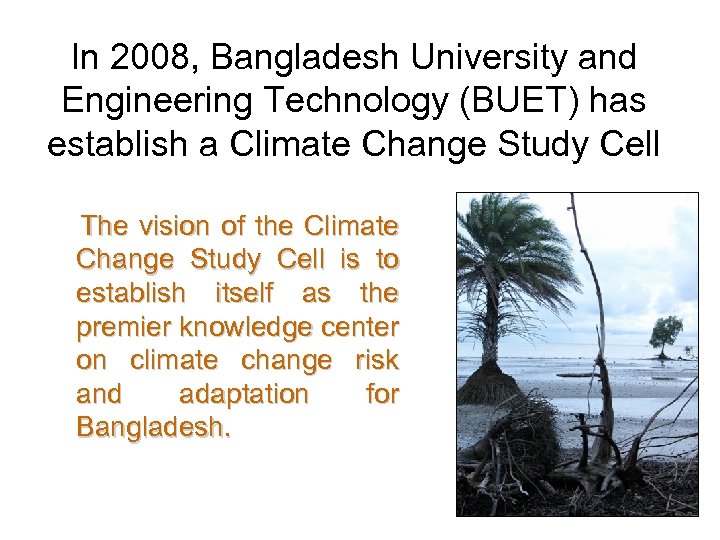 In 2008, Bangladesh University and Engineering Technology (BUET) has establish a Climate Change Study Cell The vision of the Climate Change Study Cell is to establish itself as the premier knowledge center on climate change risk and adaptation for Bangladesh.
 Mission of the cell Ø To improve knowledge about climate change and associated risk to Bangladesh; Ø To increase awareness of the planners, policy makers about the effects of climate change; Ø To become institutional home for climate modeling and predicting future scenarios; Ø To strengthen capacity of professionals in climate change modeling; and Ø To share knowledge and expertise with other organizations.
 Activities Following list of activities has been proposed for this cell. Ø Research Ø Short courses Ø Workshop Ø Seminar Ø Advisory Services Ø Conference Ø Publications of Journals Ø Climate change Database Ø Dissemination of information through web
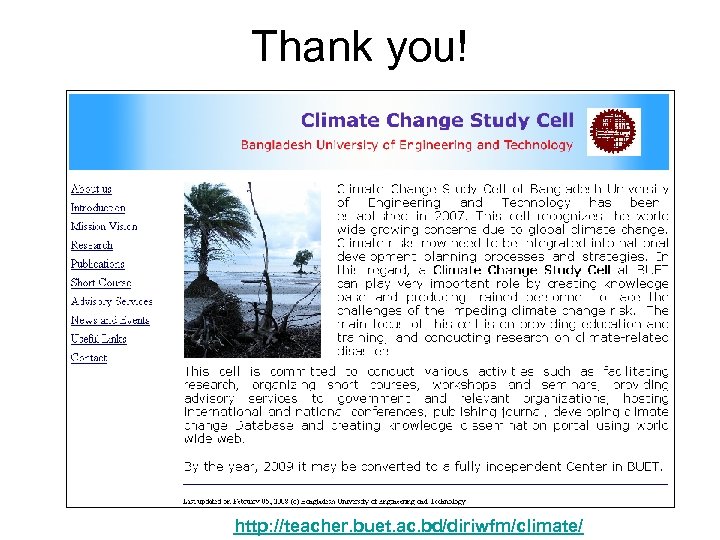 Thank you! http: //teacher. buet. ac. bd/diriwfm/climate/