


 Скачать презентацию IPCC AR 5 RCPs and CMIP 5 data
1da6b81c47ea8be7df9985b24fb08caa.ppt
- Количество слайдов: 43
 IPCC AR 5: RCPs and CMIP 5 data: how to choose scenarios and GCMs for climate modelling studies Carol Mc. Sweeney, Met Office Hadley Centre © Crown copyright Met Office
 Aims of this session • Understand how to select driving GCM data for RCM simulations to capture/prioritise different sources of uncertainty • Understand the difference between the new ‘RCPs’ and the ‘old’ SRES emissions scenarios • Understand how we can sample the uncertainty from a large ensemble using a smaller subset of models. © Crown copyright Met Office
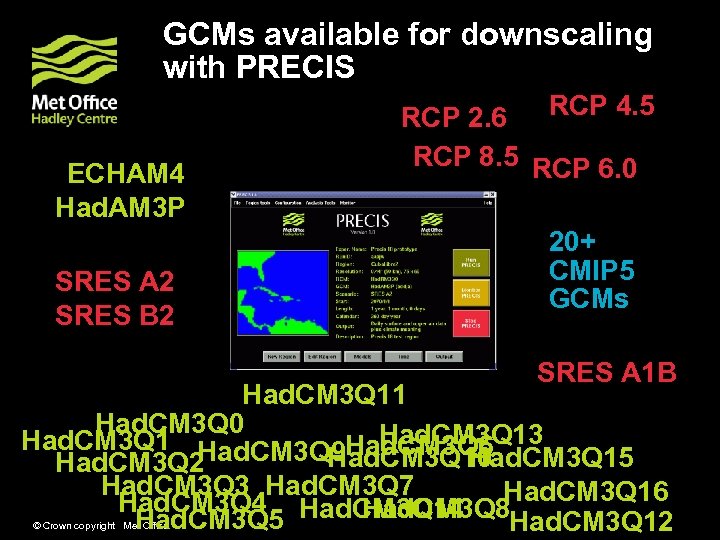 GCMs available for downscaling with PRECIS ECHAM 4 Had. AM 3 P SRES A 2 SRES B 2 RCP 2. 6 RCP 4. 5 RCP 8. 5 RCP 6. 0 20+ CMIP 5 GCMs SRES A 1 B Had. CM 3 Q 11 Had. CM 3 Q 0 Had. CM 3 Q 13 Had. CM 3 Q 1 Had. CM 3 Q 9 Had. CM 3 Q 6 Had. CM 3 Q 10 Had. CM 3 Q 15 Had. CM 3 Q 2 Had. CM 3 Q 3 Had. CM 3 Q 7 Had. CM 3 Q 4 Had. CM 3 Q 16 Had. CM 3 Q 8 Had. CM 3 Q 12 Had. CM 3 Q 5 © Crown copyright Met Office
 Constraints on RCM simulations • Boundary data availability • Computing resources • Some large regional collaborations can draw on resources from several large institutions to generate large • For most individual institutions, it is not possible to downscale all the GCMs that are currently (or soon to be) available, and for all emissions scenarios, so how can we make the best choices about which ones to use? © Crown copyright Met Office
 Table of Contents • Sources of uncertainty in projections of future climate • Emissions scenarios: SRES vs RCPs • Ensembles: Perturbed Physics and multi-model • Ensemble Sub-selection for Downscaling © Crown copyright Met Office
 Main Sources of Uncertainty Socio- Economic Uncertainty Natural annualdecadal variability (‘Internal variability’) © Crown copyright Met Office Uncertainty in the model representation of physical processes
 Sources of Uncertainty in Climate Projections uncertaint* © Crown copyright Met Office
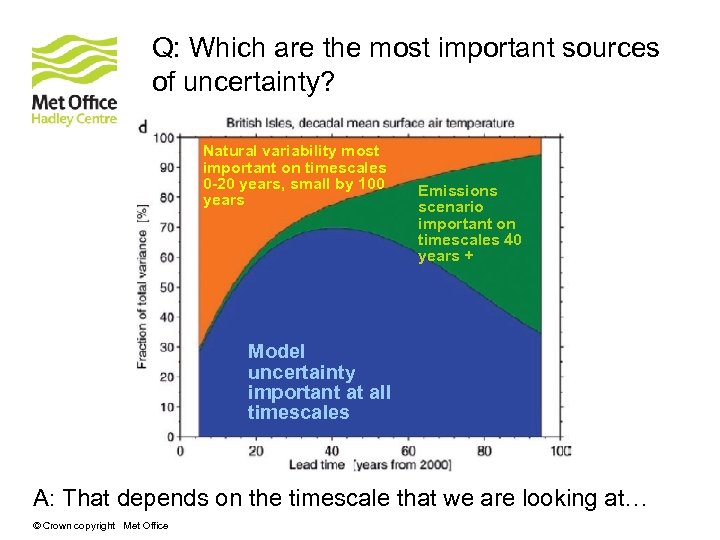 Q: Which are the most important sources of uncertainty? Natural variability most important on timescales 0 -20 years, small by 100 years Emissions scenario important on timescales 40 years + Model uncertainty important at all timescales A: That depends on the timescale that we are looking at… © Crown copyright Met Office
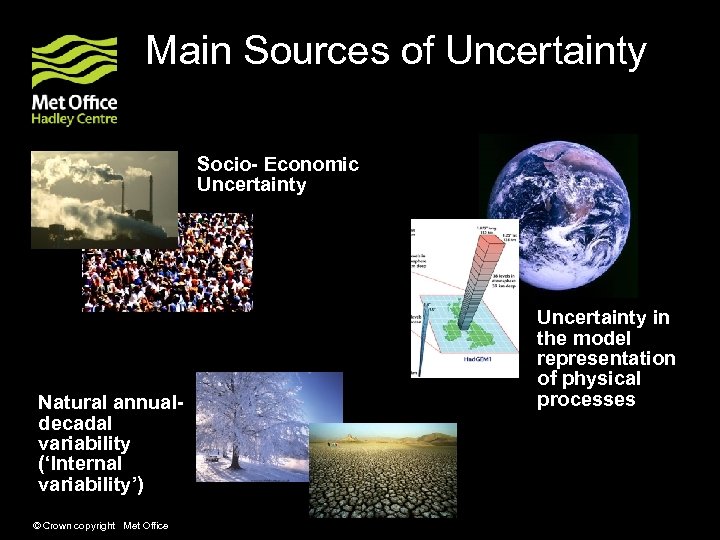
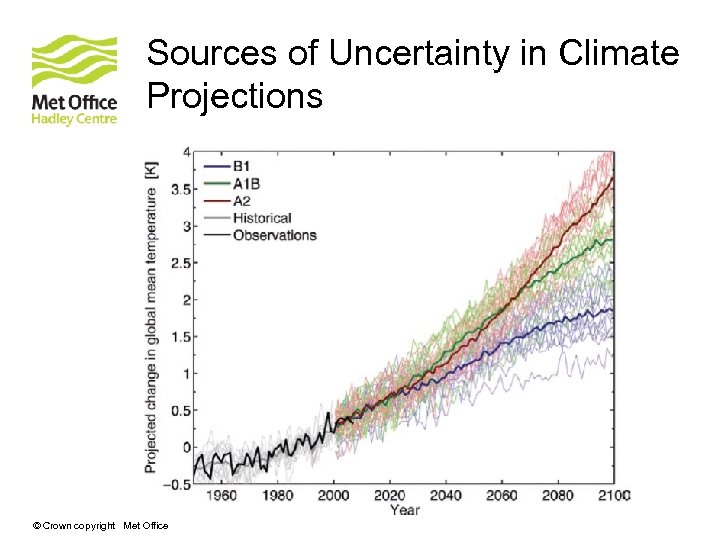
 • Natural Variability: ‘Noise’ mainly relevant for short lead times (2 -20 yrs) • Model uncertainty: • • Variations in global climate sensitivity from model-to-model More significantly, at regional level, determines characteristic of changes or the Signal (e. g. will my region get wetter or drier in the future? ) Very significant at all lead times, particularly for precipitation Emissions scenario: determines rate at which the changes indicated by any one model will occur © Crown copyright Met Office
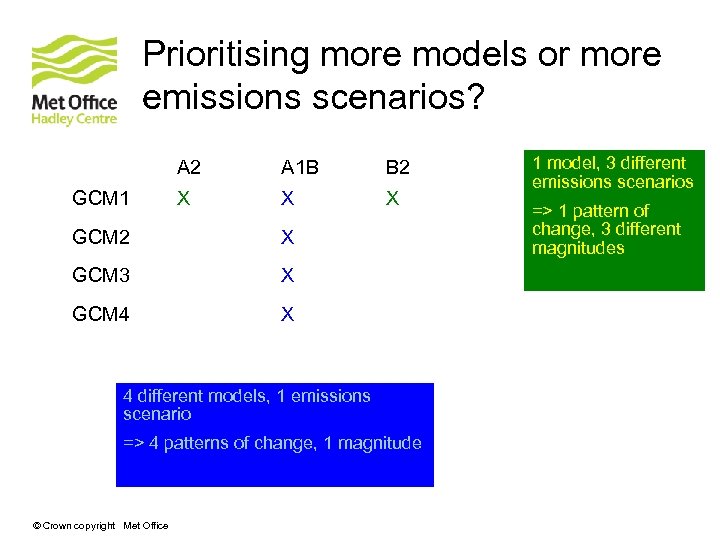 Prioritising more models or more emissions scenarios? A 2 GCM 1 A 1 B B 2 X X X GCM 2 X GCM 3 X GCM 4 X 4 different models, 1 emissions scenario => 4 patterns of change, 1 magnitude © Crown copyright Met Office 1 model, 3 different emissions scenarios => 1 pattern of change, 3 different magnitudes
 Emissions Scenarios © Crown copyright Met Office
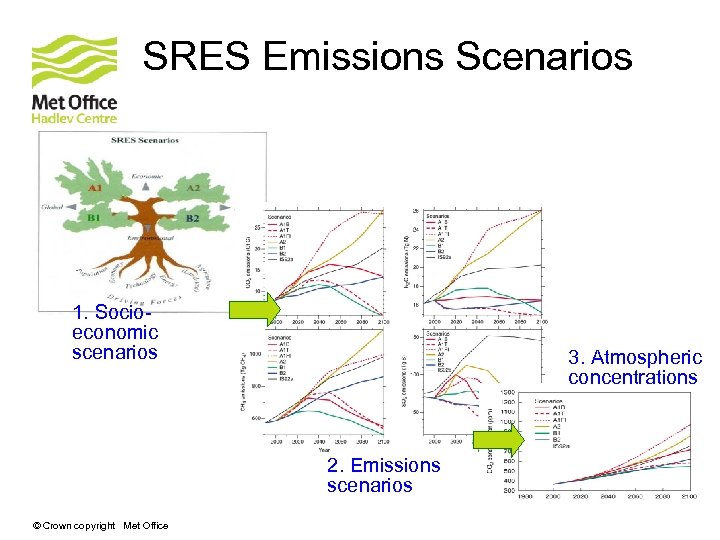 SRES Emissions Scenarios 1. Socioeconomic scenarios 3. Atmospheric concentrations 2. Emissions scenarios © Crown copyright Met Office
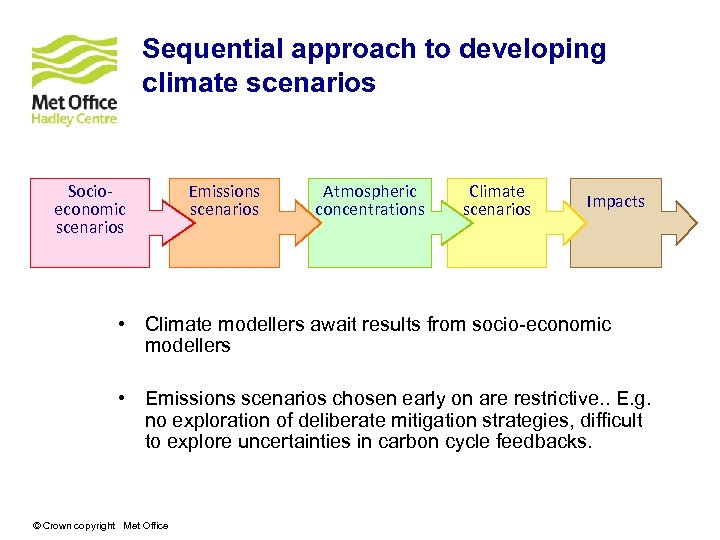 Sequential approach to developing climate scenarios Socioeconomic scenarios Emissions scenarios Atmospheric concentrations Climate scenarios Impacts • Climate modellers await results from socio-economic modellers • Emissions scenarios chosen early on are restrictive. . E. g. no exploration of deliberate mitigation strategies, difficult to explore uncertainties in carbon cycle feedbacks. © Crown copyright Met Office
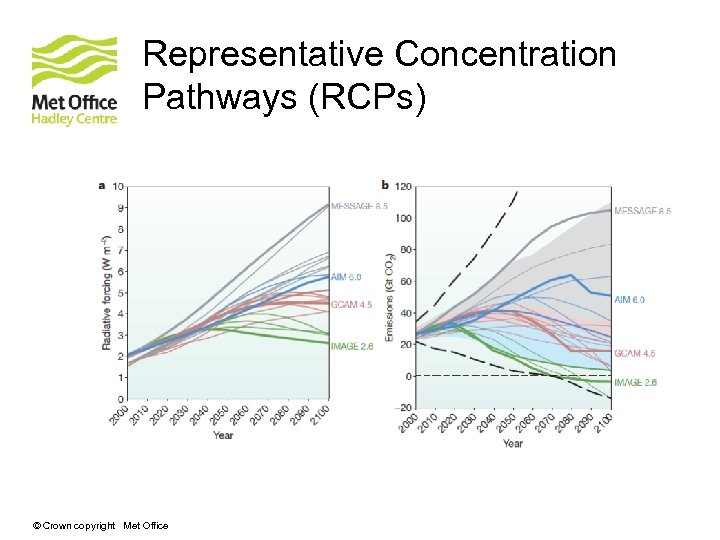 Representative Concentration Pathways (RCPs) © Crown copyright Met Office
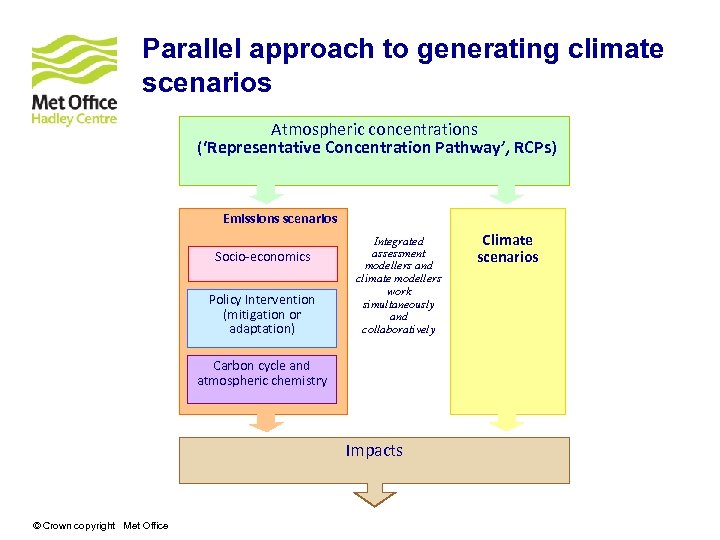 Parallel approach to generating climate scenarios Atmospheric concentrations (‘Representative Concentration Pathway’, RCPs) Emissions scenarios Socio-economics Policy Intervention (mitigation or adaptation) Integrated assessment modellers and climate modellers work simultaneously and collaboratively Carbon cycle and atmospheric chemistry Impacts © Crown copyright Met Office Climate scenarios
 Choosing scenarios • Remember that near term (10 -40 years) projections are ‘emissions independent’ • For longer lead times, Emissions scenario is important for determining rate of change, but does not determine pattern of change • RCPs useful for exploring ‘avoidable’ climate impacts • SRES useful where we want to compare with previous projections © Crown copyright Met Office
 Model Uncertainty © Crown copyright Met Office
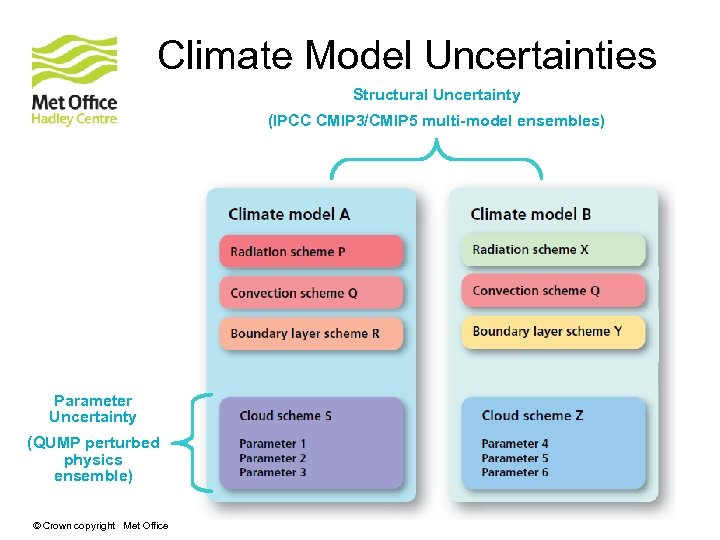 Climate Model Uncertainties Structural Uncertainty (IPCC CMIP 3/CMIP 5 multi-model ensembles) Parameter Uncertainty (QUMP perturbed physics ensemble) © Crown copyright Met Office
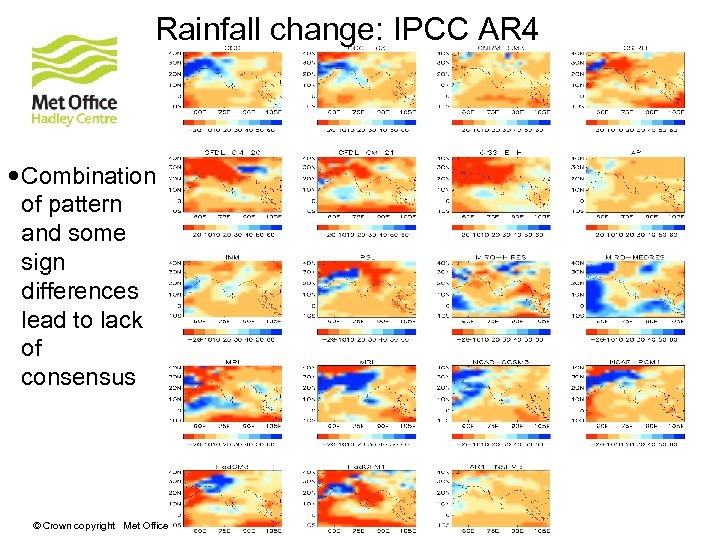 Rainfall change: IPCC AR 4 Combination of pattern and some sign differences lead to lack of consensus © Crown copyright Met Office
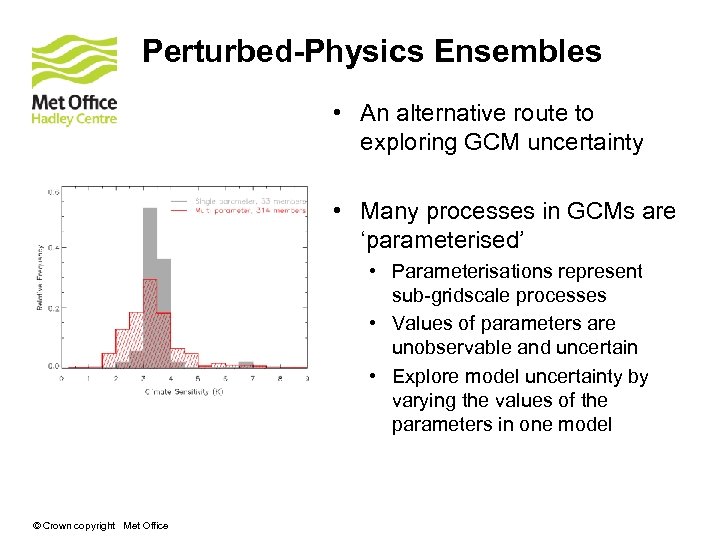 Perturbed-Physics Ensembles • An alternative route to exploring GCM uncertainty • Many processes in GCMs are ‘parameterised’ • Parameterisations represent sub-gridscale processes • Values of parameters are unobservable and uncertain • Explore model uncertainty by varying the values of the parameters in one model © Crown copyright Met Office
 The QUMP 17 -member perturbed physics ensemble Quantifying Uncertainty in Model Projections • 17 members (Had. CM 3 Q 0. . Q 16) • ‘parameter space’ = range/combinations of plausible values of parameters • Range of plausible values of parameters determined according to expert opinion • 17 models sample ‘parameter space’ systematically © Crown copyright Met Office
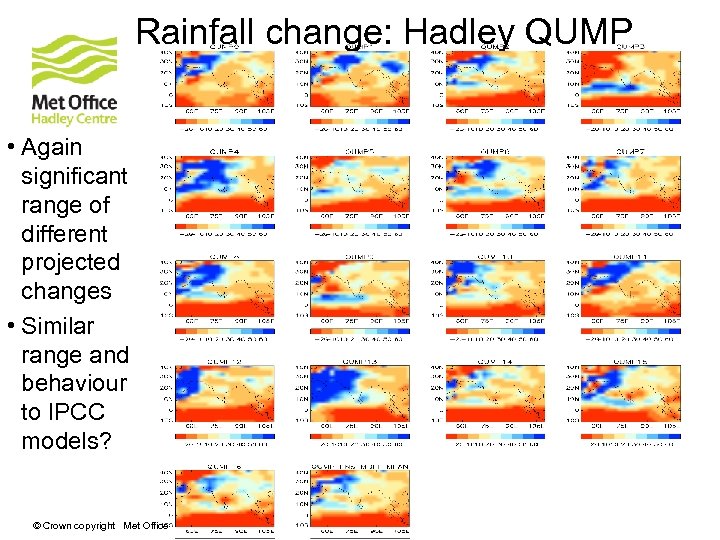 Rainfall change: Hadley QUMP • Again significant range of different projected changes • Similar range and behaviour to IPCC models? © Crown copyright Met Office
 Multi-model (MME) Vs Perturbed Physics Ensembles (PPE) PPE Strengths: • • • Can control the experimental design – Systematic sampling of modelling uncertainties Wider range of physically plausible climate outcomes Potentially include 1000 s of members • • Can design ensemble so that results can be interpreted probabilistically (e. g. UKCP 09) Logistically, More straightforward logistics for distributing boundary data due to consistent formats and MOHC ownership (i. e. feasible to provide boundary conditions from QUMP to PRECIS users!) PPE Weaknesses: • Doesn’t sample structural uncertainty (i. e. between models from different centres) © Crown copyright Met Office
 Approaching Model Sub-Selection © Crown copyright Met Office
 Why sub-select? • How do we provide ‘scientifically defendable range of climate outcomes’? • If we can represent the range of outcomes from the full ensemble with a subset of 4 -6… • Save on computing resources required to run RCMs • Save on boundary data required • More feasible to apply outputs from fewer RCMs to impacts models • Why take the time to sub-select carefully? • Because it is a waste of time to spend months running an experiment that’s not carefully planned • So, which ones do we use? © Crown copyright Met Office
 Case Study #1 • Jack is considering the impacts of climate change on international terrorism. • He decides to use the PRECIS regional modelling system and some members of the QUMP ensemble to explore model uncertainty. Maybe I will choose members Q 1, Q 7 and Q 16 to span the range of global sensitivities? © Crown copyright Met Office
 Case Study #2 • Beeker is exploring climate impacts on frog and pig populations. He will apply outputs from regional models to his species models. • Beeker wants to use a range of projections to help him understand the uncertainty in the future projections climate variables that are predictors in his model. I will choose the ‘best’ 5 models according to their validation. I could use the models with the lowest RMSE for temperature and precipitation. © Crown copyright Met Office
 Case study #3 • Inspector Lewis is considering the impact of climate change on flood frequency at some popular riverside crime scenes in Oxford. • Lewis will use the PRECIS outputs to drive a catchment model of the Cherwell and estimate peak flows. I might choose 4 members that span the widest possible range of mean precipitation change for the GCM gridbox that Oxford lies in. © Crown copyright Met Office
 Case study #4 • Uncle Bulgaria is interested in the impacts of climate change on burrow habitats on Wimbledon Common. • He needs regional climate model data to explore the possible changes in soil moisture and temperature in the future. • Uncle Bulgaria has very limited resources and can only run one simulation. Shall I just use Q 7 to give me a mid-range projection? © Crown copyright Met Office
 Can we select the models that validate the best in our region, or eliminate/downweight those that don’t? © Crown copyright Met Office
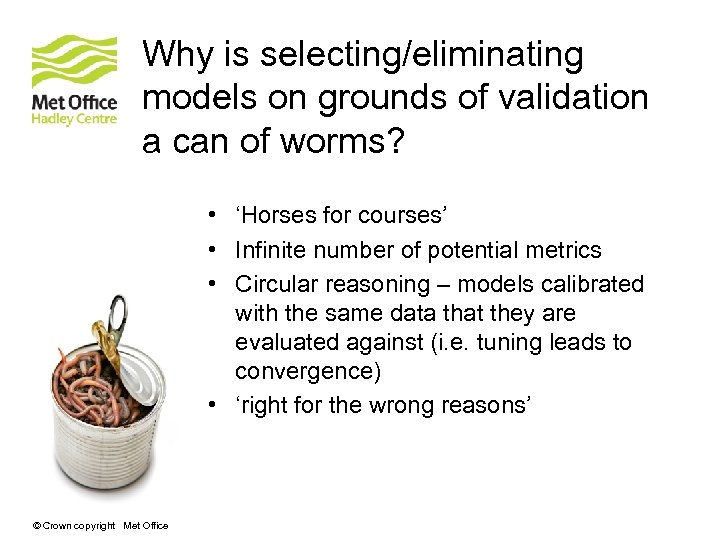 Why is selecting/eliminating models on grounds of validation a can of worms? • ‘Horses for courses’ • Infinite number of potential metrics • Circular reasoning – models calibrated with the same data that they are evaluated against (i. e. tuning leads to convergence) • ‘right for the wrong reasons’ © Crown copyright Met Office
 Some advice from Reto about combining information from multiple model projections 1. Metrics and criteria for evaluation must be demonstrated to relate to projection 2. It may be less controversial to downweight or eliminate specific projections that are clearly unable to mimic important processes than to agree on the best model. 3. Process understanding must complement ‘broad brush metrics’. For more see Knutti, 2010, Climatic Change 102. © Crown copyright Met Office
 Basis for selection: 1. ) Exclude models which we have good reason to think give unrealistic projections of the future • • Avoid cherry picking best models (might be right for wrong reasons) But we should reject models that really don’t represent the key large-scale processes 2. ) Span the range of future outcomes in the region • • © Crown copyright Met Office Span range of magnitudes of change (i. e. global sensitivity, and regional sensitivity) Span multiple variables/characteristics of change • E. g models that are wetter or drier in different regions • Different spatial patterns of change • Change in key large-scale processes
 Sub-selecting ensemble members for downscaling with PRECIS – an example from Vietnam © Crown copyright Met Office
 Example of Model sub-selection: Vietnam Criteria for selection • Validation • Selected models should represent Asian summer monsoon (position, timing, magnitude), and associated rainfall well, as this is key process • Future • Magnitude of response: greatest/least regional/local warming, greatest/least magnitude of change in precipitation • Characteristics of response • Direction of change in wet-season precipitation (increases and decreases) • Spatial patterns of precipitation response over southeast Asia • Response of the monsoon circulation © Crown copyright Met Office
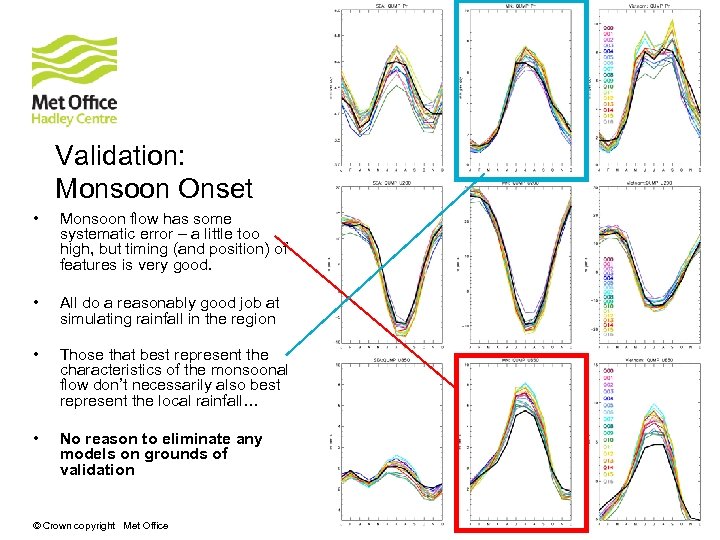 Validation: Monsoon Onset • Monsoon flow has some systematic error – a little too high, but timing (and position) of features is very good. • All do a reasonably good job at simulating rainfall in the region • Those that best represent the characteristics of the monsoonal flow don’t necessarily also best represent the local rainfall… • No reason to eliminate any models on grounds of validation © Crown copyright Met Office
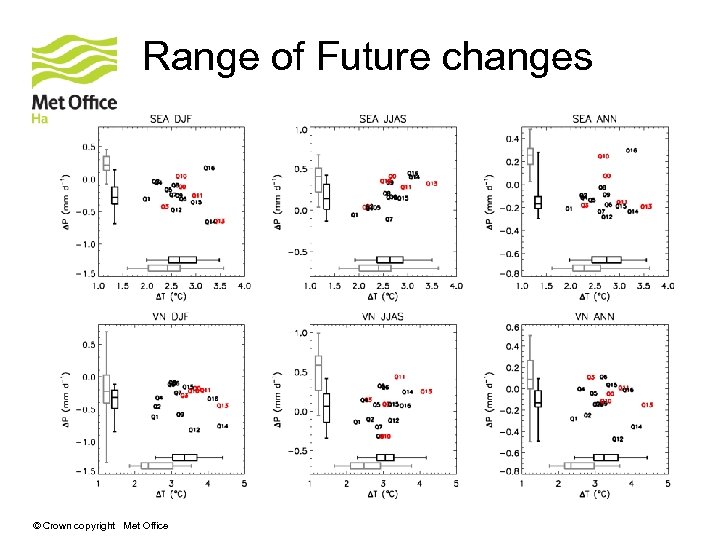 Range of Future changes © Crown copyright Met Office
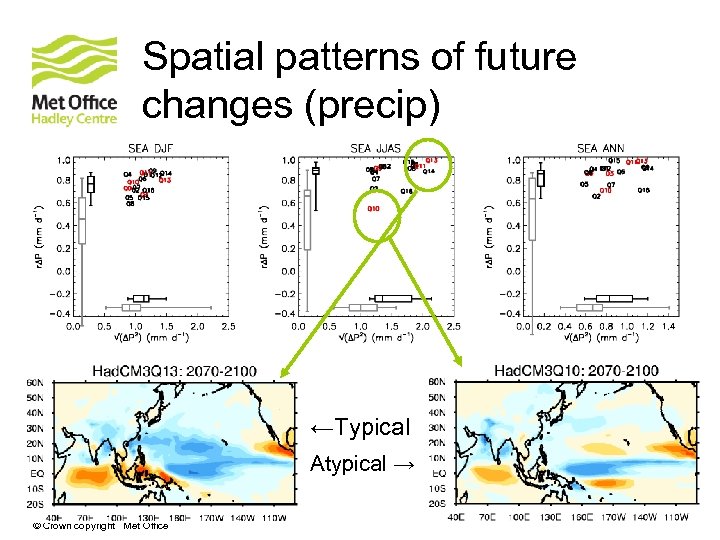 Spatial patterns of future changes (precip) ←Typical Atypical → © Crown copyright Met Office
 Recommended QUMP members for this region • Had. CM 3 Q 0 – The standard model • • Had. CM 3 Q 3 Had. CM 3 Q 13 – A model with low sensitivity (smaller temperature changes) – A model with high sensitivity (larger temperature changes) • • Had. CM 3 Q 10 Had. CM 3 Q 11 – A model that gives the driest projections – A model that gives the wettest projections • Including Q 10 and Q 13 means that we also cover models which characterise the different spatial patterns of rainfall change, and different monsoon responses. © Crown copyright Met Office
 Summary © Crown copyright Met Office
 Summary • Increasing numbers of available GCMs, as well as new emissions scenarios, make decisions about which GCMs runs to downscale more complicated • Need to balance requirement to sample a wide range of uncertainty with minimising the number of necessary RCM runs • Experimental design (or choice of models/scenarios) is important – ‘adhoc’ selections may leave us with results that are very difficult to interpret • GCM uncertainty is the most important source of uncertainty at the regional level due to differences between models is patterns of rainfall change • We can generate downscaled projections that represent the range of uncertainty in a large ensemble by carefully sub-selecting models for downscaling © Crown copyright Met Office
 Questions and answers © Crown copyright Met Office
 Ensemble regional prediction: Issues and approaches • The major uncertainties in the simulated broad-scale climate changes come from GCMs • Global climate models provide information which is often too coarse for applications thus downscaling is required • To provide the best possible information currently available we can: • Consider a range of simulated climate changes from the global climate models • Downscale these to provide information relevant to applications which accounts for this range of possible future climate changes • Also provides a set of internally-consistent inputs for impacts models © Crown copyright Met Office