 Скачать презентацию IP Technology Geoff Huston November 02 1
24dc84d6365f49d2da71e849b54950e4.ppt
- Количество слайдов: 35



IP Technology Geoff Huston November 02 1
Overview • A quick skate across the top of an entire suite of technologybased issues that exist within the IP architecture: – IP Carriage – IP, TCP and UDP – IP Addresses – IP V 6 – DNS – IP Routing – Network Management – VPNs – MPLS – VOIP – Wireless November 02 2
IP Carriage Architectures Issues in designing an efficient high speed IP backbone network November 02 3
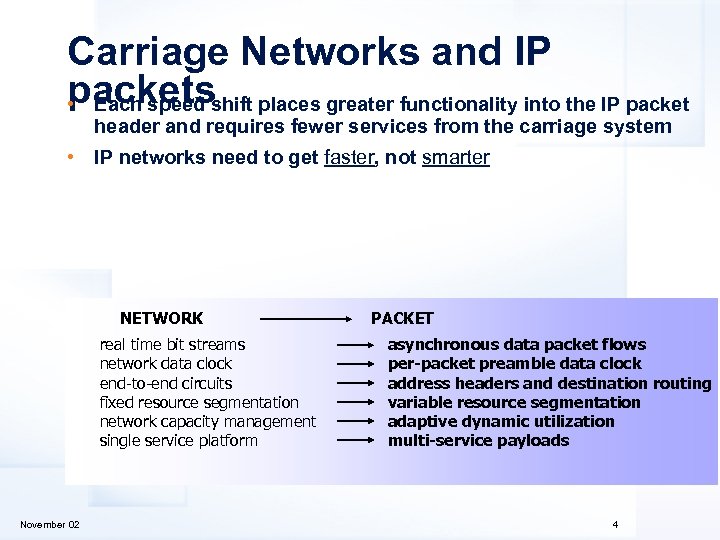
Carriage Networks and IP packetsshift places greater functionality into the IP packet • Each speed header and requires fewer services from the carriage system • IP networks need to get faster, not smarter NETWORK real time bit streams network data clock end-to-end circuits fixed resource segmentation network capacity management single service platform November 02 PACKET asynchronous data packet flows per-packet preamble data clock address headers and destination routing variable resource segmentation adaptive dynamic utilization multi-service payloads 4
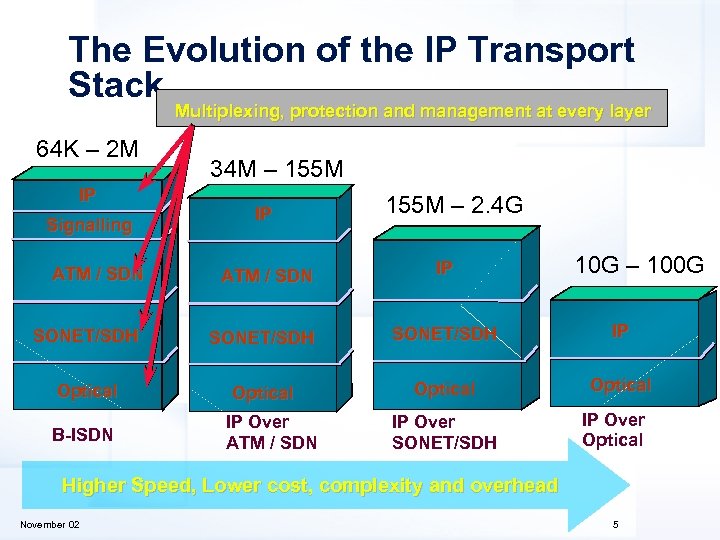
The Evolution of the IP Transport Stack Multiplexing, protection and management at every layer 64 K – 2 M IP Signalling ATM / SDN 34 M – 155 M IP ATM / SDN 155 M – 2. 4 G IP 10 G – 100 G SONET/SDH IP Optical B-ISDN IP Over ATM / SDN IP Over SONET/SDH IP Over Optical Higher Speed, Lower cost, complexity and overhead November 02 5
Engineering Internet Backbone Networks were originally designed as overlays on the • Data Networks PSTN network • As the Internet evolved its demands for carriage capacity have increased more than one million-fold – This massive increase in volume requires rethinking how to efficiently build data networks • This has lead to engineering data networks without an underlying PSTN – Such IP trunk networks are very recent developments to the carrier engineering domain • Current High Speed IP platform architectures consist of: – DWDM fibre systems – 10 G optical channels – 10 Gi. GE Ethernet framing – Multi-router POPs November 02 6 – Load distribution through topology design and ISIS link metrics
Faster Core IP Networks • From Silicon to Photons – Reduce the number of optical / electrical conversions in order to increase network speed • The optical switched backbone – Gigabit to Terabit network systems using multi-wavelength optical systems – Single hop routing to multi-hop optical Traffic-Engineering control planes November 02 7
A whole new Terminology Set: Gigabit Networking Technology Elements • Ethernet packet frames – Faster Ethernet: 100 m. FE, Gig. E, 10 Gig. E – VLANs: 802. 1 Q – Rings (802. 17) and T-Bit Fast Switches • Optical Transports – CWDM / DWDM – Wavelength-Agile Optical Cross-Connect control systems with GMPLS controls • Traffic Engineering – Rapid Response, Rapid Convergence IP Routing Systems – MPLS to maintain path vector sets November 02 8
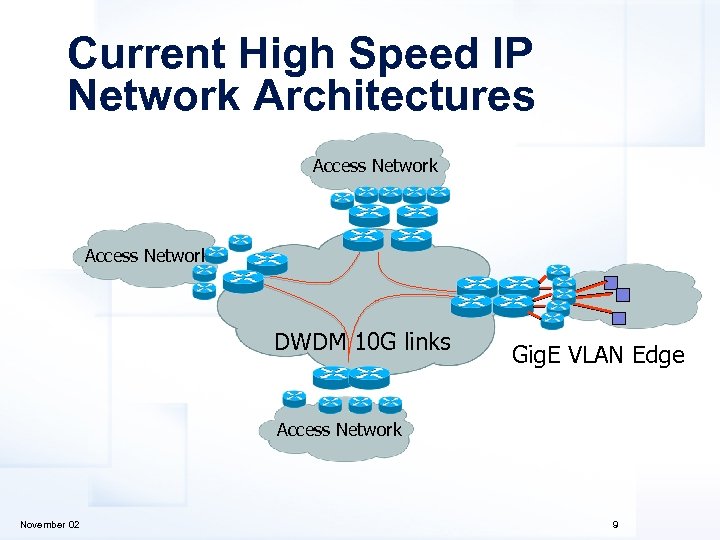
Current High Speed IP Network Architectures Access Network DWDM 10 G links Gig. E VLAN Edge Access Network November 02 9
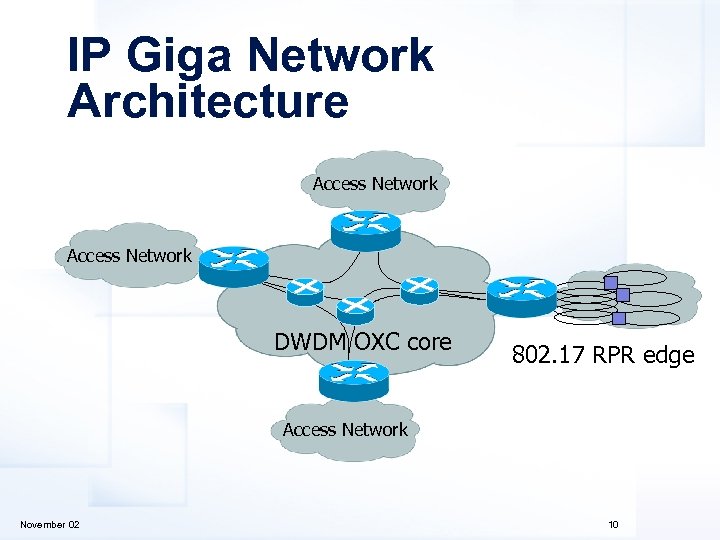
IP Giga Network Architecture Access Network DWDM OXC core 802. 17 RPR edge Access Network November 02 10
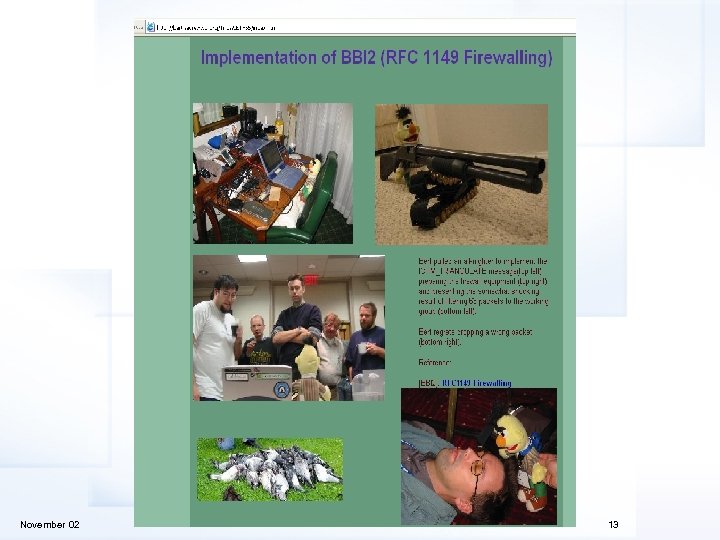
IP Architecture • IP is a simple end-to-end overlay level 3 datagram protocol – End-to-end header semantics – No signalled connection between link level conditions and transport services – Universal abstraction of a common simple packet transmission service that has been adapted to operate efficiently over wires, modems, Frame Relay, ATM, Ethernet, broadcast radio, packet radio, satellite circuits, SDH, fibre, pigeons November 02 11
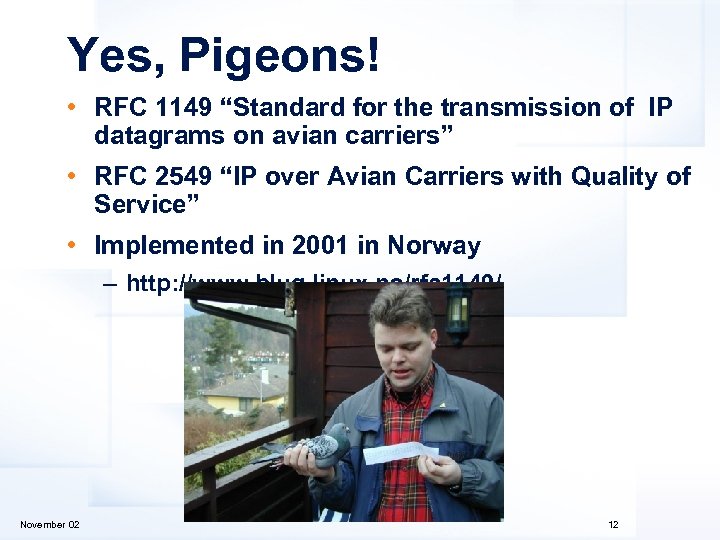
Yes, Pigeons! • RFC 1149 “Standard for the transmission of IP datagrams on avian carriers” • RFC 2549 “IP over Avian Carriers with Quality of Service” • Implemented in 2001 in Norway – http: //www. blug. linux. no/rfc 1149/ November 02 12
November 02 13
IP Architecture • TCP and UDP are DIFFERENT end-to-end transport services – UDP is an unreliable datagram service – TCP is a flow-controlled reliable stream service – Most IP payload is TCP (95% by volume) – Real-time services use a UDP base • UDP and TCP have a widely different operating model – TCP attempts to saturate network resources using a cooperative model of congestion limit probing (networkclocking of data transfer) – UDP uses an external clocking model that is normally impervious to network conditions – The fit is often not entirely comfortable • hence the Qo. S effort to attempt to impose some level of network-based arbitration November 02 14
IP Architecture Pressures • Now under some pressure – Qo. S signalling between application and network – NATS, ALGs, intercepting caches break end-to-end semantic with middleware – IPSEC, SIP, HTTPS tunnels, IPV 6 tunnelling (…) now being used to 2 nd guess middleware in order to recreate end-toend associations – Transport services under pressure to be more aggressive in recovery vs making UDP more ‘reliable’ – Identity semantics all confused with application, end-toend and network level identity assertions • This new architecture no longer simple, scaleable or efficient November 02 15
Addresses -- How to get here from there information on how to locate • Addresses provide something, e. g. , what route to take from here to there. • Internet addresses combine – a routing portion, known as the network part – a name portion known as the host part November 02 16
IP Addresses • IP uses overloaded semantics of an “address” – AN IP address is used as an IDENTITY, a LOCATOR and a ROUTING ELEMENT – These are separable concepts: • What is the best PATH to reach YOUR current LOCATION? – IP makes no distinction at present between these three roles – Consequent serious issues with Mobility, NATs, SIP, URLs, Security – This is common to both V 4 and V 6 November 02 17
IP V 4 Addresses • V 4 remains the overwhelmingly dominant protocol choice – 32 bit (4 G) address space • 50% allocated • 25% deployed • 5%- 10% utilization density achieved • Consumption at a rate of 32 M p. a. • Anticipated lifespan of a further 10 – 15 years in native mode • Indefinite lifespan in NAT mode November 02 18
IPV 6 • “IP with larger addresses” • Address space requirements are no longer being easily met by IPv 4 • This is an issue for high volume deployments including: – – GPRS mobile 3 G Mobile Web. TV Pocket IP devices • IPV 6 appears to offer reasonable technology solutions that preserve IP integrity, reduce middleware dependencies and allow full end-to-end IP functionality • Issues are concerned with co-existence with the IPv 4 base and allowing full inter-working between the two November 02 19 protocol domains
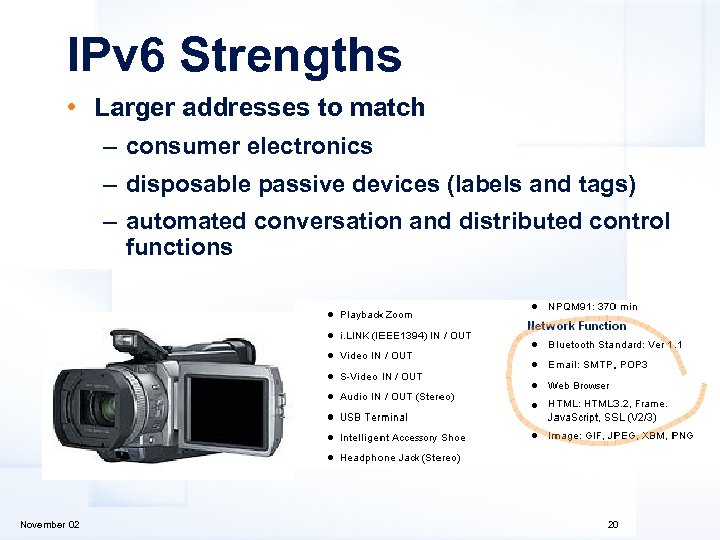
IPv 6 Strengths • Larger addresses to match – consumer electronics – disposable passive devices (labels and tags) – automated conversation and distributed control functions November 02 20
IPv 6 Weaknesses • Not sufficiently “different” from IPv 4 – No ‘value add” to fuel investment in transition – Reuses large amounts of V 4 infrastructure to there’s an expectation of identical outcomes • http: //www. kame. net • Not sufficiently “similar” to IPv 4 – The coupling of address and identity functions in the IP architecture makes transparent address translation a challenge – Referential integrity issues – is the DNS protocol independent or loosely/tightly coupled between V 6 and V 4 • Still working on the technology – – – November 02 Address architecture Site-Local addressing Multi-homing Mobility Transition mechanisms 21
V 4 and V 6 – direction? • No change and no widespread adoption of V 6 - yet • Most growth in IP is being absorbed by NATs and DHCP • Likely deployment model is in vendor-push walled garden deployments with application-specific gateway portals into and out of the V 6 domain • The next 2 years appear to be a critical period for V 6 deployment • The hype surrounding V 6 is unhelpful – V 6 is IP with larger addresses – nothing more • The lack of production high speed routing code from vendors is frustrating – Noone wants to deploy ‘experimental’ code! November 02 22
Domain Names • Hierarchical name space with an associated distributed caching database (the “DNS”) • The DNS: – Maps names to IP addresses – Maps IP addresses to names – Maps service names to other names – Maps E. 164 numbers to service addresses – Can contain unstructured text elements • Key signatures • Identity November 02 23
Domain Name Issues • Single root of the hierarchy • Control of root by USG • Short-cut name spaces • Multi-lingual DNS • Security and resilience • Alternative Identity name space (DNSSEC + Dynamic Update) • Trademarks and IPR issues • Generic TLDs November 02 24
Routing • IP uses a de-coupled routing architecture – Routing architectures can (and do) change without disrupting the service platform • Two level hierarchy – Interior routing to undertake topology maintenance and best path identification – Exterior routing to undertake connectivity maintenance and conformance to external policies November 02 25
Routing – Interior Routing • Predominant use of SPF algorithms for topology maintenance – OSPF – IS-IS • Overlay external routes with i. BGP • Little evidence of takeup of MPLS-based approaches November 02 26
Routing – Exterior Routing • BGP is the protocol of choice for exterior routing – Operator base highly familiar with BGP characteristics and capabilities – Easily disrupted • Poor security model with massive levels of distributed trust and no coupled authentication mechanisms – Poor scaling performance – Highly unstable (oscillation and damping) – Unresponsive to dynamic changes – No TE / Qo. S Support • And none likely! – No alternative to field! November 02 27
Network Management • SNMP-based architecture – In-band management model – Query-response polling architecture using a structured set of query variables – Problems: • Insecure • Vulnerable implementations • Too simple? – Efforts underway to create a successor architecture to SNMP to incorporate better security, lock and confirm actions (mutex plus confirm), shared management state November 02 28
IP VPNs • Sharing of a common base packet switching platform by a collection of IP networks • Issues of integrity of the platform and integrity of the offered IP service to the VPN client • Critical areas of technology development include – MPLS – Multi-Protocol Label Switching – MPR – Multi-Protocol Routing – VLANS – Virtual LAN Packet Frame formats – IPSEC – end-to-end IP authentication and encryption services – Qo. S – various forms of Quality of Service network mechanisms – PPP / MPLS / VLAN / VC inter- working – the enterprise-wide VPN service model – Dynamic VPN technologies – secure edge-based discovery tools November 02 29
MPLS • Where ATM collides with IP • MPLS is an encapsulation technology that adds a networkspecific egress label of a packet, and then uses this for each hop-by-hop switching decision • Originally thought of as a faster switching technology than IPlevel switching. This is not the case • Now thought of as a more robust mechanism of networkspecific encap than <IP in IP>, or <IP in L 2 TP in IP> • Has much of the characteristics of a solution looking for a problem: – IP-VPNs? IP-TE? IP-Qo. S? Multi-protocol variants of these? November 02 30
VOIP • In theory voice is just another IP application • In practice it’s a lot harder than that • Issues of Quality and Signalling • Quality – Voice is a low jitter, low loss, low latency, constant load application – TCP is a high jitter, medium loss, variable load transport – The problem is to get VOIP into the network without it being unduly impaired by TCP flows – Either overprovision the network and minimize the impacts or – differentiate the traffic to the network and allow the network elements to treat VOIP packets differently from TCP packets November 02 31
VOIP • How can you map the E. 164 telephone number space into the Internet environment? – Allow VOIP gateways to operate autonomously as an agent of the caller rather than the reciever – ENUM technology to use the DNS to map an E. 164 number to a URL service location – Use the DNS to map the URL service location to an IP address of the service point – What happens with NATs? November 02 32
Wireless • In theory – IP makes minimal assumptions about the nature of the transmission medium. IP over wireless works well. • In practice – high speed TCP over wireless solutions only works in environments of low radius of coverage and high power – TCP performance is highly sensitive to packet loss and extended packet transmission latency November 02 33
Wireless • 3 G IP-based wireless deployments will not efficiently interoperate with the wired IP Internet • Likely 3 G deployment scenario of wireless gateway systems acting as transport-level bridges, allowing the wireless domain to use a modified TCP stack that should operate efficiently in a wireless environment • 802. 11 is different • Bluetooth is yet to happen (or not) November 02 34
IP Extensions & Refinements • IP Multicast technologies – Extension of IP into support of common broadcast / conferencing models – Large-scale multicast – Small-scale multicast – conferencing – No widescale deployment as yet • IP Mobility – IP support of mobility functions for mobile hosts and mobile subnets – Difference between nomadic operation and roaming operation • IP Qo. S – IP support of distinguished service responses from the network – Per-flow responses or per-traffic class response models exist – No real uptake of either approach so far November 02 35
Скачать презентацию IP Technology Geoff Huston November 02 1
24dc84d6365f49d2da71e849b54950e4.ppt