


 Скачать презентацию IP Security Nick Feamster CS 6262 Spring 2009
0a3a4239f299ed0866f717dc1347196a.ppt
- Количество слайдов: 33
 IP Security Nick Feamster CS 6262 Spring 2009
 IP Security • have a range of application specific security mechanisms – eg. S/MIME, PGP, Kerberos, SSL/HTTPS • however there are security concerns that cut across protocol layers • would like security implemented by the network for all applications
 IPSec • general IP Security mechanisms • provides – authentication – confidentiality – key management • applicable to use over LANs, across public & private WANs, & for the Internet
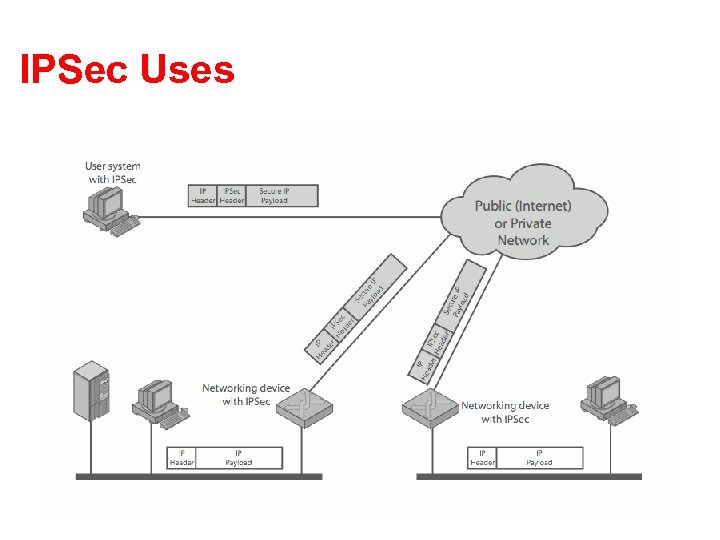 IPSec Uses
 Benefits of IPSec • in a firewall/router provides strong security to all traffic crossing the perimeter • in a firewall/router is resistant to bypass • is below transport layer, hence transparent to applications • can be transparent to end users • can provide security for individual users • secures routing architecture
 IP Security Architecture • specification is quite complex • defined in numerous RFC’s – incl. RFC 2401/2402/2406/2408 – many others, grouped by category • mandatory in IPv 6, optional in IPv 4 • have two security header extensions: – Authentication Header (AH) – Encapsulating Security Payload (ESP)
 IPSec Services • • Access control Connectionless integrity Data origin authentication Rejection of replayed packets – a form of partial sequence integrity • Confidentiality (encryption) • Limited traffic flow confidentiality
 Security Associations • a one-way relationship between sender & receiver that affords security for traffic flow • defined by 3 parameters: – Security Parameters Index (SPI) – IP Destination Address – Security Protocol Identifier • has a number of other parameters – seq no, AH & EH info, lifetime etc • have a database of Security Associations
 Authentication Header (AH) • provides support for data integrity & authentication of IP packets – end system/router can authenticate user/app – prevents address spoofing attacks by tracking sequence numbers • based on use of a MAC – HMAC-MD 5 -96 or HMAC-SHA-1 -96 • parties must share a secret key
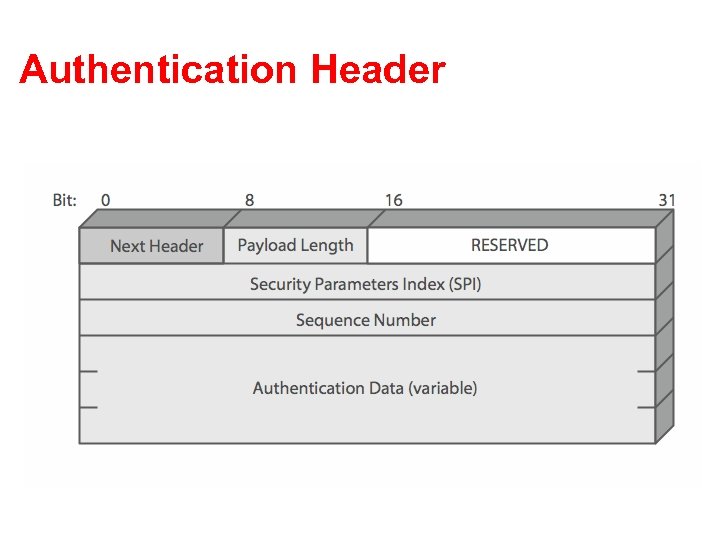 Authentication Header
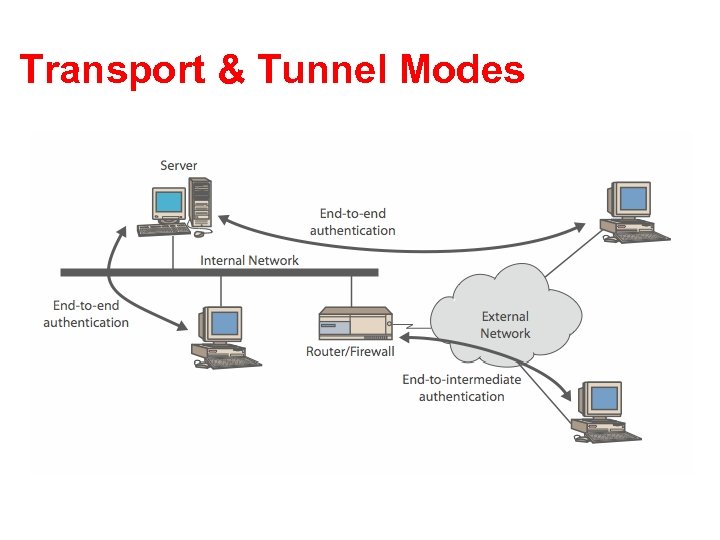 Transport & Tunnel Modes
 Encapsulating Security Payload (ESP) • provides message content confidentiality & limited traffic flow confidentiality • can optionally provide the same authentication services as AH • supports range of ciphers, modes, padding – incl. DES, Triple-DES, RC 5, IDEA, CAST etc – CBC & other modes – padding needed to fill blocksize, fields, for traffic flow
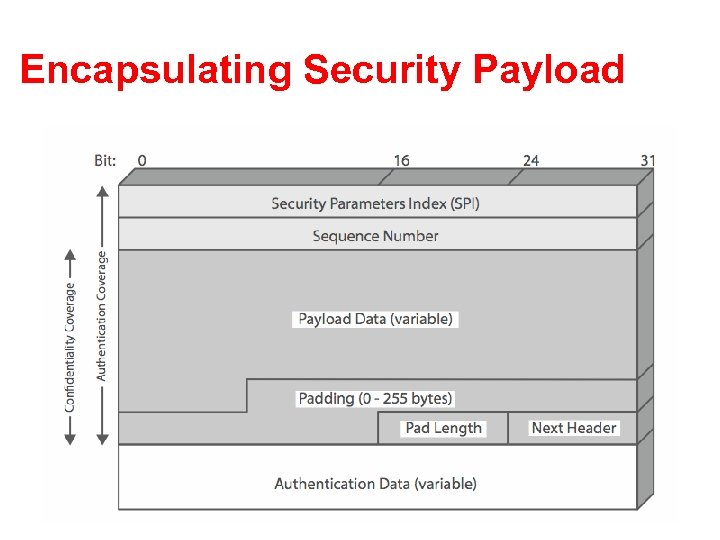 Encapsulating Security Payload
 Transport vs. Tunnel Mode ESP • transport mode is used to encrypt & optionally authenticate IP data – data protected but header left in clear – can do traffic analysis but is efficient – good for ESP host to host traffic • tunnel mode encrypts entire IP packet – add new header for next hop – good for VPNs, gateway to gateway security
 Combining Security Associations • SA’s can implement either AH or ESP • to implement both need to combine SA’s – form a security association bundle – may terminate at different or same endpoints – combined by • transport adjacency • iterated tunneling • issue of authentication & encryption order
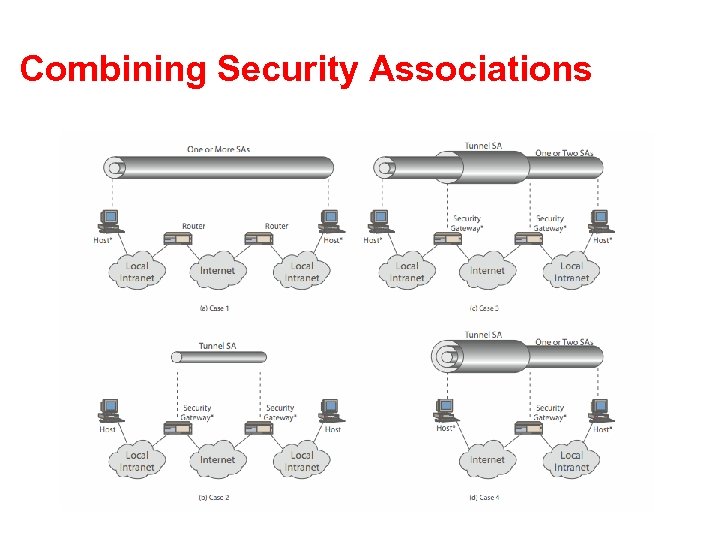 Combining Security Associations
 Key Management • handles key generation & distribution • typically need 2 pairs of keys – 2 per direction for AH & ESP • manual key management – sysadmin manually configures every system • automated key management – automated system for on demand creation of keys for SA’s in large systems – has Oakley & ISAKMP elements
 Oakley • a key exchange protocol • based on Diffie-Hellman key exchange • adds features to address weaknesses – cookies, groups (global params), nonces, DH key exchange with authentication • can use arithmetic in prime fields or elliptic curve fields
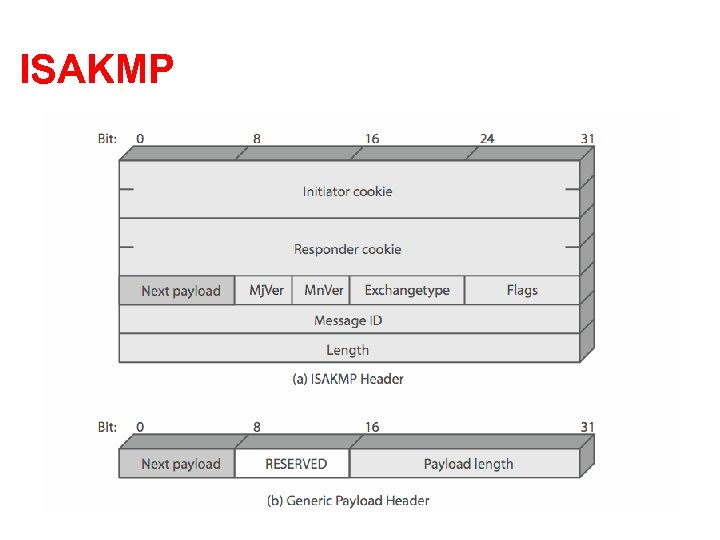
 ISAKMP • Internet Security Association and Key Management Protocol • provides framework for key management • defines procedures and packet formats to establish, negotiate, modify, & delete SAs • independent of key exchange protocol, encryption alg, & authentication method
 ISAKMP
 ISAKMP Payloads & Exchanges • have a number of ISAKMP payload types: – Security, Proposal, Transform, Key, Identification, Certificate, Hash, Signature, Nonce, Notification, Delete • ISAKMP has framework for 5 types of message exchanges: – base, identity protection, authentication only, aggressive, informational
 Summary • have considered: – – IPSec security framework AH ESP key management & Oakley/ISAKMP
 IP Addresses Lack Secure Bindings • Three kinds of IP layer names: IP address, IP prefix, AS number • No secure binding of host to its IP addresses • No secure binding of AS number to its IP prefixes
 Accountability • Many problems easier to solve with network-layer accountability: Ability to associate a principal with a message • There’s a way to make accountability intrinsic AIP 24
 How? • Key idea: New addressing scheme for networks and hosts • Addresses are self-certifying • Simple protocols that use properties of addressing scheme as foundation • Anti-spoofing, secure routing, DDo. S shut -off, etc.
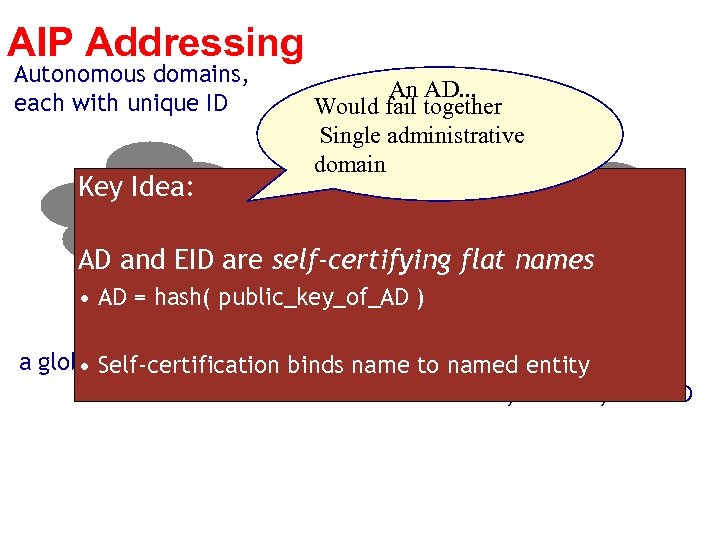 AIP Addressing Autonomous domains, each with unique ID Key Idea: AD 1 An AD. . . Would fail together AD 2 Single administrative domain AD 3 AD and EID are self-certifying flat names • AD = hash( public_key_of_AD ) Address = AD 1: EID Each host has If multihomed, has a global EID [HIP, DOA, etc. ] • Self-certification binds name to named entity multiple addresses AD 1: EID, AD 2: EID, AD 3: EID
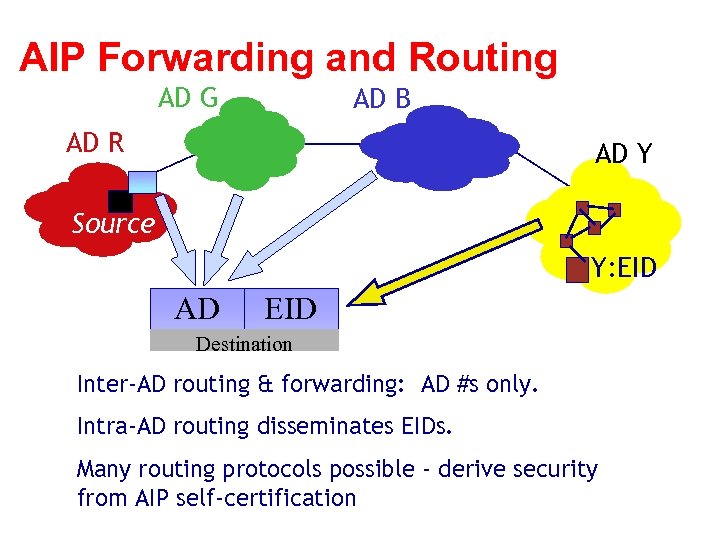 AIP Forwarding and Routing AD G AD B AD R AD Y Source Y: EID AD EID Destination Inter-AD routing & forwarding: AD #s only. Intra-AD routing disseminates EIDs. Many routing protocols possible - derive security from AIP self-certification
 Roadmap • Uses – Secure Routing – Anti-Spoofing – Shut-Off Packets • Concerns – Scalability – Key Management – Traffic Engineering 28
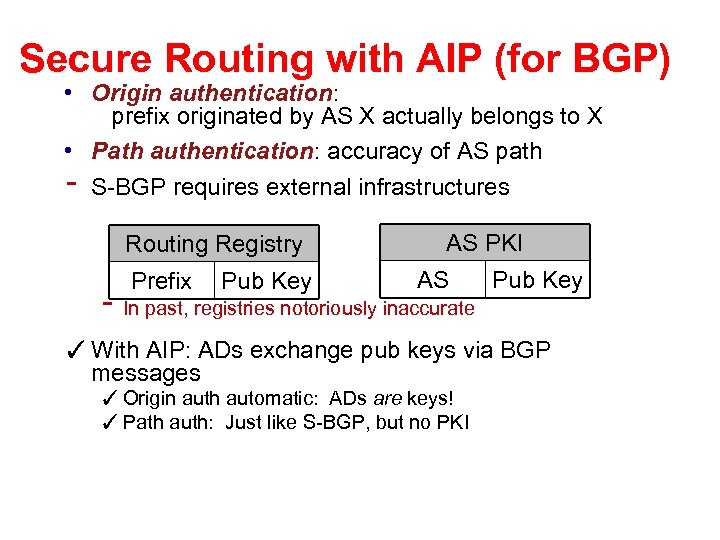 Secure Routing with AIP (for BGP) • Origin authentication: prefix originated by AS X actually belongs to X • Path authentication: accuracy of AS path S-BGP requires external infrastructures - Routing Registry Prefix Pub Key AS PKI AS - In past, registries notoriously inaccurate Pub Key ✓ With AIP: ADs exchange pub keys via BGP messages ✓ Origin auth automatic: ADs are keys! ✓ Path auth: Just like S-BGP, but no PKI
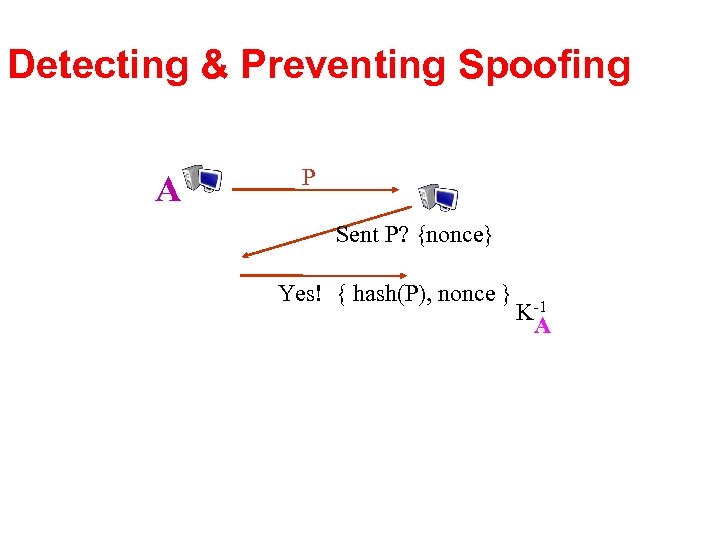 Detecting & Preventing Spoofing A P Sent P? {nonce} Yes! { hash(P), nonce } K-1 A
 Mitigating Minting • Peering ADs: – Today: List which ASes/Prefixes A can use (painful for clients and ISPs) – AIP: Configure reasonable limit on number of ADs can announce • Edge ADs can limit EIDs similarly 31
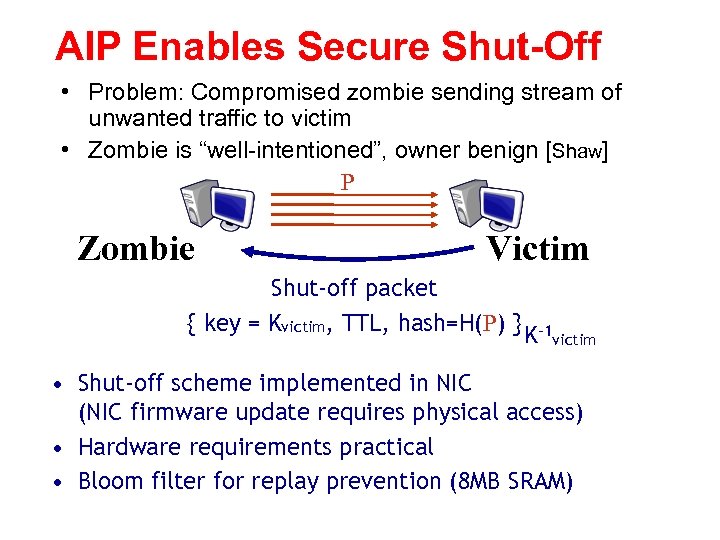 AIP Enables Secure Shut-Off • Problem: Compromised zombie sending stream of unwanted traffic to victim • Zombie is “well-intentioned”, owner benign [Shaw] P Zombie Victim Shut-off packet { key = Kvictim, TTL, hash=H(P) } K-1 victim • Shut-off scheme implemented in NIC (NIC firmware update requires physical access) • Hardware requirements practical • Bloom filter for replay prevention (8 MB SRAM)
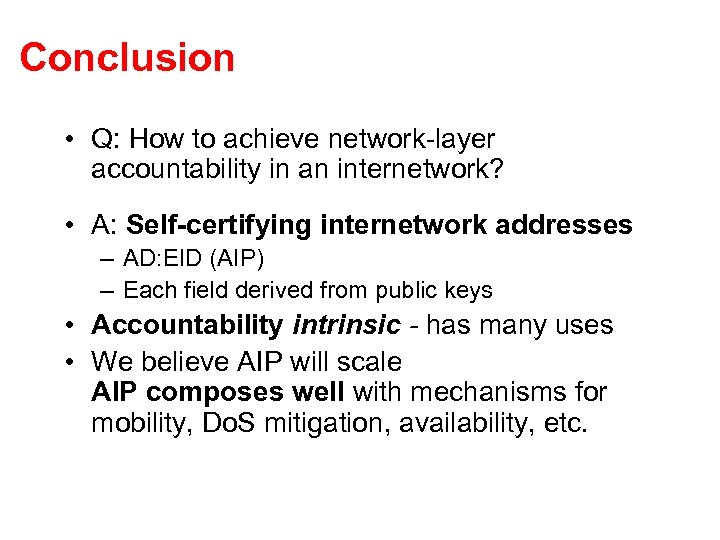 Conclusion • Q: How to achieve network-layer accountability in an internetwork? • A: Self-certifying internetwork addresses – AD: EID (AIP) – Each field derived from public keys • Accountability intrinsic - has many uses • We believe AIP will scale AIP composes well with mechanisms for mobility, Do. S mitigation, availability, etc.