 Скачать презентацию IP security architecture Courtesy of Albert Levi with
322f1e8b2b5f00ab1521c810928ec230.ppt
- Количество слайдов: 66



IP security architecture Courtesy of Albert Levi with Sabanci Univ. Gunter Schafer with TU Berlin
Internetwork Protocol (IP) • IP is an unreliable protocol – IP datagrams may be lost – IP datagrams may be duplicate – IP datagrams may arrive out of order – TCP takes care of those problems
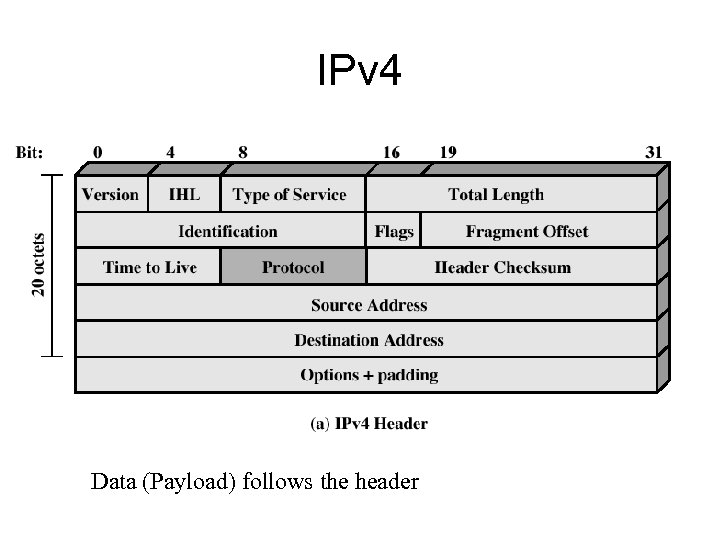
IPv 4 Data (Payload) follows the header
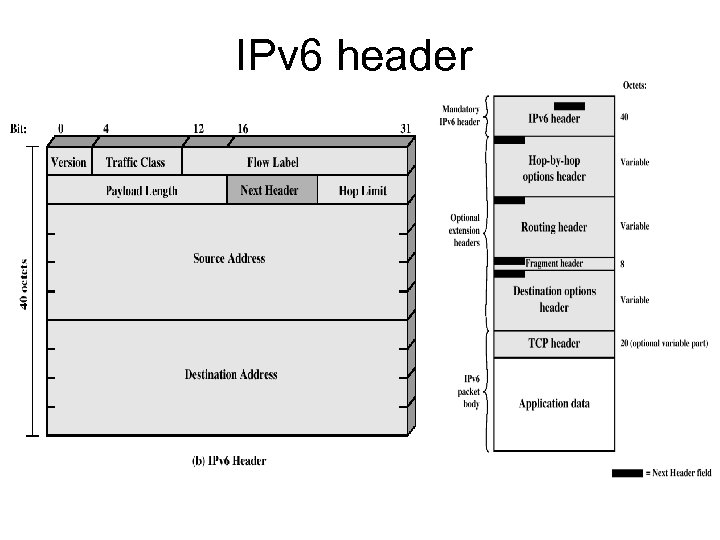
IPv 6 header
Is IP Secure? • IP spoofing – False IP address – No authentication on address • Packet sniffing – Content (Payload) is not encrypted – confidentiality is not provided
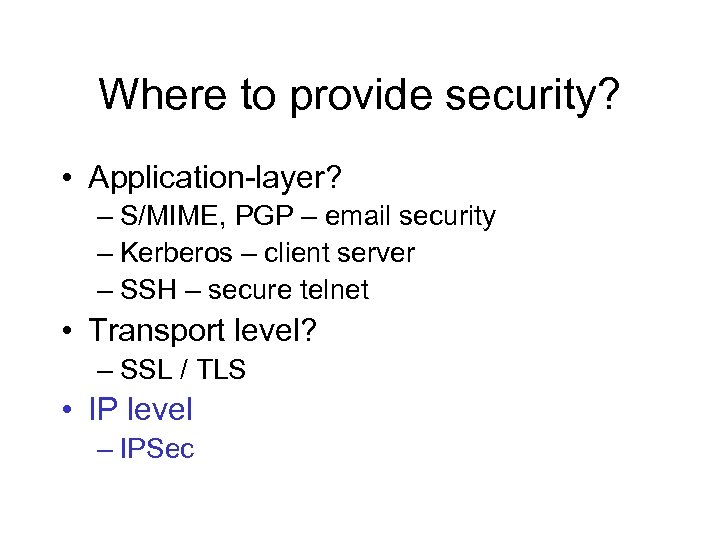
Where to provide security? • Application layer? – S/MIME, PGP – email security – Kerberos – client server – SSH – secure telnet • Transport level? – SSL / TLS • IP level – IPSec
IPSec • authentication – Header (e. g. address) – Payload: often called data integrity • Confidentiality – encryption • key management • Applications – VPNs (Virtual Private Networks) • Interconnected LANs over the insecure Internet • router to router – Secure remote access, e. g. to ISPs • individual to router • IPSec is mandatory for IPv 6, optional for v 4 – many manufacturers support IPSec in their v 4 products
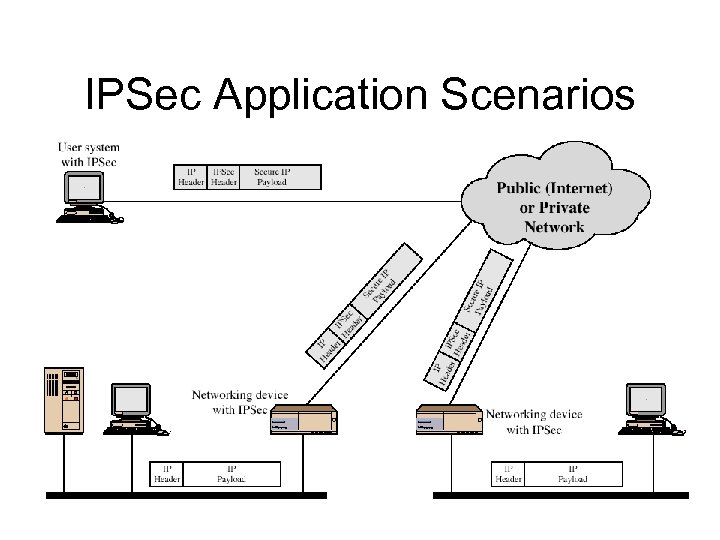
IPSec Application Scenarios
Benefits of IPSec • in a firewall/router provides strong security to all traffic entering the network – without passing the security overhead to the internal network and workstations – user transparent: no need to assume security aware users, no per user keys • IPSec is below transport layer – transparent to applications – No need to upgrade applications when IPSec is used, even if the IPSec is implemented in user machines • can provide security for individual users – not so common – may be useful for telecommuters
What is IPSec? Internet Protocol Security • A set of security protocols and algorithms used to secure IP data at the network layer • IPSec provides data confidentiality (encryption), integrity (hash), authentication (signature/certificates) of IP packets while maintaining the ability to route them through existing IP networks
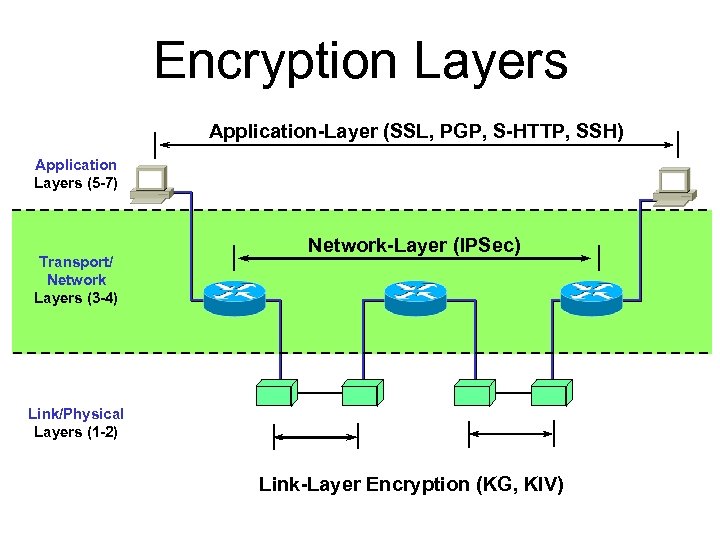
Encryption Layers Application-Layer (SSL, PGP, S-HTTP, SSH) Application Layers (5 -7) Transport/ Network Layers (3 -4) Network-Layer (IPSec) Link/Physical Layers (1 -2) Link-Layer Encryption (KG, KIV)
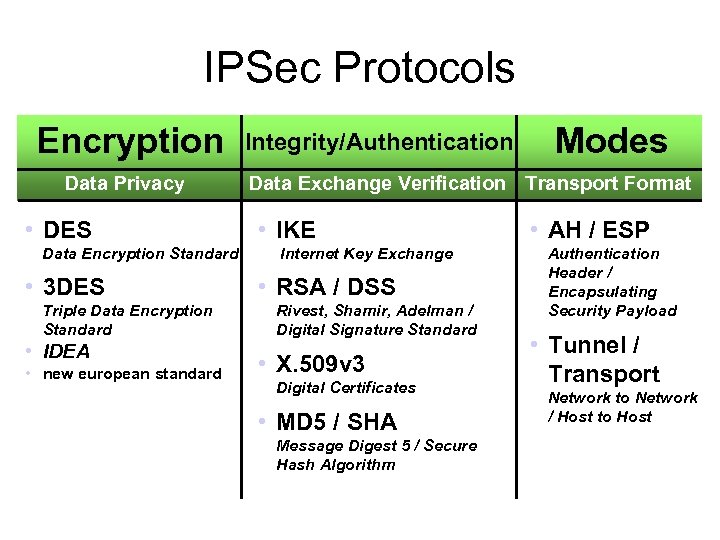
IPSec Protocols Encryption Data Privacy • DES Data Encryption Standard • 3 DES Triple Data Encryption Standard • IDEA • new european standard Integrity/Authentication Modes Data Exchange Verification Transport Format • IKE Internet Key Exchange • RSA / DSS Rivest, Shamir, Adelman / Digital Signature Standard • X. 509 v 3 Digital Certificates • MD 5 / SHA Message Digest 5 / Secure Hash Algorithm • AH / ESP Authentication Header / Encapsulating Security Payload • Tunnel / Transport Network to Network / Host to Host
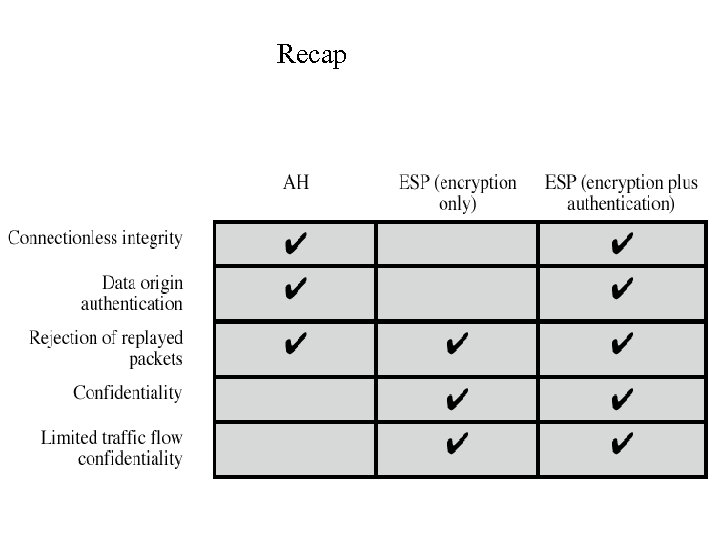
IPSec Components • Key distribution and management • Authentication Header (AH) – defines the authentication protocol – no encryption • Encapsulating Security Payload (ESP) – provides encryption – optionally authentication • Crypto algorithms that support those protocols
Security Associations (SA) • a one way relationship between sender & receiver – specifies IPSec related parameters • Identified by 3 parameters: – Security Parameters Index (SPI) • locally unique value – Destination IP Address – Security Protocol: AH or ESP (not both!) • There are several other parameters associated with an SA – stored in Security Association Database
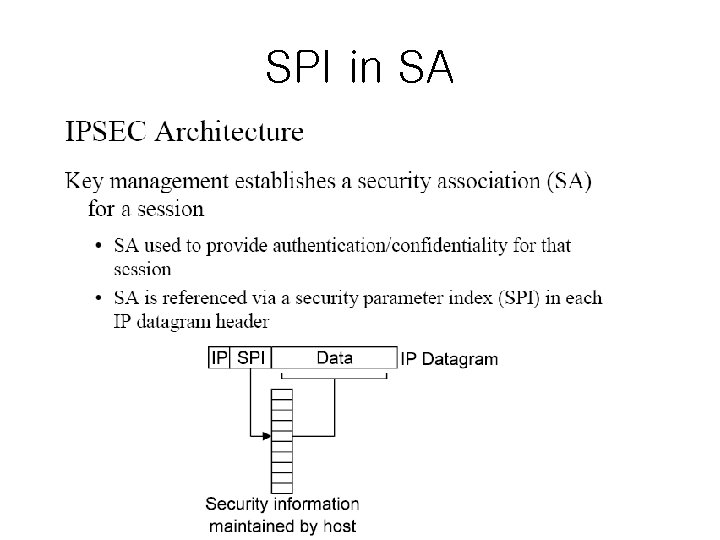
SPI in SA
SA Parameters (some of them) • Anti replay related – Sequence Number Counter • to generate sequence numbers – Sequence Counter Overflow • binary value. If overflow, then reset SA – Anti replay window • Similar to sliding window. discussed later. • AH info – authentication algorithms, key lifetimes, etc. • ESP info – encryption (and authentication) algorithms, key lifetimes, etc. • Lifetime of SA: time interval or byte count • IPSec Mode: Transport or Tunnel
SA, AH – ESP, and key management • SAs are in databases – both in sender and receiver • AH and ESP use the cryptographic primitives and other info in SA • Key Management Protocols (will discuss later) are to establish SA • So – AH / ESP are independent of key management
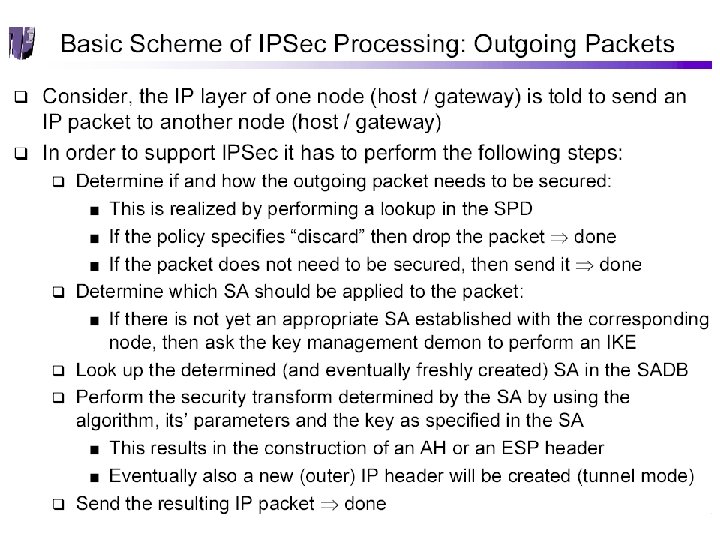
How SA is realized • IPSec is a flexible protocol – traffic from IP address X to IP address Y may use one or more SAs • or no SA if that particular traffic will not be secured • Security Policy Database (SPD) is used to assign a particular IP traffic to an SA – fields of an SPD entry are called selectors • Outbound processing – compare the selector fields of SPD with the one in the IP traffic – Determine the SA, if any – If there exists an SA, do the AH or ESP processing
Some SA Selectors (in an SPD entry) • Destination and Source IP addresses – range, list and wildcards allowed • Transport Layer Protocol – TCP, UDP, ICMP, all • Source and Destination Ports – list and wildcards allowed – from TCP or UDP header • User. ID • Ipv 4 To. S • IPv 6 traffic class and flow label
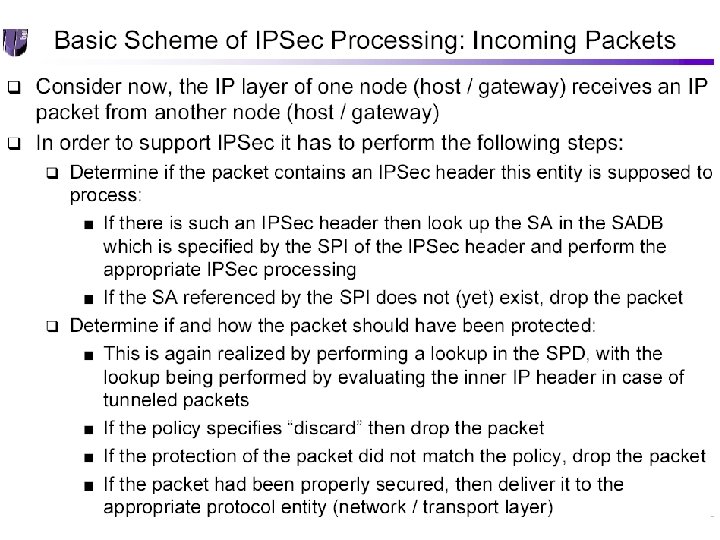
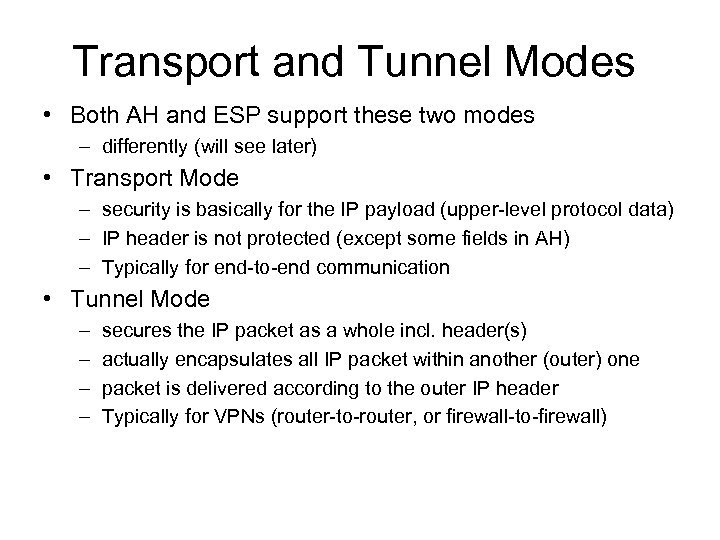
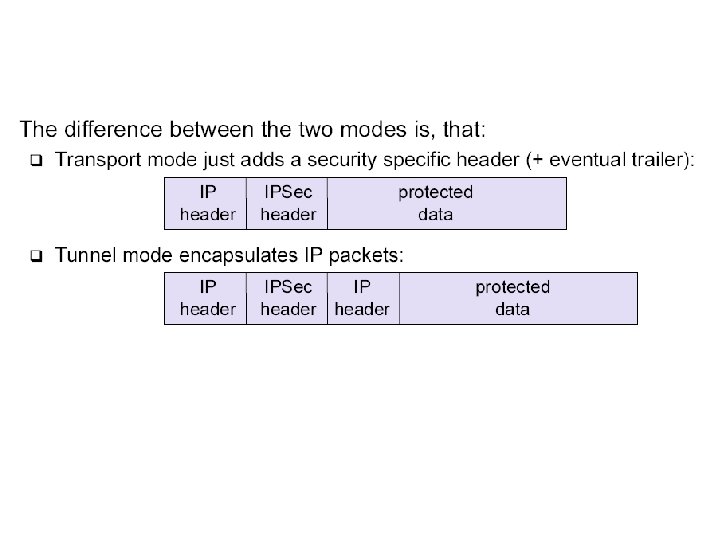
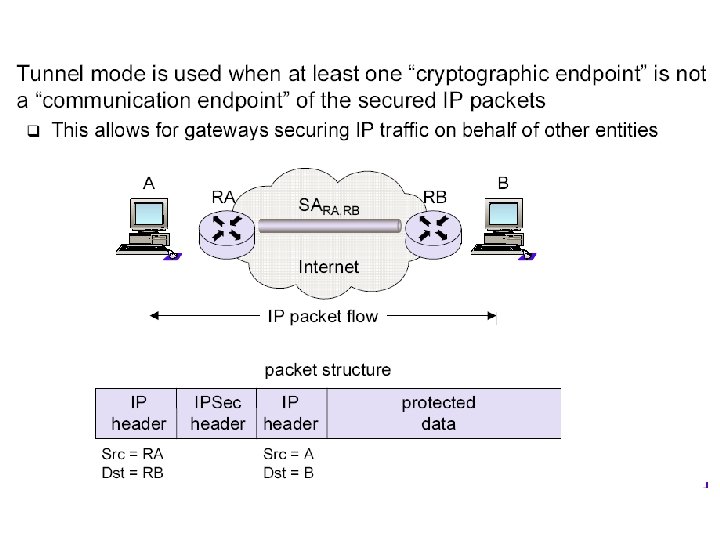
Transport and Tunnel Modes • Both AH and ESP support these two modes – differently (will see later) • Transport Mode – security is basically for the IP payload (upper level protocol data) – IP header is not protected (except some fields in AH) – Typically for end to end communication • Tunnel Mode – – secures the IP packet as a whole incl. header(s) actually encapsulates all IP packet within another (outer) one packet is delivered according to the outer IP header Typically for VPNs (router to router, or firewall to firewall)
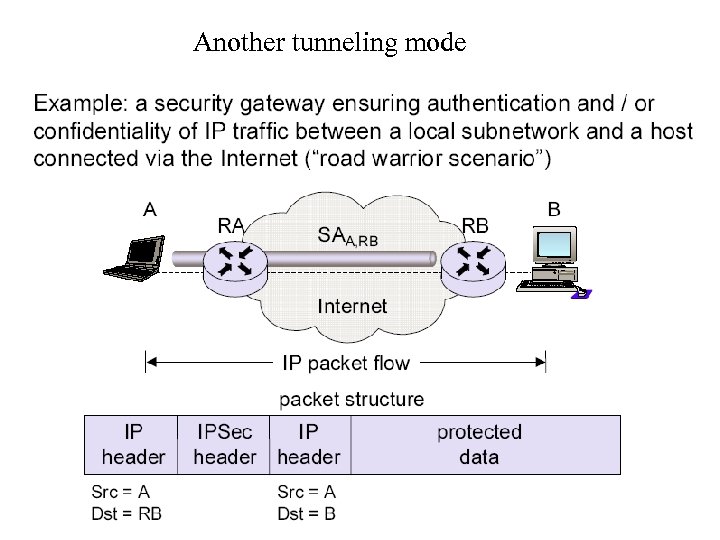
Another tunneling mode
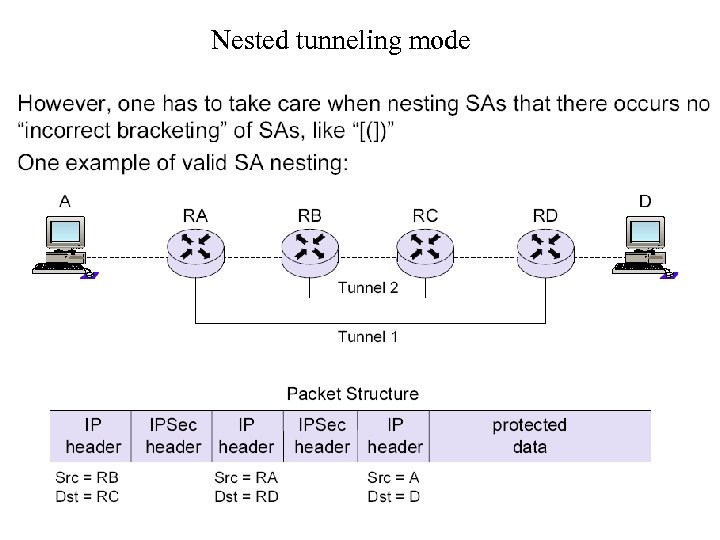
Nested tunneling mode
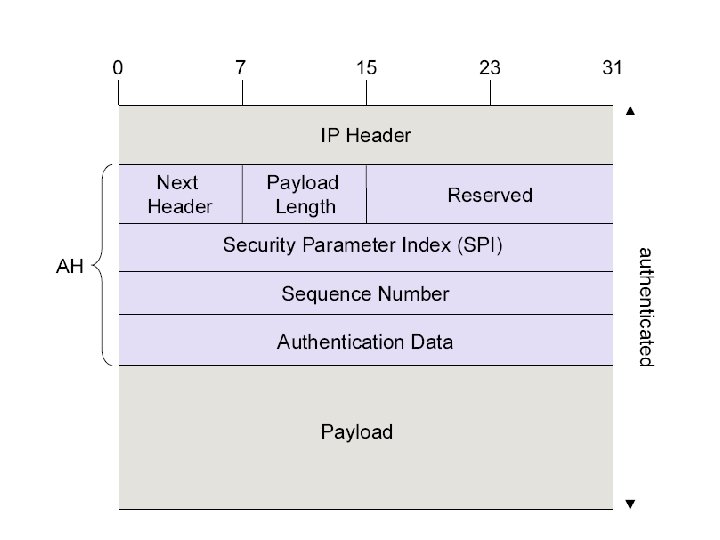
Authentication Header (AH) • provides support for data integrity and authentication of IP packets – malicious modifications are detected – address spoofing is prevented due to authentication – replays are detected via sequence numbers • Authentication is based on use of a MAC – parties must share a secret key – in SA
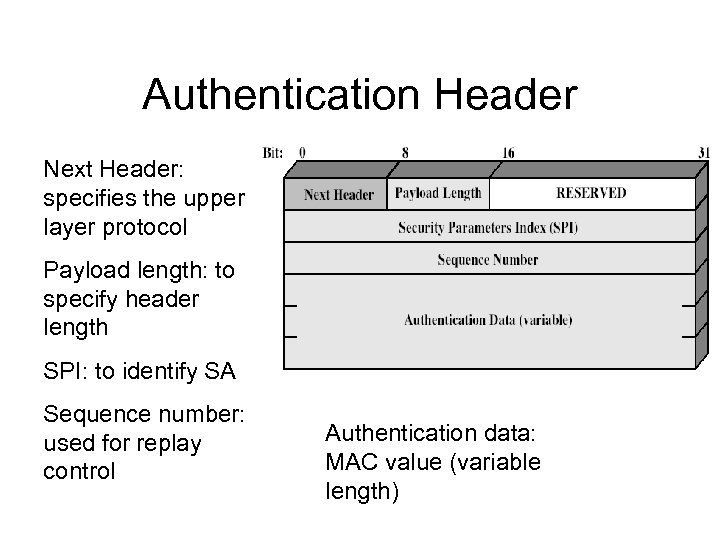
Authentication Header Next Header: specifies the upper layer protocol Payload length: to specify header length SPI: to identify SA Sequence number: used for replay control Authentication data: MAC value (variable length)
AH – Anti replay Service • Detection of duplicate packets • Sequence numbers – associated with SAs – 32 bit value – when an SA is created, initialized to 0 • when it reaches 232 1, SA must be terminated • not to allow overflows – sender increments the replay counter and puts into each AH (sequence number field) • Problem: IP is unreliable, so the receiver may receive IP packets out of order – Solution is using windows
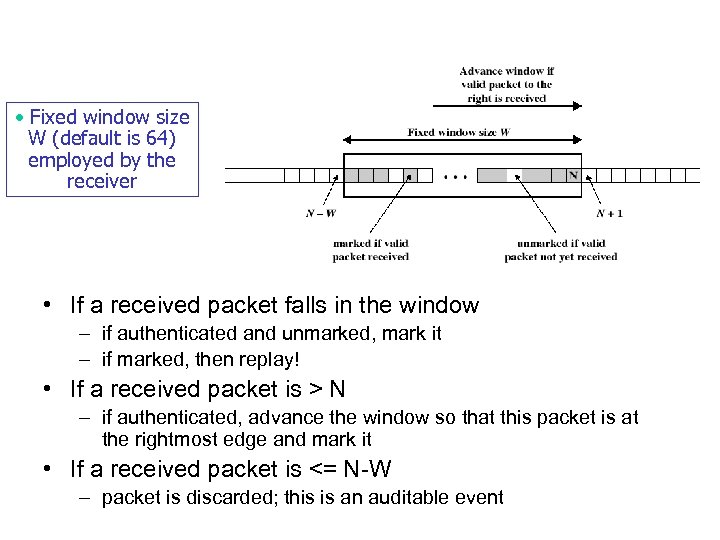
• Fixed window size W (default is 64) employed by the receiver • If a received packet falls in the window – if authenticated and unmarked, mark it – if marked, then replay! • If a received packet is > N – if authenticated, advance the window so that this packet is at the rightmost edge and mark it • If a received packet is <= N W – packet is discarded; this is an auditable event
AH Integrity Check Value (ICV) • Actually it is a MAC • HMAC is used – with either SHA 1 or MD 5 – default length of authentication data field is 96 • so HMAC output is truncated • MAC is calculated over – IP payload (upper layer protocol data) – IP Headers that are immutable or mutable but predictable at destination • e. g. source address (immutable), destination address (mutable but predictable) • Time to live field is mutable. Such mutable fields are zeroed for MAC calculation – AH header (except authentication data)
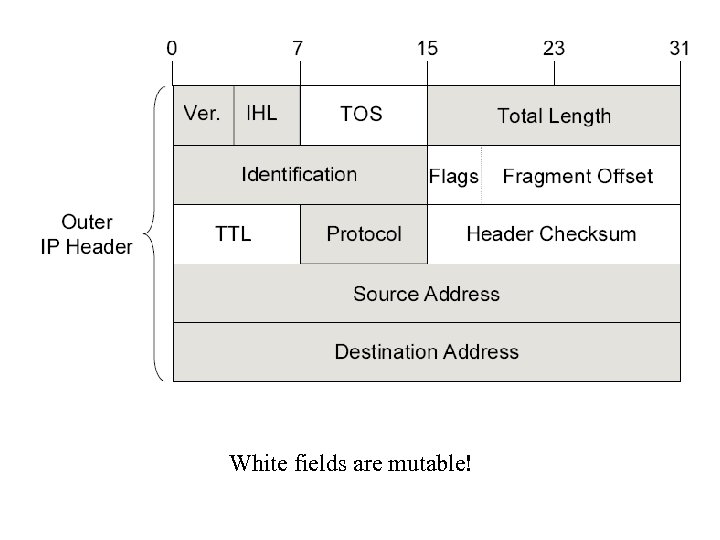
White fields are mutable!
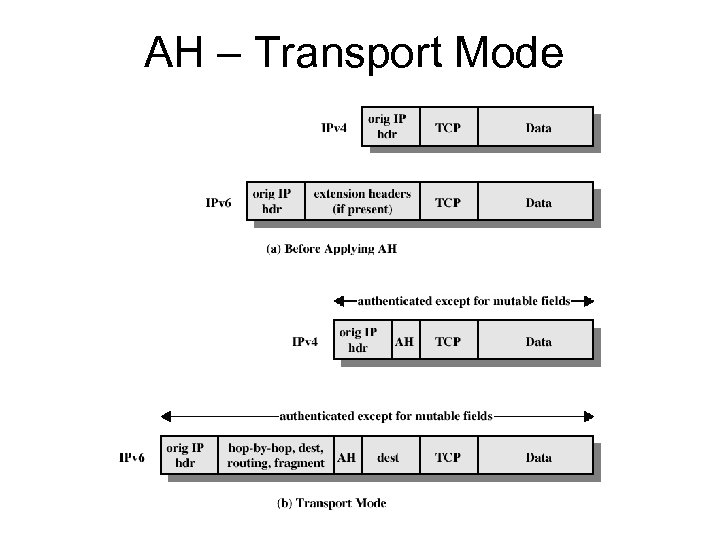
AH – Transport Mode transport mode tunnel mode
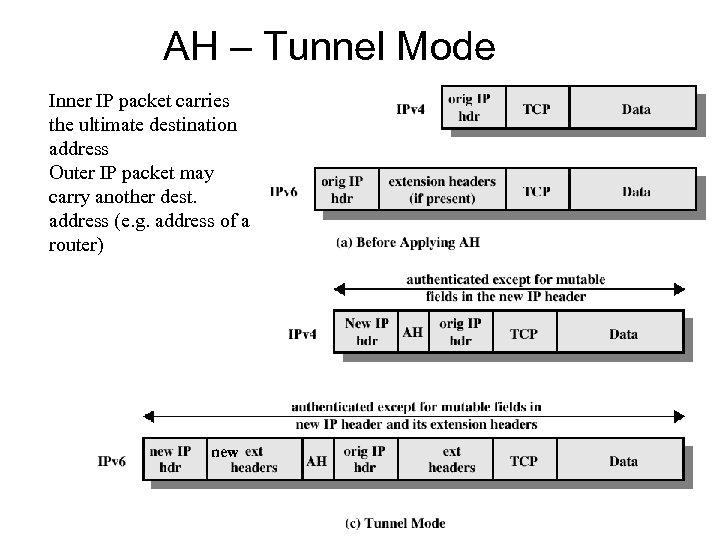
AH – Tunnel Mode Inner IP packet carries the ultimate destination address Outer IP packet may carry another dest. address (e. g. address of a router) new transport mode tunnel mode
Encapsulating Security Payload (ESP) • provides – message content confidentiality • via encryption – limited traffic flow confidentiality and measures for traffic analysis • by padding (may arbitrarily increase the data) • by encrypting the source and destination addresses in tunnel mode – optionally authentication services as AH • via MAC (HMAC), sequence numbers • supports range of ciphers, modes – incl. DES, Triple DES, RC 5, IDEA, Blowfish etc – CBC most common • Where is IV then?
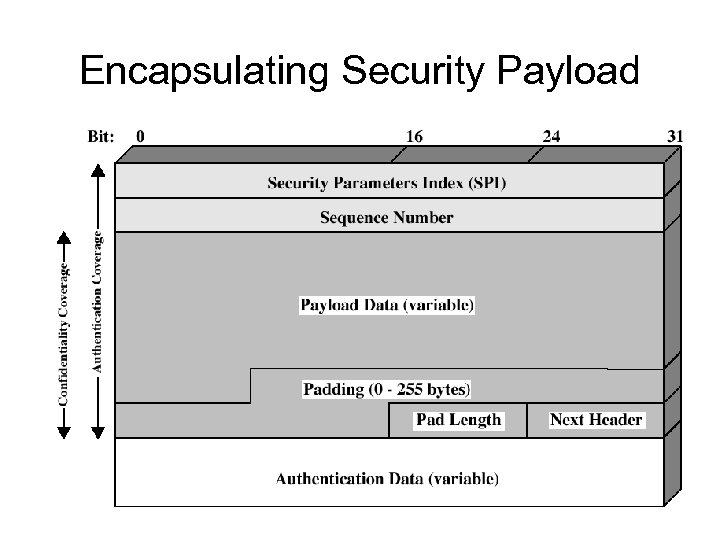
Encapsulating Security Payload
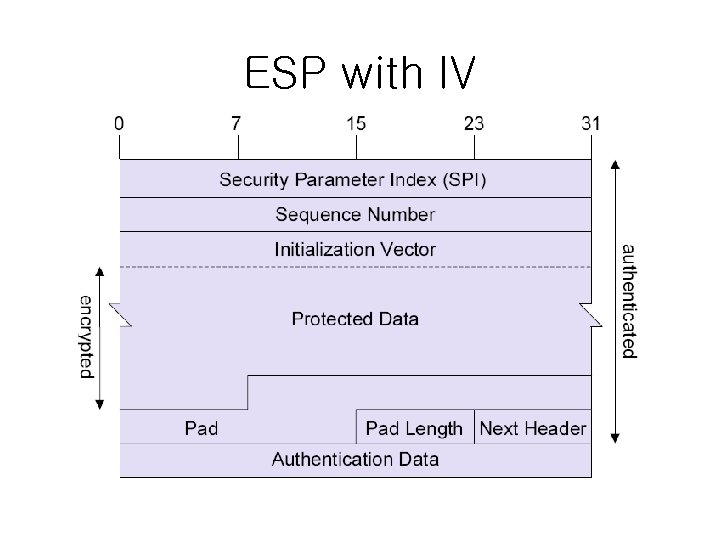
ESP with IV
Padding in ESP • several purposes and reasons – encryption algorithm may require the plaintext to be multiple of some n – ESP format requires 32 bit words – additional padding may help to provide partial traffic flow confidentiality by concealing the actual length of data
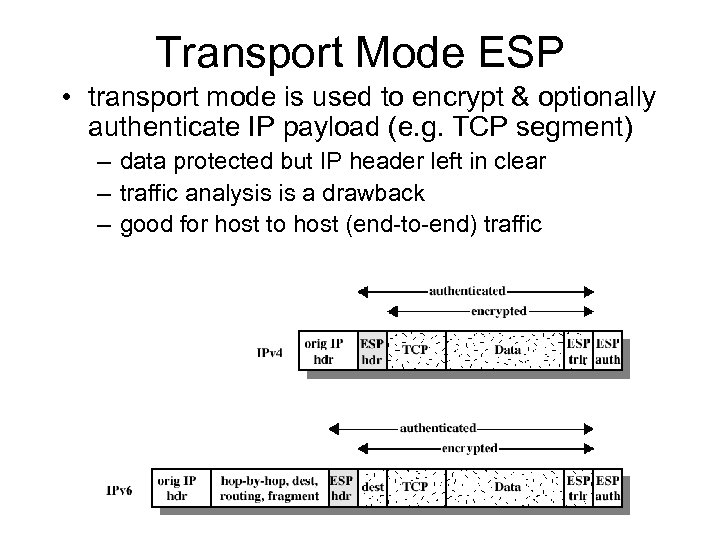
Transport Mode ESP • transport mode is used to encrypt & optionally authenticate IP payload (e. g. TCP segment) – data protected but IP header left in clear – traffic analysis is a drawback – good for host to host (end to end) traffic
Tunnel Mode ESP • Encrypts and optionally authenticates the entire IP packet – add new header for processing at intermediate routers • may not be the same as the inner (original) header, so traffic analysis can somehow be prevented – good for VPNs, gateway to gateway (router to router) security • hosts in internal network do not bother with security related processing • number of keys reduced • thwarts traffic analysis based on ultimate destination
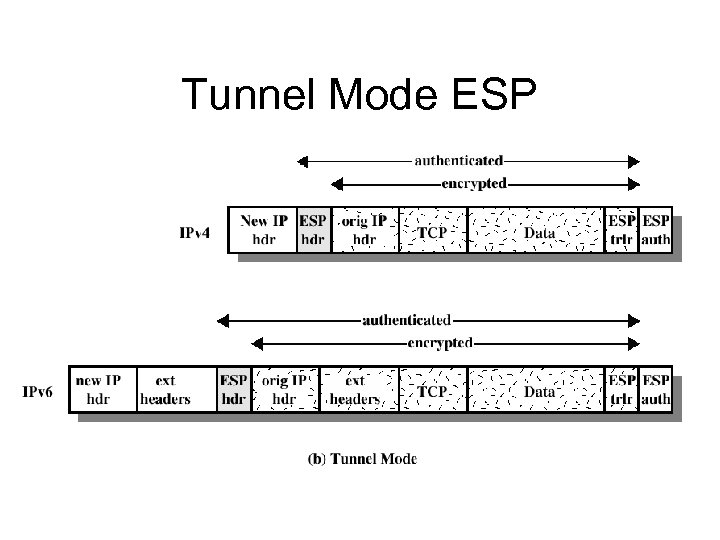
Tunnel Mode ESP
Recap
Combining Security Associations • SA’s can implement either AH or ESP • to implement both, need to combine SA’s – form a security association bundle • A possible case: End to end Authentication + Confidentiality – Solution 1: use ESP with authentication option on – Solution 2: apply ESP SA (transport mode, no auth. ) first, then apply AH SA – Solution 3: Apply AH SA first, then ESP SA • encryption is after the authentication
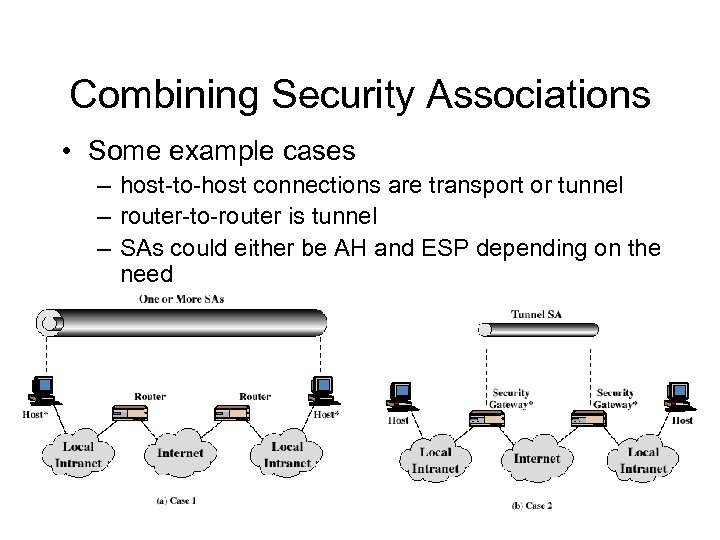
Combining Security Associations • Some example cases – host to host connections are transport or tunnel – router to router is tunnel – SAs could either be AH and ESP depending on the need
Key Management in IPSec • Ultimate aim – generate and manage SAs for AH and ESP – asymmetric • receiver and initiator have different SAs • can be manual or automated – manual key management • sysadmin manually configures every system – automated key management • on demand creation of keys for SA’s in large systems
Key Management in IPSec • Complex system – not a single protocol (theoretically) – different protocols with different roles • intersection is IPSec • but may be used for other purposes as well • Several protocols are offered by IPSec WG of IETF – Oakley, SKEME, SKIP, Photuris – ISAKMP, IKE • IKE seems to be the IPSec key management protocol but it is actually a combination of Oakley, SKEME and uses ISAKMP structure • See IPSec WG effort at http: //www. ietf. org/html. charters/ipsec charter. html
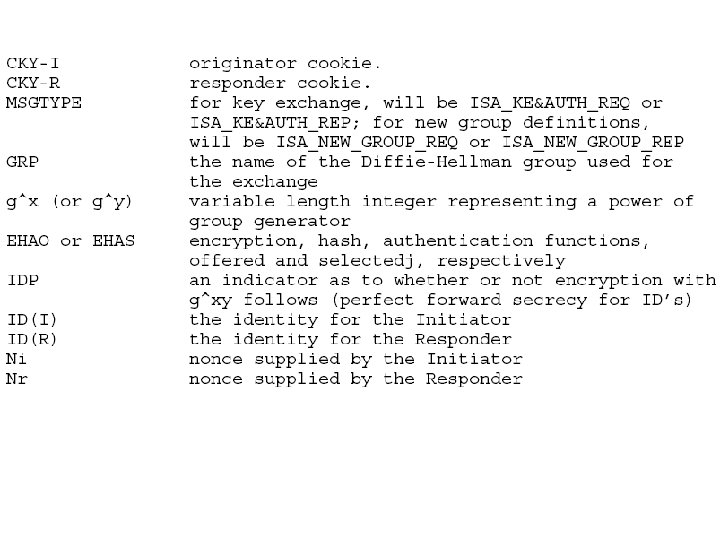
Oakley • Key exchange protocol based on Diffie Hellman – Diffie hellman has some weaknesses – Oakley adds security – Oakley does not dictate specific formats • have extra features – cookies • precaution against clogging (denial of service) attacks – What clogging? since D H key generation (modular exponentiation) is computationally intensive – makes the attack more difficult • cookies are unique values based on connection info (kind of socket identifiers such as addresses, ports) and should be generated fast • used at every message during the protocol
Oakley (other features) • predefined groups – fixed DH global parameters – regular DH and ECDH • nonces – against replay attacks • authentication (via symmetric or asymmetric crypto)
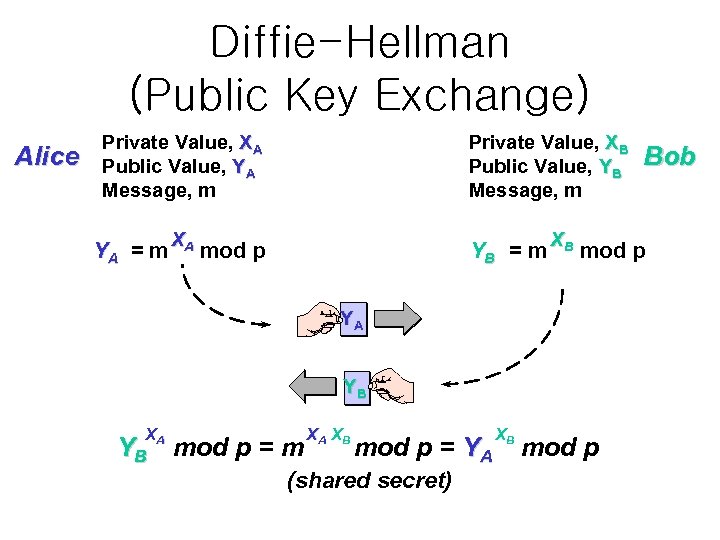
Diffie-Hellman (Public Key Exchange) Alice Private Value, XA Public Value, YA Message, m Private Value, XB Public Value, YB Message, m X X YA = m XA mod p YB = m XB mod p YA YB XA YB Bob mod p = m XA XB mod p = YA (shared secret) XB mod p
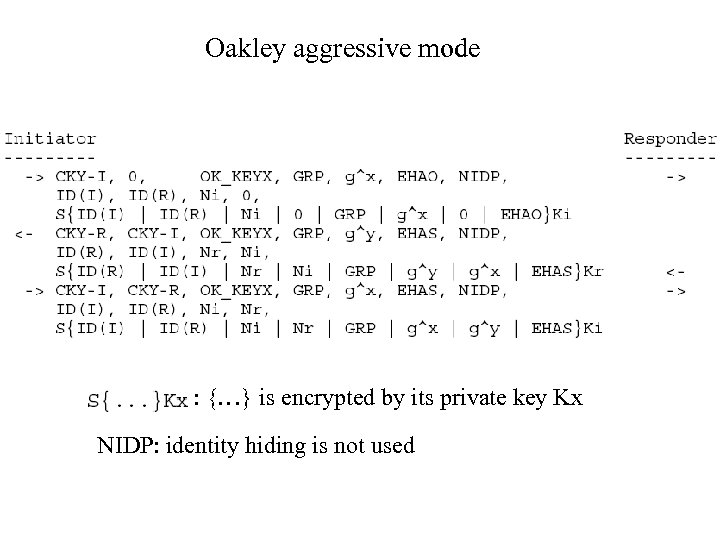
Oakley aggressive mode : {…} is encrypted by its private key Kx NIDP: identity hiding is not used
ISAKMP • Internet Security Association and Key Management Protocol • defines procedures and message formats to establish, negotiate, modify and delete SAs – SA centric, so some calls it only a SA management protocol • but we have keys in SAs – ISAKMP is NOT key exchange protocol • independent of key exchange protocol, encryption algorithm and authentication method • IKE combines everything
ISAKMP • ISAKMP (and also IKE) first creates an SA for itself – ISAKMP or IKE SA – then uses that SA to create IPSec (AH and ESP) SAs • Do. I (Domain of Interpretation) Concept – the scope of SA – not only IPSec
ISAKMP • Typical SA establishment protocol run in ISAKMP – Negotiate capabilities • Do. I, encryption algorithms, authentication methods, key exchange methods, etc. – Exchange keys • using the method agreed above – Authenticate the exchange • digital signatures based on certificates • public key authentication using previously exchanged public keys • symmetric crypto based authentication based on previously shared secret (manual entry)
payload
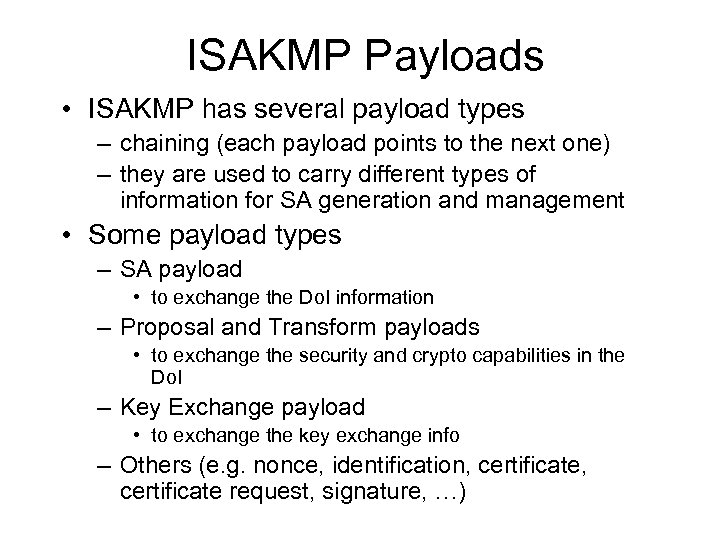
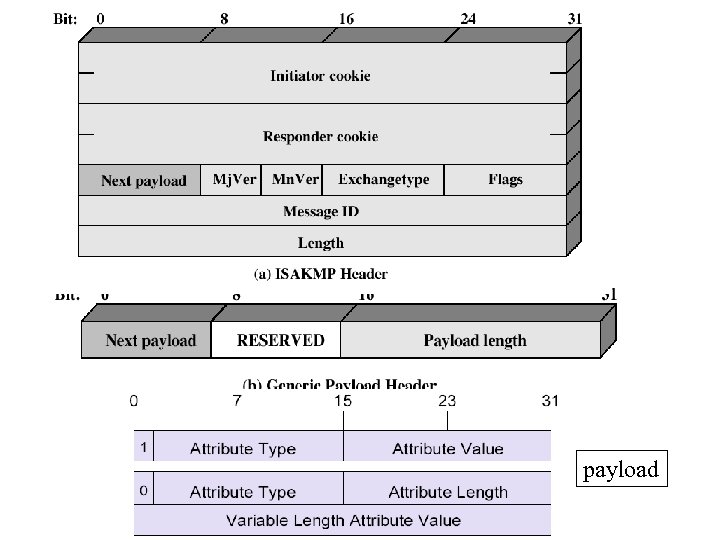
ISAKMP Payloads • ISAKMP has several payload types – chaining (each payload points to the next one) – they are used to carry different types of information for SA generation and management • Some payload types – SA payload • to exchange the Do. I information – Proposal and Transform payloads • to exchange the security and crypto capabilities in the Do. I – Key Exchange payload • to exchange the key exchange info – Others (e. g. nonce, identification, certificate request, signature, …)
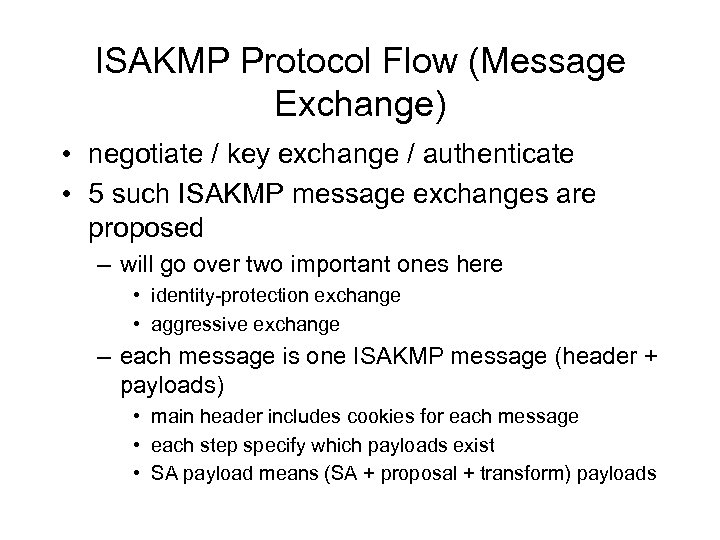
ISAKMP Protocol Flow (Message Exchange) • negotiate / key exchange / authenticate • 5 such ISAKMP message exchanges are proposed – will go over two important ones here • identity protection exchange • aggressive exchange – each message is one ISAKMP message (header + payloads) • main header includes cookies for each message • each step specify which payloads exist • SA payload means (SA + proposal + transform) payloads
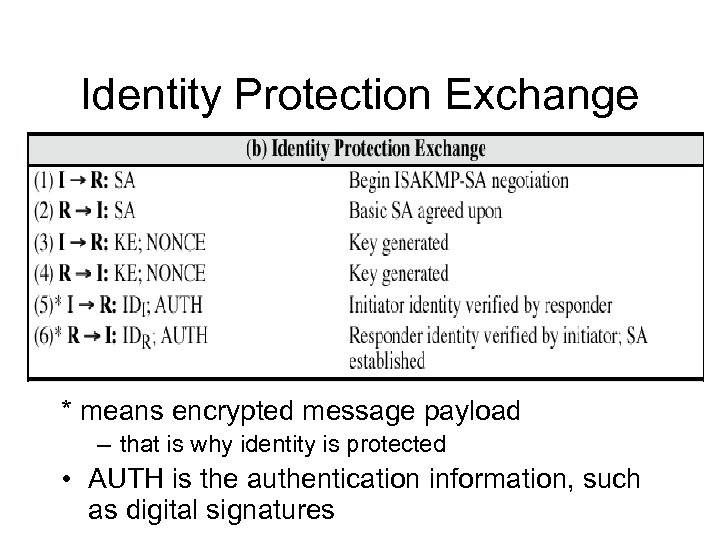
Identity Protection Exchange * means encrypted message payload – that is why identity is protected • AUTH is the authentication information, such as digital signatures
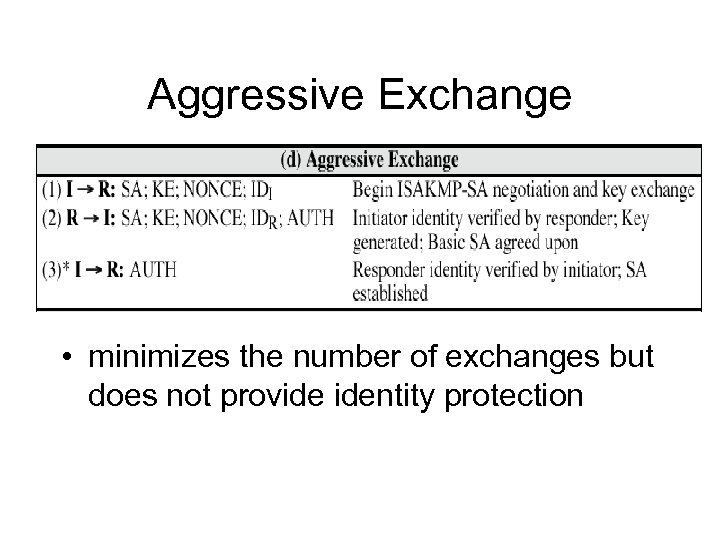
Aggressive Exchange • minimizes the number of exchanges but does not provide identity protection

What is IKE? Internet Key Exchange – A key and Security Association (SA) management protocol that implements Oakley and Skeme key exchanges inside the ISAKMP framework ISAKMP: Defines the mechanics of implementing a key exchange protocol and negotiating a Security Association Oakley: Defines how to derive authenticated keying material Skeme: Defines how to derive authenticated keying material with rapid key refreshment.
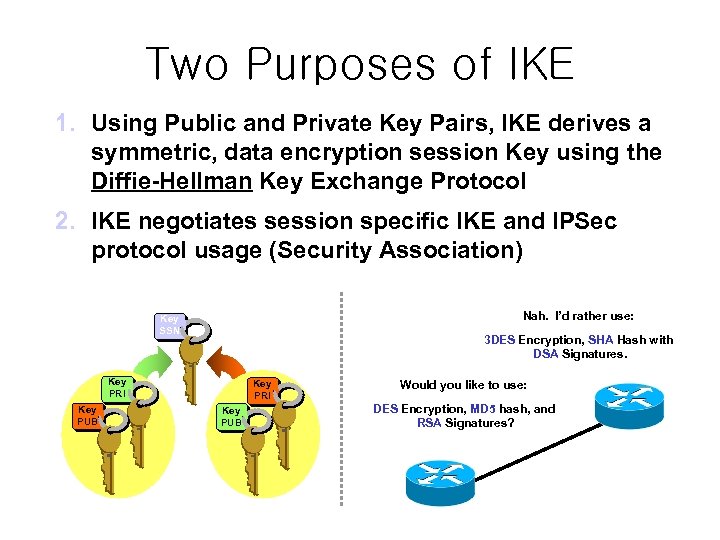
Two Purposes of IKE 1. Using Public and Private Key Pairs, IKE derives a symmetric, data encryption session Key using the Diffie-Hellman Key Exchange Protocol 2. IKE negotiates session specific IKE and IPSec protocol usage (Security Association) Nah. I’d rather use: Key SSN 3 DES Encryption, SHA Hash with DSA Signatures. Key PRI Key PUB Would you like to use: DES Encryption, MD 5 hash, and RSA Signatures?
IKE (Internet Key Exchange) • now we are ready to go over IKE – the actual protocol used in IPSec – uses parts of Oakley and SKEME • and ISAKMP messages (and framework) – to exchange authenticated keying material • Analogy for the protocols – ISAKMP: railways, highways, roads – Oakley, SKEME: prototypes for cars, trains, buses (and other vehicles) – IKE: a system that has several vehicles running on railways, highways, roads
IKE • Perfect forward secrecy (from SKEME) – disclosure of long term secret keying material does not compromise the secrecy of exchanged keys from earlier runs • PFS in IKE (basic idea) – Use a different DH key pair on each exchange • of course they have to be authenticated, probably with a digital signature mechanism • however, disclosure of the private key (long term key) for signature does not disclose earlier session keys
IKE • Authentication Methods of IKE – certificate based public key signature • certificates are exchanged – public key encryption • same as signature operations but uses previously known public keys • no certificates, so no non repudiation – pre shared key • symmetric method • simplest, no public key crypto • Material to be authenticated is derived from the messages exchanged
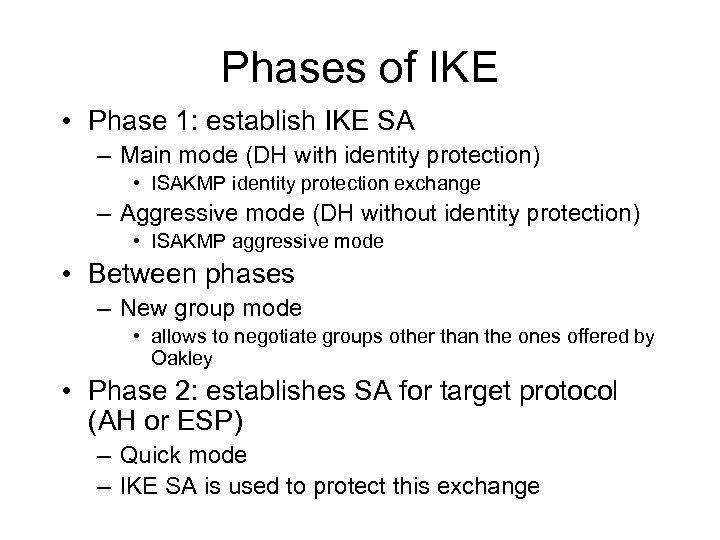
Phases of IKE • Phase 1: establish IKE SA – Main mode (DH with identity protection) • ISAKMP identity protection exchange – Aggressive mode (DH without identity protection) • ISAKMP aggressive mode • Between phases – New group mode • allows to negotiate groups other than the ones offered by Oakley • Phase 2: establishes SA for target protocol (AH or ESP) – Quick mode – IKE SA is used to protect this exchange
Скачать презентацию IP security architecture Courtesy of Albert Levi with
322f1e8b2b5f00ab1521c810928ec230.ppt