Скачать презентацию Iowa Pyrotechnic Association A Hangfire a Shell whose
0acff674547122c57cbbe665d10509b2.ppt
- Количество слайдов: 81
 Iowa Pyrotechnic Association A "Hangfire" (a Shell whose Fuse burns part-way and [almost] goes out), can be highly dangerous. This is easily one of the most dangerous situations you can have. A "Hangfire" remains a "Hangfire" until it "Misfires" and goes off. There is no way to tell if, or when a "Hangfire" will go off and become a "Misfire". A "Hangfire" becoming a "Misfire" may go off up to 45 minutes or more after lit.
 Iowa Pyrotechnic Association A "Misfire" is someone having a gun pointed at your head - the trigger pulled - and hearing it "Click". A"Hangfire" is you then holstering that gun - turning around - and having it discharge that same misfired bullet into your leg (or worse, ricocheting off something, and hitting your head). This cannot be stressed enough: At first, a potential "Hangfire" is a "Misfire. It then remains a potential "Hangfire" until it actually does fire. and; you never know IF or when it will!
 Iowa Pyrotechnic Association If a Spotter, (one or more on your crew whose ONLY job is to watch for problems like this during the show), sees a "Misfire", or possible "Dud" Shell, he/she must alert the Lead Shooter, all those in the vicinity, and mark the Tube as "Do Not Use".
 Iowa Pyrotechnic Association This may be accomplished in a number of ways: A spare wand (covered later) may be placed near the tube. A rock or other object may be used (make sure to cover which object means "Do Not Use" in your pre-Shoot Meeting - and have several ready). One of the best ways we have found to mark a tube is to place a "Chem-Stik" near the Tube. These "Chem-Stiks" will glow for hours (and it may be hours before you get to it).
 Iowa Pyrotechnic Association Examples of some Chem. Stiks.
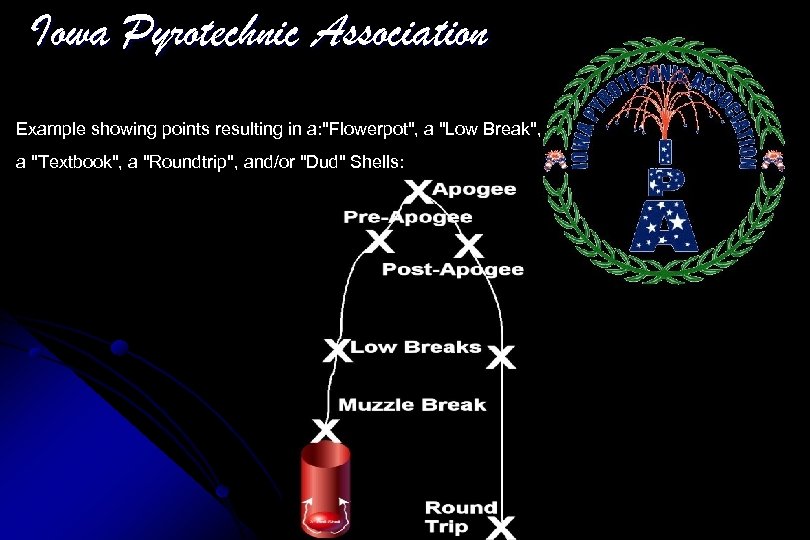
 Iowa Pyrotechnic Association Not much can be done about a "Round-trip" (a Shell which goes up, lands on the ground and explodes). Watch the Shell as it falls (Spotters? ) and be somewhere else when it lands. It IS likely to go off. Treat it as though it will - always. This is a good case for Head Protection could be a Hard-Hat, or simply a Baseball cap, it is not specified in 1123, however if a 2 to 80 pound object is going to free-fall at terminal velocity, and hit you on the top of the head - a Hard-Hat should be your choice.
 Iowa Pyrotechnic Association A "Misfire", as mentioned before - begins life as a possible "Hangfire", or a possible "Dud" Shell. If you think about it, a "Misfire" is simply a Shell which starts out as a supposedly "Normal" Shell but has for some reason not lifted. For this reason, it is in a very dangerous State. It could (hopefully) become a "Dud” and never go off - or a "Misfire” and go off at any time up to 45 minutes or more after being lit. REMEMBER, YOU WILL NEVER KNOW FOR SURE, WHICH IT IS!
 Iowa Pyrotechnic Association NEVER go back and look down the Mortar to see why it did not go off! This one simple action has caused many injuries and/or deaths. Don't become another Statistic!
 Iowa Pyrotechnic Association A "Dud" is a Shell, which never goes off. As with a "Hangfire" a "Dud" begins life as a Shell that has failed to lift. At this stage, it is a "Misfire". Only time will tell, if it is to be a true "Hangfire" or a "Dud". A "Dud" should be handled carefully. Waiting at least 45 minutes to retrieve, stay away from the area where the "Dud" has fallen. Your Spotters should have seen it land the area should be somehow marked so everyone on the Crew knows it is there. After 45 minutes, douse the "Dud" with water (this is to wet the Fuse down, not the shell, which is pretty Waterproof). Then place in a container for transport. It must be properly destroyed, or returned to your Vendor.
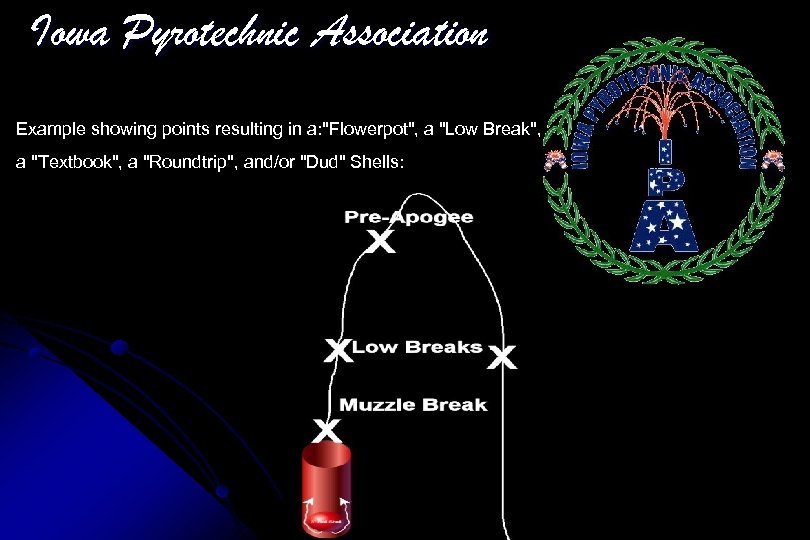
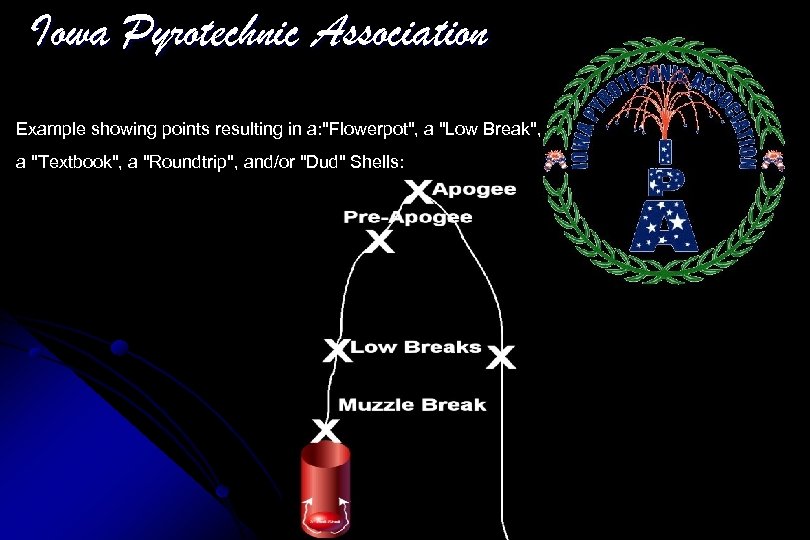
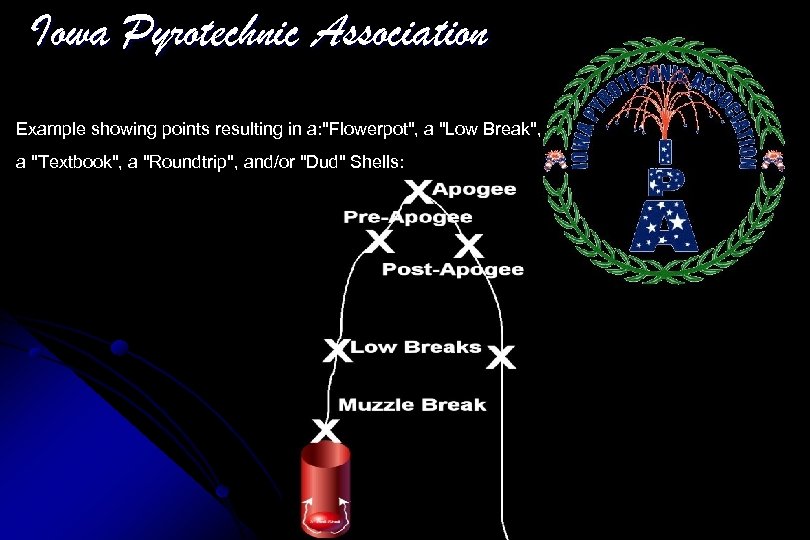
 Iowa Pyrotechnic Association A "Low Break" is a great nuisance, but only really dangerous if you are very near it when it goes off. A "Low Break" is a Shell that has lifted, but explodes at a lower-level (height), than the Shell was designed to break at. • This could be anywhere from a few feet above the mouth of the tube on upwards. • Most "Low Breaks" occurs within Eighty to a Hundred feet or so. • You May be hit with one or more "Stars". • Treat every Shell like it will "Low Break" - because it may.
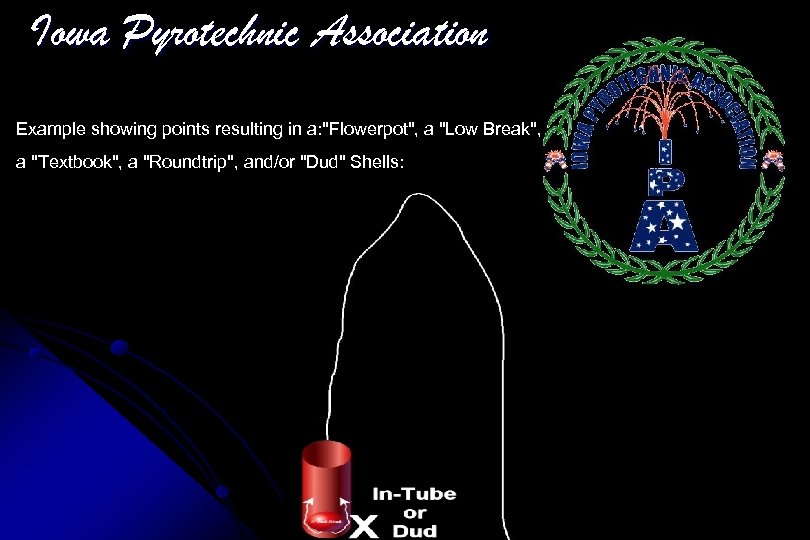 Iowa Pyrotechnic Association Example showing points resulting in a: "Flowerpot", a "Low Break", a "Textbook", a "Roundtrip", and/or "Dud" Shells:
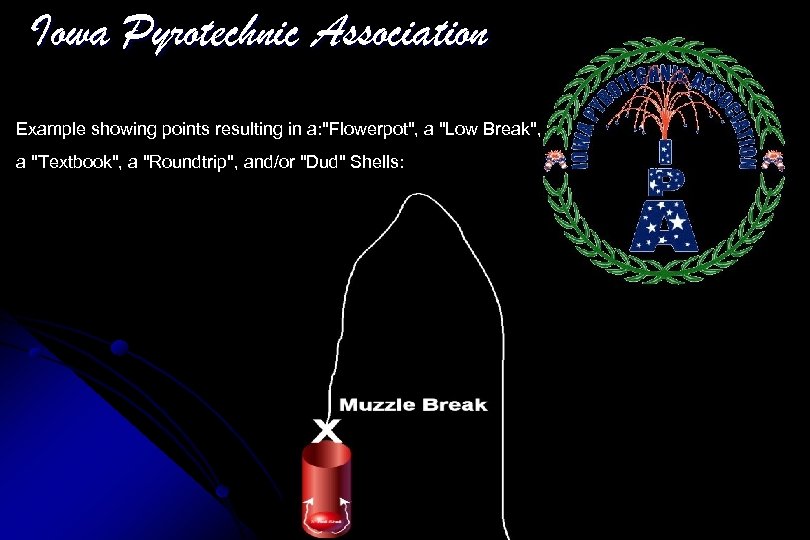 Iowa Pyrotechnic Association Example showing points resulting in a: "Flowerpot", a "Low Break", a "Textbook", a "Roundtrip", and/or "Dud" Shells:
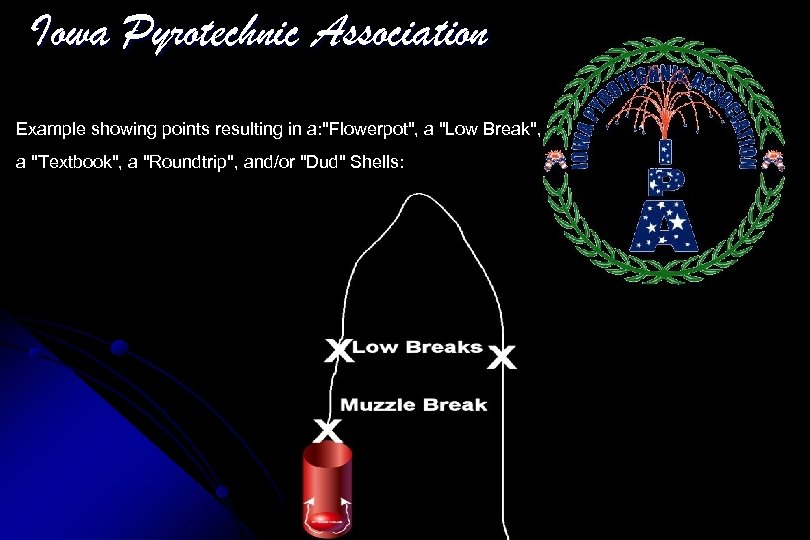 Iowa Pyrotechnic Association Example showing points resulting in a: "Flowerpot", a "Low Break", a "Textbook", a "Roundtrip", and/or "Dud" Shells:
 Iowa Pyrotechnic Association Example showing points resulting in a: "Flowerpot", a "Low Break", a "Textbook", a "Roundtrip", and/or "Dud" Shells:
 Iowa Pyrotechnic Association Example showing points resulting in a: "Flowerpot", a "Low Break", a "Textbook", a "Roundtrip", and/or "Dud" Shells:
 Iowa Pyrotechnic Association Example showing points resulting in a: "Flowerpot", a "Low Break", a "Textbook", a "Roundtrip", and/or "Dud" Shells:
 Iowa Pyrotechnic Association Example showing points resulting in a: "Flowerpot", a "Low Break", a "Textbook", a "Roundtrip", and/or "Dud" Shells:
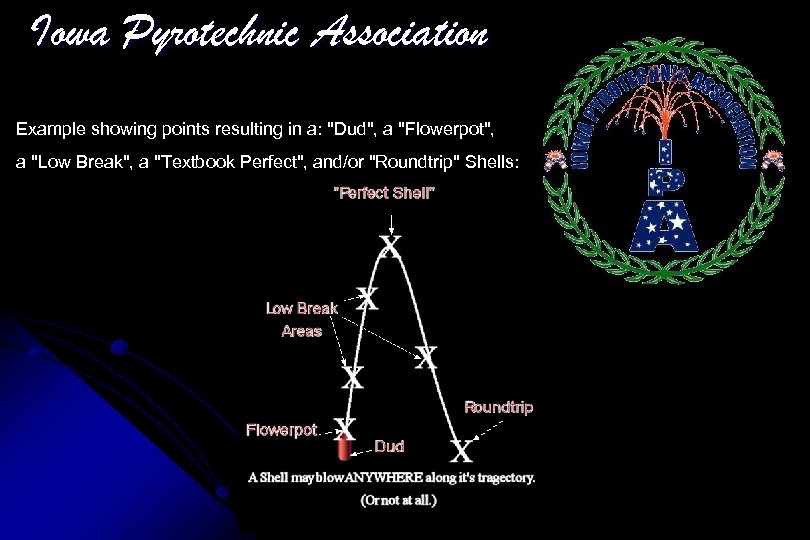 Iowa Pyrotechnic Association Example showing points resulting in a: "Dud", a "Flowerpot", a "Low Break", a "Textbook Perfect", and/or "Roundtrip" Shells:
 Iowa Pyrotechnic Association In even calm (no wind at all) conditions, a typical Shell may travel from 20 to 30' per inch of Shell off from it's center line of trajectory. This means that if a 3" Shell "Roundtrips" on you, it could land anywhere within a 60 to 90’ (Radius) or a 120 to 180’ (Diameter) area from where it's tube is centered. This is normal, and why your Spotters must be watching the Shells and not the Display. If you are Shooting within this area, you too must be on high-alert for Falling Shells.
 Iowa Pyrotechnic Association
 Iowa Pyrotechnic Association A Shell may be the more traditional Spherical (Round) Ball Shell, or a "Can" - Canister type. Both are built basically the same way, with modifications for the shapes. All classifications suffer the same problems AND whether 1. 4 G, 1. 3 G, or higher-rated, all types will kill you if not treated with respect and with care. A Shell is built to be slightly SMALLER than the tube it is to be shot from. For example, a 3" Shell will actually measure about 2 7/8". This is so inside the tube it will create enough pressure to properly "Lift" the Shell, but the Shell won't drag along the inside of the tube when it does. Scientists have used high-speed photography to show that Shells "bounce" back and forth like the clapper on a bell when traveling up the tube. This accounts for why some Shells come out of the tube at a severe angle.
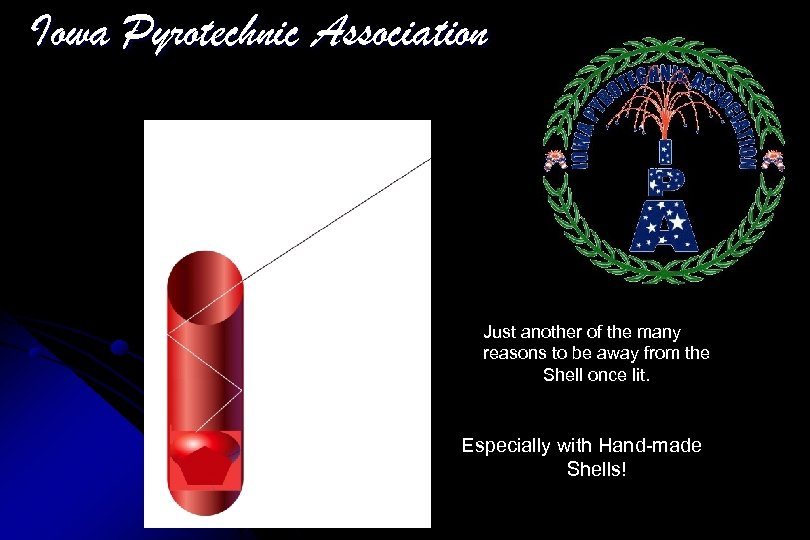 Iowa Pyrotechnic Association Just another of the many reasons to be away from the Shell once lit. Especially with Hand-made Shells!
 Iowa Pyrotechnic Association LABELS: NFPA 1123 requires that each shell shall bear a label that contains: The Shell size A Description of the shell type The Name and location of the manufacturer, importer, or distributor and a Warning label reading: WARNING: DANGEROUS EXPLOSIVE IF FOUND, DO NOT HANDLECONTACT LOCAL FIRE OR POLICE DEPARTMENT
 Iowa Pyrotechnic Association There are 4 types of tubes: • Paper • Fiberglas • HDPE ( • Steel High-Density Poly. Ethylene) They each have unique properties, regulations, limitations, and uses. Learn each one's limitations and proper uses.
 Iowa Pyrotechnic Association Paper Basically, Paper Tubes are Cheap. They may be reloaded up to seven times. Paper is NOT recommended because: They soak up water. Debris in the tube can start them on fire (then you are placing explosives into a burning tube - not usually a good idea). Per Code, they must be buried in plastic if in wet conditions, or in the ground for more than 12 hours. They are heavy and bulky
 Iowa Pyrotechnic Association Paper
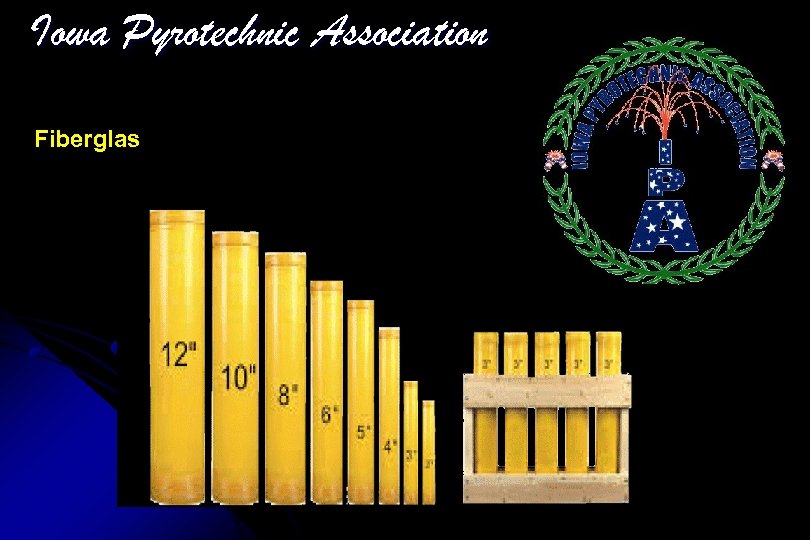
 Iowa Pyrotechnic Association Fiberglas Tubes are fairly cheap. They are light and durable. They do not warp, or burn. They may be reloaded up to seven times Per Code. They may eventually crack, and/or break, and so; may need maintenance.
 Iowa Pyrotechnic Association Fiberglas
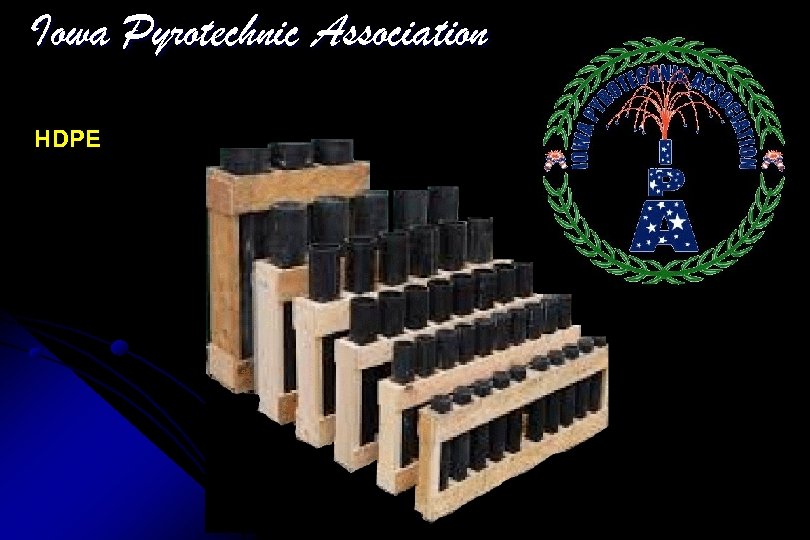
 Iowa Pyrotechnic Association HDPE Are Very Light Are fairly Cheap to buy. Per Code, may be reloaded up to seven times. Are Very Durable. They always warp over time and must be maintained however.
 Iowa Pyrotechnic Association HDPE
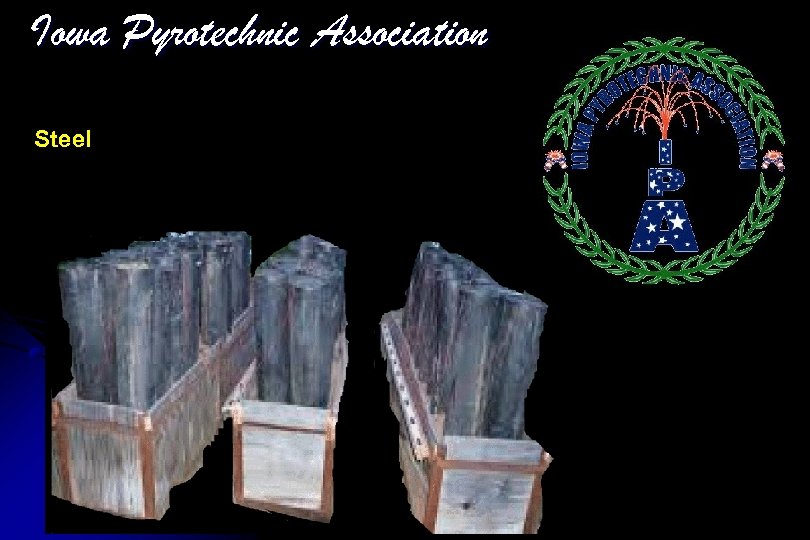
 Iowa Pyrotechnic Association Steel Mandatory per code for Multi-breaks w/bottom shot or Hand. Lit Salutes. May have an UNLIMITED number of Shells Fired from them. Offer more stability than any other type of tube. Very, very durable. May be Seamed, or Unseamed. They need no maintenance to speak of. Steel Tubes are very heavy and very bulky. Not the Cheapest Tube around.
 Iowa Pyrotechnic Association Steel
 Iowa Pyrotechnic Association We will not go through all the maximum numbers of tubes pertaining to racking. Again, we urge you all to go to www. nfpa. org, purchase your own copy of 1123 -2010 and become familiar with it. In general, you may rack tubes for above-ground racks up to 6" in diameter. Up to 8" in certain cases. NFPA 1123 goes into much more detail on this. And; no matter the size Tubes, they MUST be separated by a minimum of 2" to guard against Sympathetic Deflagration is caused by a Shell Blowing or Catastrophic Malfunction in one tube, causing an adjacent Tube to blow also. Separation guards against this.
 Iowa Pyrotechnic Association
 Iowa Pyrotechnic Association Per Code, Shells are to be arranged for Hand-firing in Ready-boxes, or laid out for E-Firing by size. Place 4" Shells next to 6" Shells, or 3" Shells with 5" Shells, etc. A 4" Shell inadvertently placed in a 6" Tube will be very apparent, and a 6" Shell will not fit into a 4" Tube. You will know instantly that something is wrong. Make sure Salutes are separate from color Shells.
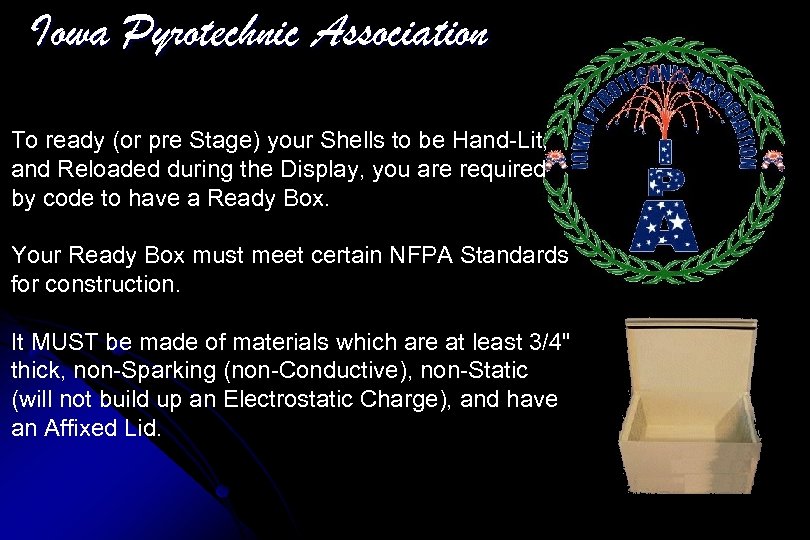 Iowa Pyrotechnic Association To ready (or pre Stage) your Shells to be Hand-Lit, and Reloaded during the Display, you are required by code to have a Ready Box. Your Ready Box must meet certain NFPA Standards for construction. It MUST be made of materials which are at least 3/4" thick, non-Sparking (non-Conductive), non-Static (will not build up an Electrostatic Charge), and have an Affixed Lid.
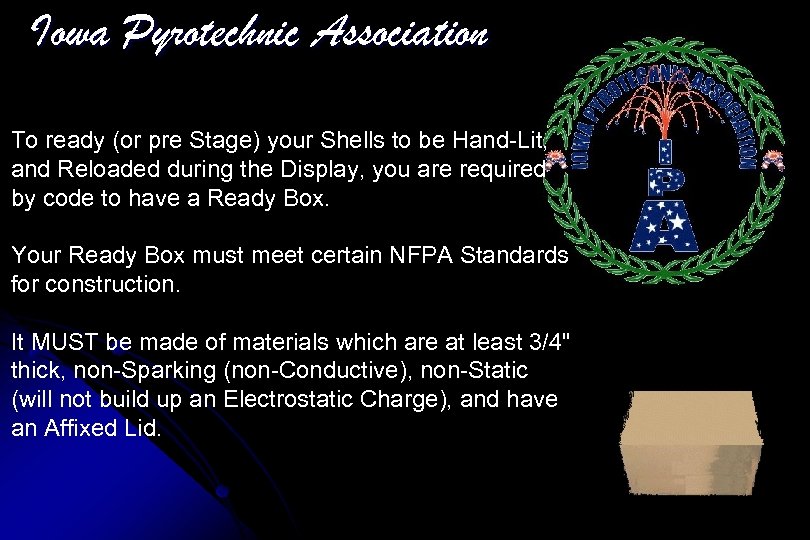 Iowa Pyrotechnic Association To ready (or pre Stage) your Shells to be Hand-Lit, and Reloaded during the Display, you are required by code to have a Ready Box. Your Ready Box must meet certain NFPA Standards for construction. It MUST be made of materials which are at least 3/4" thick, non-Sparking (non-Conductive), non-Static (will not build up an Electrostatic Charge), and have an Affixed Lid.
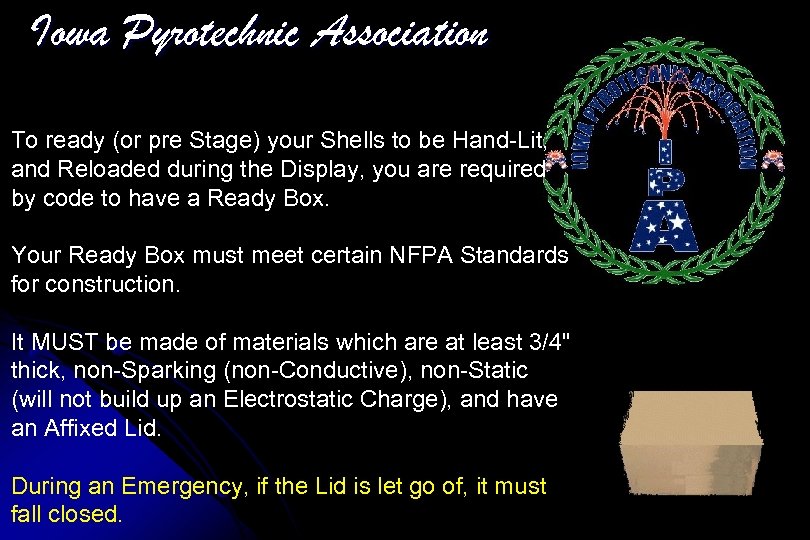 Iowa Pyrotechnic Association To ready (or pre Stage) your Shells to be Hand-Lit, and Reloaded during the Display, you are required by code to have a Ready Box. Your Ready Box must meet certain NFPA Standards for construction. It MUST be made of materials which are at least 3/4" thick, non-Sparking (non-Conductive), non-Static (will not build up an Electrostatic Charge), and have an Affixed Lid. During an Emergency, if the Lid is let go of, it must fall closed.
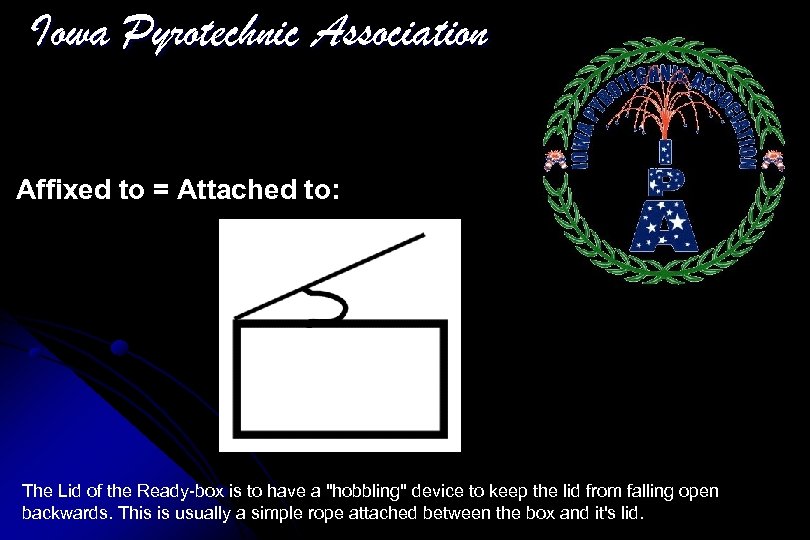 Iowa Pyrotechnic Association Affixed to = Attached to: The Lid of the Ready-box is to have a "hobbling" device to keep the lid from falling open backwards. This is usually a simple rope attached between the box and it's lid.
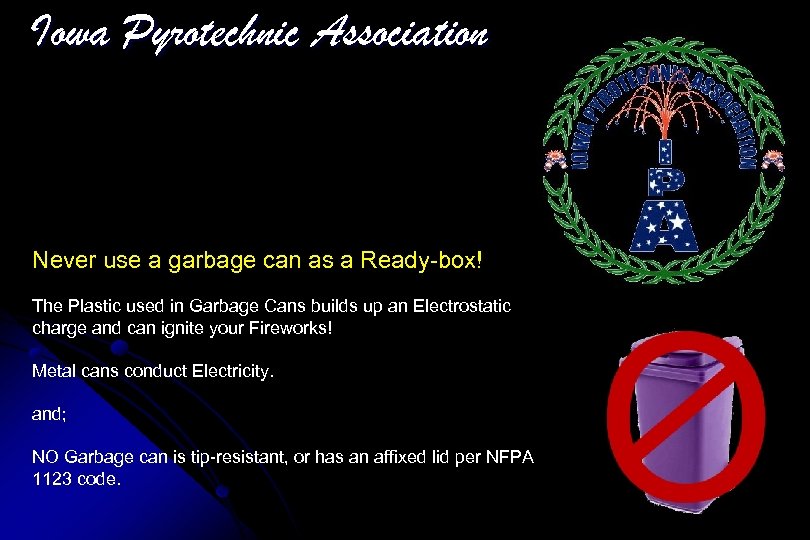 Iowa Pyrotechnic Association Never use a garbage can as a Ready-box! The Plastic used in Garbage Cans builds up an Electrostatic charge and can ignite your Fireworks! Metal cans conduct Electricity. and; NO Garbage can is tip-resistant, or has an affixed lid per NFPA 1123 code.
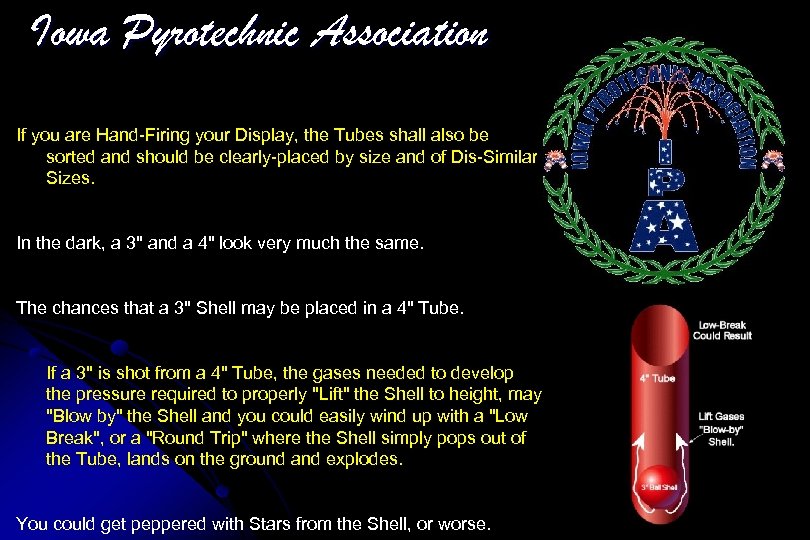 Iowa Pyrotechnic Association If you are Hand-Firing your Display, the Tubes shall also be sorted and should be clearly-placed by size and of Dis-Similar Sizes. In the dark, a 3" and a 4" look very much the same. The chances that a 3" Shell may be placed in a 4" Tube. If a 3" is shot from a 4" Tube, the gases needed to develop the pressure required to properly "Lift" the Shell to height, may "Blow by" the Shell and you could easily wind up with a "Low Break", or a "Round Trip" where the Shell simply pops out of the Tube, lands on the ground and explodes. You could get peppered with Stars from the Shell, or worse.
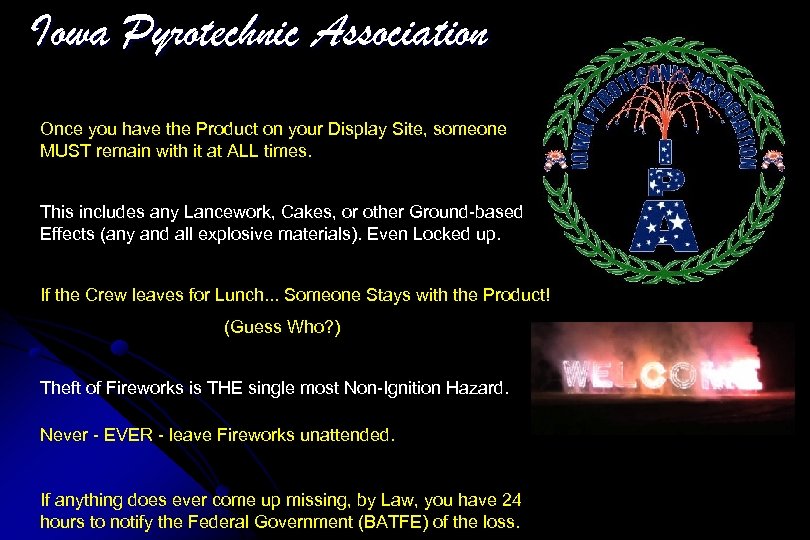 Iowa Pyrotechnic Association Once you have the Product on your Display Site, someone MUST remain with it at ALL times. This includes any Lancework, Cakes, or other Ground-based Effects (any and all explosive materials). Even Locked up. If the Crew leaves for Lunch. . . Someone Stays with the Product! (Guess Who? ) Theft of Fireworks is THE single most Non-Ignition Hazard. Never - EVER - leave Fireworks unattended. If anything does ever come up missing, by Law, you have 24 hours to notify the Federal Government (BATFE) of the loss.
 Iowa Pyrotechnic Association When loading Shells, look in the Bottom of each Box. If you see any Blackish looking powder, chances are very high that it is Gunpowder, aka "Black Powder" and it has come from a Damaged Shell. If you find any Black Powder, the Shell it came from MUST be found. If it came from the Lift Charge, the Shell may not reach full height and you'll have a "Round Trip" or a "Low Break". This is bad, for obvious reasons.
 Iowa Pyrotechnic Association If the Powder is from a "Break Charge", the danger is that the Shell will reach full height, but will probably fail to "Break" at all, or it may Break "Weak" (not all Stars go), resulting in a "Round Trip". Or worse yet, if in the lift charge, you may get a "Dud" with unexploded materials either in the tube, on the ground as a "Round trip" for unsuspecting Civilians to accidentally explode, or kids to find and play with later. Either of these scenarios are not good either.
 Iowa Pyrotechnic Association As with shells, Mortar Racks & Tubes shall be very carefully inspected before each use. As you pack them away from the previous Display is a good time. Make sure that all of the equipment that will be (or was) used during the display is not (or was not) damaged, and will not cause you any trouble in the future. There is nothing worse than having to lose part of, or all of a show because the equipment is non functional.
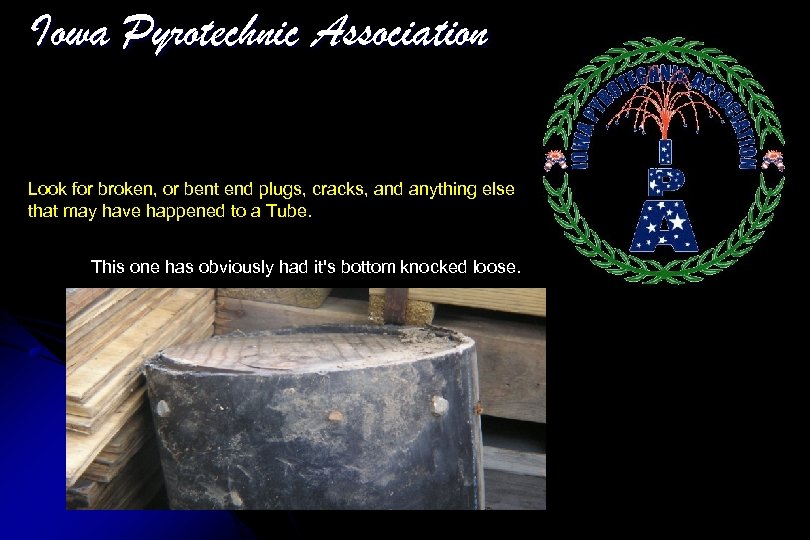 Iowa Pyrotechnic Association Look for broken, or bent end plugs, cracks, and anything else that may have happened to a Tube. This one has obviously had it's bottom knocked loose.
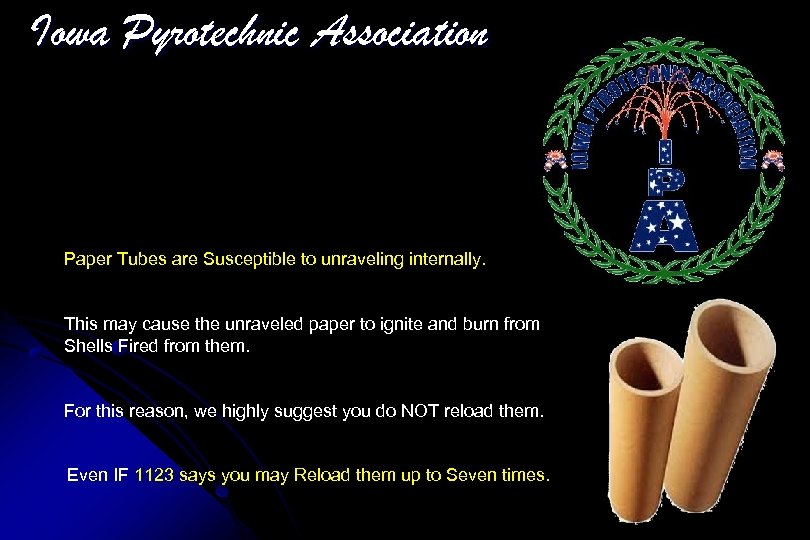 Iowa Pyrotechnic Association Paper Tubes are Susceptible to unraveling internally. This may cause the unraveled paper to ignite and burn from Shells Fired from them. For this reason, we highly suggest you do NOT reload them. Even IF 1123 says you may Reload them up to Seven times.
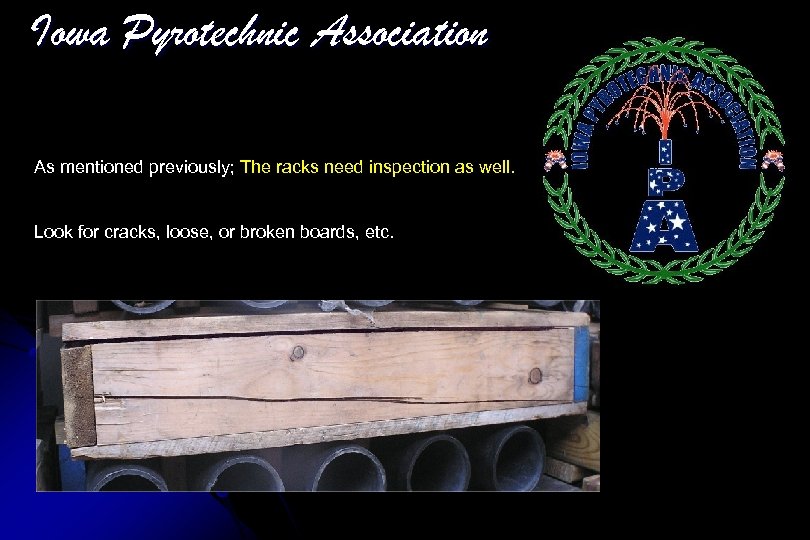 Iowa Pyrotechnic Association As mentioned previously; The racks need inspection as well. Look for cracks, loose, or broken boards, etc.
 Iowa Pyrotechnic Association Aim Mortars and/or Racks either Vertically, or Angled Slightly AWAY from the Crowd. Place Mortar Racks PERPENDICULAR to not Parallel with the Crowd. That way, in the case of a Catastrophic Failure in one of your Racks, IF it falls over, it won't be aimed at the Crowd.
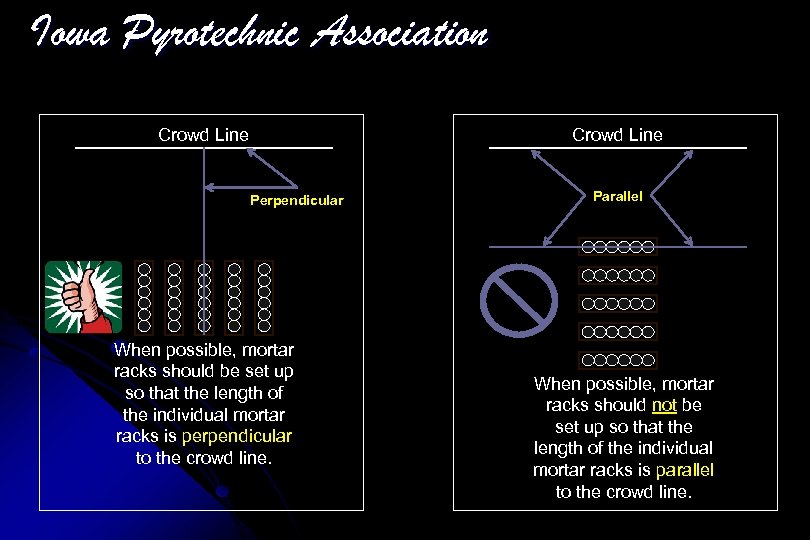 Iowa Pyrotechnic Association Crowd Line Perpendicular When possible, mortar racks should be set up so that the length of the individual mortar racks is perpendicular to the crowd line. Parallel When possible, mortar racks should not be set up so that the length of the individual mortar racks is parallel to the crowd line.
 Iowa Pyrotechnic Association NOTHING is to be overhead for 25' in all directions above your racks. This includes tree limbs, power lines, telephone wires, street lights, guy wires - anything. While it may be doubtful you could take anything (but a few dead tree limbs maybe), "out" with a shell, hitting an overhead object could easily send a Shell off course maybe into the Crowd, or Crew. Always look up and know what there may be before you place racks, or bury Mortars.
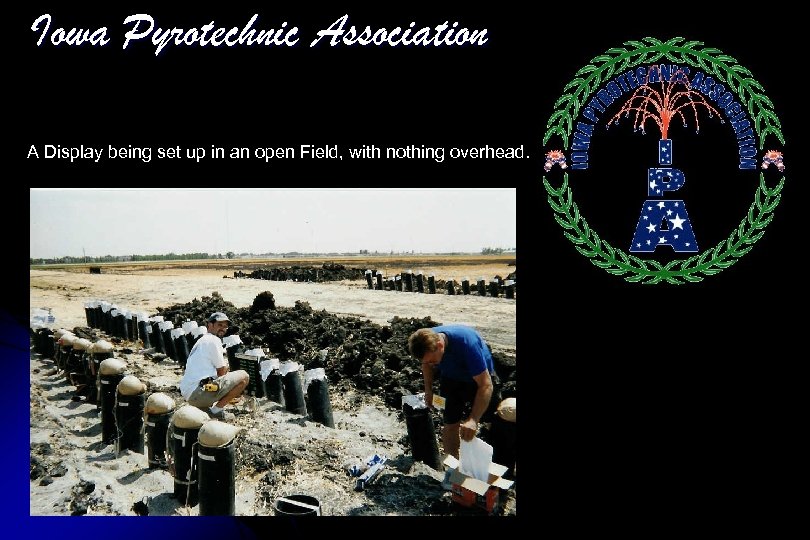 Iowa Pyrotechnic Association A Display being set up in an open Field, with nothing overhead.
 Iowa Pyrotechnic Association Please learn the proper Nomenclature (language). We've already mentioned how we use a number of acronyms. Learn the proper terminology also to help keep you out of trouble (like with the AHJ). In our post 9/11 world, certain people are VERY touchy about certain words. Among them is "Bomb" (we do NOT own, build, or light bombs). "Squib" - a Squib is a Detonator for High Explosives which works on an impact action - we use "Igniters" or "Electric Match". We "Deflagrate" (a Low-speed Explosion), NOT Detonate, our Fireworks. And; A Creamora is a Theatrical Flame Effect, not a Fireball or Mushroom (Both terms are equated with Nuclear Devices)
 Iowa Pyrotechnic Association Please learn the proper Nomenclature (language). We've already mentioned how we use a number of acronyms. Learn the proper terminology also to help keep you out of trouble (like with the AHJ). In our post 9/11 world, certain people are VERY touchy about certain words. Among them is "Bomb" (we do NOT own, build, or light bombs). "Squib" - a Squib is a Detonator for High Explosives which works on an impact action - we use "Igniters" or "Electric Match". We "Deflagrate" (a Low-speed Explosion), NOT Detonate, our Fireworks. And; A Creamora is a Theatrical Flame Effect, not a Fireball or Mushroom (Both terms are equated with Nuclear Devices)
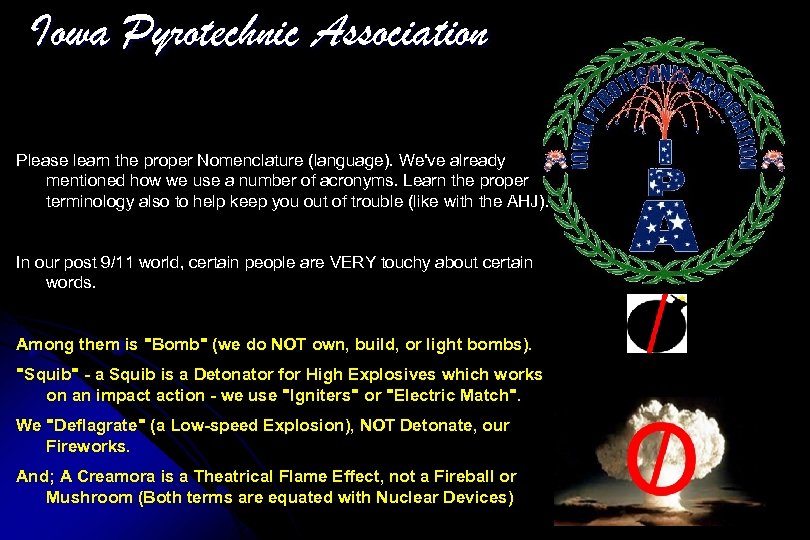 Iowa Pyrotechnic Association Please learn the proper Nomenclature (language). We've already mentioned how we use a number of acronyms. Learn the proper terminology also to help keep you out of trouble (like with the AHJ). In our post 9/11 world, certain people are VERY touchy about certain words. Among them is "Bomb" (we do NOT own, build, or light bombs). "Squib" - a Squib is a Detonator for High Explosives which works on an impact action - we use "Igniters" or "Electric Match". We "Deflagrate" (a Low-speed Explosion), NOT Detonate, our Fireworks. And; A Creamora is a Theatrical Flame Effect, not a Fireball or Mushroom (Both terms are equated with Nuclear Devices)
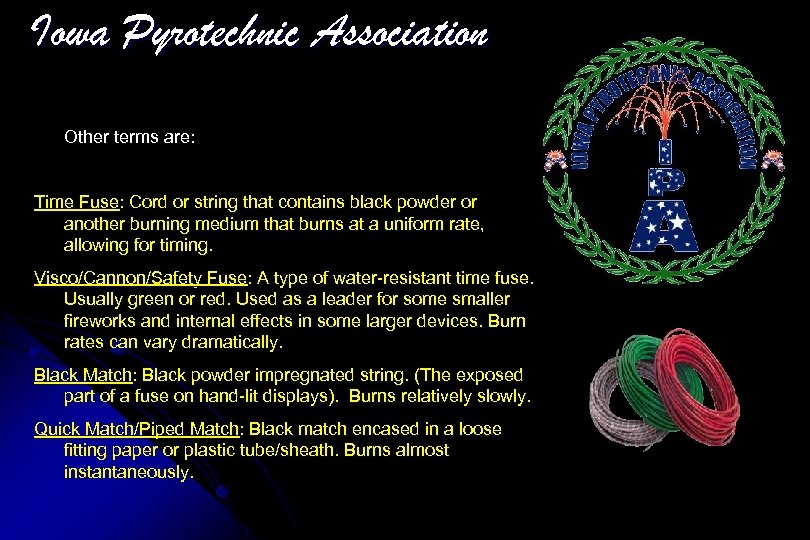 Iowa Pyrotechnic Association Other terms are: Time Fuse: Cord or string that contains black powder or another burning medium that burns at a uniform rate, allowing for timing. Visco/Cannon/Safety Fuse: A type of water-resistant time fuse. Usually green or red. Used as a leader for some smaller fireworks and internal effects in some larger devices. Burn rates can vary dramatically. Black Match: Black powder impregnated string. (The exposed part of a fuse on hand-lit displays). Burns relatively slowly. Quick Match/Piped Match: Black match encased in a loose fitting paper or plastic tube/sheath. Burns almost instantaneously.
 Iowa Pyrotechnic Association We cannot go through all the terms used. Go with a good Glossary, such as those found on reliable sites such as Tom Dimok's Pyro-Page (pyropage. com), or Larry Huber, and Dave Stoddard's (legalpyro. com), Getting Legal Web Sites. Avoid using terms which allude to High Explosives Fireworks are never High Explosive (although High Explosives can lead to Fireworks). If you "Talk the Talk", the AHJs you encounter are definitely more prone to believe you "Walk the Walk".
 Iowa Pyrotechnic Association
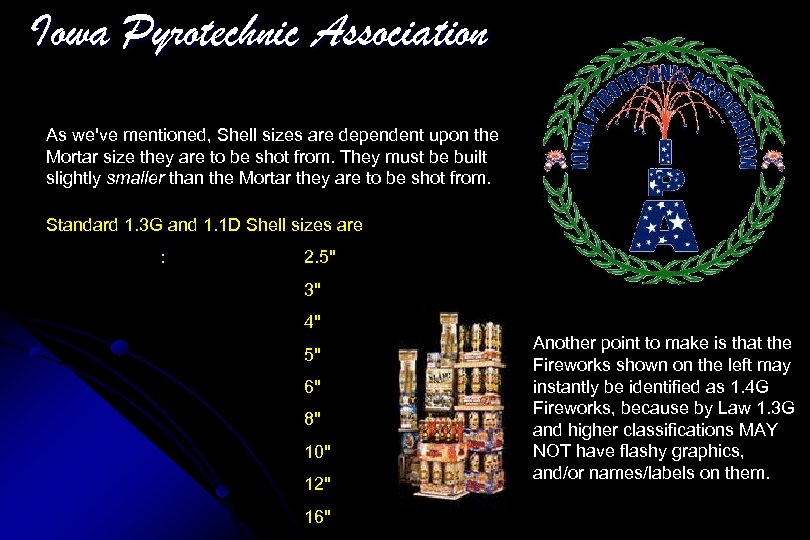 Iowa Pyrotechnic Association As we've mentioned, Shell sizes are dependent upon the Mortar size they are to be shot from. They must be built slightly smaller than the Mortar they are to be shot from. Standard 1. 3 G and 1. 1 D Shell sizes are : 2. 5" 3" 4" 5" 6" 8" 10" 12" 16" Another point to make is that the Fireworks shown on the left may instantly be identified as 1. 4 G Fireworks, because by Law 1. 3 G and higher classifications MAY NOT have flashy graphics, and/or names/labels on them.
 Iowa Pyrotechnic Association As we've mentioned, Shell sizes are dependent upon the Mortar size they are to be shot from. They must be built slightly smaller than the Mortar they are to be shot from. Standard 1. 3 G and 1. 1 D Shell sizes are : 2. 5" 3" 4" 5" 6" 8" 10" 12" 16" Another point to make is that the Fireworks shown on the left may instantly be identified as 1. 4 G Fireworks, because by Law 1. 3 G and higher classifications MAY NOT have flashy graphics, and/or names/labels on them.
 Iowa Pyrotechnic Association There are more sizes available, both in Commercial and in Competition, or Handmade. The sizes listed however, will probably make up 99. 99% of the Shells you will use. A little Geometry refresher is need here. Display sites are measured across their CIRCUMFERENCE. 70' per inch of Shell diameter (the width measured across the Shell) is required. This is measured using the Circumference of the Shell to be shot.
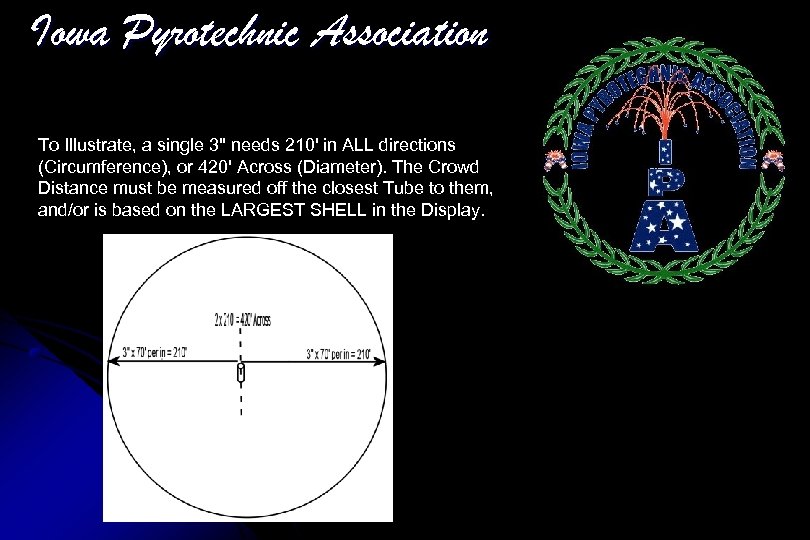 Iowa Pyrotechnic Association To Illustrate, a single 3" needs 210' in ALL directions (Circumference), or 420' Across (Diameter). The Crowd Distance must be measured off the closest Tube to them, and/or is based on the LARGEST SHELL in the Display.
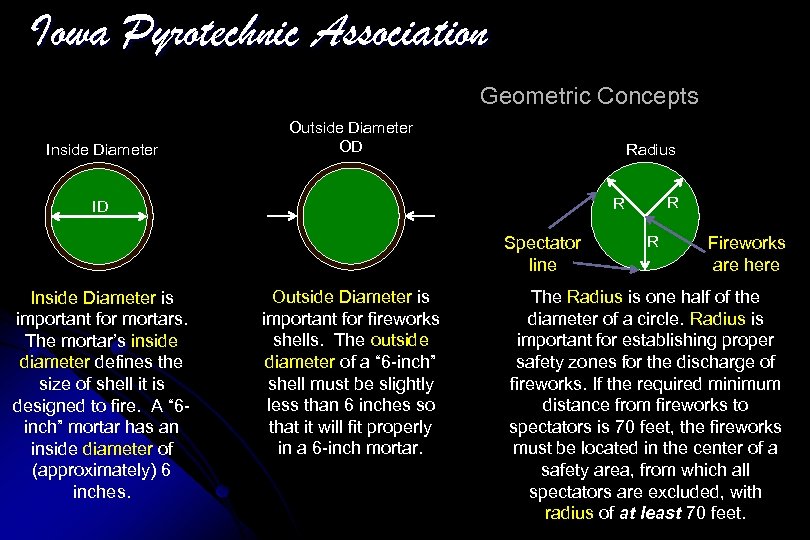 Iowa Pyrotechnic Association Geometric Concepts Inside Diameter Outside Diameter OD Radius Spectator line Inside Diameter is important for mortars. The mortar’s inside diameter defines the size of shell it is designed to fire. A “ 6 inch” mortar has an inside diameter of (approximately) 6 inches. R R ID Outside Diameter is important for fireworks shells. The outside diameter of a “ 6 -inch” shell must be slightly less than 6 inches so that it will fit properly in a 6 -inch mortar. R Fireworks are here The Radius is one half of the diameter of a circle. Radius is important for establishing proper safety zones for the discharge of fireworks. If the required minimum distance from fireworks to spectators is 70 feet, the fireworks must be located in the center of a safety area, from which all spectators are excluded, with radius of at least 70 feet.
 Iowa Pyrotechnic Association Distances are key to the Protection of the Crowd, but Distances also Apply to the Shooter, as well. There are many key distances to know: A 10' "Alley" is required between E-Fired, and Hand. Fired Portions of your show. 25' of room between the Shooter (Hand-Lighter), and the Finales being watched (after lighting). 75' from a Shell Larger Than 6" in Diameter being Hand Lit (before it lifts). and many more. . .
 Iowa Pyrotechnic Association The distances measured are always the MINIMUM DISTANCES you may be away from any crowd member, Emergency Personnel, or other member of the Public!!! You MAY make these Distances Greater (70' per Inch of Shell Diameter becomes 80', 90', or 100 fpi, etc), but NO Matter WHO tells you to, you CANNOT under ANY circumstances make it less. This is exactly like having the Sponsor, Fire Marshal, or any other AHJ tell you to go ahead and Shoot when you feel it is unsafe. DON'T do it! If you think it is NOT safe, it probably is not safe, and YOU (Alone) are responsible for all damages, and/or Injuries when you light that fuse, or push that button.
 Iowa Pyrotechnic Association If your Fallout Area is near a Retirement Village, Hospital, School, Corrections Facility, or other Facility where the inhabitants cannot be quickly, or easily evacuated, or if near a Tank Farm, Propane, Tanks, Aviation Fuel Storage , or other Permanent Hazardous Fixture, you MUST per code DOUBLE the Minimum Distances from your Display! When in the presence of such a hazard, you MAY NOT angle your Mortars to change distances. NO ONE (not the AHJ, City Council, County Board, etc), may give you permission to do so.
 Iowa Pyrotechnic Association As we have said previously, get a copy of (at least) the NFPA's Code 1123 -2010, study it in detail and keep it with you on your sites, or take it to sites for reference. These codes may be purchased through: www. nfpa. org SOME of the codes you may deal with are: 306 (Maritime Flammables) 701 (Standard Methods of Fire Tests. ) 1123 (Outdoor Displays) 1124 (Indoor Displays) 1126 (Transport & Storage) and there may be others from time to time.
 Iowa Pyrotechnic Association Obviously, if its to be an Indoor Display, we will not have these kinds of Distances. When Indoors, NFPA 1124 codes will apply. This in itself, opens a whole other can of worms.
 Iowa Pyrotechnic Association Common Sense is your greatest ally in keeping yourself and others Safe. If it doesn't feel right, it probably isn't. Don't do it. No person is ever truly Safe, but an Educated Shooter is a Safer Shooter. The most Dangerous Person out there is one who says he/she has no more to learn. This Person is Dangerous, let them die alone.
 Iowa Pyrotechnic Association Some random quick tips which may be helpful: Cover your Finales to avoid premature Firing caused by burning Debris. A plastic cap on the mouth of the Tube may be used. Weather-proof Tarps, Plastic Sheeting, Tar-Paper Roofing Material, Aluminum Foil, Saran or other Plastic Wrap are all ways to cover your Tubes. You can Shoot right through any of these, or choose to remove the covering just prior to firing.
 Iowa Pyrotechnic Association If you Hand-Light, the closer you are, the more danger you are in when lighting a shell. To stay back a few feet more while Hand-Lighting, a "wand" may be used for your fusee. This wand may be purchased commercially, or if you are crafty - be home-made. To make a wand, cut a length of commercially available 3/4" electrical conduit (or EMT/Thin wall), to 3' to 5'. Attach a 3/4" Compression coupler to one end. Tighten the end attached to the conduit.
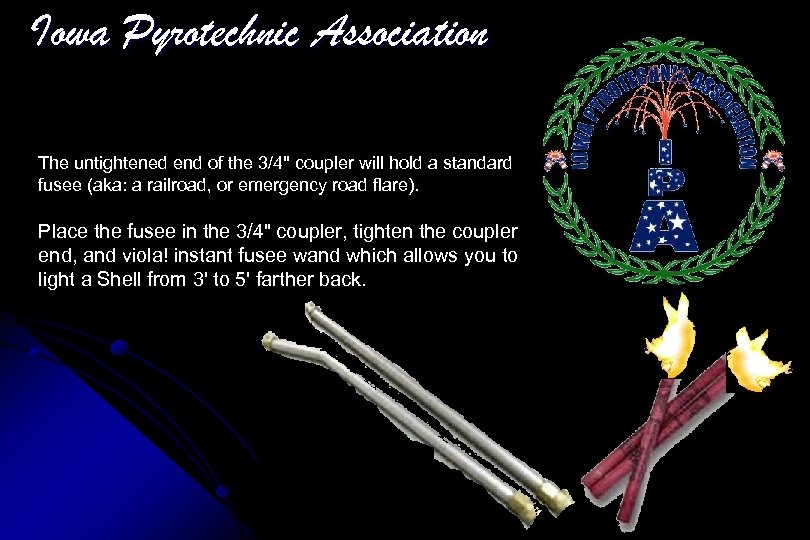 Iowa Pyrotechnic Association The untightened end of the 3/4" coupler will hold a standard fusee (aka: a railroad, or emergency road flare). Place the fusee in the 3/4" coupler, tighten the coupler end, and viola! instant fusee wand which allows you to light a Shell from 3' to 5' farther back.
 Iowa Pyrotechnic Association It is recommended for Safety, that all buried mortars be buried to 75% (or ¾) of their length. Even though, officially, NFPA 1123 -2010 states that mortars 6” & smaller shall be buried to 66% (or 2/3) of their length. But; NFPA 1123 -2010 also states that mortars larger than 6”, shall be buried to ¾ of their length. And; A 3" Mortar is 18". 2/3 of that is 12". 6 & 3/4 of that is 13. 5". So; For the difference of a couple of inches, we recommend you go the max (¾) on ALL mortars.
 Iowa Pyrotechnic Association Measure the distance needed for the LARGEST Shell in your Display first. Place each progressively SMALLER size Shell in toward the Crowd 20'. In setting up this way, you will never need to use Scab Wire, or be too close to the Crowd. Set any Ground Effects, Cakes, Lancework, etc. up in front of the Shells. Remember, NFPA 1123 Code lists only MINIMUM Distances, and the Farther you are from Fireworks, generally speaking, the better they look. Use common sense with Lancework - (200 -400' from the Crowd line is about as far back as you want to go). Farther back is not usually feasible. NFPA 1123 allows Lance to be as close as 75' to the crowd.
 Iowa Pyrotechnic Association Some Insurance REQUIRES a test Shell be fired 10 to 15 minutes prior to the Display. This is to test wind conditions aloft to determine where the fallout will end up. This is another way your Insurance Company could "duck" a claim. Get in the habit of always firing a Shell (preferably a Salute), prior to each Display you do. Make sure your Fallout Area is adequately marked off.
 Iowa Pyrotechnic Association NFPA Code states that you MUST check your Racks and/or Tubes prior to each use. If you get into the habit of doing this as you load up after each show, if you separate the Good from the Damaged, and by Repairing Damaged Equipment prior to the next Display, you can simply "Load and Go" to the next Display. You should always Segregate the Good from the Bad so you know which is which. Keep the keys to your vehicle, trailer AND your Firing System on the same ring, so you always have them with you on Displays (you wont be leaving for a Display without your vehicle keys). Keep a Road flare kit, wand, and/or any other equipment you may use on a Regular basis for Displays, in the Vehicle you normally use on Display Sites. This includes a Headlamp, Fire Gear, and anything else specific to your normally required equipment.
 Iowa Pyrotechnic Association On your Display Sites, Per Code, you must have a Fire Crew on Standby during the Display, and you MAY have Emergency Medical Personnel on Standby as well. Do NOT allow these Emergency/Standby Personnel to Stay near you! They are there, in case YOU are faced with an Emergency Situation. The very last place you want them to be is with You, where You are the one likely to be hurt. Have them Standby well away from you. It is a good idea to provide them an INSTANT form of contact with you (like a two-way radio), so you may have help immediately on the way, should you need it.
 Iowa Pyrotechnic Association This course has hopefully shown you that Shooting Fireworks is a Huge Responsibility. It has also hopefully shown you that Shooting Fireworks, has many traps and pitfalls for the un-trained, or un-thinking. Please remember that when You are in charge, You are Responsible for everything, at all times. This is a shortened course developed specifically for IPA Members is loosely based on the PGI's Premiere Safety Course and NFPA Codes. For more on the Subject – we recommend the PGI’s Display Operator Certification Course. This course has been ok’d for two hours towards PGI Recertification when signed off on by the Instructor, and submitted to the PGI.
 Iowa Pyrotechnic Association THANK YOU
 Iowa Pyrotechnic Association