 Скачать презентацию Iowa Paint Manufacturing Co Viscosity Analysis Presented By
c7ded253ac9d049dfec625a09084b3a0.ppt
- Количество слайдов: 29




Iowa Paint Manufacturing Co. Viscosity Analysis Presented By: Ruchi Patnaik Co-Author: Piyanka Roy 1

Iowa Paint Manufacturing Co. • Since 1933, Iowa Paint has been making quality paint and coatings • More than 1400 colors available • The choice of professional painting contractors for quality paints • Paints and coatings meet and/or exceed U. S. Government paint specifications 2
Satin Acrylic House Paint • • • Very durable for interior walls and ceilings Good color retention Easy water clean-up Low odor Dries to tough finish Rooms can be used almost immediately 3
Objective • Improve viscosity for batches of paint – Determine precision of viscosity measurements (and identify removable sources of imprecision) – Find the appropriate quantity of Hydroxyethyl Cellulose (HEC also known as A 44) to be added for various desired adjustments of viscosity 4
Viscosity of paint is increased or decreased by addition or removal of the following three elements • A 44 (Hydroxyethyl cellulose) • T 49 (Water) • Resin 5
Current Situation • Low initial incoming viscosity • Final viscosity requirement: 95 -100 Krebs • Use of A 44 to increase viscosity • Paint produced in 2000 or 4000 gallon tanks • Use of trial and error to get to desired viscosity 6
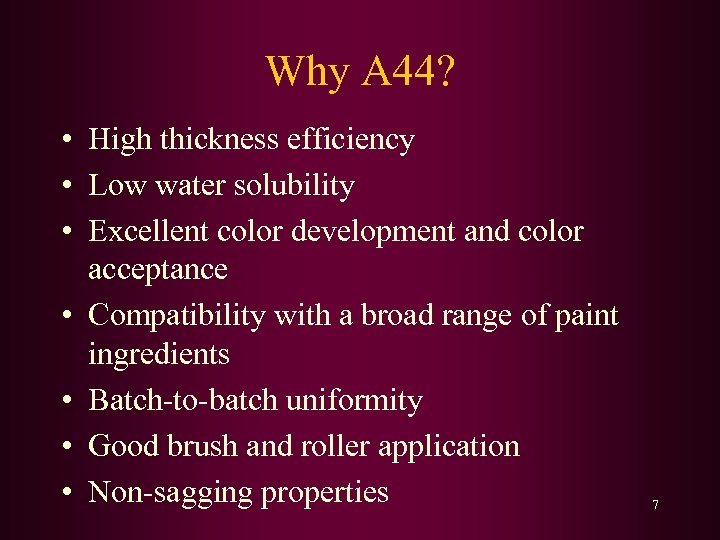
Why A 44? • High thickness efficiency • Low water solubility • Excellent color development and color acceptance • Compatibility with a broad range of paint ingredients • Batch-to-batch uniformity • Good brush and roller application • Non-sagging properties 7
Analysis • Gage R&R study for lab measurement precision • Homogeneity test for within vat sampling variance • Regression Analysis 8

Gage R&R • Repeatability is variation typical of that seen in repeat measurements for a particular operator on a particular specimen • Reproducibility is variation that can be attributed to differences between operators 9
Gage R&R • Two different batches of paint • Two measurements by each of 4 group members for each batch • Use of viscometer and stop watch to measure viscosity • Viscosity measured at 77 Fahrenheit 10
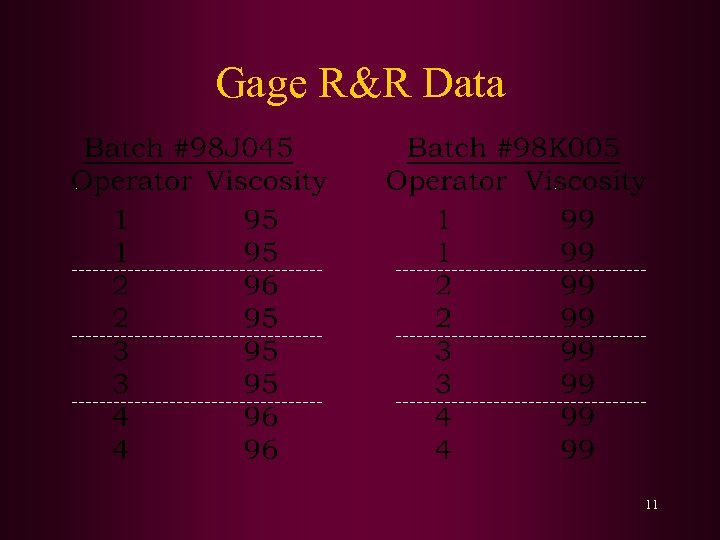
Gage R&R Data 11
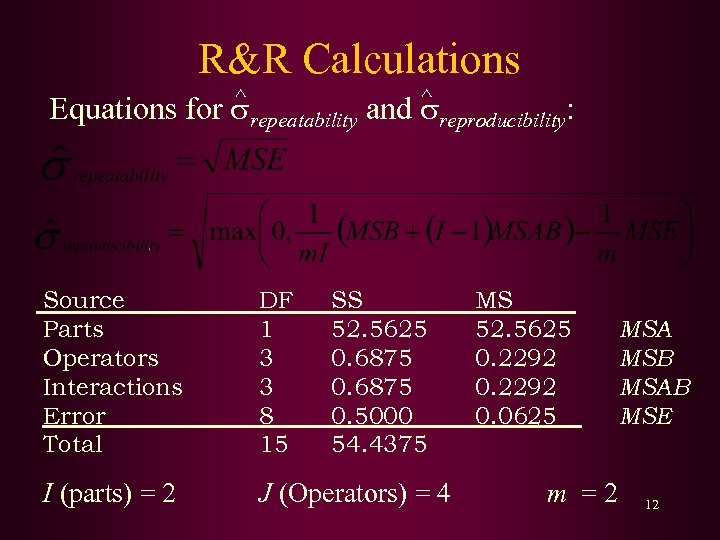
R&R Calculations ^ ^ Equations for repeatability and reproducibility: Source Parts Operators Interactions Error Total DF 1 3 3 8 15 SS 52. 5625 0. 6875 0. 5000 54. 4375 I (parts) = 2 J (Operators) = 4 MS 52. 5625 0. 2292 0. 0625 m =2 MSA MSB MSAB MSE 12
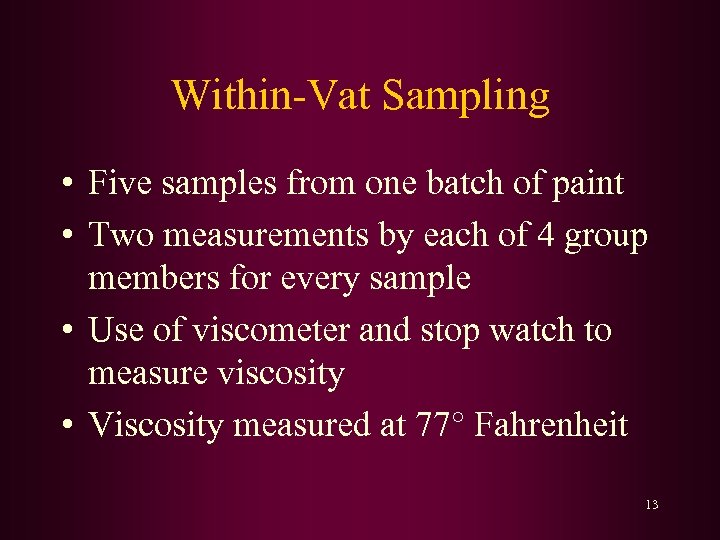
Within-Vat Sampling • Five samples from one batch of paint • Two measurements by each of 4 group members for every sample • Use of viscometer and stop watch to measure viscosity • Viscosity measured at 77° Fahrenheit 13
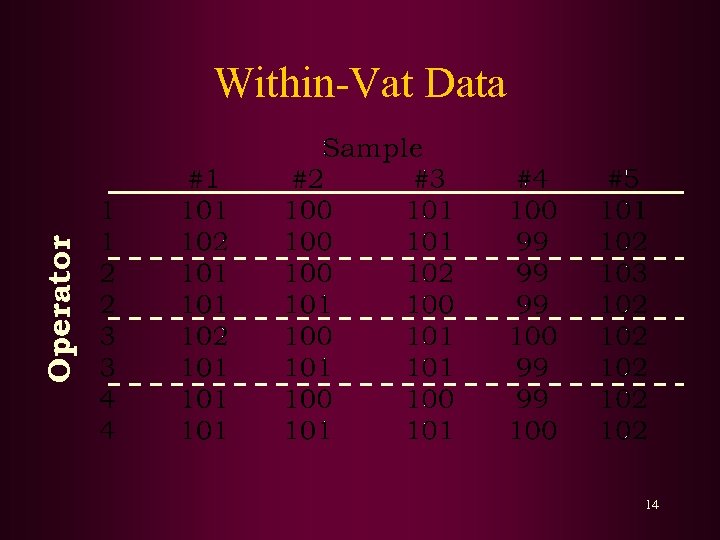
Operator Within-Vat Data 14
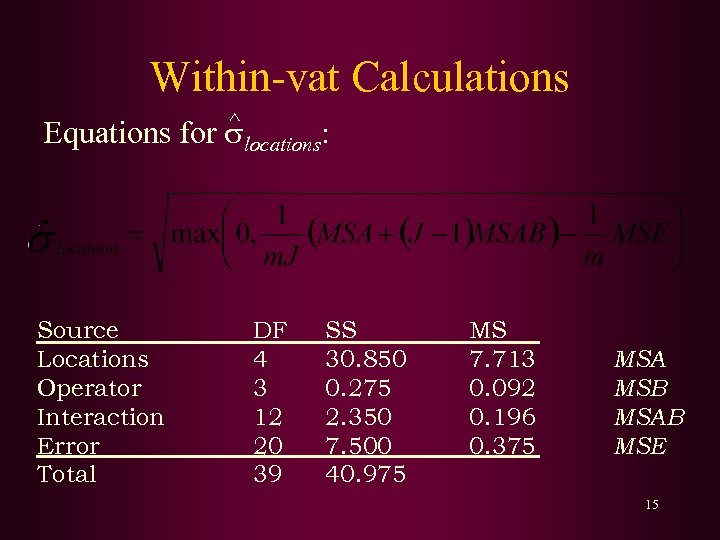
Within-vat Calculations ^ Equations for locations: Source Locations Operator Interaction Error Total DF 4 3 12 20 39 SS 30. 850 0. 275 2. 350 7. 500 40. 975 MS 7. 713 0. 092 0. 196 0. 375 MSA MSB MSAB MSE 15

Results of Measurement Precision Studies Gage R&R Calculations ^ • repeatability = 0. 250 Krebs ^ • reproducibility = 0. 327 Krebs To combat reproducibility variation, keep operator fixed 16

Results of Measurement Precision Studies Within-Vat Calculations • ^repeatability = 0. 612 Krebs • ^locations = 0. 922 Krebs To account for location variation, sample from several locations and either physically mix, or average measurements 17
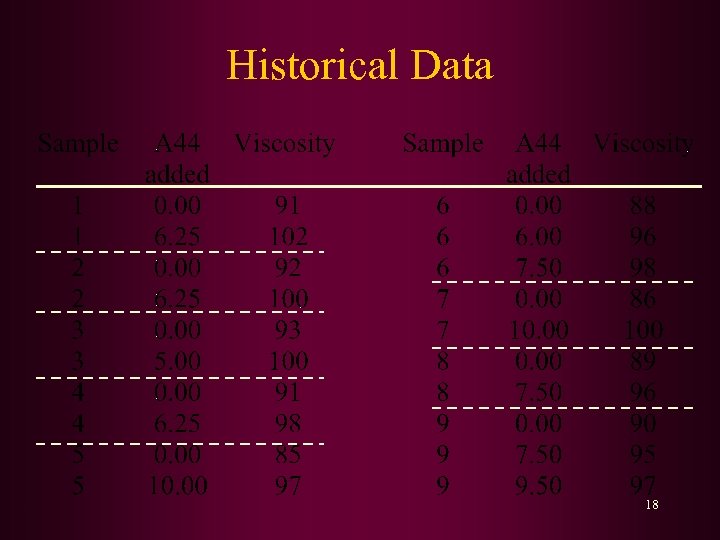
Historical Data 18
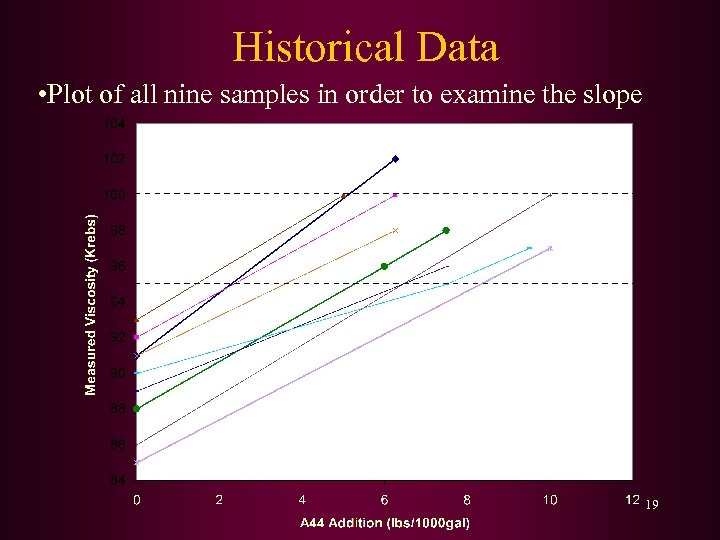
Historical Data • Plot of all nine samples in order to examine the slope 19
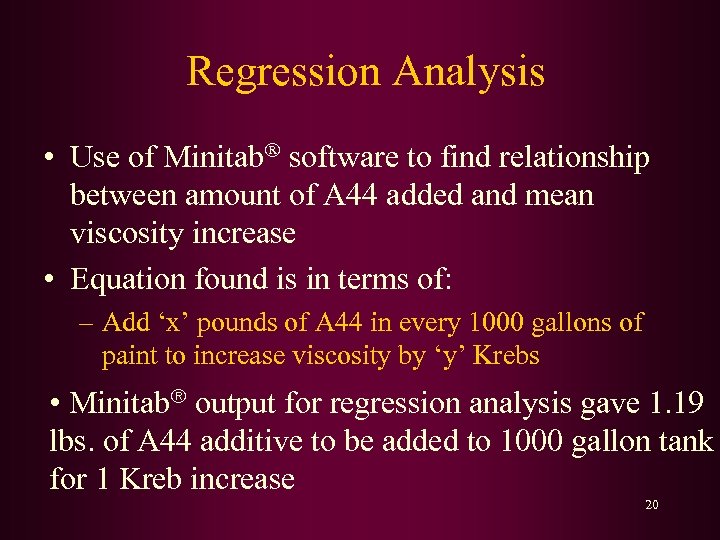
Regression Analysis • Use of Minitab software to find relationship between amount of A 44 added and mean viscosity increase • Equation found is in terms of: – Add ‘x’ pounds of A 44 in every 1000 gallons of paint to increase viscosity by ‘y’ Krebs • Minitab output for regression analysis gave 1. 19 lbs. of A 44 additive to be added to 1000 gallon tank for 1 Kreb increase 20
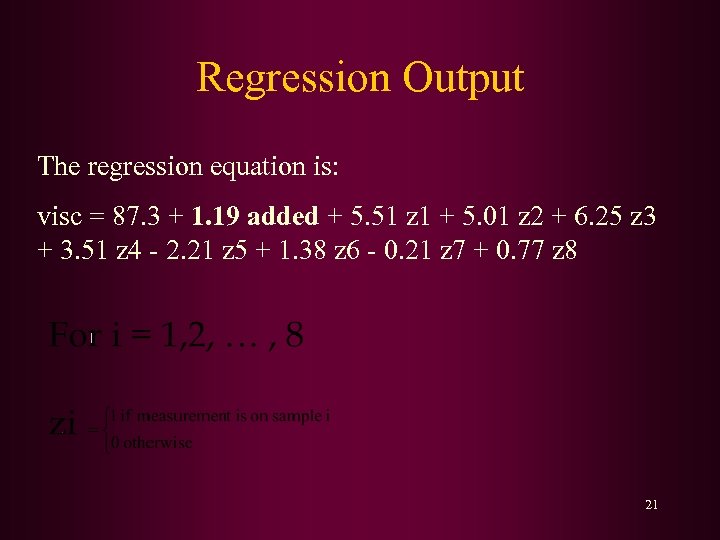
Regression Output The regression equation is: visc = 87. 3 + 1. 19 added + 5. 51 z 1 + 5. 01 z 2 + 6. 25 z 3 + 3. 51 z 4 - 2. 21 z 5 + 1. 38 z 6 - 0. 21 z 7 + 0. 77 z 8 21
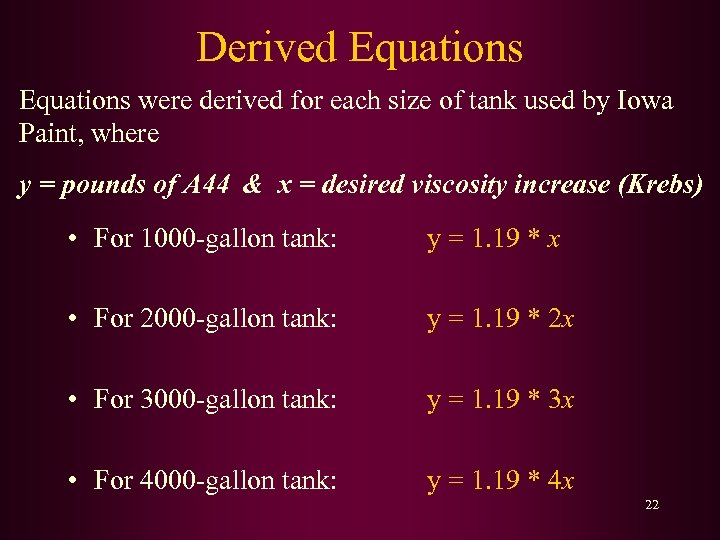
Derived Equations were derived for each size of tank used by Iowa Paint, where y = pounds of A 44 & x = desired viscosity increase (Krebs) • For 1000 -gallon tank: y = 1. 19 * x • For 2000 -gallon tank: y = 1. 19 * 2 x • For 3000 -gallon tank: y = 1. 19 * 3 x • For 4000 -gallon tank: y = 1. 19 * 4 x 22
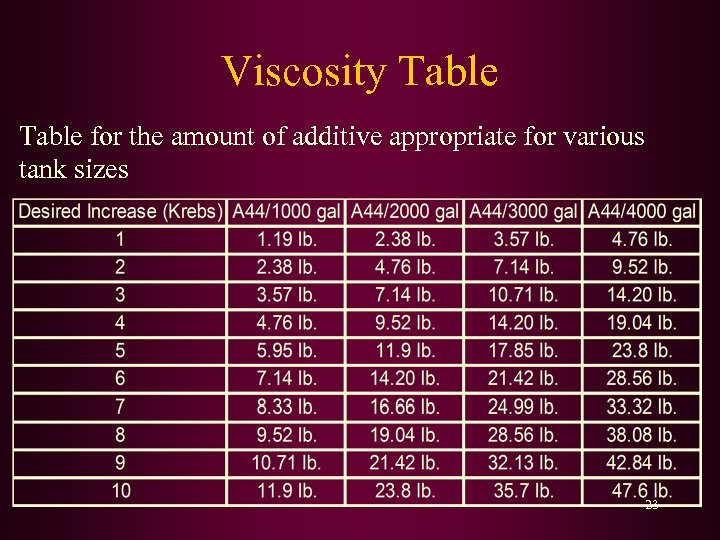
Viscosity Table for the amount of additive appropriate for various tank sizes 23
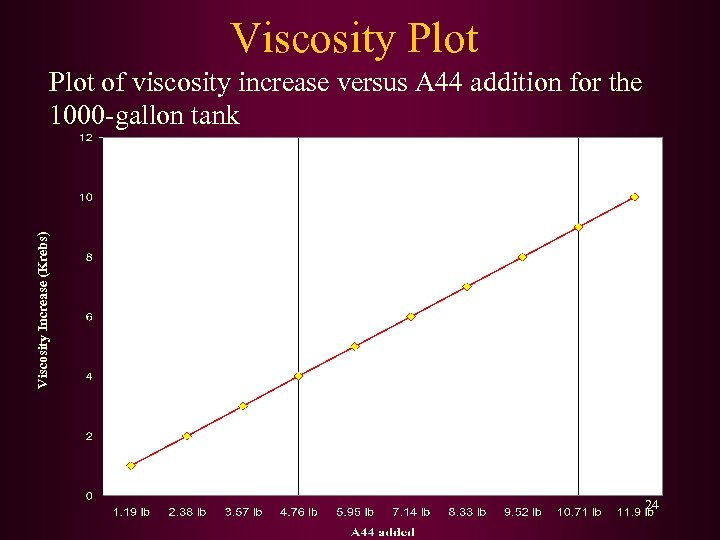
Viscosity Plot Viscosity Increase (Krebs) Plot of viscosity increase versus A 44 addition for the 1000 -gallon tank 24

Conclusions • Several factors play a role in viscosity measurements - One source of variation relates to measurements done by different people -Another relates to tank location of the sample obtained • Historical data provides quantitative guidance for viscosity adjustment 25

Recommendations • Make sure that only one person handles the viscosity measurement • Samples for measurement of viscosity may be taken from different areas of paint tank and mixed or measurements averaged • Use the equations, table and chart derived from historical data to eliminate trial and error (and get correct viscosity) 26
Aftermath • Company is willing to try it out! • Able to give the company an acceptable solution to implement • Derived accurate amounts of Hydroxyethyl Cellulose to add to achieve desired viscosity level • Graphical and tabular representation of solution for easy reference 27

Acknowledgements • Dr. Stephen Vardeman Professor Iowa State University • Mr. Mark Angerer Technical Director Iowa Paint Manufacturing Co. 28

Questions? 29
Скачать презентацию Iowa Paint Manufacturing Co Viscosity Analysis Presented By
c7ded253ac9d049dfec625a09084b3a0.ppt