 Скачать презентацию Ion Beam Centre The IAEA Intercomparison of IBA
8eefff4b0406b91d71e87b2600f4ef52.ppt
- Количество слайдов: 23



Ion Beam Centre The IAEA Intercomparison of IBA codes Joint ICTP/IAEA Workshop on Advanced Simulation and Modelling for Ion Beam Analysis 23 - 27 February 2009, Miramare - Trieste, Italy Chris Jeynes University of Surrey Ion Beam Centre Guildford, England Monday February 23 rd 2009 IBA IV: IAEA Intercomparison www. surreyibc. ac. uk
IAEA-sponsored intercomparison of IBA software codes Nuno P. Barradas Kai Arstila Gabor Battistig E. Kótai & Edit Szilágyi Marco Bianconi & G. Lulli Nick Dytlewski Chris Jeynes Matej Mayer Eero Rauhala Mike Thompson Ion Beam Centre (Instituto Tecnológico e Nuclear & University of Lisbon) (Katholieke Universiteit Leuven) (MFA Budapest) (KFKI Budapest) (CNR-IMM Bologna) (IAEA, Vienna) (University of Surrey Ion Beam Centre) (Max-Planck-Institut Garching) (University of Helsinki) (Cornell University New York) Nuclear Instruments and Methods B 262 (2007) 281 -303 summary at: Nuclear Instruments and Methods B 266 (2008) 1338 -1342 This talk was presented at the IBA conference in Hyderabad, September 2007 http: //www. mfa. kfki. hu/sigmabase/ibasoft/ IBA IV: IAEA Intercomparison www. surreyibc. ac. uk
Context Ion Beam Centre • Status of software for Ion Beam Analysis in Materials Development, NAPC/PS/2002/F 1. TM - 25886, (IAEA, Vienna 2003) • E. Rauhala, N. P. Barradas, S. Fazinić, M. Mayer, E. Szilágyi, M. Thompson, Status of ion beam data analysis and simulation software, Nucl. Instr. Meth. B 244 (2006) 436 • Barradas & Rauhala chapter on IBA Software in new IBA Handbook (this has been circulated on ION) • IAEA cross-section CRP: A. Gurbich, I. Bogdanovic-Radovic, M. Chiari, C. Jeynes, M. Kokkoris, A. R. Ramos, M. Mayer, E. Rauhala, O. Schwerer, Shi Liqun and I. Vickridge, Status of the problem of nuclear cross section data for IBA, Nucl. Instrum. Methods Phys. Res. , Sect. B, 266(2008)1198 -1202 • PIXE & PIGE not considered here IBA IV: IAEA Intercomparison www. surreyibc. ac. uk
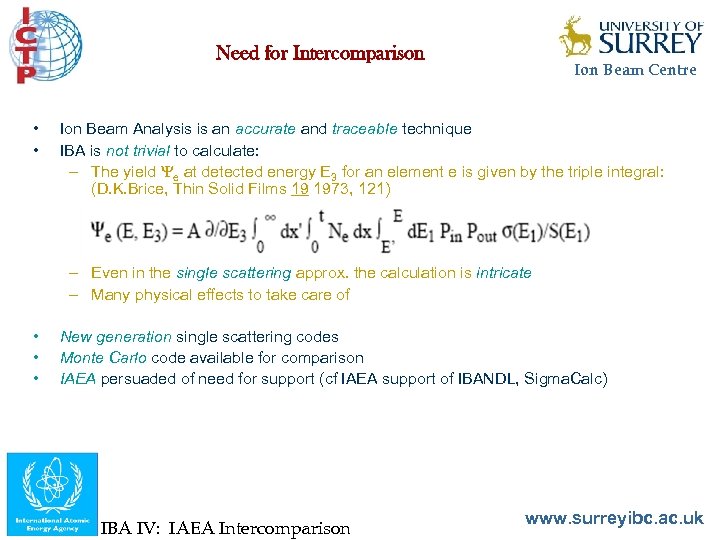
Need for Intercomparison • • Ion Beam Centre Ion Beam Analysis is an accurate and traceable technique IBA is not trivial to calculate: – The yield Ye at detected energy E 3 for an element e is given by the triple integral: (D. K. Brice, Thin Solid Films 19 1973, 121) – Even in the single scattering approx. the calculation is intricate – Many physical effects to take care of • • • New generation single scattering codes Monte Carlo code available for comparison IAEA persuaded of need for support (cf IAEA support of IBANDL, Sigma. Calc) IBA IV: IAEA Intercomparison www. surreyibc. ac. uk
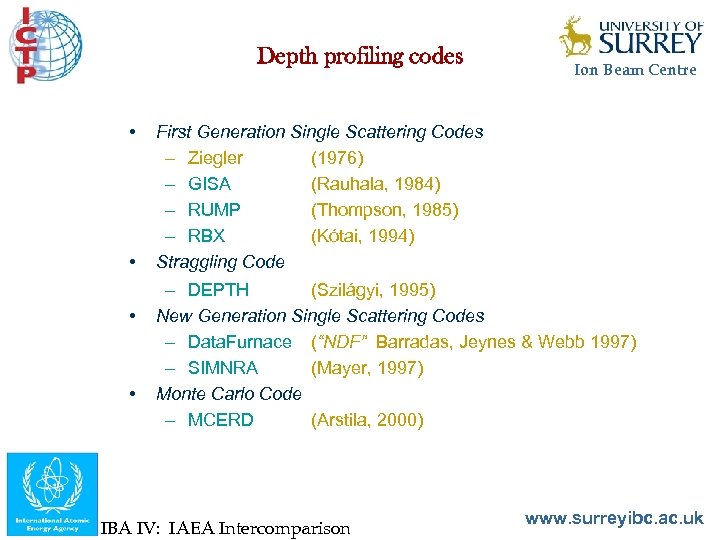
Depth profiling codes • • Ion Beam Centre First Generation Single Scattering Codes – Ziegler (1976) – GISA (Rauhala, 1984) – RUMP (Thompson, 1985) – RBX (Kótai, 1994) Straggling Code – DEPTH (Szilágyi, 1995) New Generation Single Scattering Codes – Data. Furnace (“NDF” Barradas, Jeynes & Webb 1997) – SIMNRA (Mayer, 1997) Monte Carlo Code – MCERD (Arstila, 2000) IBA IV: IAEA Intercomparison www. surreyibc. ac. uk
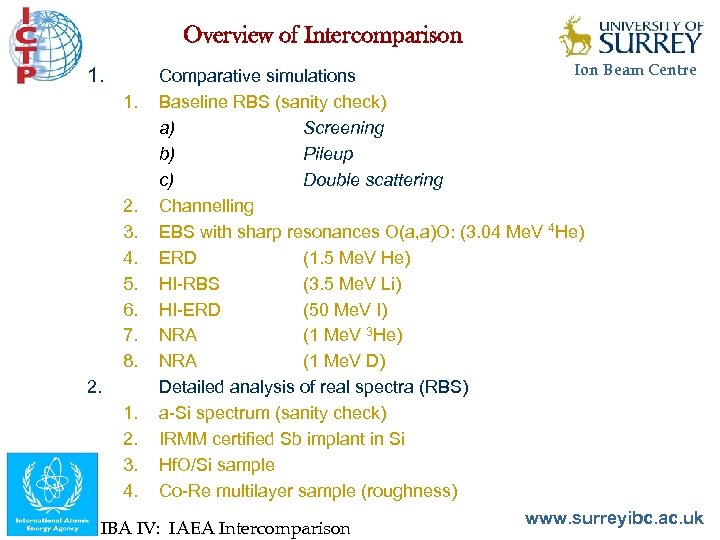
Overview of Intercomparison Ion Beam Centre Comparative simulations 1. Baseline RBS (sanity check) a) Screening b) Pileup c) Double scattering 2. Channelling 3. EBS with sharp resonances O(a, a)O: (3. 04 Me. V 4 He) 4. ERD (1. 5 Me. V He) 5. HI-RBS (3. 5 Me. V Li) 6. HI-ERD (50 Me. V I) 7. NRA (1 Me. V 3 He) 8. NRA (1 Me. V D) 2. Detailed analysis of real spectra (RBS) 1. a-Si spectrum (sanity check) 2. IRMM certified Sb implant in Si 3. Hf. O/Si sample 4. Co-Re multilayer sample (roughness) www. surreyibc. ac. uk IBA IV: IAEA Intercomparison 1.
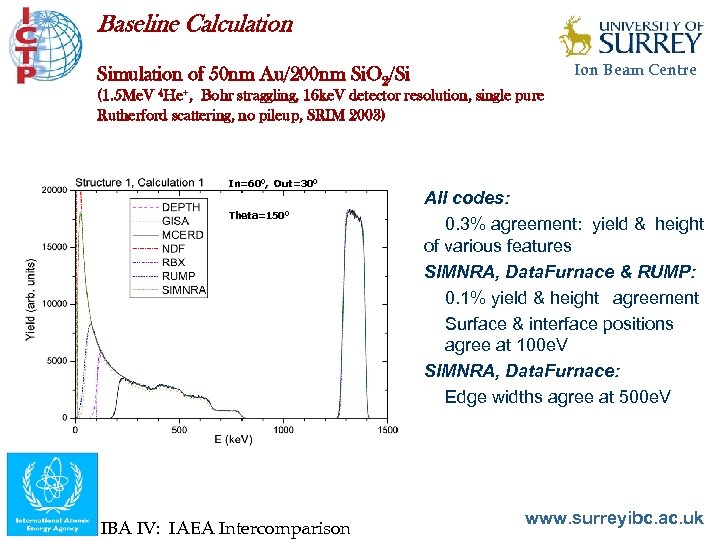
Baseline Calculation Simulation of 50 nm Au/200 nm Si. O 2/Si Ion Beam Centre (1. 5 Me. V 4 He+, Bohr straggling, 16 ke. V detector resolution, single pure Rutherford scattering, no pileup, SRIM 2003) In=600, Out=300 Theta=1500 IBA IV: IAEA Intercomparison All codes: 0. 3% agreement: yield & height of various features SIMNRA, Data. Furnace & RUMP: 0. 1% yield & height agreement Surface & interface positions agree at 100 e. V SIMNRA, Data. Furnace: Edge widths agree at 500 e. V www. surreyibc. ac. uk
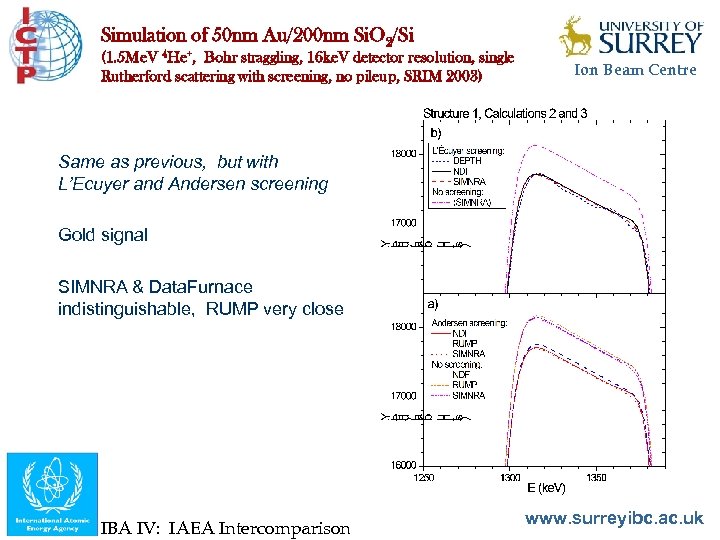
Simulation of 50 nm Au/200 nm Si. O 2/Si (1. 5 Me. V 4 He+, Bohr straggling, 16 ke. V detector resolution, single Rutherford scattering with screening, no pileup, SRIM 2003) Ion Beam Centre Same as previous, but with L’Ecuyer and Andersen screening Gold signal SIMNRA & Data. Furnace indistinguishable, RUMP very close IBA IV: IAEA Intercomparison www. surreyibc. ac. uk
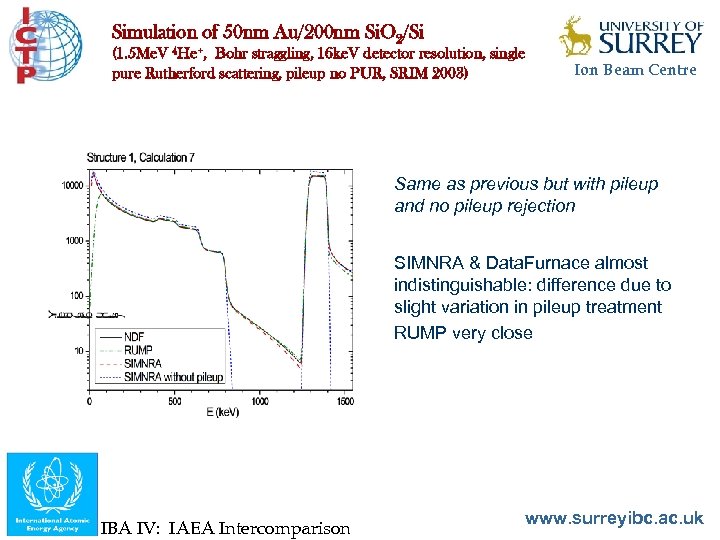
Simulation of 50 nm Au/200 nm Si. O 2/Si (1. 5 Me. V 4 He+, Bohr straggling, 16 ke. V detector resolution, single pure Rutherford scattering, pileup no PUR, SRIM 2003) Ion Beam Centre S ame as previous but with pileup and no pileup rejection SIMNRA & Data. Furnace almost indistinguishable: difference due to slight variation in pileup treatment RUMP very close IBA IV: IAEA Intercomparison www. surreyibc. ac. uk
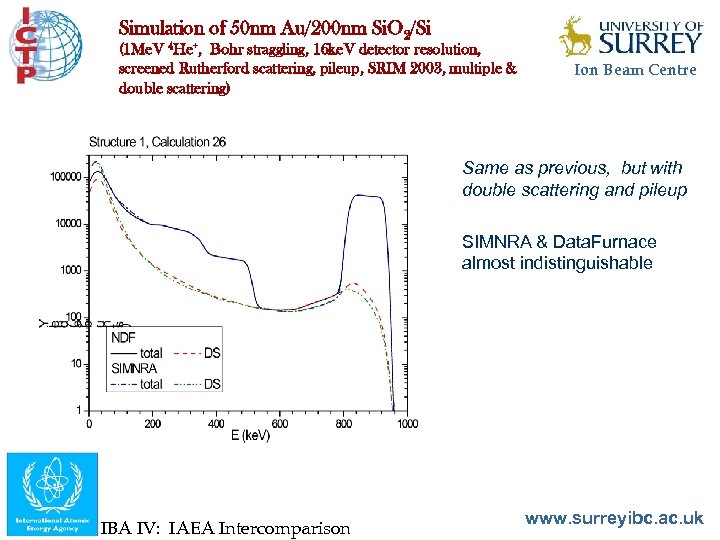
Simulation of 50 nm Au/200 nm Si. O 2/Si (1 Me. V 4 He+, Bohr straggling, 16 ke. V detector resolution, screened Rutherford scattering, pileup, SRIM 2003, multiple & double scattering) Ion Beam Centre Same as previous, but with double scattering and pileup SIMNRA & Data. Furnace almost indistinguishable IBA IV: IAEA Intercomparison www. surreyibc. ac. uk
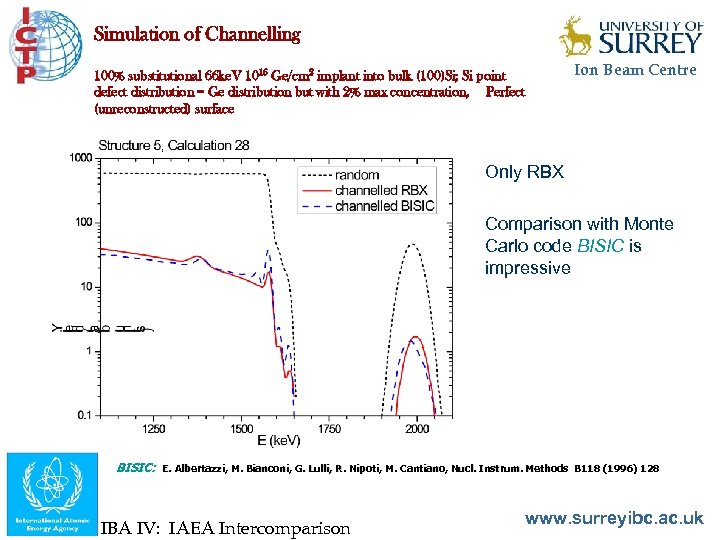
Simulation of Channelling Ion Beam Centre 100% substitutional 66 ke. V 1016 Ge/cm 2 implant into bulk (100)Si; Si point defect distribution = Ge distribution but with 2% max concentration, Perfect (unreconstructed) surface Only RBX Comparison with Monte Carlo code BISIC is impressive BISIC: E. Albertazzi, M. Bianconi, G. Lulli, R. Nipoti, M. Cantiano, Nucl. Instrum. Methods B 118 (1996) 128 IBA IV: IAEA Intercomparison www. surreyibc. ac. uk
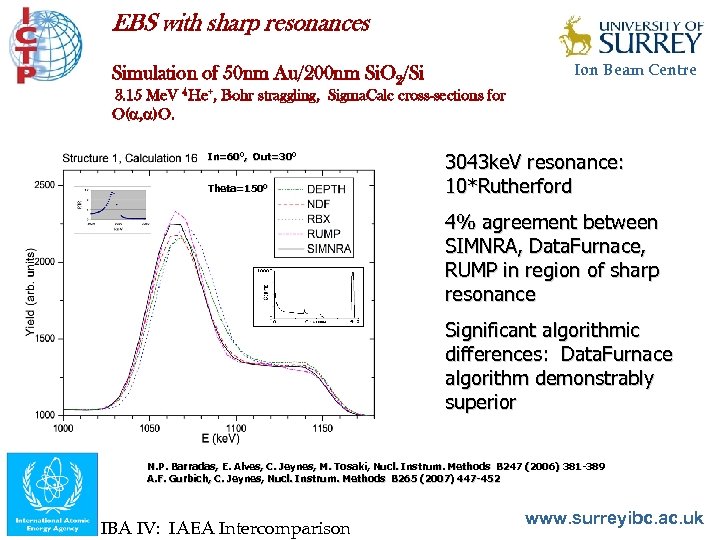
EBS with sharp resonances Simulation of 50 nm Au/200 nm Si. O 2/Si Ion Beam Centre 3. 15 Me. V 4 He+, Bohr straggling, Sigma. Calc cross-sections for O(a, a)O. In=600, Out=300 Theta=1500 3043 ke. V resonance: 10*Rutherford 4% agreement between SIMNRA, Data. Furnace, RUMP in region of sharp resonance Significant algorithmic differences: Data. Furnace algorithm demonstrably superior N. P. Barradas, E. Alves, C. Jeynes, M. Tosaki, Nucl. Instrum. Methods B 247 (2006) 381 -389 A. F. Gurbich, C. Jeynes, Nucl. Instrum. Methods B 265 (2007) 447 -452 IBA IV: IAEA Intercomparison www. surreyibc. ac. uk
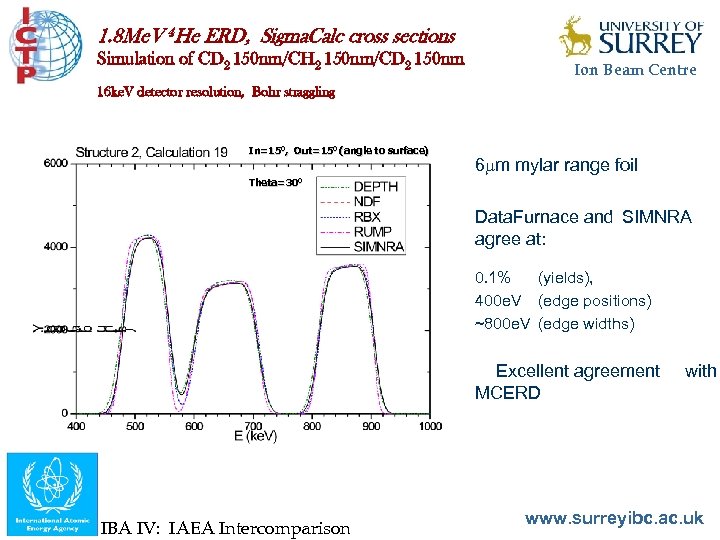
1. 8 Me. V 4 He ERD, Sigma. Calc cross sections Simulation of CD 2 150 nm/CH 2 150 nm/CD 2 150 nm Ion Beam Centre 16 ke. V detector resolution, Bohr straggling In=150, Out=150 (angle to surface) 6 mm mylar range foil Theta=300 Data. Furnace and SIMNRA agree at: 0. 1% (yields), 400 e. V (edge positions) ~800 e. V (edge widths) Excellent agreement MCERD IBA IV: IAEA Intercomparison with www. surreyibc. ac. uk
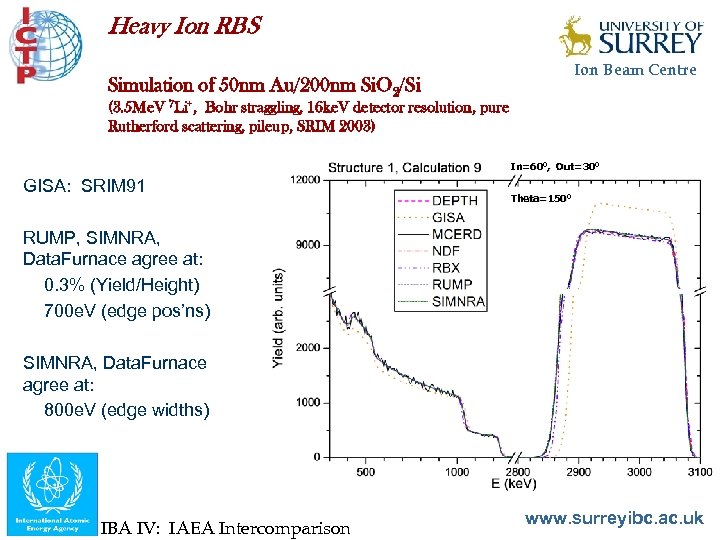
Heavy Ion RBS Ion Beam Centre Simulation of 50 nm Au/200 nm Si. O 2/Si (3. 5 Me. V 7 Li+, Bohr straggling, 16 ke. V detector resolution, pure Rutherford scattering, pileup, SRIM 2003) In=600, Out=300 GISA: SRIM 91 Theta=1500 RUMP, SIMNRA, Data. Furnace agree at: 0. 3% (Yield/Height) 700 e. V (edge pos’ns) SIMNRA, Data. Furnace agree at: 800 e. V (edge widths) IBA IV: IAEA Intercomparison www. surreyibc. ac. uk
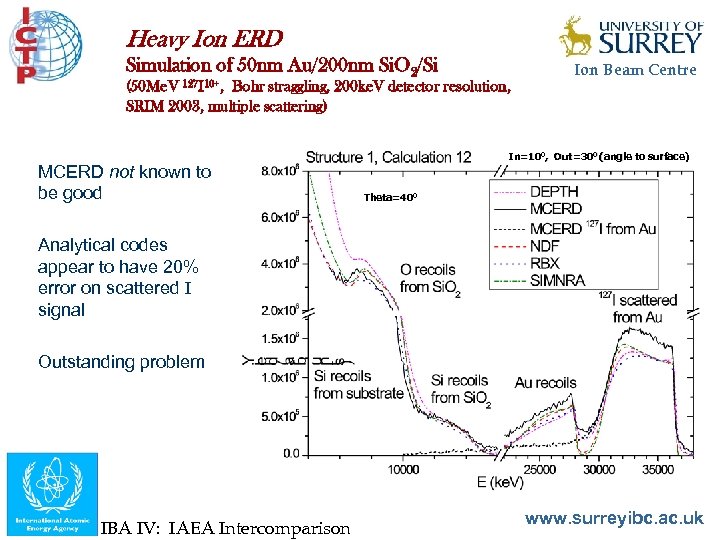
Heavy Ion ERD Simulation of 50 nm Au/200 nm Si. O 2/Si 127 I 10+, (50 Me. V Bohr straggling, 200 ke. V detector resolution, SRIM 2003, multiple scattering) MCERD not known to be good Ion Beam Centre In=100, Out=300 (angle to surface) Theta=400 Analytical codes appear to have 20% error on scattered I signal Outstanding problem IBA IV: IAEA Intercomparison www. surreyibc. ac. uk
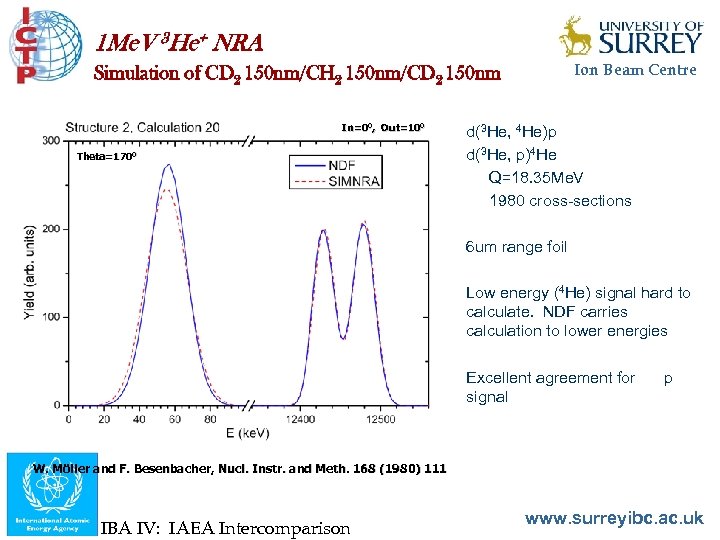
1 Me. V 3 He+ NRA Ion Beam Centre Simulation of CD 2 150 nm/CH 2 150 nm/CD 2 150 nm In=00, Out=100 Theta=1700 d(3 He, 4 He)p d(3 He, p)4 He Q=18. 35 Me. V 1980 cross-sections 6 um range foil Low energy (4 He) signal hard to calculate. NDF carries calculation to lower energies Excellent agreement for p signal W. Möller and F. Besenbacher, Nucl. Instr. and Meth. 168 (1980) 111 IBA IV: IAEA Intercomparison www. surreyibc. ac. uk
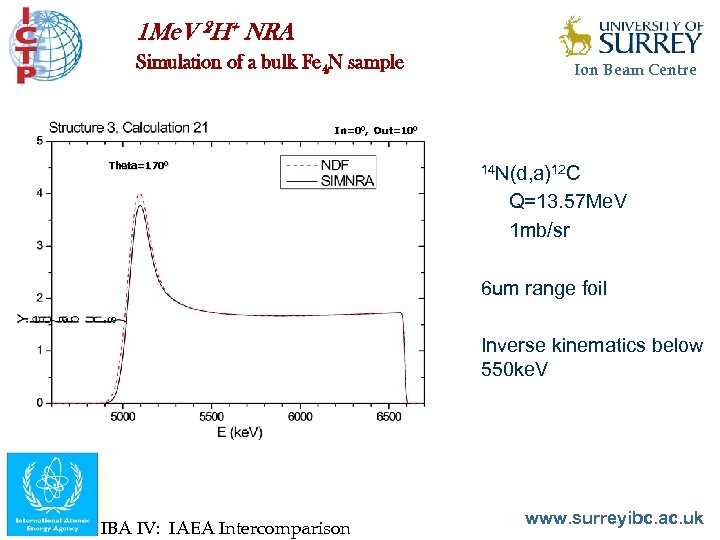
1 Me. V 2 H+ NRA Simulation of a bulk Fe 4 N sample Ion Beam Centre In=00, Out=100 Theta=1700 14 N(d, a)12 C Q=13. 57 Me. V 1 mb/sr 6 um range foil Inverse kinematics below 550 ke. V IBA IV: IAEA Intercomparison www. surreyibc. ac. uk
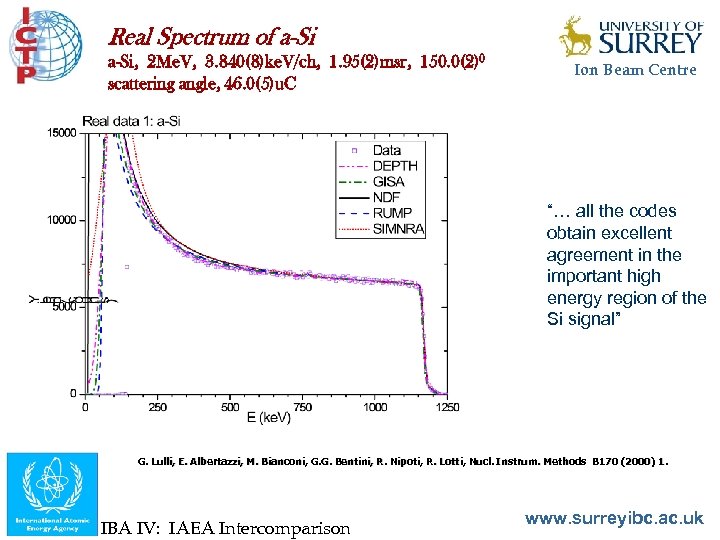
Real Spectrum of a-Si, 2 Me. V, 3. 840(8)ke. V/ch, 1. 95(2)msr, 150. 0(2)0 scattering angle, 46. 0(5)u. C Ion Beam Centre “… all the codes obtain excellent agreement in the important high energy region of the Si signal” G. Lulli, E. Albertazzi, M. Bianconi, G. G. Bentini, R. Nipoti, R. Lotti, Nucl. Instrum. Methods B 170 (2000) 1. IBA IV: IAEA Intercomparison www. surreyibc. ac. uk
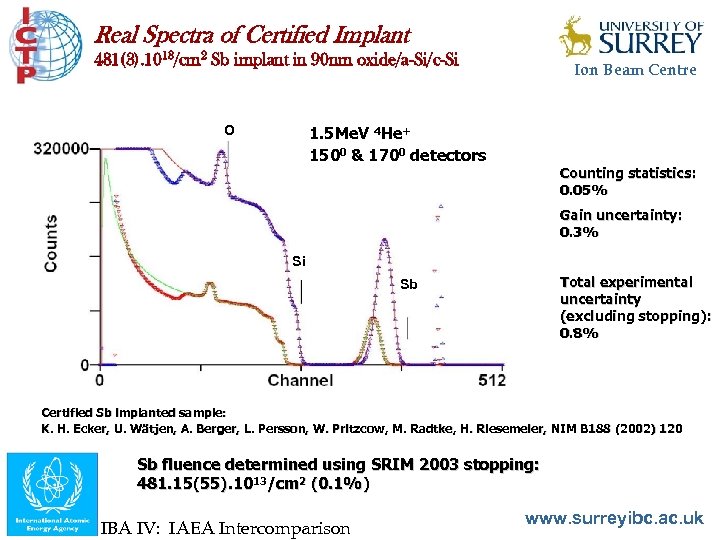
Real Spectra of Certified Implant 481(3). 1013/cm 2 Sb implant in 90 nm oxide/a-Si/c-Si O Ion Beam Centre 1. 5 Me. V 4 He+ 1500 & 1700 detectors Counting statistics: 0. 05% Gain uncertainty: 0. 3% Si Total experimental uncertainty (excluding stopping): 0. 8% Sb Certified Sb implanted sample: K. H. Ecker, U. Wätjen, A. Berger, L. Persson, W. Pritzcow, M. Radtke, H. Riesemeier, NIM B 188 (2002) 120 Sb fluence determined using SRIM 2003 stopping: 481. 15(55). 1013/cm 2 (0. 1%) IBA IV: IAEA Intercomparison www. surreyibc. ac. uk
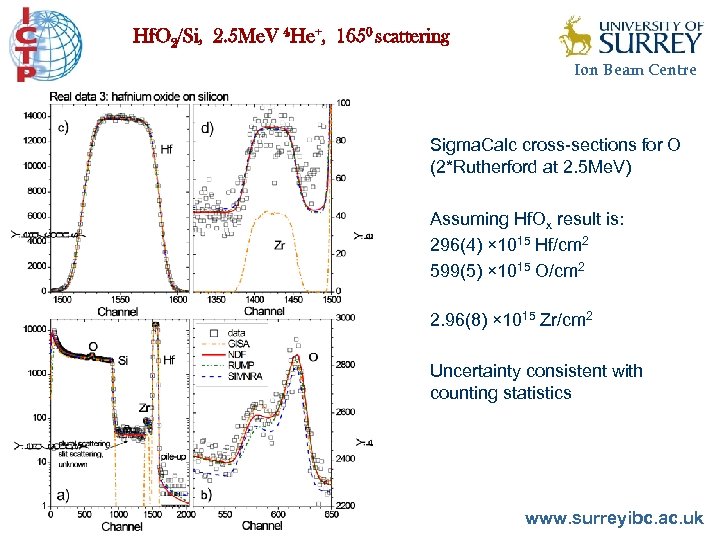
Hf. O 2/Si, 2. 5 Me. V 4 He+, 1650 scattering Ion Beam Centre Sigma. Calc cross-sections for O (2*Rutherford at 2. 5 Me. V) Assuming Hf. Ox result is: 296(4) × 1015 Hf/cm 2 599(5) × 1015 O/cm 2 2. 96(8) × 1015 Zr/cm 2 Uncertainty consistent with counting statistics IBA IV: IAEA Intercomparison www. surreyibc. ac. uk
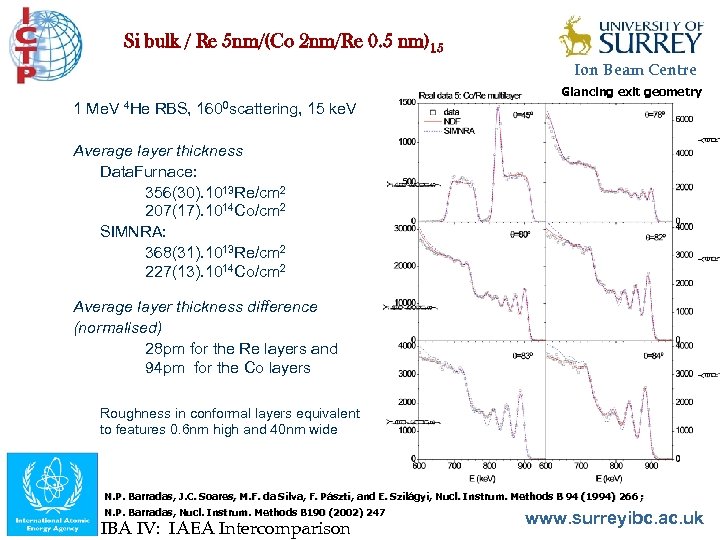
Si bulk / Re 5 nm/(Co 2 nm/Re 0. 5 nm)15 Ion Beam Centre Glancing exit geometry 1 Me. V 4 He RBS, 1600 scattering, 15 ke. V Average layer thickness Data. Furnace: 356(30). 1013 Re/cm 2 207(17). 1014 Co/cm 2 SIMNRA: 368(31). 1013 Re/cm 2 227(13). 1014 Co/cm 2 Average layer thickness difference (normalised) 28 pm for the Re layers and 94 pm for the Co layers Roughness in conformal layers equivalent to features 0. 6 nm high and 40 nm wide N. P. Barradas, J. C. Soares, M. F. da Silva, F. Pászti, and E. Szilágyi, Nucl. Instrum. Methods B 94 (1994) 266 ; N. P. Barradas, Nucl. Instrum. Methods B 190 (2002) 247 IBA IV: IAEA Intercomparison www. surreyibc. ac. uk
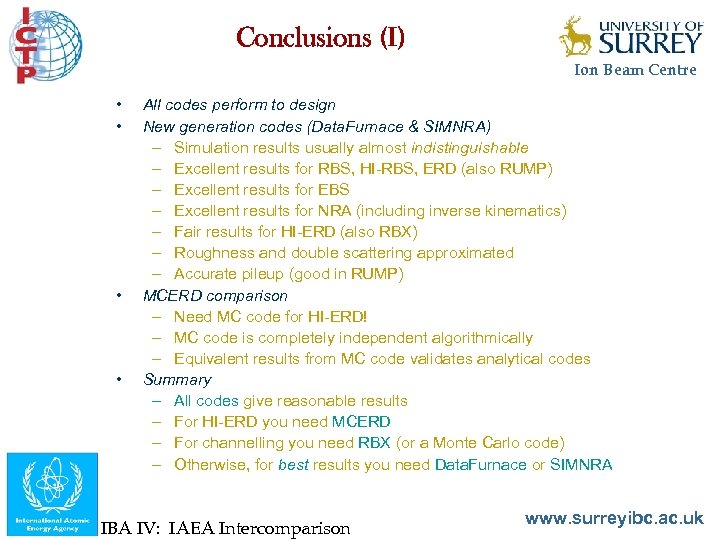
Conclusions (I) Ion Beam Centre • • All codes perform to design New generation codes (Data. Furnace & SIMNRA) – Simulation results usually almost indistinguishable – Excellent results for RBS, HI-RBS, ERD (also RUMP) – Excellent results for EBS – Excellent results for NRA (including inverse kinematics) – Fair results for HI-ERD (also RBX) – Roughness and double scattering approximated – Accurate pileup (good in RUMP) MCERD comparison – Need MC code for HI-ERD! – MC code is completely independent algorithmically – Equivalent results from MC code validates analytical codes Summary – All codes give reasonable results – For HI-ERD you need MCERD – For channelling you need RBX (or a Monte Carlo code) – Otherwise, for best results you need Data. Furnace or SIMNRA IBA IV: IAEA Intercomparison www. surreyibc. ac. uk
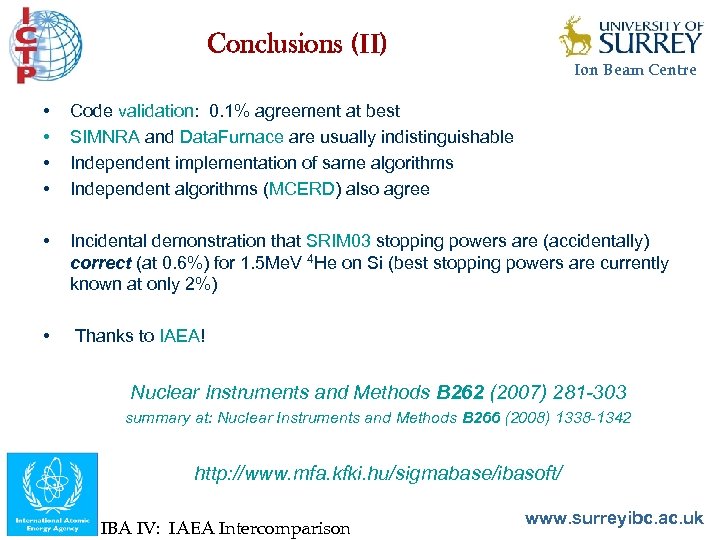
Conclusions (II) Ion Beam Centre • • Code validation: 0. 1% agreement at best SIMNRA and Data. Furnace are usually indistinguishable Independent implementation of same algorithms Independent algorithms (MCERD) also agree • Incidental demonstration that SRIM 03 stopping powers are (accidentally) correct (at 0. 6%) for 1. 5 Me. V 4 He on Si (best stopping powers are currently known at only 2%) • Thanks to IAEA! Nuclear Instruments and Methods B 262 (2007) 281 -303 summary at: Nuclear Instruments and Methods B 266 (2008) 1338 -1342 http: //www. mfa. kfki. hu/sigmabase/ibasoft/ IBA IV: IAEA Intercomparison www. surreyibc. ac. uk
Скачать презентацию Ion Beam Centre The IAEA Intercomparison of IBA
8eefff4b0406b91d71e87b2600f4ef52.ppt