


 Скачать презентацию Involving People living with HIV AIDS What does the
7b1bb680191dd3afa7153938fda7a3ec.ppt
- Количество слайдов: 15
 Involving People living with HIV/AIDS: What does the Science Tell Us? Mark Tyndall & Thomas Kerr British Columbia Centre for Excellence in HIV/AIDS Dept. of Medicine, University of British Columbia
 Involving Communities… The ethical imperative to involve people living with HIV/AIDS in policy development and program delivery is clear There is also scientific evidence supporting the principles outlined in GIPA
 The Situation… The policy response to HIV/AIDS among people who inject drugs (IDU) is inadequate and often harmful Ø The most commonly applied approach to injection drug use is to impose criminal sanctions Ø IDU are often driven into environments where they are difficult to locate for the purpose of providing prevention and risk reduction information and services Ø As a result, the most explosive HIV epidemics in the world have occurred among IDU Ø
 Challenges… Service providers often experience difficulties in reaching and communicating with drug users and other marginalized groups on their own turf Ø IDU are also known to avoid seeking services out of fear that accessing them may alert police to their illegal activities Ø In response, IDU have become increasingly involved in policy change and development, and program delivery Ø A growing body of research demonstrates the far reaching effects of this form of involvement Ø
 The Benefits…. Ø Increased acceptance Ø Improved reach & coverage Able to focus on the most important issues Ø Cost-effectiveness Ø Ø Provision of opportunities for training and employment Reduction of stigma Ø Enhanced opportunities to translate policy into action Ø (Broadhead et al. , 1995; Broadhead et al. , 1998; Grund et al. , 1993; Power et al. , 1995; Latkin, 1998; Cottler et al. , 1998, Wood et al. , 2003; Kerr et al. , 2006)
 Improved Reach and Coverage
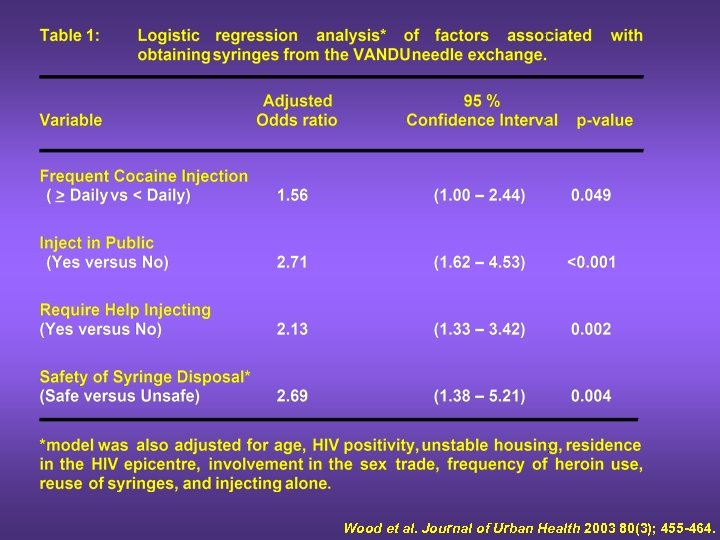 Wood et al. Journal of Urban Health 2003 80(3); 455 -464.
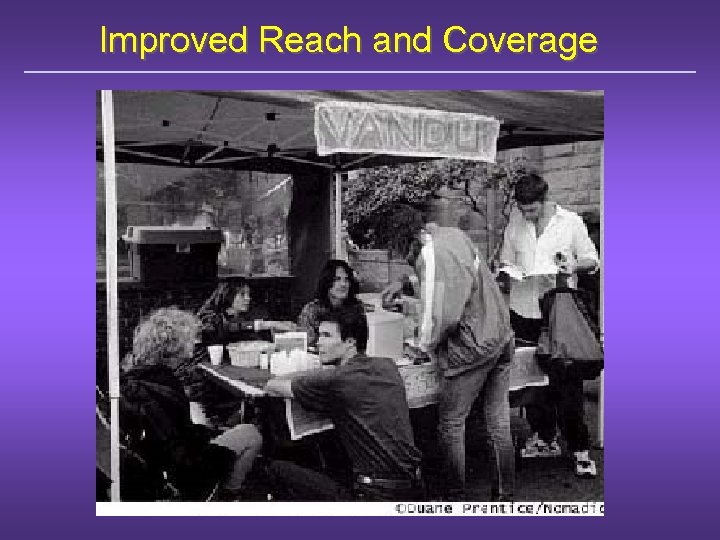
 Improved Reach and Coverage “There was a tent set up. And there was a needle exchange going on there…And I thought ‘wow’, that's a lot better than running the van around… it's just convenient. It's on the street, it's there. Right where people score dope, like it’s not far to walk. And then I found out it was called VANDU…It just feels more safe. It's nice to have that convenience especially if you're IV drug using, cause needles are a big issue. Especially when people are doing cocaine or stuff like that. It's so easy to use another rig that's been used if you can't get a syringe, and if you can't afford to buy one…Actually I used to use the [fixed] needle exchange at DEYAS all the time. Now it's just more convenient for me to use VANDU. They're just, they're there more. They're where you need them…I find them where I need them. ” (Program Recipient) Kerr et al. , IJDP 2006
 Improved Reach and Coverage
 Reduced Stigma “It brings together a collective experience and wisdom, but also you begin to get a different feeling about yourself. To become part of something for who I am and not for who I am not. For who I am as an addict, I’m poor, I’ve got hep C, I lived in wretched housing and all this, and then someone says, ‘Yeah, that all makes you a really valuable person. You have a lot to contribute to try to help people and to save other lives, and your experience can do that. ’ Then I get a different feeling about myself. ”(Founder) Kerr et al. , IJDP 2006
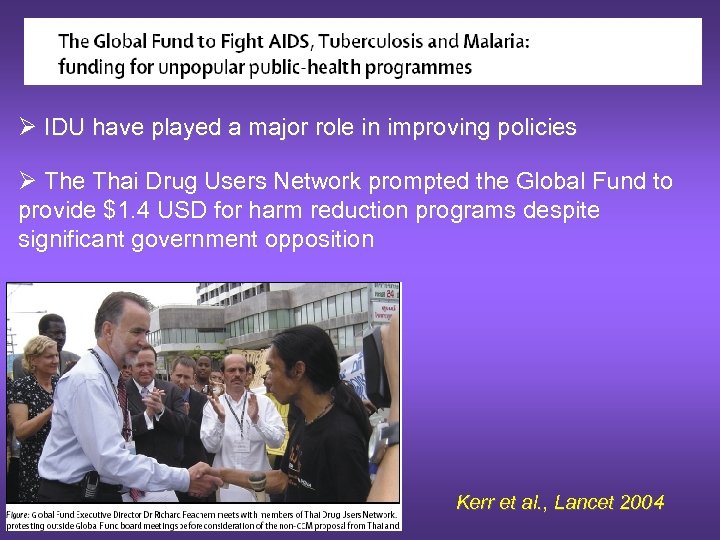 Ø IDU have played a major role in improving policies Ø The Thai Drug Users Network prompted the Global Fund to provide $1. 4 USD for harm reduction programs despite significant government opposition Kerr et al. , Lancet 2004
 Resisting Oppression
 Resisting Oppression
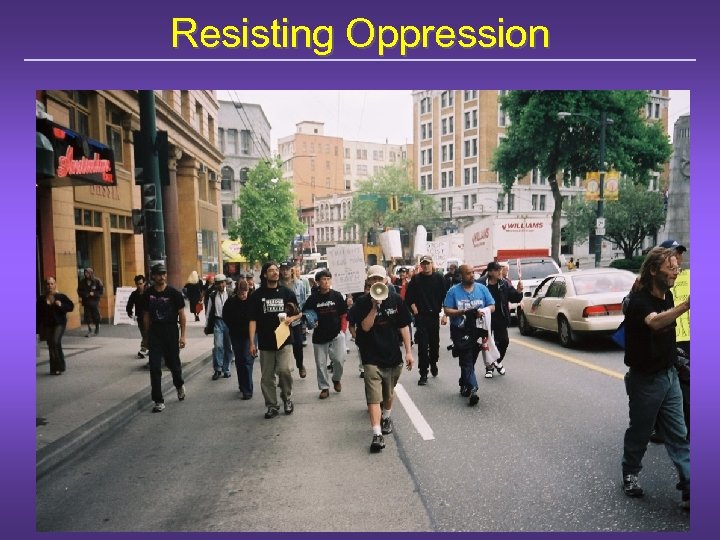
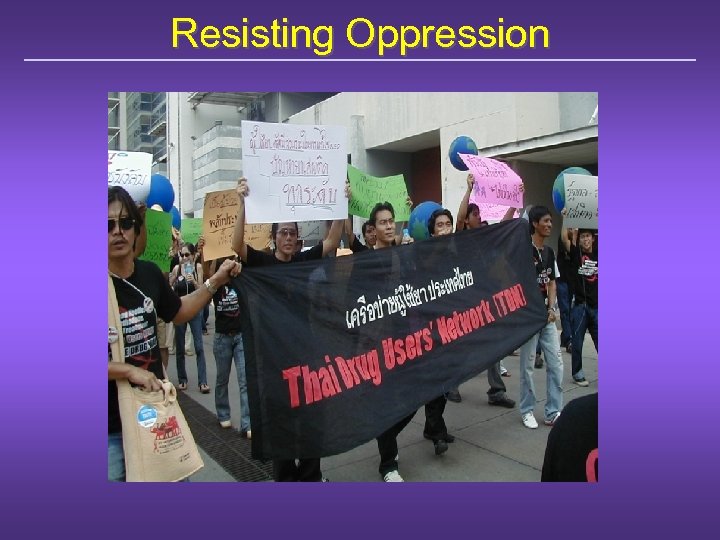
 Summary Ø A growing body of research has demonstrated the benefits of involving IDU in policy and program development and delivery Ø The involvement of IDU can improve the acceptance, reach, and coverage of programs Ø Involvement can also serve to reduce stigma and provide opportunities for training and low-threshold employment Ø IDU can also play an effective role in countering oppressive policies
 Moving Forward The GIPA principles are supported by research evidence – although more is needed Ø Governments and service providers should make efforts to promote the involvement of people living with HIV/AIDS in policy and program development and delivery Ø Involvement should be maximized by supporting the involvement of PLWA in formal systems and by supporting the development of independent PLWA groups Ø Ø For many people, this is literally a life and death issue