


 Скачать презентацию Invited Talk for the SATRIA Week University Putra
5f43e290d9ab089d843f45f283ee82e3.ppt
- Количество слайдов: 62
 Invited Talk for the SATRIA Week, University Putra Malaysia; April 9 th, 2009 Jaafar Jantan a. k. a. DR. JJ (Assoc. Prof. Dr. ) Faculty of Applied Sciences, Ui. TM, Shah Alam “The principle goal of education is to create men who are capable of doing new things, not simply of repeating what other generations have done -- men who are creative, inventive and discoverers. “ Jean Piaget “The only person who is educated is the one who has learned how to learn and change. ” Carl Rogers email: jjnita@salam. uitm. edu. my, drjjlanita@hotmail. com; fsgobe@gmail. com Website: http: //drjj. uitm. edu. my/ Copyright Dr. JJ, ASERG, FSG Ui. TM, May 2008 1
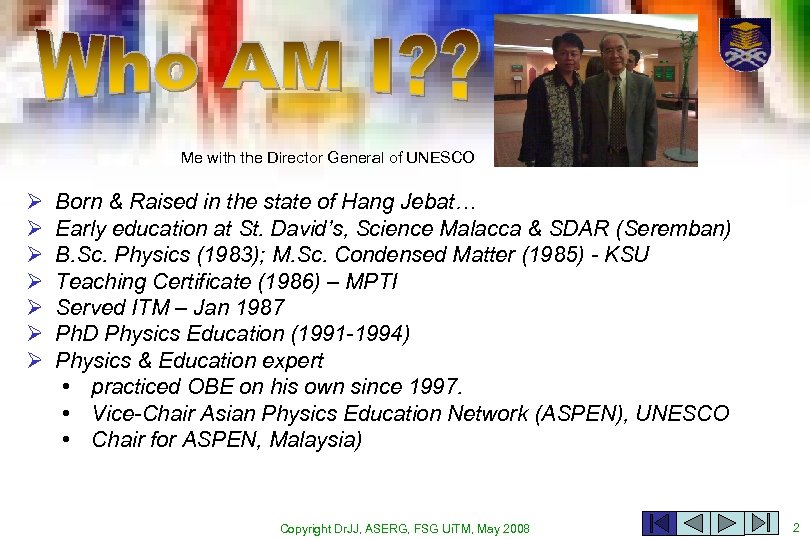 Me with the Director General of UNESCO Ø Ø Ø Ø Born & Raised in the state of Hang Jebat… Early education at St. David’s, Science Malacca & SDAR (Seremban) B. Sc. Physics (1983); M. Sc. Condensed Matter (1985) - KSU Teaching Certificate (1986) – MPTI Served ITM – Jan 1987 Ph. D Physics Education (1991 -1994) Physics & Education expert • practiced OBE on his own since 1997. • Vice-Chair Asian Physics Education Network (ASPEN), UNESCO • Chair for ASPEN, Malaysia) Copyright Dr. JJ, ASERG, FSG Ui. TM, May 2008 2
 Copyright Dr. JJ, ASERG, FSG Ui. TM, May 2008 3
 Copyright Dr. JJ, ASERG, FSG Ui. TM, May 2008 4
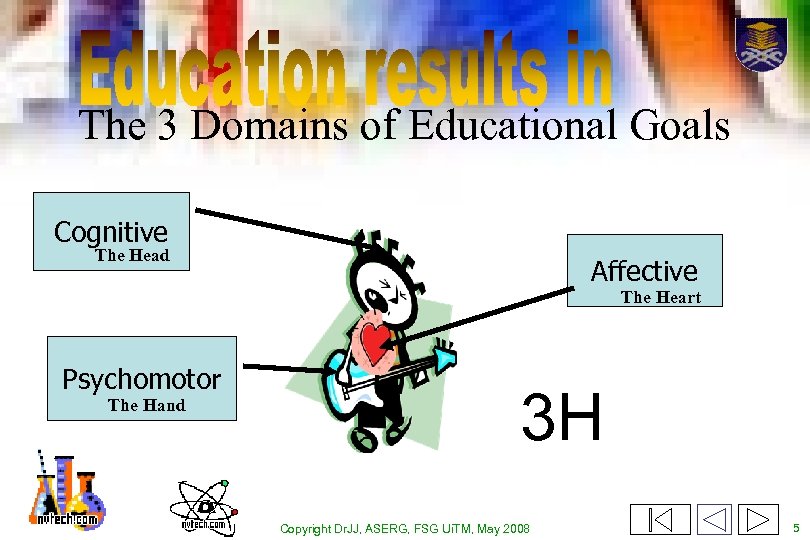 The 3 Domains of Educational Goals Cognitive The Head Affective The Heart Psychomotor The Hand 3 H Copyright Dr. JJ, ASERG, FSG Ui. TM, May 2008 5
 “We must produce confident students with a sense of balance and proportion. While an individual may specialise in a certain area, his or her perspective should be enriched by other experiences as well. ” “The MOHE will thus introduce a holistic programme that will cut across all disciplines and focus on communication and entrepreneurial skills. The programme, which is intended to build a balanced perspective in all students, will expose them to subjects beyond their area of specialisation. For example, students reading for degrees in the sciences such as medicine, engineering and chemistry will be exposed to courses covering literature and philosophy. Likewise, students in the humanities will be exposed to the rudiments of science and technology, and certainly, ICT. ” Source: NATIONAL HIGHER EDUCATION ACTION PLAN 2007 -2010 Copyright Dr. JJ, ASERG, FSG Ui. TM, May 2008 6
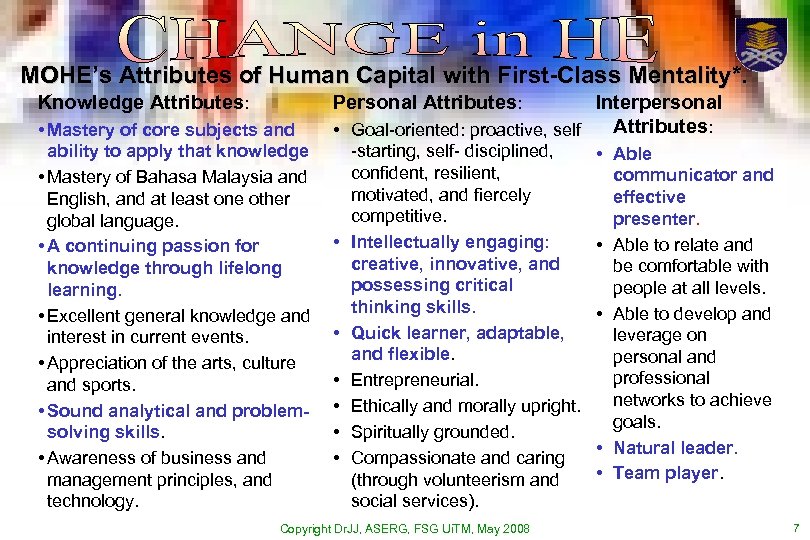 MOHE’s Attributes of Human Capital with First-Class Mentality*. Knowledge Attributes: Personal Attributes: • Mastery of core subjects and ability to apply that knowledge • Mastery of Bahasa Malaysia and English, and at least one other global language. • A continuing passion for knowledge through lifelong learning. • Excellent general knowledge and interest in current events. • Appreciation of the arts, culture and sports. • Sound analytical and problemsolving skills. • Awareness of business and management principles, and technology. Interpersonal Attributes: • Goal-oriented: proactive, self • • • -starting, self- disciplined, confident, resilient, motivated, and fiercely competitive. Intellectually engaging: creative, innovative, and possessing critical thinking skills. Quick learner, adaptable, and flexible. Entrepreneurial. Ethically and morally upright. Spiritually grounded. Compassionate and caring (through volunteerism and social services). Copyright Dr. JJ, ASERG, FSG Ui. TM, May 2008 • Able communicator and effective presenter. • Able to relate and be comfortable with people at all levels. • Able to develop and leverage on personal and professional networks to achieve goals. • Natural leader. • Team player. 7
 Copyright Dr. JJ, ASERG, FSG Ui. TM, May 2008 8
 Strategi #1 P&P: Menyemak kurikulum berteraskan attributes graduan berkualiti & berdaya saing Pelan Tindakan Petunjuk Prestasi (KPI) 1. 1. 1 Menyebarluaskan kefahaman LO & 100% TNC A&A & HEPA menguasai KI di semua IPT rekabentuk kurikulum berteraskan LO & KI. 1 Prog/IPTA sehingga Dis 2008 1. 1. 2 Menyemak semua kurikulum berteraskan LO & KI 100% kurikulum disemak berteraskan LO & KI menjelang 2010 1. 1. 3 Menjalankan keperluan pasaran berteraskan kajian halatuju prog & kebolehpasaran graduan 100% program kritikal mempunyai kajian halatuju & model unjuran pasaran kerja menjelang Julai 2009 1. 1. 4 Mendokumentasikan semua kurikulum 100% kurikulum IPT dikelaskan sebagai dokumen kawalan di JPT menjelang 2010 Copyright Dr. JJ, ASERG, FSG Ui. TM, May 2008 9
 Keperluan JKPT • Memenuhi/mencapai PSPTN Teras Kedua – Menambahbaik Kualiti Pengajaran & Pembelajaran • Di akhir pengajian di IPTA, pelajar perlu memenuhi attributes/kriteria tertentu. . Yang telah dijanjikan kepada pelajar dalam Hasil Pembelajaran samada Program atau Kursus. • Kurikulum pengajian perlu diasaskan kepada kelebaran dan kedalaman yang sesuai i. e. breadth and depth Copyright Dr. JJ, ASERG, FSG Ui. TM, May 2008 10
 IS WAS 1. 2. 3. 4. 5. 6. 7. 8. Knowledge (K) Practical Skills (P) Social skills and responsibility (A) Values, attitudes and professionalism (A) Communication, leadership and team skills (P/A) Problem solving and scientific skills (K/P) Information management and lifelong learning skills(P/A) Managerial and entrepreneurial skills (K/P/A) 1. 2. 3. 4. 5. 6. 7. 8. 9. Knowledge (K) Practical Skills (P) Thinking and scientific skills Communication skills Social skills, teamwork and responsibility Values, ethics, moral and professionalism (A) Information management and lifelong learning skills(P/A) Managerial and entrepreneurial skills (K/P/A) Leadership skills Copyright Dr. JJ, ASERG, FSG Ui. TM, May 2008 11
 7 Soft Skills Learning Outcomes (LO KI) 1. 2. 3. 4. 5. 6. 7. Critical thinking and problem solving skills (P) Communication skills (P) Ethics and professionalism (A) Group working skills (A) Lifelong learning and information management (A) Entrepreneurship skills (P) Leadership skills (A) Copyright Dr. JJ, ASERG, FSG Ui. TM, May 2008 12
 Copyright Dr. JJ, ASERG, FSG Ui. TM, May 2008 13
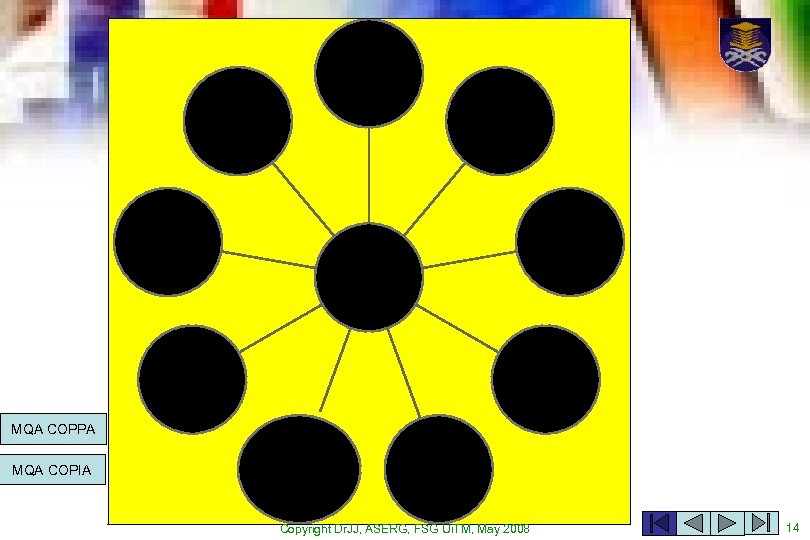 Vision, mission, and learning outcomes Total continual quality improvement Leadership, governance and administration Curriculum design and delivery Assessment of students MQA Aspects of Standards Student selection and support services Programme monitoring and review MQA COPPA MQA COPIA Educational resources Academic staff Copyright Dr. JJ, ASERG, FSG Ui. TM, May 2008 14
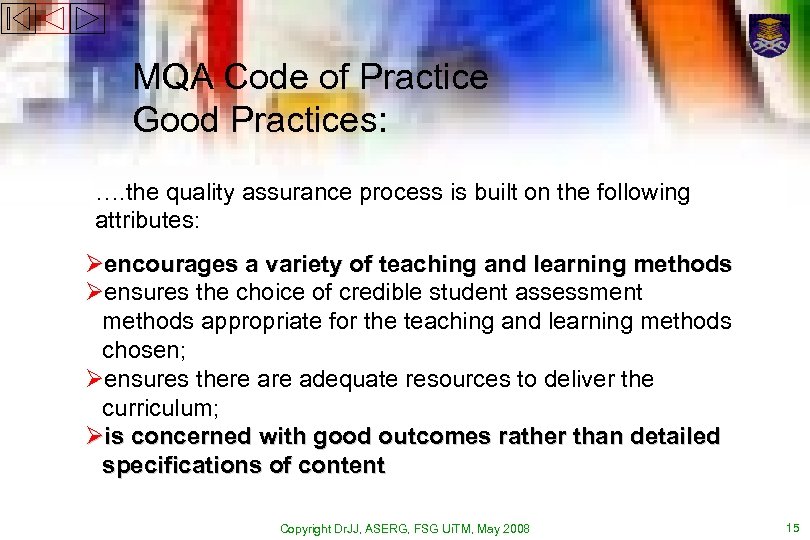 MQA Code of Practice Good Practices: …. the quality assurance process is built on the following attributes: Øencourages a variety of teaching and learning methods Øensures the choice of credible student assessment methods appropriate for the teaching and learning methods chosen; Øensures there adequate resources to deliver the curriculum; Øis concerned with good outcomes rather than detailed specifications of content Copyright Dr. JJ, ASERG, FSG Ui. TM, May 2008 15
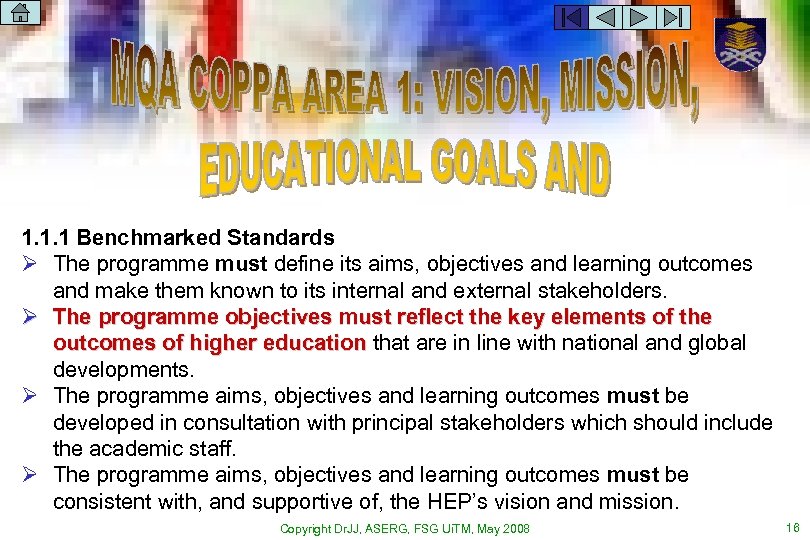 1. 1. 1 Benchmarked Standards Ø The programme must define its aims, objectives and learning outcomes and make them known to its internal and external stakeholders. Ø The programme objectives must reflect the key elements of the outcomes of higher education that are in line with national and global outcomes of higher education developments. Ø The programme aims, objectives and learning outcomes must be developed in consultation with principal stakeholders which should include the academic staff. Ø The programme aims, objectives and learning outcomes must be consistent with, and supportive of, the HEP’s vision and mission. Copyright Dr. JJ, ASERG, FSG Ui. TM, May 2008 16
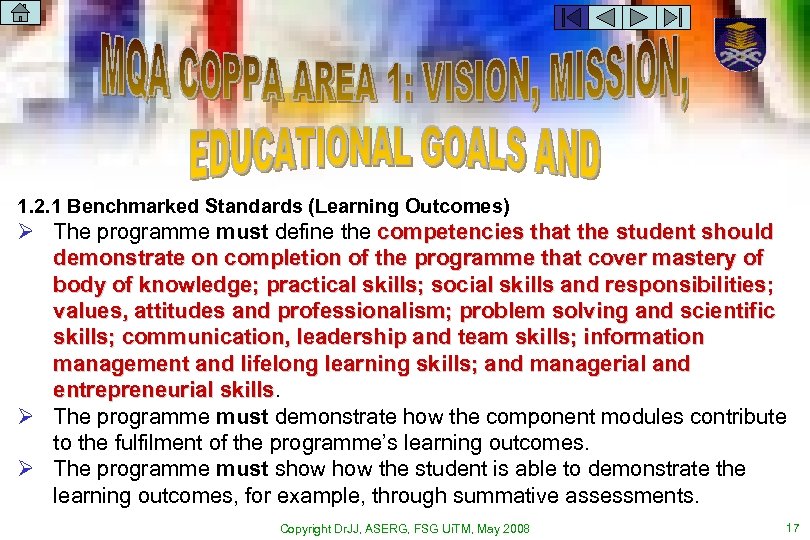 1. 2. 1 Benchmarked Standards (Learning Outcomes) Ø The programme must define the competencies that the student should demonstrate on completion of the programme that cover mastery of body of knowledge; practical skills; social skills and responsibilities; values, attitudes and professionalism; problem solving and scientific skills; communication, leadership and team skills; information management and lifelong learning skills; and managerial and entrepreneurial skills Ø The programme must demonstrate how the component modules contribute to the fulfilment of the programme’s learning outcomes. Ø The programme must show the student is able to demonstrate the learning outcomes, for example, through summative assessments. Copyright Dr. JJ, ASERG, FSG Ui. TM, May 2008 17
 Copyright Dr. JJ, ASERG, FSG Ui. TM, May 2008 18
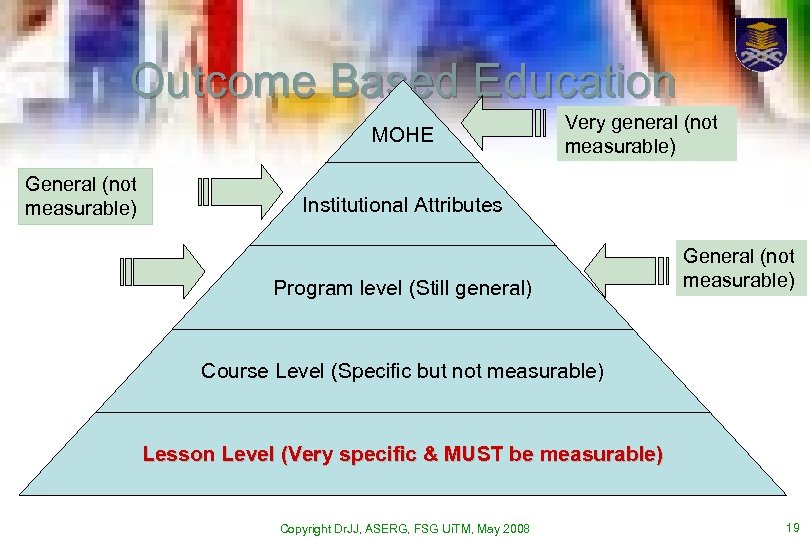 Outcome Based Education MOHE General (not measurable) Very general (not measurable) Institutional Attributes Program level (Still general) General (not measurable) Course Level (Specific but not measurable) Lesson Level (Very specific & MUST be measurable) Copyright Dr. JJ, ASERG, FSG Ui. TM, May 2008 19
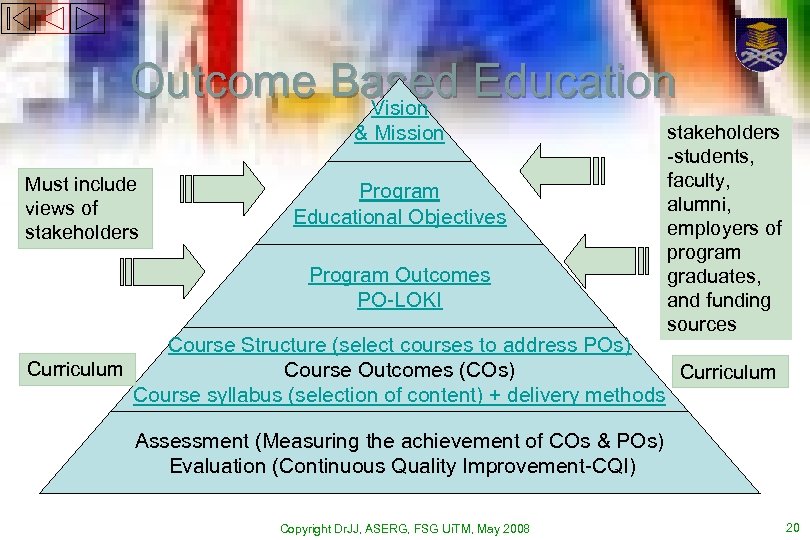 Outcome Based Education Vision & Mission Must include views of stakeholders Program Educational Objectives Program Outcomes PO-LOKI stakeholders -students, faculty, alumni, employers of program graduates, and funding sources Course Structure (select courses to address POs) Curriculum Course Outcomes (COs) Curriculum Course syllabus (selection of content) + delivery methods Assessment (Measuring the achievement of COs & POs) Evaluation (Continuous Quality Improvement-CQI) Copyright Dr. JJ, ASERG, FSG Ui. TM, May 2008 20
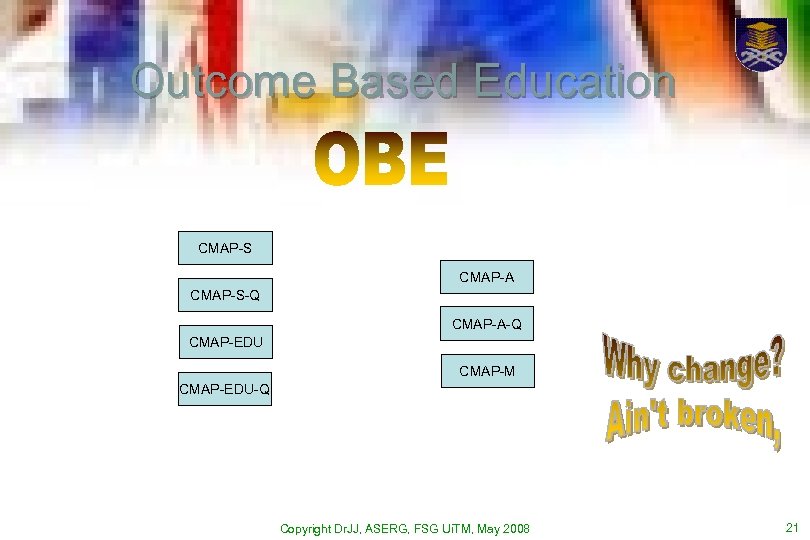 Outcome Based Education CMAP-S CMAP-A CMAP-S-Q CMAP-A-Q CMAP-EDU CMAP-M CMAP-EDU-Q Copyright Dr. JJ, ASERG, FSG Ui. TM, May 2008 21
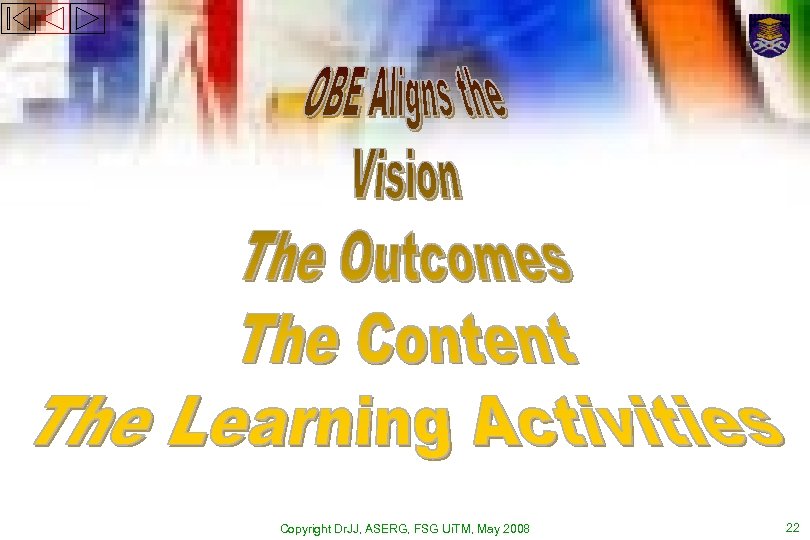 Copyright Dr. JJ, ASERG, FSG Ui. TM, May 2008 22
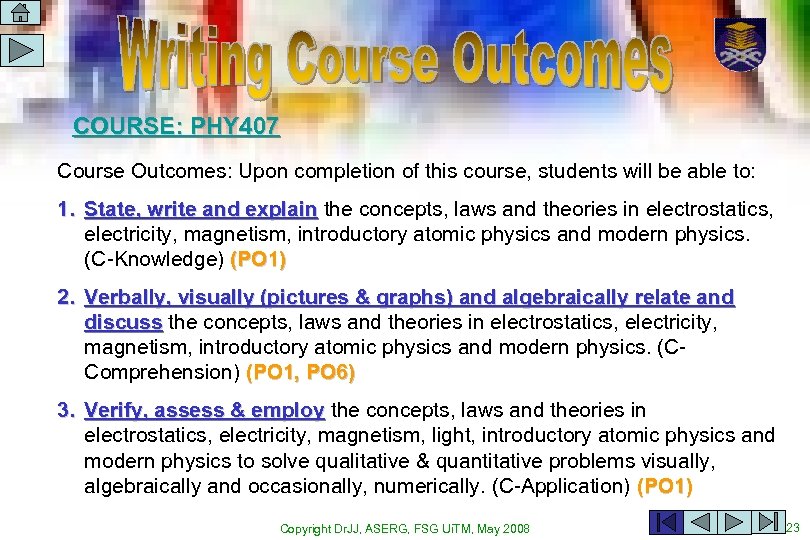 COURSE: PHY 407 Course Outcomes: Upon completion of this course, students will be able to: 1. State, write and explain the concepts, laws and theories in electrostatics, State, write and explain electricity, magnetism, introductory atomic physics and modern physics. (C-Knowledge) (PO 1) 2. Verbally, visually (pictures & graphs) and algebraically relate and discuss the concepts, laws and theories in electrostatics, electricity, discuss magnetism, introductory atomic physics and modern physics. (CComprehension) (PO 1, PO 6) 3. Verify, assess & employ the concepts, laws and theories in Verify, assess & employ electrostatics, electricity, magnetism, light, introductory atomic physics and modern physics to solve qualitative & quantitative problems visually, algebraically and occasionally, numerically. (C-Application) (PO 1) Copyright Dr. JJ, ASERG, FSG Ui. TM, May 2008 23
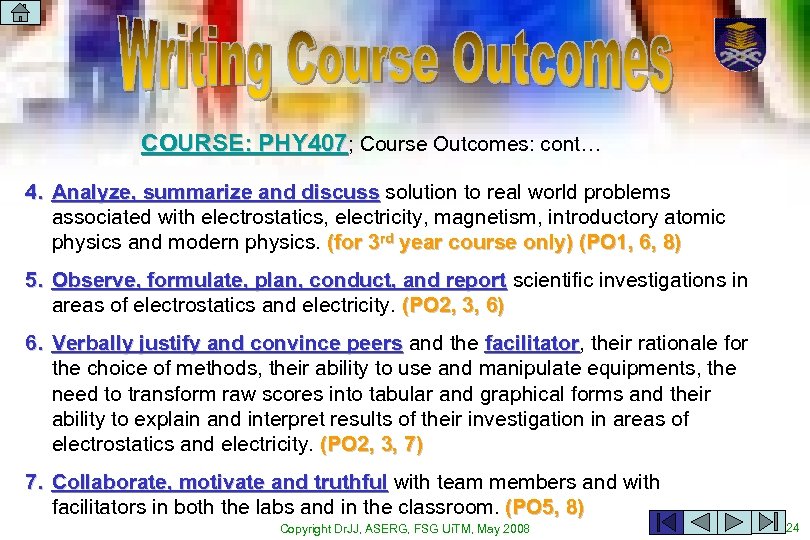 COURSE: PHY 407; Course Outcomes: cont… 4. Analyze, summarize and discuss solution to real world problems Analyze, summarize and discuss associated with electrostatics, electricity, magnetism, introductory atomic physics and modern physics. (for 3 rd year course only) (PO 1, 6, 8) 5. Observe, formulate, plan, conduct, and report scientific investigations in Observe, formulate, plan, conduct, and report areas of electrostatics and electricity. (PO 2, 3, 6) 6. Verbally justify and convince peers and the facilitator, their rationale for Verbally justify and convince peers facilitator the choice of methods, their ability to use and manipulate equipments, the need to transform raw scores into tabular and graphical forms and their ability to explain and interpret results of their investigation in areas of electrostatics and electricity. (PO 2, 3, 7) 7. Collaborate, motivate and truthful with team members and with Collaborate, motivate and truthful facilitators in both the labs and in the classroom. (PO 5, 8) Copyright Dr. JJ, ASERG, FSG Ui. TM, May 2008 24
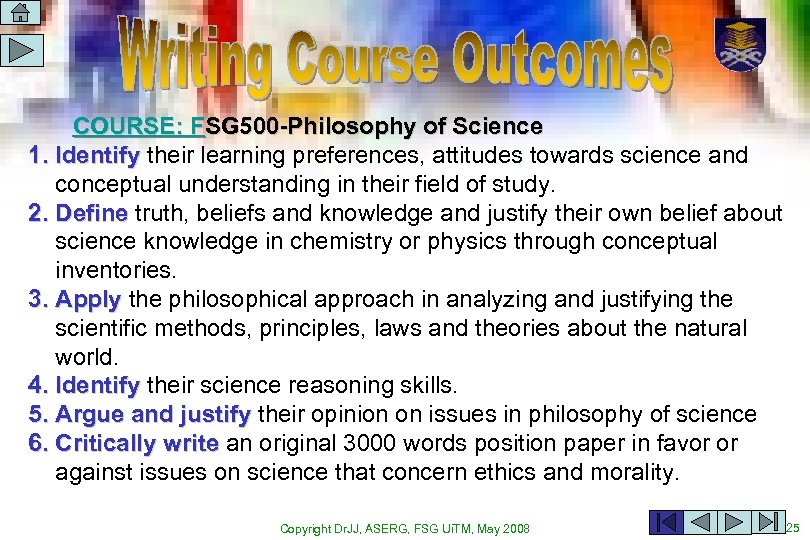 COURSE: FSG 500 -Philosophy of Science 1. Identify their learning preferences, attitudes towards science and Identify conceptual understanding in their field of study. 2. Define truth, beliefs and knowledge and justify their own belief about Define science knowledge in chemistry or physics through conceptual inventories. 3. Apply the philosophical approach in analyzing and justifying the Apply scientific methods, principles, laws and theories about the natural world. 4. Identify their science reasoning skills. Identify 5. Argue and justify their opinion on issues in philosophy of science Argue and justify 6. Critically write an original 3000 words position paper in favor or Critically write against issues on science that concern ethics and morality. Copyright Dr. JJ, ASERG, FSG Ui. TM, May 2008 25
 Copyright Dr. JJ, ASERG, FSG Ui. TM, May 2008 26
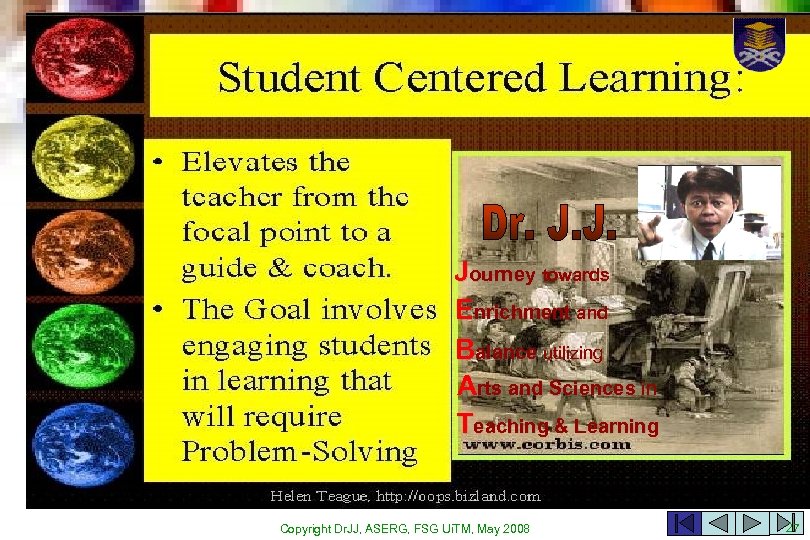 Journey towards ourney Enrichment and nrichment Balance utilizing alance Arts and Sciences in rts and Sciences Teaching & Learning Copyright Dr. JJ, ASERG, FSG Ui. TM, May 2008 27
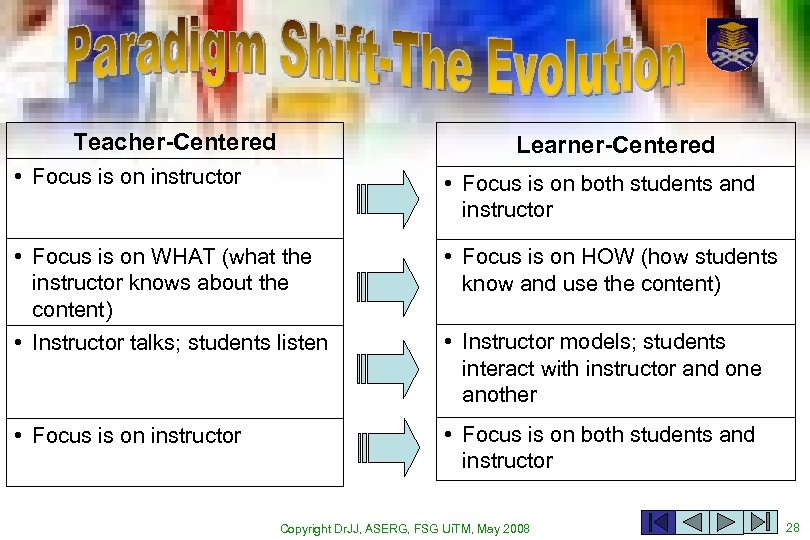 Teacher-Centered Learner-Centered • Focus is on instructor • Focus is on both students and instructor • Focus is on WHAT (what the instructor knows about the content) • Instructor talks; students listen • Focus is on HOW (how students know and use the content) • Focus is on instructor • Focus is on both students and instructor • Instructor models; students interact with instructor and one another Copyright Dr. JJ, ASERG, FSG Ui. TM, May 2008 28
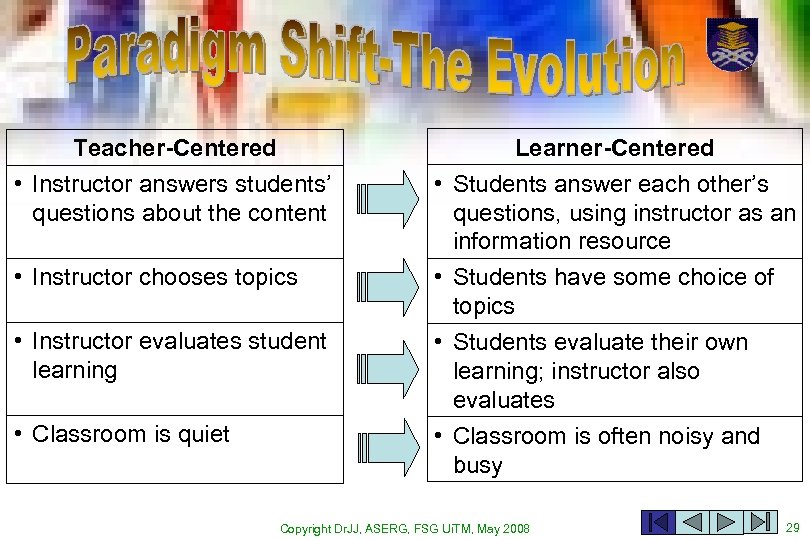 Teacher-Centered • Instructor answers students’ questions about the content • Instructor chooses topics • Instructor evaluates student learning • Classroom is quiet Learner-Centered • Students answer each other’s questions, using instructor as an information resource • Students have some choice of topics • Students evaluate their own learning; instructor also evaluates • Classroom is often noisy and busy Copyright Dr. JJ, ASERG, FSG Ui. TM, May 2008 29
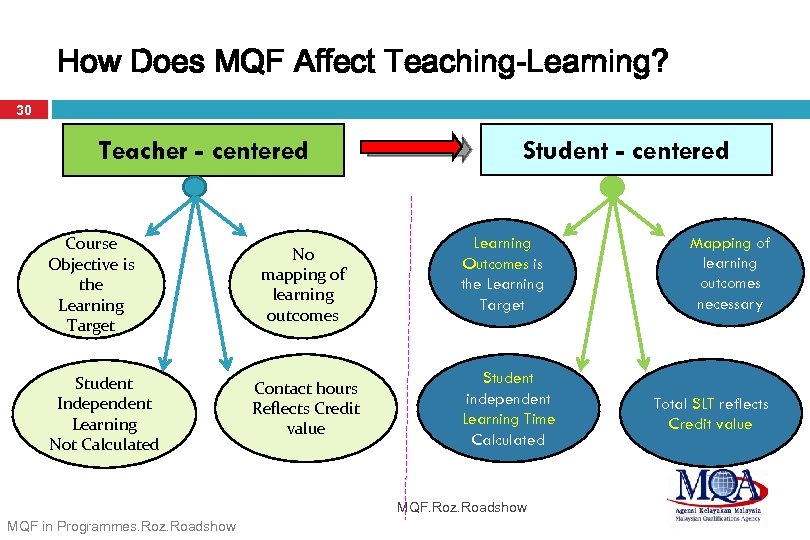 How Does MQF Affect Teaching-Learning? 30 Teacher - centered Course Objective is the Learning Target Student Independent Learning Not Calculated No mapping of learning outcomes Contact hours Reflects Credit value Student - centered Learning Outcomes is the Learning Target Student independent Learning Time Calculated MQF. Roz. Roadshow MQF in Programmes. Roz. Roadshow Mapping of learning outcomes necessary Total SLT reflects Credit value
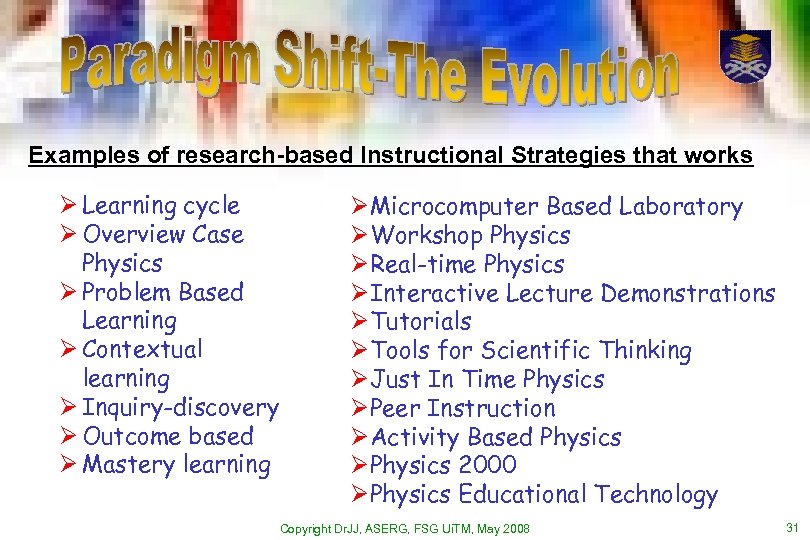 Examples of research-based Instructional Strategies that works Ø Learning cycle Ø Overview Case Physics Ø Problem Based Learning Ø Contextual learning Ø Inquiry-discovery Ø Outcome based Ø Mastery learning ØMicrocomputer Based Laboratory ØWorkshop Physics ØReal-time Physics ØInteractive Lecture Demonstrations ØTutorials ØTools for Scientific Thinking ØJust In Time Physics ØPeer Instruction ØActivity Based Physics ØPhysics 2000 ØPhysics Educational Technology Copyright Dr. JJ, ASERG, FSG Ui. TM, May 2008 31
 Copyright Dr. JJ, ASERG, FSG Ui. TM, May 2008 32
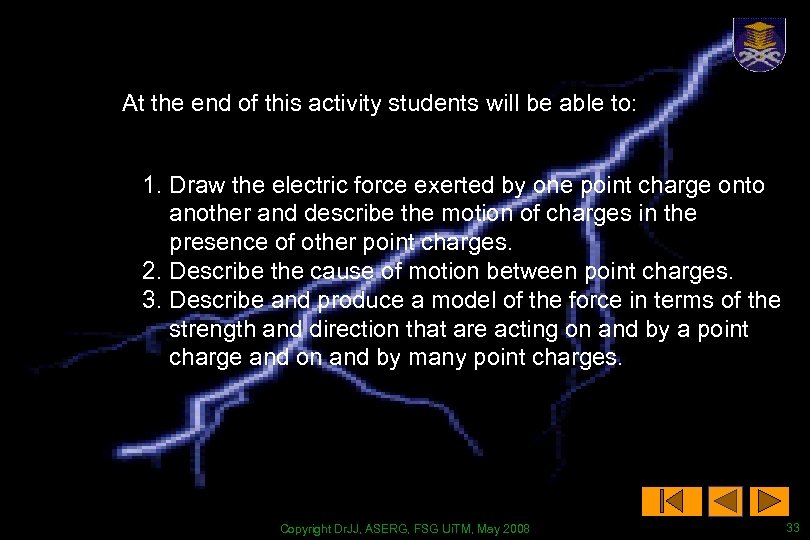 At the end of this activity students will be able to: 1. Draw the electric force exerted by one point charge onto another and describe the motion of charges in the presence of other point charges. 2. Describe the cause of motion between point charges. 3. Describe and produce a model of the force in terms of the strength and direction that are acting on and by a point charge and on and by many point charges. Copyright Dr. JJ, ASERG, FSG Ui. TM, May 2008 33
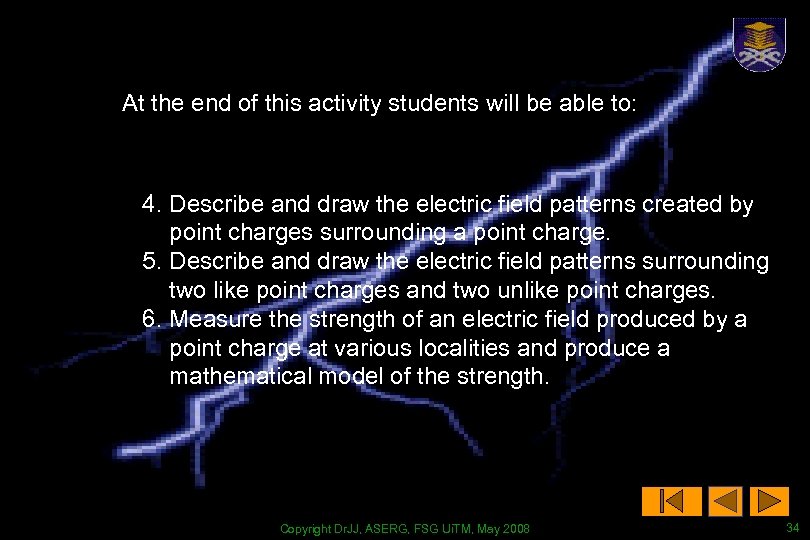 At the end of this activity students will be able to: 4. Describe and draw the electric field patterns created by point charges surrounding a point charge. 5. Describe and draw the electric field patterns surrounding two like point charges and two unlike point charges. 6. Measure the strength of an electric field produced by a point charge at various localities and produce a mathematical model of the strength. Copyright Dr. JJ, ASERG, FSG Ui. TM, May 2008 34
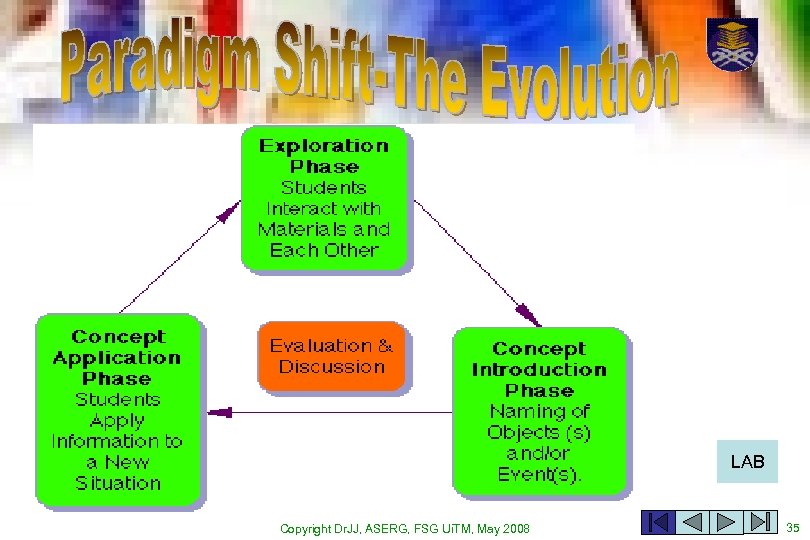 LAB Copyright Dr. JJ, ASERG, FSG Ui. TM, May 2008 35
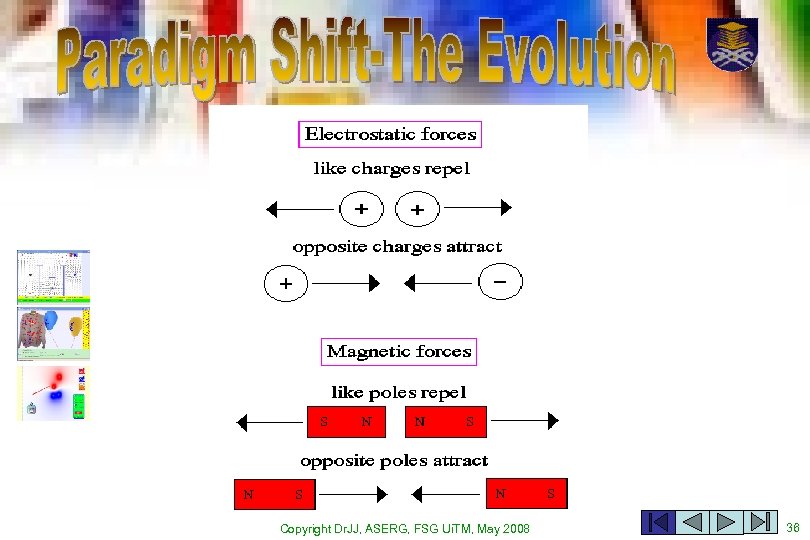 Copyright Dr. JJ, ASERG, FSG Ui. TM, May 2008 36
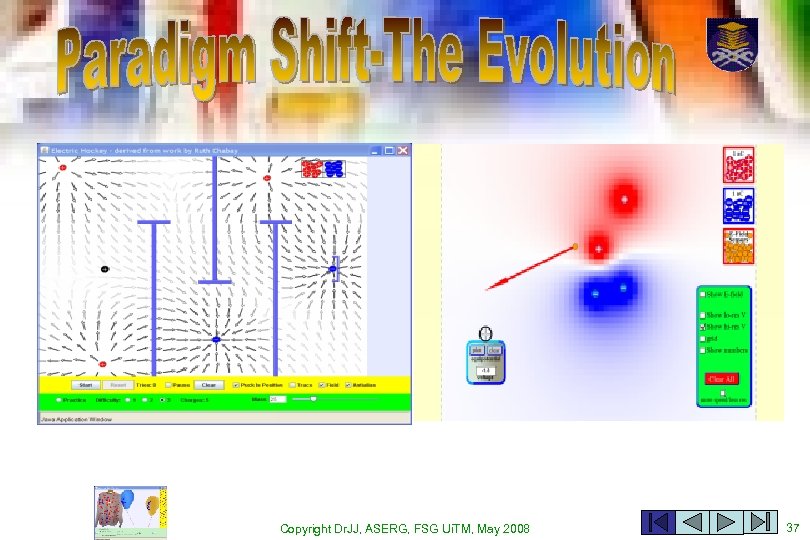 Copyright Dr. JJ, ASERG, FSG Ui. TM, May 2008 37
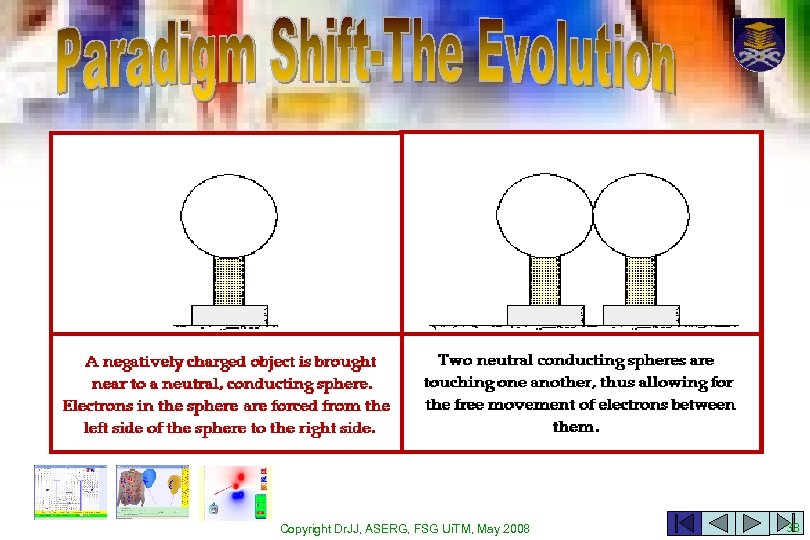 Copyright Dr. JJ, ASERG, FSG Ui. TM, May 2008 38
 Copyright Dr. JJ, ASERG, FSG Ui. TM, May 2008 39
 Copyright Dr. JJ, ASERG, FSG Ui. TM, May 2008 40
 Copyright Dr. JJ, ASERG, FSG Ui. TM, May 2008 41
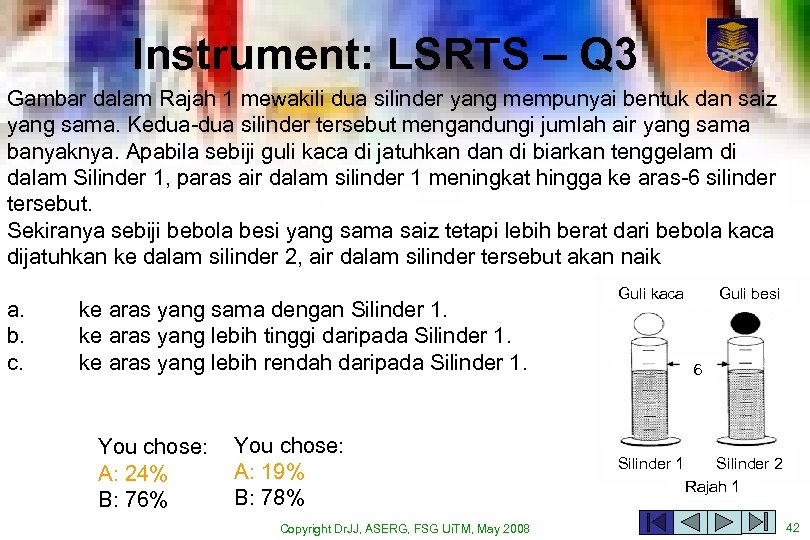 Instrument: LSRTS – Q 3 Gambar dalam Rajah 1 mewakili dua silinder yang mempunyai bentuk dan saiz yang sama. Kedua-dua silinder tersebut mengandungi jumlah air yang sama banyaknya. Apabila sebiji guli kaca di jatuhkan di biarkan tenggelam di dalam Silinder 1, paras air dalam silinder 1 meningkat hingga ke aras-6 silinder tersebut. Sekiranya sebiji bebola besi yang sama saiz tetapi lebih berat dari bebola kaca dijatuhkan ke dalam silinder 2, air dalam silinder tersebut akan naik Guli kaca Guli besi a. ke aras yang sama dengan Silinder 1. b. ke aras yang lebih tinggi daripada Silinder 1. c. ke aras yang lebih rendah daripada Silinder 1. 6 You chose: A: 24% B: 76% You chose: A: 19% B: 78% Copyright Dr. JJ, ASERG, FSG Ui. TM, May 2008 Silinder 1 Silinder 2 Rajah 1 42
 Instrument: LSRTS – Q 4 Jawapan di atas dipilih kerana a Guli besi akan tenggelam lebih cepat. b. Guli-guli tersebut diperbuat daripada bahan-bahan berlainan. c. Guli besi lebih berat daripada guli kaca. d. Guli kaca menghasilkan tekanan lebih rendah. e. Kedua-dua guli bersaiz sama. Guli kaca You chose: A: 3% B: 9% C: 57% D: 11% E: 20% You chose: A: 0% B: 9% C: 64% D: 7% E: 19% Copyright Dr. JJ, ASERG, FSG Ui. TM, May 2008 Guli besi 6 Silinder 1 Silinder 2 Rajah 1 43
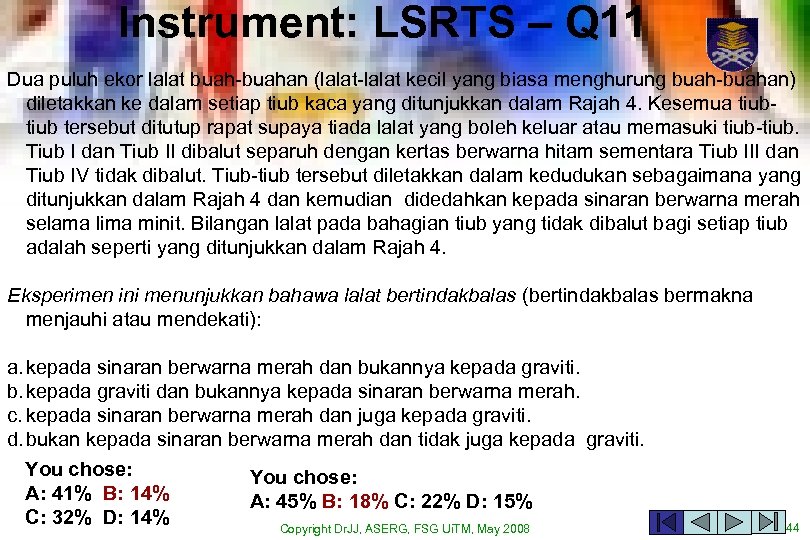 Instrument: LSRTS – Q 11 Dua puluh ekor lalat buah-buahan (lalat-lalat kecil yang biasa menghurung buah-buahan) diletakkan ke dalam setiap tiub kaca yang ditunjukkan dalam Rajah 4. Kesemua tiub tersebut ditutup rapat supaya tiada lalat yang boleh keluar atau memasuki tiub-tiub. Tiub I dan Tiub II dibalut separuh dengan kertas berwarna hitam sementara Tiub III dan Tiub IV tidak dibalut. Tiub-tiub tersebut diletakkan dalam kedudukan sebagaimana yang ditunjukkan dalam Rajah 4 dan kemudian didedahkan kepada sinaran berwarna merah selama lima minit. Bilangan lalat pada bahagian tiub yang tidak dibalut bagi setiap tiub adalah seperti yang ditunjukkan dalam Rajah 4. Eksperimen ini menunjukkan bahawa lalat bertindakbalas (bertindakbalas bermakna menjauhi atau mendekati): a. kepada sinaran berwarna merah dan bukannya kepada graviti. b. kepada graviti dan bukannya kepada sinaran berwarna merah. c. kepada sinaran berwarna merah dan juga kepada graviti. d. bukan kepada sinaran berwarna merah dan tidak juga kepada graviti. You chose: A: 41% B: 14% C: 32% D: 14% You chose: A: 45% B: 18% C: 22% D: 15% Copyright Dr. JJ, ASERG, FSG Ui. TM, May 2008 44
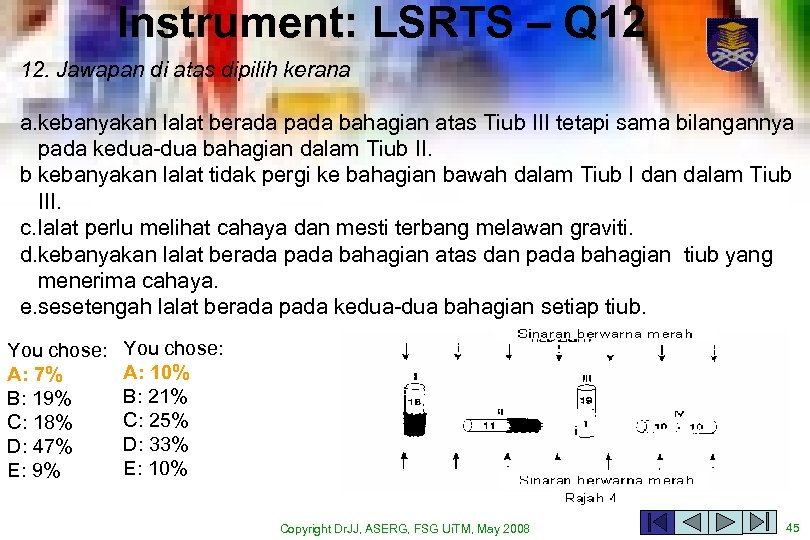 Instrument: LSRTS – Q 12 12. Jawapan di atas dipilih kerana a. kebanyakan lalat berada pada bahagian atas Tiub III tetapi sama bilangannya pada kedua-dua bahagian dalam Tiub II. b kebanyakan lalat tidak pergi ke bahagian bawah dalam Tiub I dan dalam Tiub III. c. lalat perlu melihat cahaya dan mesti terbang melawan graviti. d. kebanyakan lalat berada pada bahagian atas dan pada bahagian tiub yang menerima cahaya. e. sesetengah lalat berada pada kedua-dua bahagian setiap tiub. You chose: A: 7% B: 19% C: 18% D: 47% E: 9% You chose: A: 10% B: 21% C: 25% D: 33% E: 10% Copyright Dr. JJ, ASERG, FSG Ui. TM, May 2008 45
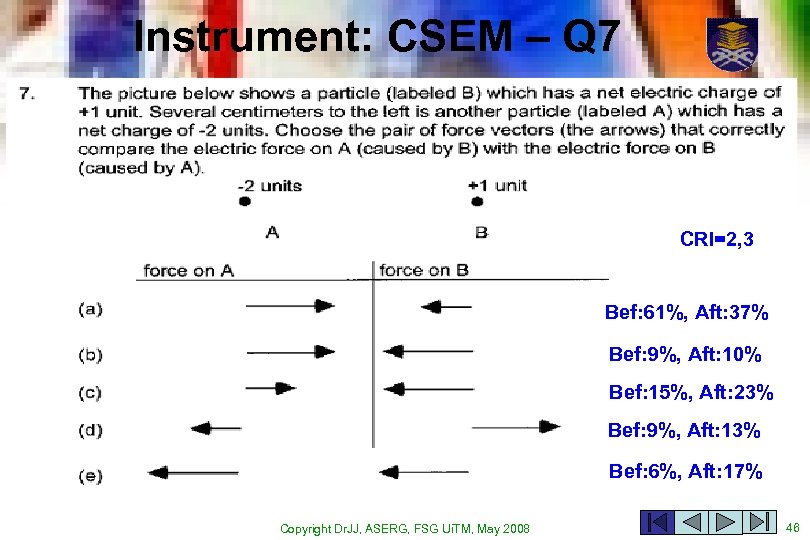 Instrument: CSEM – Q 7 CRI=2, 3 Bef: 61%, Aft: 37% Bef: 9%, Aft: 10% Bef: 15%, Aft: 23% Bef: 9%, Aft: 13% Bef: 6%, Aft: 17% Copyright Dr. JJ, ASERG, FSG Ui. TM, May 2008 46
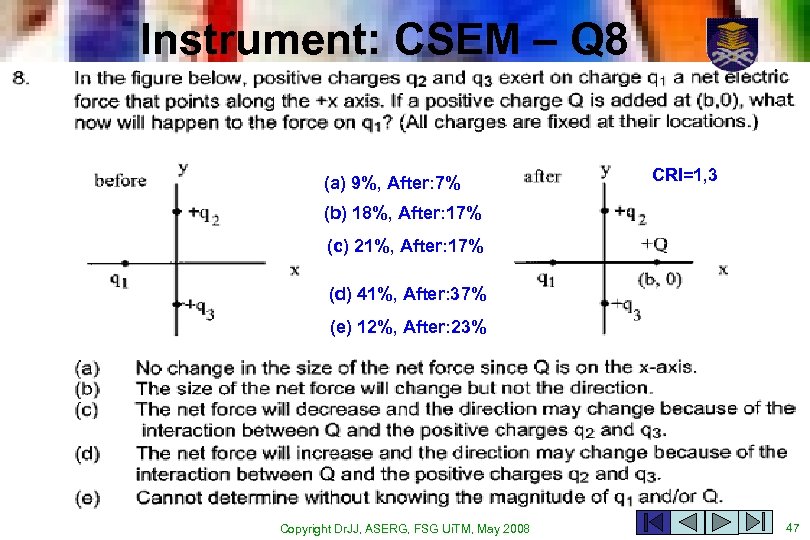 Instrument: CSEM – Q 8 (a) 9%, After: 7% CRI=1, 3 (b) 18%, After: 17% (c) 21%, After: 17% (d) 41%, After: 37% (e) 12%, After: 23% Copyright Dr. JJ, ASERG, FSG Ui. TM, May 2008 47
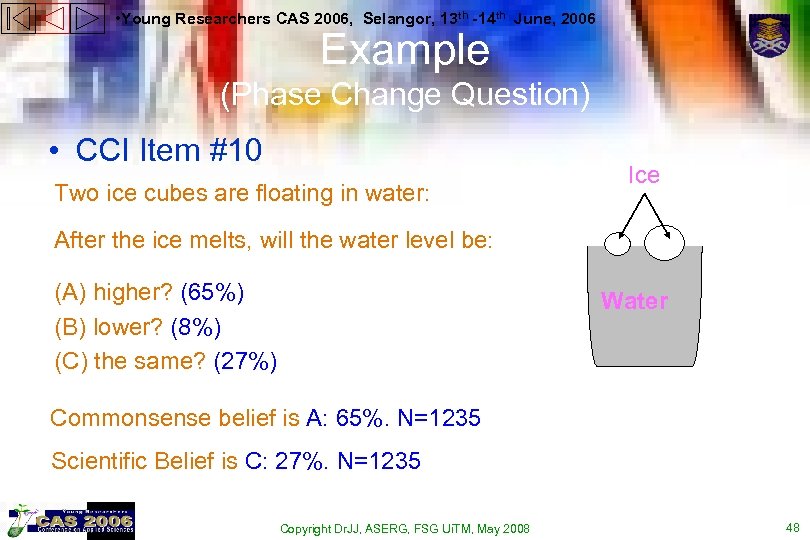 • Young Researchers CAS 2006, Selangor, 13 th -14 th June, 2006 Example (Phase Change Question) • CCI Item #10 Two ice cubes are floating in water: Ice After the ice melts, will the water level be: (A) higher? (65%) (B) lower? (8%) (C) the same? (27%) Water Commonsense belief is A: 65%. N=1235 Scientific Belief is C: 27%. N=1235 Copyright Dr. JJ, ASERG, FSG Ui. TM, May 2008 48
 Example: CCI Item#11 What is the reason for your answer to question 10? (a) The weight of water displaced is equal to the weight of the ice. (20%) (b) Water is more dense in its solid form (ice) (10%) (c) Water molecules displace more volume than ice molecules. (10%) (d) The water from the ice melting changes the water level. (46%) (e) When ice melts, its molecules expand. (14%) Copyright Dr. JJ, ASERG, FSG Ui. TM, May 2008 49
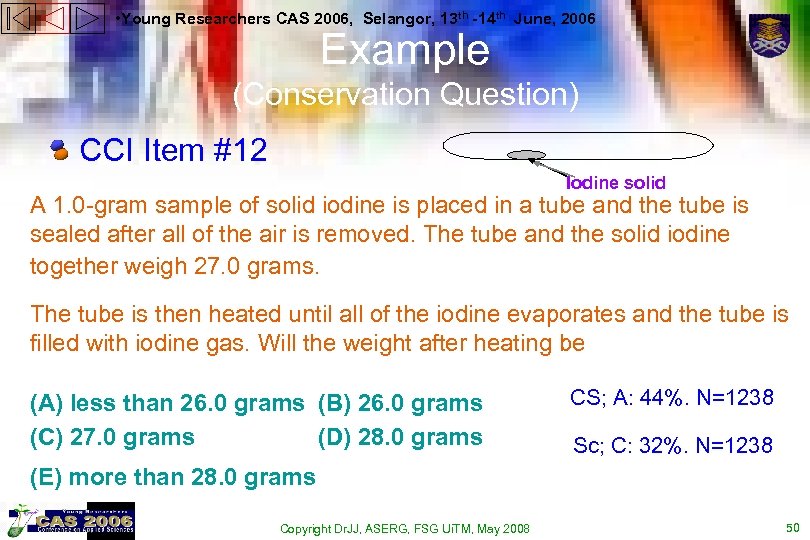 • Young Researchers CAS 2006, Selangor, 13 th -14 th June, 2006 Example (Conservation Question) CCI Item #12 Iodine solid A 1. 0 -gram sample of solid iodine is placed in a tube and the tube is sealed after all of the air is removed. The tube and the solid iodine together weigh 27. 0 grams. The tube is then heated until all of the iodine evaporates and the tube is filled with iodine gas. Will the weight after heating be (A) less than 26. 0 grams (B) 26. 0 grams (C) 27. 0 grams (D) 28. 0 grams CS; A: 44%. N=1238 Sc; C: 32%. N=1238 (E) more than 28. 0 grams Copyright Dr. JJ, ASERG, FSG Ui. TM, May 2008 50
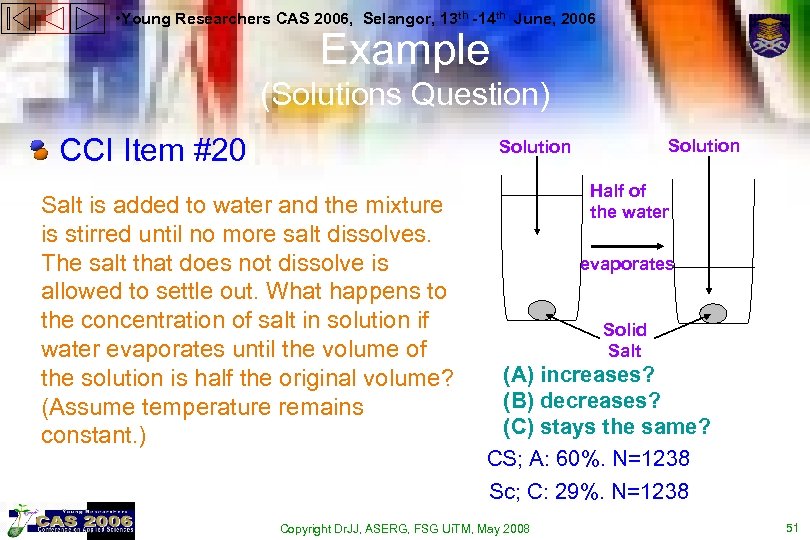 • Young Researchers CAS 2006, Selangor, 13 th -14 th June, 2006 Example (Solutions Question) CCI Item #20 Solution Salt is added to water and the mixture is stirred until no more salt dissolves. The salt that does not dissolve is allowed to settle out. What happens to the concentration of salt in solution if water evaporates until the volume of the solution is half the original volume? (Assume temperature remains constant. ) Half of the water evaporates Solid Salt (A) increases? (B) decreases? (C) stays the same? CS; A: 60%. N=1238 Sc; C: 29%. N=1238 Copyright Dr. JJ, ASERG, FSG Ui. TM, May 2008 51
 Copyright Dr. JJ, ASERG, FSG Ui. TM, May 2008 52
 What makes meaningful learning difficult? ? Learning Preferences Learning Styles ". . . a biologically and developmentally imposed set of personal characteristics that make the same teaching method effective for some students and ineffective for others, . . . " (Dunn, Beaudry, and Klavas, 1989) Copyright Dr. JJ, ASERG, FSG Ui. TM, May 2008 53
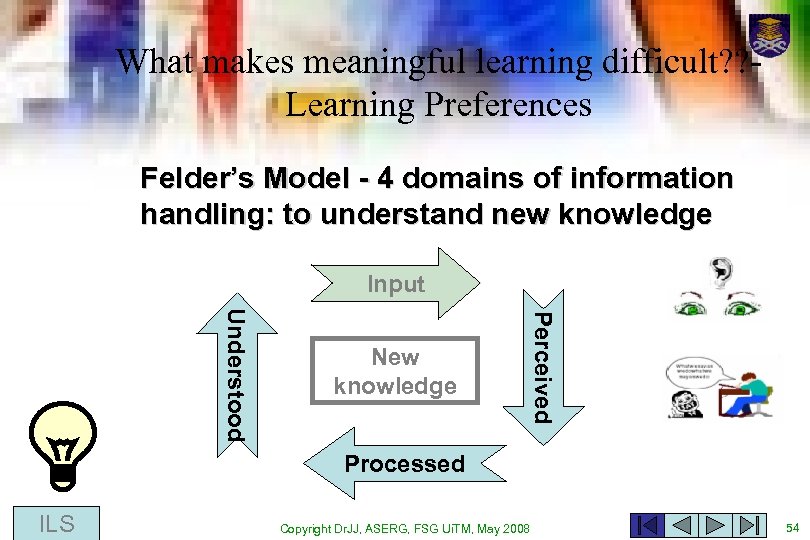 What makes meaningful learning difficult? ? Learning Preferences Felder’s Model - 4 domains of information handling: to understand new knowledge Input Perceived Understood New knowledge Processed ILS Copyright Dr. JJ, ASERG, FSG Ui. TM, May 2008 54
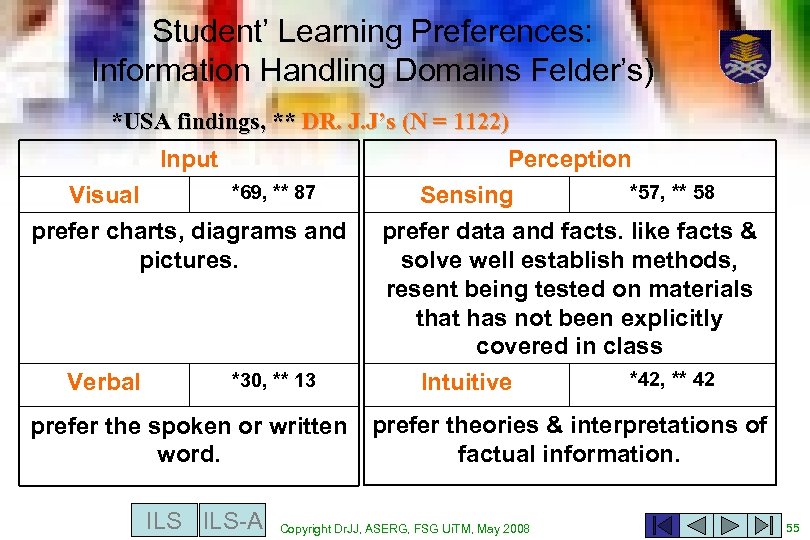 Student’ Learning Preferences: Information Handling Domains Felder’s) *USA findings, ** DR. J. J’s (N = 1122) Input Perception *69, ** 87 Visual prefer charts, diagrams and pictures. *57, ** 58 Sensing prefer data and facts. like facts & solve well establish methods, resent being tested on materials that has not been explicitly covered in class *42, ** 42 Intuitive Verbal *30, ** 13 prefer the spoken or written prefer theories & interpretations of factual information. word. ILS-A Copyright Dr. JJ, ASERG, FSG Ui. TM, May 2008 55
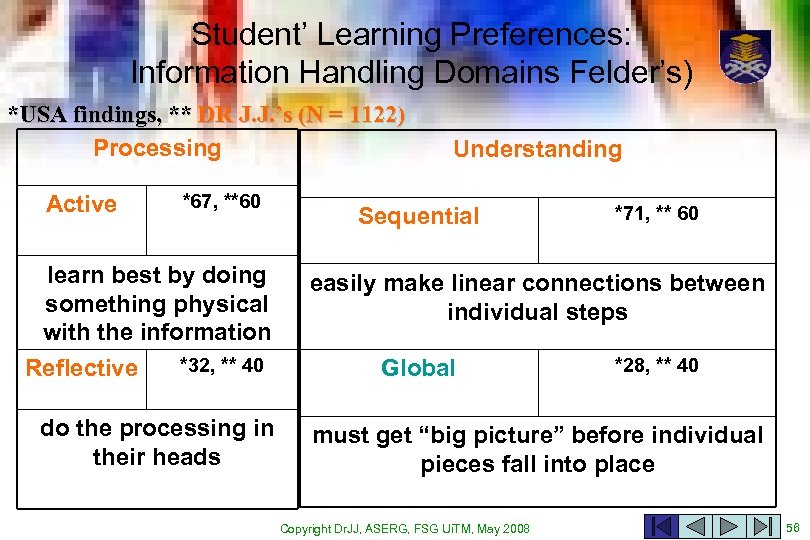 Student’ Learning Preferences: Information Handling Domains Felder’s) *USA findings, ** DR J. J. ’s (N = 1122) Processing Active *67, **60 Sequential learn best by doing something physical with the information Reflective Understanding *71, ** 60 easily make linear connections between individual steps *32, ** 40 Global do the processing in their heads *28, ** 40 must get “big picture” before individual pieces fall into place Copyright Dr. JJ, ASERG, FSG Ui. TM, May 2008 56
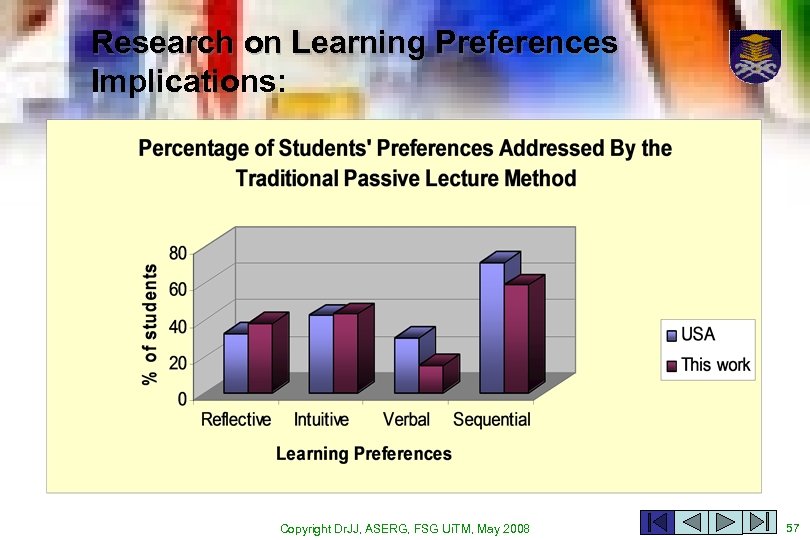 Research on Learning Preferences Implications: Copyright Dr. JJ, ASERG, FSG Ui. TM, May 2008 57
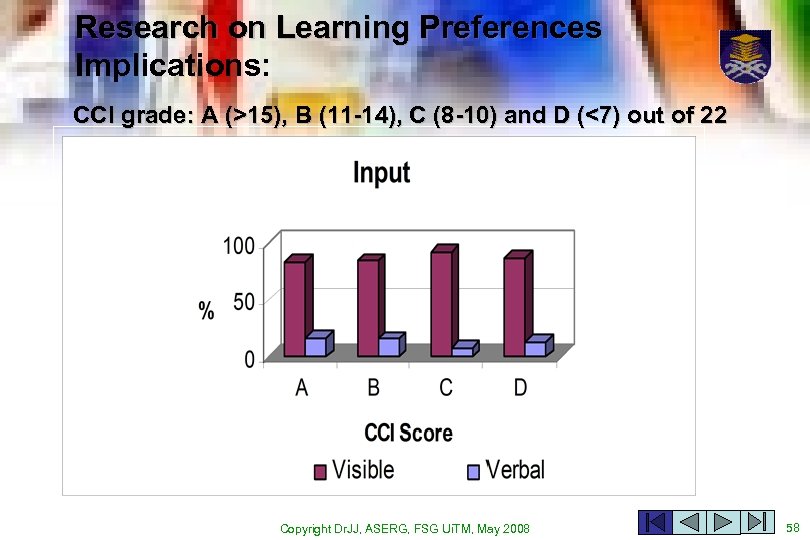 Research on Learning Preferences Implications: CCI grade: A (>15), B (11 -14), C (8 -10) and D (<7) out of 22 Copyright Dr. JJ, ASERG, FSG Ui. TM, May 2008 58
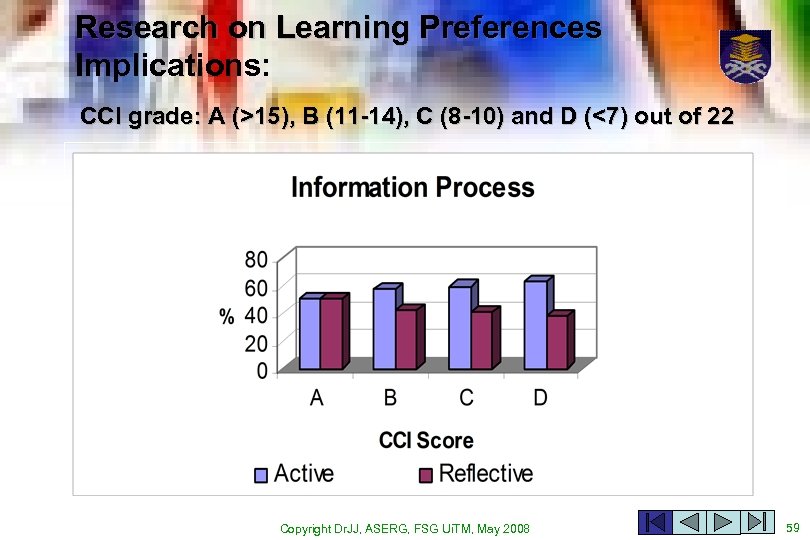 Research on Learning Preferences Implications: CCI grade: A (>15), B (11 -14), C (8 -10) and D (<7) out of 22 Copyright Dr. JJ, ASERG, FSG Ui. TM, May 2008 59
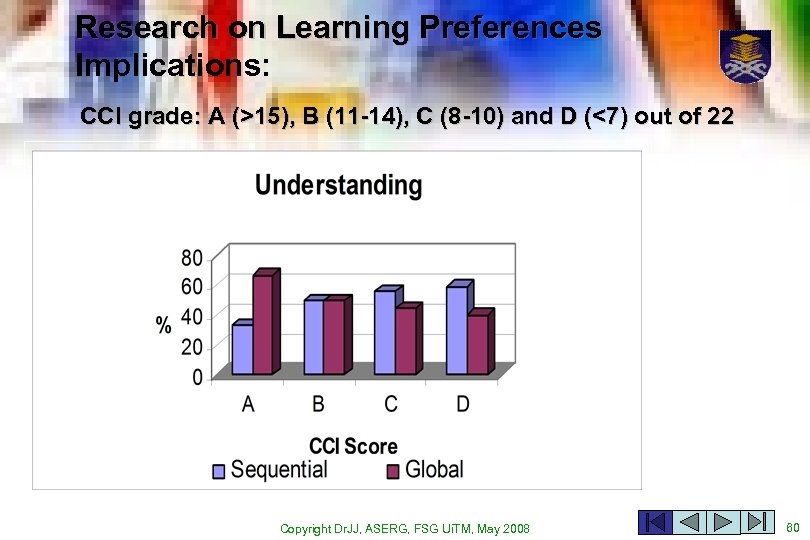 Research on Learning Preferences Implications: CCI grade: A (>15), B (11 -14), C (8 -10) and D (<7) out of 22 Copyright Dr. JJ, ASERG, FSG Ui. TM, May 2008 60
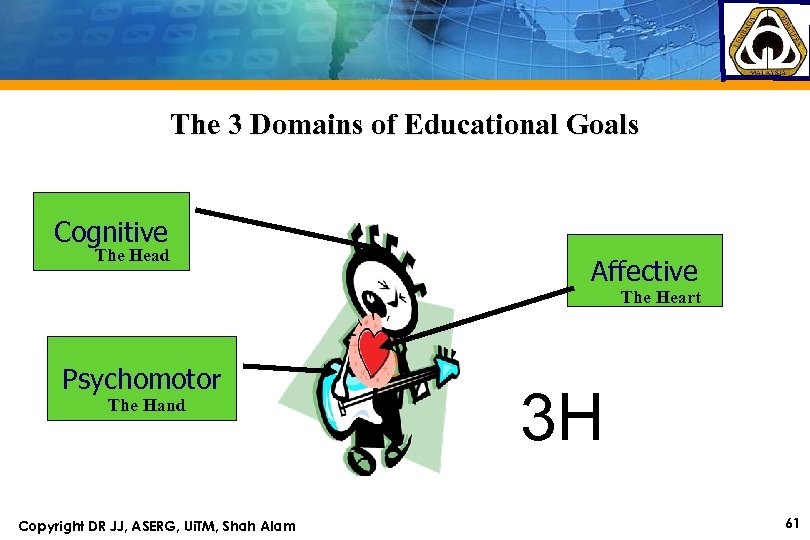 The 3 Domains of Educational Goals Cognitive The Head Affective The Heart Psychomotor The Hand Copyright DR JJ, ASERG, Ui. TM, Shah Alam 3 H 61
 “Education, we see, is not merely gaining knowledge or skills helpful toward productive work, though certainly that is a part of it. Rather it is a replenishment and an expansion of the natural thirst of the mind and soul. Learning is a gradual process of growth, each step building upon the other. It is a process whereby the learner organizes and integrates not only facts but attitudes and values. The Lord has told us that we must open our minds and our hearts to learn. There is a Chinese proverb: Wisdom is as the moon rises, perceptible not in progress but in result. As our knowledge is converted to wisdom, the door to opportunity is unlocked. “ Barbara W. Winder “The one real goal of education is to leave a person asking questions. ” Max Beerbohm Copyright Dr. JJ, ASERG, FSG Ui. TM, April 2008 62