


 Скачать презентацию Investors should carefully consider a fund s investment goals
dbc5f5f061c4f5b05c56936124e59042.ppt
- Количество слайдов: 39
 Investors should carefully consider a fund’s investment goals, risks, charges and expenses before investing. To obtain a summary prospectus and/or prospectus, which contains this and other information, talk to your financial advisor, call (800) DIAL BEN/342 -5236 or visit franklintempleton. com. Please carefully read a prospectus before investing. Not FDIC Insured • May Lose Value • No Bank Guarantee
 Investing 101
 2 Agenda • Why Invest? • Investment Basics • Mutual Funds • Asset Allocation • Why Invest NOW?
 Why Invest?
 4 WHY INVEST? Investing Can Help You Reach Your Financial Goals Buying a House Paying for College Tuition Saving for Retirement
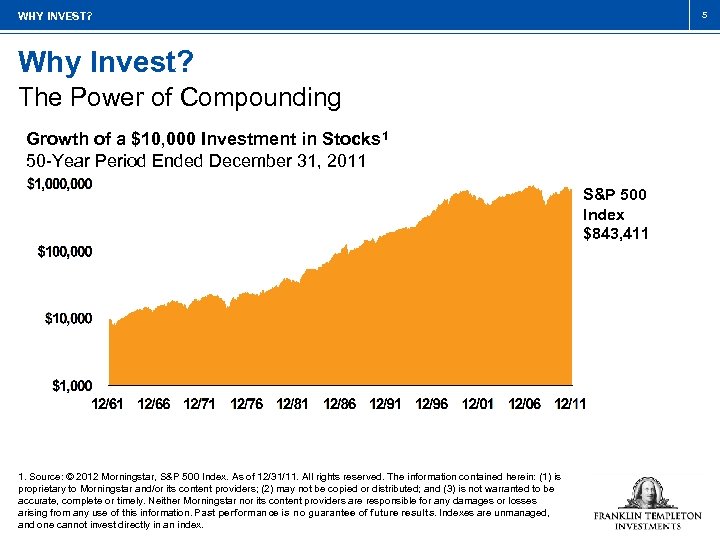 5 WHY INVEST? Why Invest? The Power of Compounding Growth of a $10, 000 Investment in Stocks 1 50 -Year Period Ended December 31, 2011 S&P 500 Index $843, 411 1. Source: © 2012 Morningstar, S&P 500 Index. As of 12/31/11. All rights reserved. The information contained herein: (1) is proprietary to Morningstar and/or its content providers; (2) may not be copied or distributed; and (3) is not warranted to be accurate, complete or timely. Neither Morningstar nor its content providers are responsible for any damages or losses arising from any use of this information. Past performance is no guarantee of future results. Indexes are unmanaged, and one cannot invest directly in an index.
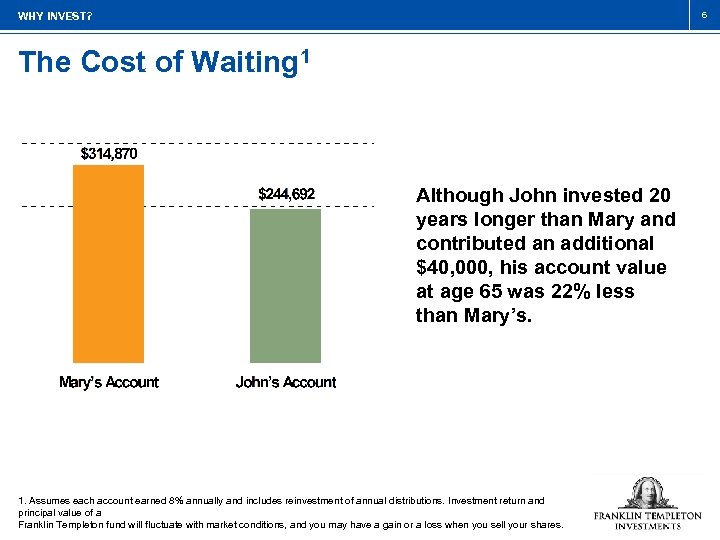 6 WHY INVEST? The Cost of Waiting 1 Although John invested 20 years longer than Mary and contributed an additional $40, 000, his account value at age 65 was 22% less than Mary’s. 1. Assumes each account earned 8% annually and includes reinvestment of annual distributions. Investment return and principal value of a Franklin Templeton fund will fluctuate with market conditions, and you may have a gain or a loss when you sell your shares.
 Investment Basics
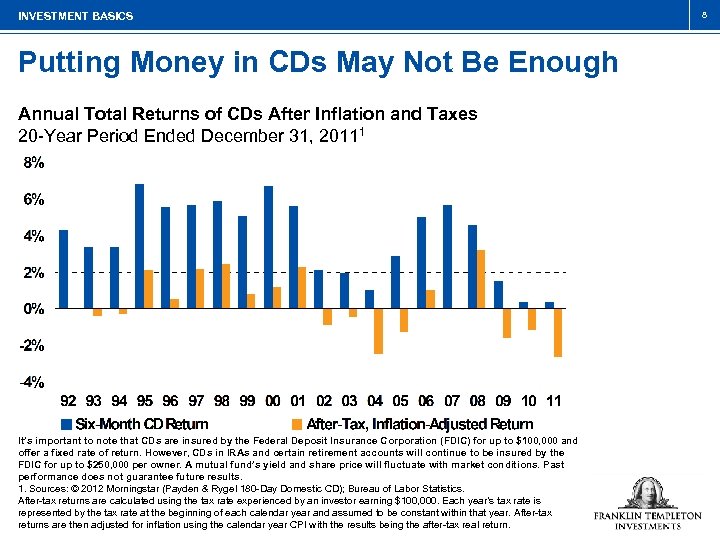 INVESTMENT BASICS Putting Money in CDs May Not Be Enough Annual Total Returns of CDs After Inflation and Taxes 20 -Year Period Ended December 31, 20111 It’s important to note that CDs are insured by the Federal Deposit Insurance Corporation (FDIC) for up to $100, 000 and offer a fixed rate of return. However, CDs in IRAs and certain retirement accounts will continue to be insured by the FDIC for up to $250, 000 per owner. A mutual fund’s yield and share price will fluctuate with market conditions. Past performance does not guarantee future results. 1. Sources: © 2012 Morningstar (Payden & Rygel 180 -Day Domestic CD); Bureau of Labor Statistics. After-tax returns are calculated using the tax rate experienced by an investor earning $100, 000. Each year’s tax rate is represented by the tax rate at the beginning of each calendar year and assumed to be constant within that year. After-tax returns are then adjusted for inflation using the calendar year CPI with the results being the after-tax real return. 8
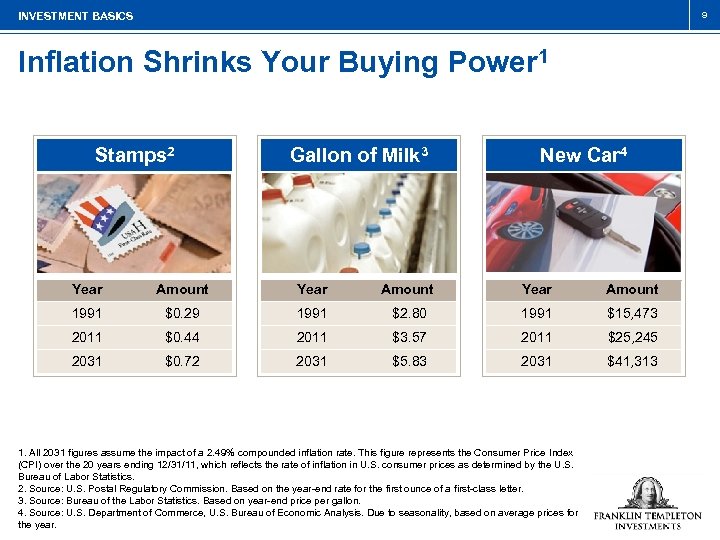 9 INVESTMENT BASICS Inflation Shrinks Your Buying Power 1 Stamps 2 Gallon of Milk 3 New Car 4 Year Amount 1991 $0. 29 1991 $2. 80 1991 $15, 473 2011 $0. 44 2011 $3. 57 2011 $25, 245 2031 $0. 72 2031 $5. 83 2031 $41, 313 1. All 2031 figures assume the impact of a 2. 49% compounded inflation rate. This figure represents the Consumer Price Index (CPI) over the 20 years ending 12/31/11, which reflects the rate of inflation in U. S. consumer prices as determined by the U. S. Bureau of Labor Statistics. 2. Source: U. S. Postal Regulatory Commission. Based on the year-end rate for the first ounce of a first-class letter. 3. Source: Bureau of the Labor Statistics. Based on year-end price per gallon. 4. Source: U. S. Department of Commerce, U. S. Bureau of Economic Analysis. Due to seasonality, based on average prices for the year.
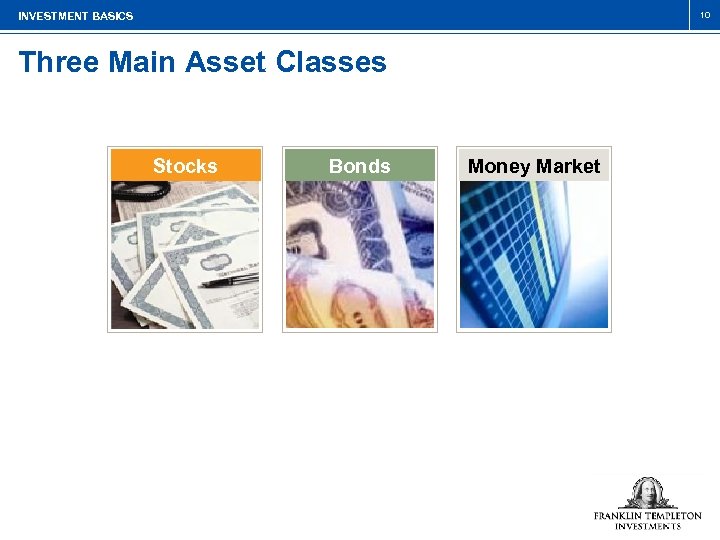 10 INVESTMENT BASICS Three Main Asset Classes Stocks Bonds Money Market
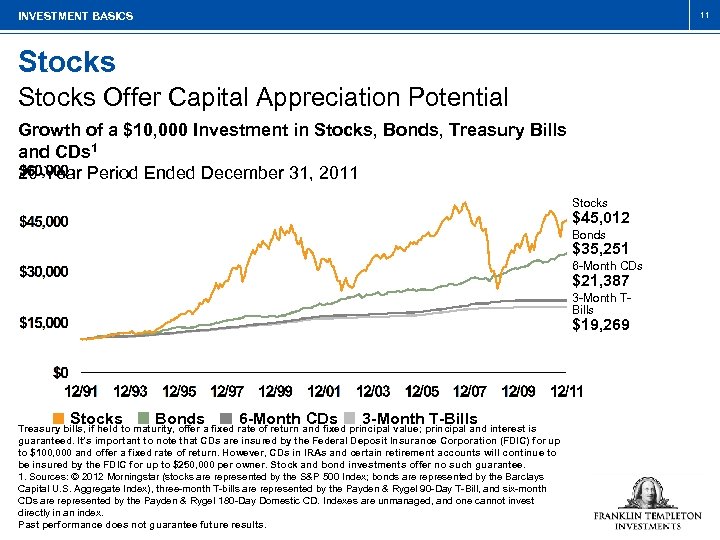 11 INVESTMENT BASICS Stocks Offer Capital Appreciation Potential Growth of a $10, 000 Investment in Stocks, Bonds, Treasury Bills and CDs 1 20 -Year Period Ended December 31, 2011 Stocks $45, 012 Bonds $35, 251 6 -Month CDs $21, 387 3 -Month TBills $19, 269 Stocks Bonds 6 -Month CDs 3 -Month T-Bills Treasury bills, if held to maturity, offer a fixed rate of return and fixed principal value; principal and interest is guaranteed. It’s important to note that CDs are insured by the Federal Deposit Insurance Corporation (FDIC) for up to $100, 000 and offer a fixed rate of return. However, CDs in IRAs and certain retirement accounts will continue to be insured by the FDIC for up to $250, 000 per owner. Stock and bond investments offer no such guarantee. 1. Sources: © 2012 Morningstar (stocks are represented by the S&P 500 Index; bonds are represented by the Barclays Capital U. S. Aggregate Index), three-month T-bills are represented by the Payden & Rygel 90 -Day T-Bill, and six-month CDs are represented by the Payden & Rygel 180 -Day Domestic CD. Indexes are unmanaged, and one cannot invest directly in an index. Past performance does not guarantee future results.
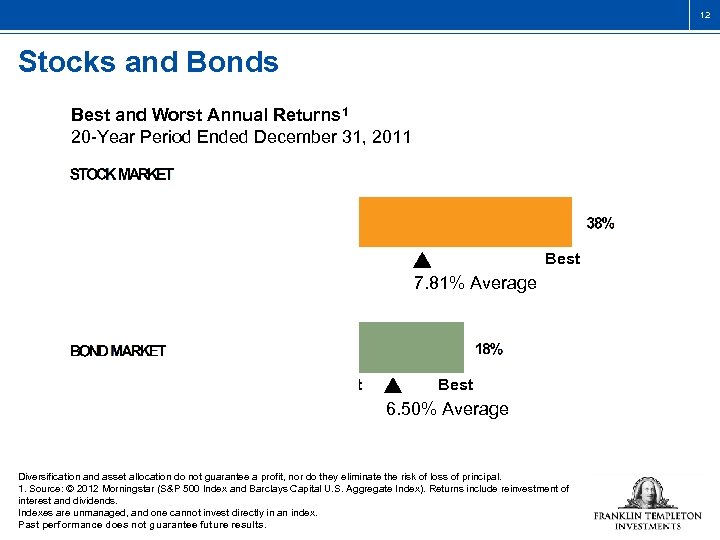 12 Stocks and Bonds Best and Worst Annual Returns 1 20 -Year Period Ended December 31, 2011 Worst Best 7. 81% Average Worst Best 6. 50% Average Diversification and asset allocation do not guarantee a profit, nor do they eliminate the risk of loss of principal. 1. Source: © 2012 Morningstar (S&P 500 Index and Barclays Capital U. S. Aggregate Index). Returns include reinvestment of interest and dividends. Indexes are unmanaged, and one cannot invest directly in an index. Past performance does not guarantee future results.
 Mutual Funds
 MUTUAL FUNDS Mutual Fund • An actively managed investment company • Pools money from individuals and institutions sharing a common goal • Professional money managers build a portfolio of securities • Share price is determined daily • Open-end vs. closed-end 14
 MUTUAL FUNDS The Mutual Fund Prospectus • Investment objectives and goals • Investment strategy • Risks • Management team • Fees and expenses • Financial highlights • Performance tables 15
 MUTUAL FUNDS The Advantages of Mutual Funds • Diversification • Professional management • Convenience • Affordability • Liquidity Front-end and, in some cases back-end sales loads, management fees, Rule 12 b-1 fees and other expenses are associated with Franklin, Templeton and Mutual Series fund investments. Investor returns are reduced by these fees and expenses. Funds are offered through prospectuses, which contain detailed information about a fund’s goals, sales charges, expenses and risks. You should carefully read the prospectus before investing or sending money. 16
 17 MUTUAL FUNDS Understanding Mutual Fund Risks • Principal (Market) risk • Interest rate risk • Foreign risk
 18 MUTUAL FUNDS Stock Fund Investing • Growth funds • Value funds • Sector funds
 19 MUTUAL FUNDS Bond Fund Investing • Taxable bond funds • Tax-free bond funds 1 • Certain risks are associated with investing in bond funds Bonds are particularly sensitive to interest rate movements, and their prices will fluctuate with market conditions. Bond prices, and thus a bond fund’s share price, generally move in the opposite direction of interest rates. Thus, as the prices of bonds in a fund adjust to a rise in interest rates, a fund’s share price may decline. 1. For investors subject to the alternative minimum tax, all or a portion of a fund’s dividends may be subject to such tax, depending on the fund. Distributions of capital gains, if any, are generally taxable.
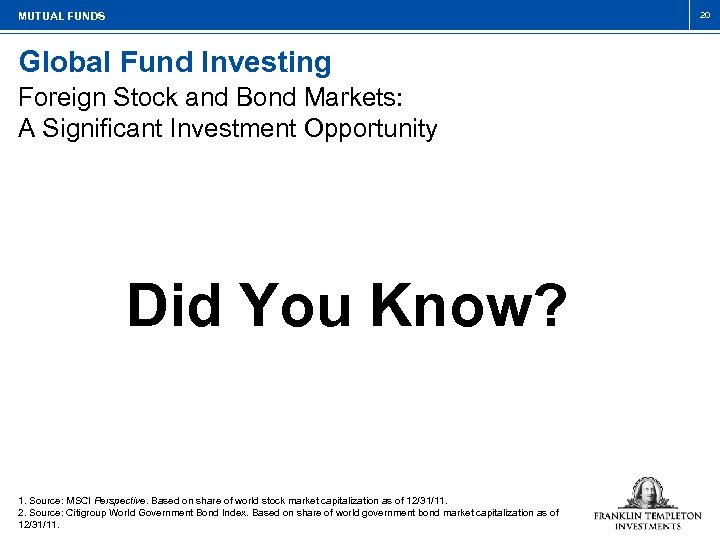 20 MUTUAL FUNDS Global Fund Investing Foreign Stock and Bond Markets: A Significant Investment Opportunity Foreign Stock Market Capitalization 1 As of December 31, 2011 Foreign Government Bond Market Capitalization 2 As of December 31, 2011 Did You Know? 1. Source: MSCI Perspective. Based on share of world stock market capitalization as of 12/31/11. 2. Source: Citigroup World Government Bond Index. Based on share of world government bond market capitalization as of 12/31/11.
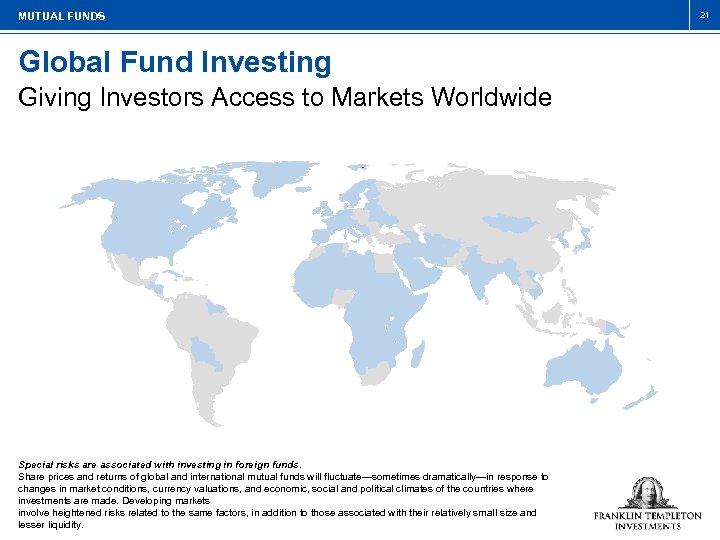 MUTUAL FUNDS Global Fund Investing Giving Investors Access to Markets Worldwide Special risks are associated with investing in foreign funds. Share prices and returns of global and international mutual funds will fluctuate—sometimes dramatically—in response to changes in market conditions, currency valuations, and economic, social and political climates of the countries where investments are made. Developing markets involve heightened risks related to the same factors, in addition to those associated with their relatively small size and lesser liquidity. 21
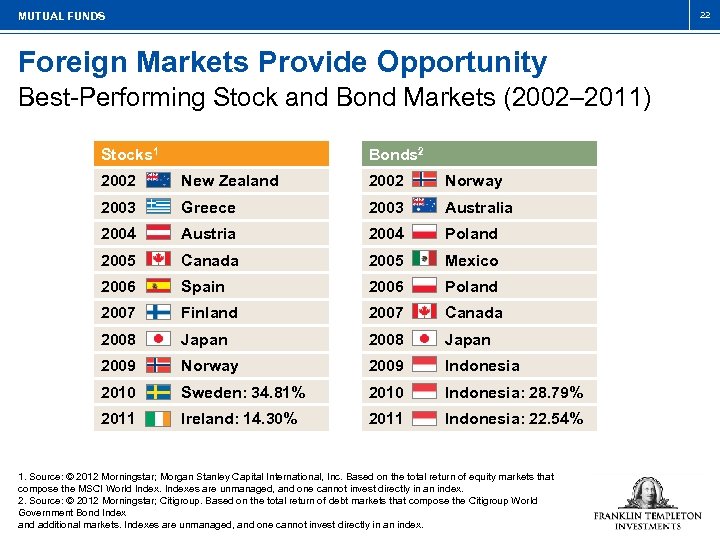 22 MUTUAL FUNDS Foreign Markets Provide Opportunity Best-Performing Stock and Bond Markets (2002– 2011) Stocks 1 Bonds 2 2002 New Zealand 2002 Norway 2003 Greece 2003 Australia 2004 Austria 2004 Poland 2005 Canada 2005 Mexico 2006 Spain 2006 Poland 2007 Finland 2007 Canada 2008 Japan 2009 Norway 2009 Indonesia 2010 Sweden: 34. 81% 2010 Indonesia: 28. 79% 2011 Ireland: 14. 30% 2011 Indonesia: 22. 54% 1. Source: © 2012 Morningstar; Morgan Stanley Capital International, Inc. Based on the total return of equity markets that compose the MSCI World Indexes are unmanaged, and one cannot invest directly in an index. 2. Source: © 2012 Morningstar; Citigroup. Based on the total return of debt markets that compose the Citigroup World Government Bond Index and additional markets. Indexes are unmanaged, and one cannot invest directly in an index.
 Asset Allocation
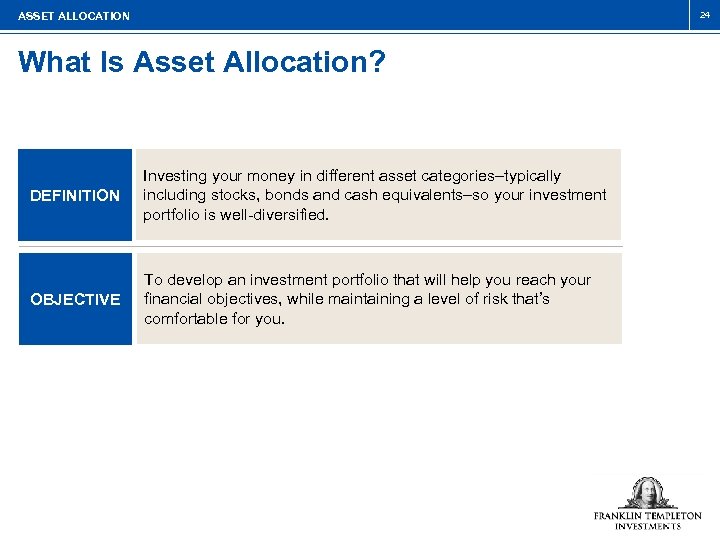 24 ASSET ALLOCATION What Is Asset Allocation? DEFINITION Investing your money in different asset categories–typically including stocks, bonds and cash equivalents–so your investment portfolio is well-diversified. OBJECTIVE To develop an investment portfolio that will help you reach your financial objectives, while maintaining a level of risk that’s comfortable for you.
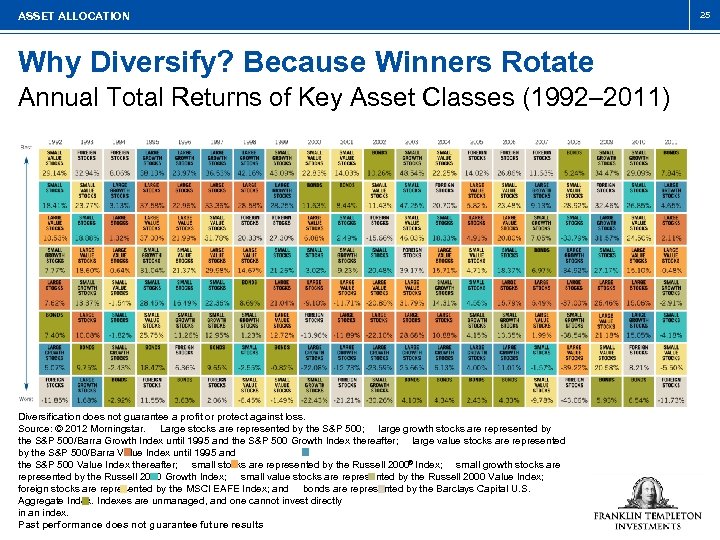 ASSET ALLOCATION Why Diversify? Because Winners Rotate Annual Total Returns of Key Asset Classes (1992– 2011) Diversification does not guarantee a profit or protect against loss. Source: © 2012 Morningstar. Large stocks are represented by the S&P 500; large growth stocks are represented by the S&P 500/Barra Growth Index until 1995 and the S&P 500 Growth Index thereafter; large value stocks are represented by the S&P 500/Barra Value Index until 1995 and ® the S&P 500 Value Index thereafter; small stocks are represented by the Russell 2000 Index; small growth stocks are represented by the Russell 2000 Growth Index; small value stocks are represented by the Russell 2000 Value Index; foreign stocks are represented by the MSCI EAFE Index; and bonds are represented by the Barclays Capital U. S. Aggregate Indexes are unmanaged, and one cannot invest directly in an index. Past performance does not guarantee future results 25
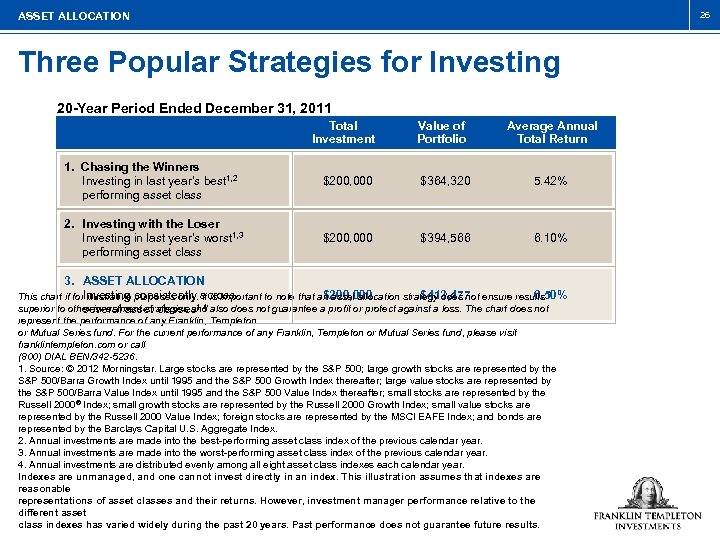 26 ASSET ALLOCATION Three Popular Strategies for Investing 20 -Year Period Ended December 31, 2011 Total Investment Value of Portfolio Average Annual Total Return 1. Chasing the Winners Investing in last year’s best 1, 2 performing asset class $200, 000 $364, 320 5. 42% 2. Investing with the Loser Investing in last year’s worst 1, 3 performing asset class $200, 000 $394, 566 6. 10% 3. ASSET ALLOCATION $200, 000 $413, 477 6. 50% This chart if for. Investing consistently across illustrative purposes only. It is important to note that an asset allocation strategy does not ensure results 1, 4 superior to other investment strategies and also does not guarantee a profit or protect against a loss. The chart does not several asset classes represent the performance of any Franklin, Templeton or Mutual Series fund. For the current performance of any Franklin, Templeton or Mutual Series fund, please visit franklintempleton. com or call (800) DIAL BEN/342 -5236. 1. Source: © 2012 Morningstar. Large stocks are represented by the S&P 500; large growth stocks are represented by the S&P 500/Barra Growth Index until 1995 and the S&P 500 Growth Index thereafter; large value stocks are represented by the S&P 500/Barra Value Index until 1995 and the S&P 500 Value Index thereafter; small stocks are represented by the Russell 2000® Index; small growth stocks are represented by the Russell 2000 Growth Index; small value stocks are represented by the Russell 2000 Value Index; foreign stocks are represented by the MSCI EAFE Index; and bonds are represented by the Barclays Capital U. S. Aggregate Index. 2. Annual investments are made into the best-performing asset class index of the previous calendar year. 3. Annual investments are made into the worst-performing asset class index of the previous calendar year. 4. Annual investments are distributed evenly among all eight asset class indexes each calendar year. Indexes are unmanaged, and one cannot invest directly in an index. This illustration assumes that indexes are reasonable representations of asset classes and their returns. However, investment manager performance relative to the different asset class indexes has varied widely during the past 20 years. Past performance does not guarantee future results.
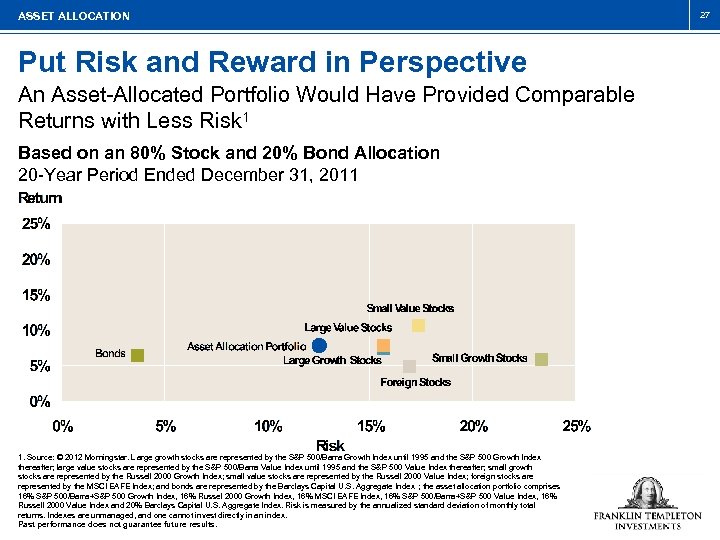 ASSET ALLOCATION Put Risk and Reward in Perspective An Asset-Allocated Portfolio Would Have Provided Comparable Returns with Less Risk 1 Based on an 80% Stock and 20% Bond Allocation 20 -Year Period Ended December 31, 2011 1. Source: © 2012 Morningstar. L arge growth stocks are represented by the S&P 500/Barra Growth Index until 1995 and the S&P 500 Growth Index thereafter; large value stocks are represented by the S&P 500/Barra Value Index until 1995 and the S&P 500 Value Index thereafter; small growth stocks are represented by the Russell 2000 Growth Index; small value stocks are represented by the Russell 2000 Value Index; foreign stocks are represented by the MSCI EAFE Index; and bonds are represented by the Barclays Capital U. S. Aggregate Index ; the asset allocation portfolio comprises 16% S&P 500/Barra+S&P 500 Growth Index, 16% Russel 2000 Growth Index, 16% MSCI EAFE Index, 16% S&P 500/Barra+S&P 500 Value Index, 16% Russell 2000 Value Index and 20% Barclays Capital U. S. Aggregate Index. Risk is measured by the annualized standard deviation of monthly total returns. Indexes are unmanaged, and one cannot invest directly in an index. Past performance does not guarantee future results. 27
 Why Invest NOW?
 29 “History shows that time–not timing– is the key to investment success. ” — The late Sir John Templeton Funds Founder and Former Chairman
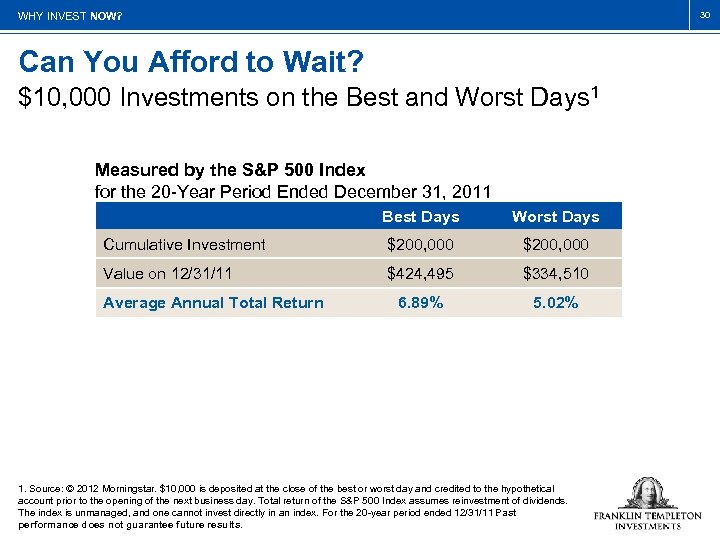 30 WHY INVEST NOW? Can You Afford to Wait? $10, 000 Investments on the Best and Worst Days 1 Measured by the S&P 500 Index for the 20 -Year Period Ended December 31, 2011 Best Days Worst Days Cumulative Investment $200, 000 Value on 12/31/11 $424, 495 $334, 510 6. 89% 5. 02% Average Annual Total Return 1. Source: © 2012 Morningstar. $10, 000 is deposited at the close of the best or worst day and credited to the hypothetical account prior to the opening of the next business day. Total return of the S&P 500 Index assumes reinvestment of dividends. The index is unmanaged, and one cannot invest directly in an index. For the 20 -year period ended 12/31/11. ast P performance does not guarantee future results.
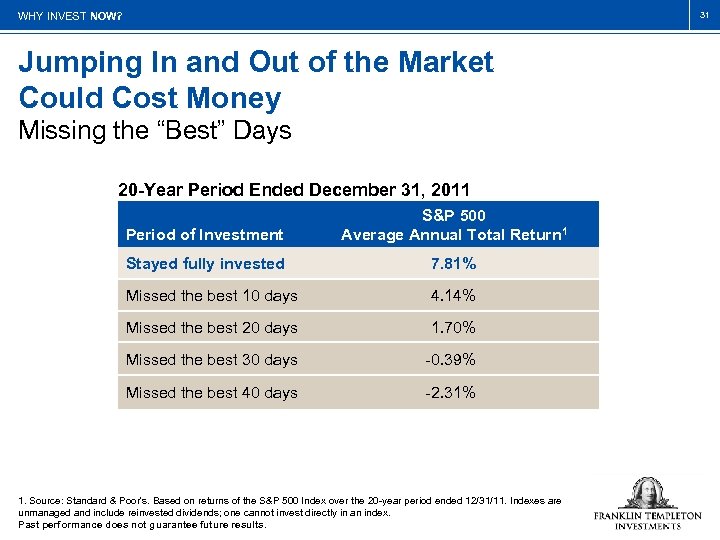 31 WHY INVEST NOW? Jumping In and Out of the Market Could Cost Money Missing the “Best” Days 20 -Year Period Ended December 31, 2011 Period of Investment S&P 500 Average Annual Total Return 1 Stayed fully invested 7. 81% Missed the best 10 days 4. 14% Missed the best 20 days 1. 70% Missed the best 30 days -0. 39% Missed the best 40 days -2. 31% 1. Source: Standard & Poor's. Based on returns of the S&P 500 Index over the 20 -year period ended 12/31/11. Indexes are unmanaged and include reinvested dividends; one cannot invest directly in an index. Past performance does not guarantee future results.
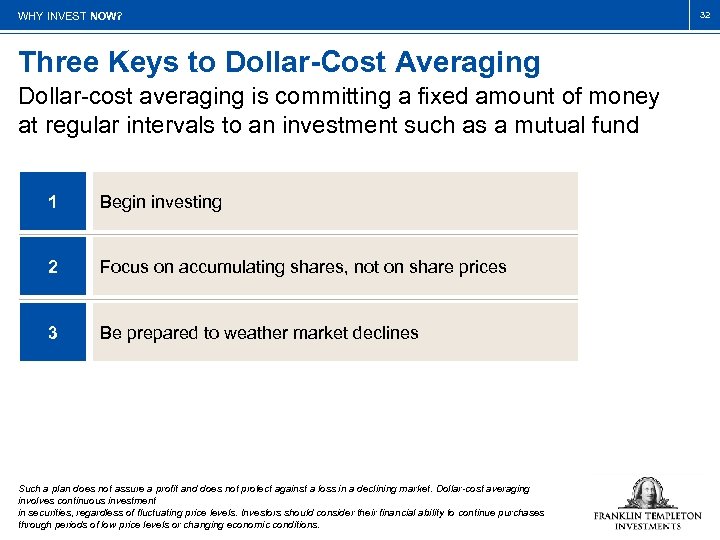 WHY INVEST NOW? Three Keys to Dollar-Cost Averaging Dollar-cost averaging is committing a fixed amount of money at regular intervals to an investment such as a mutual fund 1 Begin investing 2 Focus on accumulating shares, not on share prices 3 Be prepared to weather market declines Such a plan does not assure a profit and does not protect against a loss in a declining market. Dollar-cost averaging involves continuous investment in securities, regardless of fluctuating price levels. Investors should consider their financial ability to continue purchases through periods of low price levels or changing economic conditions. 32
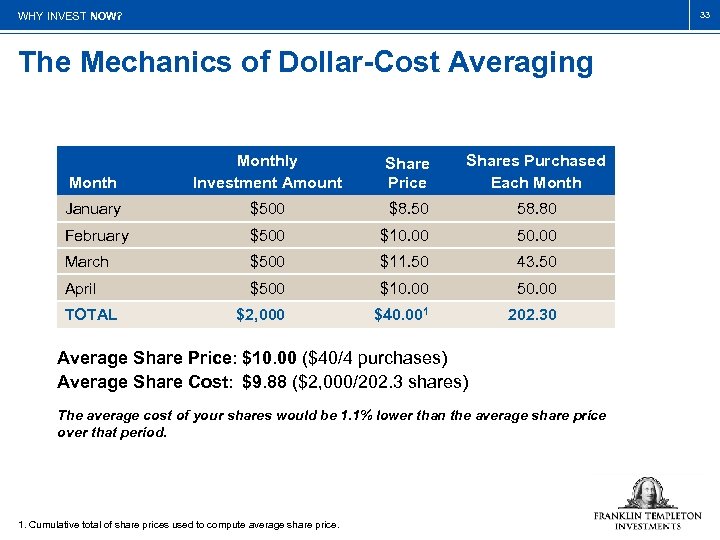 33 WHY INVEST NOW? The Mechanics of Dollar-Cost Averaging Monthly Investment Amount Share Price Shares Purchased Each Month January $500 $8. 50 58. 80 February $500 $10. 00 50. 00 March $500 $11. 50 43. 50 April $500 $10. 00 50. 00 $2, 000 $40. 001 202. 30 TOTAL Average Share Price: $10. 00 ($40/4 purchases) Average Share Cost: $9. 88 ($2, 000/202. 3 shares) The average cost of your shares would be 1. 1% lower than the average share price over that period. 1. Cumulative total of share prices used to compute average share price.
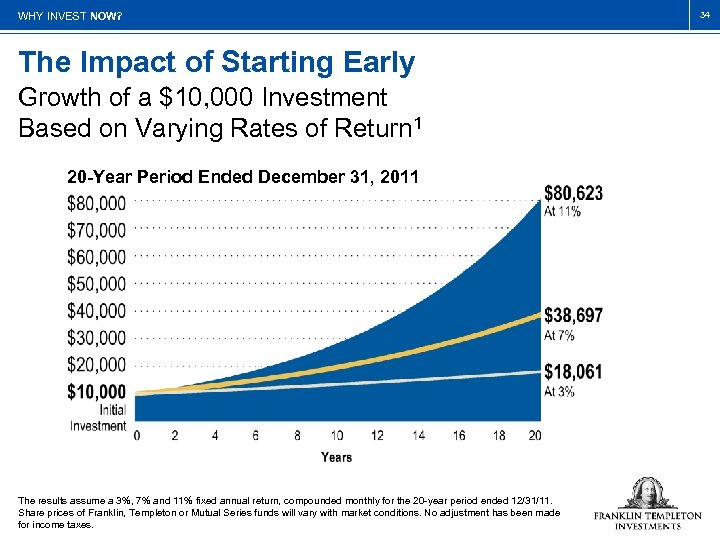 WHY INVEST NOW? The Impact of Starting Early Growth of a $10, 000 Investment Based on Varying Rates of Return 1 20 -Year Period Ended December 31, 2011 The results assume a 3%, 7% and 11% fixed annual return, compounded monthly for the 20 -year period ended 12/31/11. Share prices of Franklin, Templeton or Mutual Series funds will vary with market conditions. No adjustment has been made for income taxes. 34
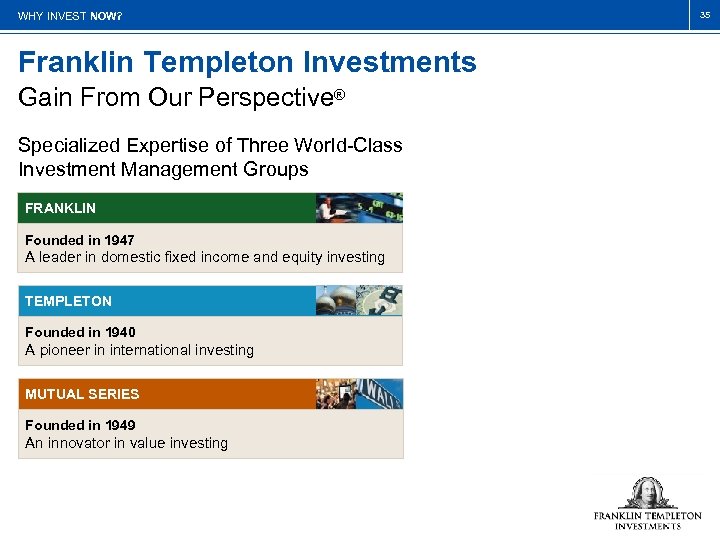 WHY INVEST NOW? Franklin Templeton Investments Gain From Our Perspective® Specialized Expertise of Three World-Class Investment Management Groups FRANKLIN Founded in 1947 A leader in domestic fixed income and equity investing TEMPLETON Founded in 1940 A pioneer in international investing MUTUAL SERIES Founded in 1949 An innovator in value investing 35
 36 Review • Why Invest? • Investment Basics • Mutual Funds • Asset Allocation • Why Invest NOW?
 37 Action Step Let’s set up an appointment
 Franklin Templeton Distributors, Inc. One Franklin Parkway San Mateo, California 94403 -1906 (800) DIAL BEN®/342 -5236 franklintempleton. com Investors should carefully consider a fund’s investment goals, risks, charges and expenses before investing. To obtain a summary prospectus and/or prospectus, which contains this and other information, talk to your financial advisor, call (800) DIAL BEN/342 -5236 or visit franklintempleton. com. Please carefully read a prospectus before investing. SEM INV 03/12