


 Скачать презентацию Investments Theory and Applications Mark Hirschey Harcourt Inc
232ed12622eefdfd9fe5a47f444f5d9f.ppt
- Количество слайдов: 59
 Investments: Theory and Applications Mark Hirschey Harcourt, Inc. items and derived items copyright © 2001 by Harcourt, Inc.
 Chapter 14 Stock Market Anomalies Harcourt, Inc. items and derived items copyright © 2001 by Harcourt, Inc.
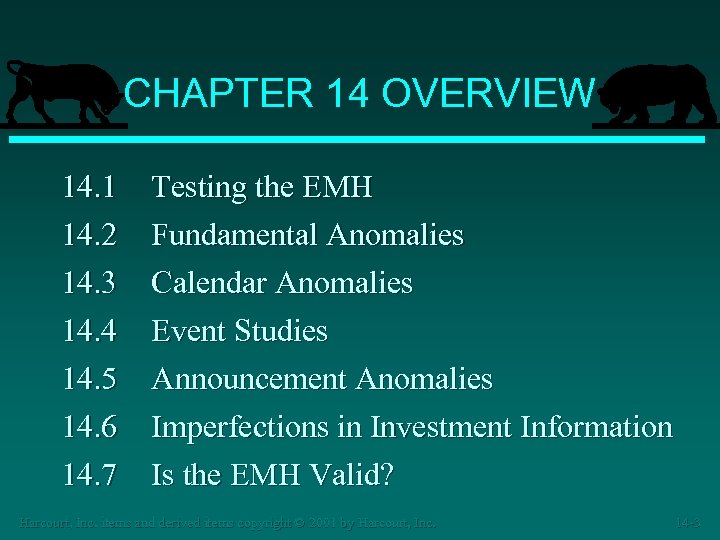 CHAPTER 14 OVERVIEW 14. 1 14. 2 14. 3 Testing the EMH Fundamental Anomalies Calendar Anomalies 14. 4 14. 5 Event Studies Announcement Anomalies 14. 6 14. 7 Imperfections in Investment Information Is the EMH Valid? Harcourt, Inc. items and derived items copyright © 2001 by Harcourt, Inc. 14 -3
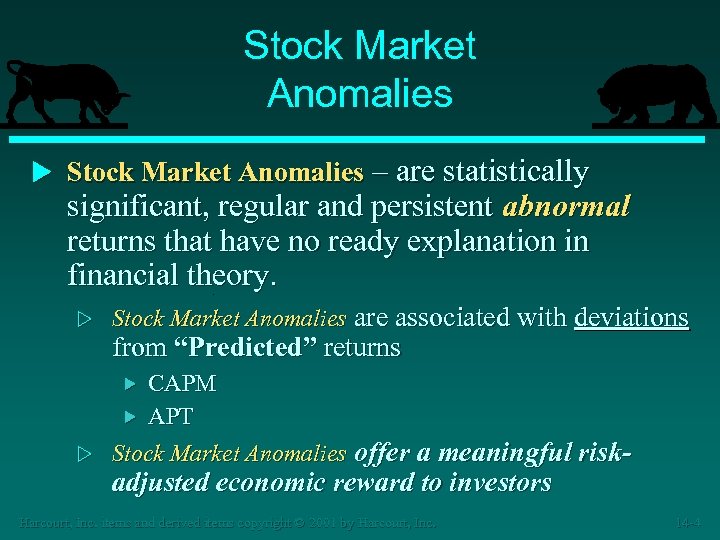 Stock Market Anomalies u Stock Market Anomalies – are statistically significant, regular and persistent abnormal returns that have no ready explanation in financial theory. w Stock Market Anomalies are associated with deviations from “Predicted” returns CAPM APT w Stock Market Anomalies offer a meaningful risk adjusted economic reward to investors Harcourt, Inc. items and derived items copyright © 2001 by Harcourt, Inc. 14 -4
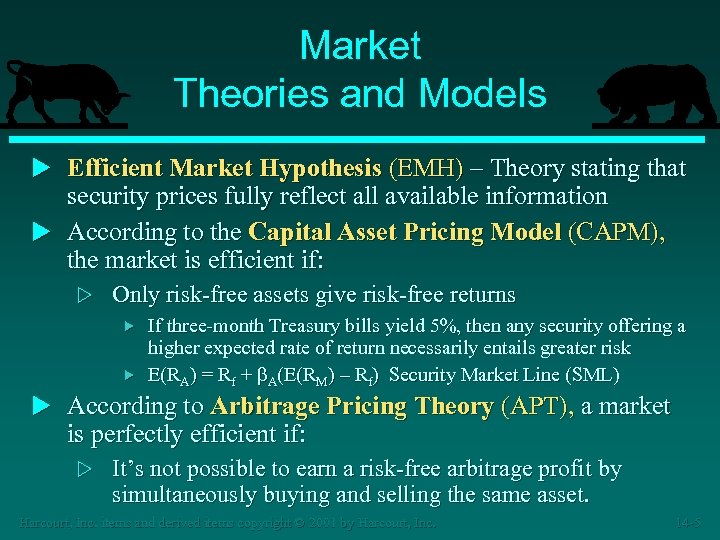 Market Theories and Models u Efficient Market Hypothesis (EMH) – Theory stating that security prices fully reflect all available information u According to the Capital Asset Pricing Model (CAPM), the market is efficient if: w Only risk-free assets give risk-free returns If three-month Treasury bills yield 5%, then any security offering a higher expected rate of return necessarily entails greater risk E(RA) = Rf + A(E(RM) – Rf) Security Market Line (SML) u According to Arbitrage Pricing Theory (APT), a market is perfectly efficient if: w It’s not possible to earn a risk-free arbitrage profit by simultaneously buying and selling the same asset. Harcourt, Inc. items and derived items copyright © 2001 by Harcourt, Inc. 14 -5
 EMH, CAPM, & APT MODELS As A Tools Theories and models like EMH, CAPM and APT are only tools. They’re “tested” by their ability to explain or predict events. A “useful” asset pricing model is able to: explain and predict returns. Harcourt, Inc. items and derived items copyright © 2001 by Harcourt, Inc. 14 -6
 Average-Return Anomaly u By isolating deviations from predicted u u returns, CAPM and APT have potential as tools to help investors isolate instances in which the pricing of individual securities deviates from that predicted. Under such circumstances, there might be profitmaking opportunities. When unexplainable patterns of abnormal stock market returns are detected in the market, an average-return anomaly is said to be found. Harcourt, Inc. items and derived items copyright © 2001 by Harcourt, Inc. 14 -7
 MARKET ANOMALIES u Important stock market anomalies are: Significant, regular, and persistent abnormal returns that have no ready explanation in financial theory. w Average return anomalies may reflect some market inefficiency. w Suppose stock prices rise after a widely anticipated stock split announcement or A corporate insider regularly earns above-market returns on insider buy/sell transactions w Such abnormal returns are inconsistent with the strong form of the EMH. Harcourt, Inc. items and derived items copyright © 2001 by Harcourt, Inc. 14 -8
 MARKET ANOMALIES u A useful asset pricing model is able to explain and predict returns u Abnormal returns detected when using the CAPM or APT may simply reflect the fact that these models fail to precisely capture the stock return generating process: w i. e. some component is left out of the model. u When CAPM or APT fail to precisely capture, or “model, ” stock market returns, model specification bias is present Harcourt, Inc. items and derived items copyright © 2001 by Harcourt, Inc. 14 -9
 MARKET ANOMALIES u Suppose stock returns during late December and early January appear unusual given the predictions of the CAPM This average-return anomaly is an inexplicable pattern of abnormal stock market returns. w This could mean that the stock market is inefficient during the turn of the year w Or the CAPM may simply offer an incomplete picture of the stock return generating process w u Thus the - Joint Test Problem: Do anomalies indicate market inefficiencies or market-model inaccuracies? Harcourt, Inc. items and derived items copyright © 2001 by Harcourt, Inc. 14 -10
 MARKET ANOMALIES Testing the EMH u During recent years, the “practical relevance” of the joint test problem has become increasingly obvious u Increasing numbers of anomalies in 80 s and 90 s led many to doubt EMH. Harcourt, Inc. items and derived items copyright © 2001 by Harcourt, Inc. 14 -11
 MARKET ANOMALIES Testing the EMH u During the 80’s and 90’s, however, millions of investors began aggressively investing retirement funds in diversified low-cost index funds that seek to match the market without any “active” portfolio management w This was a ringing endorsement for EMH: w i. e all information is reflected in the stock price and there are no profit-making opportunities based on abnormal returns A buy-and-hold strategy works best in an efficient market. u Even if CAPM and APT don’t have predictive power, EMH may still hold. Harcourt, Inc. items and derived items copyright © 2001 by Harcourt, Inc. 14 -12
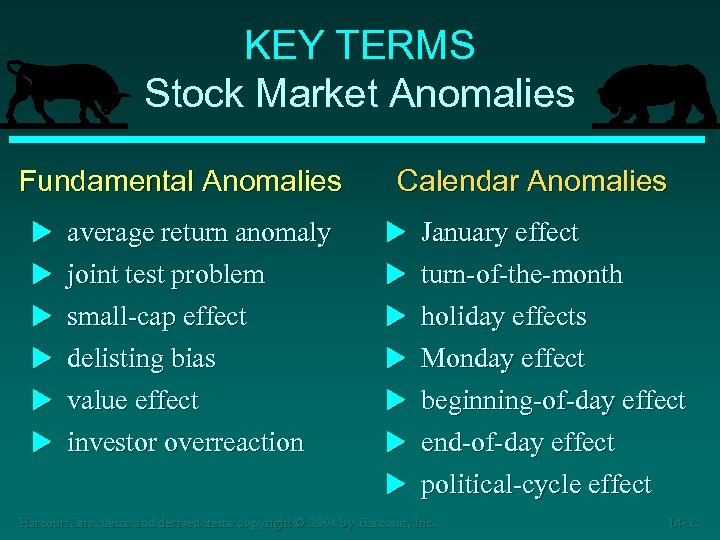 KEY TERMS Stock Market Anomalies Fundamental Anomalies Calendar Anomalies u average return anomaly u January effect u joint test problem u turn-of-the-month u small-cap effect u holiday effects u delisting bias u Monday effect u value effect u beginning-of-day effect u investor overreaction u end-of-day effect u political-cycle effect Harcourt, Inc. items and derived items copyright © 2001 by Harcourt, Inc. 14 -13
 FUNDAMENTAL ANOMALIES Small-Cap Effect (or Myth? ) u Small-Cap Effect: tendency for small-capitalization stocks (price x # of o/s shares - measured with Russell 2000 Index) to outperform the market (prior to 1980) This suggests a size-related market inefficiency w However, many stocks in this index are apt to be underperforming “Fallen Angels”, or companies with significant revenues and profitability that have fallen on hard times and seen their share prices collapse w Many researchers think that measurement errors rather than market inefficiency may explain the perceived out performance of smallcap stocks w For instance: by ignoring the effects of firms that are delisted for poor performance, previous studies may be infected with delisting bias. Harcourt, Inc. items and derived items copyright © 2001 by Harcourt, Inc. w 14 -14
 FUNDAMENTAL ANOMALIES Small-Cap Effect (or Myth? ) u Delisting Bias: tendency to ignore the effects of firms that are delisted for poor performance By excluding small-cap losers from previous studies, the total returns earned on small-cap stocks may have been overstated w Focus was only on small-cap winners w Creates measurement error rather than market inefficiency w Proper adjustment for the effects of delisting reduce annual returns by more than enough to account for the entire smallcap effect w Harcourt, Inc. items and derived items copyright © 2001 by Harcourt, Inc. 14 -15
 FUNDAMENTAL ANOMALIES Small-Cap Effect (or Myth? ) w Alternatively, above-average returns for small-cap stocks may simply reflect the small-cap risk premium? Small cap firms seldom feature extensive product lines, enjoy only narrow geographic dispersion, and often have only limited managerial and financial resources The failure of beta to capture small-firm risk undermines the usefulness of CAPM Harcourt, Inc. items and derived items copyright © 2001 by Harcourt, Inc. 14 -16
 FUNDAMENTAL ANOMALIES Small-Cap Effect (or Myth? ) u 1980 – 1999 Less-risky large-cap stocks beat small-caps, based on average return and standard deviation Large-cap firms may be better equipped to compete with worldwide competitors w Or modern stock markets may simply be more efficient than the stock markets of previous generations w Harcourt, Inc. items and derived items copyright © 2001 by Harcourt, Inc. 14 -17
 FUNDAMENTAL ANOMALIES Value Effects u Value Effect: Tendency for value stocks to outperform the market u Beaten-down stocks have low: prices; market values; and price/earnings, price/cash flow, and price/book ratios u While higher expected returns for beaten down stocks make economic sense, the CAPM can’t reflect the effect of beaten-down stocks u CAPM and APT may not reflect the higher risk associated with value stocks. Harcourt, Inc. items and derived items copyright © 2001 by Harcourt, Inc. 14 -18
 FUNDAMENTAL ANOMALIES Investor Overreaction u Investor Overreaction: when greed or fear push stock prices too high or too low w Investors become too optimistic with growth stocks and too pessimistic in the case of value stocks w Growth stock investors tend to encounter poorer than expected stock market returns and Value stock investors tend to encounter better than expected stock market returns Harcourt, Inc. items and derived items copyright © 2001 by Harcourt, Inc. 14 -19
 CALENDAR ANOMALIES Ø Seasonal variation in asset prices is inconsistent with the notion of an efficient market Ø We see the: Ø January Effect: unusually large positive rates of return for stocks during the first few trading days of the year – though weak to nonexistent during recent years Ø Small cap stock performance is especially strong on the last trading day of the year and on the first four trading days of the new year Ø Turn-of-the-Month Effect: tendency for strong stock market returns on the last two trading days of the month and on the first three trading days of the new month Harcourt, Inc. items and derived items copyright © 2001 by Harcourt, Inc. 14 -20
 CALENDAR ANOMALIES Day Effects u Holiday Effects: regularity of unusually good performance for stocks on the day prior to marketclosing holidays u Monday Effect: only day of the week that averages a negative rate of return w Given rise to the refrain: “Don’t sell stocks on (blue) Monday!” w Wednesdays and Fridays are the best return days Harcourt, Inc. items and derived items copyright © 2001 by Harcourt, Inc. 14 -21
 CALENDAR ANOMALIES Day Effects u Beginning-of-Day Effect: stock prices usually rise the first 45 minutes of the trading day – Tuesdays through Fridays, then trade flat until the last 15 minutes. w Strong openings are usually attributed to the first few trades of the day w On Mondays, stocks tend to fall during the first 45 minutes of trading and then trade as on any other day of the week Harcourt, Inc. items and derived items copyright © 2001 by Harcourt, Inc. 14 -22
 CALENDAR ANOMALIES Day Effects u End-of-day Effect: stock prices usually rise near the close of the trading day. w Strong closings are attributed to the last trade of the day Harcourt, Inc. items and derived items copyright © 2001 by Harcourt, Inc. 14 -23
 Yearly Seasonals u Political-Cycle Effect: during first and last years of new presidential administration, annual returns are abnormally high. Harcourt, Inc. items and derived items copyright © 2001 by Harcourt, Inc. 14 -24
 Yearly Seasonals u Annual returns appear abnormally low during the third year of a presidential administration w Due to political motives to make “tough” decisions after the election so that economic recovery and renewed prosperity can be ensured prior to the next election u During years ending in the digit “ 5” annual returns average a whopping 28. 962% before dividends Harcourt, Inc. items and derived items copyright © 2001 by Harcourt, Inc. 14 -25
 KEY TERMS Event Studies & Announcement Anomalies u postannouncement drift u stock splits u economic event effect u record date u announcement period u event studies u earnings surprise u postearnings announcement effect u announcement date u pay date u ex-split date u split ratio u reverse stock splits u spinoff anomaly u index effect Harcourt, Inc. items and derived items copyright © 2001 by Harcourt, Inc. 14 -26
 EVENT STUDIES Economic Events According to the semistrong-form EMH, current stock prices reflect all public information. u The strong-form EMH states that current stock prices incorporate all public and nonpublic information u In both instances, new information is instantaneously reflected in stock prices so that subsequent investors are able to earn just a risk-adjusted normal rate of return. u A test of the EMH is to consider a firm’s stock market returns in the few days surrounding a cleanly identified date on which some important new information was communicated to the marketplace. u Harcourt, Inc. items and derived items copyright © 2001 by Harcourt, Inc. 14 -27
 EVENT STUDIES Economic Events u In a perfectly efficient market, Good News results in a sharp upward spike in shareholder returns on the announcement day u Bad News results in a downward spike in shareholder returns on the announcement day u In both instances, there should be no Postannouncement Drift: predictable returns in the postannouncement period w In the postannouncement period, stock returns should be random. Harcourt, Inc. items and derived items copyright © 2001 by Harcourt, Inc. 14 -28
 EVENT STUDIES Economic Events For any news item to represent an important Economic Event: it must change the investors’ underlying perceptions, and result in a unusual movement in the stock’s price during the Announcement Period: time frame during which an economic event occurs u Event Studies: measure abnormal returns surrounding significant news items that may have important economic consequences for the firm u w such as earnings announcements, mergers, the death of a CEO, etc. Harcourt, Inc. items and derived items copyright © 2001 by Harcourt, Inc. 14 -29
 Announcement Anomalies u It’s consistent with the EMH: for stock prices to move when there’s an u Earnings Surprise: an announcement that actual earnings differ from expected earnings Harcourt, Inc. items and derived items copyright © 2001 by Harcourt, Inc. 14 -30
 Announcement Anomalies u Postearnings Announcement Effect: stock price movements tied to earnings announcements that continue (or drift) after the earnings announcement u In these cases, investors have the potential to profit from previously disclosed public information by buying stocks in companies that report favorable results or selling companies that report sub-par results Harcourt, Inc. items and derived items copyright © 2001 by Harcourt, Inc. 14 -31
 Announcement Anomalies u The postearnings announcement effect is inconsistent with the EMH u In a perfectly efficient market, there is no post announcement drift. u In a perfectly efficient market, good and bad earnings information is “instantaneously” reflected in company stock prices so that subsequent investors earn only a risk-adjusted normal rate of return on their investment Harcourt, Inc. items and derived items copyright © 2001 by Harcourt, Inc. 14 -32
 Stock Split Announcements u Stock splits themselves have no effect on market value of the firm. w Following any stock split, the quantity of shares increases, and the share price declines by a commensurate amount so that the net effect on the value of the firm is zero w Merely cosmetic changes Harcourt, Inc. items and derived items copyright © 2001 by Harcourt, Inc. 14 -33
 Stock Split Announcements u Split Ratio: rate of increase in stock outstanding With a 2: 1 stock split, the investor comes to own twice as many shares as before the split, but the post-split price falls by one-half w Stock splits increase the number of small shareholders w w Not all stock splits feature a 2: 1 ratio although it is the most popular Other ratios are 3: 1, 3: 2, and 5: 4 In some cases the stock split involves the spin-off of a subsidiary to current shareholders. Harcourt, Inc. items and derived items copyright © 2001 by Harcourt, Inc. 14 -34
 Stock Split Announcements u Record Date: date on which a shareholder must be a registered owner to receive the benefit of a stock split (or other stockholder benefit) and follows the announcement date by roughly two weeks. u Announcement Date: date when news of split is published u Pay Date: date on which a split becomes effective u Ex-Split Date: the day following the pay date and marks the date on which the stock begins trading at the new postsplit price Harcourt, Inc. items and derived items copyright © 2001 by Harcourt, Inc. 14 -35
 Stock Split Announcements u Many investors remain convinced that stock splits represent good news that tends to move the company’s market value upward u Stock splits create a positive feeling among shareholders u More individual investors jump on board as the stock price drops as a result of the split u In the 1990’s many individual investors have come to expect stock to shoot higher on the announcement of a stock split w However, this popular perception that stock splits cause stocks to shoot higher is fallacious Harcourt, Inc. items and derived items copyright © 2001 by Harcourt, Inc. 14 -36
 Stock Split Announcements u It’s not the stock split itself, or the expectation of a stock split, that causes stock prices to rise u Stocks tend to rise with the announcement of a stock split only if other favorable fundamental news is issued at the same time as the stock split announcement Exceptional financial results w Stock repurchase plan w u Stocks tend to split after their share price has surged, not before. Harcourt, Inc. items and derived items copyright © 2001 by Harcourt, Inc. 14 -37
 Reverse Stock Splits u Reverse Split: stock split that reduces the number of outstanding shares In a 1: 3 reverse stock split, investors receive one share of stock for every three shares of stock held previously. w Most common among companies with deteriorating fundamentals and a crumbling share price. w Just as a stock split does not cause superior performance, reverse stock splits do not cause inferior performance. w Harcourt, Inc. items and derived items copyright © 2001 by Harcourt, Inc. 14 -38
 Spin-Off Anomalies u A spin-off is the separation of a business from a diversified corporation accomplished through the distribution of stock in the new entity to current shareholders. u Spin-Off Anomaly: tendency of spin-offs of smaller companies from larger organizations to lead to favorable stock market performance “Before” the spin-off, smaller companies do not get as much executive attention as necessary. w “After” the spin-off, management of the smaller company: w tends to be much better focused has the right incentives to maximize shareholder value the stock tends to move up substantially Harcourt, Inc. items and derived items copyright © 2001 by Harcourt, Inc. 14 -39
 S&P 500 LISTING u Index Effect: tendency of stock prices to jump when Standard & Poor’s announces that firms are about to be added to the S&P 500 u The S&P 500 index is viewed as: w the leading companies w in leading industries w an overall reflection of the U. S. stock market u Turnover among S&P 500 companies averages roughly 25 -50 firms per year Harcourt, Inc. items and derived items copyright © 2001 by Harcourt, Inc. 14 -40
 S&P 500 LISTING u These price rises are generated by index funds buying the stock and by arbitrageurs trying to create a profitable market squeeze u Standard & Poor’s doesn’t intend to move markets with these announcements. u S&P seeks to add only relatively stable stocks to the S&P 500. Harcourt, Inc. items and derived items copyright © 2001 by Harcourt, Inc. 14 -41
 S&P 500 LISTING u The index effect can be explained as consistent with the EMH to the extent that: it merely reflects the implicit endorsement of a company’s future economic prospects by the S&P corporation. u However, the index effect is inconsistent with the EMH to the extend that: it suggests stock prices move for reasons that have nothing to do with the economic prospects of the companies involved. Harcourt, Inc. items and derived items copyright © 2001 by Harcourt, Inc. 14 -42
 KEY TERMS Imperfect Information Anomalies u u u u u Microcap stocks penny stocks OTC bulletin board pink sheets cold calls three-call technique house stock touting pump-and-dump scalping Harcourt, Inc. items and derived items copyright © 2001 by Harcourt, Inc. 14 -43
 Imperfect Investment Information Anomalies Microcap Stocks u Microcap Stocks: companies with very small stock market capitalizations w w w The biggest difference between Microcaps and other stocks is the amount of reliable public information about the company. Accurate info on these companies can be difficult to find Large public companies file reports with the SEC Professional securities analysts regularly provide research reports about larger public companies Its easy to find timely stock quotes on the Internet or in leading financial newspapers for large public companies Harcourt, Inc. items and derived items copyright © 2001 by Harcourt, Inc. 14 -44
 Imperfect Investment Information Anomalies Microcap Stocks u Microcap companies are often Penny Stocks: stocks that trade at prices below $1 and in low volumes u OTC Bulletin Board (OTCBB): OTC market for microcap stocks u OTCBB is an electronic quotation system that displays realtime quotes, last-sale prices, and volume information for many OTC securities not listed on the Nasdaq Stock Market u Brokers who subscribe to the system use the OTCBB to look up prices or enter quotes for OTC securities u The NASD oversees the OTCBB, but the OTCBB is not part of the Nasdaq Stock Market Harcourt, Inc. items and derived items copyright © 2001 by Harcourt, Inc. 14 -45
 Imperfect Investment Information Anomalies Microcap Stocks u Pink Sheets: circulars describing microcap stocks u u Gives a thumbnail sketch of info about a large number of thinly traded stocks (on pink paper). u u A weekly publication by a company called The National Quotation Bureau It’s often difficult to obtain timely intraday price and volume info on such companies Companies on the OTCBB or pink sheets face no minimum financial standards, as do companies listed on major exchanges or the Nasdaq Harcourt, Inc. items and derived items copyright © 2001 by Harcourt, Inc. 14 -46
 Imperfect Investment Information Anomalies Microcap Stocks u Microcap companies tend to: u Be new u Often have no proven performance record u Have products and services that are still in development or untested in the marketplace u Or have virtually no assets u As of June 2000, however, companies on the OTCBB that refuse to file with the SEC, banking, or insurance regulators cannot remain on the OTCBB Harcourt, Inc. items and derived items copyright © 2001 by Harcourt, Inc. 14 -47
 Microcap Fraud u Most microcap companies are legit businesses with real products or services u However, the lack of reliable available info about some microcap companies opens the door to fraud. u Microcap Fraud depends on spreading false information— erroneous or misleading press releases u Brokers may contribute by touting (extravagantly praising) little-known companies. Harcourt, Inc. items and derived items copyright © 2001 by Harcourt, Inc. 14 -48
 Microcap Fraud u “Dishonest” brokers and stock promoters may assemble small armies of high-pressure salespeople to make hundreds of telephone Cold Calls: unrequested telephone solicitations to potential investors. u Three-Call Technique: A cold call technique for gaining investor confidence Harcourt, Inc. items and derived items copyright © 2001 by Harcourt, Inc. 14 -49
 Microcap Fraud u In the first call, the “warm-up”, the broker tries to build investor trust and confidence by describing the broker’s past successes and high-quality research w No solicitation for business is made at this time, the caller simply asks permission to call again if an “exciting” deal comes along u In their second call, the “set-up”, dishonest brokers whet the investor’s appetite by telling them about fabulous deals that they “think” they can get them into u In the third call, the “closer, ” dishonest brokers often frantically urge the investor to buy now or miss the opportunity of a lifetime. Harcourt, Inc. items and derived items copyright © 2001 by Harcourt, Inc. 14 -50
 Microcap Fraud u Bait-and-Switch tactics – dishonest brokers often lure new customers buy encouraging them to purchase well-known and widely traded “blue-chip” stocks but ultimately pressure them to invest in small or unknown companies with little or no earnings. w Dishonest brokers often work for firms that themselves own large amounts of the stock or are involved in the company’s IPO The broker’s employer may have been involved in the company’s initial public offering (IPO) or may simply make a market in the stock. w If only one dealer or a small group of dealers makes a market in a thinly traded stock, its price can often be easily manipulated. w Some dishonest brokers overcharge their customers by adding an undisclosed markup to the price the broker’s employer paid for the stock. Although it’s illegal for brokers to charge excessive markups, some dishonest brokers mark up the prices of the stocks that they sell by 100% or more. Harcourt, Inc. items and derived items copyright © 2001 by Harcourt, Inc. 14 -51
 Microcap Fraud u Many investors find that once they buy a House Stock: a stock sponsored by a broker’s employer, they can’t get what they paid for it, even if they decide to sell immediately Harcourt, Inc. items and derived items copyright © 2001 by Harcourt, Inc. 14 -52
 Fraud on the Internet u Internet is a wild and wooly frontier for stock fraud and manipulation u Hundreds of online investment newsletters—hard to tell the fraudulent from the credible u Beware of companies touting stocks without telling who is paying for promotion u Beware of the “insider’s” stock tip Harcourt, Inc. items and derived items copyright © 2001 by Harcourt, Inc. 14 -53
 Fraud on the Internet Companies sometimes pay the people who write online newsletters cash or securities to tout or aggressively recommend their stocks w Con artist sell their stock or exercise their options immediately following their buy recommendations. w Harcourt, Inc. items and derived items copyright © 2001 by Harcourt, Inc. 14 -54
 Fraud on the Internet u Pump-and-Dump: a market manipulation scheme in which promoters pump up a stock price so that they can sell their own inventories to unwitting investors u Spam Mail: favorite con tool u Scalping: fraudulent touting and sale of securities Harcourt, Inc. items and derived items copyright © 2001 by Harcourt, Inc. 14 -55
 Is the EMH Valid? What Are the Riddles? u Trying to take advantage of small-cap and January effects may expose investors to losses: w commissions/transaction costs w small company stocks more risky u Underreaction and overreaction is about equal in an efficient market with regard to announcements u The overwhelming majority of professional money managers fail to beat a buy-and-hold strategy which speaks in favor of the strong-form EMH Harcourt, Inc. items and derived items copyright © 2001 by Harcourt, Inc. 14 -56
 So What Do We Know? u Clearest implication from last 50 years: A simple Buy-and-Hold Strategy is the Best Portfolio Management Technique u When 90% of professional mutual fund managers fail to beat market averages, we must conclude that the market is extremely efficient. Harcourt, Inc. items and derived items copyright © 2001 by Harcourt, Inc. 14 -57
 Psychology & The Stock Market Subtle psychological influences help explain anomalies: “Classical economic theory assumes that market participants act on the basis of perfect knowledge. That assumption is false. The participants’ perceptions influence the market in which they participate, but the market action also influences the participants’ perceptions. They cannot obtain perfect knowledge of the market because their thinking is always affecting the market and the market is affecting their thinking. ” EMH as Working Hypothesis: primarily rational investors typically price securities rationally. Harcourt, Inc. items and derived items copyright © 2001 by Harcourt, Inc. 14 -58
 Answers to Selected End of Chapter 14 Questions and Suggested Study u Study the following end-of- chapter questions: u 1. (c) u 2. (c) u 3. (a) u 4. (c) u 6. (a) u 7. (a) u 8. (b) u 12. (b) u 14. (a) u 18. (d) u 19. (d) u Read the Chapter “Summary” u Review the Power Point Presentation Harcourt, Inc. items and derived items copyright © 2001 by Harcourt, Inc. 14 -59