 Скачать презентацию Investments Bonds Business Administration 365 Professor Scott Hoover
1dce6c320cf8cdb636613aa8a59a2abf.ppt
- Количество слайдов: 22



Investments: Bonds Business Administration 365 Professor Scott Hoover 1
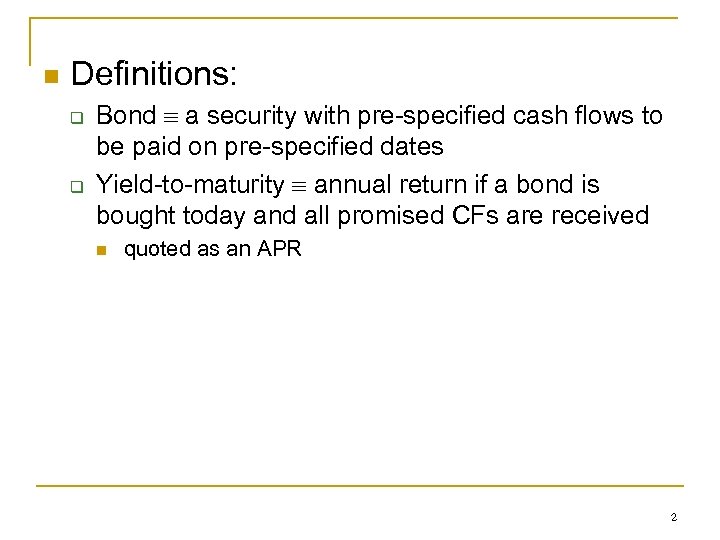
n Definitions: q q Bond a security with pre-specified cash flows to be paid on pre-specified dates Yield-to-maturity annual return if a bond is bought today and all promised CFs are received n quoted as an APR 2
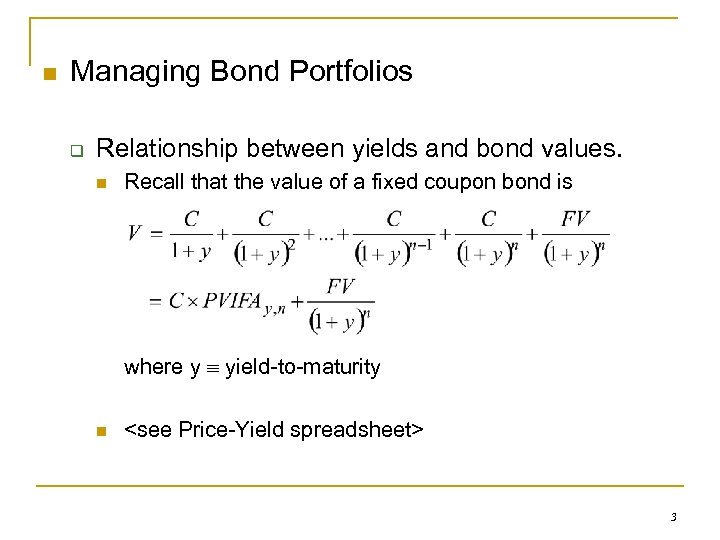
n Managing Bond Portfolios q Relationship between yields and bond values. n Recall that the value of a fixed coupon bond is where y yield-to-maturity n <see Price-Yield spreadsheet> 3
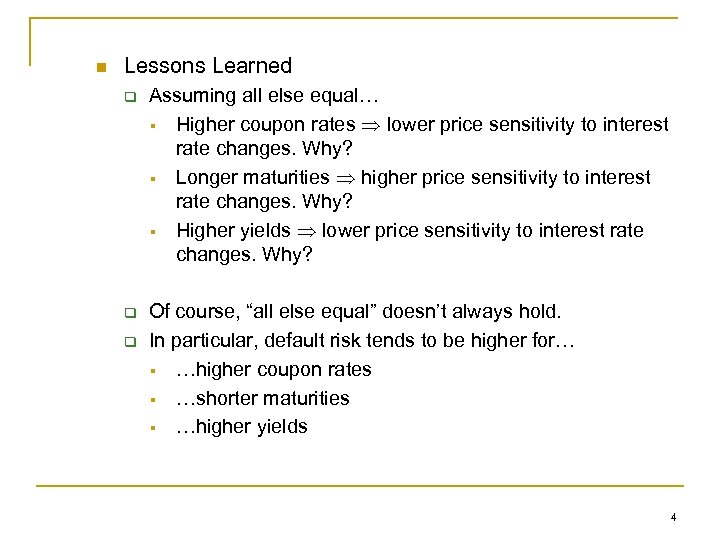
n Lessons Learned q Assuming all else equal… § Higher coupon rates lower price sensitivity to interest rate changes. Why? § Longer maturities higher price sensitivity to interest rate changes. Why? § Higher yields lower price sensitivity to interest rate changes. Why? q Of course, “all else equal” doesn’t always hold. In particular, default risk tends to be higher for… § …higher coupon rates § …shorter maturities § …higher yields q 4
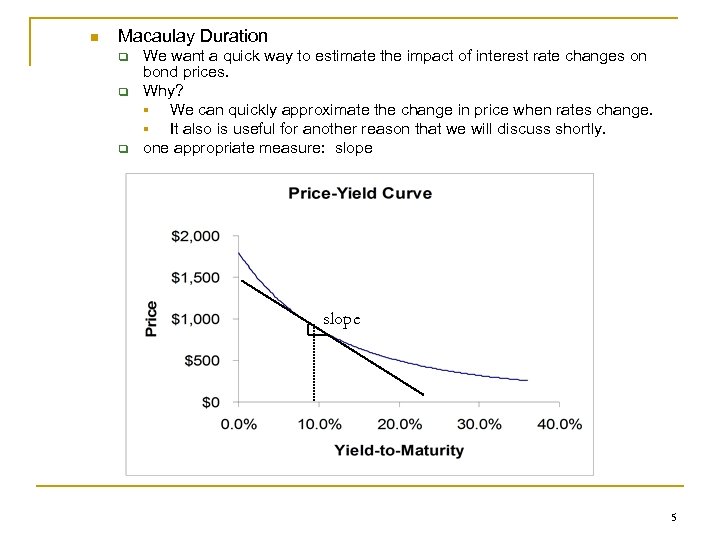
n Macaulay Duration q q q We want a quick way to estimate the impact of interest rate changes on bond prices. Why? § We can quickly approximate the change in price when rates change. § It also is useful for another reason that we will discuss shortly. one appropriate measure: slope 5
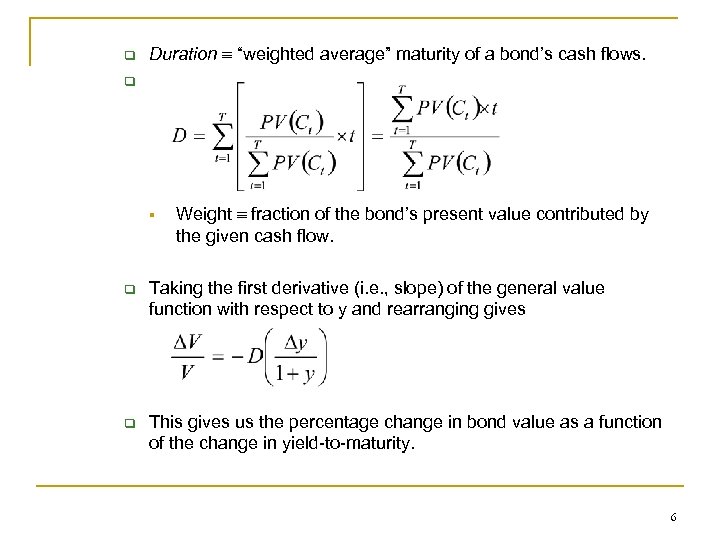
q Duration “weighted average” maturity of a bond’s cash flows. q § Weight fraction of the bond’s present value contributed by the given cash flow. q Taking the first derivative (i. e. , slope) of the general value function with respect to y and rearranging gives q This gives us the percentage change in bond value as a function of the change in yield-to-maturity. 6
q We sometimes use the “modified duration, ” which gives q Note that the greater the convexity of the price-yield curve, the greater the error. 7
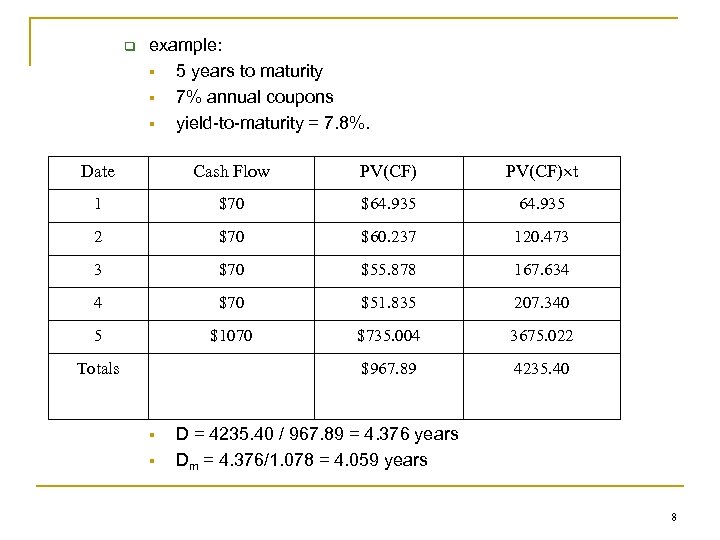
q example: § 5 years to maturity § 7% annual coupons § yield-to-maturity = 7. 8%. Date Cash Flow PV(CF) t 1 $70 $64. 935 2 $70 $60. 237 120. 473 3 $70 $55. 878 167. 634 4 $70 $51. 835 207. 340 5 $1070 $735. 004 3675. 022 $967. 89 4235. 40 Totals § § D = 4235. 40 / 967. 89 = 4. 376 years Dm = 4. 376/1. 078 = 4. 059 years 8
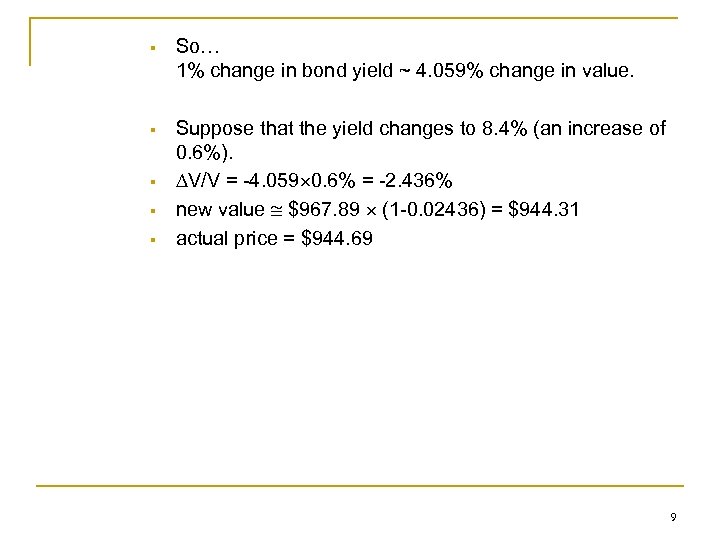
§ So… 1% change in bond yield ~ 4. 059% change in value. § Suppose that the yield changes to 8. 4% (an increase of 0. 6%). V/V = -4. 059 0. 6% = -2. 436% new value $967. 89 (1 -0. 02436) = $944. 31 actual price = $944. 69 § § § 9
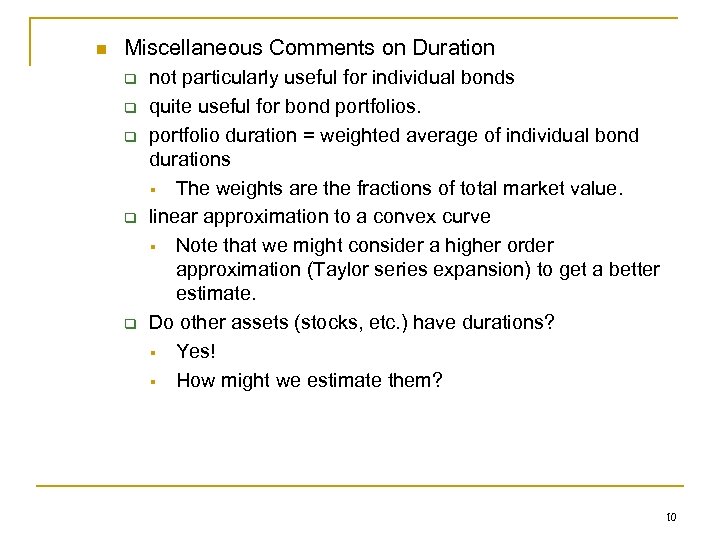
n Miscellaneous Comments on Duration q q q not particularly useful for individual bonds quite useful for bond portfolios. portfolio duration = weighted average of individual bond durations § The weights are the fractions of total market value. linear approximation to a convex curve § Note that we might consider a higher order approximation (Taylor series expansion) to get a better estimate. Do other assets (stocks, etc. ) have durations? § Yes! § How might we estimate them? 10
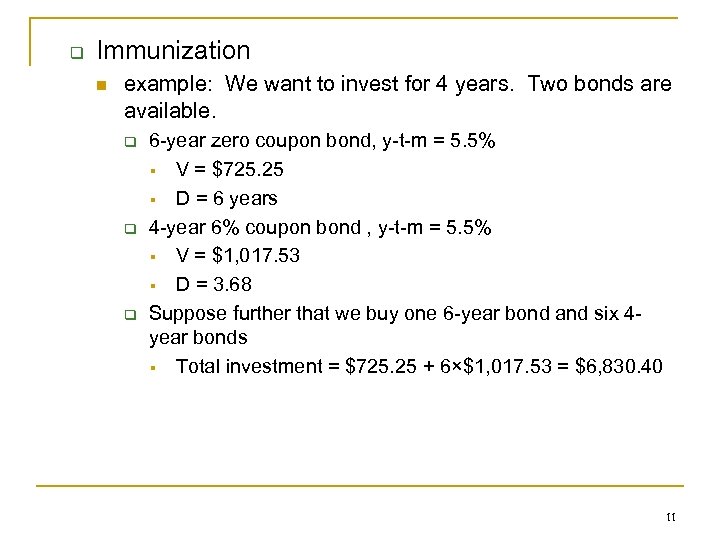
q Immunization n example: We want to invest for 4 years. Two bonds are available. q q q 6 -year zero coupon bond, y-t-m = 5. 5% § V = $725. 25 § D = 6 years 4 -year 6% coupon bond , y-t-m = 5. 5% § V = $1, 017. 53 § D = 3. 68 Suppose further that we buy one 6 -year bond and six 4 year bonds § Total investment = $725. 25 + 6×$1, 017. 53 = $6, 830. 40 11
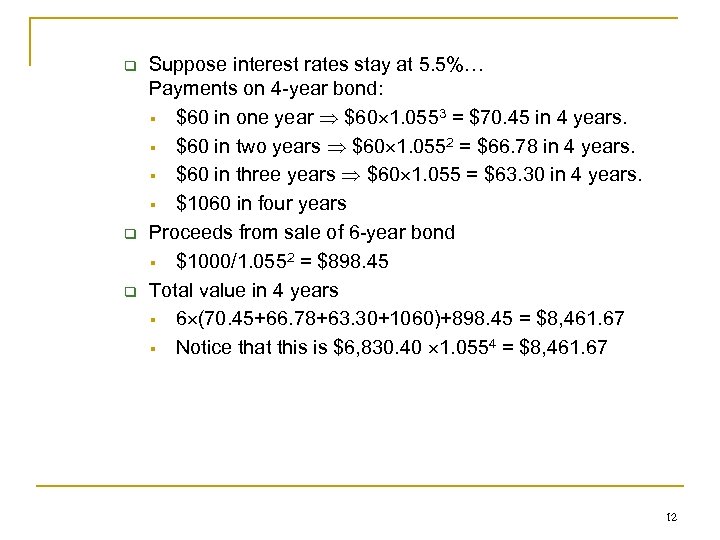
q q q Suppose interest rates stay at 5. 5%… Payments on 4 -year bond: § $60 in one year $60 1. 0553 = $70. 45 in 4 years. § $60 in two years $60 1. 0552 = $66. 78 in 4 years. § $60 in three years $60 1. 055 = $63. 30 in 4 years. § $1060 in four years Proceeds from sale of 6 -year bond § $1000/1. 0552 = $898. 45 Total value in 4 years § 6 (70. 45+66. 78+63. 30+1060)+898. 45 = $8, 461. 67 § Notice that this is $6, 830. 40 1. 0554 = $8, 461. 67 12
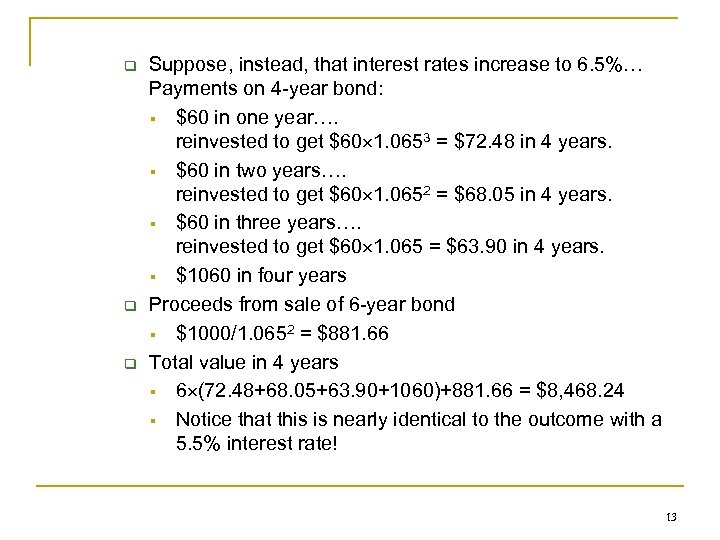
q q q Suppose, instead, that interest rates increase to 6. 5%… Payments on 4 -year bond: § $60 in one year…. reinvested to get $60 1. 0653 = $72. 48 in 4 years. § $60 in two years…. reinvested to get $60 1. 0652 = $68. 05 in 4 years. § $60 in three years…. reinvested to get $60 1. 065 = $63. 90 in 4 years. § $1060 in four years Proceeds from sale of 6 -year bond § $1000/1. 0652 = $881. 66 Total value in 4 years § 6 (72. 48+68. 05+63. 90+1060)+881. 66 = $8, 468. 24 § Notice that this is nearly identical to the outcome with a 5. 5% interest rate! 13
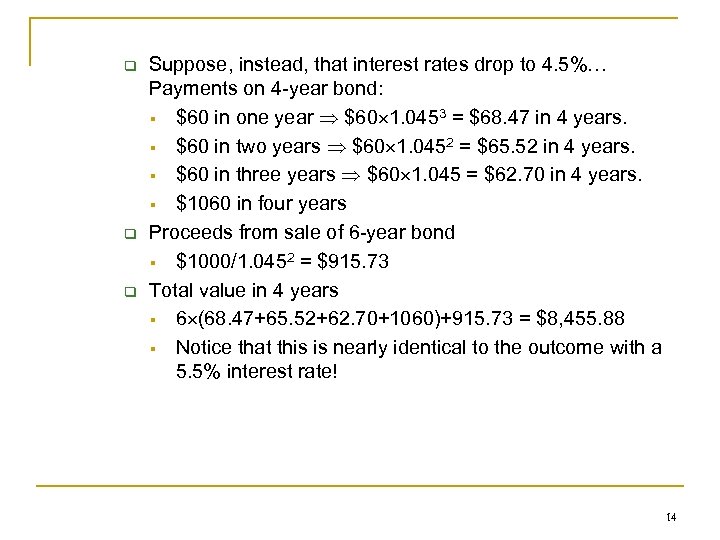
q q q Suppose, instead, that interest rates drop to 4. 5%… Payments on 4 -year bond: § $60 in one year $60 1. 0453 = $68. 47 in 4 years. § $60 in two years $60 1. 0452 = $65. 52 in 4 years. § $60 in three years $60 1. 045 = $62. 70 in 4 years. § $1060 in four years Proceeds from sale of 6 -year bond § $1000/1. 0452 = $915. 73 Total value in 4 years § 6 (68. 47+65. 52+62. 70+1060)+915. 73 = $8, 455. 88 § Notice that this is nearly identical to the outcome with a 5. 5% interest rate! 14
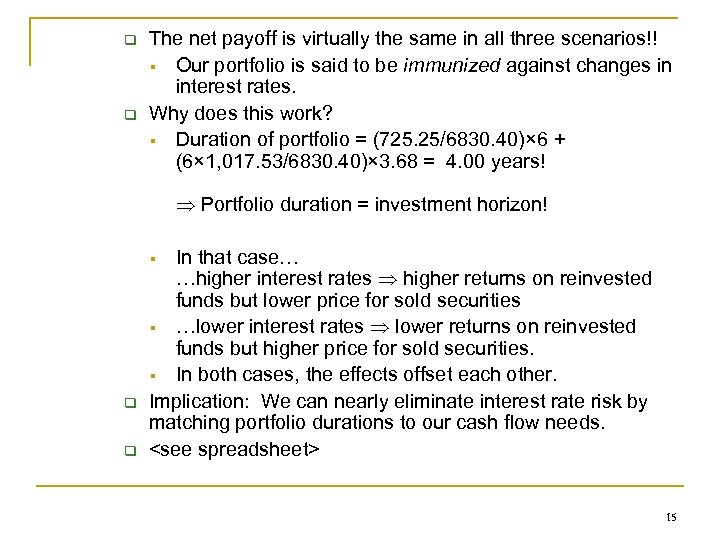
q q The net payoff is virtually the same in all three scenarios!! § Our portfolio is said to be immunized against changes in interest rates. Why does this work? § Duration of portfolio = (725. 25/6830. 40)× 6 + (6× 1, 017. 53/6830. 40)× 3. 68 = 4. 00 years! Portfolio duration = investment horizon! In that case… …higher interest rates higher returns on reinvested funds but lower price for sold securities § …lower interest rates lower returns on reinvested funds but higher price for sold securities. § In both cases, the effects offset each other. Implication: We can nearly eliminate interest rate risk by matching portfolio durations to our cash flow needs. <see spreadsheet> § q q 15
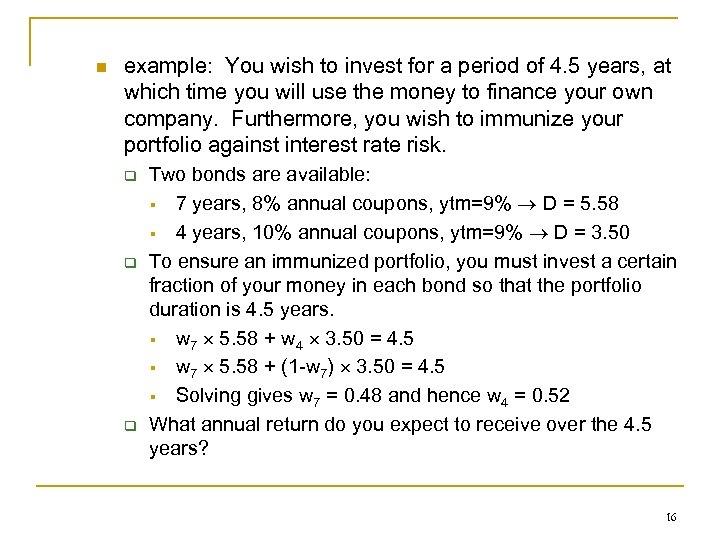
n example: You wish to invest for a period of 4. 5 years, at which time you will use the money to finance your own company. Furthermore, you wish to immunize your portfolio against interest rate risk. q q q Two bonds are available: § 7 years, 8% annual coupons, ytm=9% D = 5. 58 § 4 years, 10% annual coupons, ytm=9% D = 3. 50 To ensure an immunized portfolio, you must invest a certain fraction of your money in each bond so that the portfolio duration is 4. 5 years. § w 7 5. 58 + w 4 3. 50 = 4. 5 § w 7 5. 58 + (1 -w 7) 3. 50 = 4. 5 § Solving gives w 7 = 0. 48 and hence w 4 = 0. 52 What annual return do you expect to receive over the 4. 5 years? 16
n Bond portfolios are often managed in this way. q q n We choose an investment horizon. Then we choose a portfolio with a duration equal to that investment horizon. Problems with immunization q q q may need to rebalance frequently high transactions costs Which portfolio should be chosen (there are literally an infinite number of possible ones) ? § one that suits our risk preference § one that most closely resembles the cash needs The duration calculation assumes no embedded options (call, conversion, etc. ) and no default. § How might we get around this? 17
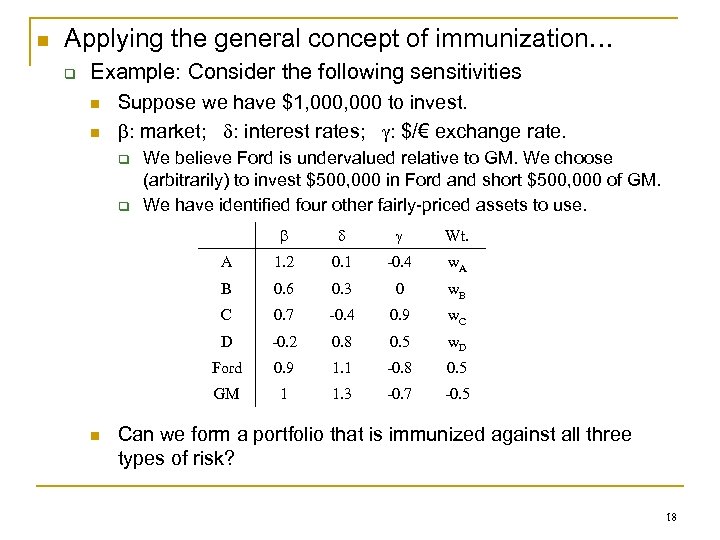
n Applying the general concept of immunization… q Example: Consider the following sensitivities n n Suppose we have $1, 000 to invest. b: market; d: interest rates; g: $/€ exchange rate. q q We believe Ford is undervalued relative to GM. We choose (arbitrarily) to invest $500, 000 in Ford and short $500, 000 of GM. We have identified four other fairly-priced assets to use. d g Wt. A 1. 2 0. 1 -0. 4 w. A B 0. 6 0. 3 0 w. B C 0. 7 -0. 4 0. 9 w. C D -0. 2 0. 8 0. 5 w. D Ford 0. 9 1. 1 -0. 8 0. 5 GM n b 1 1. 3 -0. 7 -0. 5 Can we form a portfolio that is immunized against all three types of risk? 18
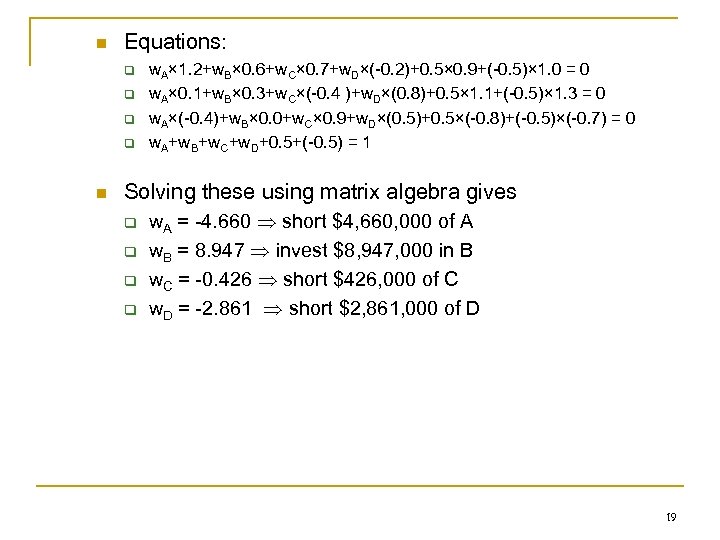
n Equations: q q n w. A× 1. 2+w. B× 0. 6+w. C× 0. 7+w. D×(-0. 2)+0. 5× 0. 9+(-0. 5)× 1. 0 = 0 w. A× 0. 1+w. B× 0. 3+w. C×(-0. 4 )+w. D×(0. 8)+0. 5× 1. 1+(-0. 5)× 1. 3 = 0 w. A×(-0. 4)+w. B× 0. 0+w. C× 0. 9+w. D×(0. 5)+0. 5×(-0. 8)+(-0. 5)×(-0. 7) = 0 w. A+w. B+w. C+w. D+0. 5+(-0. 5) = 1 Solving these using matrix algebra gives q q w. A = -4. 660 short $4, 660, 000 of A w. B = 8. 947 invest $8, 947, 000 in B w. C = -0. 426 short $426, 000 of C w. D = -2. 861 short $2, 861, 000 of D 19
n Of course, our desire is to control for risk while taking advantage of mispricings. n Adding more assets gives us degrees of freedom. q n This allows us to take advantage of relative mispricings while controlling for various risk factors. Note: Matrix algebra is not fair game on the final exam. 20
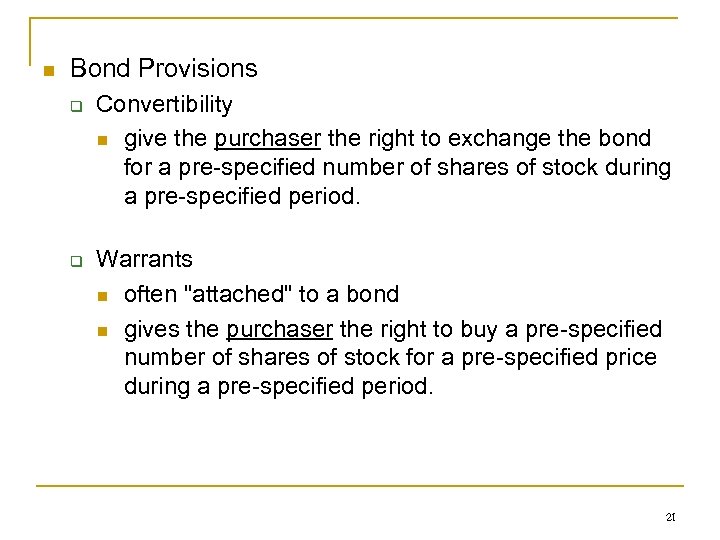
n Bond Provisions q q Convertibility n give the purchaser the right to exchange the bond for a pre-specified number of shares of stock during a pre-specified period. Warrants n often "attached" to a bond n gives the purchaser the right to buy a pre-specified number of shares of stock for a pre-specified price during a pre-specified period. 21
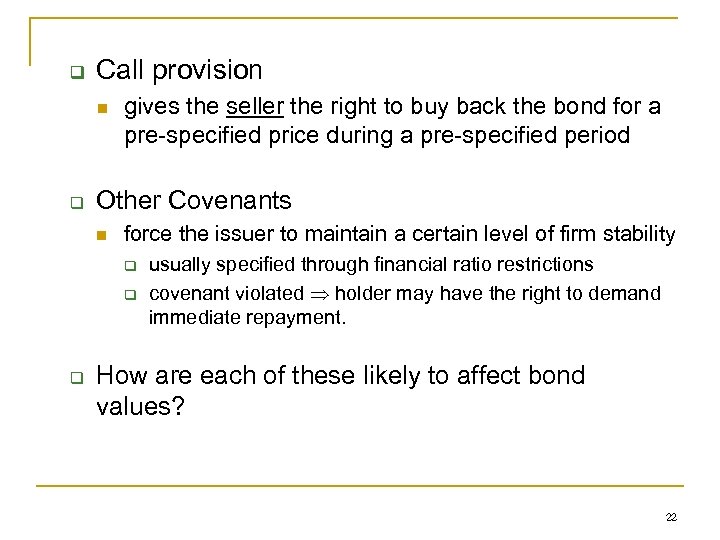
q Call provision n q gives the seller the right to buy back the bond for a pre-specified price during a pre-specified period Other Covenants n force the issuer to maintain a certain level of firm stability q q q usually specified through financial ratio restrictions covenant violated holder may have the right to demand immediate repayment. How are each of these likely to affect bond values? 22
Скачать презентацию Investments Bonds Business Administration 365 Professor Scott Hoover
1dce6c320cf8cdb636613aa8a59a2abf.ppt