 Скачать презентацию Investments Analysis and Behavior Chapter 17 — Global
41a0fd995ec2529dd3b75756fe821483.ppt
- Количество слайдов: 26



Investments: Analysis and Behavior Chapter 17 - Global Investing © 2008 Mc. Graw-Hill/Irwin
Learning Objectives n n n Know the benefits of international diversification Understand the risks of international investing Track developed and emerging markets Recognize the home bias Be able to utilize the different tools of international investing 17 -2
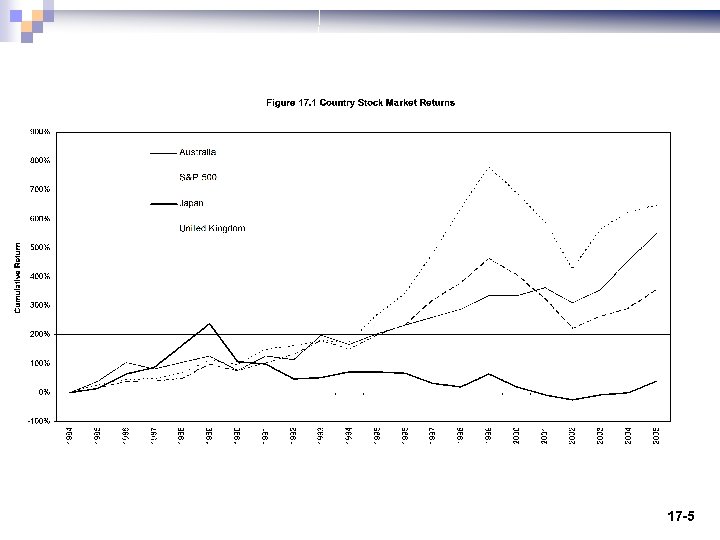
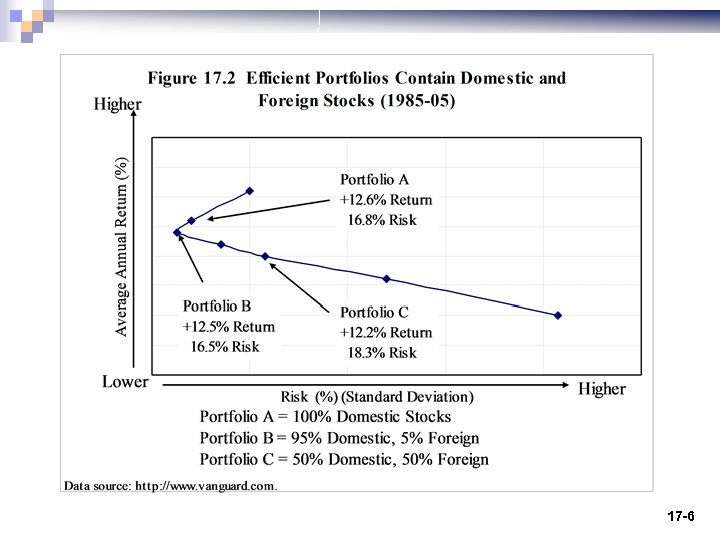
Global investing benefits n Global stock market moves differently from domestic markets ¨ Some international markets grow much faster than domestic markets n Global diversification: potential to cushion investor portfolios from downward fluctuations in domestic markets ¨ Adding foreign stocks to portfolio may enhance total returns while reducing overall volatility. 17 -3
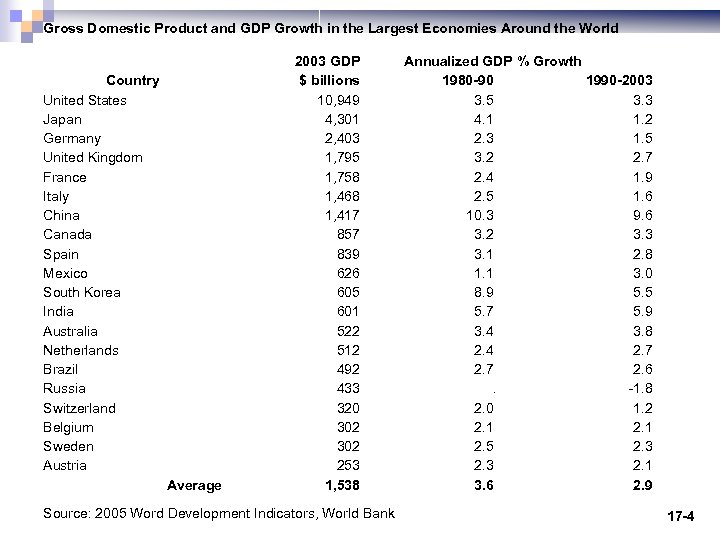
Gross Domestic Product and GDP Growth in the Largest Economies Around the World Country United States Japan Germany United Kingdom France Italy China Canada Spain Mexico South Korea India Australia Netherlands Brazil Russia Switzerland Belgium Sweden Austria Average 2003 GDP $ billions 10, 949 4, 301 2, 403 1, 795 1, 758 1, 468 1, 417 857 839 626 605 601 522 512 492 433 320 302 253 1, 538 Source: 2005 Word Development Indicators, World Bank Annualized GDP % Growth 1980 -90 1990 -2003 3. 5 3. 3 4. 1 1. 2 2. 3 1. 5 3. 2 2. 7 2. 4 1. 9 2. 5 1. 6 10. 3 9. 6 3. 2 3. 3 3. 1 2. 8 1. 1 3. 0 8. 9 5. 5 5. 7 5. 9 3. 4 3. 8 2. 4 2. 7 2. 6. -1. 8 2. 0 1. 2 2. 1 2. 5 2. 3 2. 1 3. 6 2. 9 17 -4
17 -5
17 -6
Tracking global markets n n n Global market indices available for investors Problem: local indexes are computed in the local currency, using different computing methods Morgan Stanley Capital International Inc provides consistent information for global market 17 -7
Morgan Stanley Capital International n n n Apply the same company selection criteria and calculation methodology across all markets Provide individual country coverage, regional and composite indexes for developed markets, emerging markets and all countries by region Use full market capitalization weights (Price x number of outstanding shares) 17 -8
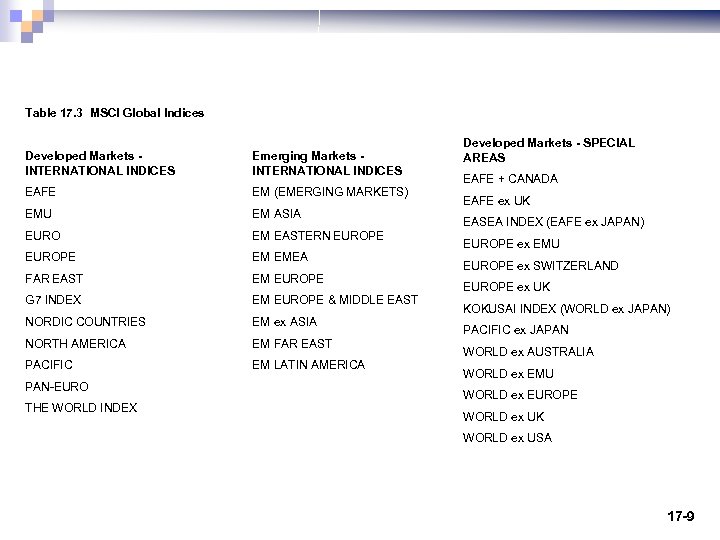
Table 17. 3 MSCI Global Indices Developed Markets INTERNATIONAL INDICES Emerging Markets INTERNATIONAL INDICES EAFE EM (EMERGING MARKETS) EMU EM ASIA EURO EM EASTERN EUROPE EM EMEA FAR EAST EM EUROPE G 7 INDEX EM EUROPE & MIDDLE EAST NORDIC COUNTRIES EM ex ASIA NORTH AMERICA EM FAR EAST PACIFIC EM LATIN AMERICA PAN-EURO THE WORLD INDEX Developed Markets - SPECIAL AREAS EAFE + CANADA EAFE ex UK EASEA INDEX (EAFE ex JAPAN) EUROPE ex EMU EUROPE ex SWITZERLAND EUROPE ex UK KOKUSAI INDEX (WORLD ex JAPAN) PACIFIC ex JAPAN WORLD ex AUSTRALIA WORLD ex EMU WORLD ex EUROPE WORLD ex UK WORLD ex USA 17 -9
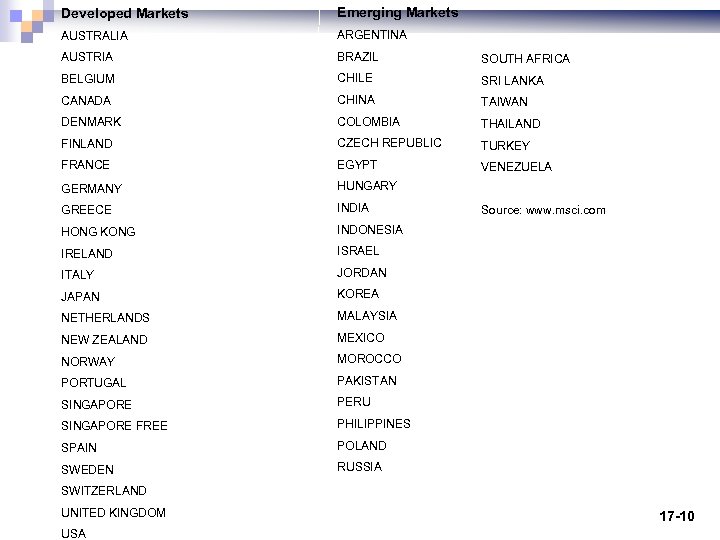
Developed Markets Emerging Markets AUSTRALIA ARGENTINA AUSTRIA BRAZIL SOUTH AFRICA BELGIUM CHILE SRI LANKA CANADA CHINA TAIWAN DENMARK COLOMBIA THAILAND FINLAND CZECH REPUBLIC TURKEY FRANCE EGYPT VENEZUELA GERMANY HUNGARY GREECE INDIA HONG KONG INDONESIA IRELAND ISRAEL ITALY JORDAN JAPAN KOREA NETHERLANDS MALAYSIA NEW ZEALAND MEXICO NORWAY MOROCCO PORTUGAL PAKISTAN SINGAPORE PERU SINGAPORE FREE PHILIPPINES SPAIN POLAND SWEDEN RUSSIA Source: www. msci. com SWITZERLAND UNITED KINGDOM USA 17 -10
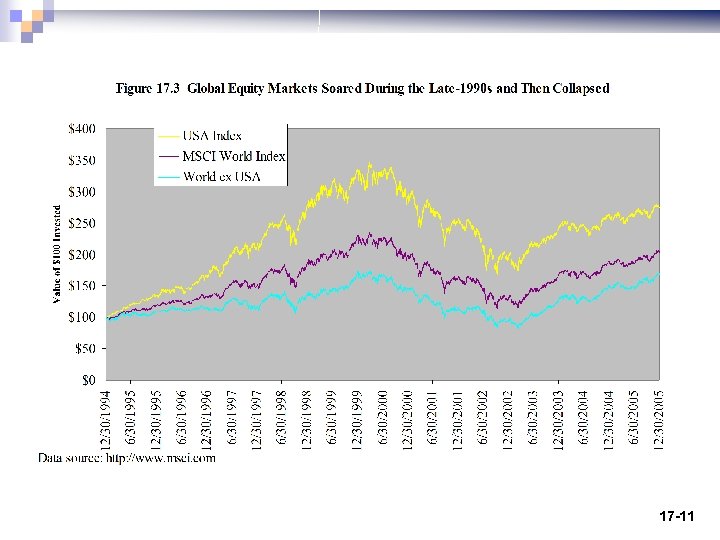
17 -11
Developed and Emerging markets n n n Developed markets: Securities markets in countries with advanced economics Emerging markets: Securities markets in countries with rapidly evolving economics Problems with investing in emerging markets: amount of investable assets available ¨ much of the equity in emerging markets is not available to international investors n MSCI designates free index and non-free index. 17 -12
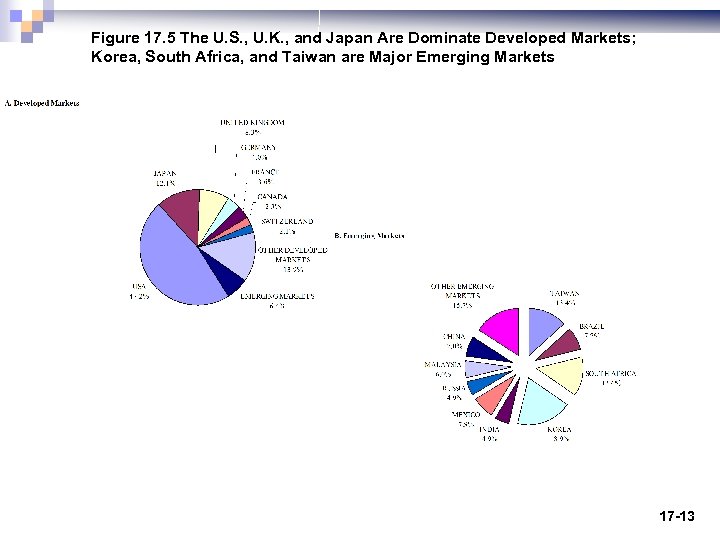
Figure 17. 5 The U. S. , U. K. , and Japan Are Dominate Developed Markets; Korea, South Africa, and Taiwan are Major Emerging Markets 17 -13
Countries vs. sectors n n Diversifying globally is especially useful when countries have segmented markets Alternative to country diversification: global sector diversification MSCI developed the All Country Sector Indices using Global Industry Classification Standard (GICS) system ETF i. Shares available in global sectors 17 -14
Global Investing Risks n Market volatility ¨ Investing in foreign market involves much higher market volatility ¨ Above average gain, above average loss ¨ On average, foreign markets have tended to under perform the U. S market while displaying a higher level of return 17 -15
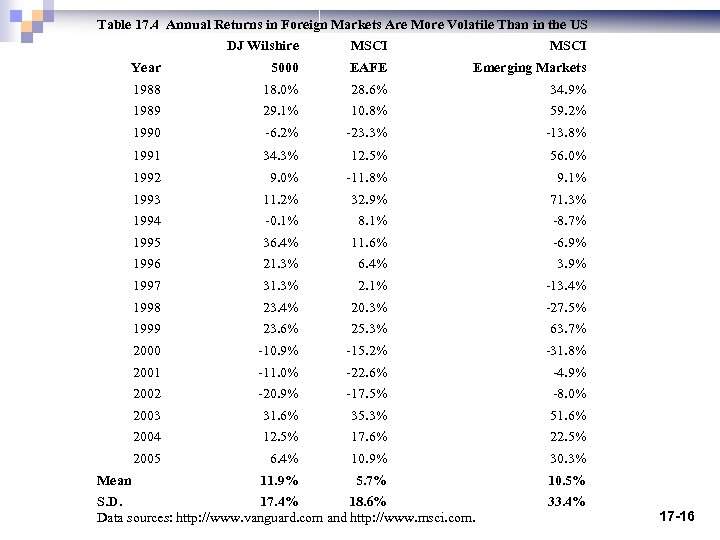
Table 17. 4 Annual Returns in Foreign Markets Are More Volatile Than in the US DJ Wilshire MSCI Year 5000 EAFE Emerging Markets 1988 18. 0% 28. 6% 34. 9% 1989 29. 1% 10. 8% 59. 2% 1990 -6. 2% -23. 3% -13. 8% 1991 34. 3% 12. 5% 56. 0% 1992 9. 0% -11. 8% 9. 1% 1993 11. 2% 32. 9% 71. 3% 1994 -0. 1% 8. 1% -8. 7% 1995 36. 4% 11. 6% -6. 9% 1996 21. 3% 6. 4% 3. 9% 1997 31. 3% 2. 1% -13. 4% 1998 23. 4% 20. 3% -27. 5% 1999 23. 6% 25. 3% 63. 7% 2000 -10. 9% -15. 2% -31. 8% 2001 -11. 0% -22. 6% -4. 9% 2002 -20. 9% -17. 5% -8. 0% 2003 31. 6% 35. 3% 51. 6% 2004 12. 5% 17. 6% 22. 5% 2005 6. 4% 10. 9% 30. 3% 11. 9% 5. 7% 10. 5% Mean S. D. 17. 4% 18. 6% Data sources: http: //www. vanguard. com and http: //www. msci. com. 33. 4% 17 -16
n Liquidity risk ¨ Emerging markets often permit foreigners to buy only specific classes of shares for certain companies. ¨ Scarcity of investment opportunity, thin volume, high premium ¨ Higher market impact cost (costs tied to changing market bid and ask prices) ¨ Especially high in emerging markets (brokerage commissions, exchange fees, currency translation costs, custodial fees higher in emerging markets) 17 -17
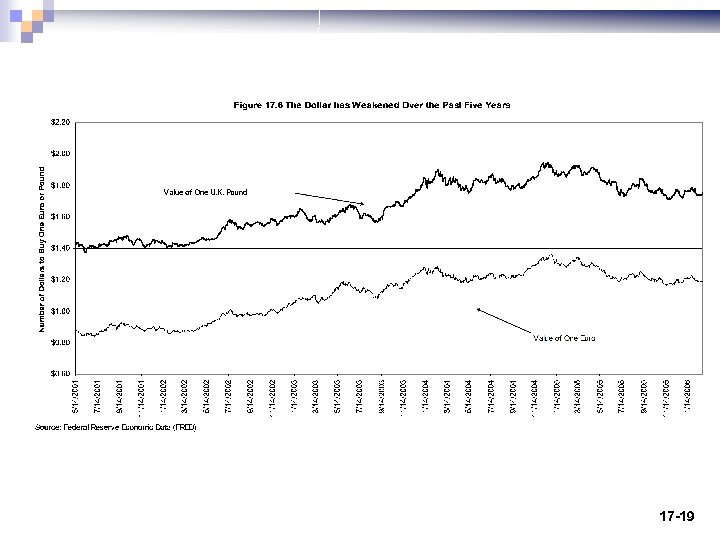
n Political risk ¨ Loss potential tied to government stemming from coups, assassinations, or civil unrest. ¨ Government policy risk: lookout for policy changes ¨ Expropriation risk: government confiscation of assets n Currency risk ¨ Value of US dollar and all other currencies fluctuate ¨ Strong dollar: increase in the amount of foreign currency per 1 US dollar Weak dollar: decrease in the amount of foreign currency per 1 US dollar 17 -18
17 -19
Home bias n Despite the advantage of international investing, most investors commit very little of their investment portfolio to global equities ¨ Home n bias Investors believe things they are familiar with are better than things they are not familiar with (familiarity bias) 17 -20

17 -21
Global investment opportunities n Buy multinational companies: exposure to international market, reduce the impact of home bias. (Ex. Coca-Cola, Wal-Mart, Toyota. . ) Ways to gain global diversification n n Buy stocks in companies with corporate headquarters in foreign countries Buy stocks of multinational corporations that have globally diverse business operation 17 -22
n American Depository Receipts (ADRs) Negotiable instruments that represent ownership in the equity securities of a non-US company ¨ Issued by US commercial banks ¨ Each ADR shares traded on US exchange is backed by specific number of foreign shares held by a custodian bank ¨ ADR ratio: number of underlying shares represented by each ADR ¨ n n n Level I ADRs: issuers are not initially seeking to raise capital in US Level II ADRs: no immediate financing needs, listed on US Level III ADRs: issuer floats a public offering in US and obtain listing on major US exchange. 17 -23
International Bonds n n Domestic Bonds: Borrowers issuing bonds in their local market. Foreign Bonds: Borrowers from another country issue bonds in your country, denominated in your currency ¨ Yankee bonds ¨ Samurai bonds ¨ Bulldog bonds 17 -24
n Global mutual funds ¨ International stock and bond mutual fund: cost efficient means of investing in global markets ¨ Emerging market’s fund: invest in stocks of companies based in developing countries ¨ Global equity fund (or world equity fund): a mutual fund that invests in US and foreign stocks ¨ International equity fund (foreign fund): invest in the equity of the companies outside the US. Generally prohibited from investing in US equities ¨ Foreign regional fund: an international fund investing in particular geographical region (Europe, Pacific Basin) ¨ Single country fund: invest in a sole foreign country (Hong Kong, Mexico, Italy). Closed-end fund, extremely risky. 17 -25
n International i. Shares ¨ Barclays Global Investors: leader in Index shares (i. Shares) ¨ International i. Shares: track market movements around the world. ¨ Most popular international i. Shares based on wellknown MSCI indexes. ¨ Good options for international exposure in an easy and cost effective way 17 -26
Скачать презентацию Investments Analysis and Behavior Chapter 17 — Global
41a0fd995ec2529dd3b75756fe821483.ppt