 Скачать презентацию Investment Themes in Optical Networking September 2001 Bill
da9350e2d53ced836dc719f2daa85297.ppt
- Количество слайдов: 45



Investment Themes in Optical Networking September 2001 Bill Magill – Optical Components & Systems
Overview Ø Optical networking: defining the ecosystem Ø State of the industry Ø Looking forward: the bad and the good Ø Identifying the pain Ø Relieving the pain Ø Hot growth opportunities Ø Creating a Metric Of Interest Ø Investment summary 2
Defining The Ecosystem 3
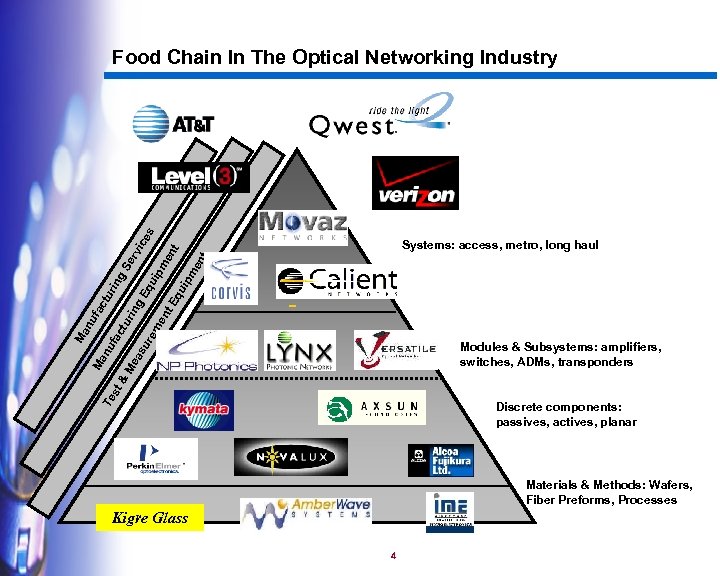
t ipm en t en Systems: access, metro, long haul Me as ur em en t. E qu ipm g. E qu tu ac uf Modules & Subsystems: amplifiers, switches, ADMs, transponders Te st & Ma n uf rin ac tu rin g. S er vic es Food Chain In The Optical Networking Industry Discrete components: passives, actives, planar Materials & Methods: Wafers, Fiber Preforms, Processes Kigre Glass 4
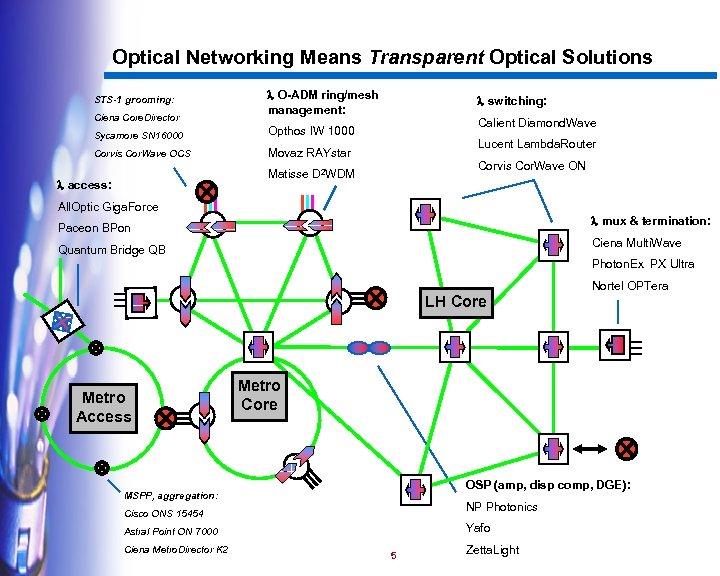
Optical Networking Means Transparent Optical Solutions STS-1 grooming: Ciena Core. Director O-ADM ring/mesh management: Sycamore SN 16000 Calient Diamond. Wave Opthos IW 1000 Corvis Cor. Wave OCS switching: Movaz RAYstar Lucent Lambda. Router Corvis Cor. Wave ON Matisse D 2 WDM access: All. Optic Giga. Force mux & termination: Paceon BPon Ciena Multi. Wave Quantum Bridge QB Photon. Ex PX Ultra Nortel OPTera LH Core Metro Access Metro Core OSP (amp, disp comp, DGE): MSPP, aggregation: NP Photonics Cisco ONS 15454 Yafo Astral Point ON 7000 Ciena Metro. Director K 2 5 Zetta. Light
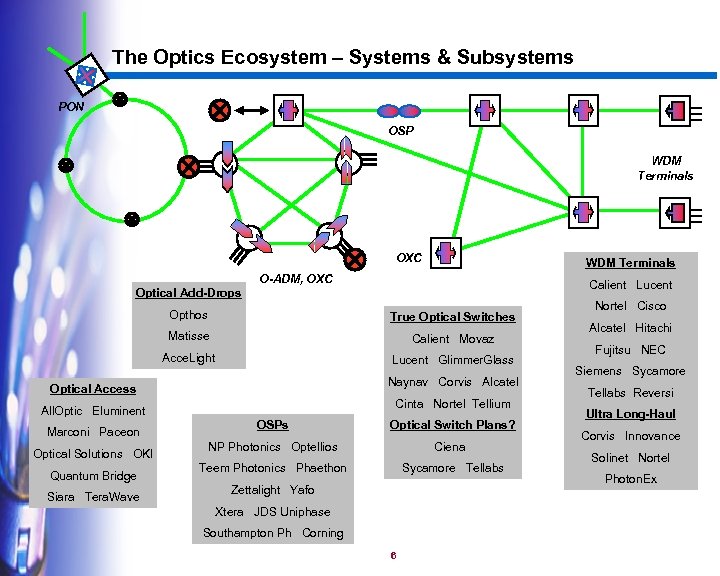
The Optics Ecosystem – Systems & Subsystems PON OSP WDM Terminals OXC WDM Terminals O-ADM, OXC Calient Lucent Optical Add-Drops Opthos True Optical Switches Matisse Calient Movaz Acce. Light Lucent Glimmer. Glass Naynav Corvis Alcatel Optical Access Cinta Nortel Tellium All. Optic Eluminent Marconi Paceon Optical Solutions OKI Quantum Bridge Siara Tera. Wave OSPs Optical Switch Plans? NP Photonics Optellios Ciena Teem Photonics Phaethon Sycamore Tellabs Zettalight Yafo Xtera JDS Uniphase Southampton Ph Corning 6 Nortel Cisco Alcatel Hitachi Fujitsu NEC Siemens Sycamore Tellabs Reversi Ultra Long-Haul Corvis Innovance Solinet Nortel Photon. Ex
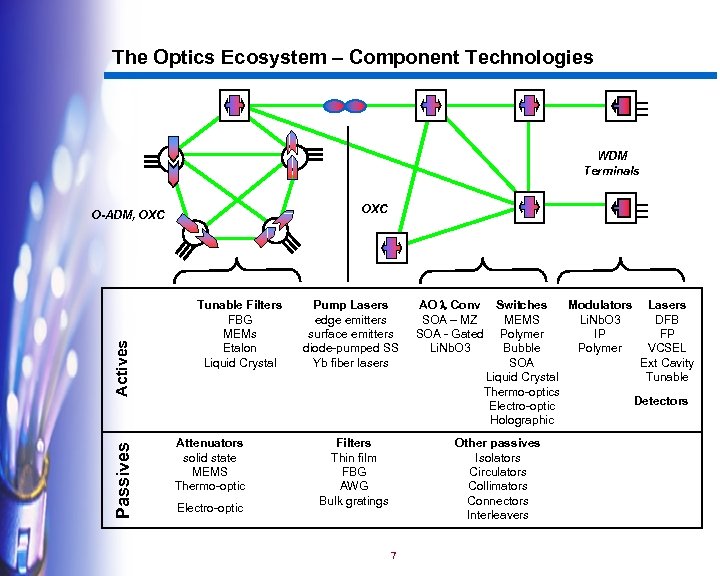
The Optics Ecosystem – Component Technologies WDM Terminals OXC Passives Actives O-ADM, OXC Tunable Filters FBG MEMs Etalon Liquid Crystal Attenuators solid state MEMS Thermo-optic Electro-optic Pump Lasers edge emitters surface emitters diode-pumped SS Yb fiber lasers Filters Thin film FBG AWG Bulk gratings AO Conv Switches Modulators Lasers SOA – MZ MEMS Li. Nb. O 3 DFB SOA - Gated Polymer IP FP Li. Nb. O 3 Bubble Polymer VCSEL SOA Ext Cavity Liquid Crystal Tunable Thermo-optics Detectors Electro-optic Holographic Other passives Isolators Circulators Collimators Connectors Interleavers 7
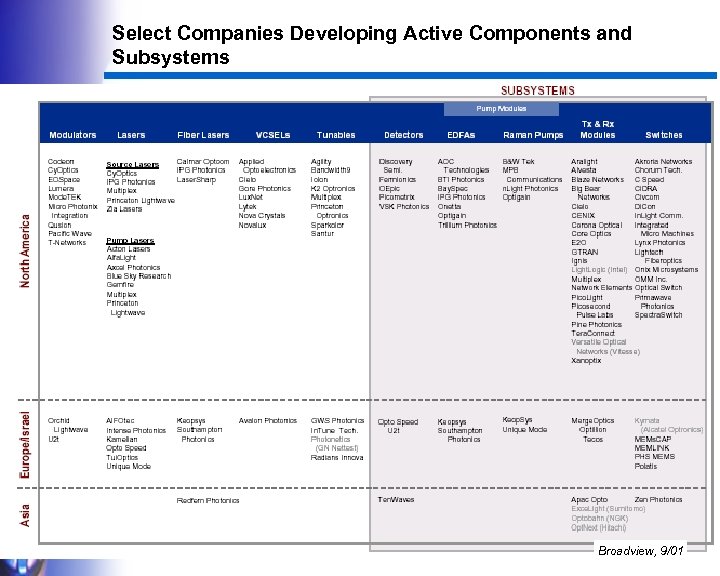
Select Companies Developing Active Components and Subsystems 8 Broadview, 9/01
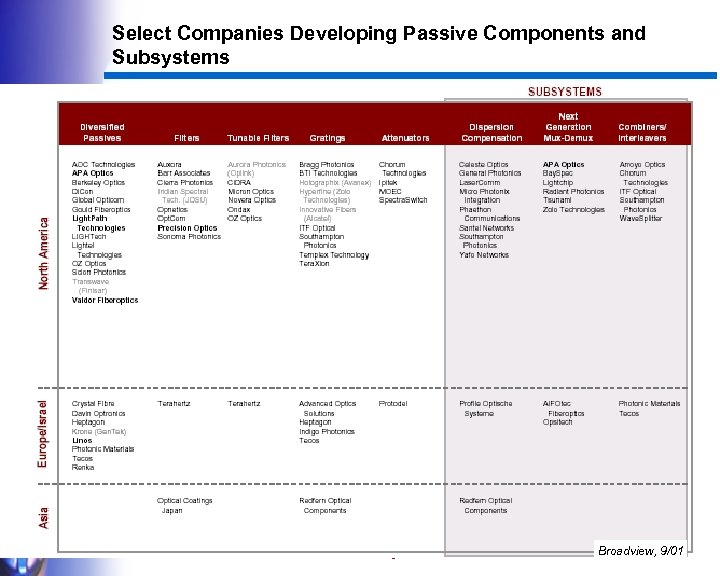
Select Companies Developing Passive Components and Subsystems 9 Broadview, 9/01
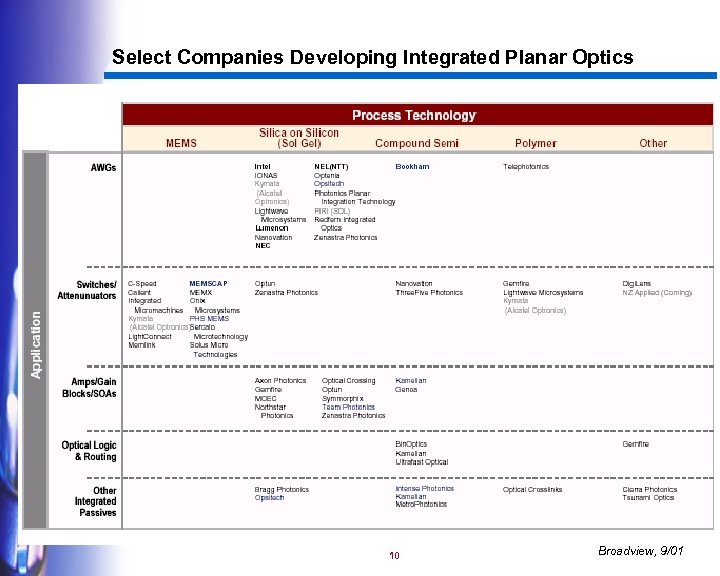
Select Companies Developing Integrated Planar Optics 10 Broadview, 9/01

State Of The Industry 11
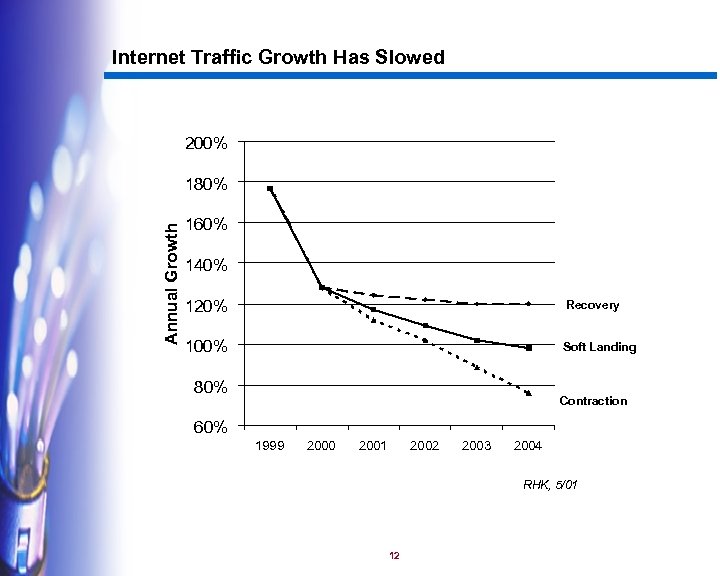
Internet Traffic Growth Has Slowed 200% Annual Growth 180% 160% 140% 120% Recovery 100% Soft Landing 80% Contraction 60% 1999 2000 2001 2002 2003 2004 RHK, 5/01 12
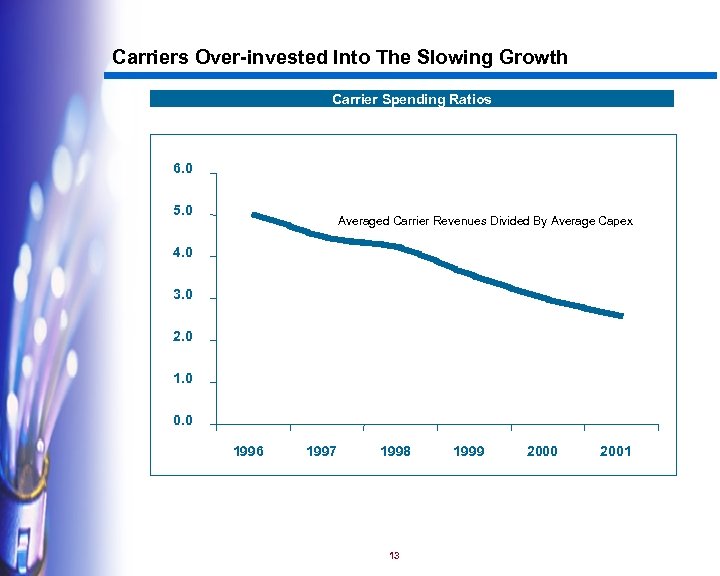
Carriers Over-invested Into The Slowing Growth Carrier Spending Ratios 6. 0 5. 0 Averaged Carrier Revenues Divided By Average Capex 4. 0 3. 0 2. 0 1. 0 0. 0 1996 1997 1998 13 1999 2000 2001
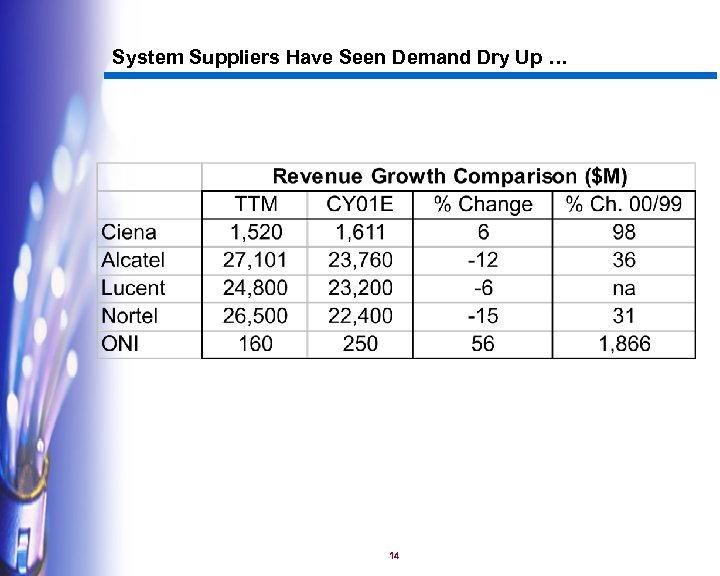
System Suppliers Have Seen Demand Dry Up … 14
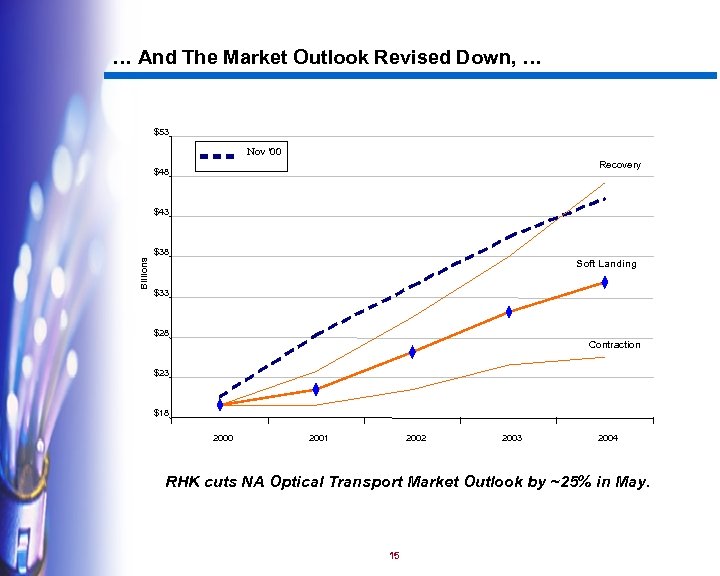
… And The Market Outlook Revised Down, … $53 Nov '00 Recovery $48 $43 Billions $38 Soft Landing $33 $28 Contraction $23 $18 2000 2001 2002 2003 2004 RHK cuts NA Optical Transport Market Outlook by ~25% in May. 15
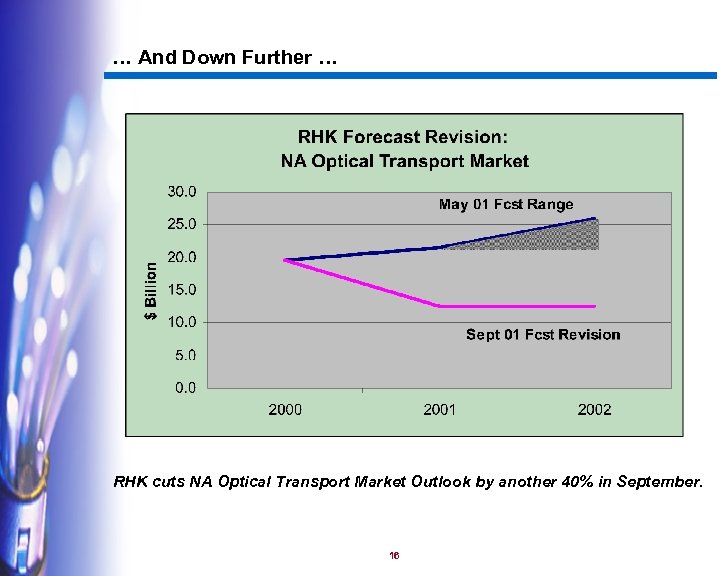
… And Down Further … RHK cuts NA Optical Transport Market Outlook by another 40% in September. 16
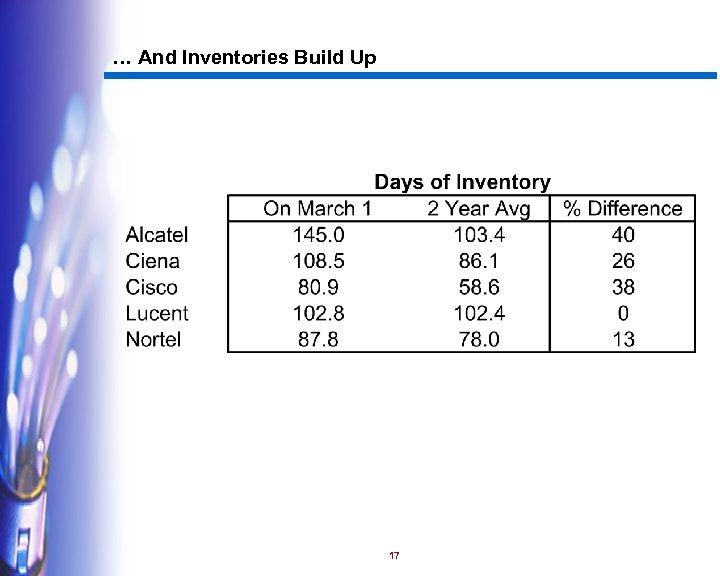
… And Inventories Build Up 17
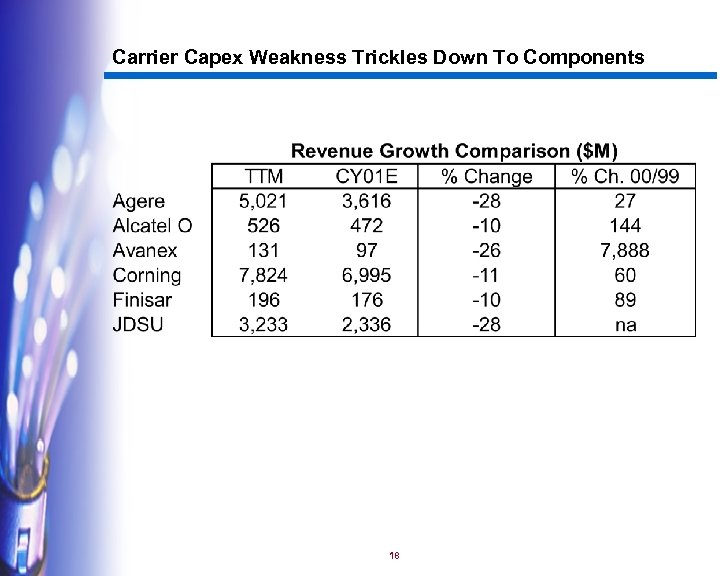
Carrier Capex Weakness Trickles Down To Components 18
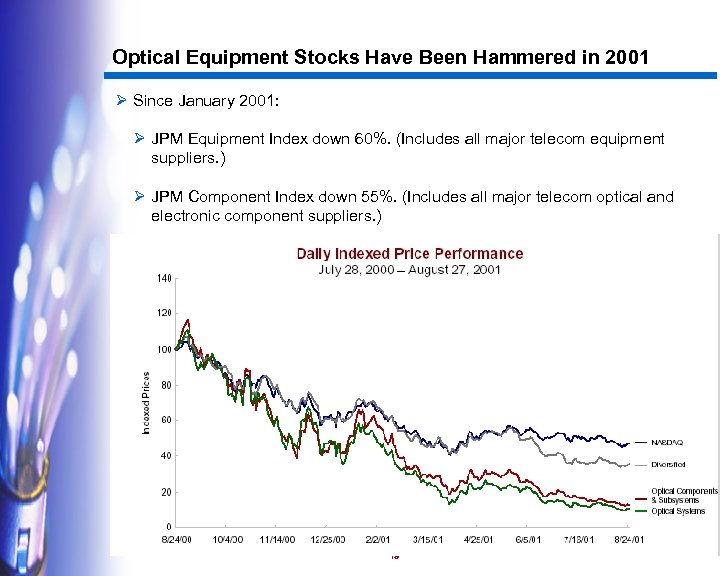
Optical Equipment Stocks Have Been Hammered in 2001 Ø Since January 2001: Ø JPM Equipment Index down 60%. (Includes all major telecom equipment suppliers. ) Ø JPM Component Index down 55%. (Includes all major telecom optical and electronic component suppliers. ) Ø Nasdaq off 25% 19
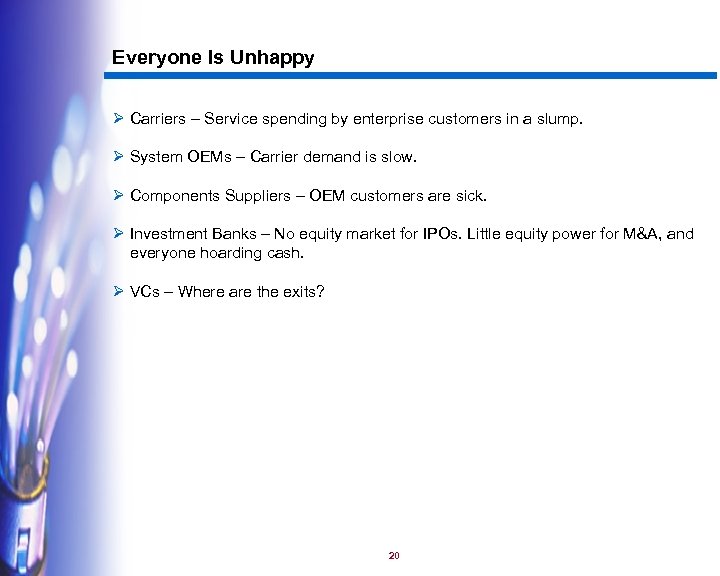
Everyone Is Unhappy Ø Carriers – Service spending by enterprise customers in a slump. Ø System OEMs – Carrier demand is slow. Ø Components Suppliers – OEM customers are sick. Ø Investment Banks – No equity market for IPOs. Little equity power for M&A, and everyone hoarding cash. Ø VCs – Where are the exits? 20

Looking Forward 21
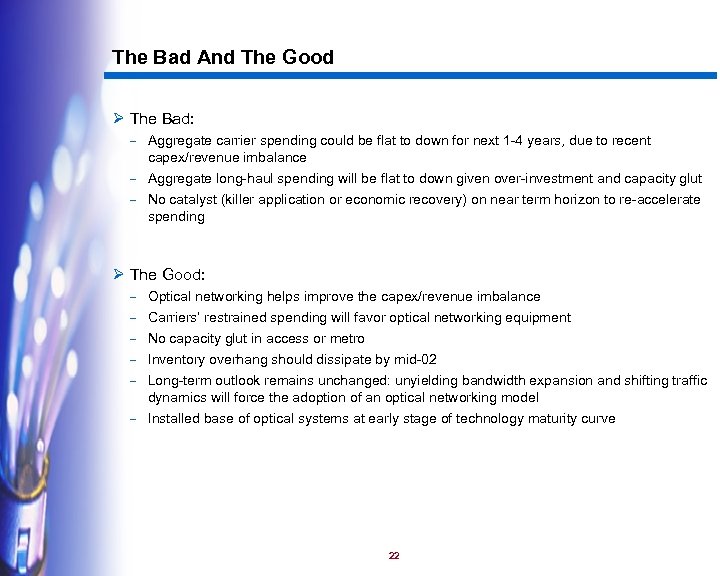
The Bad And The Good Ø The Bad: – Aggregate carrier spending could be flat to down for next 1 -4 years, due to recent capex/revenue imbalance – Aggregate long-haul spending will be flat to down given over-investment and capacity glut – No catalyst (killer application or economic recovery) on near term horizon to re-accelerate spending Ø The Good: – Optical networking helps improve the capex/revenue imbalance – Carriers’ restrained spending will favor optical networking equipment – No capacity glut in access or metro – Inventory overhang should dissipate by mid-02 – Long-term outlook remains unchanged: unyielding bandwidth expansion and shifting traffic dynamics will force the adoption of an optical networking model – Installed base of optical systems at early stage of technology maturity curve 22
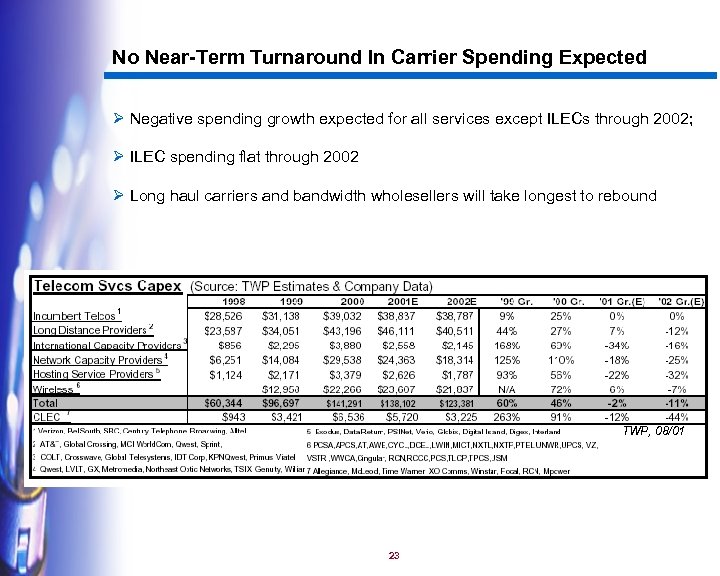
No Near-Term Turnaround In Carrier Spending Expected Ø Negative spending growth expected for all services except ILECs through 2002; Ø ILEC spending flat through 2002 Ø Long haul carriers and bandwidth wholesellers will take longest to rebound TWP, 08/01 23
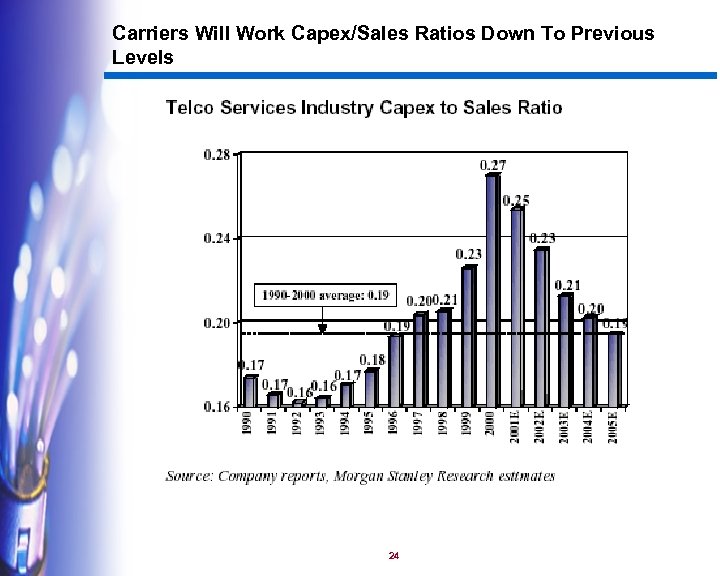
Carriers Will Work Capex/Sales Ratios Down To Previous Levels 24
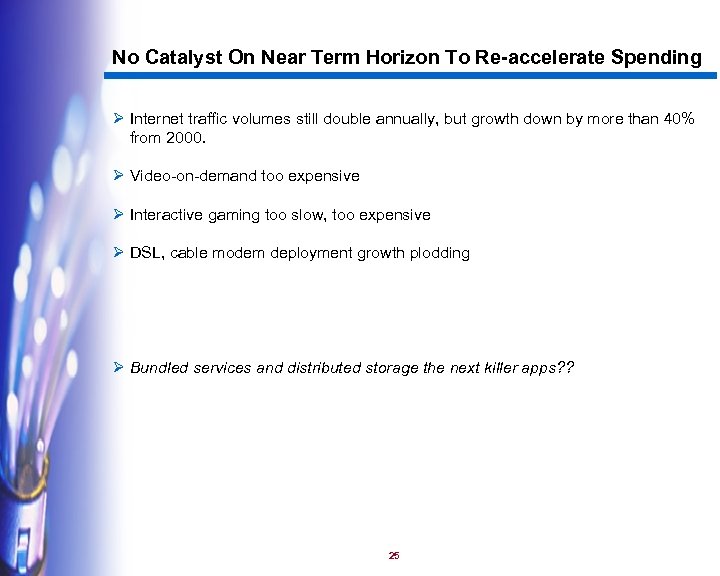
No Catalyst On Near Term Horizon To Re-accelerate Spending Ø Internet traffic volumes still double annually, but growth down by more than 40% from 2000. Ø Video-on-demand too expensive Ø Interactive gaming too slow, too expensive Ø DSL, cable modem deployment growth plodding Ø Bundled services and distributed storage the next killer apps? ? 25
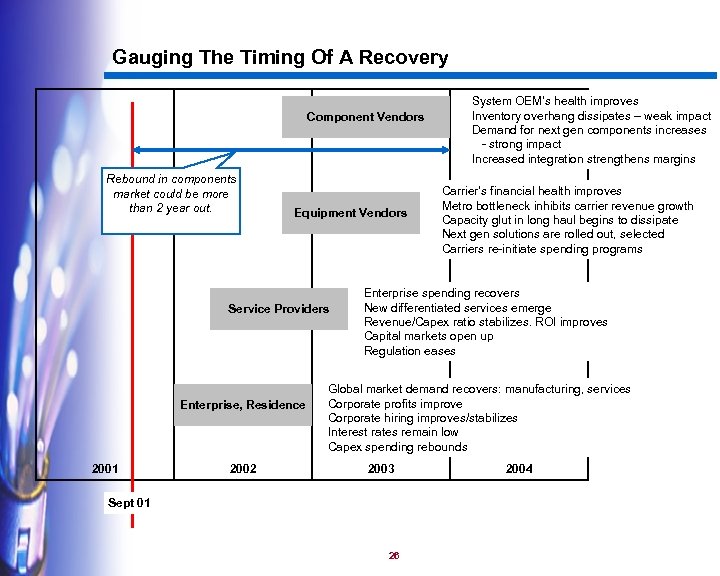
Gauging The Timing Of A Recovery Component Vendors Rebound in components market could be more than 2 year out. Equipment Vendors Service Providers Enterprise, Residence 2001 2002 System OEM’s health improves Inventory overhang dissipates – weak impact Demand for next gen components increases - strong impact Increased integration strengthens margins Carrier’s financial health improves Metro bottleneck inhibits carrier revenue growth Capacity glut in long haul begins to dissipate Next gen solutions are rolled out, selected Carriers re-initiate spending programs Enterprise spending recovers New differentiated services emerge Revenue/Capex ratio stabilizes. ROI improves Capital markets open up Regulation eases Global market demand recovers: manufacturing, services Corporate profits improve Corporate hiring improves/stabilizes Interest rates remain low Capex spending rebounds 2003 Sept 01 26 2004
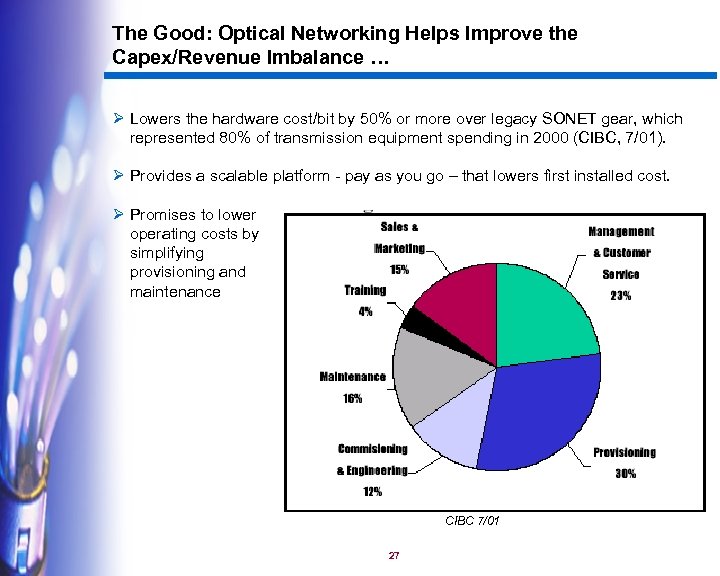
The Good: Optical Networking Helps Improve the Capex/Revenue Imbalance … Ø Lowers the hardware cost/bit by 50% or more over legacy SONET gear, which represented 80% of transmission equipment spending in 2000 (CIBC, 7/01). Ø Provides a scalable platform - pay as you go – that lowers first installed cost. Ø Promises to lower operating costs by simplifying provisioning and maintenance CIBC 7/01 27
… While Future-Proofing The Network Ø Scales in step with growing capacity needs Ø Transparent, so accommodates any transmission format and service type, including wavelength services Ø Reduces need for overlay networks 28
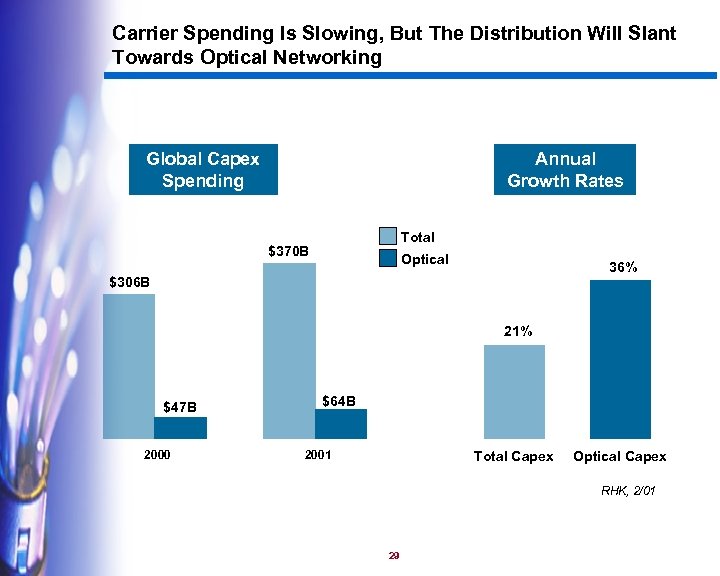
Carrier Spending Is Slowing, But The Distribution Will Slant Towards Optical Networking Global Capex Spending Annual Growth Rates Total $370 B Optical 36% $306 B 21% $47 B 2000 $64 B 2001 Total Capex Optical Capex RHK, 2/01 29
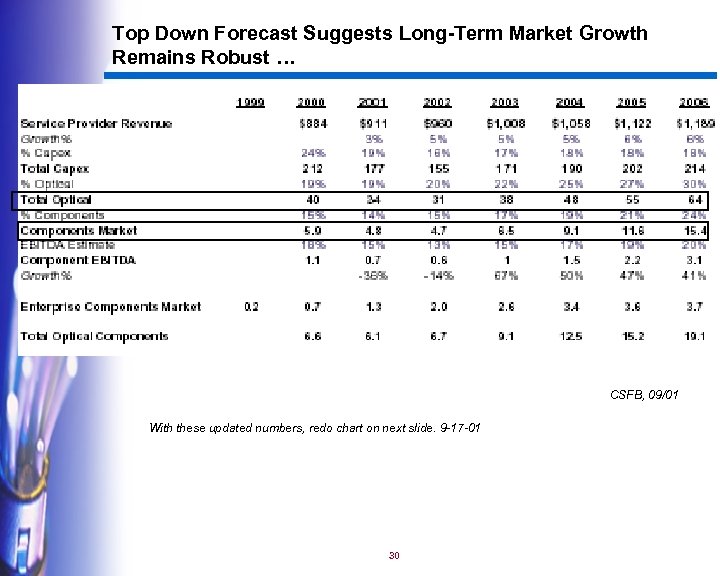
Top Down Forecast Suggests Long-Term Market Growth Remains Robust … CSFB, 09/01 With these updated numbers, redo chart on next slide. 9 -17 -01 30
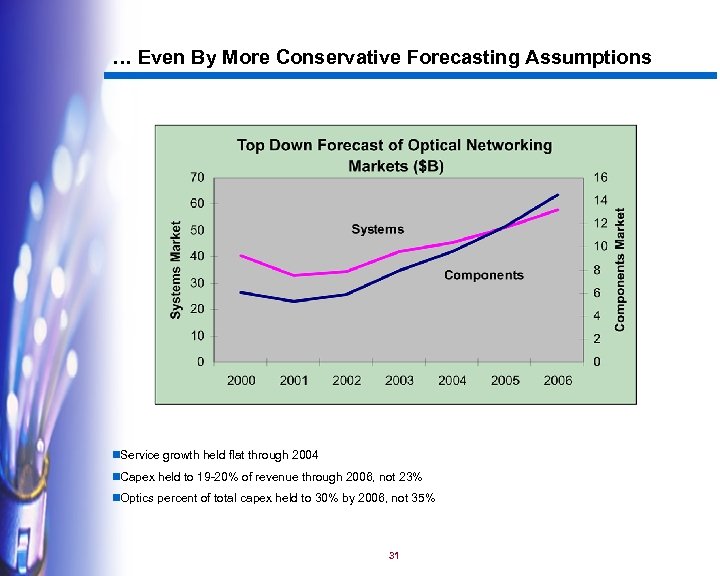
… Even By More Conservative Forecasting Assumptions n. Service growth held flat through 2004 n. Capex held to 19 -20% of revenue through 2006, not 23% n. Optics percent of total capex held to 30% by 2006, not 35% 31
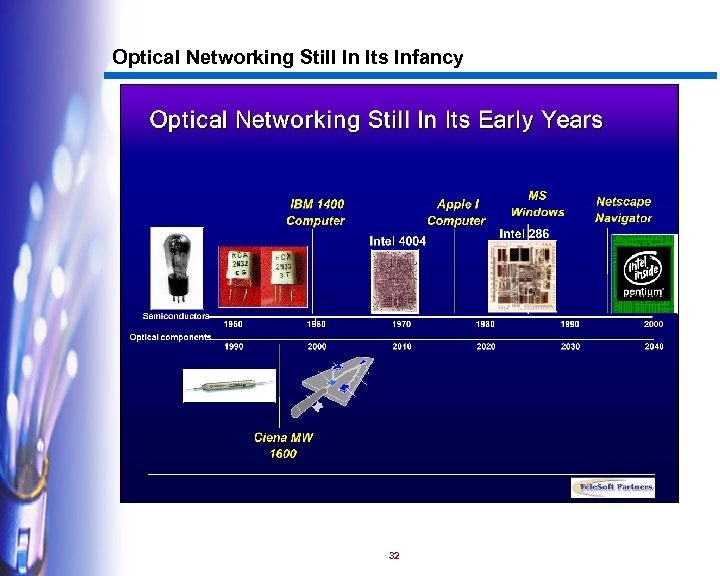
Optical Networking Still In Its Infancy 32
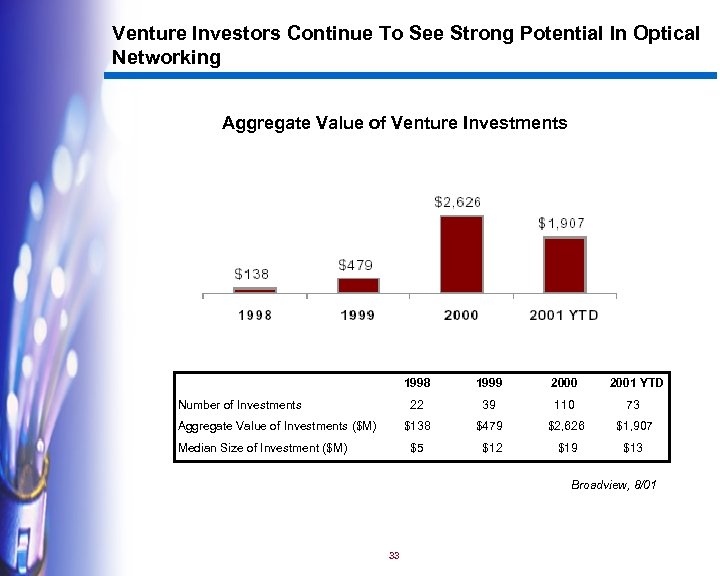
Venture Investors Continue To See Strong Potential In Optical Networking Aggregate Value of Venture Investments 1998 110 73 $479 $2, 626 $1, 907 $5 Median Size of Investment ($M) 39 $138 Aggregate Value of Investments ($M) 2000 22 Number of Investments 1999 2001 YTD $12 $19 $13 Broadview, 8/01 33

Identifying The Pain 34
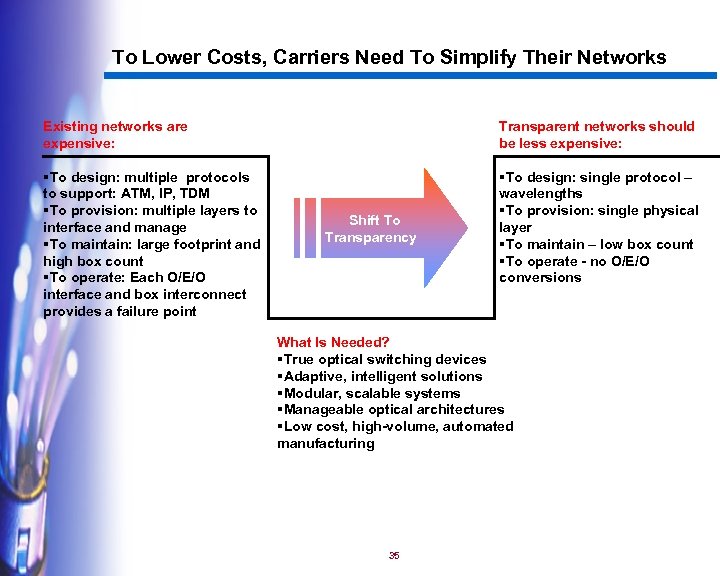
To Lower Costs, Carriers Need To Simplify Their Networks Existing networks are expensive: Transparent networks should be less expensive: §To design: multiple protocols to support: ATM, IP, TDM §To provision: multiple layers to interface and manage §To maintain: large footprint and high box count §To operate: Each O/E/O interface and box interconnect provides a failure point §To design: single protocol – wavelengths §To provision: single physical layer §To maintain – low box count §To operate - no O/E/O conversions Shift To Transparency What Is Needed? §True optical switching devices §Adaptive, intelligent solutions §Modular, scalable systems §Manageable optical architectures §Low cost, high-volume, automated manufacturing 35
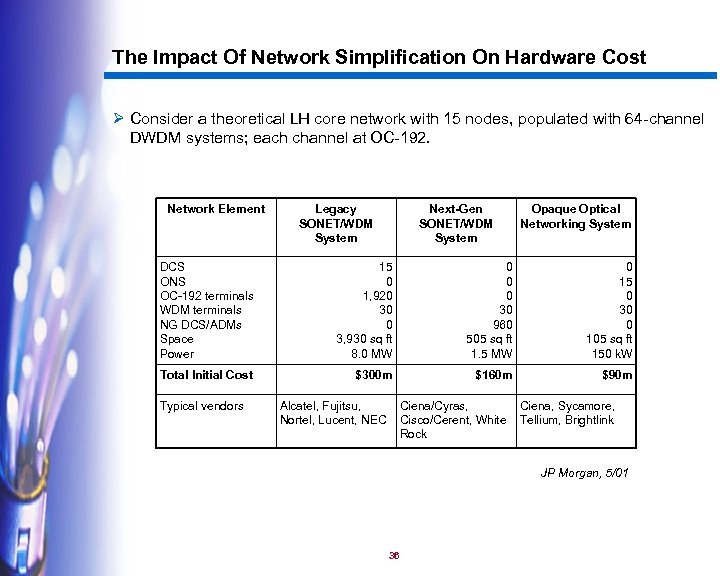
The Impact Of Network Simplification On Hardware Cost Ø Consider a theoretical LH core network with 15 nodes, populated with 64 -channel DWDM systems; each channel at OC-192. Network Element Legacy SONET/WDM System Next-Gen SONET/WDM System Opaque Optical Networking System DCS ONS OC-192 terminals WDM terminals NG DCS/ADMs Space Power 15 0 1, 920 30 0 3, 930 sq ft 8. 0 MW 0 0 0 30 960 505 sq ft 1. 5 MW 0 15 0 30 0 105 sq ft 150 k. W Total Initial Cost $300 m $160 m $90 m Typical vendors Alcatel, Fujitsu, Nortel, Lucent, NEC Ciena/Cyras, Cisco/Cerent, White Rock Ciena, Sycamore, Tellium, Brightlink JP Morgan, 5/01 36
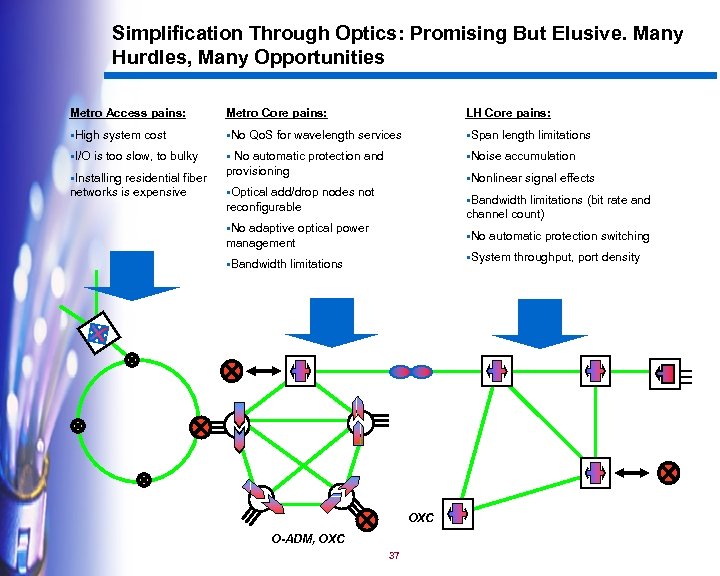
Simplification Through Optics: Promising But Elusive. Many Hurdles, Many Opportunities Metro Access pains: Metro Core pains: LH Core pains: §High system cost §No Qo. S for wavelength services §Span length limitations §I/O is too slow, to bulky § No automatic protection and §Noise accumulation §Installing residential fiber networks is expensive provisioning §Nonlinear signal effects §Optical add/drop nodes not §Bandwidth limitations (bit rate and reconfigurable channel count) §No adaptive optical power §No automatic protection switching management §System throughput, port density §Bandwidth limitations OXC O-ADM, OXC 37
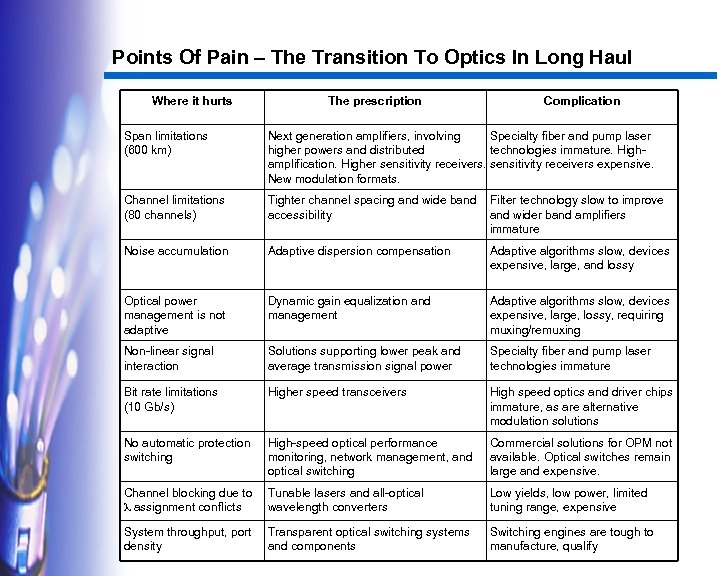
Points Of Pain – The Transition To Optics In Long Haul Where it hurts The prescription Complication Span limitations (600 km) Next generation amplifiers, involving Specialty fiber and pump laser higher powers and distributed technologies immature. Highamplification. Higher sensitivity receivers expensive. New modulation formats. Channel limitations (80 channels) Tighter channel spacing and wide band accessibility Filter technology slow to improve and wider band amplifiers immature Noise accumulation Adaptive dispersion compensation Adaptive algorithms slow, devices expensive, large, and lossy Optical power management is not adaptive Dynamic gain equalization and management Adaptive algorithms slow, devices expensive, large, lossy, requiring muxing/remuxing Non-linear signal interaction Solutions supporting lower peak and average transmission signal power Specialty fiber and pump laser technologies immature Bit rate limitations (10 Gb/s) Higher speed transceivers High speed optics and driver chips immature, as are alternative modulation solutions No automatic protection switching High-speed optical performance monitoring, network management, and optical switching Commercial solutions for OPM not available. Optical switches remain large and expensive. Channel blocking due to assignment conflicts Tunable lasers and all-optical wavelength converters Low yields, low power, limited tuning range, expensive System throughput, port density Transparent optical switching systems and components Switching engines are tough to manufacture, qualify 38
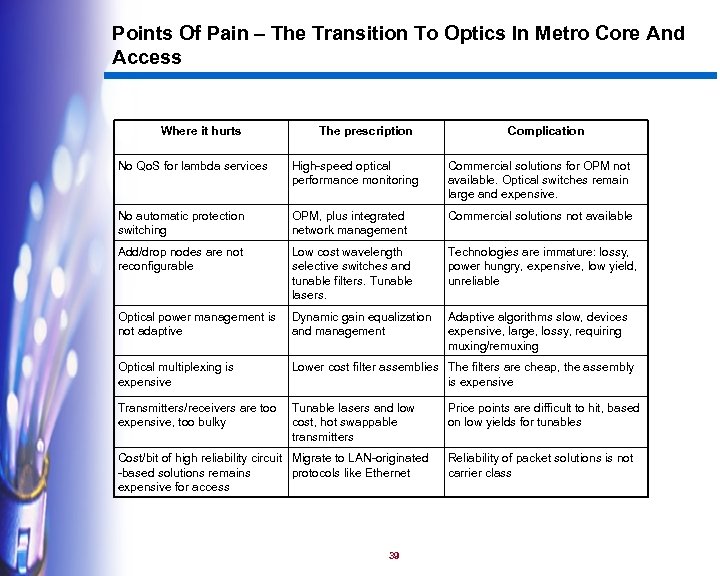
Points Of Pain – The Transition To Optics In Metro Core And Access Where it hurts The prescription Complication No Qo. S for lambda services High-speed optical performance monitoring Commercial solutions for OPM not available. Optical switches remain large and expensive. No automatic protection switching OPM, plus integrated network management Commercial solutions not available Add/drop nodes are not reconfigurable Low cost wavelength selective switches and tunable filters. Tunable lasers. Technologies are immature: lossy, power hungry, expensive, low yield, unreliable Optical power management is not adaptive Dynamic gain equalization and management Adaptive algorithms slow, devices expensive, large, lossy, requiring muxing/remuxing Optical multiplexing is expensive Lower cost filter assemblies The filters are cheap, the assembly is expensive Transmitters/receivers are too expensive, too bulky Tunable lasers and low cost, hot swappable transmitters Cost/bit of high reliability circuit Migrate to LAN-originated -based solutions remains protocols like Ethernet expensive for access 39 Price points are difficult to hit, based on low yields for tunables Reliability of packet solutions is not carrier class

Relieving The Pain 40
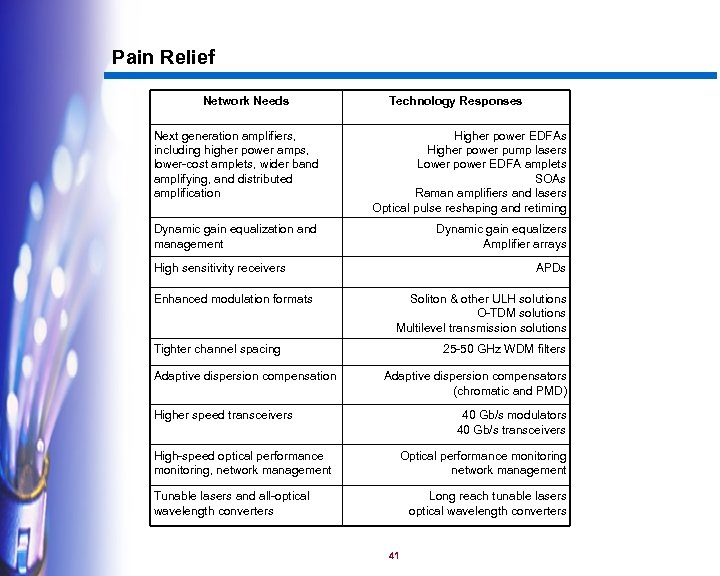
Pain Relief Network Needs Technology Responses Next generation amplifiers, including higher power amps, lower-cost amplets, wider band amplifying, and distributed amplification Higher power EDFAs Higher power pump lasers Lower power EDFA amplets SOAs Raman amplifiers and lasers Optical pulse reshaping and retiming Dynamic gain equalization and management Dynamic gain equalizers Amplifier arrays High sensitivity receivers Enhanced modulation formats APDs Soliton & other ULH solutions O-TDM solutions Multilevel transmission solutions Tighter channel spacing Adaptive dispersion compensation 25 -50 GHz WDM filters Adaptive dispersion compensators (chromatic and PMD) Higher speed transceivers High-speed optical performance monitoring, network management 40 Gb/s modulators 40 Gb/s transceivers Optical performance monitoring network management Tunable lasers and all-optical wavelength converters Long reach tunable lasers optical wavelength converters 41
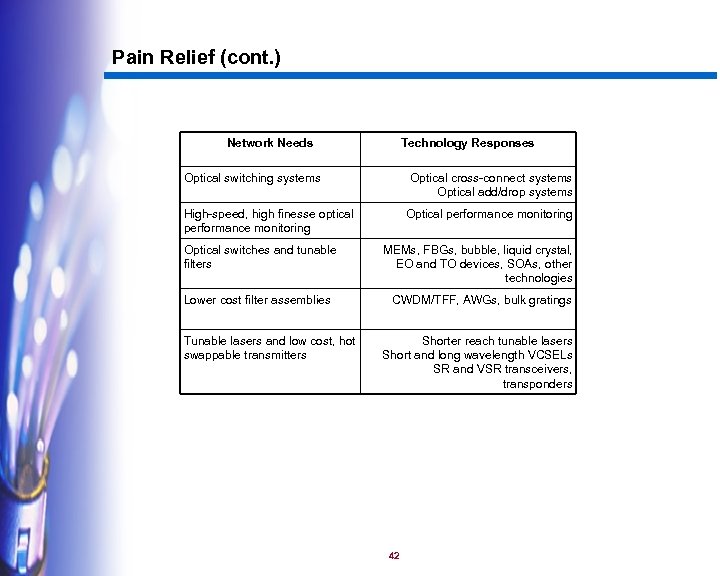
Pain Relief (cont. ) Network Needs Technology Responses Optical switching systems Optical cross-connect systems Optical add/drop systems High-speed, high finesse optical performance monitoring Optical switches and tunable filters Lower cost filter assemblies Tunable lasers and low cost, hot swappable transmitters Optical performance monitoring MEMs, FBGs, bubble, liquid crystal, EO and TO devices, SOAs, other technologies CWDM/TFF, AWGs, bulk gratings Shorter reach tunable lasers Short and long wavelength VCSELs SR and VSR transceivers, transponders 42
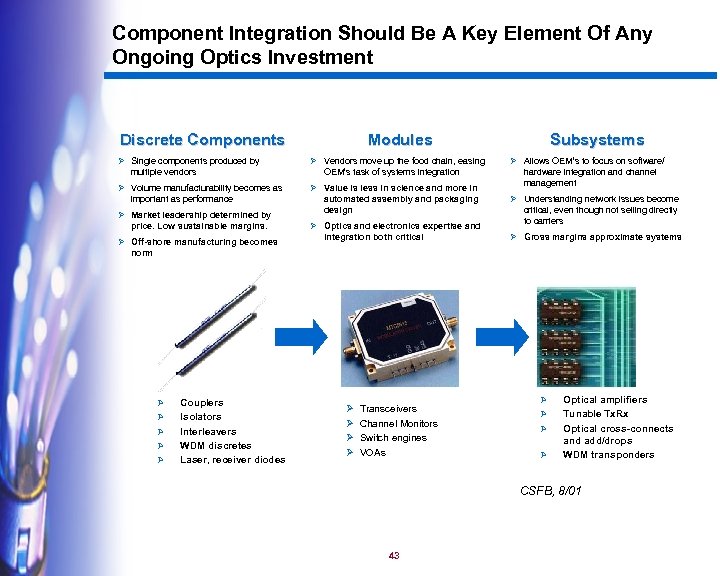
Component Integration Should Be A Key Element Of Any Ongoing Optics Investment Discrete Components Modules Ø Single components produced by multiple vendors Ø Vendors move up the food chain, easing OEM’s task of systems integration Ø Volume manufacturability becomes as important as performance Ø Value is less in science and more in automated assembly and packaging design Ø Market leadership determined by price. Low sustainable margins. Ø Off-shore manufacturing becomes norm Ø Ø Ø Couplers Isolators Interleavers WDM discretes Laser, receiver diodes Ø Optics and electronics expertise and integration both critical Ø Ø Transceivers Channel Monitors Switch engines VOAs Subsystems Ø Allows OEM’s to focus on software/ hardware integration and channel management Ø Understanding network issues become critical, even though not selling directly to carriers Ø Gross margins approximate systems Ø Ø Optical amplifiers Tunable Tx. Rx Optical cross-connects and add/drops WDM transponders CSFB, 8/01 43
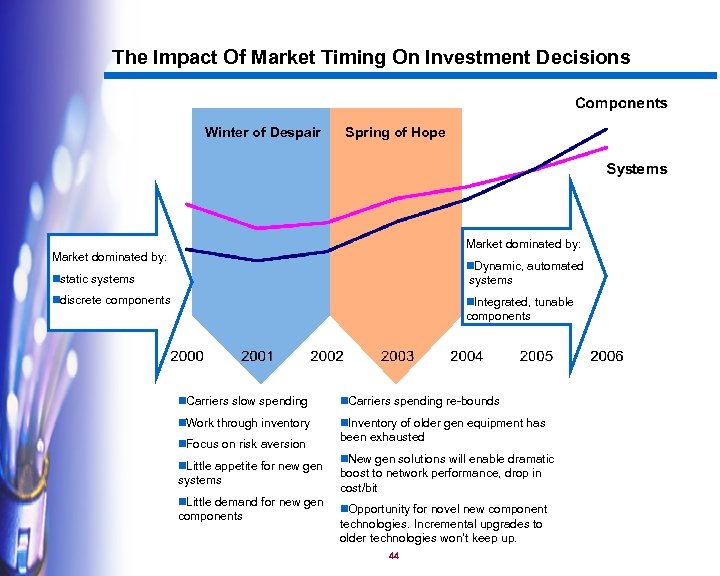
The Impact Of Market Timing On Investment Decisions Winter of Despair Spring of Hope Market dominated by: n. Dynamic, automated nstatic systems ndiscrete components n. Integrated, tunable components n. Carriers slow spending n. Carriers spending re-bounds n. Work through inventory n. Inventory of older gen equipment has n. Focus on risk aversion n. Little appetite for new gen systems n. Little demand for new gen components been exhausted n. New gen solutions will enable dramatic boost to network performance, drop in cost/bit n. Opportunity for novel new component technologies. Incremental upgrades to older technologies won’t keep up. 44
Investment Conclusions Ø Invest selectively now for the Spring of Hope Ø Focus on early stage companies that provide new approaches to network optimization: – Low cost – Integration – Tunable, adaptive – Automated operation – High bandwidth – Transparency Ø Avoid later-stage companies that provide incremental improvements to older generation equipment. If budget assumes substantial ramp in 2002, 2003 revenue, be wary. – Give little weight to OEM penetration, given the uncertainty of equipment markets and players Ø Survive the Winter of Despair – See funding well into 2003 – Keep burn low – Avoid high capitalization companies that are vulnerable to extended Winter 45
Скачать презентацию Investment Themes in Optical Networking September 2001 Bill
da9350e2d53ced836dc719f2daa85297.ppt