


 Скачать презентацию Investment Information and Allocation Mechanism Channels of Technological
4a5f74f24bf26c5be0f67ba443b41c5e.ppt
- Количество слайдов: 35
 Investment, Information, and Allocation Mechanism: Channels of Technological Change and Economic Efficiency Philip Obazee Finance and Investment Workshop Edo Okpamakhin Annual Convention Boston, MA July 3 - 4, 2004
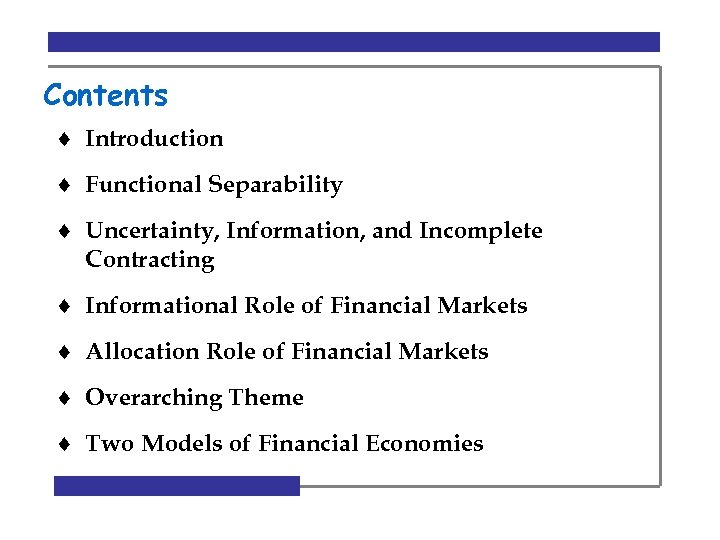 Contents ¨ Introduction ¨ Functional Separability ¨ Uncertainty, Information, and Incomplete Contracting ¨ Informational Role of Financial Markets ¨ Allocation Role of Financial Markets ¨ Overarching Theme ¨ Two Models of Financial Economies
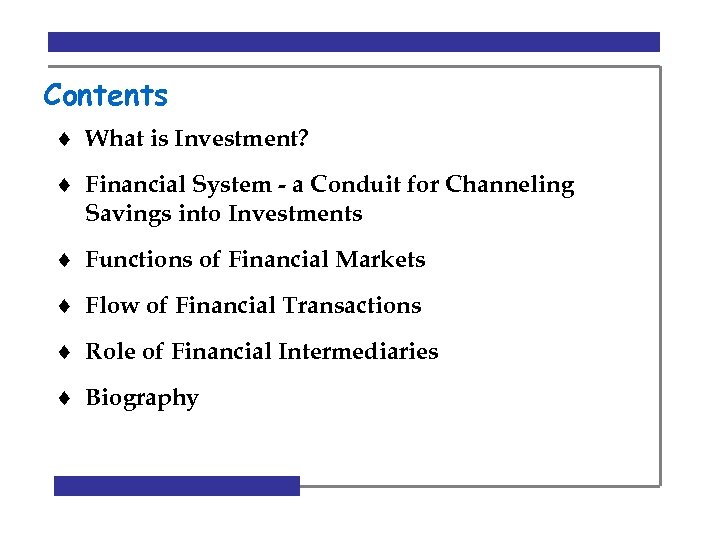 Contents ¨ What is Investment? ¨ Financial System - a Conduit for Channeling Savings into Investments ¨ Functions of Financial Markets ¨ Flow of Financial Transactions ¨ Role of Financial Intermediaries ¨ Biography
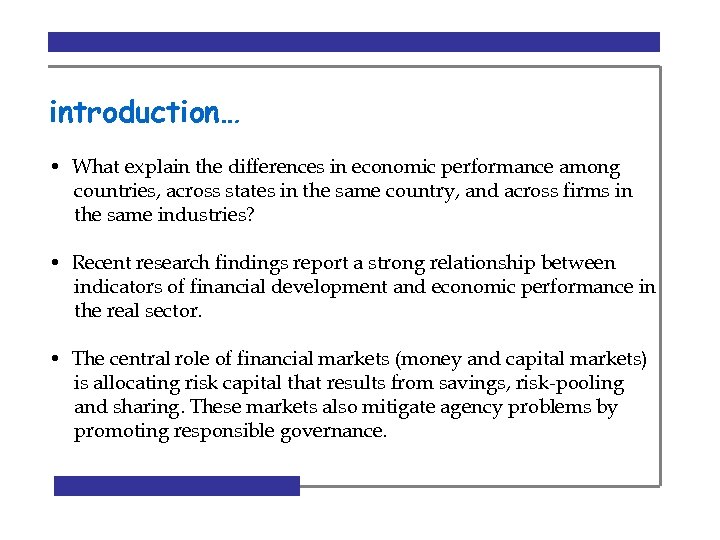 introduction… • What explain the differences in economic performance among countries, across states in the same country, and across firms in the same industries? • Recent research findings report a strong relationship between indicators of financial development and economic performance in the real sector. • The central role of financial markets (money and capital markets) is allocating risk capital that results from savings, risk-pooling and sharing. These markets also mitigate agency problems by promoting responsible governance.
 introduction… • Financial system positively affects economic growth and productivity through improving efficient utilization of resources and enabling technological inventions and innovation. • Monitoring and governance role of financial markets help induce improvements in efficiency. The allocation role helps accelerate technological advances.
 functional separability… • The allocation function of financial markets involves channeling savings from economic units with excess capital to individuals with entrepreneurial skills augmenting risk-pooling and sharing. • Monitoring and governance roles involve how well financial system helps in reducing the agency problem between stakeholders. • The degree to which a financial system influences economic performance in the real sector depends on how effectively it carries out its allocation , monitoring and governance functions.
 uncertainty, information and incomplete contracting… • Uncertainty, imperfect information, incomplete contracting and moral hazard problems may prevent the first-best value maximizing investment behavior. • Financial markets mitigate the consequence of imperfect information, and moral hazard by producing information that facilitates monitoring. • Financial markets process information from diverse market participants by extracting it from the trading behaviors and price signals.
 informational role of financial markets… • Financial assets’ prices convey valuable information about the profitability of current investment opportunities thereby guiding entrepreneurial and managerial decisions. • Based on information available to investors, mangers, and entrepreneurs, bad firms’ management teams or projects do not get funding. • Inefficient managers get forced out through the mechanism of market for corporate control. • Threat of takeover induces managerial discipline, preventing managerial actions that waste resources.
 allocation role of financial markets… • Financial system aggregates small savings of numerous individuals for use by economic agents with entrepreneurial skills, who use the funds for capital investments. • Availability of capital and ability to share risk, influence the degree of risk tolerance, and choice of technologies in the economy.
 allocation role of financial markets… • One see a link between the allocation role of financial markets and technological innovation through: 1. Adoption of technologies requires a large sum of capital that is easier to mobilize in a well-developed financial system. 2. Risk-pooling and sharing functions of capital markets promote the assimilation of specialized and risky technologies. 3. Economies with mature financial markets should achieve higher rates of technological change, which translates to higher productivity and economic growth. •
 overarching theme… • The strong relationship between economic performance and the effectiveness of financial markets suggests the importance of financial markets development as a policy for accelerating economic growth. • Policies that promote financial markets’ functional capacities lead to better real economic performance. • Mere launching of financial markets and institutions is not sufficient for accelerating economic growth. Efficient functioning of these markets is the most important consideration.
 two models of financial economies… • Anglo-American Decentralized Market-Based System • Germano-Japanese Centralized Bank Based System
 anglo-american decentralized marketbased system… • Pooling and risk sharing among diverse Participants • Price system as a source of relative value • Information is publicly available from prices • Accounting standard is important to information transmission • Monitoring and control are costly
 germano-japanese centralized bankbased system… • Pooling and risk sharing limited to fewer participants • Banking system is predominant • Information is not readily available from prices • Monitoring and control are under a unified institution
 what is investment? … • Investment is a ubiquitous concept, and means many things to many people. • Examples: 1. A collector that spend millions of dollars to acquire a Degas painting at major auction house; 2. IBM Corporation spending millions of dollars on research and development; 3. A house wife buying a common stock of Microsoft; 4. A young couple buying their first home, etc.
 what is investment? … • Economists speak of postponing of consumption, which facilitates savings, and savings, which are turned into investment opportunities by the entrepreneurial class in tracing the evolution of investment. • Key Attributes Of Investment: Time and Risk
 what is investment? … • In every investment decision there is a time element because you are making sacrifice today, for which the reward would come at a later date. The reward is not necessary guaranteed, so there is an element of risk. • Working Definition: In the broadest sense, by investment I mean the sacrifice of certain present value for “possibly” uncertain future value.
 what is investment? … • Example: if you have $1, 000 today and decide to buy U. S. Government bond that pays a semi-annual coupon of 3% and matures in 10 years, in all likelihood you will receive your 19 coupon payments plus the return of principal and the last coupon payment. • This type of investment is considered to be risk-free, and serve as a benchmark for pricing risky investments. The dominating element in this investment is time and the purchasing power of the dollar.
 real vs. financial investments … • Buying and selling bonds and common stocks are examples of financial investments because they represent claims on the assets of a firm. • Buying equipment, land, and mining rights are examples of real investment.
 financial system - a conduit for channeling savings to investments … There are three types of markets: • Factor market: Factors of production like land, capital, labor, and entrepreneurial skills are sold to business firms and governments in return for income in the form of wages and other payments. • Product market: Goods and services are sold.
 financial system - a conduit for channeling savings to investments … • Financial market: Financial claims are channeled between the surplus budget units (SBU), and the deficit budget units (DBU). SBU are individuals that make more money than they spend, and are capable of saving. DBU are individuals that spend more than they make, and are capable of borrowing from the SBU.
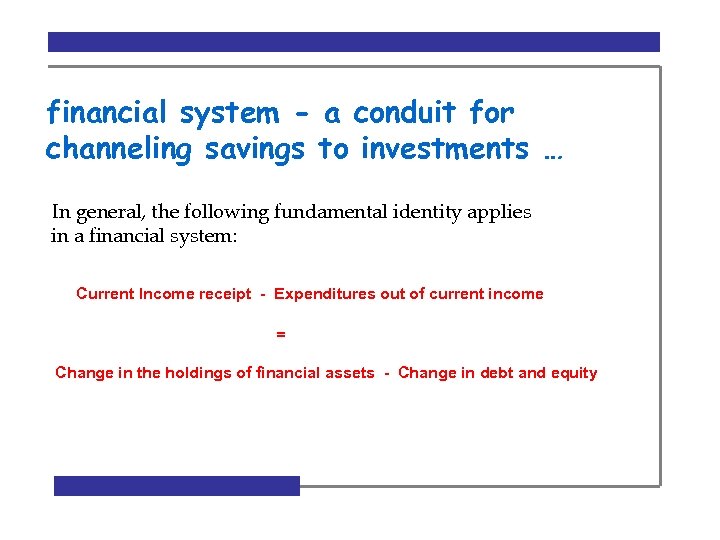 financial system - a conduit for channeling savings to investments … In general, the following fundamental identity applies in a financial system: Current Income receipt - Expenditures out of current income = Change in the holdings of financial assets - Change in debt and equity
 financial system - a conduit for channeling savings to investments … Using this identity, if current expenditures exceed current receipts, the difference is made up by: (1) reducing our holdings of financial assets (for example withdrawing money from savings accounts); (2) issuing IOU, debt or stock; or (3) using a combination of both.
 financial system - a conduit for channeling savings to investments … If the current period receipts are greater than current expenditures, we can: (1) Build our holdings of financial assets, (for example, by placing money in a saving account); (2) Pay off debt or buy back common stock; or (3) Utilize some combination of both.
 financial system - a conduit for channeling savings to investments … For any given period, an individual economic unit (household, business or government) must belong to one of the following groups: (1) Deficit-budget unit (DBU), (2) Surplus-budget unit (SBU), or (3) Balanced-budget unit (BBU).
 functions of financial system… • Savings function– providing a potentially profitable and low-risk outlet for public savings. • Liquidity function– providing a means of raising funds by converting securities and other financial assets to cash balances. • Payments function – providing mechanism for making payments to purchase goods and services.
 functions of financial system… • Policy function – providing a channel for government policy to achieve a society’s goal of high employment, low inflation, and sustainable economic growth. • Wealth function – providing means to store purchasing power until needed for future spending on goods and services. • Credit function – providing a supply of credit to support both consumption and investment spending in the economy.
 functions of financial system… • Risk function –providing a means to protect businesses, consumers and governments against risks to people, property, and income. In general, a financial system, whether simple or complex, performs one major function, which is to move scare financial resources from those who save and lend (SBU) to those who wish to borrow and invest (DBU).
 flow of financial transactions… • Direct Finance: Is a financial transaction between SBU, and DBU in which borrowers and lenders meet each other and exchange funds in return for financial claims. For example, when you borrow from a friend or family and give them an IOU. • Problems: (1) there must be coincidence of wants between DBU and SBU in terms of the size of the loan and the form of the loan. (2) Information and search costs; borrowers may have to contact many lenders to find suitable terms of the loan.
 flow of financial transactions… • Semi-direct Finance: A financial transaction intermediated by security brokers, dealers and investment bankers, for which there is a transfer of fund from SBU to DBU. Brokers, in contrast to dealers do not take a position in the financial claim. Instead facilitate the transaction by providing information about possible purchases and sales of financial assets. Dealers actually take a position in financial assets hoping to sell it for a profit.
 flow of financial transactions… • Indirect Finance: Financial transactions are carried out with the help of financial intermediaries or financial service firms. Examples of such firms include; commercial banks, insurance companies, credit unions, finance companies, savings- and-loan associations, savings banks, pension funds, mutual funds, etc. Financial intermediaries issue their own secondary securities to the ultimate lender (demand deposits, savings account, life insurance policies) and at the same time accept IOUs from borrowers in the form of primary securities (loans).
 role of financial intermediaries… • Payment Services: Providing payment accounts against which customers can write checks or wire funds to pay for purchases of goods and services. • Thrift Services: Providing financial instruments with adequate safety and yield to encourage people, businesses, and governments to save for their future needs.
 role of financial intermediaries… • Insurance Services: Providing protection from loss of income or property in the event of death, disability, negligence, and other adverse conditions. • Credit Services: Providing loanable funds to supplement current income. • Hedging Services: Providing protection against loss due to unfavorable movements in market prices or interest rates.
 role of financial intermediaries… • Agency Services: Providing services by acting as an agent for customers in managing retirement funds, or other property.
 Biography Mr. Philip Obazee is a Vice President at Delaware Investments. He is responsible for the management of derivative portfolios. In addition to this responsibility, he also maintains a risk management leadership role. He joined Delaware Investments from First Union Securities Inc. , where he served as Vice President of Quantitative Research. Prior to that responsibility, Mr. Obazee was a Managing Director of Structured Derivative Products and Agency Debt Origination at Core. States Securities Corp. and Vice President and Head of Financial Analytics and Structured Transactions at Core. States Capital Markets. From 1993 to 1996, he served as Vice President of Trading and Hedging in the Interest Rate Group of Meridian Capital Markets (Division of Meridian Bank). He has also held academic positions in colleges and universities in the southern and northeastern United States. Philip has contributed several chapters to professional books in fixed income as well as articles to professional journals. He holds BS and MBA degrees and did doctoral studies in mathematical finance at the University of Pennsylvania.