


 Скачать презентацию INVESTMENT FINANCING CONCEPT TO CLOSURE 1 Economic
0214f313903d8f26aec036d10711807e.ppt
- Количество слайдов: 44
 INVESTMENT FINANCING CONCEPT TO CLOSURE 1
 Economic Environment Impact of Foreign trade agreements and related EXIM policies Regulation of foreign direct investment both Inward & Outward and limited capital account convertibility Financial sector reforms Tax regime – Direct & Indirect Government finances GAAP – Consolidation of Accounts 2
 Corporate investment structuring Ball park figure of investment capability - Strength of existing balance sheet - Borrowing power - Equity injection ability - Non-balance sheet recourse financing Sectoral analysis Investment vehicle Investment location Firm up cost of project Investment consortium Structure means of financing Establish viability 3
 Sectoral analysis for investments • Existing organisational core competences • Demand / supply equilibrium • Level of protection • key financial ratios • Indirect Tax structure • Scalability • Backward / forward integration • Risk balancing • Flocking mentality 4
 Investment vehicle • Strategic Positioning • Control and promoter funding / exposure. • Depreciation as a tax shield. • Direct & Indirect Tax regime • Tax Status and jurisdiction • Joint venture partners – FDI restrictions • Synergy with existing businesses. • Size / risk of new investment on overall rating • Leveraging of existing Balance sheet 5
 Cost of project Land Civil Construction Plant & Machinery Misc. . fixed assets Erection and commissioning Technical know-how fees preliminary & preoperative expenses Contingencies Total capital cost Margin money Total project cost 6
 Project financing Firming up cost of project Analysis of factors influencing financial projections Financial projections Structure means of financing Determine cost of capital Project NPV / IRR with Sensitivity analysis Equity / Dividend IRR & value generation Sanction / Term Sheet / Pre disbursement conditions Security creation / Documentation 7
 Investment document for bank ability Part - I Introduction . Background of promoters. . Sister concerns / group activities. Group financial strengths. Part - II (A) The Project TECHNICAL ASPECTS (i) (iii) Proposed activity Product Statistics on other existing/proposed units in the field 8
 (iv) Site details (v) Technology and process (vi) Raw materials (vii) Infrastructural requirements (viii) License, permits, clearances (ix) Capital equipment suppliers. (x) Implementation schedule 9
 (B) FINANCIAL ASPECTS a) b) c) d) e) f) g) (C) Cost of project Means of financing Working capital requirements Cash flow planning during construction phase Projections Inter firm / industry ratio analysis Sensitivity analysis BUSINESS PROPOSECTS i) iii) Demand supply equilibrium Competitor profile Marketing strategy 10
 Lender’s participation Direct financial support. a. b. c. d. e. f. g. h Rupee term loans. Multilateral lines of credit. Underwriting of instruments. Direct subscription to equity capital. Issuing guarantees. Bill rediscounting. Securitisation of receivables Loan syndication. M&A financing Over run financing. Financial restructuring. Promoter financing 11
 Facets of project appraisal The important facets for project viability analysis are: ¨Market analysis ¨Technical analysis ¨Financial analysis ¨Economic analysis ¨Ecological analysis Market analysis • What is the expected growth of the industry in the near future in which investments are sought to be made. • What would be the market share the project will have to achieve 12 for financial viability.
 A detailed analysis of the marketability of the products / Services proposed to be manufactured will have to be carried out which will encompass the following: ¨Consumption trends in the past and the present consumption level ¨Past and present supply position ¨Production possibilities and constraints ¨Imports and exports ¨Structure of competition ¨Cost structure ¨Elasticity of demand ¨Consumer behaviour, intentions, motivations, attitudes, . ¨Distribution channels and marketing policies in use ¨Administrative, technical, and legal 13
 Technical analysis Analysis of the technical and engineering aspects of a project needs to be done at the project formulation stage. Technical analysis seeks to determine whether the prerequisites for the successful commissioning of the project have been considered and reasonably good choices have been made with respect to location, size, process, etc. the important questions raised in technical analysis are: ¨Whether the preliminary tests and studies have been done ¨Whether the availability of raw materials, power, and other inputs has been established? ¨Whether the selected scale of operation is optimal? ¨Whether the production process chosen is suitable? 14
 ¨Whether the equipment and machines chosen are appropriate? ¨Whether the auxiliary equipments and engineering works have been provided for? supplementary ¨Whether provision has been made for the treatment of effluents? ¨Whether the proposed layout of the site, buildings, and plant is sound? ¨Whether work schedules have been realistically drawn up? ¨Whether the technology proposed to be employed is appropriate from the social point of view? 15
 Financial Analysis Financial analysis seeks to ascertain whether the proposed project will be financially viable in the sense of being able to meet the burden of servicing debt and whether the proposed project will satisfy the return expectations of those who provide the capital. The aspects, which have to be looked into are: ¨Investment outlay and cost of project ¨Means of financing ¨Cost of capital ¨Projected profitability ¨Cash flows of the project ¨Projected financial position ¨Level of risk 16
 Economic Analysis Economic analysis, also referred to as social cost benefit analysis, is concerned with judging a project form the larger social point of view. benefits. The questions sought to be answered in social cost benefit analysis are: ¨ What are the direct economic benefits and costs of the project measured in terms of shadow (efficiency) prices. What would be impact of the project on the distribution of income in the society? ¨ What would be impact of the project on the level of savings and investment in the society? ¨ What would be the contribution of the project towards the fulfillment of certain merit wants like self-sufficiency, employment, and social order. 17
 Ecological Analysis In recent years, environmental concerns have assumed a great deal of significance and rightly so. Ecological analysis should be done particularly for major projects, which have significant ecological implications like power plants and irrigation schemes, and environmental – polluting industries (like bulk drugs, chemicals, and leather processing). The key questions raised in ecological analysis are: ¨What is the likely damage caused by the project to the environment? 18
 Financial indicators – Lender’s perspective 1) Operating & Cash break even point 2) Capex per unit of installed capacity 3) Debt service coverage ratio 4) Internal rate of return and cost of capital 5) Gross profit margin (EBIDTA / Net sales) 6) Enterprise value to Installed capacity 7) Return on capital employed (ROCE) 19
 8) Fixed asset coverage 9) Capital structure leveraging 11) Economic rate of protection (ERP) 12) Debt / EBIDTA : not to exceed 5 times 13) Return on net worth 14) Free cash flow generating capacity 15) NPV under different scenarios 16) Door to Door tenure of debt 20
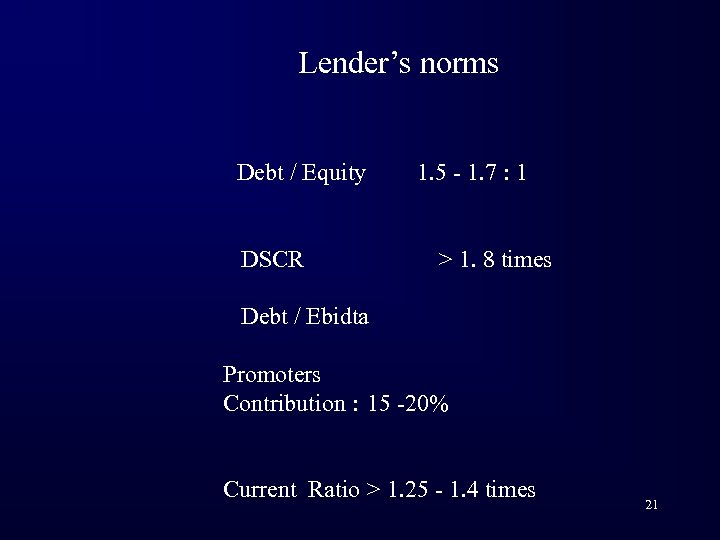 Lender’s norms Debt / Equity DSCR 1. 5 - 1. 7 : 1 > 1. 8 times Debt / Ebidta Promoters Contribution : 15 -20% Current Ratio > 1. 25 - 1. 4 times 21
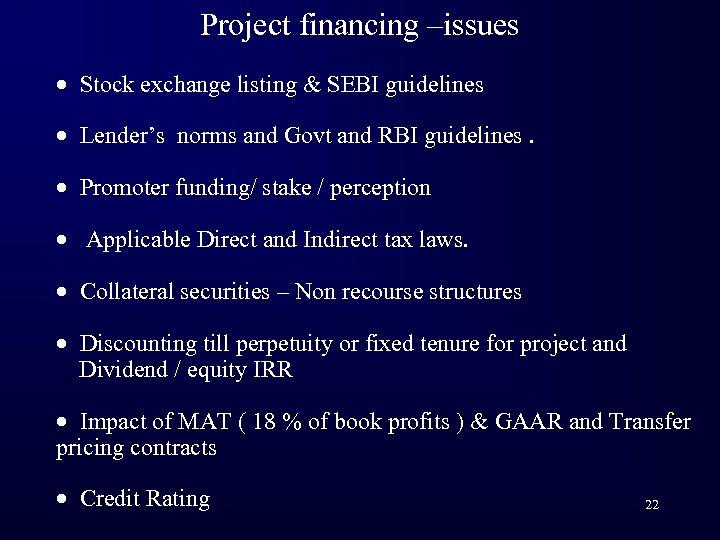 Project financing –issues · Stock exchange listing & SEBI guidelines · Lender’s norms and Govt and RBI guidelines. · Promoter funding/ stake / perception · Applicable Direct and Indirect tax laws. · Collateral securities – Non recourse structures · Discounting till perpetuity or fixed tenure for project and Dividend / equity IRR · Impact of MAT ( 18 % of book profits ) & GAAR and Transfer pricing contracts · Credit Rating 22
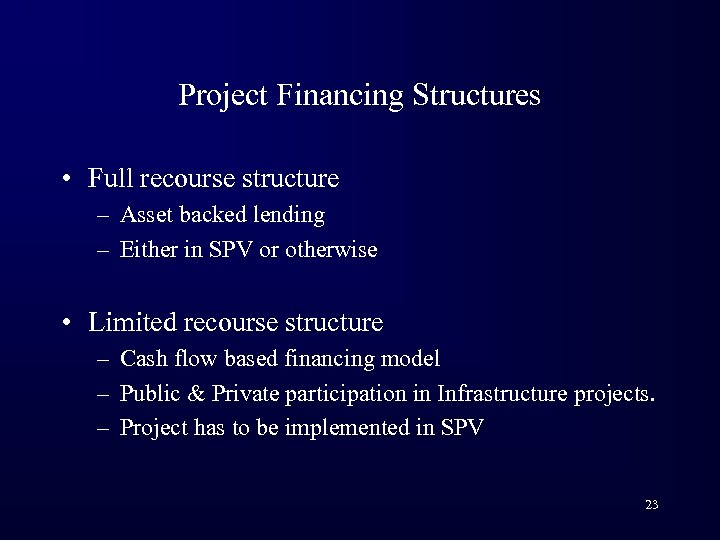 Project Financing Structures • Full recourse structure – Asset backed lending – Either in SPV or otherwise • Limited recourse structure – Cash flow based financing model – Public & Private participation in Infrastructure projects. – Project has to be implemented in SPV 23
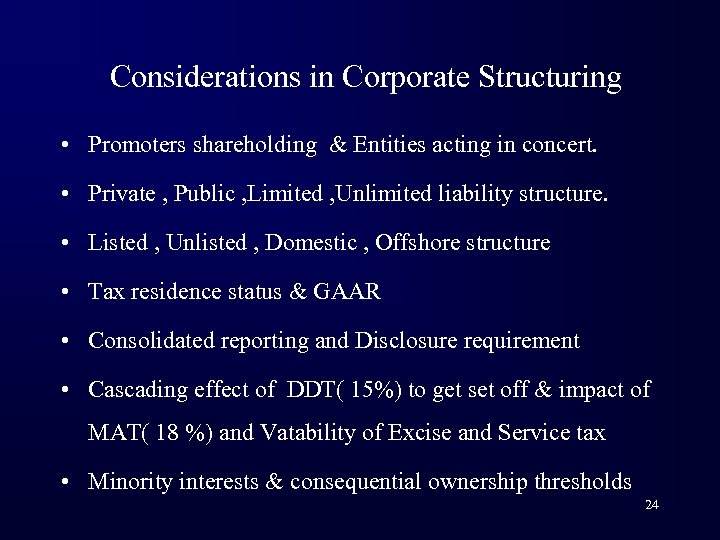 Considerations in Corporate Structuring • Promoters shareholding & Entities acting in concert. • Private , Public , Limited , Unlimited liability structure. • Listed , Unlisted , Domestic , Offshore structure • Tax residence status & GAAR • Consolidated reporting and Disclosure requirement • Cascading effect of DDT( 15%) to get set off & impact of MAT( 18 %) and Vatability of Excise and Service tax • Minority interests & consequential ownership thresholds 24
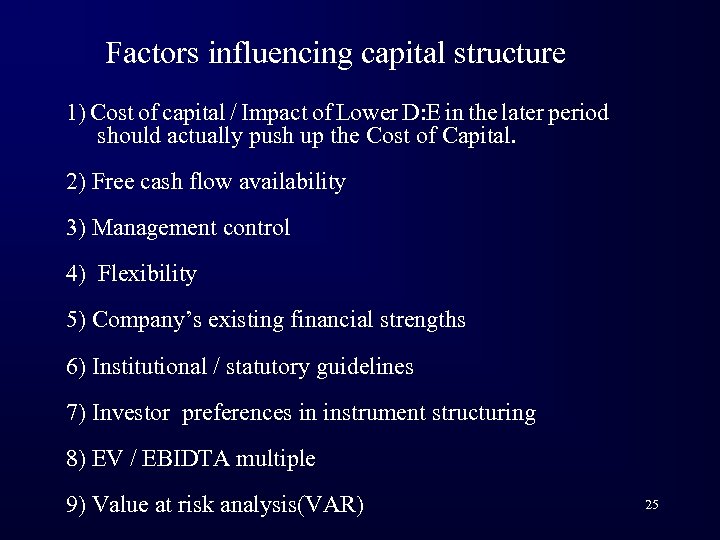 Factors influencing capital structure 1) Cost of capital / Impact of Lower D: E in the later period should actually push up the Cost of Capital. 2) Free cash flow availability 3) Management control 4) Flexibility 5) Company’s existing financial strengths 6) Institutional / statutory guidelines 7) Investor preferences in instrument structuring 8) EV / EBIDTA multiple 9) Value at risk analysis(VAR) 25
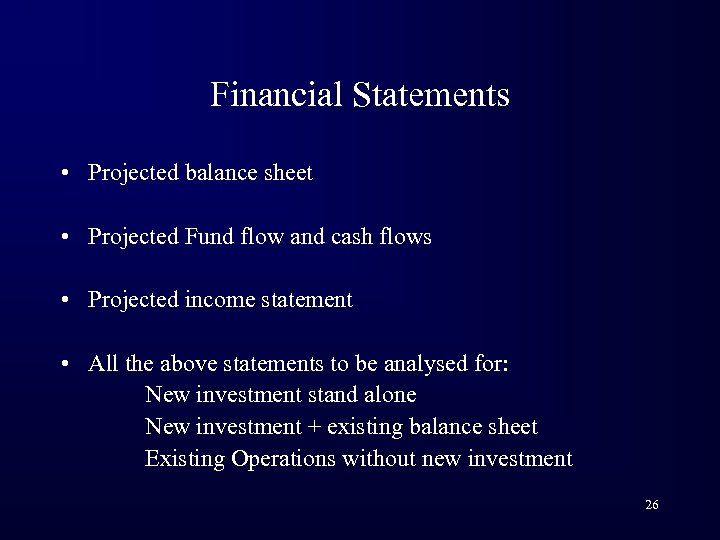 Financial Statements • Projected balance sheet • Projected Fund flow and cash flows • Projected income statement • All the above statements to be analysed for: New investment stand alone New investment + existing balance sheet Existing Operations without new investment 26
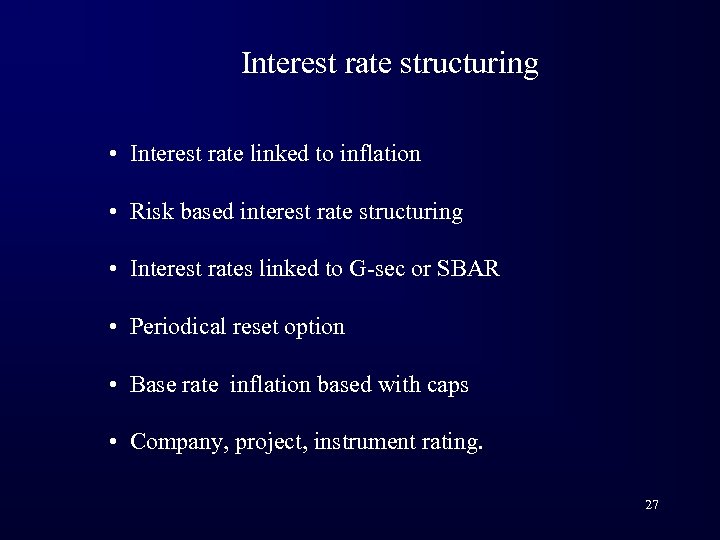 Interest rate structuring • Interest rate linked to inflation • Risk based interest rate structuring • Interest rates linked to G-sec or SBAR • Periodical reset option • Base rate inflation based with caps • Company, project, instrument rating. 27
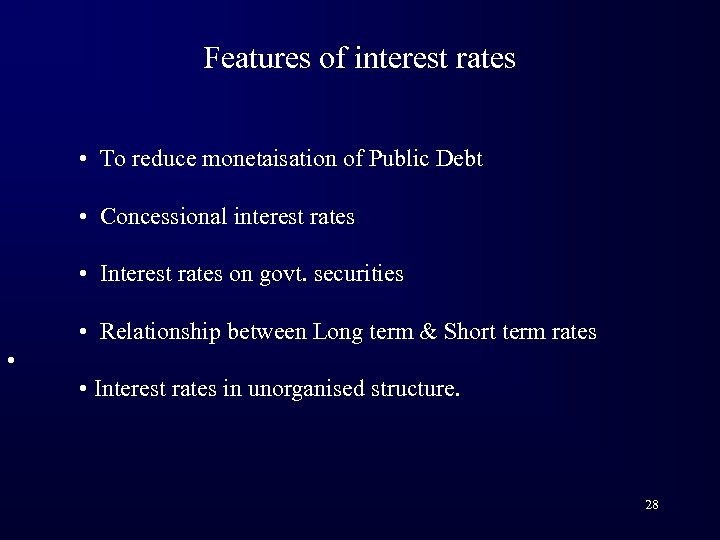 Features of interest rates • To reduce monetaisation of Public Debt • Concessional interest rates • Interest rates on govt. securities • Relationship between Long term & Short term rates • • Interest rates in unorganised structure. 28
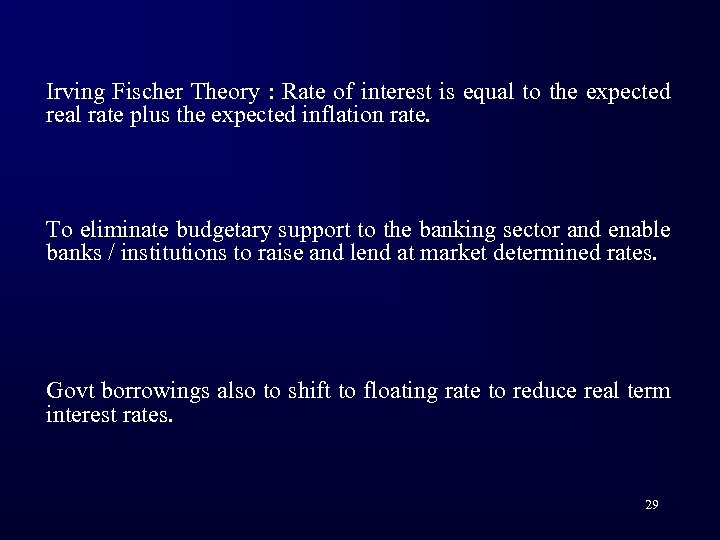 Irving Fischer Theory : Rate of interest is equal to the expected real rate plus the expected inflation rate. To eliminate budgetary support to the banking sector and enable banks / institutions to raise and lend at market determined rates. Govt borrowings also to shift to floating rate to reduce real term interest rates. 29
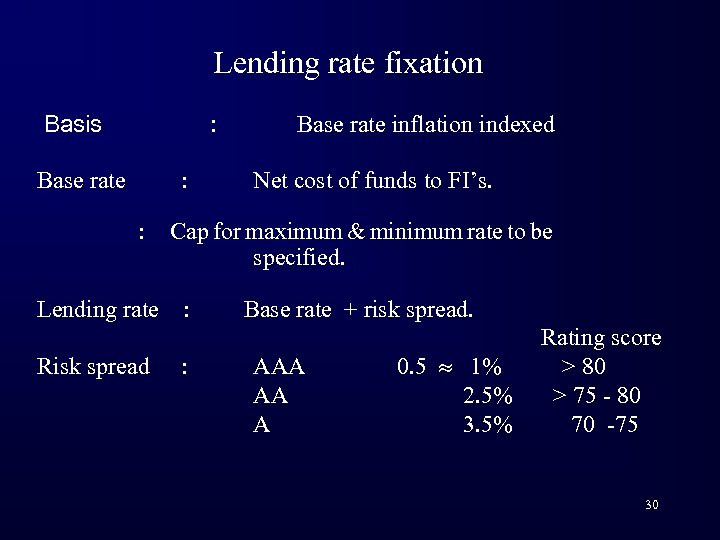 Lending rate fixation Basis : Base rate : : Lending rate Risk spread Base rate inflation indexed Net cost of funds to FI’s. Cap for maximum & minimum rate to be specified. : : Base rate + risk spread. AAA AA A 0. 5 1% 2. 5% 3. 5% Rating score > 80 > 75 - 80 70 -75 30
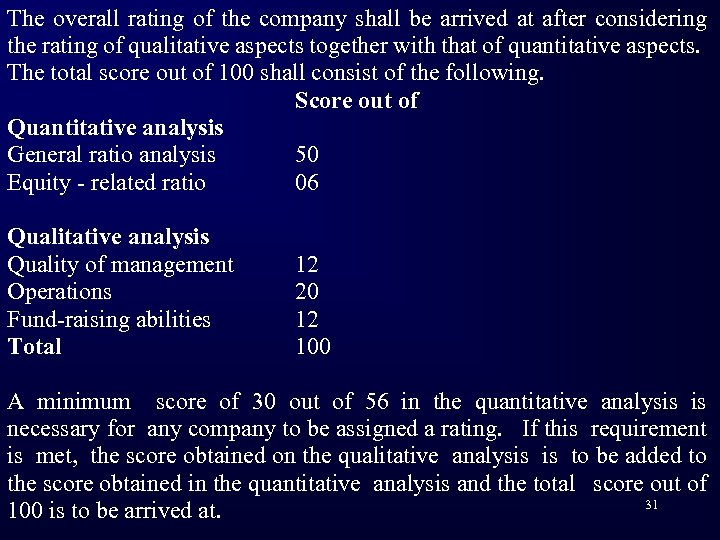 The overall rating of the company shall be arrived at after considering the rating of qualitative aspects together with that of quantitative aspects. The total score out of 100 shall consist of the following. Score out of Quantitative analysis General ratio analysis 50 Equity - related ratio 06 Qualitative analysis Quality of management Operations Fund-raising abilities Total 12 20 12 100 A minimum score of 30 out of 56 in the quantitative analysis is necessary for any company to be assigned a rating. If this requirement is met, the score obtained on the qualitative analysis is to be added to the score obtained in the quantitative analysis and the total score out of 31 100 is to be arrived at.
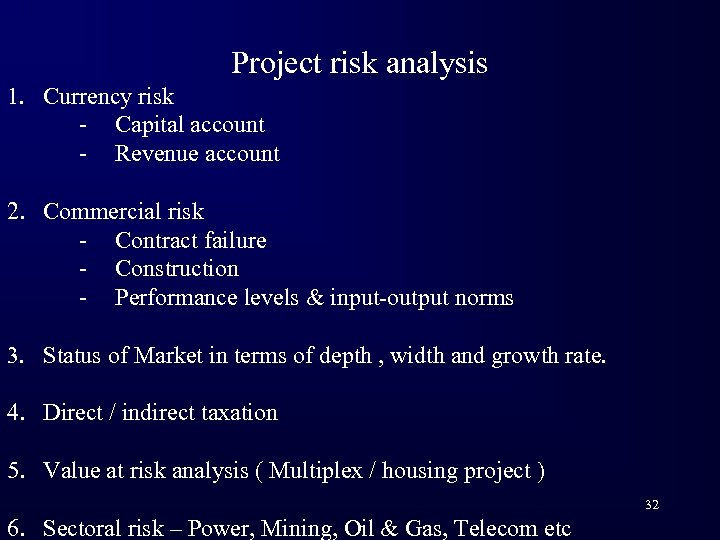 Project risk analysis 1. Currency risk - Capital account - Revenue account 2. Commercial risk - Contract failure - Construction - Performance levels & input-output norms 3. Status of Market in terms of depth , width and growth rate. 4. Direct / indirect taxation 5. Value at risk analysis ( Multiplex / housing project ) 32 6. Sectoral risk – Power, Mining, Oil & Gas, Telecom etc
 Evaluating Risk • “Base case’ forecast for future cash flows and sensitivity analysis • Determine Debt appetite of the project under different debt door to door tenures and operating scenarios. • Calculate Project / Equity/ Dividend IRR’s and compare with returns available on alternate investments of similar risk profile. • Key to successful Project financing is the right allocation of risks among the project participants • Risks must be allocated to the party that is best possible to manage it. 33
 Political Risk • • Change in Government Change in Legal and Tax system Dividend repatriation Currency Fluctuation Mitigation measures : • Off shore Escrow accounts • Government investment in the project • Political risk insurance 34
 Force Majure Risk • • War Flood / Fire / Explosion Earthquake Strike Mitigation measures : • Commercial Insurance • Construction Insurance 35
 Price Risk • Commodity Price Volatility • Foreign exchange fluctuations • Prices of Utilities Mitigations measures : • Floor prices with sponsors or third party • Contracted price with sponsors or third party buyers • Commodity price and forex hedging techniques 36
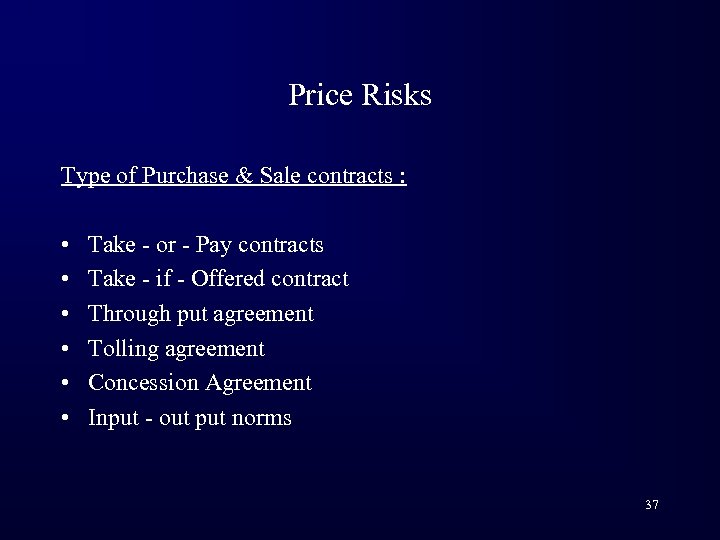 Price Risks Type of Purchase & Sale contracts : • • • Take - or - Pay contracts Take - if - Offered contract Through put agreement Tolling agreement Concession Agreement Input - out put norms 37
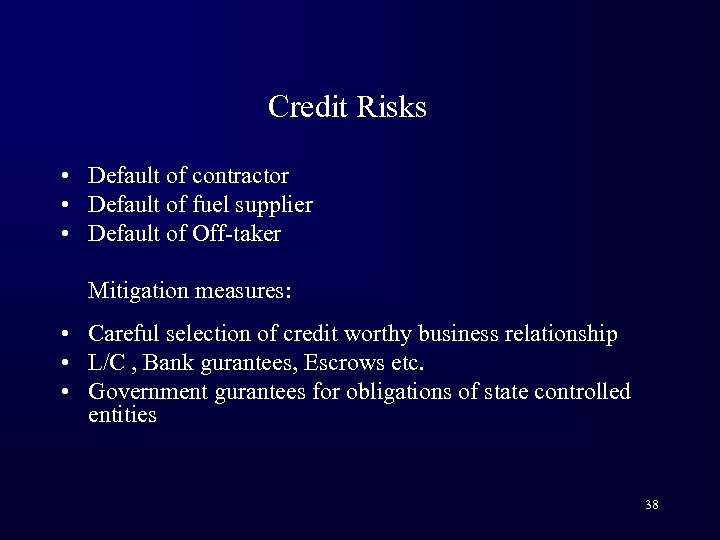 Credit Risks • Default of contractor • Default of fuel supplier • Default of Off-taker Mitigation measures: • Careful selection of credit worthy business relationship • L/C , Bank gurantees, Escrows etc. • Government gurantees for obligations of state controlled entities 38
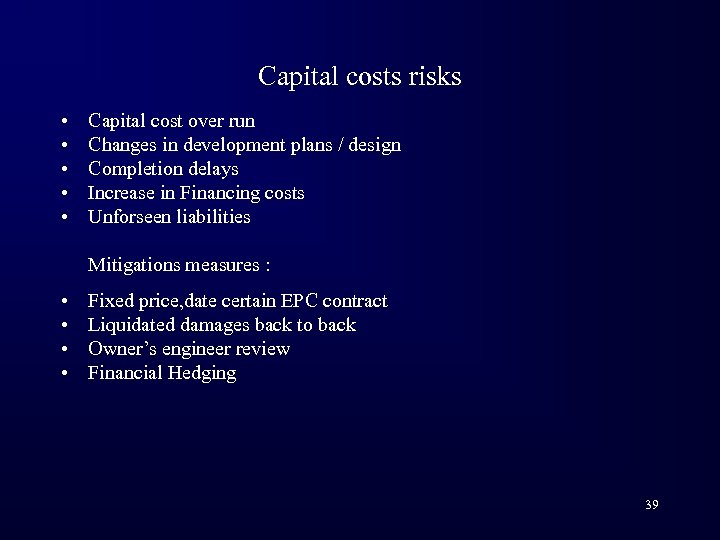 Capital costs risks • • • Capital cost over run Changes in development plans / design Completion delays Increase in Financing costs Unforseen liabilities Mitigations measures : • • Fixed price, date certain EPC contract Liquidated damages back to back Owner’s engineer review Financial Hedging 39
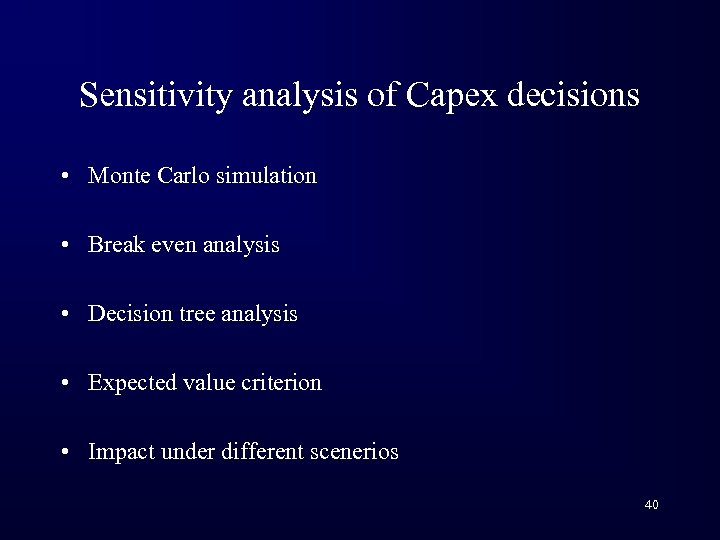 Sensitivity analysis of Capex decisions • Monte Carlo simulation • Break even analysis • Decision tree analysis • Expected value criterion • Impact under different scenerios 40
 Sensitivity analysis - Basis of financial projections is based on the assumptions - Key parameters a. Gestation period b. Capacity utilisation c. Selling price d. Raw material consumption / price e. Capital cost overrun - Impact of changes in the parameters on DSCR, NPV and IRR. - Project resilience to changes 41
 Debt security • Exclusive charge / Parri-passu charge • Covenant Financing • First charge / Second charge • Hypothecation of movables • Mortgage of immovable • Personal guarantees • Escrow cover • Co-lateral securities : Corporate gurantees • Permanent security / Interim security • Trust & Retention account • Debt service retention account 42
 Equity Financing • • • Treasury issuance through IPO Private Placement SPV structure with holding company Local market / Offshore Valuation Controlling stake Rights / Offer for sale No long term capital gains tax if STT is paid Short term capital gains tax at 10% if STT Paid. For Listed Entities 25% must be public float Share premium collected in excess of FMP to be taxed as income in Private & closely held companies 43
 Taxation of Securities • Equity Oriented Funds • • • Debt Oriented Funds Nil on Div recd Nil on LTCG 15% on STCG No DDT • Nil on Div recd • 10% with indexation or 20 % without whichever is lower on LTCG • 30% on STCG • LTCG on shares : Nil ( STT ) • DDT of 12. 5% for • STCG on shares : 15 % ( STT ) individuals and 30% for companies. • Without STT on LTCG : 20% • Interest income fully taxed and STCG : Slab rate at Slab rate. 44