 Скачать презентацию Investment Club September 27 th 2013 Agenda
92a03aa97d2b07c5b3cb7491ddd188f8.ppt
- Количество слайдов: 37



Investment Club September 27 th, 2013

Agenda Market News Ryan Portfolio Restructure (Part 1) Peter Mc. Cormick Oberrender, Sean O’Toole and Angel Stoychev Buy Presentaion Chris Busuttil

MARKET UPDATE September 27 th, 2013
Debt Ceiling The debt ceiling is a spending limit set by Congress U. S. spends more than it takes in forcing the government to issue debt That debt limit is currently $16. 7 trillion
Debt Ceiling Pressures Expected to reach $16. 7 trillion limit by the end of October Without raising borrowing ceiling, it will impossible to pay $55 billion in Social Security, Medicare, military payments on Nov. 1 Stand off between Rep. and Dem.
Consequences Debt Ceiling not prominent due to Fed/economic concerns If U. S. does not pay debt obligations, government programs will be unfunded Expect credit downgrades on government debt Creates uncertainty in equity markets
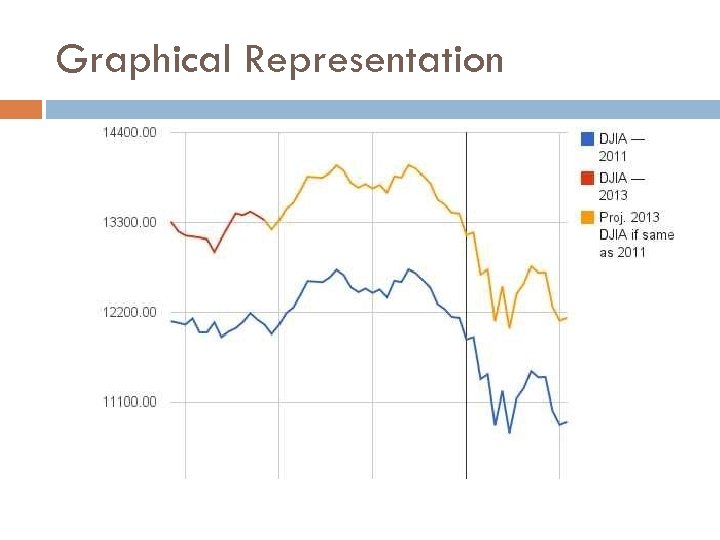
Graphical Representation
J. P. Morgan Chase Lawsuit Justice Department officials are preparing civil lawsuit against J. P. Morgan Chase Suit is in relation to the sale of MBS from 20052007 Latest setback for bank: fined $920 million by regulators for the “London Whale” trading blunder that cost $6 billion in losses
Settlement Potential CEO Jamie Dimon met with Justice Department to discuss potential $11 billion settlement Potentially pay $7 billion in penalties and another $4 billion to consumers J. P. Morgan wants to end probes
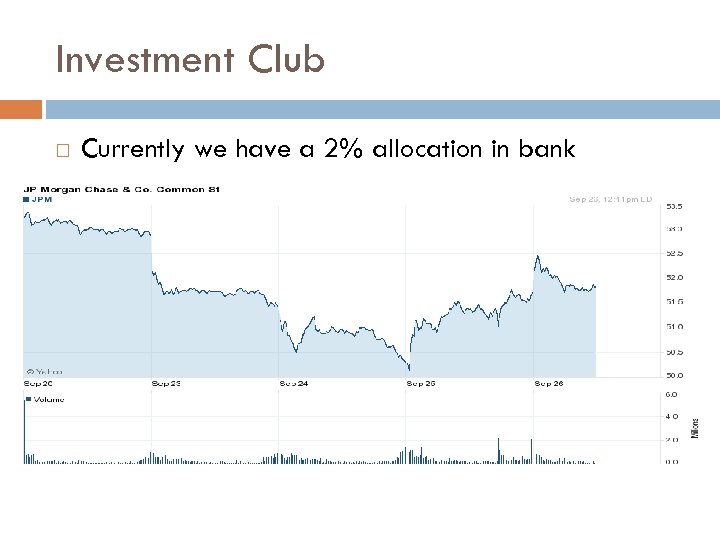
Investment Club Currently we have a 2% allocation in bank
Housing Market Buoyed by extremely low mortgage rates housing prices have been increasing Lower than pre-crises, but prices are increasing at the same price (slope) Besides Home Depot, do not own much Worth discussing our options Drawback: market appears a bit “bubbly”

PORTFOLIO RESTRUCTURE Pete, Sean and Angel
Coca Cola (KO) Buy: 150 Shares @ $39. 00
Buy Hypothesis Undervalued at the time P/E – around 15 times earnings Trades at a ev/ebitda multiple of 13 Dividend yields about 3%. Most ratios in line with the industry average 60% gross margins, better then the industry by nearly 20%. Need to Diversify into the Consumer Goods Market
What has happened Disappointed on volume growth Unusual seasonal weather and economic conditions hit European market Analysts are calling this an anomaly All other aspects of the company intact Operating margin slightly below forecast w/ increased marketing investments Gained share in global non-alcohol beverage market Strong Cash flow Valuation ratios are in line with competitors UBS High Conviction Call Value investment - long term
Risks Increased competition from Pepsi A trend toward health and wellness Downturn in Global Markets
Goldman Sachs Group Inc. (GS) Buy: 50 Shares @$162. 29
Solid Company With Many Services One of the world’s leading investment banking and securities firms Strong client relations to offset industry flux Clients consist of: Corporations Financial institutions Governments High net worth individuals
Fundamentals Industry leader with market cap of 73 Billion Yields a 1. 23% dividend P/E: 10. 4 x EBITDA GS: 18. 73 Industry Avg. 3. 07 Profit margin beats industry avg. 18% compared to 12%
Risks Capital Markets experiencing weaker recovery Regulations are always looming Actions by government greatly effect PWM taking less compensation Could be too big for its own good
JAKK’S Pacific Inc. (JAKK) Sell: 165 Shares
Company Produces, markets and distributes toys and related products, pet toys, consumables and related products, electronics and related products, kids indoor and outdoor furniture, and other consumer products Trades @ $5. 07 on NASDAQ Beta. 96 Negative margins
Struggles Hit Toys Negative earnings from last 3 quarters JAKK’s has to go out of its comfort zone to make ends meet Traditional toys are suffering Future is electronics Jakks struggles with electronics
Vestas Wind Systems (VWDRY) Sell 500 Shares
We Cannot Own This Trades on pink sheets One of our rules is that we are not suppose to own companies that trade on pink sheets

Buy 215 Shares Chris Busuttil
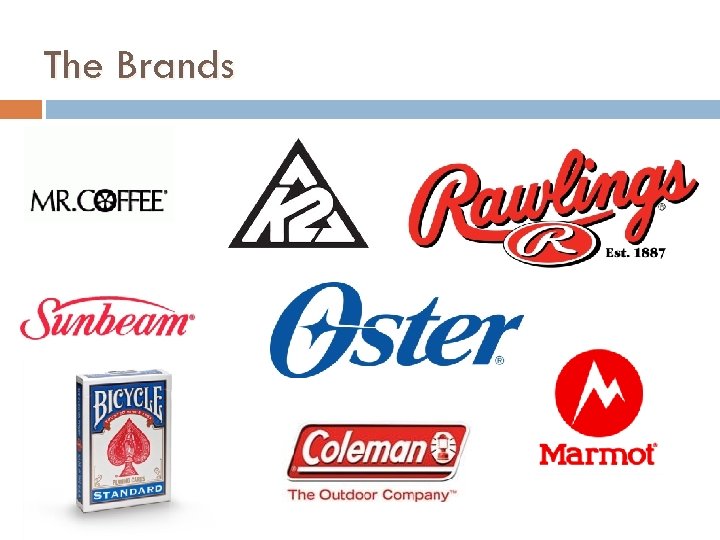
The Brands
Business Overview Focus on developing consumer products to provide market leading brands Company includes over 100 brand names Growth through: Geographic Expansion Brand Expansion Acquisitions
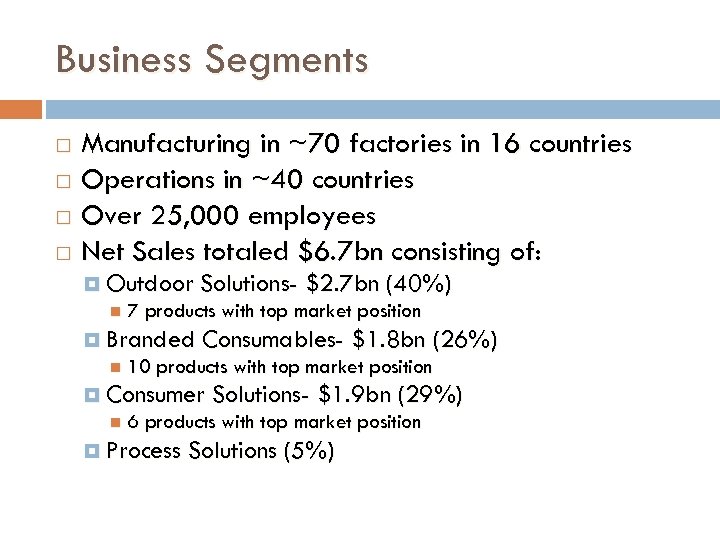
Business Segments Manufacturing in ~70 factories in 16 countries Operations in ~40 countries Over 25, 000 employees Net Sales totaled $6. 7 bn consisting of: Outdoor 7 products with top market position Branded Solutions- $2. 7 bn (40%) Consumables- $1. 8 bn (26%) 10 products with top market position Consumer Solutions- $1. 9 bn (29%) 6 products with top market position Process Solutions (5%)
Organic Growth and Investment Target 3 -5% long-term average annual organic growth Accomplish this goal through pricing and volume: Brand Leverage Product Innovation Geographic Expansion Retail dispersion $384 MM brand equity investment “Reinvestment” leads to innovation and product recognition as well as higher prices
Marmot Relevant market: Lifestyle apparel and equipment ($10 billion estimate) Brand development of equipment and multiseason apparel (non-winter) Retail Store expansion Serve broader casual lifestyle while maintaining technical apparel
Rawlings and Tailgating Expand the brand to other sports, specifically football Expand on “tailgating” experience Through license and marketing rights NFL, MLB and NCAA Geographic Expansion (Asia markets). New products = New Revenue growth $3. 4 billion market estimate
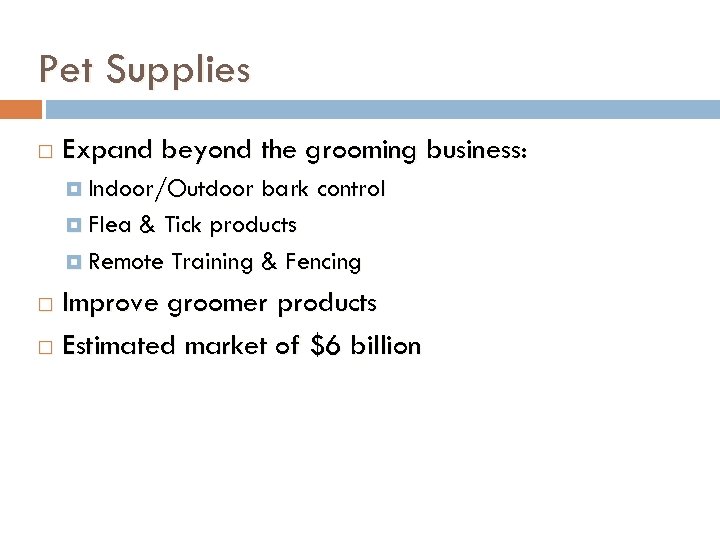
Pet Supplies Expand beyond the grooming business: Indoor/Outdoor bark control Flea & Tick products Remote Training & Fencing Improve groomer products Estimated market of $6 billion
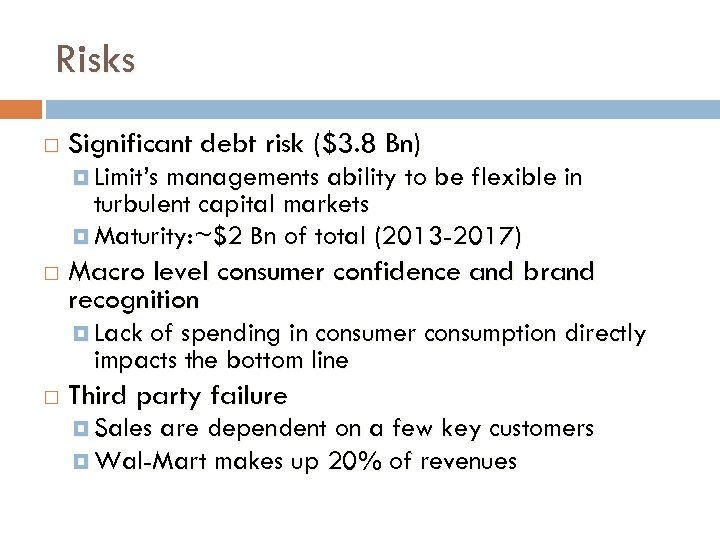
Risks Significant debt risk ($3. 8 Bn) Limit’s managements ability to be flexible in turbulent capital markets Maturity: ~$2 Bn of total (2013 -2017) Macro level consumer confidence and brand recognition Lack of spending in consumer consumption directly impacts the bottom line Third party failure Sales are dependent on a few key customers Wal-Mart makes up 20% of revenues
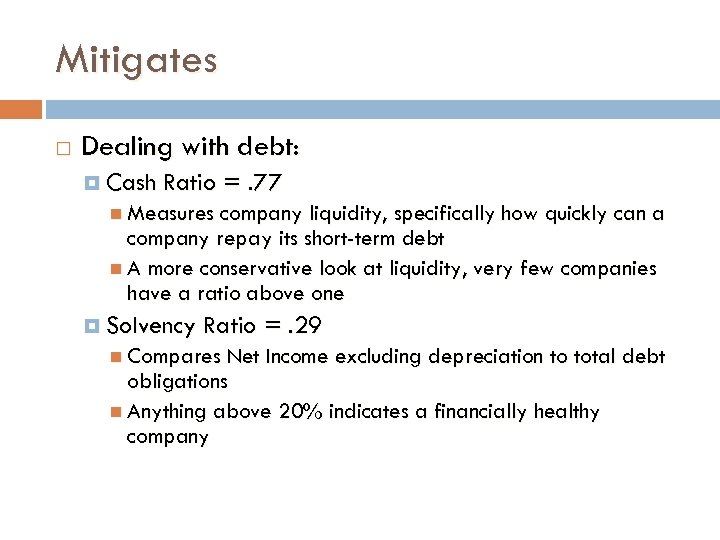
Mitigates Dealing with debt: Cash Ratio =. 77 Measures company liquidity, specifically how quickly can a company repay its short-term debt A more conservative look at liquidity, very few companies have a ratio above one Solvency Ratio =. 29 Compares Net Income excluding depreciation to total debt obligations Anything above 20% indicates a financially healthy company
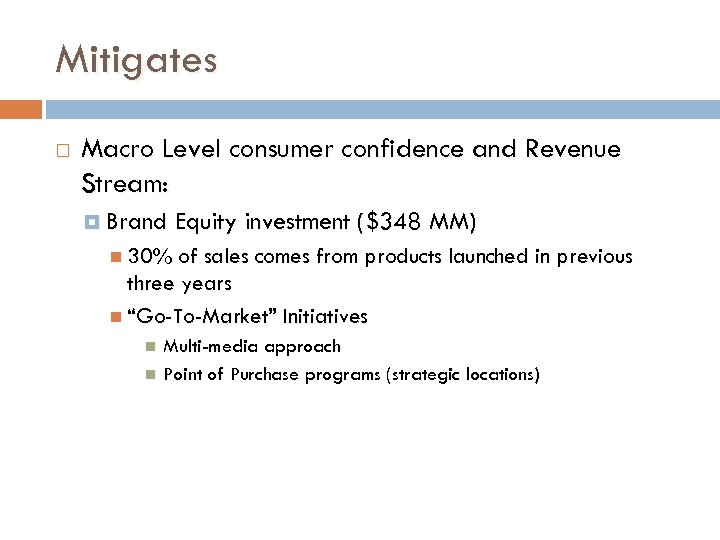
Mitigates Macro Level consumer confidence and Revenue Stream: Brand Equity investment ($348 MM) 30% of sales comes from products launched in previous three years “Go-To-Market” Initiatives Multi-media approach Point of Purchase programs (strategic locations)
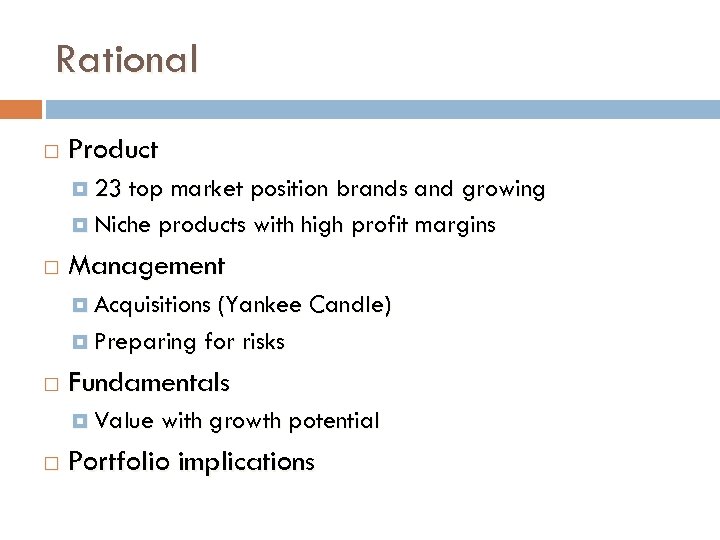
Rational Product 23 top market position brands and growing Niche products with high profit margins Management Acquisitions (Yankee Candle) Preparing for risks Fundamentals Value with growth potential Portfolio implications
Скачать презентацию Investment Club September 27 th 2013 Agenda
92a03aa97d2b07c5b3cb7491ddd188f8.ppt