 Скачать презентацию Investment Basics Clench Fraud Trust Investment Workshop October
120a41043f5cdc36fca104e6dd762230.ppt
- Количество слайдов: 34



Investment Basics Clench Fraud Trust Investment Workshop October 24, 2011 Jeff Frketich, CFA
Topics l Risk and Return l Fixed income (bonds) l Equities (stocks) l Asset Mix (how you combine stocks and bonds) l Diversification 2
Risk and Return 3
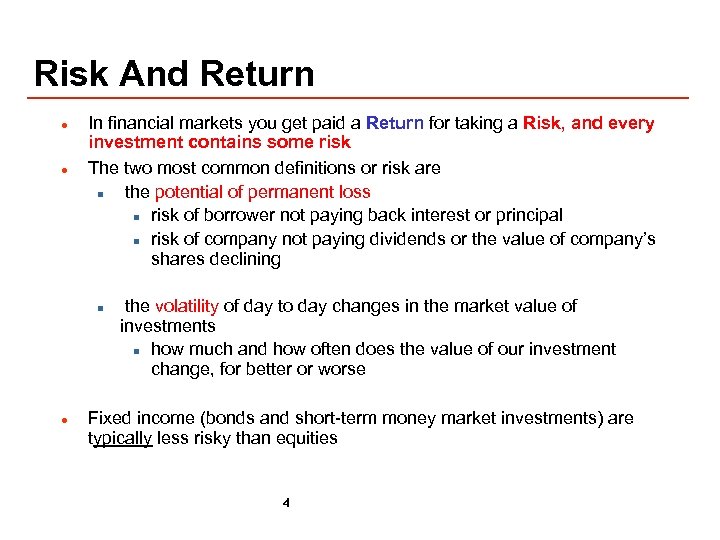
Risk And Return l l In financial markets you get paid a Return for taking a Risk, and every investment contains some risk The two most common definitions or risk are n the potential of permanent loss n risk of borrower not paying back interest or principal n risk of company not paying dividends or the value of company’s shares declining n l the volatility of day to day changes in the market value of investments n how much and how often does the value of our investment change, for better or worse Fixed income (bonds and short-term money market investments) are typically less risky than equities 4
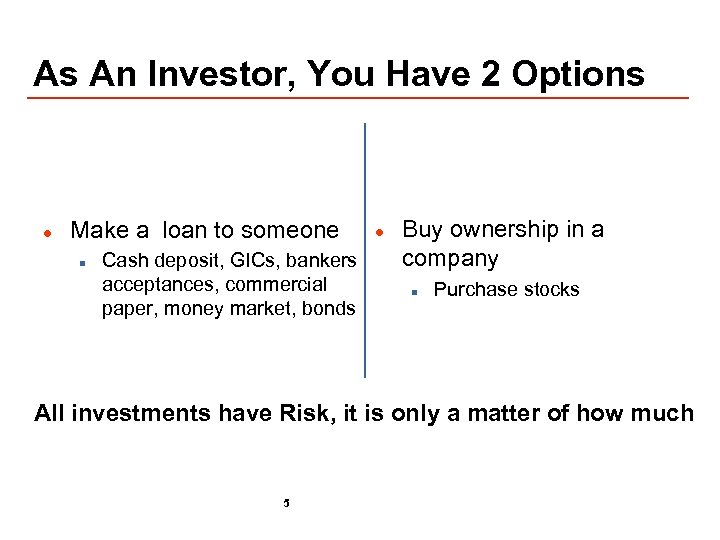
As An Investor, You Have 2 Options l Make a loan to someone n Cash deposit, GICs, bankers acceptances, commercial paper, money market, bonds l Buy ownership in a company n Purchase stocks All investments have Risk, it is only a matter of how much 5
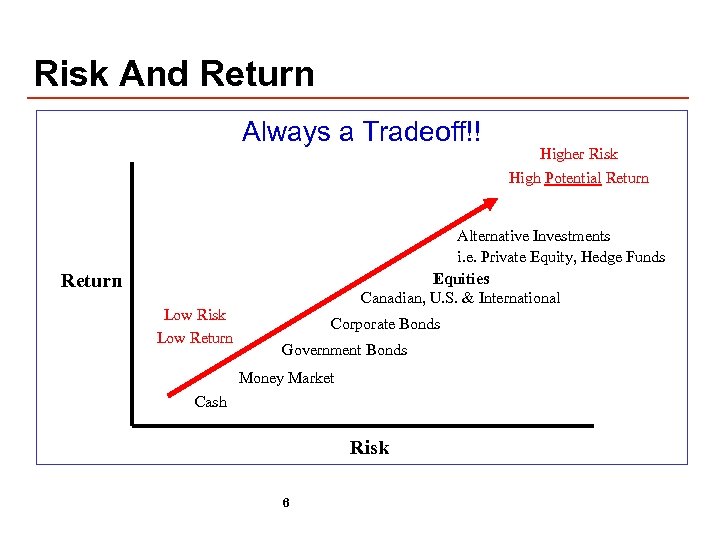
Risk And Return Always a Tradeoff!! Higher Risk High Potential Return Alternative Investments i. e. Private Equity, Hedge Funds Equities Canadian, U. S. & International Return Low Risk Low Return Corporate Bonds Government Bonds Money Market Cash Risk 6
Fixed Income Securities (Bonds) 7
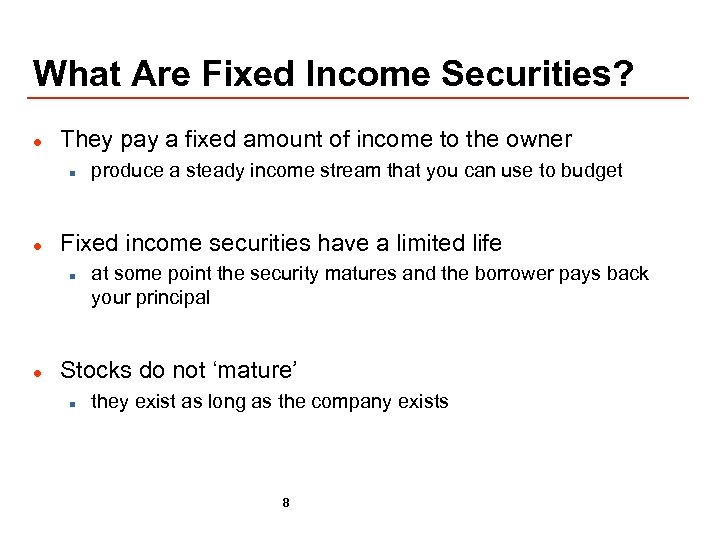
What Are Fixed Income Securities? l They pay a fixed amount of income to the owner n l Fixed income securities have a limited life n l produce a steady income stream that you can use to budget at some point the security matures and the borrower pays back your principal Stocks do not ‘mature’ n they exist as long as the company exists 8
Short Term Fixed Income Securities l Examples of short-term (usually less than one year) fixed income include: n GICs n n Treasury Bills n n short-term borrowing by banks short-term borrowing by Federal and Provincial Governments Bankers Acceptances and Commercial Paper n short-term borrowing by corporations 9
Short Term Fixed Income Securities l Examples of short-term (usually less than one year) fixed income include: n Money Market n a pool of treasury bills, bankers acceptances, commercial paper, short term bonds, all with a very short term to maturity 10
Long-Term Fixed Income Securities l Examples of long-term fixed income include: n Bonds n n long-term borrowing by governments (federal, provincial and municipal) and corporations Mortgage and Asset Backed Securities n pools of mortgages that are packaged together and sold just like bonds 11
Bonds l l l When talking about fixed income securities, we are usually talking about bonds Bonds are a contract that entitle the owner to regular interest payments and the return of their principal (original amount of the loan) when the bond matures Bonds are bought and sold in the open market, like stocks 12
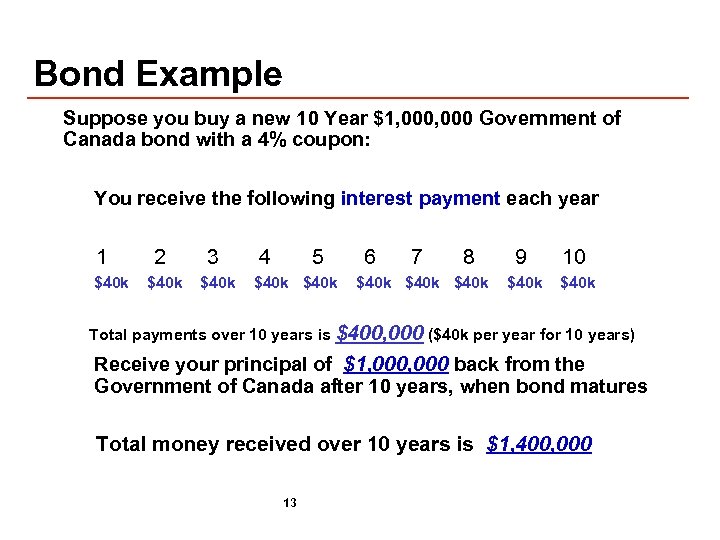
Bond Example Suppose you buy a new 10 Year $1, 000 Government of Canada bond with a 4% coupon: You receive the following interest payment each year 1 $40 k 2 $40 k 3 $40 k 4 5 $40 k 6 7 8 $40 k 9 10 $40 k Total payments over 10 years is $400, 000 ($40 k per year for 10 years) Receive your principal of $1, 000 back from the Government of Canada after 10 years, when bond matures Total money received over 10 years is $1, 400, 000 13
Bonds: Changing Interest Rates l l Interest rates affect the price of most fixed income securities, especially bonds Interest rates (yields) go up and down, depending on what is happening in the economy; generally the better the economy, the higher the interest rate 14
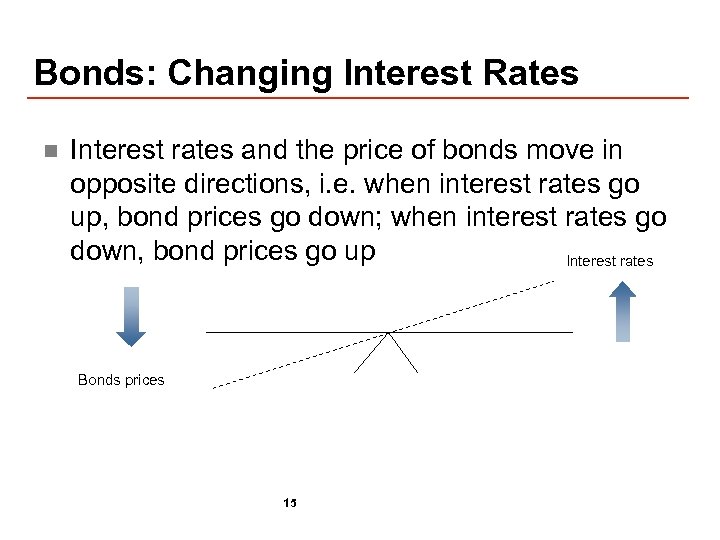
Bonds: Changing Interest Rates n Interest rates and the price of bonds move in opposite directions, i. e. when interest rates go up, bond prices go down; when interest rates go down, bond prices go up Interest rates Bonds prices 15
Bonds: Time to Maturity Can Have A Large Impact on Bond Prices l The longer the time to maturity, the more volatile the bond price for a given change in interest rates n n a change in interest rates of 1% will not affect the price of a bond that matures tomorrow. however, a 1% change in interest rates will have a much larger effect on a bond that matures in 10 years 16
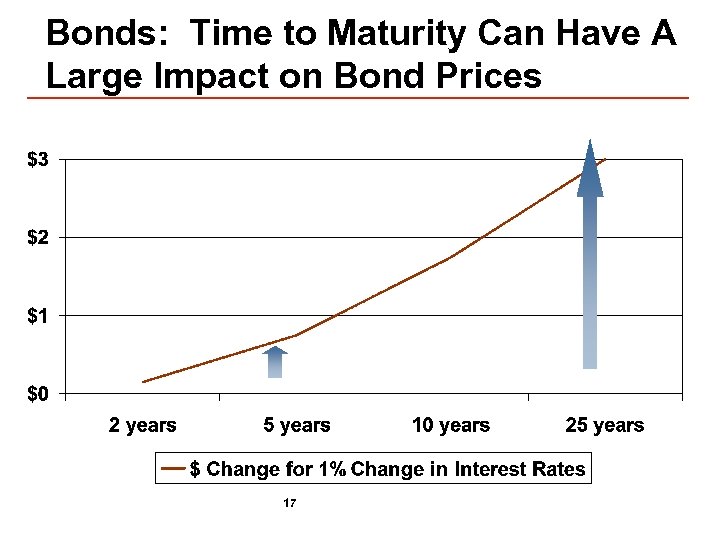
Bonds: Time to Maturity Can Have A Large Impact on Bond Prices 17
Credit Rating Agencies l l l How do you know which bonds to buy and which to avoid? Your investment counsellor starts the process by reviewing what independent credit rating agencies say about the bond Two examples of credit rating agencies are Dominion Bond Rating Service and Standard & Poors 18
Credit Rating Agencies l l l DBRS and S&P look at things like cash flows, earnings growth, the firm’s competitive position and future capital expenditures. The agencies come up with a grade representing the credit quality of the borrower. The better the credit quality, the higher the credit rating; the higher the rating, the lower the interest rate the borrower must pay on the debt. 19
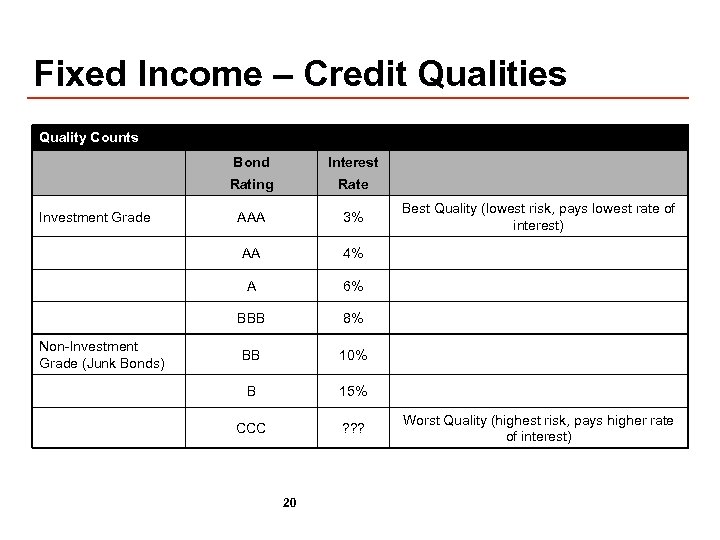
Fixed Income – Credit Qualities Quality Counts Bond Rating AAA 3% 4% A 6% BBB Non-Investment Grade (Junk Bonds) Rate AA Investment Grade Interest 8% BB 10% B 15% CCC ? ? ? 20 Best Quality (lowest risk, pays lowest rate of interest) Worst Quality (highest risk, pays higher rate of interest)
Equities (Stocks) (Shares of Companies) 21
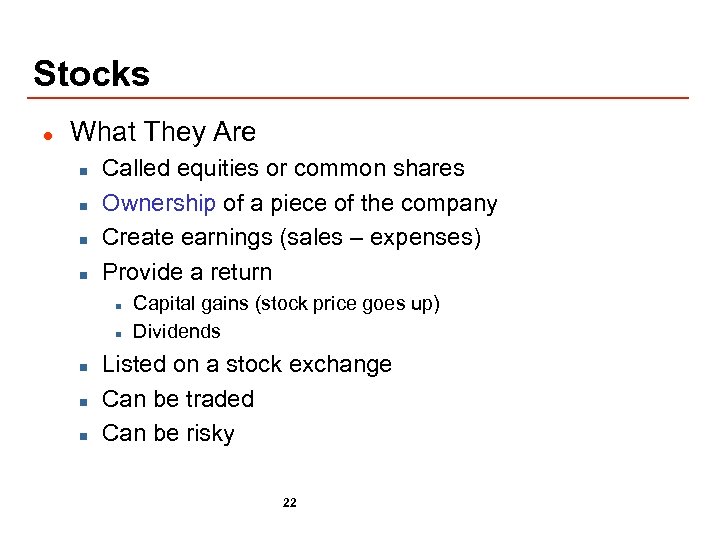
Stocks l What They Are n n Called equities or common shares Ownership of a piece of the company Create earnings (sales – expenses) Provide a return n n Capital gains (stock price goes up) Dividends Listed on a stock exchange Can be traded Can be risky 22
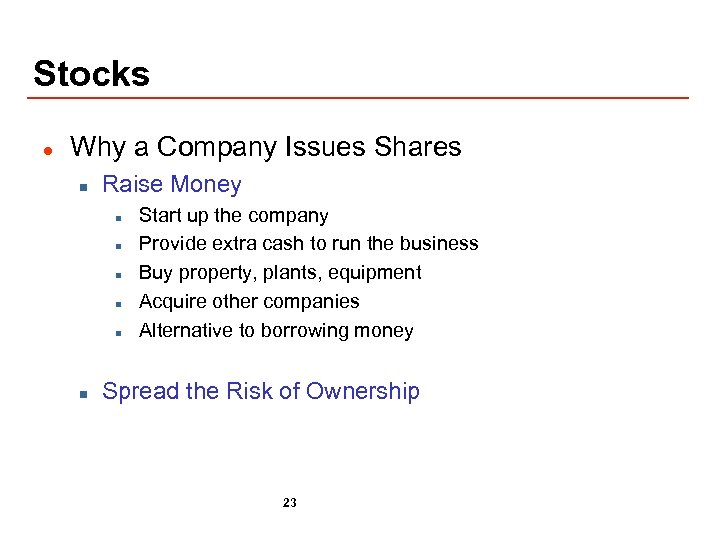
Stocks l Why a Company Issues Shares n Raise Money n n n Start up the company Provide extra cash to run the business Buy property, plants, equipment Acquire other companies Alternative to borrowing money Spread the Risk of Ownership 23
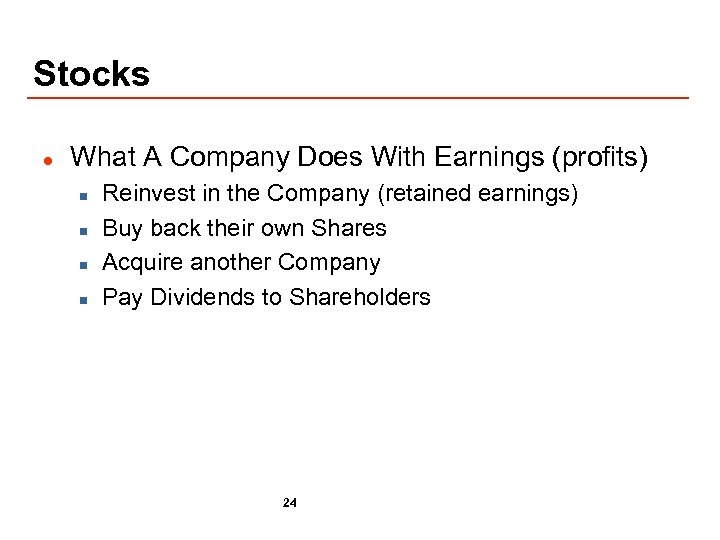
Stocks l What A Company Does With Earnings (profits) n n Reinvest in the Company (retained earnings) Buy back their own Shares Acquire another Company Pay Dividends to Shareholders 24
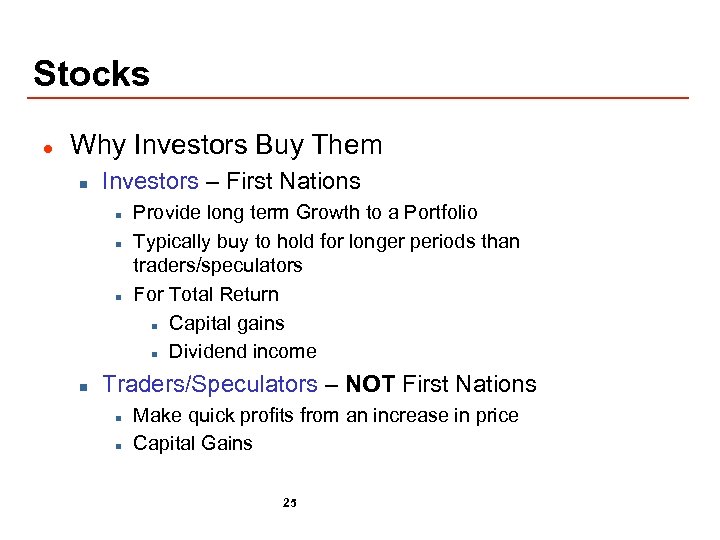
Stocks l Why Investors Buy Them n Investors – First Nations n n Provide long term Growth to a Portfolio Typically buy to hold for longer periods than traders/speculators For Total Return n Capital gains n Dividend income Traders/Speculators – NOT First Nations n n Make quick profits from an increase in price Capital Gains 25
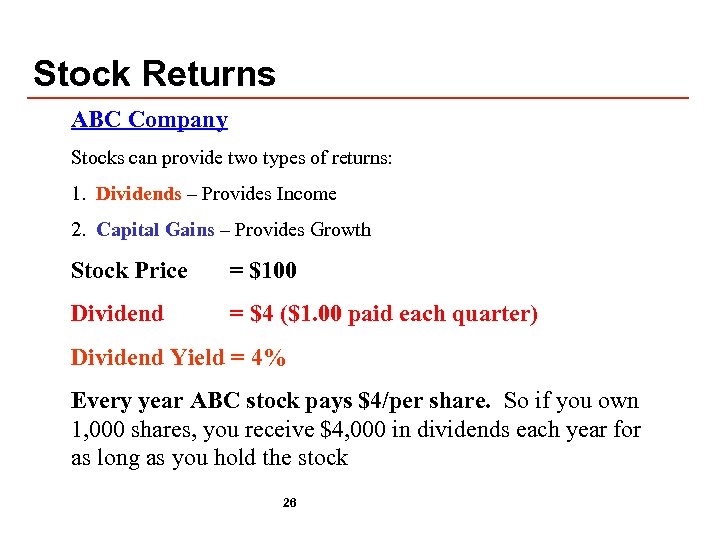
Stock Returns ABC Company Stocks can provide two types of returns: 1. Dividends – Provides Income 2. Capital Gains – Provides Growth Stock Price = $100 Dividend = $4 ($1. 00 paid each quarter) Dividend Yield = 4% Every year ABC stock pays $4/per share. So if you own 1, 000 shares, you receive $4, 000 in dividends each year for as long as you hold the stock 26
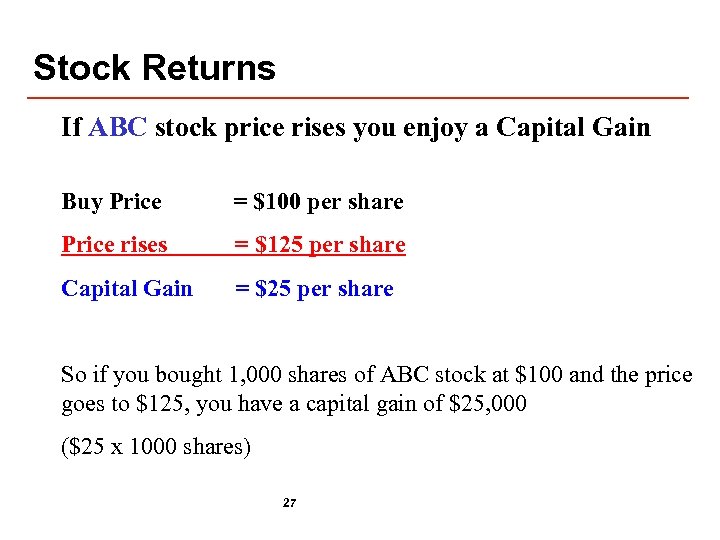
Stock Returns If ABC stock price rises you enjoy a Capital Gain Buy Price = $100 per share Price rises = $125 per share Capital Gain = $25 per share So if you bought 1, 000 shares of ABC stock at $100 and the price goes to $125, you have a capital gain of $25, 000 ($25 x 1000 shares) 27
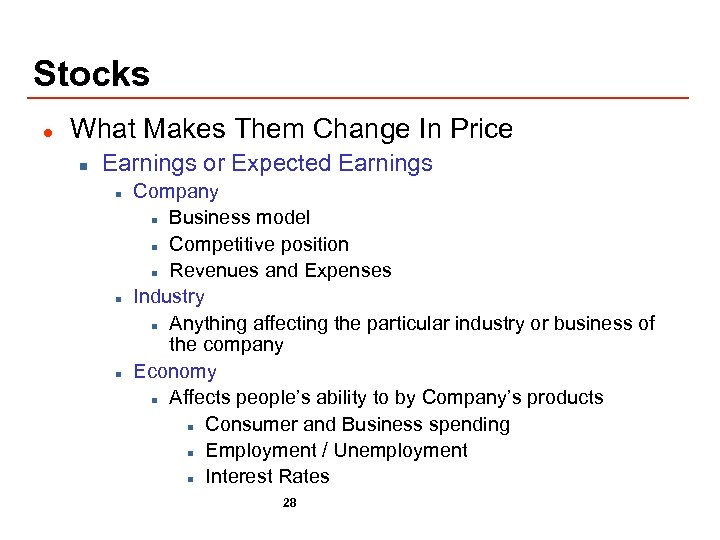
Stocks l What Makes Them Change In Price n Earnings or Expected Earnings n n n Company n Business model n Competitive position n Revenues and Expenses Industry n Anything affecting the particular industry or business of the company Economy n Affects people’s ability to by Company’s products n Consumer and Business spending n Employment / Unemployment n Interest Rates 28
Stocks l What Makes Them Change In Price n Demand for a Company’s Stock n n Information n What is know or factual about the Company n Company reports and results n Past performance , Earnings, etc. Speculation n What is assumed about the Company and its prospects n Anticipation of changes to business and potential earnings n Rumours about the Company n Takeovers n New business opportunities 29
Asset Mix: Combining Stocks and Bonds 30
Asset Mix l l l Asset mix is another way of saying how much do you have in stocks and how much do you have in bonds Each Trust has its own unique return requirements and risk tolerance Asset mix will determine the risk/return levels in your trust portfolio n generally, the more stocks you have the more risk you take 31
Asset Mix l How do you decide on asset mix? n Assessment of First Nation’s n n financial needs & long term goals ability to tolerate short-term loss in value ability to tolerate permanent loss of capital Professional help is recommended n n do it right the first time (very costly to fix later) avoid actual losses or lost opportunities 32
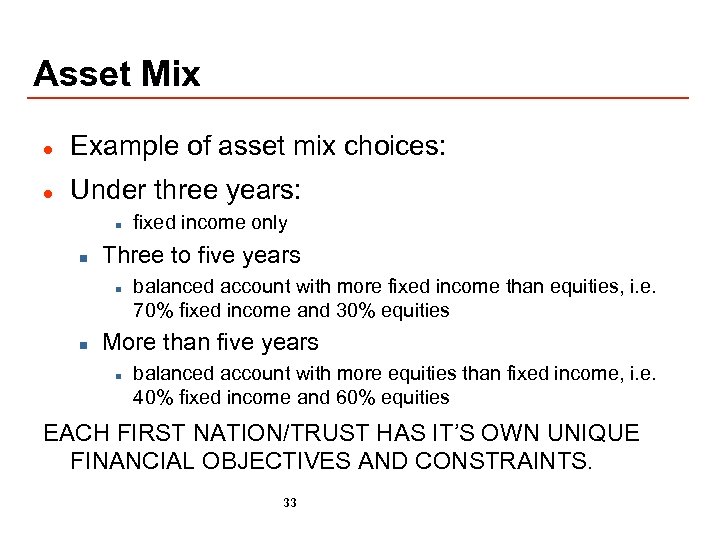
Asset Mix l Example of asset mix choices: l Under three years: n n Three to five years n n fixed income only balanced account with more fixed income than equities, i. e. 70% fixed income and 30% equities More than five years n balanced account with more equities than fixed income, i. e. 40% fixed income and 60% equities EACH FIRST NATION/TRUST HAS IT’S OWN UNIQUE FINANCIAL OBJECTIVES AND CONSTRAINTS. 33
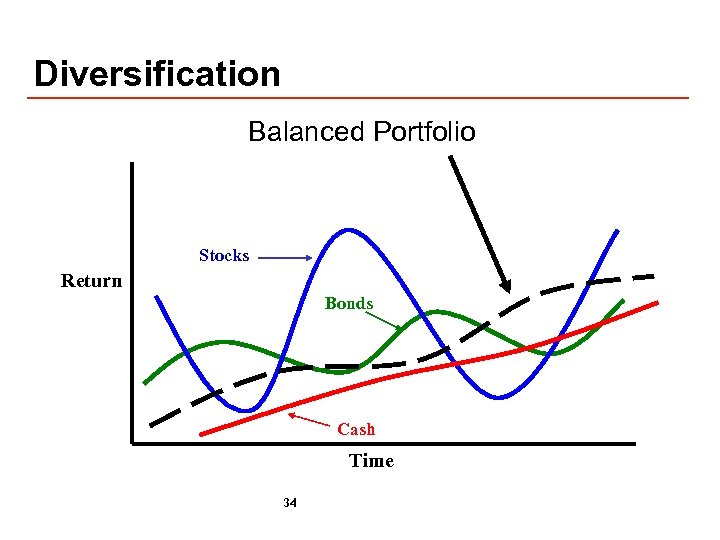
Diversification Balanced Portfolio Stocks Return Bonds Cash Time 34
Скачать презентацию Investment Basics Clench Fraud Trust Investment Workshop October
120a41043f5cdc36fca104e6dd762230.ppt