


 Скачать презентацию Investing Risk and Return Risk no
b2489943d8583d9064e36fd30ae474b1.ppt
- Количество слайдов: 55
 Investing
 Risk and Return • Risk no matter what • Greater risk could mean greater return • Portfolio: record of an individuals investments • Diversification: utilizing different investment opportunities; • “Don’t put all your eggs in one basket. ”
 Investments: • Stocks • Bonds • Mutual Funds • Real Estate • Retirement Plans • Collectibles
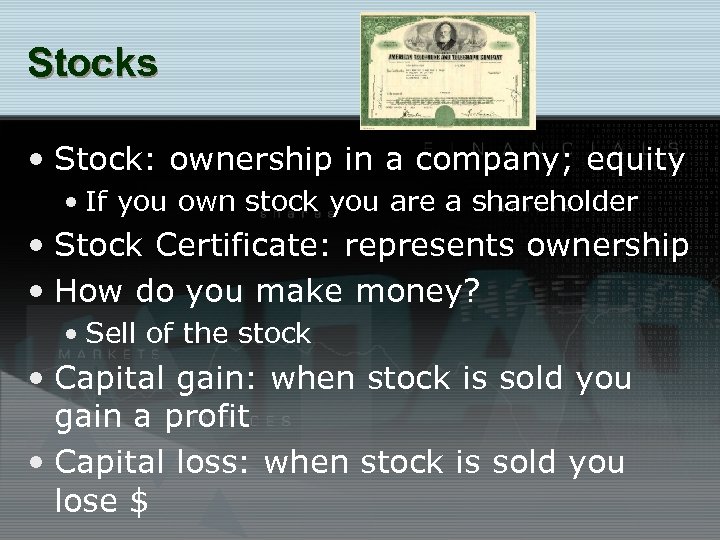 Stocks • Stock: ownership in a company; equity • If you own stock you are a shareholder • Stock Certificate: represents ownership • How do you make money? • Sell of the stock • Capital gain: when stock is sold you gain a profit • Capital loss: when stock is sold you lose $
 Securities • Choice of Securities: stocks, bonds, mutual funds, options, and commodities (sold on commodities exchange). • Companies use money from stocks to make and sell products, fund operations and expand. • Private Corporation: issues stock to small group of people. • Public Corporation: issues stock openly
 Common vs. Preferred Stock • Common stock: voting rights and dividends • Preferred stockholders: receive cash dividends before common stockholder; limited voting rights • Considered a “middle investment. ” Safer than common stock , but not as safe as bonds.
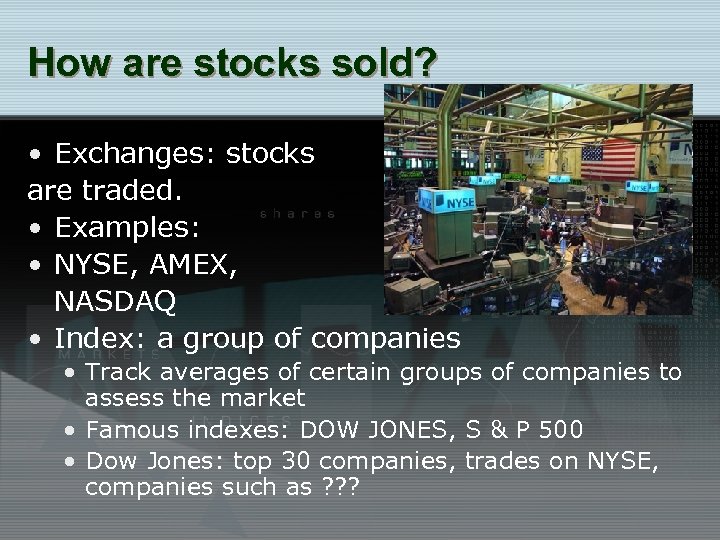 How are stocks sold? • Exchanges: stocks are traded. • Examples: • NYSE, AMEX, NASDAQ • Index: a group of companies • Track averages of certain groups of companies to assess the market • Famous indexes: DOW JONES, S & P 500 • Dow Jones: top 30 companies, trades on NYSE, companies such as ? ? ?
 Other things about Stocks • Dividends: company’s profits that are paid to shareholders (usually paid quarterly) • Companies do not have to issue dividends • What is the incentive to issuing dividends? • Ticker Symbol: represents company’s stock, often similar to their name • Example: Disney’s is DIS
 ADVANTAGES • Why invest in stock? • Larger return than from bonds, savings… • Money from: • Dividends • Appreciation of Stock Value (captial gain) • Stock Splits: • Shares of stock owned by existing stockholders are divided into a larger number of shares. • Liquid • Easy
 Disadvantages • Lose money if company does not do well (stock depreciates) • No cash dividends if board of directors votes accordingly • No guarantee of making money
 What are sources for evaluating stock? • Read pages 280 -285 • Start at “Sources for Evaluating Stocks” • End after reading “Corporate News Publications. ” • Write a one page essay answering the following questions: • Where would you research a stock before buying? Would you use more than one source? • What kind of stock will you look for (see pages 277 -280)? • Why should you track and graph a stocks’ activity before buying? For how long? • What would make you consider selling it?
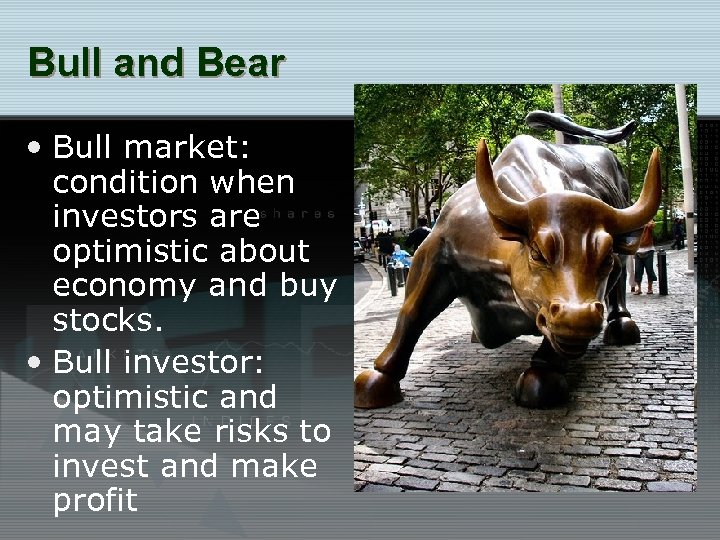 Bull and Bear • Bull market: condition when investors are optimistic about economy and buy stocks. • Bull investor: optimistic and may take risks to invest and make profit
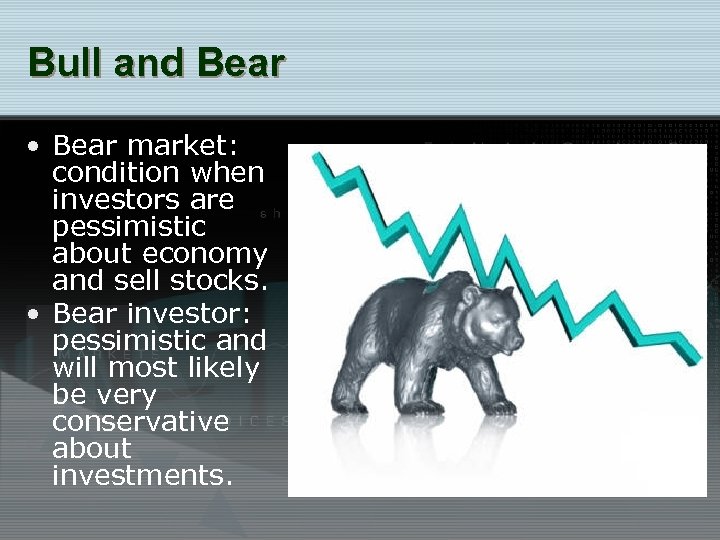 Bull and Bear • Bear market: condition when investors are pessimistic about economy and sell stocks. • Bear investor: pessimistic and will most likely be very conservative about investments.
 Primary and Secondary Markets • Primary: securities are sold from company to an investor • IPO: Initial Public Offering; company sells stock to general publics for the first time. (Considered a high-risk investment. ) • Secondary: securities are sold from investor to investor. • NYSE, AMEX
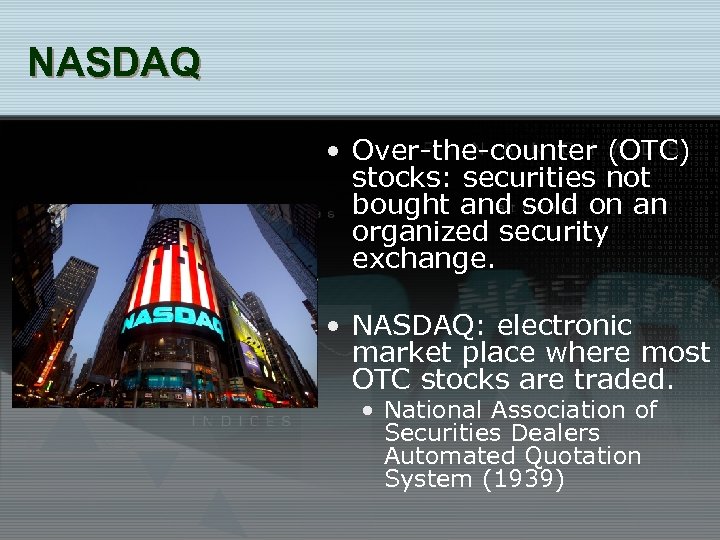 NASDAQ • Over-the-counter (OTC) stocks: securities not bought and sold on an organized security exchange. • NASDAQ: electronic market place where most OTC stocks are traded. • National Association of Securities Dealers Automated Quotation System (1939)
 How to Buy and Sell Stocks • Read pages 291 -299 (pay particular attention to page 295. ) • Answer the questions on page 299; • #’s 1 -3, 6
 Bonds • Loan to a corporation or government. • (Company’s written pledge to repay bondholder with interest. ) • Maturity date: date when a bond will be repaid. • Range from 1 to 30 years; • Short term: less than 5 years • Intermediate: 5 to 15 years • Long term: more than 15 years
 Bonds • Face Value: dollar amount that the bondholder will receive at maturity. • Typically $1000 • Interest is based annually, paid semiannually • Turn to page 307 in your book. • Complete the GO FIGURE Section here in your notes.
 Why Corporations Sell Bonds • Raise money when cannot sell stock. • Could reduce amount of tax because interest is tax-deductible. • Pay for different activities.
 Government Bonds • Issued by federal, state or local government • Lower interest rate than corporate bonds, but less risky. • Three types: • T-bills – discounted securities • Treasury Notes and Bonds – longer maturity date • US Government Savings Bonds – Series EE and Series I.
 Municipal Bonds • Security issued by a state or local government • Not as safe as Federal Bonds
 Advantages • Safer than stocks • Paid before stockholders • Could use as diversification • Interest income • Bond may increase in value • Face value is repaid at maturity.
 Disadvantages • Could lose money • Bond value could go down
 Questions about Bonds Answer the following questions: (Start on page 319) 1. How do you determine the investment value of a bond? 2. What are the most important questions you should ask yourself to be aware of the financial stability of the issuer of the bond? 3. List three items of information a typical annual report would include. 4. What are the ways you can research a bond? 5. Why are bond ratings important to investors?
 Mutual Funds • A fund that pools the money of its investors to buy a variety of securities. • Allows those with limited options to invest in diverse securities • Price • Risk management • Professional managers: manage the fund; research and evaluate, track performance,
 Different Mutual Funds • Closed-end Fund • Fixed number of shares that are issued by an investment company when first organized. • Open-end Fund • Unlimited number of shares that are issue and redeemed by an investment company at the investors’ request.
 Commission on MF • Load Funds • Pay commission every time you buy or sell shares (ave 3 -5 %) • No-load Funds • No commission fee • Back-end Load • Fee charged for withdrawing money from the fund (ave 1 -5%); based on how long you own shares in the fund
 Categories of MF • Stock Mutual Funds • Most are stock funds • Bond Funds • Only in bonds • Mixed Mutual Funds • Mix of stocks and bonds or other various types of securities
 Advantages • Diversification • Risk management • Professionally Managed • Potential of high returns • Potential dividends • Liquid
 Disadvantages • Loss of money • Commission fees
 Mutual Fund Assignment Start on Page 335 1. What steps can you take to decide on mutual fund investments? 2. List three items of information that is provided in a mutual fund prospectus. 3. What is the difference between a capital gain distribution and a capital gain? 4. What are income dividends? 5. How are mutual fund earnings taxed? 6. List your purchase options and one sentence on each. 7. List your withdrawal options and one sentence on each.
 Retirement Plans • Plans that help individuals set aside money to be used when they stop working. • Penalty charges apply if money is withdrawn before retirement
 Retirement Income • Social Security (1935) • Provides benefits to retirees, survivors, and disabled persons • Amount you receive is based on your earnings over your working years. • Dependents of a worker may also receive benefits
 Retirement Income cont. • Public pension plans • Other plans for government employees, railroad employees, veterans, etc. • State and local governments provide retirement plans.
 Defined-Contribution Plans • An individual account plan where individuals contribute as well as employers • Receive money when retire as well as investment earnings
 401 K • Salary-Reduction plan, funded by portion of your salary that is deducted from gross pay check and placed in special account. • Employers contribute: • Matching • Percentage • Invested in stocks, bonds and mutual funds • Tax-deferred: No taxes until you withdraw
 Roth 401 K • Available as of Jan 2006 • Funds come from after-tax income • No tax on proceeds • Larger limits than that of IRAs
 403(b) • If employed by tax exempt institution • Also tax-deferred (TSA’s) • Amount that can be contributed by both 403 b and 401 k is limited
 Personal Retirement Accounts • IRA: Individual Retirement Account • Tax-deferred interest and earnings • Annual limit • Roth IRA: • Tax-deferred interest and earnings • Annual limit • Withdrawals are tax free • Age 59 ½ • First Home • Education
 SEP Plan (Simplified Employee Plan) • Small businesses or self-employed • Limited amount per year • Set up through financial institution • Spousal IRA • Rollover IRA • Education IRA
 Keogh Plan • (Also HR 10) • Self-employed retirement • Limited amounts per year • Tax Restrictions/Deductions TURN TO PAGE 493 Figure 15. 6 Answer the caption question
 Complete the Crossword • Complete the Crossword puzzle using your notes.
 Real Estate • Property such as land structures • Types: • Vacation homes • Commercial Properties • Land (developed or undeveloped) • Condominiums • Apartments • Houses
 Types of Real Estate Investments • Direct Investment • Owner holds legal title to property • Homes • Vacation Homes • Commercial Properties: land or building that produce rental income • Land • Indirect Investment • Trustee is appointed to hold legal title to property in behalf of investor(s).
 Types of Indirect Real Estate • Syndicate • Temporary association of individuals or business firm organized to perform a task that require a large amount of funds. • REIT’s (Real Estate Investment Trusts) • Combine money from many investors like a mutual fund • Traded on stock exchanges • Three Types • Mortgage: construction loans and mortgages • Equity: properties • Hybrid: Combination
 Participation Certificates • Group of mortgages that have been purchased by a government agency • Considered a mutual fund because it is a group of mortgages
 Advantages of Real Estate • Hedge against inflation • Easy Entry • Limited Financial Liability • Financial Leverage • Potential for large capital gains
 Disadvantages of Real Estate • Illiquid • Declining Property Values • Lack of Diversification • With exceptions of PC’s, REIT’s and syndicates • Management
 Real Estate Assignment • Complete the Word Search assignment
 Collectibles and Precious Metals and Gems • Precious metals: gold, platinum, silver • Turn to page 362 in your book. Read through Figure 11. 2. Write in 20 words or LESS a summarization on what you have learned. • When you are finished look at Figure 11. 3 on page 363.
 Precious Gems • Rough mineral deposits, mined and cut into jewels • Diamonds, sapphires, rubies, and emeralds • Protection against inflation
 Collectibles • Rare coins, books (especially first edition), works of art • Antiques, stamps, comic books, • Sports memorabilia, rugs, ceramics, paintings, and other items
 Internet • Changed from trade magazines and shows • Makes collecting more efficient and easier and wider variety (across the world) • Comparison shopping made easier • Drawback is fraudulent investments
 Other things about Collecting • Advantage: hobby and could make money • Disadvantage: no guarantee to make money and fraud; illiquid • NCL: National Consumer League • Sponsors the Internet Fraud Watch • Safe guard against fraud by learning everything you can about the item and only use reputable dealers and auction sites
 Collectibles assignment • Page 369 answer questions 1 -3 4. Do you own any items that might be considered collectibles in the future? List them. 5. Look at Figure 11. 4. What do you learn by looking at this table?