


 Скачать презентацию Investing in Transport Infrastructure Aus Rail 2006 21
ee14eb40397ba2f5d924d4e52c4004be.ppt
- Количество слайдов: 24
 Investing in Transport Infrastructure Aus. Rail, 2006 21 st & 22 nd November Sofitel Hotel, Brisbane
 Agenda 1. Overview of Babcock & Brown 2. Transport Industry – Outline of Babcock & Brown’s Involvement 3. Why Invest in Transport Infrastructure? 4. Latest Trends – Investment in Transport Infrastructure 5. Conclusion For further information please contact: Berry Talintyre Babcock & Brown Tel: 61 412 380 098 or +1 347 610 7511 berry. talintyre@babcockbrown. com 1
 1. Overview of Babcock & Brown • Global investment and advisory firm • Founded in San Francisco in 1977, listed on ASX on the 6 th of October, 2004 • >800 employees. Employees own 45% of the Babcock & Brown Group • Operates from 23 offices across Australia, North America, Europe, Asia, United Arab Emirates and Africa • Group market capitalization over A$7 billion • Five operating divisions – Real Estate, Infrastructure and Project Finance, Operating Leasing, Structured Finance and Corporate Finance • A$31 billion in specialized funds and assets under management at 30 th of June, 2006 2
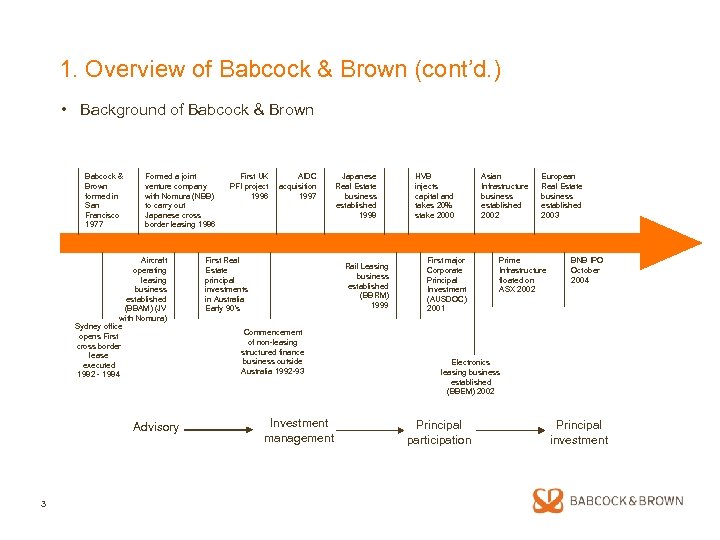 1. Overview of Babcock & Brown (cont’d. ) • Background of Babcock & Brown formed in San Francisco 1977 Formed a joint venture company with Nomura (NBB) to carry out Japanese cross border leasing 1986 Aircraft operating leasing business established (BBAM) (JV with Nomura) Sydney office opens First cross border lease executed 1982 - 1984 Advisory 3 First UK PFI project 1996 AIDC acquisition 1997 First Real Estate principal investments in Australia Early 90’s Japanese Real Estate business established 1998 Rail Leasing business established (BBRM) 1999 Commencement of non-leasing structured finance business outside Australia 1992 -93 Investment management HVB injects capital and takes 20% stake 2000 First major Corporate Principal Investment (AUSDOC) 2001 Asian Infrastructure business established 2002 European Real Estate business established 2003 Prime Infrastructure floated on ASX 2002 BNB IPO October 2004 Electronics leasing business established (BBEM) 2002 Principal participation Principal investment
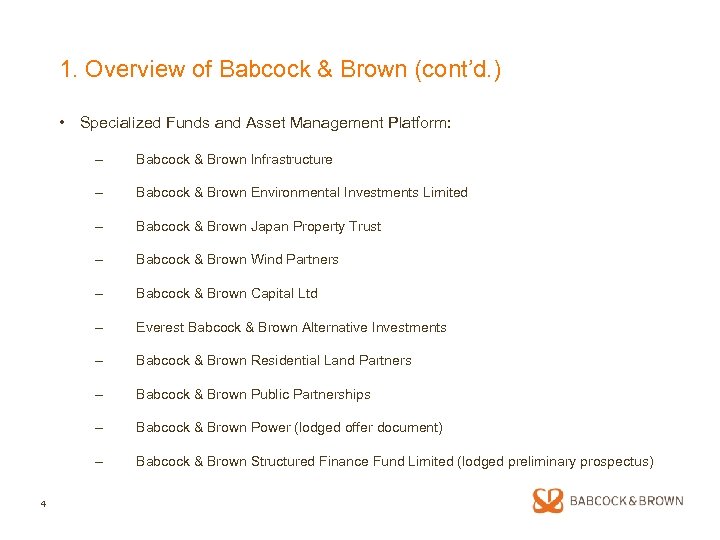 1. Overview of Babcock & Brown (cont’d. ) • Specialized Funds and Asset Management Platform: – – Babcock & Brown Environmental Investments Limited – Babcock & Brown Japan Property Trust – Babcock & Brown Wind Partners – Babcock & Brown Capital Ltd – Everest Babcock & Brown Alternative Investments – Babcock & Brown Residential Land Partners – Babcock & Brown Public Partnerships – Babcock & Brown Power (lodged offer document) – 4 Babcock & Brown Infrastructure Babcock & Brown Structured Finance Fund Limited (lodged preliminary prospectus)
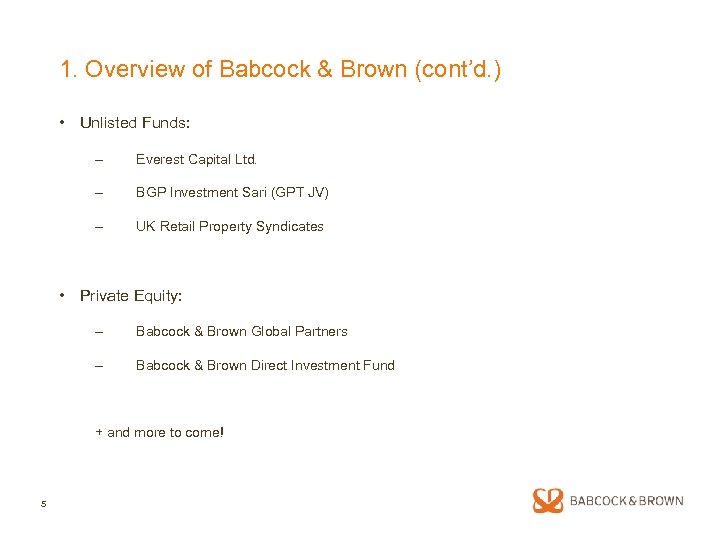 1. Overview of Babcock & Brown (cont’d. ) • Unlisted Funds: – Everest Capital Ltd. – BGP Investment Sari (GPT JV) – UK Retail Property Syndicates • Private Equity: – Babcock & Brown Global Partners – Babcock & Brown Direct Investment Fund + and more to come! 5
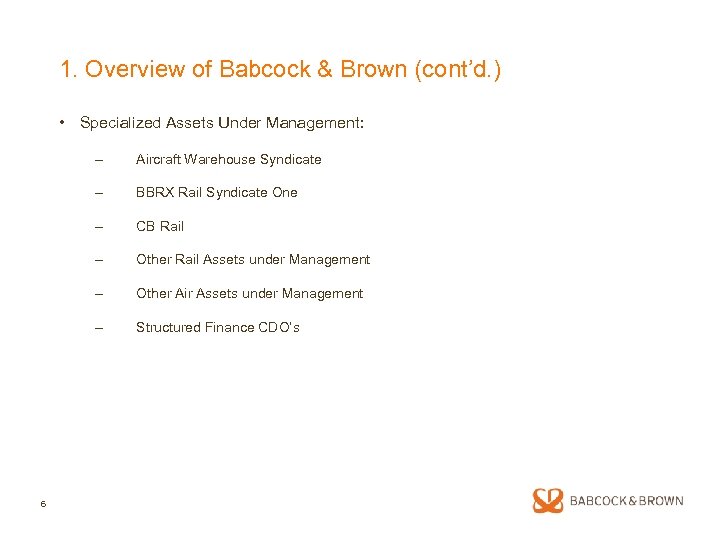 1. Overview of Babcock & Brown (cont’d. ) • Specialized Assets Under Management: – – BBRX Rail Syndicate One – CB Rail – Other Rail Assets under Management – Other Air Assets under Management – 6 Aircraft Warehouse Syndicate Structured Finance CDO’s
 Agenda 1. Overview of Babcock & Brown 2. Transport Industry – Outline of Babcock & Brown’s Involvement 3. Why Invest in Transport Infrastructure? 4. Latest Trends – Investment in Transport Infrastructure 5. Conclusion 7
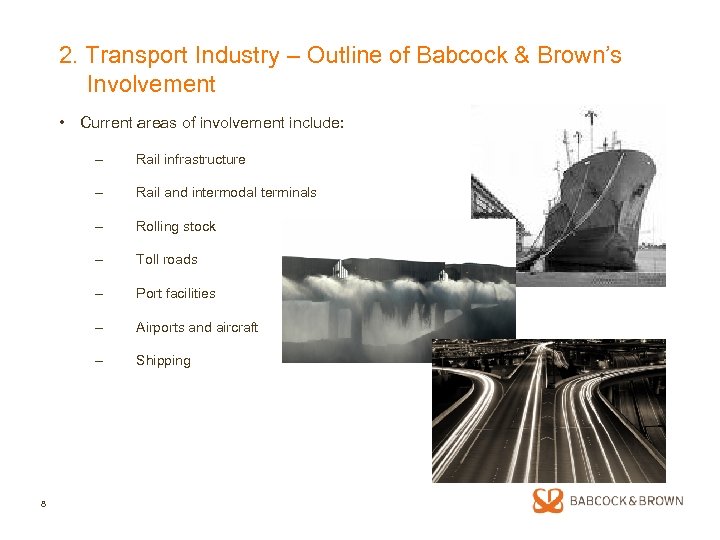 2. Transport Industry – Outline of Babcock & Brown’s Involvement • Current areas of involvement include: – – Rail and intermodal terminals – Rolling stock – Toll roads – Port facilities – Airports and aircraft – 8 Rail infrastructure Shipping
 2. Transport Industry – Outline of Babcock & Brown’s Involvement – Selected Examples • Rail Infrastructure – West. Net Rail in Western Australia – Greenfield rail infrastructure assets • Rail & Intermodal Terminals – Cross Rail AG (Italy and Switzerland) – WCT (Belgium – one of largest inland container terminals in Europe) – Rail Storage Terminal in North America (Under negotiation) • Rolling Stock – – CB Rail & Euro Rail (UK and Europe) – NSW Rolling Stock PPP (sponsor, equity investor & financial advisor) – 9 Babcock & Brown Rail Management (North America) Advisor/arranger for clients around the world including BHP, BNSF, Rail. Corp, QR, RATP, Amtrak, Virgin Rail, etc.
 2. Transport Industry – Outline of Babcock & Brown’s Involvement – Selected Examples • Toll Roads, Airports and Aircraft – North South Bypass Tunnel Project (Brisbane) – Newly established North American team – Small European airport – Babcock & Brown Aircraft Management • Port Facilities – Dalrymple Bay Coal Terminal (near Mackay, Queensland) – PD Ports • Shipping – 10 Advisory and arranging business based in London
 Agenda 1. Overview of Babcock & Brown 2. Transport Industry – Outline of Babcock & Brown’s Involvement 3. Why Invest in Transport Infrastructure? 4. Latest Trends – Investment in Transport Infrastructure 5. Conclusion 11
 3. Why Invest in Transport Infrastructure? • Background – Some of the earliest private sector investment in Australian ‘infrastructure’ involved the transport industry due to the ‘economic’ nature of select components, ‘visible’ need for investment and vote winner! Similar trend now occurring in North America – Began with BOT/BOOT types schemes privatization PPP/PFI type structures secondary market investment (greenfield projects throughout) – Originally focused on toll roads and airports. Expanded to ports, railways and associated facilities 12
 3. Why Invest in Transport Infrastructure? (cont’d. ) • Demand Driven Investment – Basic facilities and services required to support the economic and social ‘health’ of communities i. e. ‘essential’ – Freight related transport demand typically driven by a multiple of GDP – Passenger related transport demand typically driven by population and employment growth and demographic changes – Private sector financing involvement driven by various factors including: Ø government budgetary constraints (infrastructure investment as a proportion of GDP has steadily declined since 1985 across the globe) and greater focus on social infrastructure and defence Ø desire for risk transfer and access to alternative forms of management Ø super/pension funds seeking longer term assets to match longer term and growing super/pension liabilities Ø development of investors such as Babcock & Brown 13
 3. Why Invest in Transport Infrastructure? (cont’d. ) • ‘Attraction’ of Transport Infrastructure Investment Attractive features include the following in no particular order: – Essential infrastructure, typically with strong barriers to entry. Customers often invest significantly in connecting/related infrastructure -> continued usage and hence cashflow – Generally source of stable and predictable cashflows and/or asset values with growth potential -> ability to apply financial engineering techniques and offer cost of capital advantage – Typically, capital intensive assets & capacity/congestion issues -> provide ongoing financing opportunities – For Babcock & Brown, the ability to enhance assets/businesses and mitigate risks using in-house specialist resources and ‘cross-fertilisation’ of ideas -> greater returns 14
 3. Why Invest in Transport Infrastructure? (cont’d. ) – Consistent drivers of growth eg. GDP, inflation and population -> easier to forecast cashflows – In respect of rail freight, expected greater use as a means of transport globally over the longer term due to economic, environmental and social benefits -> support underlying cashflows – Typically long asset lives -> facilitate ‘financial engineering’ and match super/pension fund requirements – – 15 Generally manageable operational and capex risk Often ‘scalable’ businesses and significant economies of scale to be achieved
 3. Why Invest in Transport Infrastructure? (cont’d. ) • Complexities associated with Transport Infrastructure Investment The Transport industry isn’t easy, however…. – Large number and often diverse stakeholders with varying needs and wants – Varying regulatory, policy and taxation regimes (strengths and weaknesses) – investors require stability – The high capital costs and capital intensive nature of the businesses and the need to earn an appropriate return on sunk and future investment – often requires government contributions – Pricing issues across modes – In Australia, the small (and ever decreasing) number of operators and overall market size 16
 3. Why Invest in Transport Infrastructure? (cont’d. ) – Time and cost of bids – Mix of government and private sector ownership and control and varying political acceptance of PPP type arrangements and privatisation – Increasing security requirements and technological change – Relative ‘newness’ of select industry components as an investment asset class eg. rail infrastructure – Highly ‘visible’ nature of many of the projects/businesses and implications for industry and other stakeholders if forecast demand isn’t met 17
 Agenda 1. Overview of Babcock & Brown 2. Transport Industry – Outline of Babcock & Brown’s Involvement 3. Why Invest in Transport Infrastructure? 4. Latest Trends – Investment in Transport Infrastructure 5. Conclusion 18
 4. Latest Trends - Investment in Transport Infrastructure • The latest trends in Transport Infrastructure investment include in no particular order: – Decreasing returns as investment community ‘appetite’ increases and various components of the industry ‘mature’ – change if forecasts aren’t met, appropriate risk transfer isn’t achieved ? – Vertical and horizontal integration, and expansion geographically to create economies of scale and heighten monopoly positions so as to improve return levels – Increasing flow of Australian ‘deal-doing’ experience (and hence funds) to places such as North America where in many sectors (but definitely not all) the industry is less ‘mature’ in its financing 19
 4. Latest Trends - Investment in Transport Infrastructure (cont’d. ) – Greater use of private sector finance in all aspects of industry due to factors including budgetary constraints, congestion/capacity issues (eg arising from the ‘China effect’), user pay policy etc. – However, there also ever increasing jurisdictions (developed and emerging economies) and industries competing for capital, hence the risk/return must be competitive to secure the funds – Increasing focus on operational cashflow supporting yield rather than features such as asset revaluations – 20 Increasing size of deals
 Agenda 1. Overview of Babcock & Brown 2. Transport Industry – Outline of Babcock & Brown’s Involvement 3. Why Invest in Transport Infrastructure? 4. Latest Trends – Investment in Transport Infrastructure 5. Conclusion 21
 5. Conclusion • Babcock & Brown is a major participant in the transport industry and aims to increase its involvement substantially i. e. we have $ seeking deals! • Private investment in the transport industry overall is increasing both in size and across sub-components. This is forecast to continue as demand for transport infrastructure (new, expanded and refurbished) continues and governments focus more on social infrastructure and defence • Whilst transport infrastructure investment is increasingly popular by the private sector, it isn’t necessarily easy eg. Alice Springs Darwin Railway and Cross City Tunnel • Increasing flow of Australian ‘deal doing’ experience (and hence funds) offshore where in many sectors the industry is less ‘mature’ in its financing and market size is larger • Deal sizes are increasing but generally returns are decreasing – change if investors view of risk changes ? Encourage even more innovative financing and focus on achieving economies of scale & add-on opportunities 22
 Thank you