


 Скачать презентацию Investigations of Cd Te and Cd Zn Te crystals
a254b8811c2c956910bacae4f7dfc580.ppt
- Количество слайдов: 27
 Investigations of Cd. Te and (Cd, Zn)Te crystals grown by the Bridgman method M. Fiederle, A. Fauler, V. Babentsov, J. Franc, J. Ludwig, K. W. Benz Freiburger Materialforschungszentrum FMF Albert-Ludwigs-Universität Stefan-Meier-Straße 21, D-79104 Freiburg www. 2 -6. uni-freiburg. de; Email: michael. fiederle@fmf. uni-freiburg. de • growth of 25 and 75 mm Cd. Te • defects and compensation • material properties and detector performance Freiburger Materialforschungszentrum FMF M. Fiederle
 Why is doping of Cd. Te/(Cd, Zn)Te necessary? • there are three posibilities to obtain high resistivity: – intrinsic material (problem of shallow impurities) – shallow compensation (problem of stability) • Cl, In, . . . – three level compensation • deep intrinsic defect (Te. Cd, VCd, ? ? ) • deep donor – V, Ge, Fe, . . . (problem of deep traps) • doping is mandatory to obtain high resistivity! Freiburger Materialforschungszentrum FMF M. Fiederle
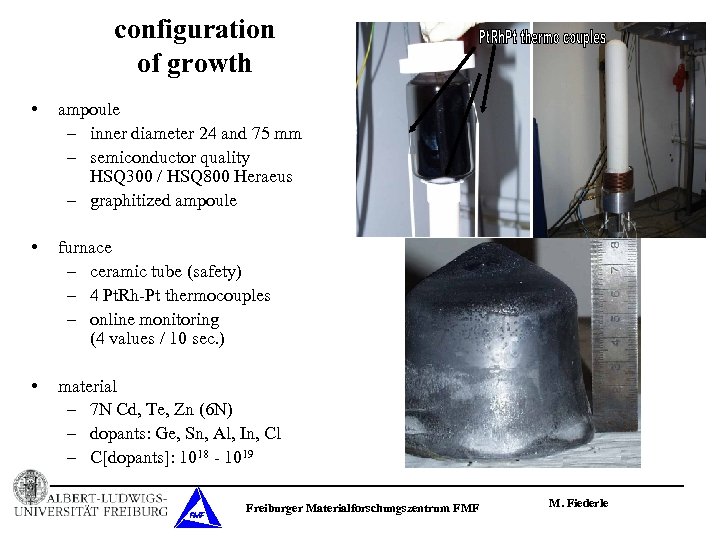 configuration of growth • ampoule – inner diameter 24 and 75 mm – semiconductor quality HSQ 300 / HSQ 800 Heraeus – graphitized ampoule • furnace – ceramic tube (safety) – 4 Pt. Rh-Pt thermocouples – online monitoring (4 values / 10 sec. ) • material – 7 N Cd, Te, Zn (6 N) – dopants: Ge, Sn, Al, In, Cl – C[dopants]: 1018 - 1019 Freiburger Materialforschungszentrum FMF M. Fiederle
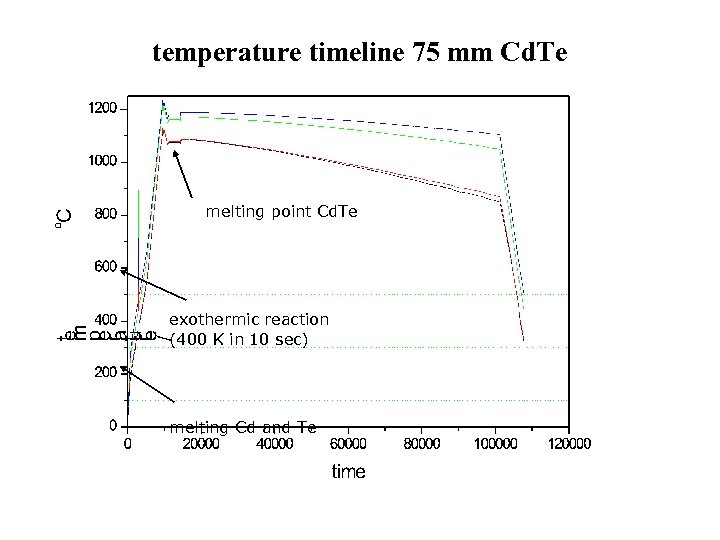 temperature timeline 75 mm Cd. Te melting point Cd. Te exothermic reaction (400 K in 10 sec) melting Cd and Te Freiburger Materialforschungszentrum FMF M. Fiederle
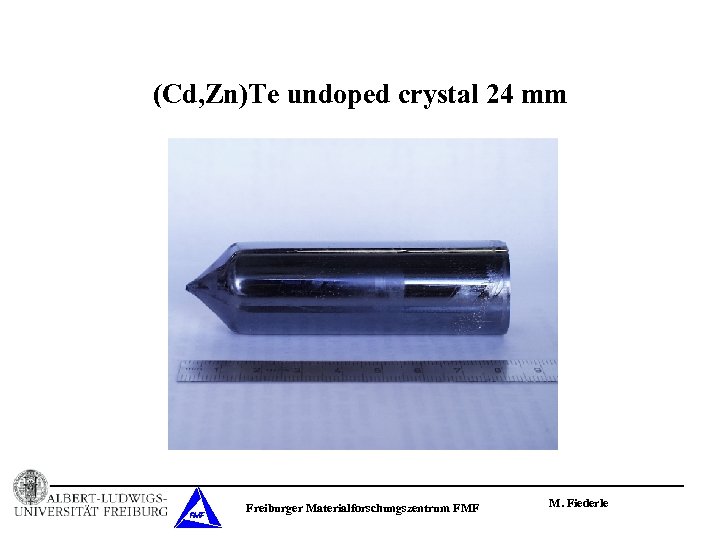 (Cd, Zn)Te undoped crystal 24 mm Freiburger Materialforschungszentrum FMF M. Fiederle
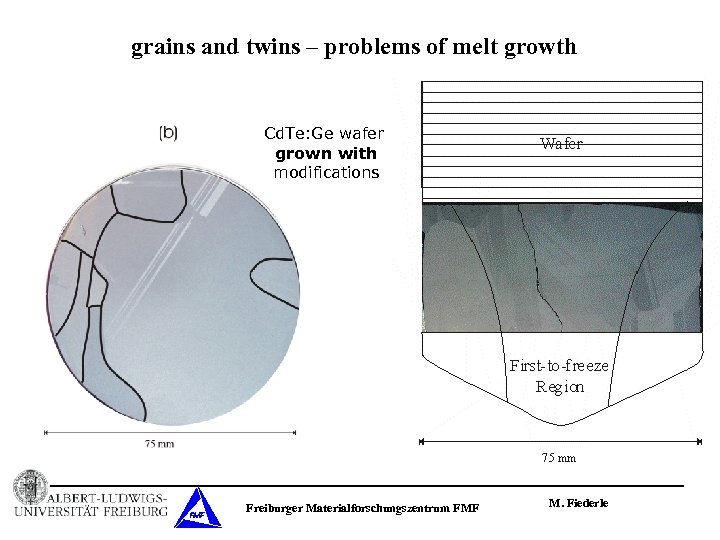 grains and twins – problems of melt growth Cd. Te: Ge wafer grown with modifications Freiburger Materialforschungszentrum FMF M. Fiederle
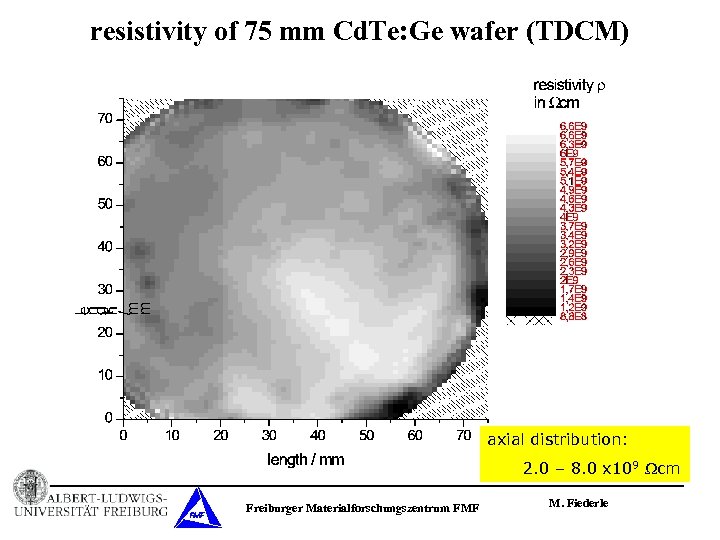 resistivity of 75 mm Cd. Te: Ge wafer (TDCM) axial distribution: 2. 0 – 8. 0 x 109 Wcm Freiburger Materialforschungszentrum FMF M. Fiederle
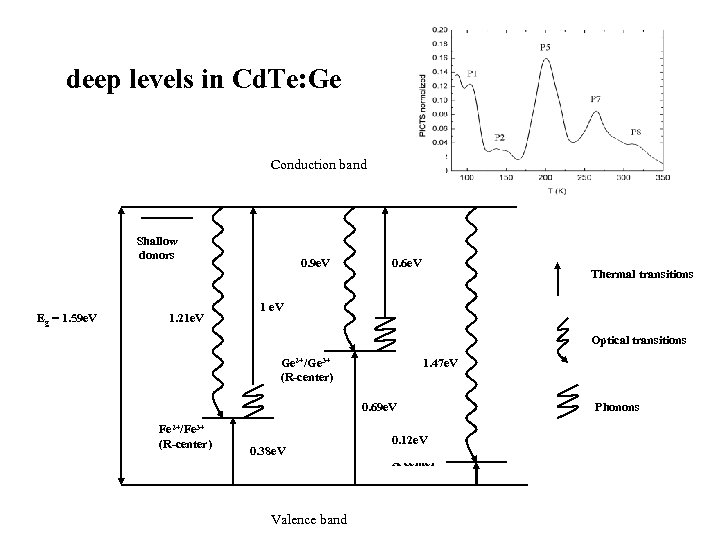
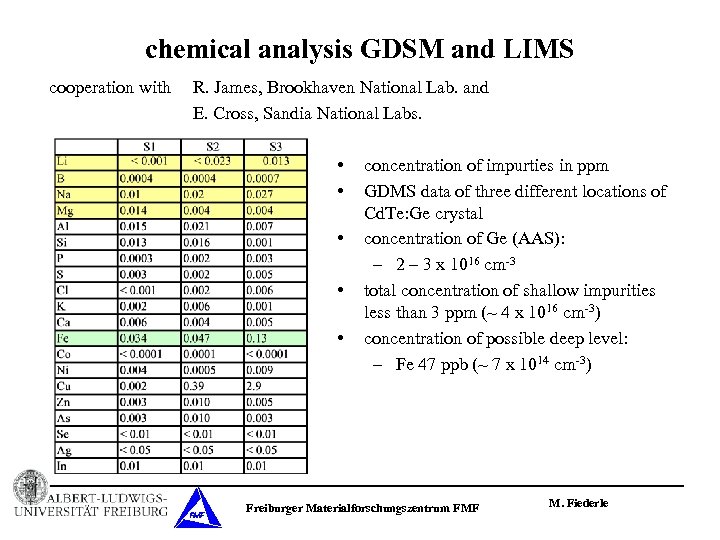 chemical analysis GDSM and LIMS cooperation with R. James, Brookhaven National Lab. and E. Cross, Sandia National Labs. • • • concentration of impurties in ppm GDMS data of three different locations of Cd. Te: Ge crystal concentration of Ge (AAS): – 2 – 3 x 1016 cm-3 total concentration of shallow impurities less than 3 ppm (~ 4 x 1016 cm-3) concentration of possible deep level: – Fe 47 ppb (~ 7 x 1014 cm-3) Freiburger Materialforschungszentrum FMF M. Fiederle
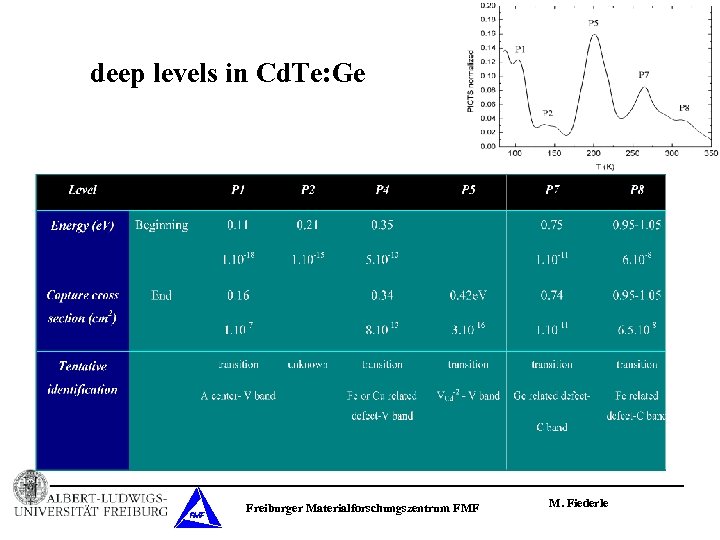 deep levels in Cd. Te: Ge Freiburger Materialforschungszentrum FMF M. Fiederle
 Freiburger Materialforschungszentrum FMF M. Fiederle
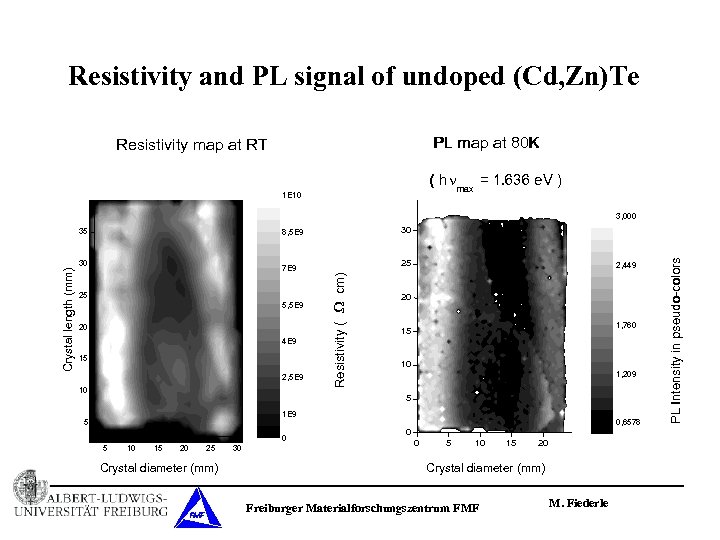 Resistivity and PL signal of undoped (Cd, Zn)Te PL map at 80 K Resistivity map at RT ( h nmax = 1. 636 e. V ) 1 E 10 3, 000 7 E 9 25 5, 5 E 9 20 4 E 9 15 2, 5 E 9 10 25 Resistivity ( W cm) 30 Crystal length (mm) 30 8, 5 E 9 2, 449 20 1, 760 15 10 1, 209 5 1 E 9 5 0 5 10 15 20 25 Crystal diameter (mm) 30 0, 6578 0 0 5 10 15 20 Crystal diameter (mm) Freiburger Materialforschungszentrum FMF M. Fiederle PL Intensity in pseudo-colors 35
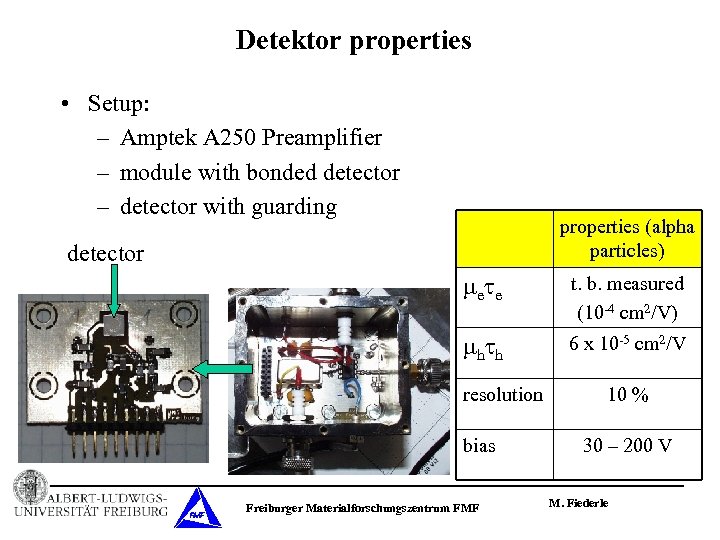 Detektor properties • Setup: – Amptek A 250 Preamplifier – module with bonded detector – detector with guarding properties (alpha particles) detector me t e t. b. measured (10 -4 cm 2/V) m ht h 6 x 10 -5 cm 2/V resolution bias Freiburger Materialforschungszentrum FMF 10 % 30 – 200 V M. Fiederle
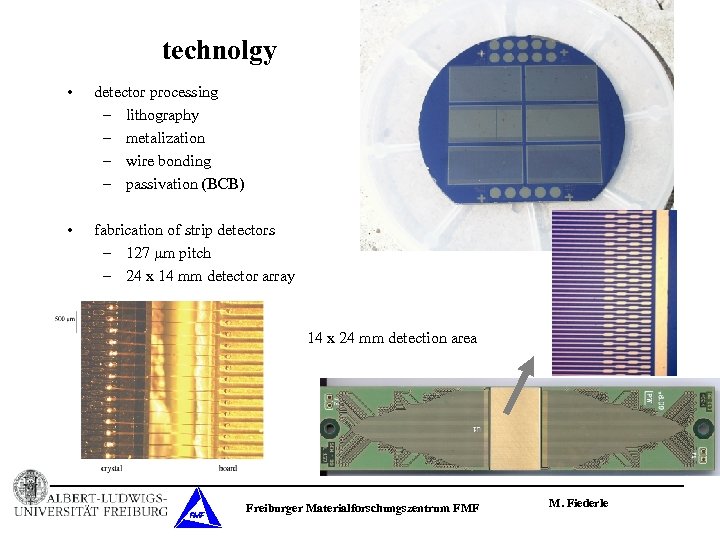 technolgy • detector processing – lithography – metalization – wire bonding – passivation (BCB) • fabrication of strip detectors – 127 µm pitch – 24 x 14 mm detector array 14 x 24 mm detection area Freiburger Materialforschungszentrum FMF M. Fiederle
![Photocurrent a. u. X-ray analysis of a copper-cable ( 500 µm diameter) X [mm]](https://present5.com/presentation/a254b8811c2c956910bacae4f7dfc580/image-14.jpg "Photocurrent a. u. X-ray analysis of a copper-cable ( 500 µm diameter) X [mm]") Photocurrent a. u. X-ray analysis of a copper-cable ( 500 µm diameter) X [mm] ©Sikora Industrieelektronik Gmb. H Freiburger Materialforschungszentrum FMF M. Fiederle
Photocurrent a. u. X-ray analysis of a copper-cable ( 500 µm diameter) X [mm] ©Sikora Industrieelektronik Gmb. H Freiburger Materialforschungszentrum FMF M. Fiederle
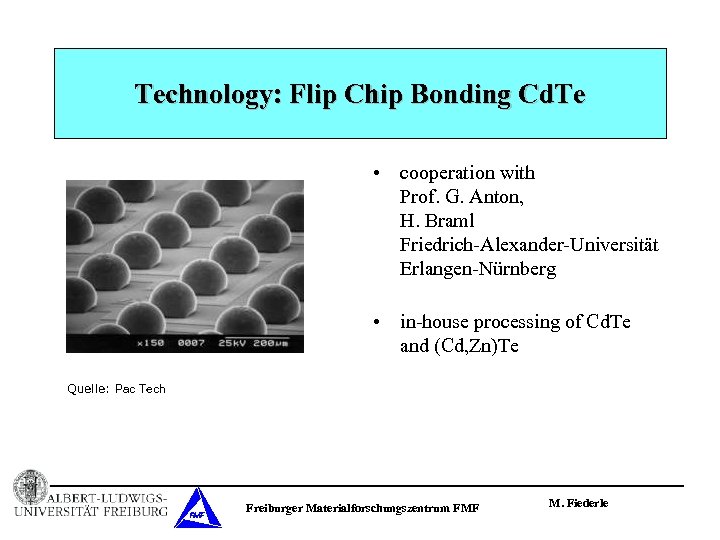 Technology: Flip Chip Bonding Cd. Te • cooperation with Prof. G. Anton, H. Braml Friedrich-Alexander-Universität Erlangen-Nürnberg • in-house processing of Cd. Te and (Cd, Zn)Te Quelle: Pac Tech Freiburger Materialforschungszentrum FMF M. Fiederle
 Technology: Flip Chip Bonding Cd. Te • technology: Solder bumps • material: Pb. Sn and In • processing: Electroplating (Cu+Pb. Sn) Deposition (Indium) • backend: manual Flip-Chip-Bonding Freiburger Materialforschungszentrum FMF M. Fiederle
 Summary • successful growth of 75 mm and 24 mm Cd. Te and (Cd, Zn)Te – large single crystalline areas • high resistivity material (>5 x 10⁹ Wcm) – successful compensation by • deep donor Ge, Sn and undoped (Cd, Zn)Te – homogeneous distribution of material properties – deep levels correlated with Ge, Fe and Cu were detected • detector performance suffient – reduction of impurities / dopants necessary • successful detector technology – pixel detectors under developing Freiburger Materialforschungszentrum FMF Acknowledgement: • European Space Agency – MAP programm • Humboldt Stiftung M. Fiederle
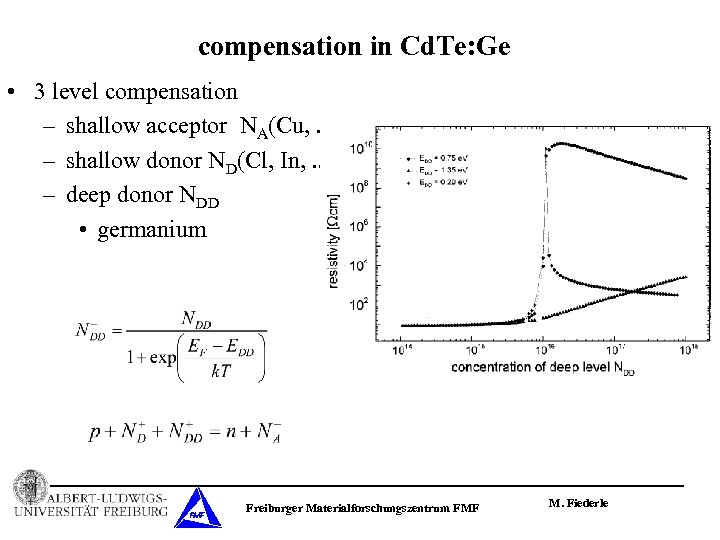
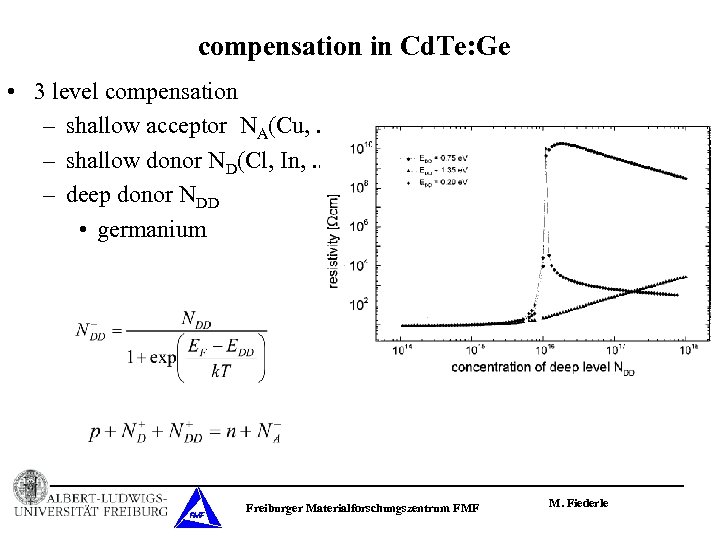 compensation in Cd. Te: Ge • 3 level compensation – shallow acceptor NA(Cu, . . . ) – shallow donor ND(Cl, In, . . ) – deep donor NDD • germanium Freiburger Materialforschungszentrum FMF M. Fiederle
 compensation in Cd. Te: Ge • 3 level compensation – shallow acceptor NA(Cu, . . . ) – shallow donor ND(Cl, In, . . ) – deep donor NDD • germanium Freiburger Materialforschungszentrum FMF M. Fiederle
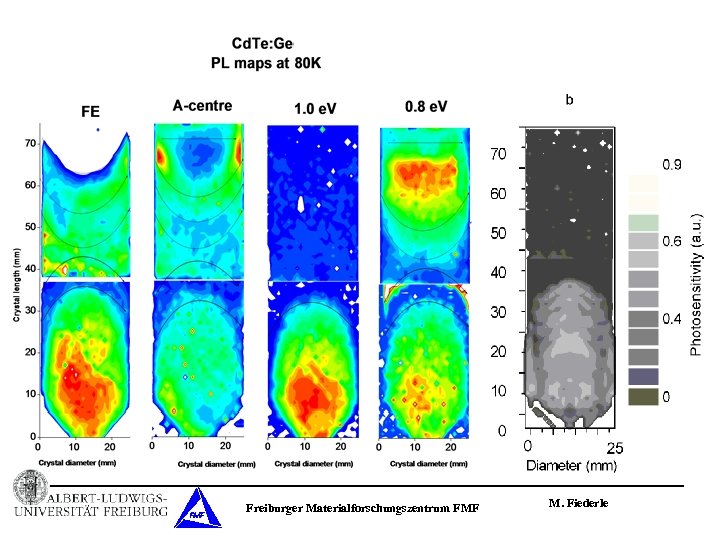
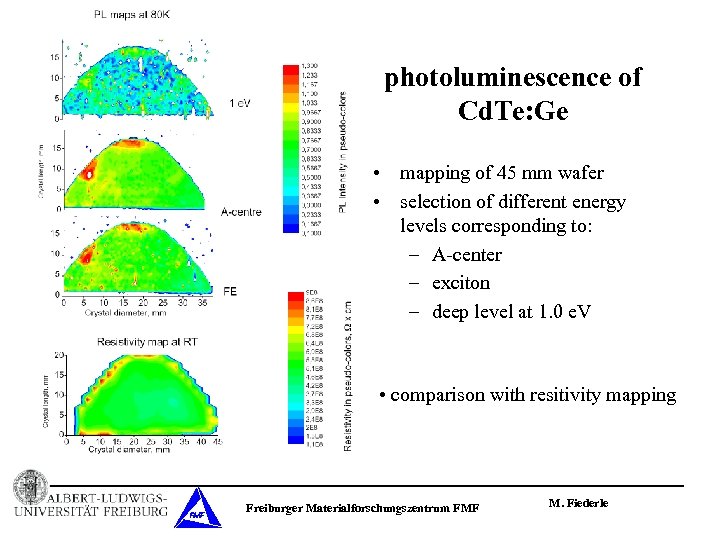 photoluminescence of Cd. Te: Ge • mapping of 45 mm wafer • selection of different energy levels corresponding to: – A-center – exciton – deep level at 1. 0 e. V • comparison with resitivity mapping Freiburger Materialforschungszentrum FMF M. Fiederle
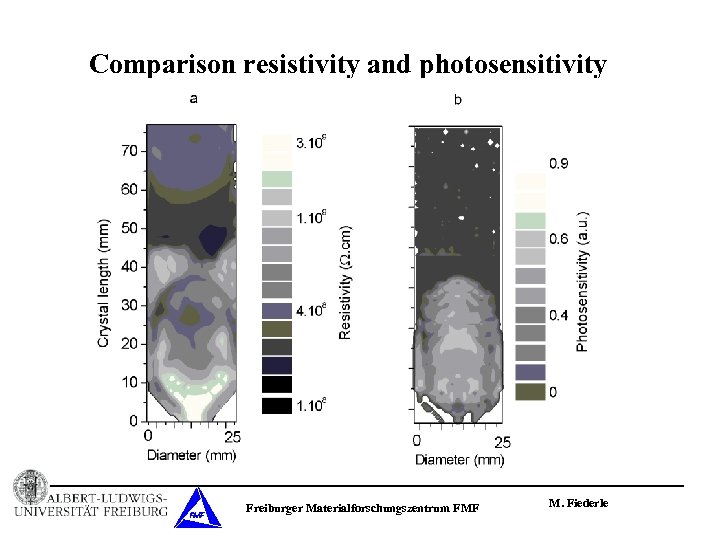 Comparison resistivity and photosensitivity Freiburger Materialforschungszentrum FMF M. Fiederle
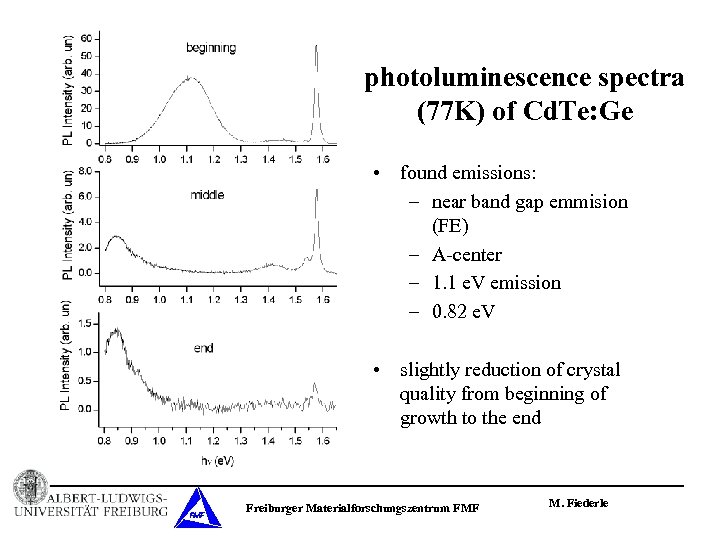 photoluminescence spectra (77 K) of Cd. Te: Ge • found emissions: – near band gap emmision (FE) – A-center – 1. 1 e. V emission – 0. 82 e. V • slightly reduction of crystal quality from beginning of growth to the end Freiburger Materialforschungszentrum FMF M. Fiederle
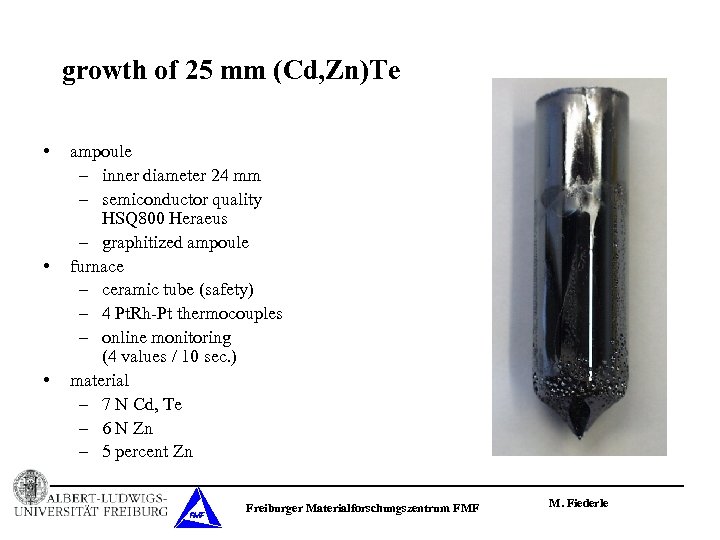 growth of 25 mm (Cd, Zn)Te • • • ampoule – inner diameter 24 mm – semiconductor quality HSQ 800 Heraeus – graphitized ampoule furnace – ceramic tube (safety) – 4 Pt. Rh-Pt thermocouples – online monitoring (4 values / 10 sec. ) material – 7 N Cd, Te – 6 N Zn – 5 percent Zn Freiburger Materialforschungszentrum FMF M. Fiederle
 Freiburger Materialforschungszentrum FMF M. Fiederle
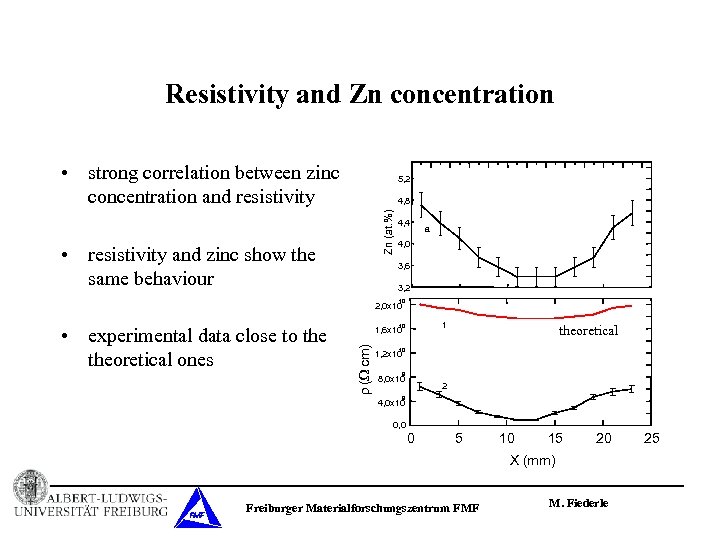 Resistivity and Zn concentration • strong correlation between zinc concentration and resistivity 5, 2 Zn (at. %) 4, 8 • resistivity and zinc show the same behaviour 4, 4 a 4, 0 3, 6 3, 2 10 2, 0 x 10 r (W cm) • experimental data close to theoretical ones 1 10 1, 6 x 10 theoretical 10 1, 2 x 10 9 8, 0 x 10 2 9 4, 0 x 10 0, 0 0 5 10 15 20 X (mm) Freiburger Materialforschungszentrum FMF M. Fiederle 25
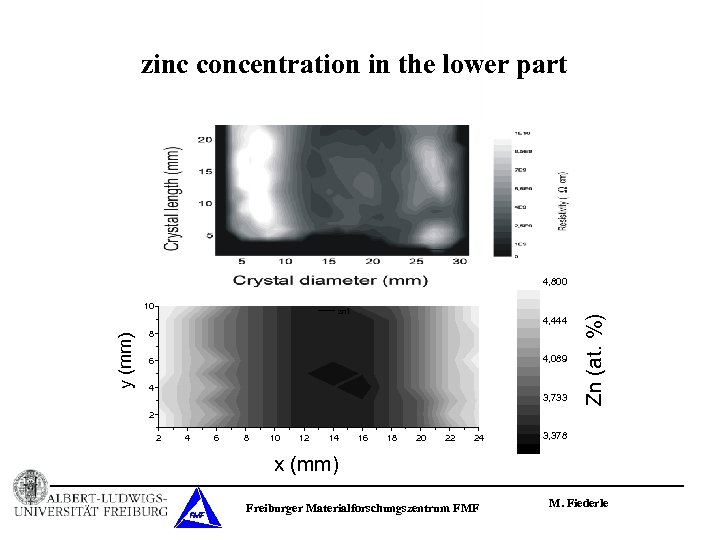 zinc concentration in the lower part y (mm) 10 zn 1 4, 444 8 4, 089 6 4 3, 733 Zn (at. %) 4, 800 2 2 4 6 8 10 12 14 16 18 20 22 24 3, 378 x (mm) Freiburger Materialforschungszentrum FMF M. Fiederle
 deep levels in Cd. Te: Ge Conduction band Shallow donors Eg = 1. 59 e. V 1. 21 e. V 0. 9 e. V 0. 6 e. V Thermal transitions 1 e. V Optical transitions 1. 47 e. V Ge 2+/Ge 3+ (R-center) 0. 69 e. V Fe 2+/Fe 3+ (R-center) 0. 38 e. V 0. 12 e. V A center Freiburger Materialforschungszentrum FMF Valence band Phonons M. Fiederle