


 Скачать презентацию Investigation of C-14 in the CRUD collected on
4ecc11182b54a9dcddc1aed472192565.ppt
- Количество слайдов: 12
 Investigation of C-14 in the CRUD collected on the coolant filter for safety disposal of radioactive waste containing C-14 (II) – Chemical alteration of ion exchange resin under simulated condition in primary coolant of PWR – Nakata K. a)*, Hironaga M. a), Minato D. a), Kino K. b), Sakashita A. c), Takao K. d), Sakakihara T. e) a) b) c) d) e) Central Research Institute of Electric Power Industry (CRIEPI) Nuclear Development Mitsubishi Heavy Indstries Tokyo Institute of Technology Shikoku Electric Power Co. INC. 1
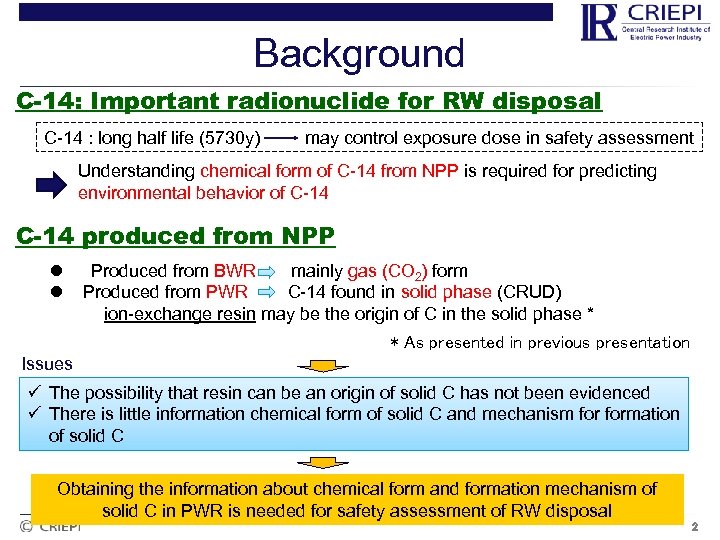 Background C-14: Important radionuclide for RW disposal C-14 : long half life (5730 y) may control exposure dose in safety assessment Understanding chemical form of C-14 from NPP is required for predicting environmental behavior of C-14 produced from NPP l Produced from BWR mainly gas (CO 2) form l Produced from PWR C-14 found in solid phase (CRUD) ion-exchange resin may be the origin of C in the solid phase * * As presented in previous presentation Issues ü The possibility that resin can be an origin of solid C has not been evidenced ü There is little information chemical form of solid C and mechanism formation of solid C Obtaining the information about chemical form and formation mechanism of solid C in PWR is needed for safety assessment of RW disposal 2
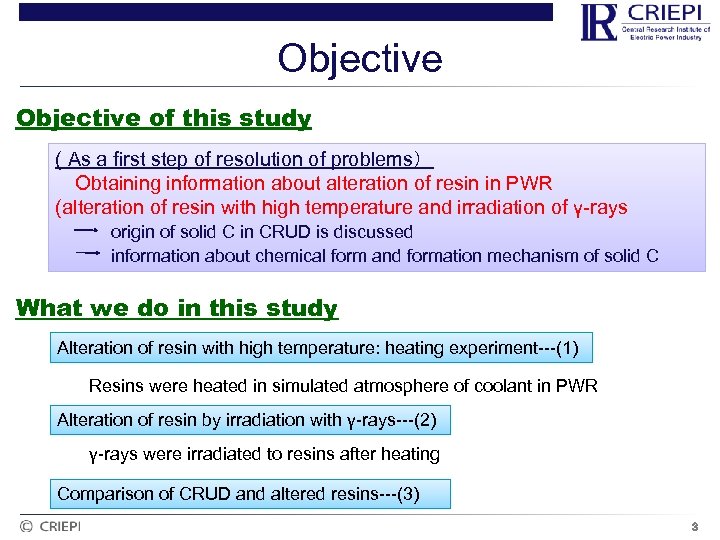 Objective of this study ( As a first step of resolution of problems) Obtaining information about alteration of resin in PWR (alteration of resin with high temperature and irradiation of γ-rays origin of solid C in CRUD is discussed information about chemical form and formation mechanism of solid C What we do in this study Alteration of resin with high temperature: heating experiment---(1) Resins were heated in simulated atmosphere of coolant in PWR Alteration of resin by irradiation with γ-rays---(2) γ-rays were irradiated to resins after heating Comparison of CRUD and altered resins---(3) 3
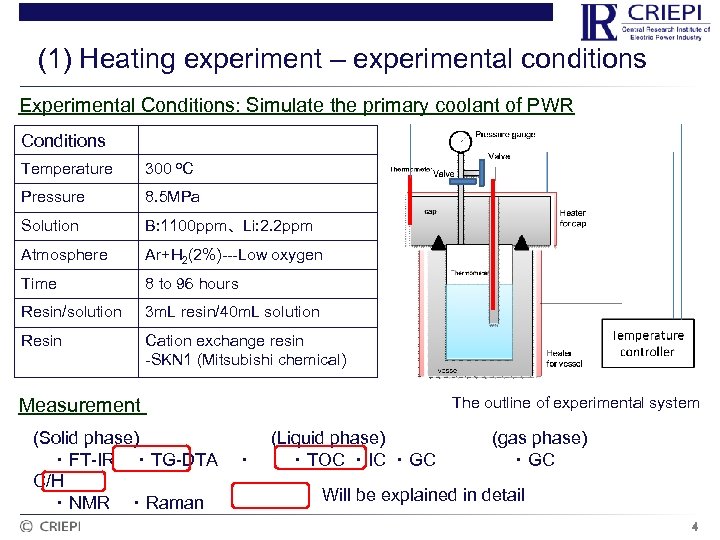 (1) Heating experiment – experimental conditions Experimental Conditions: Simulate the primary coolant of PWR Conditions Temperature 300 o. C Pressure 8. 5 MPa Solution B: 1100 ppm、Li: 2. 2 ppm Atmosphere Ar+H 2(2%)---Low oxygen Time 8 to 96 hours Resin/solution 3 m. L resin/40 m. L solution Resin Cation exchange resin -SKN 1 (Mitsubishi chemical) Measurement The outline of experimental system (Solid phase) (Liquid phase) (gas phase) ・FT-IR ・TG-DTA ・ ・TOC ・IC ・GC C/H Will be explained in detail ・NMR ・Raman 4
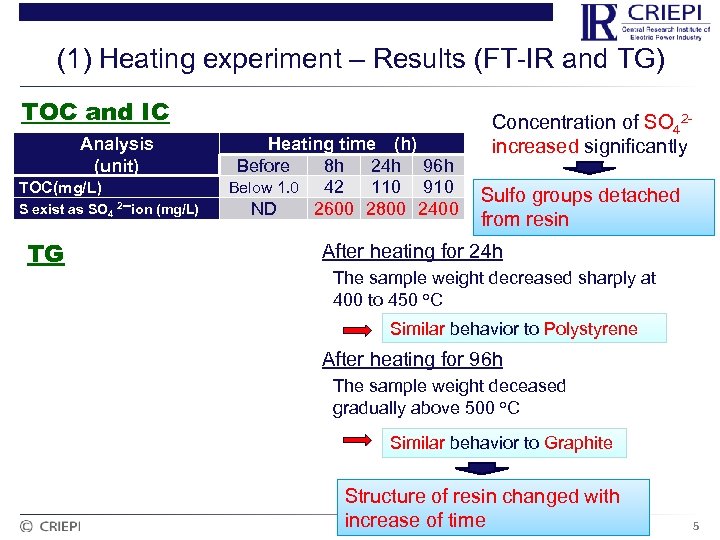 (1) Heating experiment – Results (FT-IR and TG) TOC and IC Analysis (unit) TOC(mg/L) S exist as SO 4 2-ion (mg/L) TG Heating time (h) Before 8 h 24 h 96 h Below 1. 0 42 110 910 ND 2600 2800 2400 Concentration of SO 42 increased significantly Sulfo groups detached from resin After heating for 24 h The sample weight decreased sharply at 400 to 450 o. C Similar behavior to Polystyrene After heating for 96 h The sample weight deceased gradually above 500 o. C Similar behavior to Graphite Structure of resin changed with increase of time 5
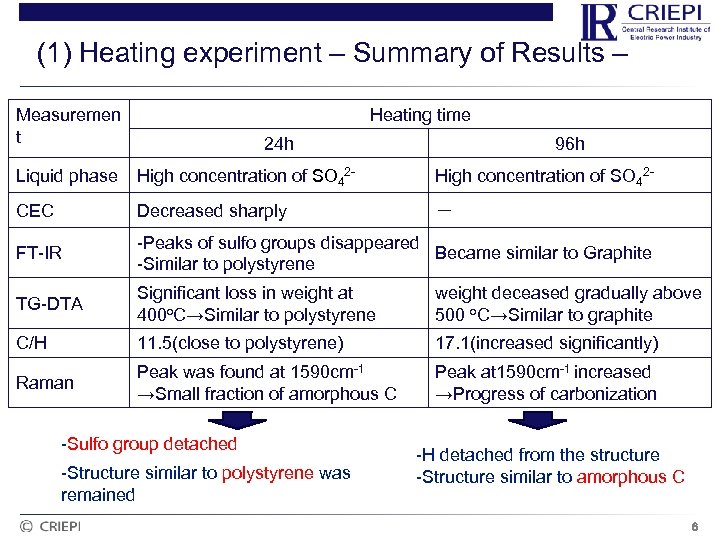 (1) Heating experiment – Summary of Results – Measuremen t Heating time 24 h 96 h Liquid phase High concentration of SO 42 - CEC Decreased sharply - FT-IR -Peaks of sulfo groups disappeared Became similar to Graphite -Similar to polystyrene TG-DTA Significant loss in weight at 400 o. C→Similar to polystyrene weight deceased gradually above 500 o. C→Similar to graphite C/H 11. 5(close to polystyrene) 17. 1(increased significantly) Raman Peak was found at 1590 cm-1 →Small fraction of amorphous C Peak at 1590 cm-1 increased →Progress of carbonization -Sulfo group detached -Structure similar to polystyrene was remained -H detached from the structure -Structure similar to amorphous C 6
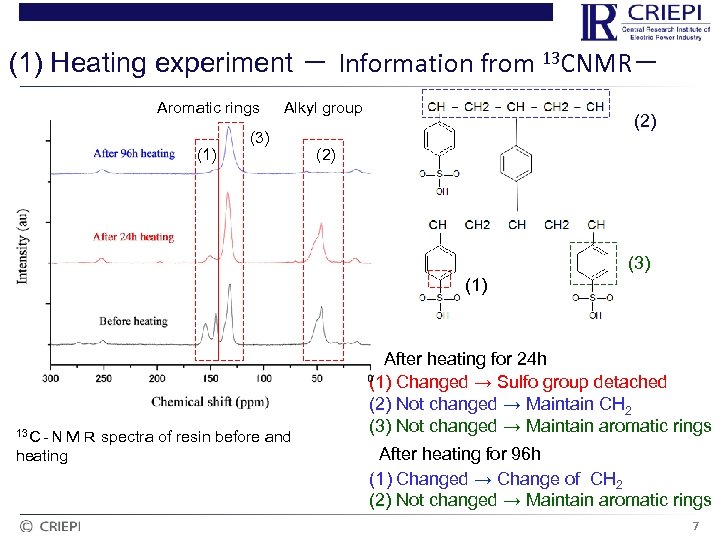 (1) Heating experiment - Information from 13 CNMR- Aromatic rings (1) Alkyl group (3) (2) (3) (1) 13C-NMR heating spectra of resin before and After heating for 24 h (1) Changed → Sulfo group detached (2) Not changed → Maintain CH 2 (3) Not changed → Maintain aromatic rings After heating for 96 h (1) Changed → Change of CH 2 (2) Not changed → Maintain aromatic rings 7
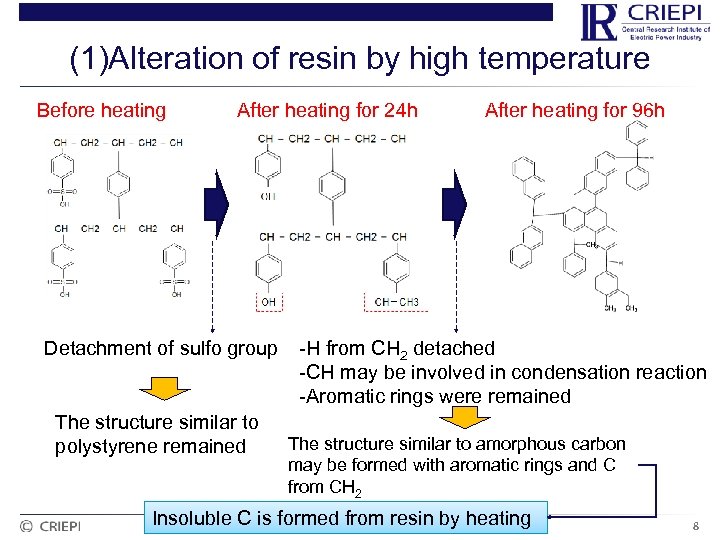 (1)Alteration of resin by high temperature Before heating After heating for 24 h Detachment of sulfo group The structure similar to polystyrene remained After heating for 96 h -H from CH 2 detached -CH may be involved in condensation reaction -Aromatic rings were remained The structure similar to amorphous carbon may be formed with aromatic rings and C from CH 2 Insoluble C is formed from resin by heating 8
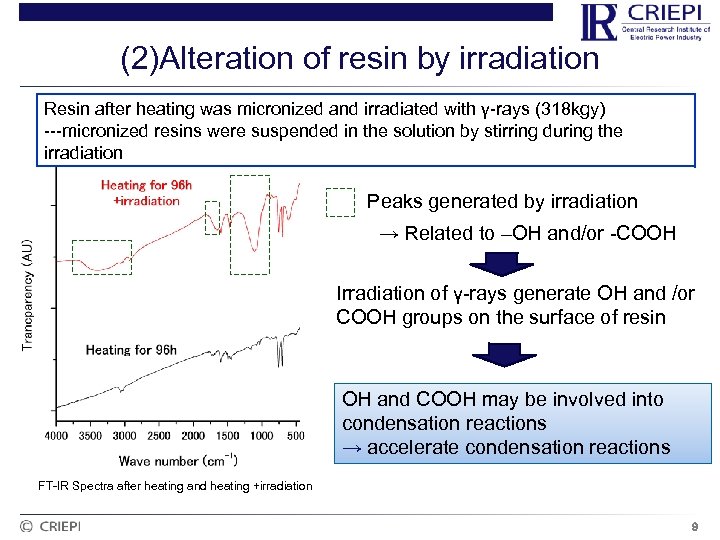 (2)Alteration of resin by irradiation Resin after heating was micronized and irradiated with γ-rays (318 kgy) ---micronized resins were suspended in the solution by stirring during the irradiation Peaks generated by irradiation → Related to –OH and/or -COOH Irradiation of γ-rays generate OH and /or COOH groups on the surface of resin OH and COOH may be involved into condensation reactions → accelerate condensation reactions FT-IR Spectra after heating and heating +irradiation 9
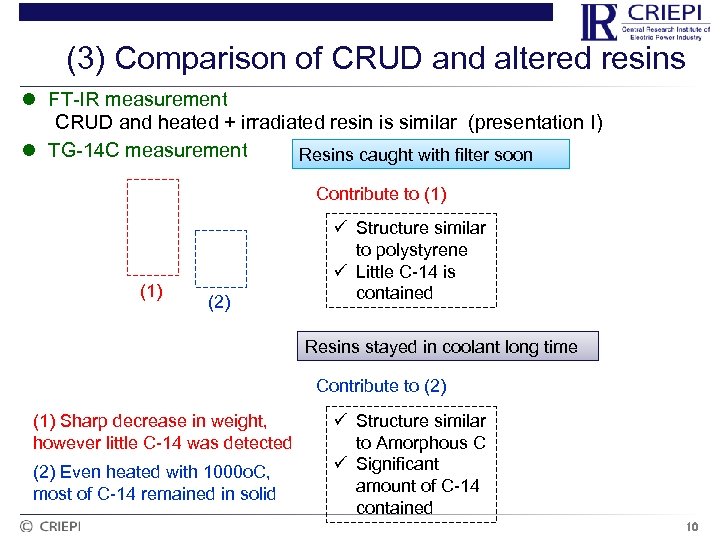 (3) Comparison of CRUD and altered resins l FT-IR measurement CRUD and heated + irradiated resin is similar (presentation I) l TG-14 C measurement Resins caught with filter soon Contribute to (1) (2) ü Structure similar to polystyrene ü Little C-14 is contained Resins stayed in coolant long time Contribute to (2) (1) Sharp decrease in weight, however little C-14 was detected (2) Even heated with 1000 o. C, most of C-14 remained in solid ü Structure similar to Amorphous C ü Significant amount of C-14 contained 10
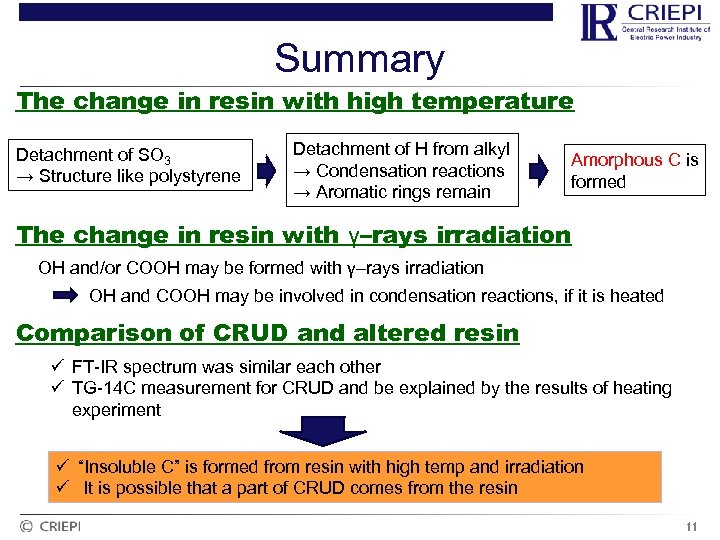 Summary The change in resin with high temperature Detachment of SO 3 → Structure like polystyrene Detachment of H from alkyl → Condensation reactions → Aromatic rings remain Amorphous C is formed The change in resin with γ–rays irradiation OH and/or COOH may be formed with γ–rays irradiation OH and COOH may be involved in condensation reactions, if it is heated Comparison of CRUD and altered resin ü FT-IR spectrum was similar each other ü TG-14 C measurement for CRUD and be explained by the results of heating experiment ü “Insoluble C” is formed from resin with high temp and irradiation ü It is possible that a part of CRUD comes from the resin 11
 Acknowledgements We would like to appreciate u. For helpful and insightful advices Prof. Ishigure (Univ. of Tokyo) Prof. Ikeda, Associate Prof. Tsukahara (Tokyo Institute of Technology) u. For help in irradiation experiment Mr. Yoda (Tokyo Institute of Technology) 12