 Скачать презентацию Investigation of Bubble Formation in Tuohy-Borst Adaptors The
7724f8b28d786455f99ae283f905b149.ppt
- Количество слайдов: 1



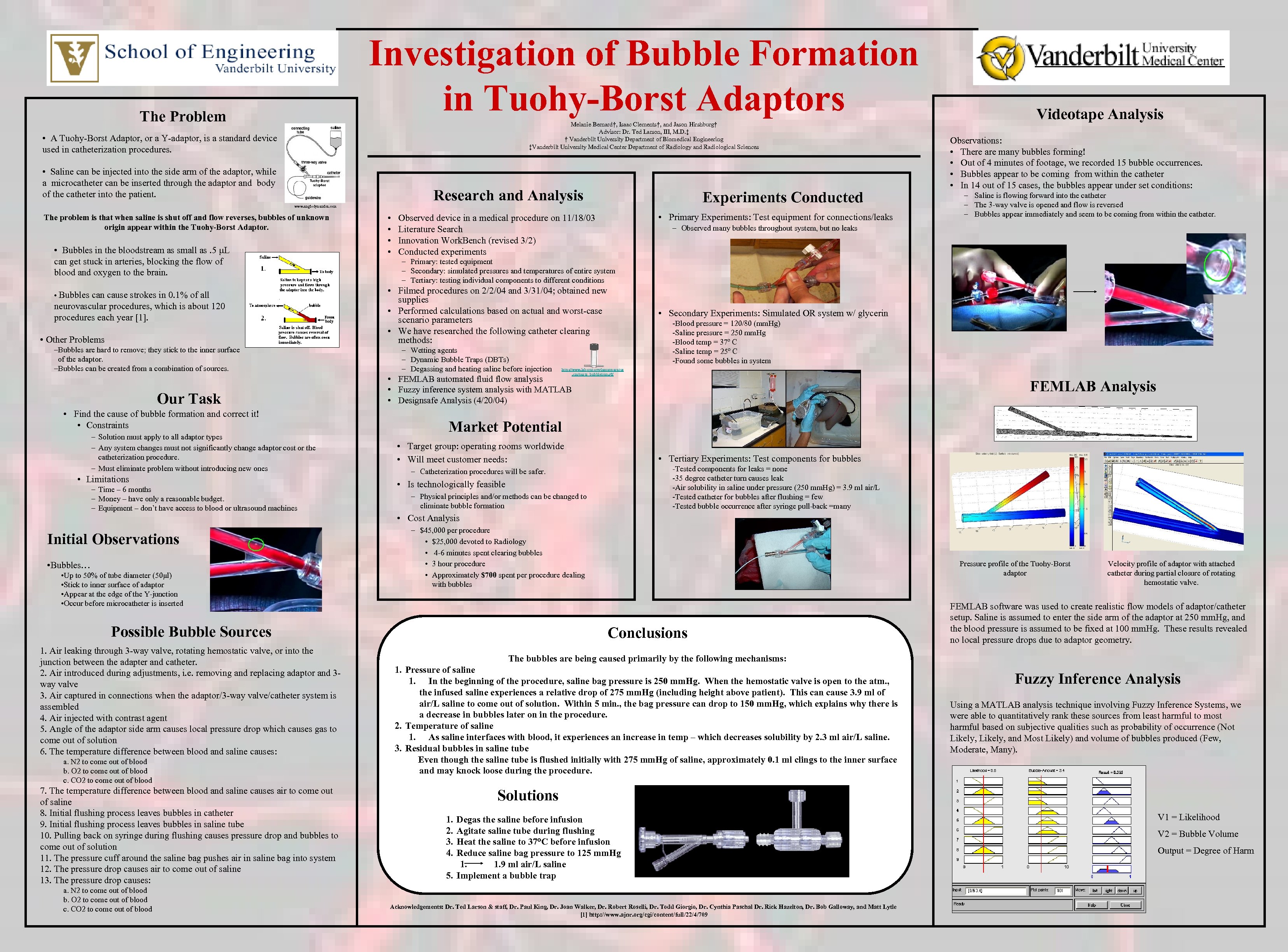
Investigation of Bubble Formation in Tuohy-Borst Adaptors The Problem Melanie Bernard†, Isaac Clements†, and Jason Hirshburg† Advisor: Dr. Ted Larson, III, M. D. ‡ † Vanderbilt University Department of Biomedical Engineering ‡Vanderbilt University Medical Center Department of Radiology and Radiological Sciences • A Tuohy-Borst Adaptor, or a Y-adaptor, is a standard device used in catheterization procedures. • Saline can be injected into the side arm of the adaptor, while a microcatheter can be inserted through the adaptor and body of the catheter into the patient. Research and Analysis Experiments Conducted www. angiodynamics. com The problem is that when saline is shut off and flow reverses, bubbles of unknown origin appear within the Tuohy-Borst Adaptor. • Bubbles in the bloodstream as small as. 5 μL can get stuck in arteries, blocking the flow of blood and oxygen to the brain. • Bubbles can cause strokes in 0. 1% of all neurovascular procedures, which is about 120 procedures each year [1]. • Other Problems –Bubbles are hard to remove; they stick to the inner surface of the adaptor. –Bubbles can be created from a combination of sources. Our Task • Find the cause of bubble formation and correct it! • Constraints – Solution must apply to all adaptor types – Any system changes must not significantly change adaptor cost or the catheterization procedure. – Must eliminate problem without introducing new ones • Limitations – Time – 6 months – Money – have only a reasonable budget. – Equipment – don’t have access to blood or ultrasound machines • • • Primary Experiments: Test equipment for connections/leaks Observed device in a medical procedure on 11/18/03 Literature Search Innovation Work. Bench (revised 3/2) Conducted experiments Videotape Analysis Observations: • There are many bubbles forming! • Out of 4 minutes of footage, we recorded 15 bubble occurrences. • Bubbles appear to be coming from within the catheter • In 14 out of 15 cases, the bubbles appear under set conditions: – Saline is flowing forward into the catheter – The 3 -way valve is opened and flow is reversed – Bubbles appear immediately and seem to be coming from within the catheter. – Observed many bubbles throughout system, but no leaks – Primary: tested equipment – Secondary: simulated pressures and temperatures of entire system – Tertiary: testing individual components to different conditions • Filmed procedures on 2/2/04 and 3/31/04; obtained new supplies • Performed calculations based on actual and worst-case scenario parameters • We have researched the following catheter clearing methods: – Wetting agents – Dynamic Bubble Traps (DBTs) – Degassing and heating saline before injection • Secondary Experiments: Simulated OR system w/ glycerin -Blood pressure = 120/80 (mm. Hg) -Saline pressure = 250 mm. Hg -Blood temp = 37º C -Saline temp = 25º C -Found some bubbles in system http: //www. laboratoryglassapparatus. cm/parts_bubbletrap. gif • FEMLAB automated fluid flow analysis • Fuzzy inference system analysis with MATLAB • Designsafe Analysis (4/20/04) FEMLAB Analysis Market Potential • Target group: operating rooms worldwide • Will meet customer needs: • Tertiary Experiments: Test components for bubbles -Tested components for leaks = none -35 degree catheter turn causes leak -Air solubility in saline under pressure (250 mm. Hg) = 3. 9 ml air/L -Tested catheter for bubbles after flushing = few -Tested bubble occurrence after syringe pull-back =many – Catheterization procedures will be safer. • Is technologically feasible – Physical principles and/or methods can be changed to eliminate bubble formation • Cost Analysis Initial Observations • Bubbles… • Up to 50% of tube diameter (50μl) • Stick to inner surface of adaptor • Appear at the edge of the Y-junction • Occur before microcatheter is inserted – $45, 000 per procedure • $25, 000 devoted to Radiology • 4 -6 minutes spent clearing bubbles • 3 hour procedure • Approximately $700 spent per procedure dealing with bubbles Possible Bubble Sources 1. Air leaking through 3 -way valve, rotating hemostatic valve, or into the junction between the adapter and catheter. 2. Air introduced during adjustments, i. e. removing and replacing adaptor and 3 way valve 3. Air captured in connections when the adaptor/3 -way valve/catheter system is assembled 4. Air injected with contrast agent 5. Angle of the adaptor side arm causes local pressure drop which causes gas to come out of solution 6. The temperature difference between blood and saline causes: a. N 2 to come out of blood b. O 2 to come out of blood c. CO 2 to come out of blood 7. The temperature difference between blood and saline causes air to come out of saline 8. Initial flushing process leaves bubbles in catheter 9. Initial flushing process leaves bubbles in saline tube 10. Pulling back on syringe during flushing causes pressure drop and bubbles to come out of solution 11. The pressure cuff around the saline bag pushes air in saline bag into system 12. The pressure drop causes air to come out of saline 13. The pressure drop causes: a. N 2 to come out of blood b. O 2 to come out of blood c. CO 2 to come out of blood Pressure profile of the Tuohy-Borst adaptor Conclusions Velocity profile of adaptor with attached catheter during partial closure of rotating hemostatic valve. FEMLAB software was used to create realistic flow models of adaptor/catheter setup. Saline is assumed to enter the side arm of the adaptor at 250 mm. Hg, and the blood pressure is assumed to be fixed at 100 mm. Hg. These results revealed no local pressure drops due to adaptor geometry. The bubbles are being caused primarily by the following mechanisms: 1. Pressure of saline 1. In the beginning of the procedure, saline bag pressure is 250 mm. Hg. When the hemostatic valve is open to the atm. , the infused saline experiences a relative drop of 275 mm. Hg (including height above patient). This can cause 3. 9 ml of air/L saline to come out of solution. Within 5 min. , the bag pressure can drop to 150 mm. Hg, which explains why there is a decrease in bubbles later on in the procedure. 2. Temperature of saline 1. As saline interfaces with blood, it experiences an increase in temp – which decreases solubility by 2. 3 ml air/L saline. 3. Residual bubbles in saline tube Even though the saline tube is flushed initially with 275 mm. Hg of saline, approximately 0. 1 ml clings to the inner surface and may knock loose during the procedure. Fuzzy Inference Analysis Using a MATLAB analysis technique involving Fuzzy Inference Systems, we were able to quantitatively rank these sources from least harmful to most harmful based on subjective qualities such as probability of occurrence (Not Likely, and Most Likely) and volume of bubbles produced (Few, Moderate, Many). Solutions 1. 2. 3. 4. Degas the saline before infusion Agitate saline tube during flushing Heat the saline to 37°C before infusion Reduce saline bag pressure to 125 mm. Hg 1. 1. 9 ml air/L saline 5. Implement a bubble trap Acknowledgements: Dr. Ted Larson & staff, Dr. Paul King, Dr. Joan Walker, Dr. Robert Roselli, Dr. Todd Giorgio, Dr. Cynthia Paschal Dr. Rick Hazelton, Dr. Bob Galloway, and Matt Lytle [1] http: //www. ajnr. org/cgi/content/full/22/4/709 V 1 = Likelihood V 2 = Bubble Volume Output = Degree of Harm
Скачать презентацию Investigation of Bubble Formation in Tuohy-Borst Adaptors The
7724f8b28d786455f99ae283f905b149.ppt