


 Скачать презентацию Invest Like the Professionals Asset Allocation and Diversification
bca2a6a50d69a587dca1085f52535101.ppt
- Количество слайдов: 30
 Invest Like the Professionals… Asset Allocation and Diversification Are Key Jennison. Dryden is a registered trademark of The Prudential Insurance Company of America. IFS-A 103119 Ed. 4/2005 IFS-Axxxx Ed. 02/2005
 Smart Investing Begins With An Investment Plan § One that reflects your unique needs and goals § The time you have to achieve them § Your attitude toward risk. Step One: Review your current portfolio Step Two: Determine your future needs. Step Three: Make a plan and stick to your plan.
 Invest Like the Professionals Time-tested strategies Asset allocation § Diversification §
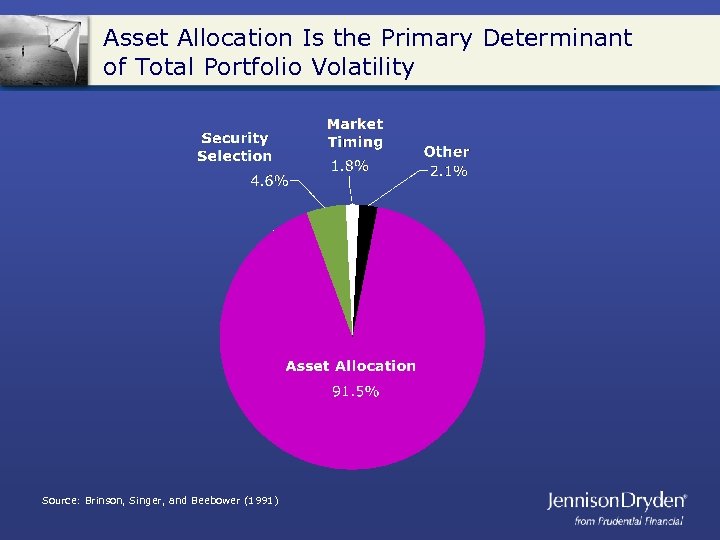 Asset Allocation Is the Primary Determinant of Total Portfolio Volatility Source: Brinson, Singer, and Beebower (1991)
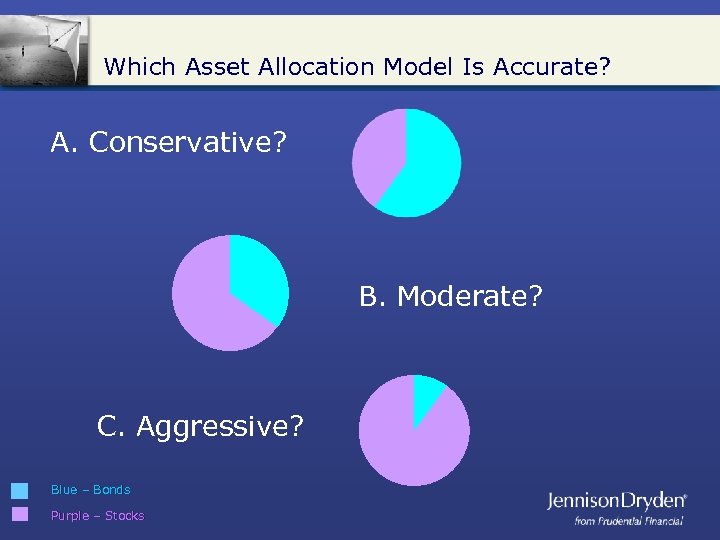 Which Asset Allocation Model Is Accurate? A. Conservative? B. Moderate? C. Aggressive? Blue – Bonds Purple – Stocks
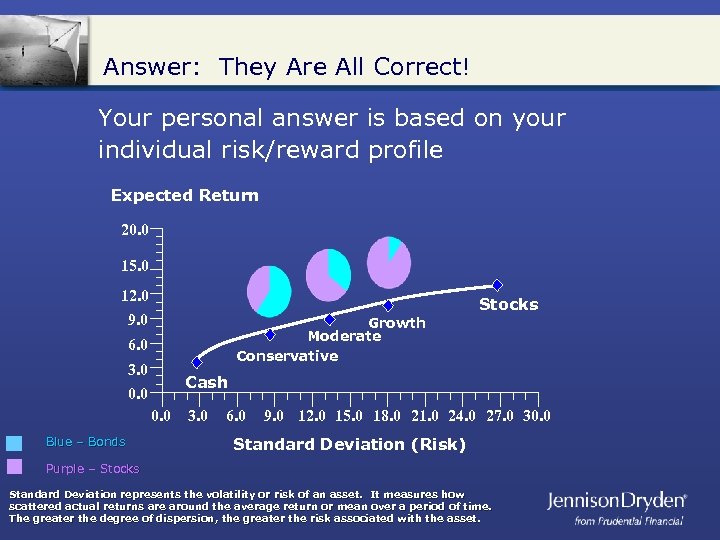 Answer: They Are All Correct! Your personal answer is based on your individual risk/reward profile Expected Return 20. 0 15. 0 12. 0 Stocks 9. 0 Growth Moderate Conservative 6. 0 3. 0 Cash 0. 0 Blue – Bonds 3. 0 6. 0 9. 0 12. 0 15. 0 18. 0 21. 0 24. 0 27. 0 30. 0 Standard Deviation (Risk) Purple – Stocks Standard Deviation represents the volatility or risk of an asset. It measures how scattered actual returns are around the average return or mean over a period of time. The greater the degree of dispersion, the greater the risk associated with the asset.
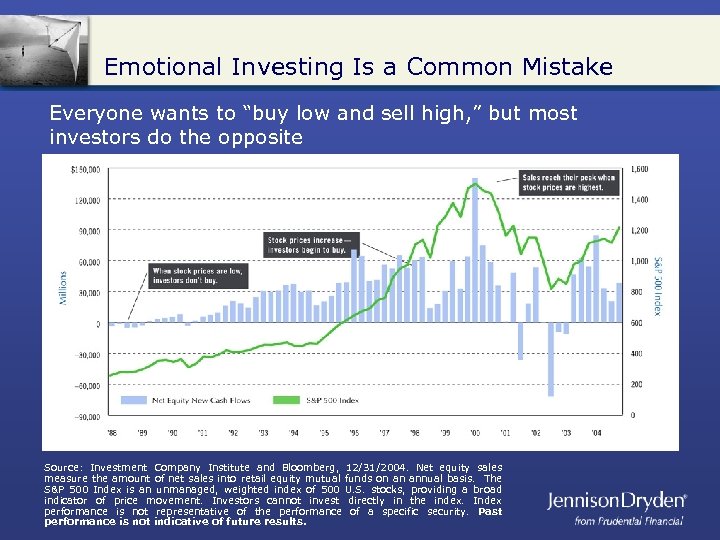 Emotional Investing Is a Common Mistake Everyone wants to “buy low and sell high, ” but most investors do the opposite Source: Investment Company Institute and Bloomberg, 12/31/2004. Net equity sales measure the amount of net sales into retail equity mutual funds on an annual basis. The S&P 500 Index is an unmanaged, weighted index of 500 U. S. stocks, providing a broad indicator of price movement. Investors cannot invest directly in the index. Index performance is not representative of the performance of a specific security. Past performance is not indicative of future results.
 So How Do You Build An Asset Allocation Strategy • You need the right mix of stocks and bonds. • Regular Monitoring and adjusting is necessary to maintain your desired allocation. • Periodic Rebalancing
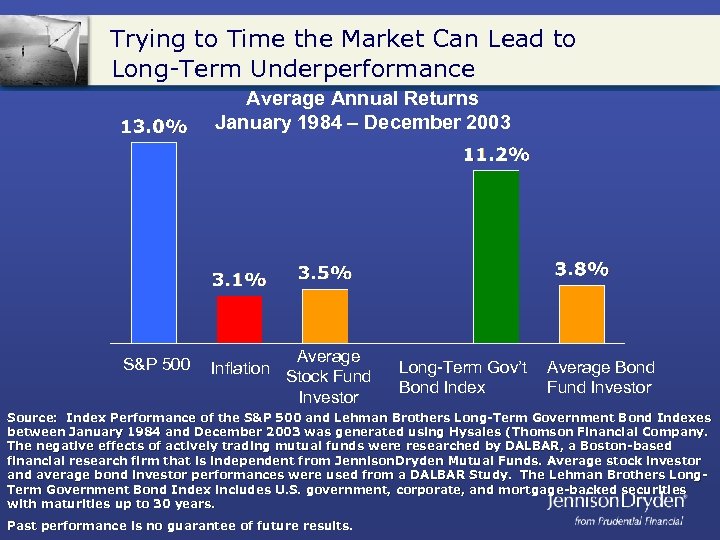 Trying to Time the Market Can Lead to Long-Term Underperformance Average Annual Returns January 1984 – December 2003 S&P 500 Average Inflation Stock Fund Investor Long-Term Gov’t Bond Index Average Bond Fund Investor Source: Index Performance of the S&P 500 and Lehman Brothers Long-Term Government Bond Indexes between January 1984 and December 2003 was generated using Hysales (Thomson Financial Company. The negative effects of actively trading mutual funds were researched by DALBAR, a Boston-based financial research firm that is independent from Jennison. Dryden Mutual Funds. Average stock investor and average bond investor performances were used from a DALBAR Study. The Lehman Brothers Long. Term Government Bond Index includes U. S. government, corporate, and mortgage-backed securities with maturities up to 30 years. Past performance is no guarantee of future results.
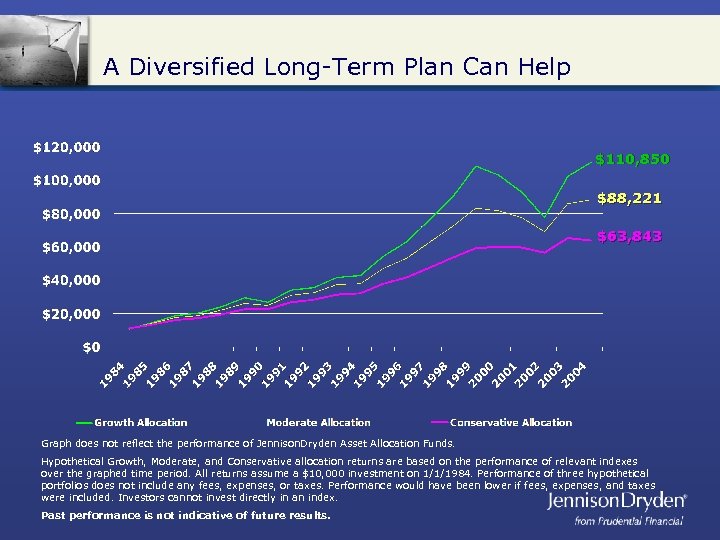 A Diversified Long-Term Plan Can Help $110, 850 $88, 221 $63, 843 Graph does not reflect the performance of Jennison. Dryden Asset Allocation Funds. Hypothetical Growth, Moderate, and Conservative allocation returns are based on the performance of relevant indexes over the graphed time period. All returns assume a $10, 000 investment on 1/1/1984. Performance of three hypothetical portfolios does not include any fees, expenses, or taxes. Performance would have been lower if fees, expenses, and taxes were included. Investors cannot invest directly in an index. Past performance is not indicative of future results.
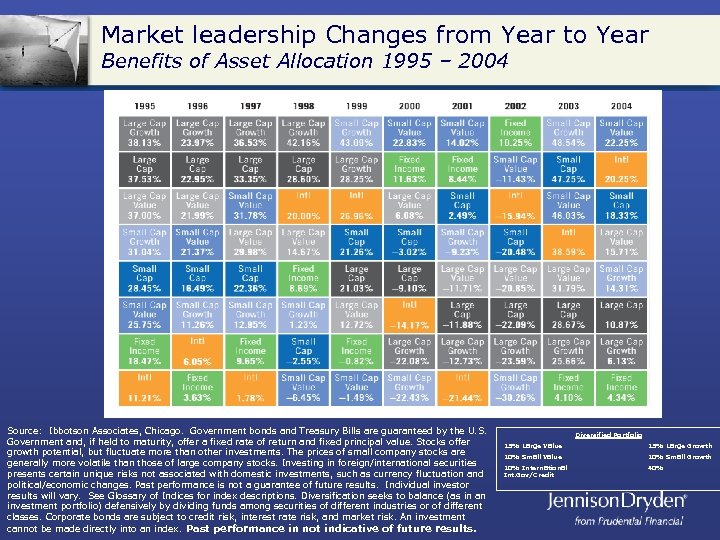 Market leadership Changes from Year to Year Benefits of Asset Allocation 1995 – 2004 Source: Ibbotson Associates, Chicago. Government bonds and Treasury Bills are guaranteed by the U. S. Government and, if held to maturity, offer a fixed rate of return and fixed principal value. Stocks offer growth potential, but fluctuate more than other investments. The prices of small company stocks are generally more volatile than those of large company stocks. Investing in foreign/international securities presents certain unique risks not associated with domestic investments, such as currency fluctuation and political/economic changes. Past performance is not a guarantee of future results. Individual investor results will vary. See Glossary of Indices for index descriptions. Diversification seeks to balance (as in an investment portfolio) defensively by dividing funds among securities of different industries or of different classes. Corporate bonds are subject to credit risk, interest rate risk, and market risk. An investment cannot be made directly into an index. Past performance in not indicative of future results. Diversified Portfolio 15% Large Value 15% Large Growth 10% Small Value 10% Small Growth 10% International Int. Gov/Credit 40%
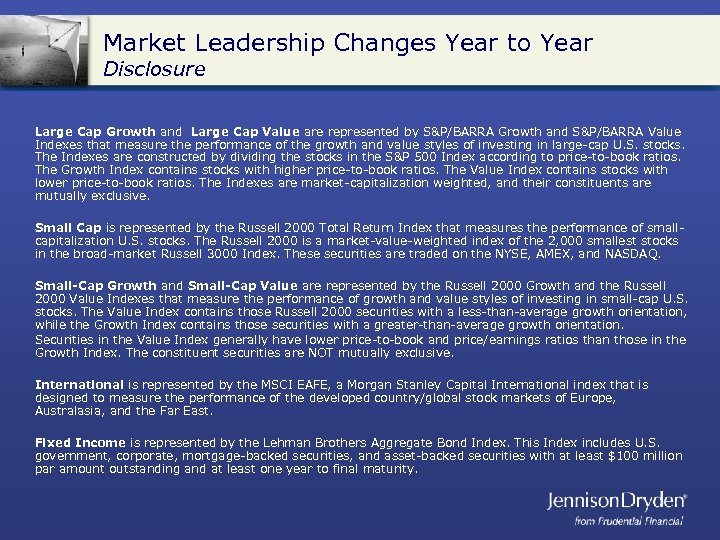 Market Leadership Changes Year to Year Disclosure Large Cap Growth and Large Cap Value are represented by S&P/BARRA Growth and S&P/BARRA Value Indexes that measure the performance of the growth and value styles of investing in large-cap U. S. stocks. The Indexes are constructed by dividing the stocks in the S&P 500 Index according to price-to-book ratios. The Growth Index contains stocks with higher price-to-book ratios. The Value Index contains stocks with lower price-to-book ratios. The Indexes are market-capitalization weighted, and their constituents are mutually exclusive. Small Cap is represented by the Russell 2000 Total Return Index that measures the performance of smallcapitalization U. S. stocks. The Russell 2000 is a market-value-weighted index of the 2, 000 smallest stocks in the broad-market Russell 3000 Index. These securities are traded on the NYSE, AMEX, and NASDAQ. Small-Cap Growth and Small-Cap Value are represented by the Russell 2000 Growth and the Russell 2000 Value Indexes that measure the performance of growth and value styles of investing in small-cap U. S. stocks. The Value Index contains those Russell 2000 securities with a less-than-average growth orientation, while the Growth Index contains those securities with a greater-than-average growth orientation. Securities in the Value Index generally have lower price-to-book and price/earnings ratios than those in the Growth Index. The constituent securities are NOT mutually exclusive. International is represented by the MSCI EAFE, a Morgan Stanley Capital International index that is designed to measure the performance of the developed country/global stock markets of Europe, Australasia, and the Far East. Fixed Income is represented by the Lehman Brothers Aggregate Bond Index. This Index includes U. S. government, corporate, mortgage-backed securities, and asset-backed securities with at least $100 million par amount outstanding and at least one year to final maturity.
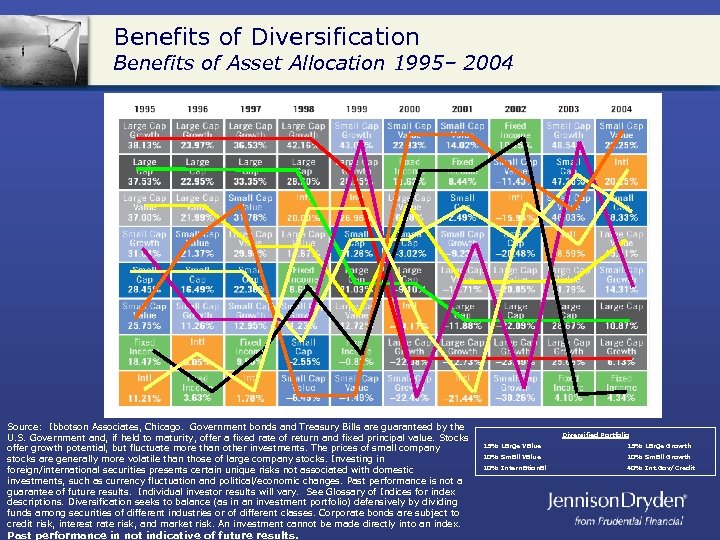 Benefits of Diversification Benefits of Asset Allocation 1995– 2004 Source: Ibbotson Associates, Chicago. Government bonds and Treasury Bills are guaranteed by the U. S. Government and, if held to maturity, offer a fixed rate of return and fixed principal value. Stocks offer growth potential, but fluctuate more than other investments. The prices of small company stocks are generally more volatile than those of large company stocks. Investing in foreign/international securities presents certain unique risks not associated with domestic investments, such as currency fluctuation and political/economic changes. Past performance is not a guarantee of future results. Individual investor results will vary. See Glossary of Indices for index descriptions. Diversification seeks to balance (as in an investment portfolio) defensively by dividing funds among securities of different industries or of different classes. Corporate bonds are subject to credit risk, interest rate risk, and market risk. An investment cannot be made directly into an index. Past performance in not indicative of future results. Diversified Portfolio 15% Large Value 15% Large Growth 10% Small Value 10% Small Growth 10% International 40% Int. Gov/Credit
 Introducing Jennison. Dryden Asset Allocation Funds One step to a diversified long-term investment plan § Diversified allocation strategies designed in consultation with Ibbotson Associates § Covers key asset classes § Multiple style funds § Leading asset managers § Day-to day management and portfolio rebalancing by Quantitative Management Associates Ibbotson Associates is not a Prudential Financial company.
 Allocation Strategies Designed by Ibbotson Associates § Asset class modeling § Portfolio design § Quarterly review of fund style consistency § Annual review of asset class modeling
 Allocation Strategies Designed by Ibbotson Associates Founded in 1977, Ibbotson is well known throughout the investment industry as an experienced and objective provider of asset allocation products. Source: Ibbotson Associates
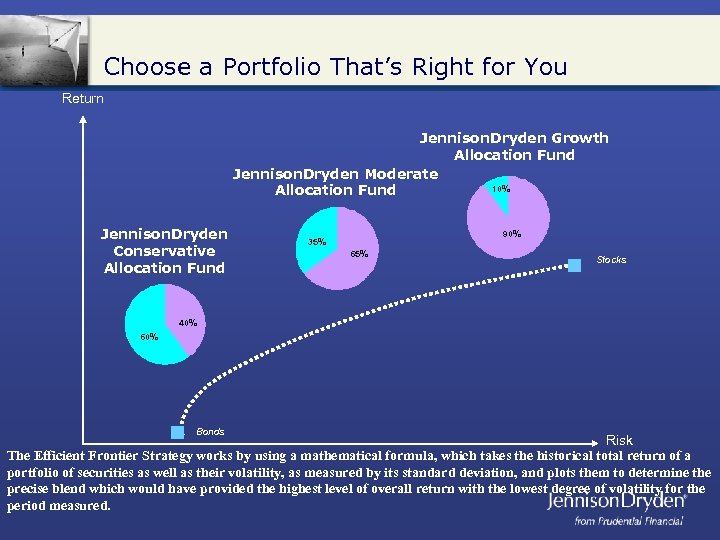 Choose a Portfolio That’s Right for You Return Jennison. Dryden Growth Allocation Fund Jennison. Dryden Moderate 10% Allocation Fund Jennison. Dryden Conservative Allocation Fund 90% 35% 65% Stocks 40% 60% Bonds Risk The Efficient Frontier Strategy works by using a mathematical formula, which takes the historical total return of a portfolio of securities as well as their volatility, as measured by its standard deviation, and plots them to determine the precise blend which would have provided the highest level of overall return with the lowest degree of volatility for the period measured.
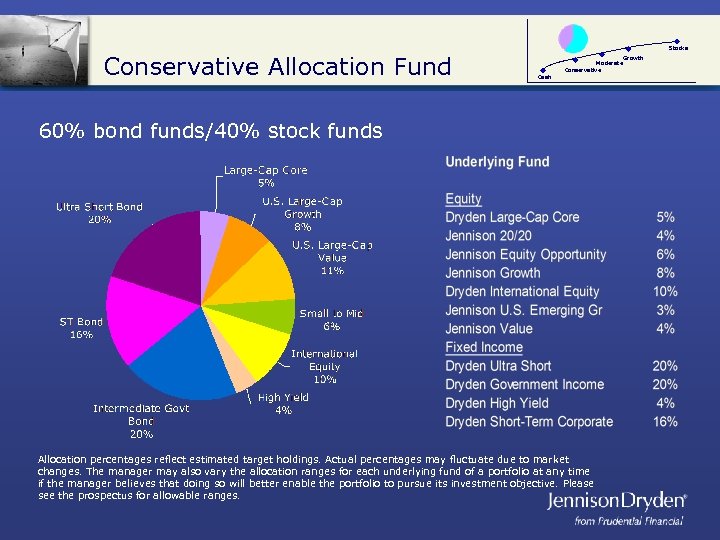 Stocks Conservative Allocation Fund Moderate Conservative Cash 60% bond funds/40% stock funds Allocation percentages reflect estimated target holdings. Actual percentages may fluctuate due to market changes. The manager may also vary the allocation ranges for each underlying fund of a portfolio at any time if the manager believes that doing so will better enable the portfolio to pursue its investment objective. Please see the prospectus for allowable ranges. Growth
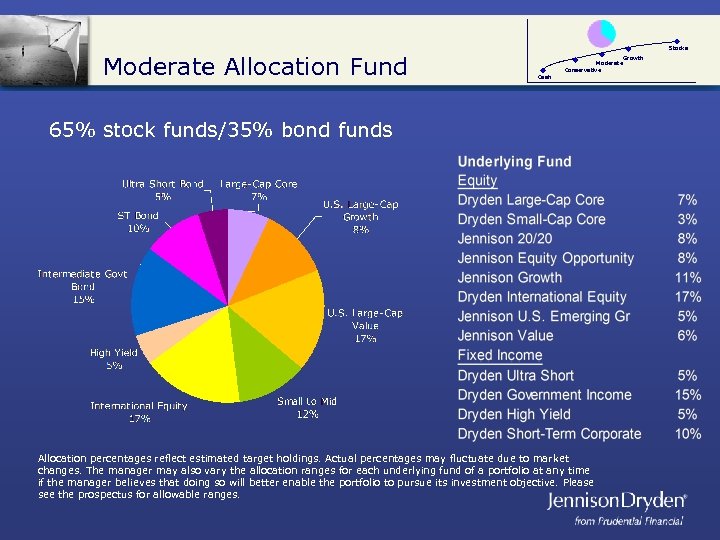 Stocks Moderate Allocation Fund Moderate Conservative Cash 65% stock funds/35% bond funds Allocation percentages reflect estimated target holdings. Actual percentages may fluctuate due to market changes. The manager may also vary the allocation ranges for each underlying fund of a portfolio at any time if the manager believes that doing so will better enable the portfolio to pursue its investment objective. Please see the prospectus for allowable ranges. Growth
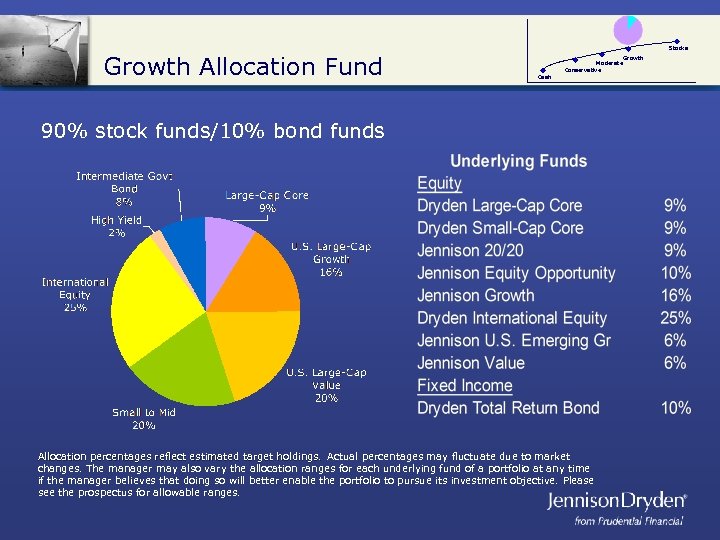 Stocks Growth Allocation Fund Moderate Conservative Cash 90% stock funds/10% bond funds Allocation percentages reflect estimated target holdings. Actual percentages may fluctuate due to market changes. The manager may also vary the allocation ranges for each underlying fund of a portfolio at any time if the manager believes that doing so will better enable the portfolio to pursue its investment objective. Please see the prospectus for allowable ranges. Growth
 Fund Disclosures Investors should keep in mind that the Funds will not be diversified for the purposes of the Investment Company Act of 1940. Investment in a nondiversified fund involves greater risks than a diversified investment because a loss resulting from a particular security will have a greater impact on the fund’s overall return. The Funds may not be appropriate for all investors, nor should they be considered a complete investment program. There is no assurance that the Funds’ investment objectives will be achieved. They may invest in smalland mid-cap stocks, which may have limited marketability and may be subject to more abrupt or erratic movements than larger-capitalization stocks. The Funds may engage in the following nonprincipal strategies. The Funds may invest in foreign securities, which are subject to the risk of currency fluctuation and the impact of political, social, and economic change. Noninvestment-grade debt securities, commonly referred to as high yield or “junk” bonds, may be subject to greater market fluctuations and risk of loss of income and principal than securities in higher-rating categories. The Funds also may trade their portfolio securities actively and frequently, resulting in an annual portfolio turnover rate of up to approximately 100%. High portfolio turnover can result in higher costs, which may affect Fund performance. The Funds also may invest in derivative securities, which have their own risks. These risks may result in greater share price volatility.
 Three Leading Asset Managers Jennison. Dryden Mutual Funds Jennison. Dryden is Prudential Financial’s mutual fund and managed accounts family. We offer a broad spectrum of investments—from core portfolio building blocks to strong sector funds. The managers of our funds are known and respected by major corporations and pension funds throughout the world. When you invest with us, you benefit from the same process, research, risk management, and competitive performance demanded by today’s largest investors. Three Successful Asset Managers § Jennison Associates § Quantitative Management Associates § Prudential Fixed Income is a division of Prudential Investment Management, Inc. (PIM). Jennison Associates, Quantitative Management Associates, and PIM are registered investment advisers and Prudential Financial companies.
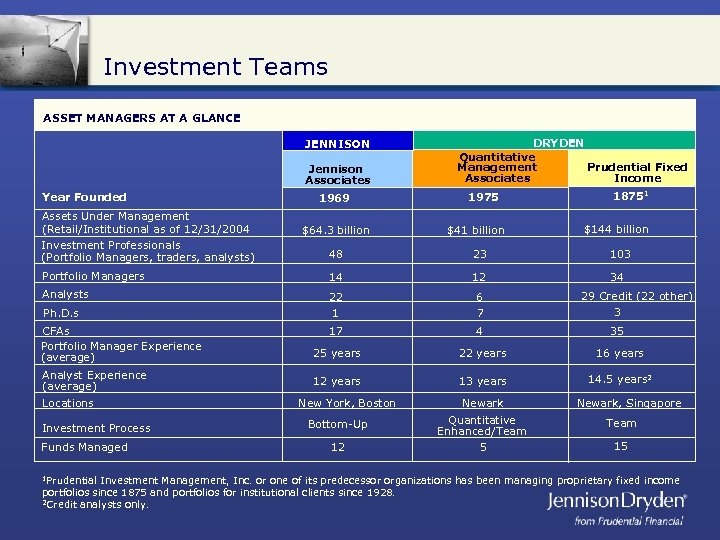 Investment Teams ASSET MANAGERS AT A GLANCE JENNISON Jennison Associates Year Founded Assets Under Management (Retail/Institutional as of 12/31/2004 Investment Professionals (Portfolio Managers, traders, analysts) 1969 $64. 3 billion DRYDEN Quantitative Management Prudential Fixed Associates Income 1975 $41 billion 18751 $144 billion 48 23 103 Portfolio Managers 14 12 34 Analysts 22 1 6 7 Ph. D. s 29 Credit (22 other) 3 35 CFAs Portfolio Manager Experience (average) 17 4 25 years 22 years 16 years Analyst Experience (average) 12 years 13 years 14. 5 years 2 Locations Investment Process Funds Managed 1 Prudential New York, Boston Bottom-Up 12 Newark Quantitative Enhanced/Team 5 Newark, Singapore Team 15 Investment Management, Inc. or one of its predecessor organizations has been managing proprietary fixed income portfolios since 1875 and portfolios for institutional clients since 1928. 2 Credit analysts only.
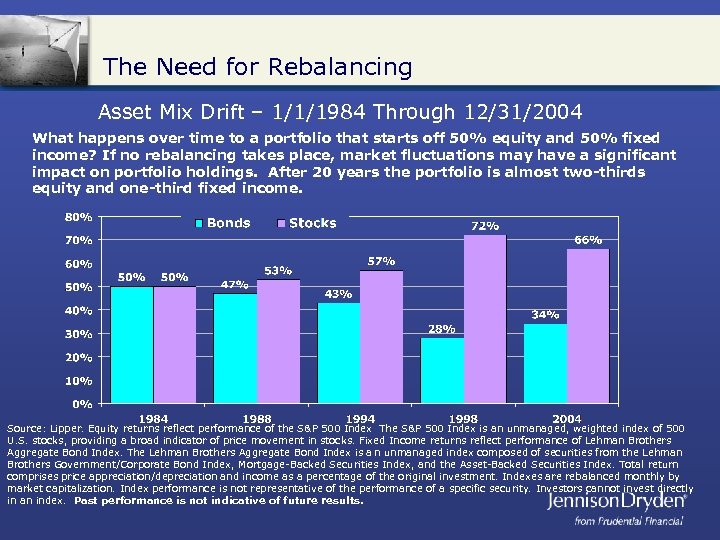 The Need for Rebalancing Asset Mix Drift – 1/1/1984 Through 12/31/2004 What happens over time to a portfolio that starts off 50% equity and 50% fixed income? If no rebalancing takes place, market fluctuations may have a significant impact on portfolio holdings. After 20 years the portfolio is almost two-thirds equity and one-third fixed income. Source: Lipper. Equity returns reflect performance of the S&P 500 Index The S&P 500 Index is an unmanaged, weighted index of 500 U. S. stocks, providing a broad indicator of price movement in stocks. Fixed Income returns reflect performance of Lehman Brothers Aggregate Bond Index. The Lehman Brothers Aggregate Bond Index is a n unmanaged index composed of securities from the Lehman Brothers Government/Corporate Bond Index, Mortgage-Backed Securities Index, and the Asset-Backed Securities Index. Total return comprises price appreciation/depreciation and income as a percentage of the original investment. Indexes are rebalanced monthly by market capitalization. Index performance is not representative of the performance of a specific security. Investors cannot invest directly in an index. Past performance is not indicative of future results.
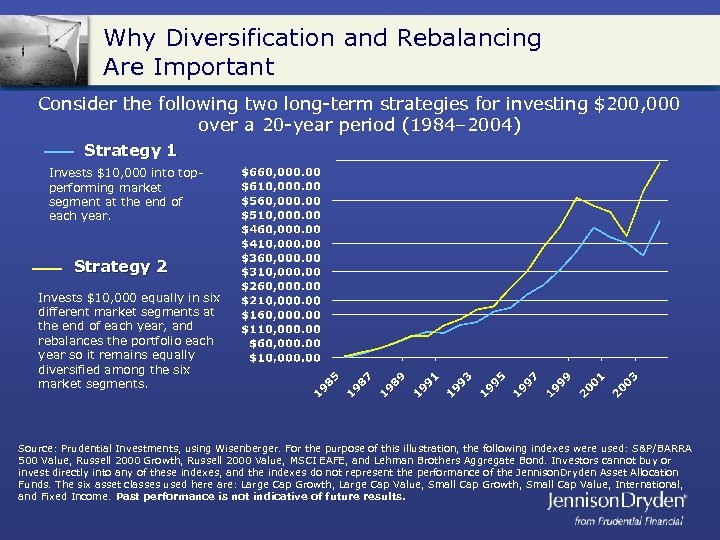 Why Diversification and Rebalancing Are Important Consider the following two long-term strategies for investing $200, 000 over a 20 -year period (1984– 2004) Strategy 1 Invests $10, 000 into topperforming market segment at the end of each year. Strategy 2 Invests $10, 000 equally in six different market segments at the end of each year, and rebalances the portfolio each year so it remains equally diversified among the six market segments. Source: Prudential Investments, using Wisenberger. For the purpose of this illustration, the following indexes were used: S&P/BARRA 500 Value, Russell 2000 Growth, Russell 2000 Value, MSCI EAFE, and Lehman Brothers Aggregate Bond. Investors cannot buy or invest directly into any of these indexes, and the indexes do not represent the performance of the Jennison. Dryden Asset Allocation Funds. The six asset classes used here are: Large Cap Growth, Large Cap Value, Small Cap Growth, Small Cap Value, International, and Fixed Income. Past performance is not indicative of future results.
 Keeping Your Asset Allocation on Track Jennison. Dryden Asset Allocation Funds Automatic Rebalancing- we do the work for you. § Quantitative Management Associates periodically rebalances the three asset class portfolios to bring them back to their original allocations
 What Jennison. Dryden Asset Allocation Funds Offer You § Immediate and consistent diversification § Asset management expertise of the Jennison. Dryden fund family § Three funds for differing risk profiles § Automatic portfolio rebalancing § Simplicity—one investment, one NAV § Accessibility—investment minimums as low as $1, 000
 You Have Needs § Secure retirement § College education for children or grandchildren § New home § Growing/protecting your nest egg We can help Jennison. Dryden Asset Allocation Funds
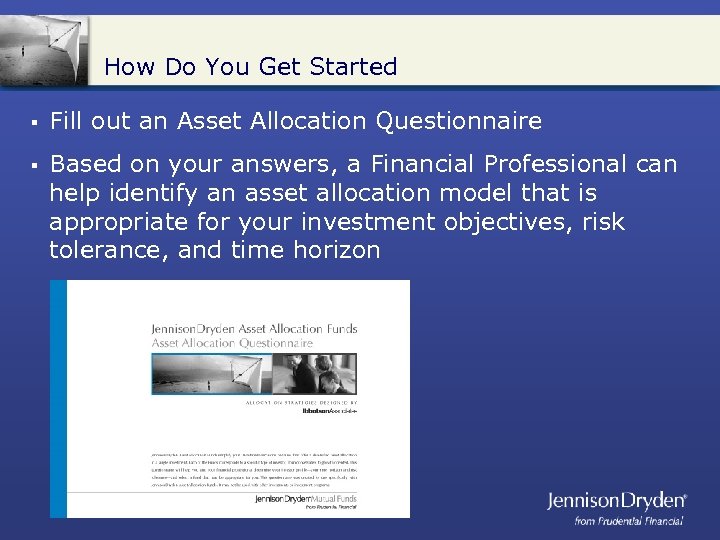 How Do You Get Started § Fill out an Asset Allocation Questionnaire § Based on your answers, a Financial Professional can help identify an asset allocation model that is appropriate for your investment objectives, risk tolerance, and time horizon
 Disclosures For more information about the Jennison. Dryden Asset Allocation Funds, call your financial professional for a free prospectus. You should consider the Funds’ investment objectives, risks, and charges and expenses carefully before investing. The prospectus will contain this and other information about the investment company. Please read the prospectus carefully before investing. Shares of the Jennison. Dryden Asset Allocation Funds are distributed by Prudential Investment Management Services LLC (PIMS), a Prudential Financial company and member SIPC. Jennison. Dryden is a registered trademark of The Prudential Insurance Company of America. Mutual Funds: ARE NOT INSURED BY THE FDIC OR ANY FEDERAL GOVERNMENT AGENCY, MAY LOSE VALUE, AND ARE NOT A DEPOSIT OF OR GUARANTEED BY ANY BANK OR ANY BANK AFFILIATE.