


 Скачать презентацию Inventory Management V Finite Planning Horizon Lecture 9
f4447d4974ef4b9f5f54665dc214d28f.ppt
- Количество слайдов: 19
 Inventory Management V Finite Planning Horizon Lecture 9 ESD. 260 Fall 2003 Caplice
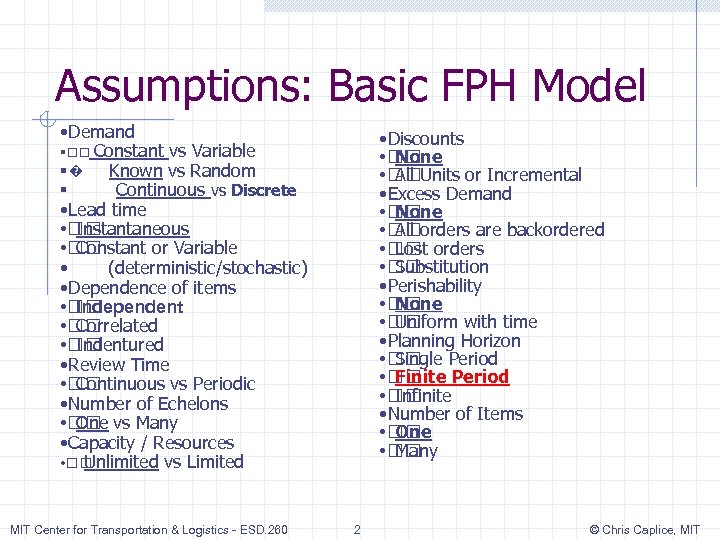 Assumptions: Basic FPH Model • Demand § Constant vs Variable §� Known vs Random § Continuous vs Discrete • Lead time • Instantaneous • Constant or Variable • (deterministic/stochastic) • Dependence of items • Independent • Correlated • Indentured • Review Time • Continuous vs Periodic • Number of Echelons • vs Many One • Capacity / Resources • Unlimited vs Limited MIT Center for Transportation & Logistics - ESD. 260 • Discounts • None • Units or Incremental All • Excess Demand • None • orders are backordered All • orders Lost • Substitution • Perishability • None • Uniform with time • Planning Horizon • Period Single • Finite Period • Infinite • Number of Items • One • Many 2 © Chris Caplice, MIT
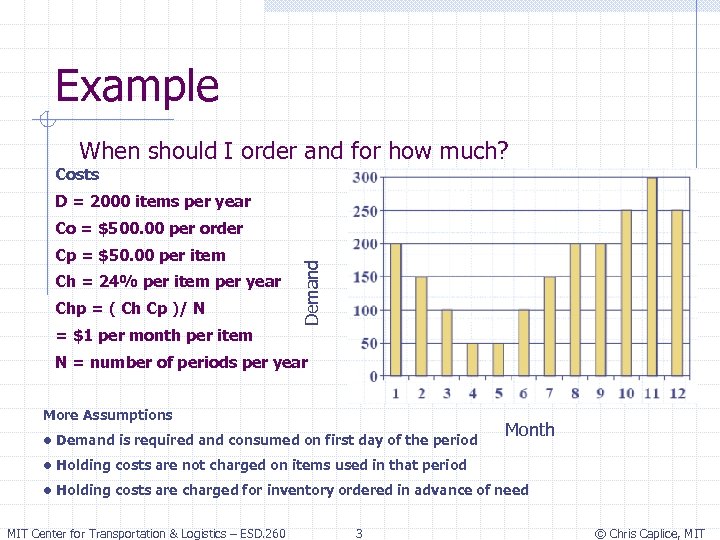 Example When should I order and for how much? Costs D = 2000 items per year Cp = $50. 00 per item Ch = 24% per item per year Chp = ( Ch Cp )/ N = $1 per month per item Demand Co = $500. 00 per order N = number of periods per year More Assumptions • Demand is required and consumed on first day of the period Month • Holding costs are not charged on items used in that period • Holding costs are charged for inventory ordered in advance of need MIT Center for Transportation & Logistics – ESD. 260 3 © Chris Caplice, MIT
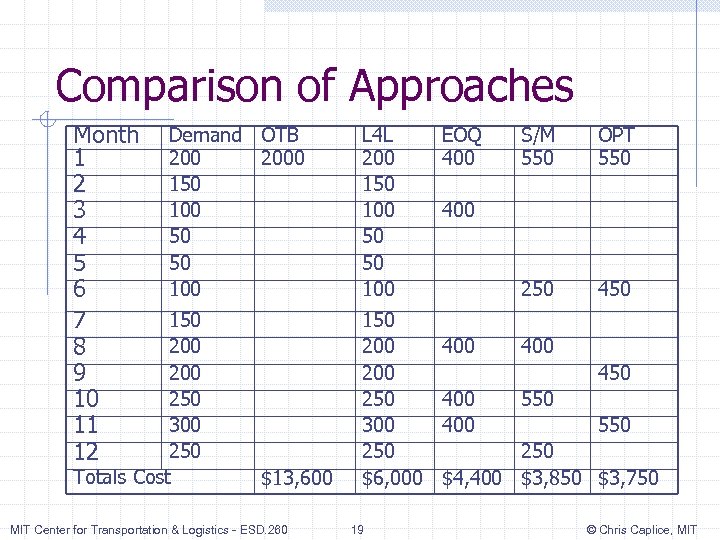
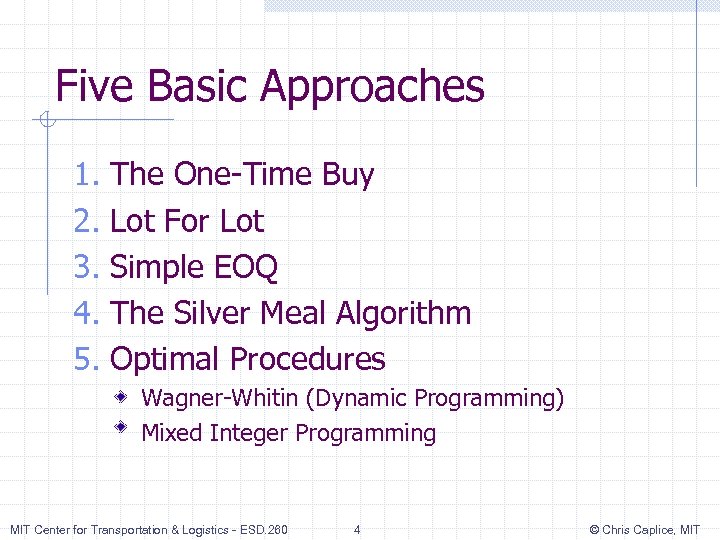 Five Basic Approaches 1. 2. 3. 4. 5. The One-Time Buy Lot For Lot Simple EOQ The Silver Meal Algorithm Optimal Procedures Wagner-Whitin (Dynamic Programming) Mixed Integer Programming MIT Center for Transportation & Logistics - ESD. 260 4 © Chris Caplice, MIT
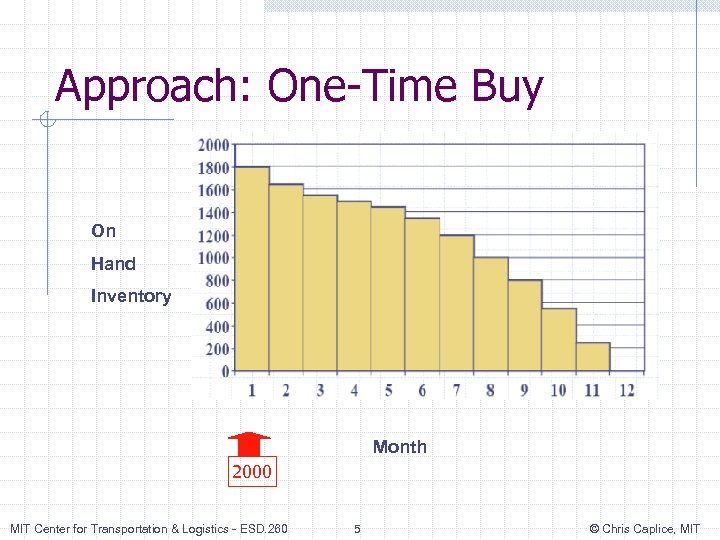 Approach: One-Time Buy On Hand Inventory Month 2000 MIT Center for Transportation & Logistics - ESD. 260 5 © Chris Caplice, MIT
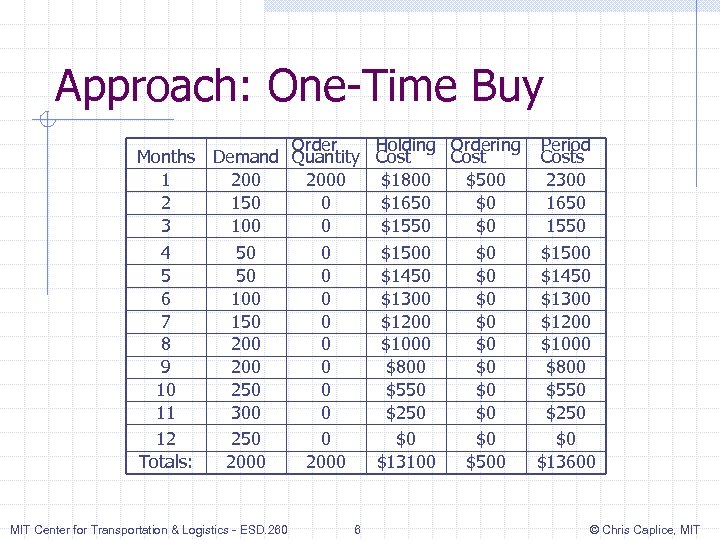 Approach: One-Time Buy Months 1 2 3 4 5 6 7 8 9 10 11 12 Totals: Order Holding Ordering Demand Quantity Cost 2000 $1800 $500 150 0 $1650 $0 100 0 $1550 $0 50 50 100 150 200 250 300 250 2000 MIT Center for Transportation & Logistics - ESD. 260 0 0 0 0 2000 $1500 $1450 $1300 $1200 $1000 $800 $550 $250 $0 $13100 6 $0 $0 $0 $500 Period Costs 2300 1650 1550 $1500 $1450 $1300 $1200 $1000 $800 $550 $250 $0 $13600 © Chris Caplice, MIT
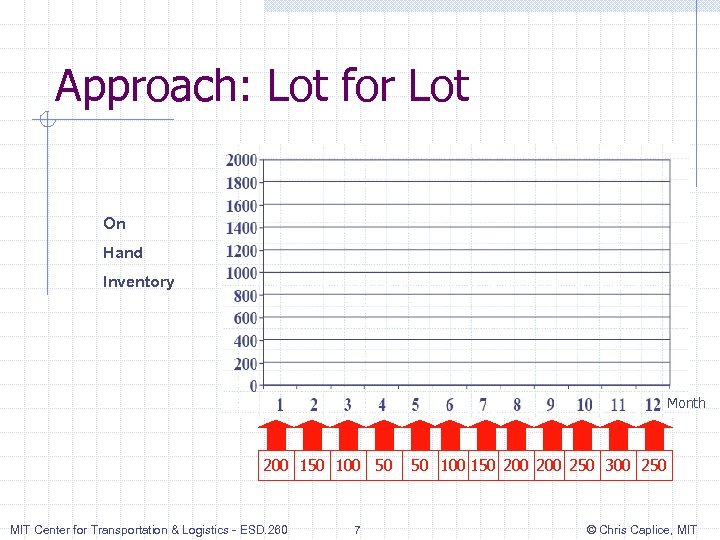 Approach: Lot for Lot On Hand Inventory Month 200 150 100 50 MIT Center for Transportation & Logistics - ESD. 260 7 50 100 150 200 250 300 250 © Chris Caplice, MIT
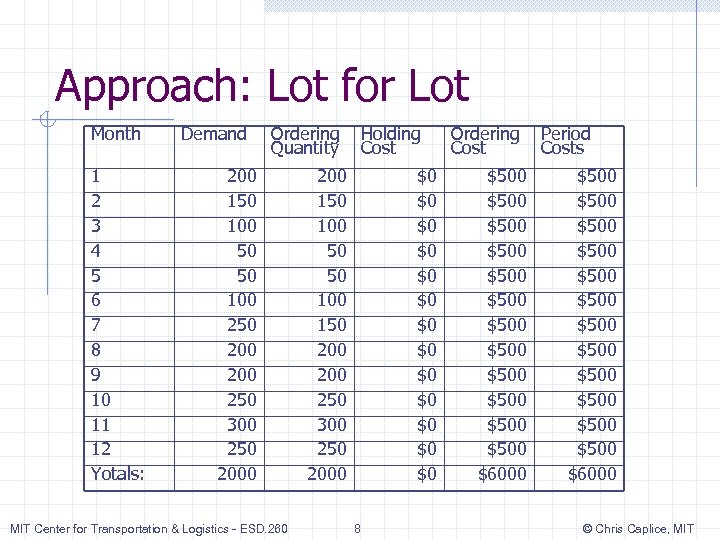 Approach: Lot for Lot Month 1 2 3 4 5 6 7 8 9 10 11 12 Yotals: Demand Ordering Quantity 200 150 100 50 50 100 250 200 250 300 250 2000 MIT Center for Transportation & Logistics - ESD. 260 Holding Cost 200 150 100 50 50 100 150 200 250 300 250 2000 $0 $0 $0 $0 8 Ordering Cost $500 $500 $500 $6000 Period Costs $500 $500 $500 $6000 © Chris Caplice, MIT
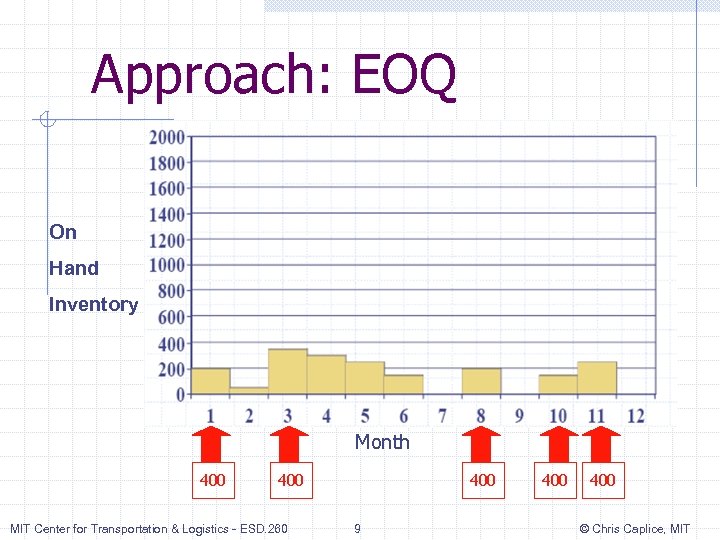 Approach: EOQ On Hand Inventory Month 400 MIT Center for Transportation & Logistics - ESD. 260 400 9 400 © Chris Caplice, MIT
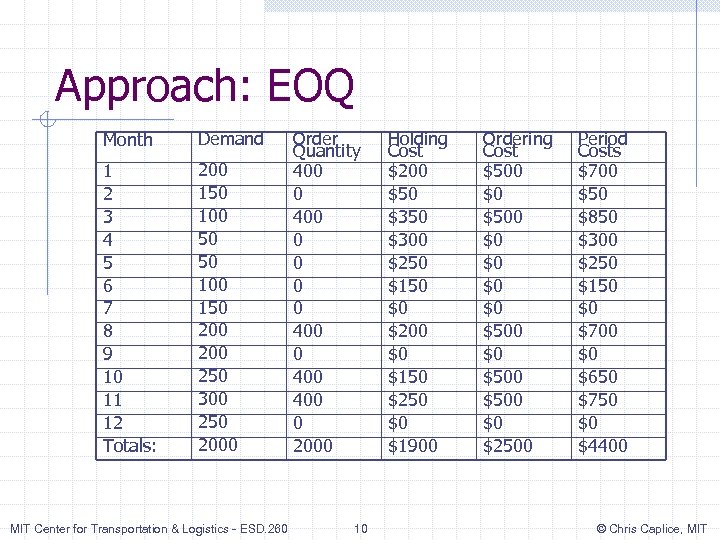 Approach: EOQ Month Demand 1 2 3 4 5 6 7 8 9 10 11 12 Totals: 200 150 100 50 50 100 150 200 250 300 250 2000 MIT Center for Transportation & Logistics - ESD. 260 Order Quantity 400 0 0 0 0 400 400 0 2000 10 Holding Cost $200 $50 $300 $250 $150 $0 $200 $0 $150 $250 $0 $1900 Ordering Cost $500 $0 $0 $500 $0 $2500 Period Costs $700 $50 $850 $300 $250 $150 $0 $700 $0 $650 $750 $0 $4400 © Chris Caplice, MIT
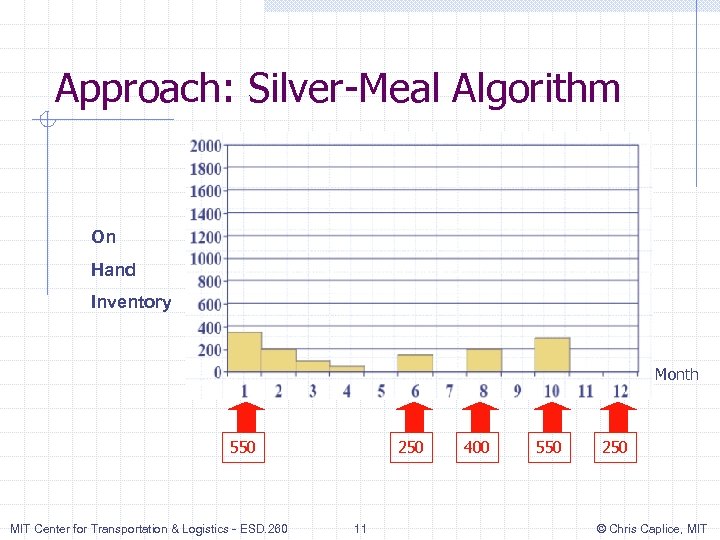 Approach: Silver-Meal Algorithm On Hand Inventory Month 550 MIT Center for Transportation & Logistics - ESD. 260 250 11 400 550 250 © Chris Caplice, MIT
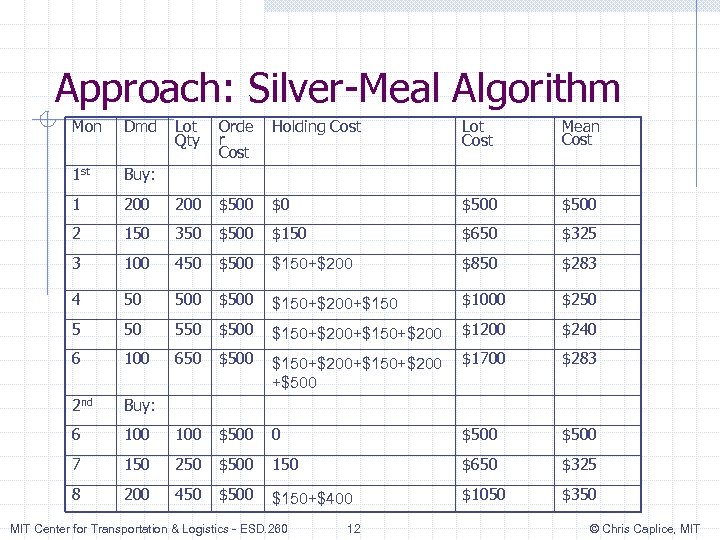 Approach: Silver-Meal Algorithm Mon Dmd Lot Qty Orde r Cost Holding Cost Lot Cost Mean Cost 1 st Buy: 1 200 $500 $0 $500 2 150 350 $500 $150 $650 $325 3 100 450 $500 $150+$200 $850 $283 4 50 500 $150+$200+$150 $1000 $250 550 $500 $150+$200+$150+$200 $1200 $240 6 100 650 $500 $150+$200+$150+$200 +$500 $1700 $283 2 nd Buy: 6 100 $500 7 150 250 $500 150 $650 $325 8 200 450 $500 $150+$400 $1050 $350 MIT Center for Transportation & Logistics - ESD. 260 12 © Chris Caplice, MIT
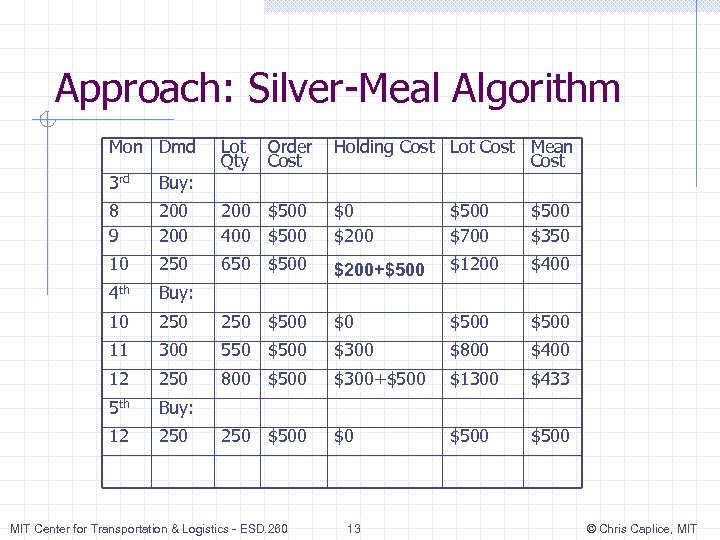 Approach: Silver-Meal Algorithm Mon Dmd Lot Qty Order Cost Holding Cost Lot Cost Mean Cost 3 rd Buy: 8 9 200 200 $500 400 $500 $0 $200 $500 $700 $500 $350 10 250 650 $500 $200+$500 $1200 $400 4 th Buy: 10 250 $500 11 300 550 $500 $300 $800 $400 12 250 800 $500 $300+$500 $1300 $433 5 th Buy: 12 250 $500 $0 $500 MIT Center for Transportation & Logistics - ESD. 260 13 © Chris Caplice, MIT
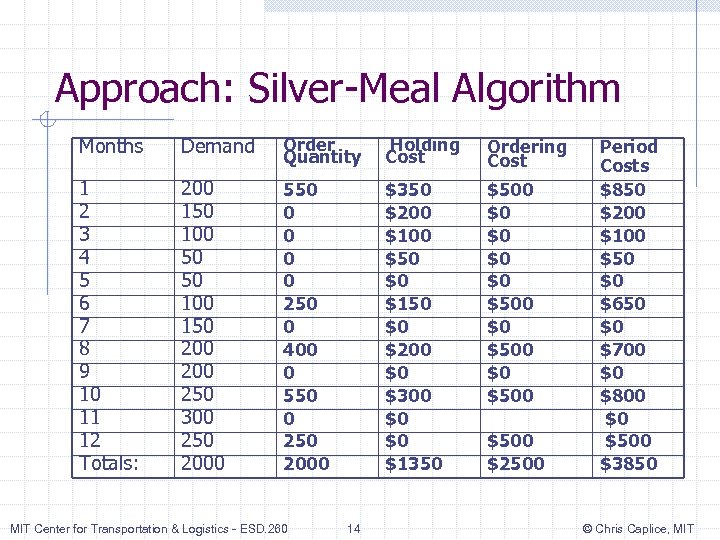 Approach: Silver-Meal Algorithm Months Demand Order Quantity Holding Cost Ordering Cost 1 2 3 4 5 6 7 8 9 10 11 12 Totals: 200 150 100 50 50 100 150 200 250 300 250 2000 550 0 0 250 0 400 0 550 0 250 2000 $350 $200 $100 $50 $0 $150 $0 $200 $0 $300 $0 $0 $1350 $500 $0 $0 $500 MIT Center for Transportation & Logistics - ESD. 260 14 $500 $2500 Period Costs $850 $200 $100 $50 $0 $650 $0 $700 $0 $800 $0 $500 $3850 © Chris Caplice, MIT
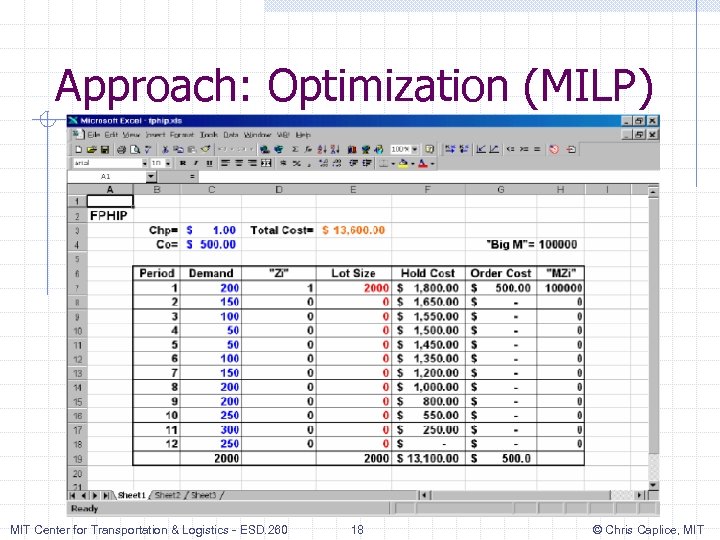
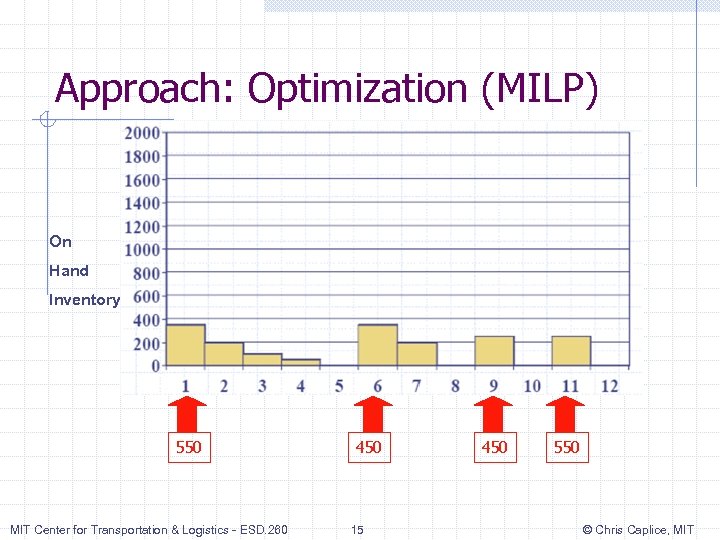 Approach: Optimization (MILP) On Hand Inventory 550 MIT Center for Transportation & Logistics - ESD. 260 450 15 450 550 © Chris Caplice, MIT
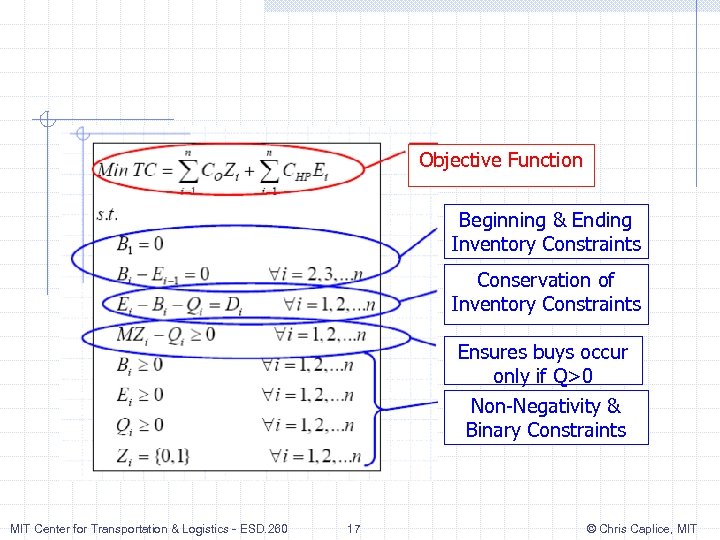
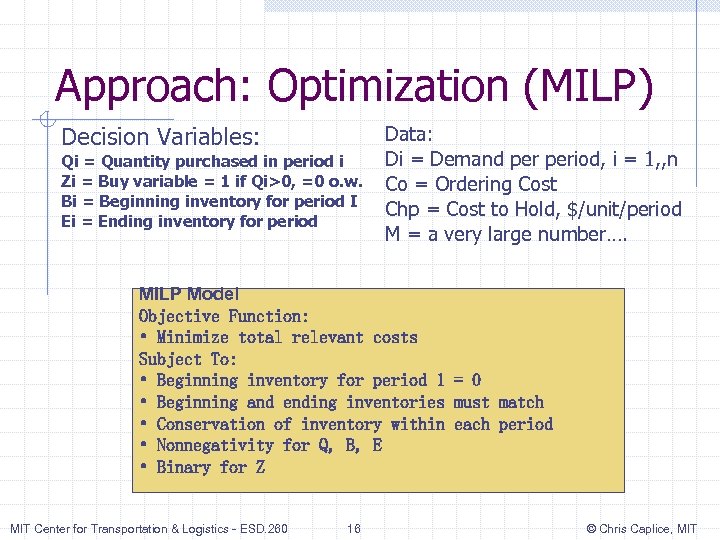 Approach: Optimization (MILP) Decision Variables: Qi = Quantity purchased in period i Zi = Buy variable = 1 if Qi>0, =0 o. w. Bi = Beginning inventory for period I Ei = Ending inventory for period Data: Di = Demand period, i = 1, , n Co = Ordering Cost Chp = Cost to Hold, $/unit/period M = a very large number…. MILP Model Objective Function: • Minimize total relevant costs Subject To: • Beginning inventory for period 1 = 0 • Beginning and ending inventories must match • Conservation of inventory within each period • Nonnegativity for Q, B, E • Binary for Z MIT Center for Transportation & Logistics - ESD. 260 16 © Chris Caplice, MIT
 Objective Function Beginning & Ending Inventory Constraints Conservation of Inventory Constraints Ensures buys occur only if Q>0 Non-Negativity & Binary Constraints MIT Center for Transportation & Logistics - ESD. 260 17 © Chris Caplice, MIT
 Approach: Optimization (MILP) MIT Center for Transportation & Logistics - ESD. 260 18 © Chris Caplice, MIT
 Comparison of Approaches Month 1 2 3 4 5 6 7 8 9 10 11 12 Demand OTB 2000 150 100 50 50 100 150 200 250 300 250 Totals Cost $13, 600 MIT Center for Transportation & Logistics - ESD. 260 L 4 L 200 150 100 50 50 100 150 200 250 300 250 $6, 000 19 EOQ 400 S/M 550 OPT 550 250 400 400 450 400 550 250 $4, 400 $3, 850 $3, 750 © Chris Caplice, MIT