 Скачать презентацию Invasive Species as a global threat to biodiversity
394bc777c1983e65eb07f4c11c004bdc.ppt
- Количество слайдов: 58



Invasive Species as a global threat to biodiversity
What prevents species from dispersing globally? Geographic Barriers: Oceans Mountains Deserts Large Lakes Barriers are in the eye of the beholder: what is a barrier for one species is not a barrier to another e. g. mountains may restrict plant distributions, but not birds
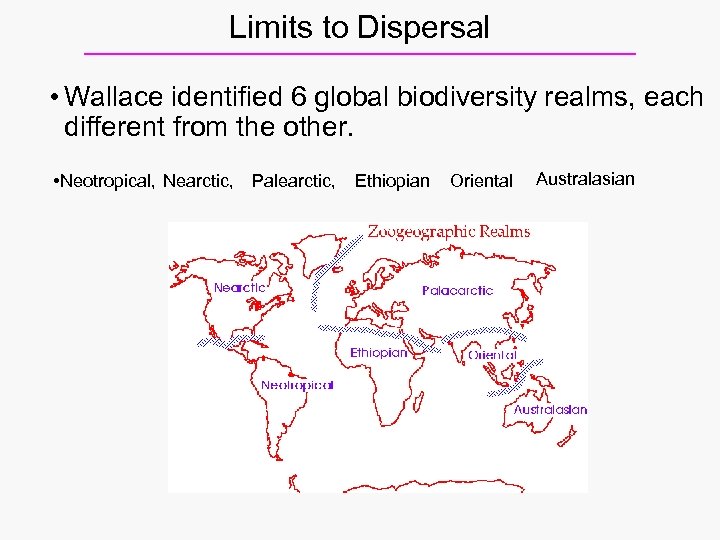
Limits to Dispersal • Wallace identified 6 global biodiversity realms, each different from the other. • Neotropical, Nearctic, Palearctic, Ethiopian Oriental Australasian
Invasive Species: Species introduced to regions outside of their historic native range; Species are being transported across these barriers at an increasing rate owing to human movement and commerce (50, 000 times greater rate of spread than by natural dispersal in some cases) major vectors are planes, ships and humans
Invasive Species: • What are they? • Why should we care? • ecological concerns • human, plant and animal health • economic concerns
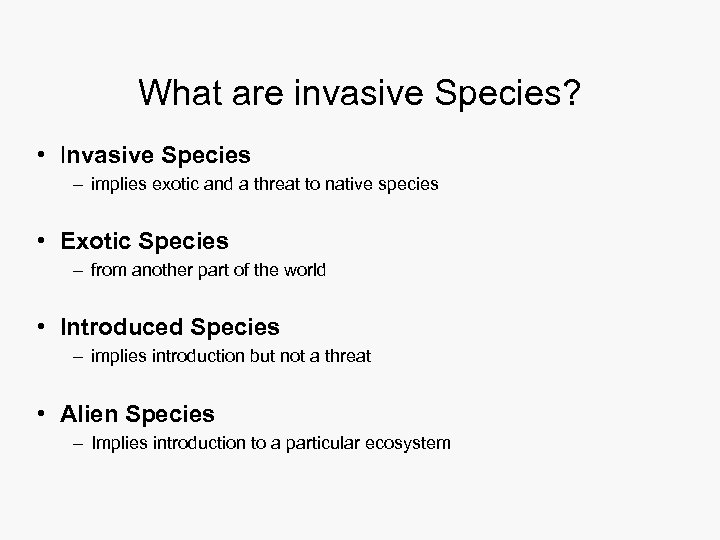
What are invasive Species? • Invasive Species – implies exotic and a threat to native species • Exotic Species – from another part of the world • Introduced Species – implies introduction but not a threat • Alien Species – Implies introduction to a particular ecosystem
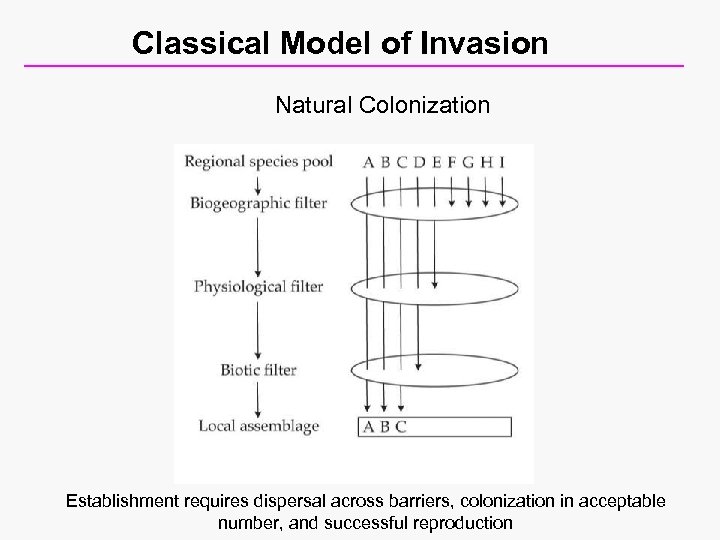
Classical Model of Invasion Natural Colonization Establishment requires dispersal across barriers, colonization in acceptable number, and successful reproduction
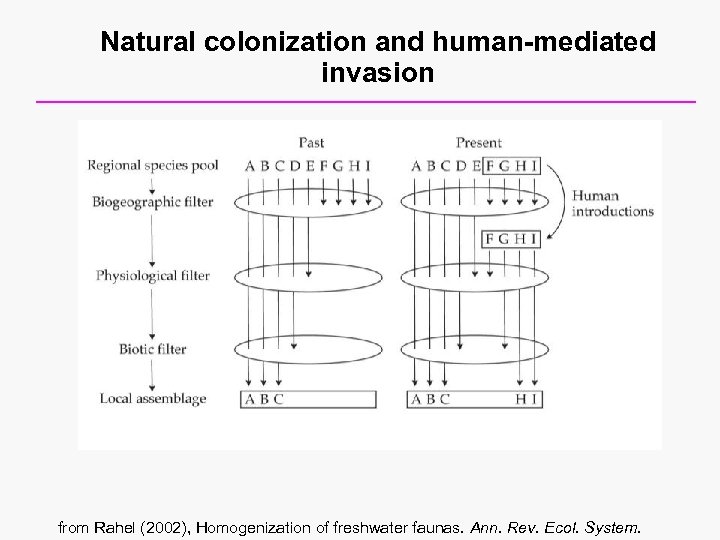
Natural colonization and human-mediated invasion from Rahel (2002), Homogenization of freshwater faunas. Ann. Rev. Ecol. System.
What allows invaders to invade? • Only some novel species will survive and establish self-sustaining populations in the novel habitat. • A subset of these species may not only survive, but become invasive, dominating the new community and even causing the extinction of natives. • But, what allows a species to become invasive?
What allows invaders to invade? Broad Environmental Tolerance - posses life history traits that confer superior colonizing ability or ability to acclimate to a wide range of habitats. Local Adaptation - readily adapt to local selective pressures. Sexton et al. 2002. Ecological Applications 12: 1652 -1660.
Evolution of Increased Competitive Ability Hypothesis (EICA) • As applied to plants – • Under identical growing conditions, species will produce more biomass in an area where it has been introduced vs. in its native range. • Invasive species will exhibit lower herbivore defense rates in introduced range than in native range. • A species is not as fit (in its native habitat) at the time of introduction vs. when it becomes invasive. Blossey and Notzold. 1995. Journal of Ecology 83(5): 887 -889.
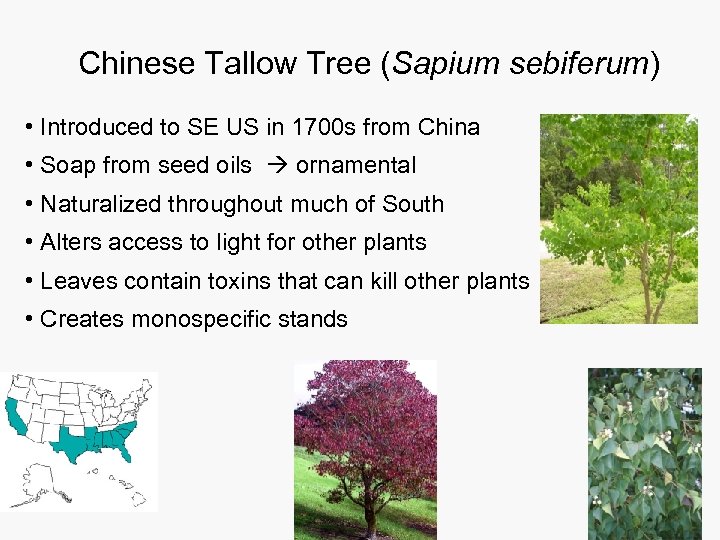
Chinese Tallow Tree (Sapium sebiferum) • Introduced to SE US in 1700 s from China • Soap from seed oils ornamental • Naturalized throughout much of South • Alters access to light for other plants • Leaves contain toxins that can kill other plants • Creates monospecific stands
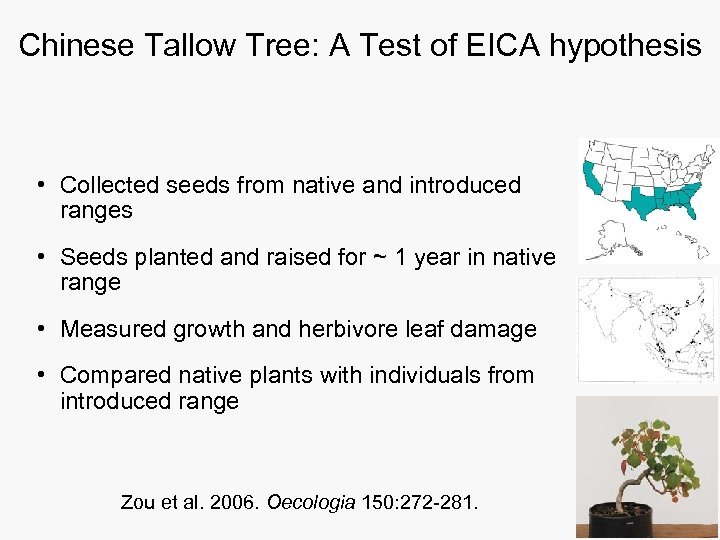
Chinese Tallow Tree: A Test of EICA hypothesis • Collected seeds from native and introduced ranges • Seeds planted and raised for ~ 1 year in native range • Measured growth and herbivore leaf damage • Compared native plants with individuals from introduced range Zou et al. 2006. Oecologia 150: 272 -281.
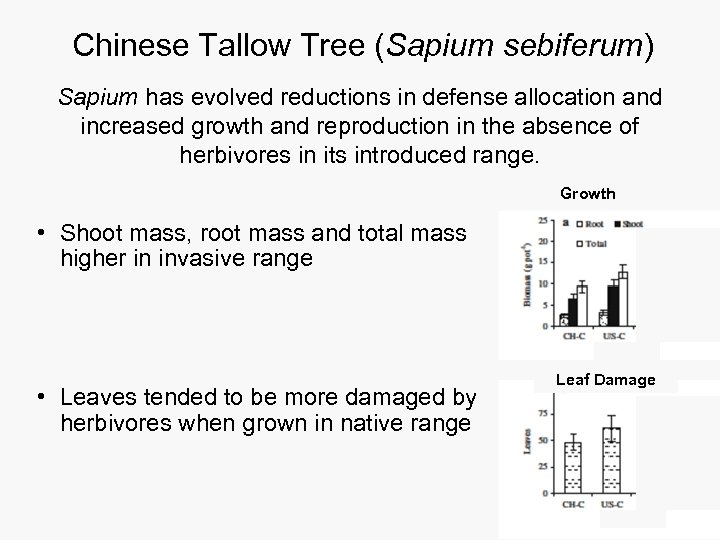
Chinese Tallow Tree (Sapium sebiferum) Sapium has evolved reductions in defense allocation and increased growth and reproduction in the absence of herbivores in its introduced range. Growth • Shoot mass, root mass and total mass higher in invasive range • Leaves tended to be more damaged by herbivores when grown in native range Leaf Damage
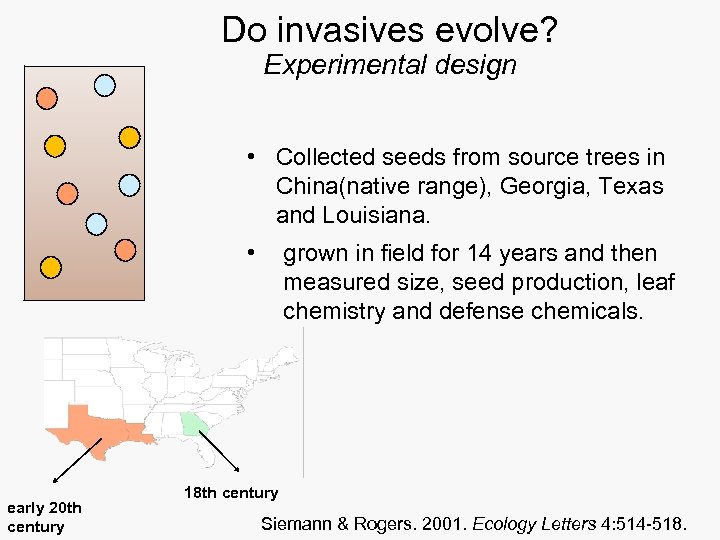
Do invasives evolve? Experimental design • Collected seeds from source trees in China(native range), Georgia, Texas and Louisiana. • early 20 th century grown in field for 14 years and then measured size, seed production, leaf chemistry and defense chemicals. 18 th century Siemann & Rogers. 2001. Ecology Letters 4: 514 -518.
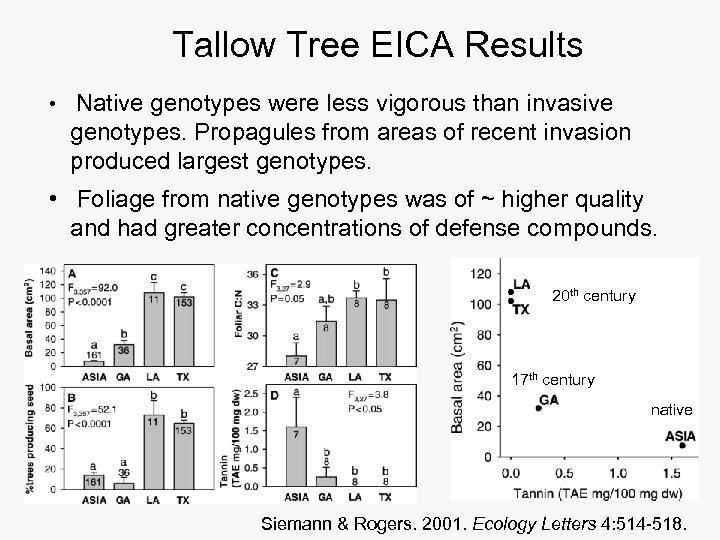
Tallow Tree EICA Results • Native genotypes were less vigorous than invasive genotypes. Propagules from areas of recent invasion produced largest genotypes. • Foliage from native genotypes was of ~ higher quality and had greater concentrations of defense compounds. 20 th century 17 th century native Siemann & Rogers. 2001. Ecology Letters 4: 514 -518.
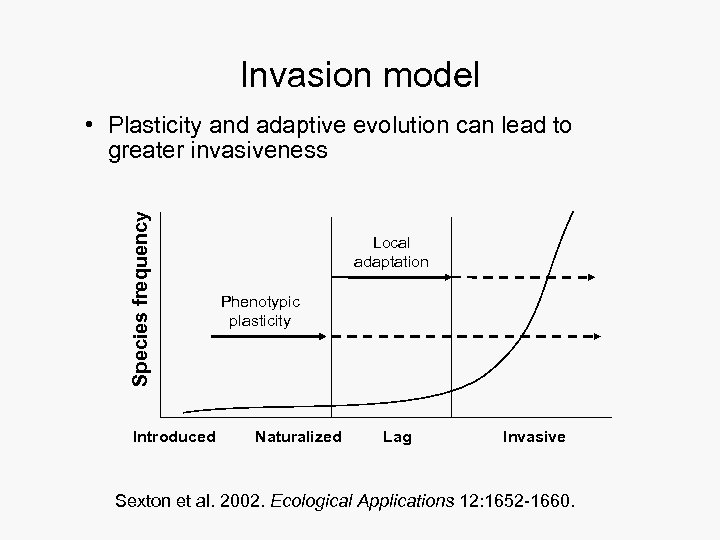
Invasion model Species frequency • Plasticity and adaptive evolution can lead to greater invasiveness Introduced Local adaptation Phenotypic plasticity Naturalized Lag Invasive Sexton et al. 2002. Ecological Applications 12: 1652 -1660.

Why should we care?
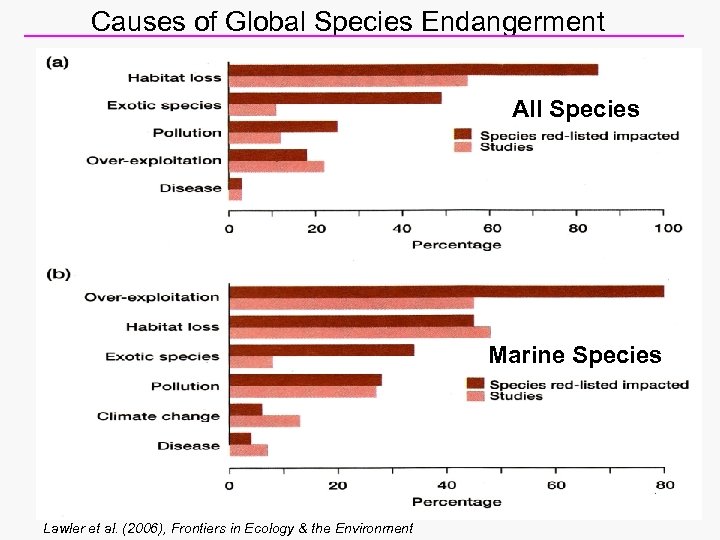
Causes of Global Species Endangerment All Species Marine Species Lawler et al. (2006), Frontiers in Ecology & the Environment
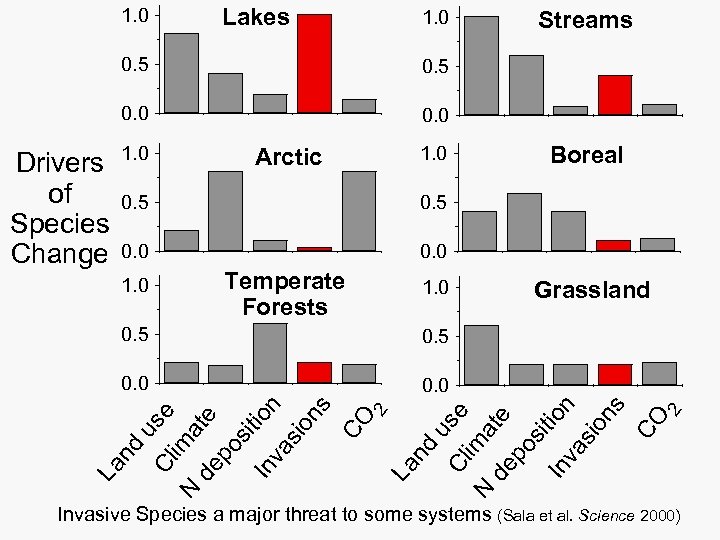
Lakes 1. 0 0. 5 0. 0 1. 0 Boreal 1. 0 Arctic 0. 5 0. 0 Temperate Forests 1. 0 2 de CO at e e im Cl La nd us CO ns io as In v po s iti e at de N Cl im us nd La po si In tion va sio ns 0. 0 2 0. 0 on 0. 5 e 0. 5 Grassland N Drivers of Species Change 0. 5 0. 0 Streams Invasive Species a major threat to some systems (Sala et al. Science 2000)
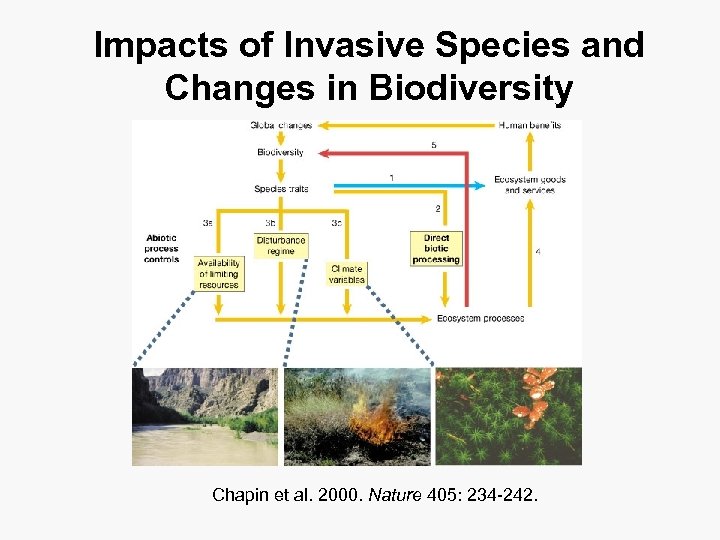
Impacts of Invasive Species and Changes in Biodiversity Chapin et al. 2000. Nature 405: 234 -242.
Negative Impacts of Invasive Species Ecosystem Level Impacts • Disturbance Regimes • Hydrology: Alterations of Water Regimes • Geomorphological processes (erosion, sedimentation) • Soil chemistry Community or Population Level Impacts • Habitat structure • Community composition • Resource competition • Population reductions, eliminations • Genetic Impacts
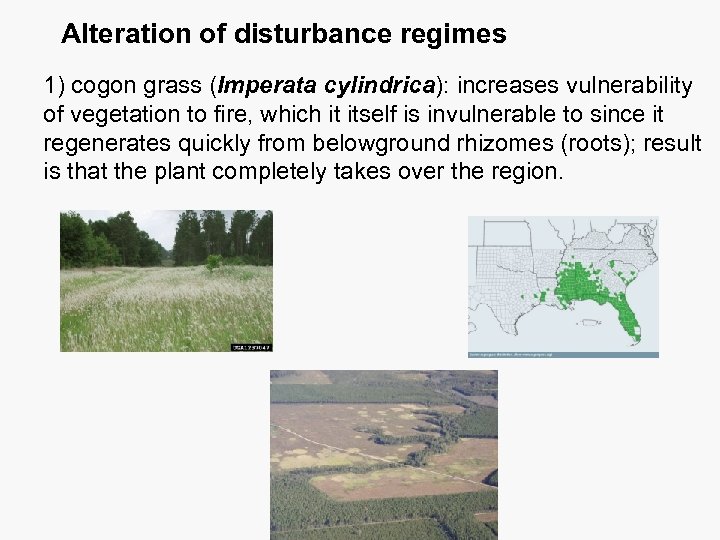
Alteration of disturbance regimes 1) cogon grass (Imperata cylindrica): increases vulnerability of vegetation to fire, which it itself is invulnerable to since it regenerates quickly from belowground rhizomes (roots); result is that the plant completely takes over the region.
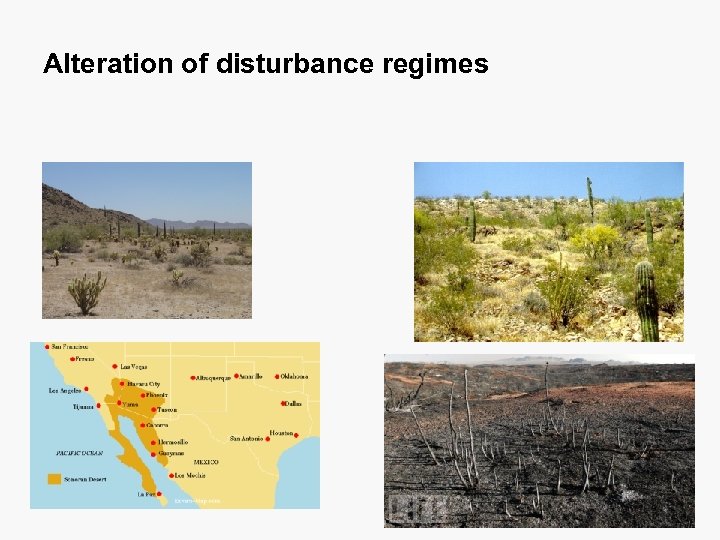
Alteration of disturbance regimes
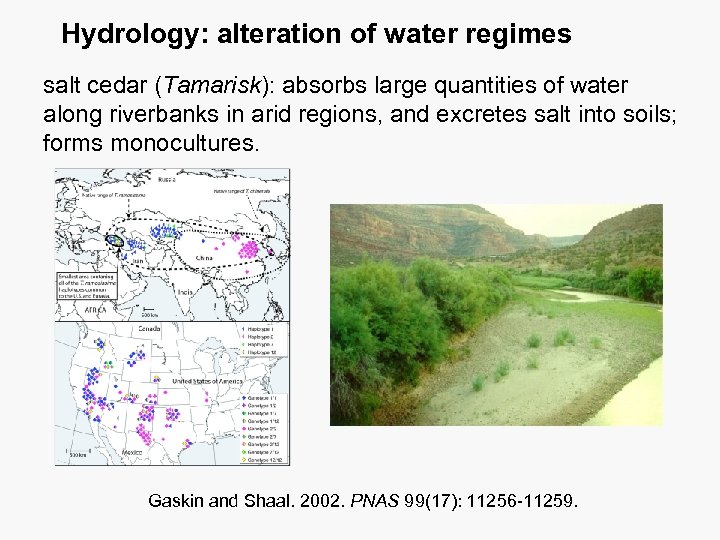
Hydrology: alteration of water regimes salt cedar (Tamarisk): absorbs large quantities of water along riverbanks in arid regions, and excretes salt into soils; forms monocultures. Gaskin and Shaal. 2002. PNAS 99(17): 11256 -11259.
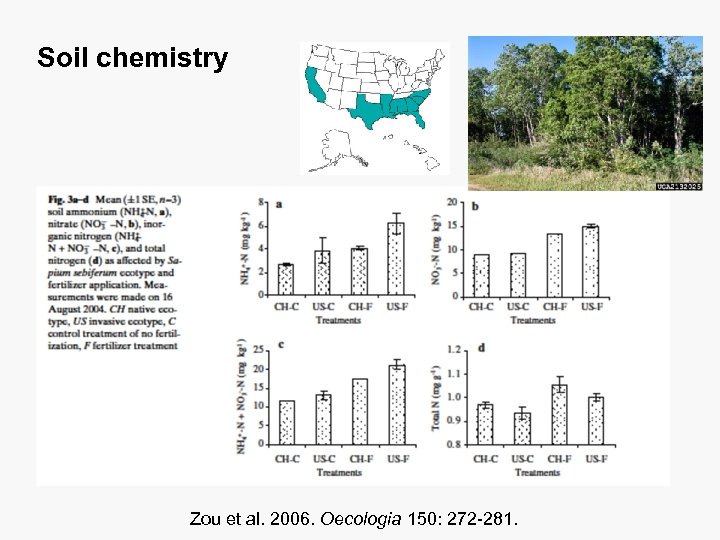
Soil chemistry Zou et al. 2006. Oecologia 150: 272 -281.
Community or Population Level Impacts Community Composition and Structure a) Predation b) Competition c) Parasitism d) Disease
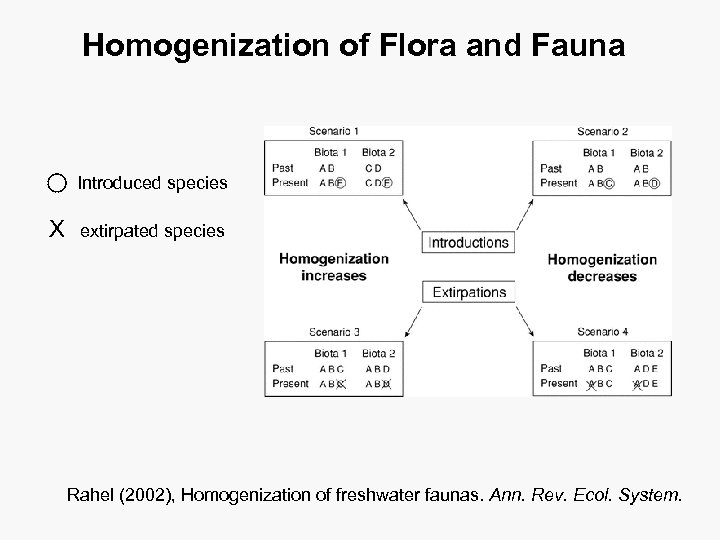
Homogenization of Flora and Fauna Introduced species X extirpated species Rahel (2002), Homogenization of freshwater faunas. Ann. Rev. Ecol. System.
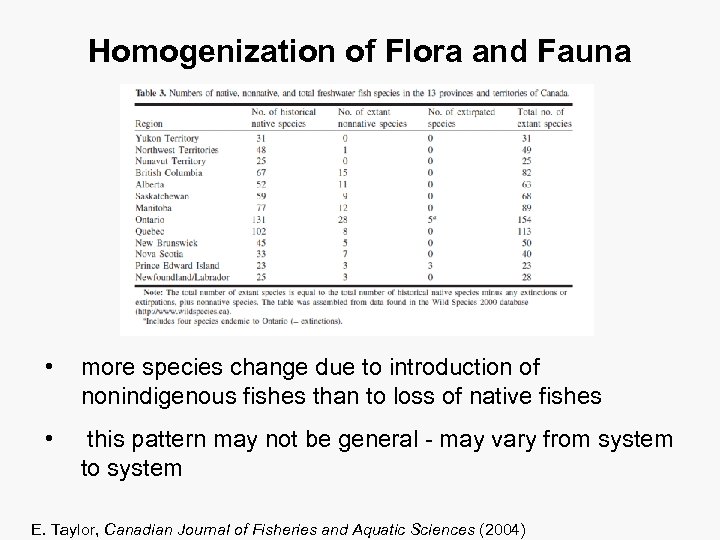
Homogenization of Flora and Fauna • more species change due to introduction of nonindigenous fishes than to loss of native fishes • this pattern may not be general - may vary from system to system E. Taylor, Canadian Journal of Fisheries and Aquatic Sciences (2004)
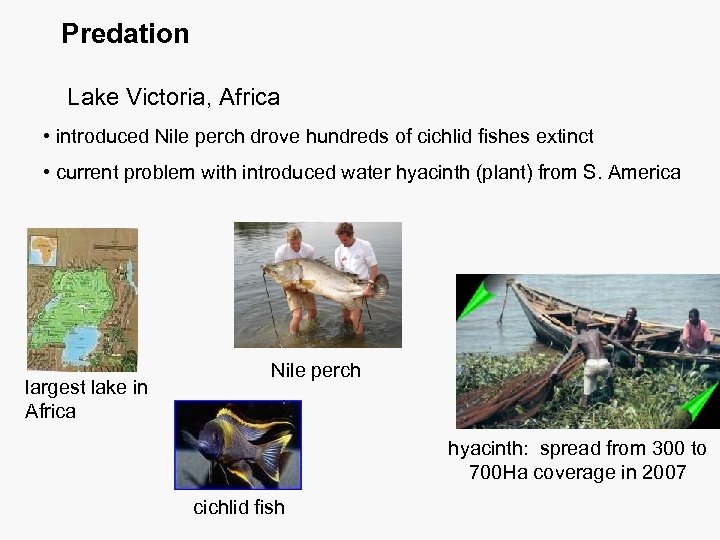
Predation Lake Victoria, Africa • introduced Nile perch drove hundreds of cichlid fishes extinct • current problem with introduced water hyacinth (plant) from S. America largest lake in Africa Nile perch hyacinth: spread from 300 to 700 Ha coverage in 2007 cichlid fish
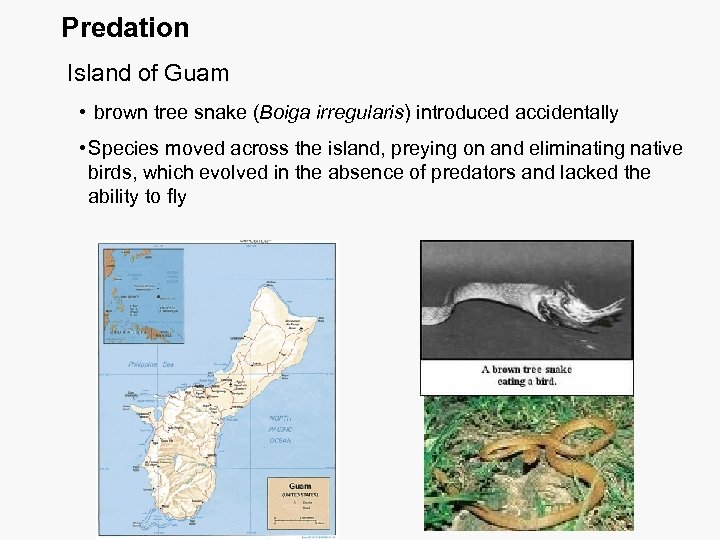
Predation Island of Guam • brown tree snake (Boiga irregularis) introduced accidentally • Species moved across the island, preying on and eliminating native birds, which evolved in the absence of predators and lacked the ability to fly
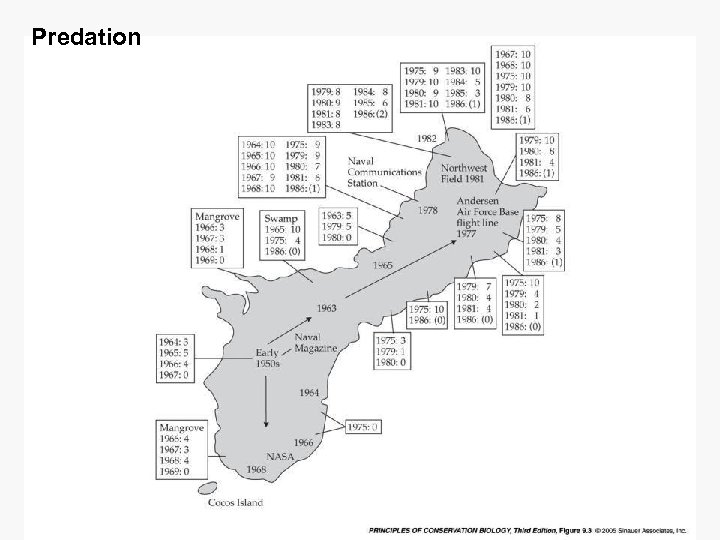
Predation
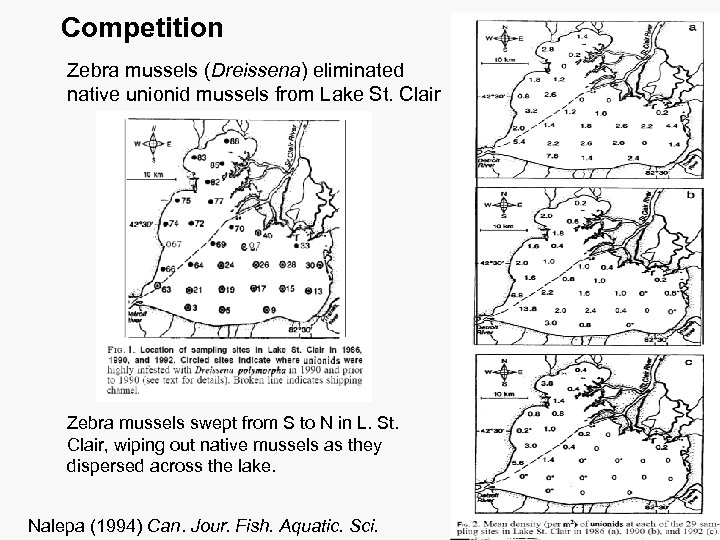
Competition Zebra mussels (Dreissena) eliminated native unionid mussels from Lake St. Clair Zebra mussels swept from S to N in L. St. Clair, wiping out native mussels as they dispersed across the lake. Nalepa (1994) Can. Jour. Fish. Aquatic. Sci.
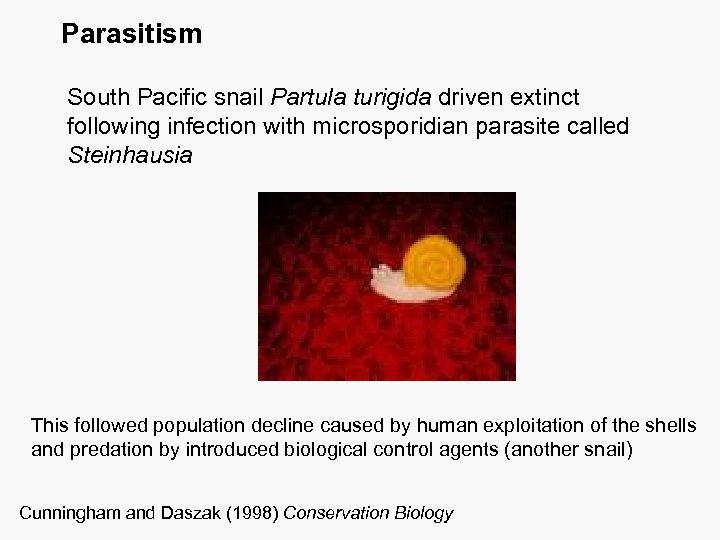
Parasitism South Pacific snail Partula turigida driven extinct following infection with microsporidian parasite called Steinhausia This followed population decline caused by human exploitation of the shells and predation by introduced biological control agents (another snail) Cunningham and Daszak (1998) Conservation Biology
Human, Plant and Animal Diseases • Cholera spread (e. g. Peru from India) • West Nile Virus (spread by birds and mosquitoes) • Dutch Elm disease (fungus arrived with beetles from Europe) • Chronic Wasting Disease (affects cattle in Alberta) • Infectious Salmon Anemia (came to farmed salmon in N. B. from Europe) • SARS and HIV in humans
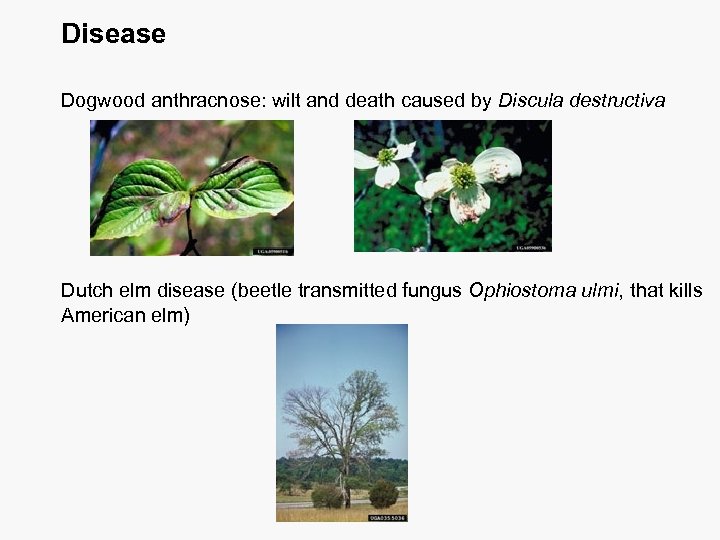
Disease Dogwood anthracnose: wilt and death caused by Discula destructiva Dutch elm disease (beetle transmitted fungus Ophiostoma ulmi, that kills American elm)
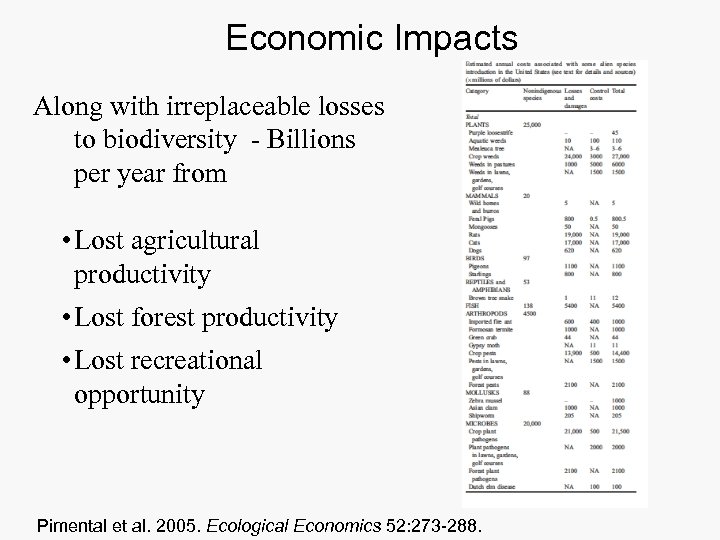
Economic Impacts Along with irreplaceable losses to biodiversity - Billions per year from • Lost agricultural productivity • Lost forest productivity • Lost recreational opportunity Pimental et al. 2005. Ecological Economics 52: 273 -288.
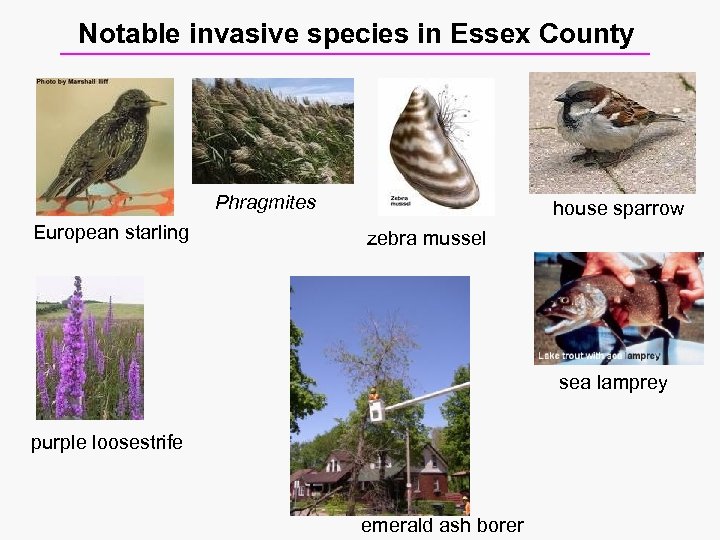
Notable invasive species in Essex County Phragmites European starling house sparrow zebra mussel sea lamprey purple loosestrife emerald ash borer
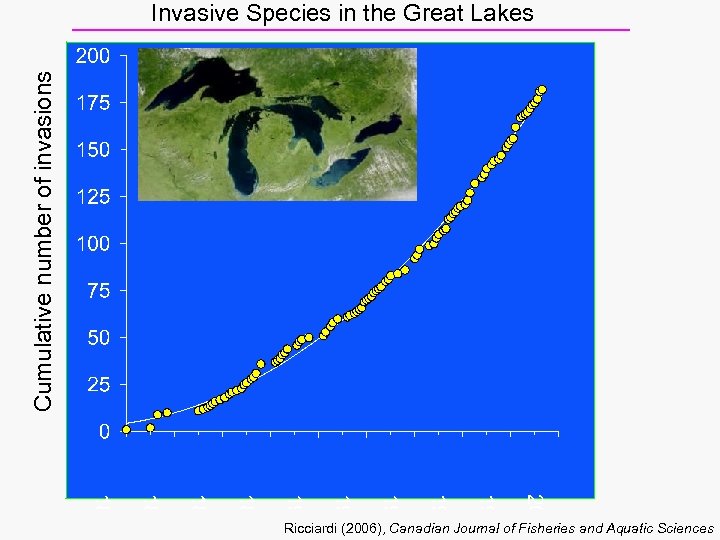
Cumulative number of invasions Invasive Species in the Great Lakes Ricciardi (2006), Canadian Journal of Fisheries and Aquatic Sciences
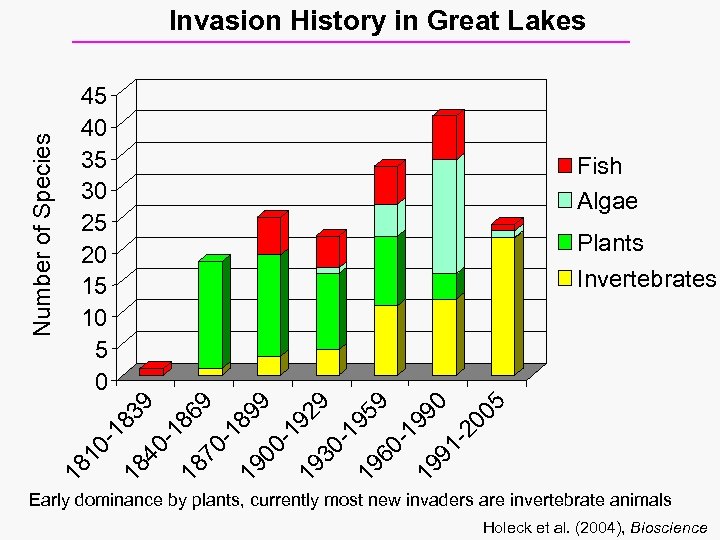
45 40 35 30 25 20 15 10 5 0 Fish Algae 5 00 -2 0 91 99 19 -1 60 19 19 30 -1 95 9 9 -1 92 9 00 19 18 70 -1 89 86 -1 40 83 18 -1 10 18 9 Plants Invertebrates 9 Number of Species Invasion History in Great Lakes Early dominance by plants, currently most new invaders are invertebrate animals Holeck et al. (2004), Bioscience
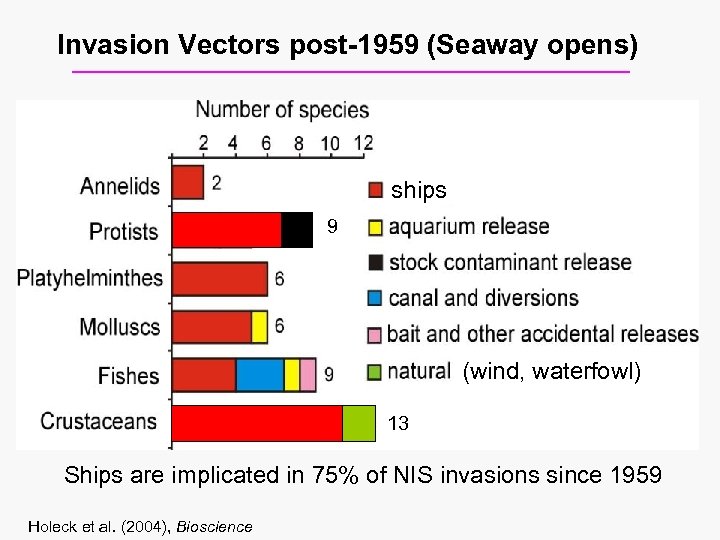
Invasion Vectors post-1959 (Seaway opens) ships 9 (wind, waterfowl) 13 Ships are implicated in 75% of NIS invasions since 1959 Holeck et al. (2004), Bioscience
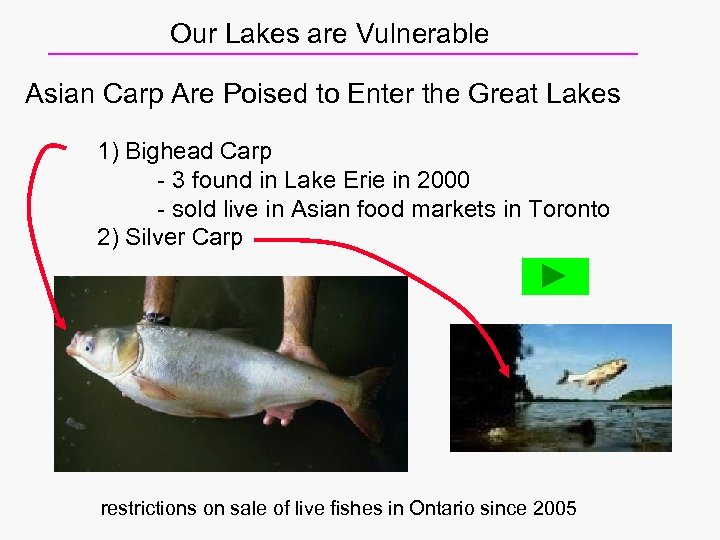
Our Lakes are Vulnerable Asian Carp Are Poised to Enter the Great Lakes 1) Bighead Carp - 3 found in Lake Erie in 2000 - sold live in Asian food markets in Toronto 2) Silver Carp restrictions on sale of live fishes in Ontario since 2005
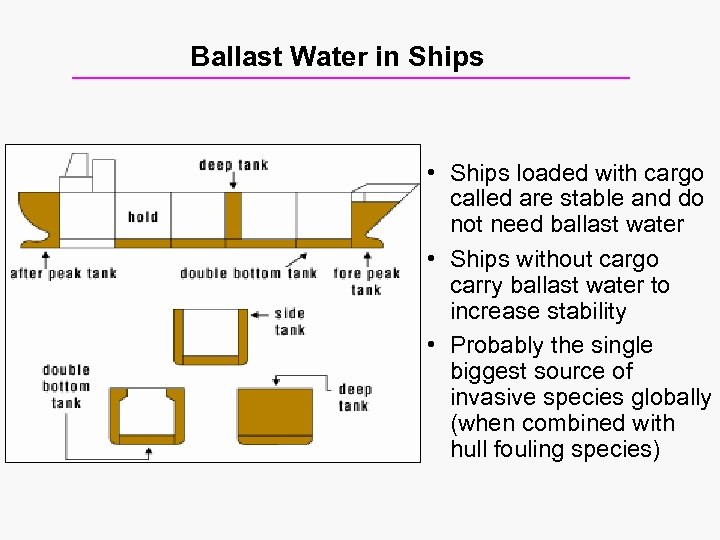
Ballast Water in Ships • Ships loaded with cargo called are stable and do not need ballast water • Ships without cargo carry ballast water to increase stability • Probably the single biggest source of invasive species globally (when combined with hull fouling species)
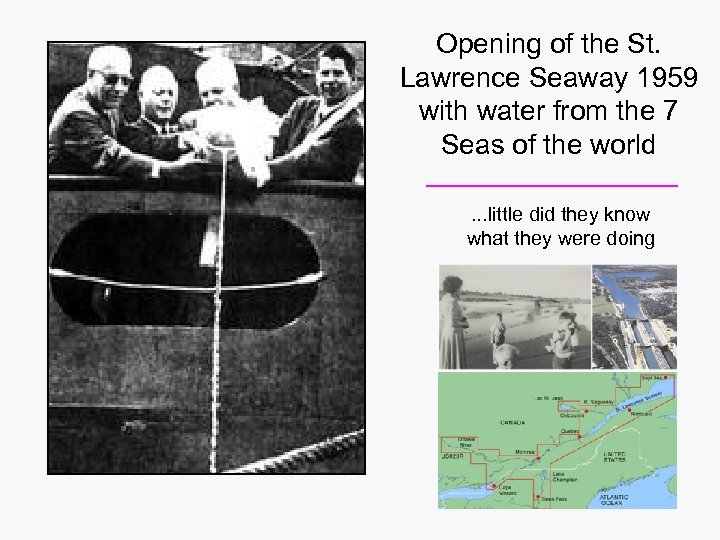
Opening of the St. Lawrence Seaway 1959 with water from the 7 Seas of the world. . . little did they know what they were doing
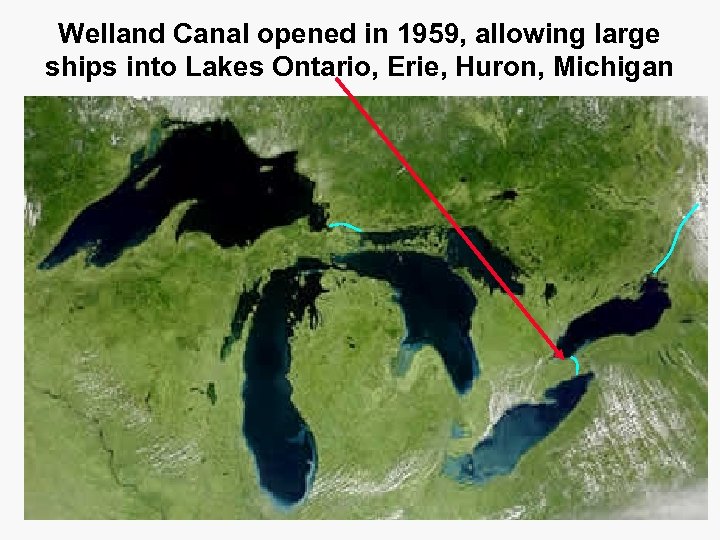
Welland Canal opened in 1959, allowing large ships into Lakes Ontario, Erie, Huron, Michigan
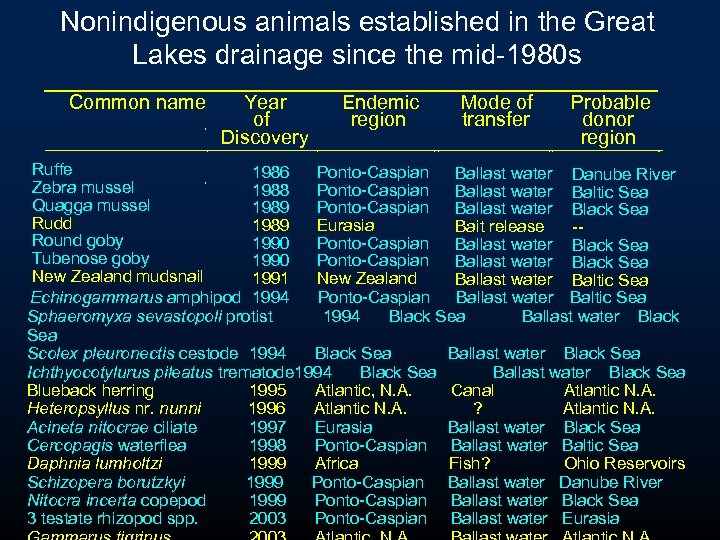
Nonindigenous animals established in the Great Lakes drainage since the mid-1980 s Common name Year of Discovery Endemic region Mode of transfer Probable donor region Ruffe 1986 Ponto-Caspian Ballast water Danube River Zebra mussel 1988 Ponto-Caspian Ballast water Baltic Sea Quagga mussel 1989 Ponto-Caspian Ballast water Black Sea Rudd 1989 Eurasia Bait release -Round goby 1990 Ponto-Caspian Ballast water Black Sea Tubenose goby 1990 Ponto-Caspian Ballast water Black Sea New Zealand mudsnail 1991 New Zealand Ballast water Baltic Sea Echinogammarus amphipod 1994 Ponto-Caspian Ballast water Baltic Sea Sphaeromyxa sevastopoli protist 1994 Black Sea Ballast water Black Sea Scolex pleuronectis cestode 1994 Black Sea Ballast water Black Sea Ichthyocotylurus pileatus trematode 1994 Black Sea Ballast water Black Sea Blueback herring 1995 Atlantic, N. A. Canal Atlantic N. A. Heteropsyllus nr. nunni 1996 Atlantic N. A. ? Atlantic N. A. Acineta nitocrae ciliate 1997 Eurasia Ballast water Black Sea Cercopagis waterflea 1998 Ponto-Caspian Ballast water Baltic Sea Daphnia lumholtzi 1999 Africa Fish? Ohio Reservoirs Schizopera borutzkyi 1999 Ponto-Caspian Ballast water Danube River Nitocra incerta copepod 1999 Ponto-Caspian Ballast water Black Sea 3 testate rhizopod spp. 2003 Ponto-Caspian Ballast water Eurasia
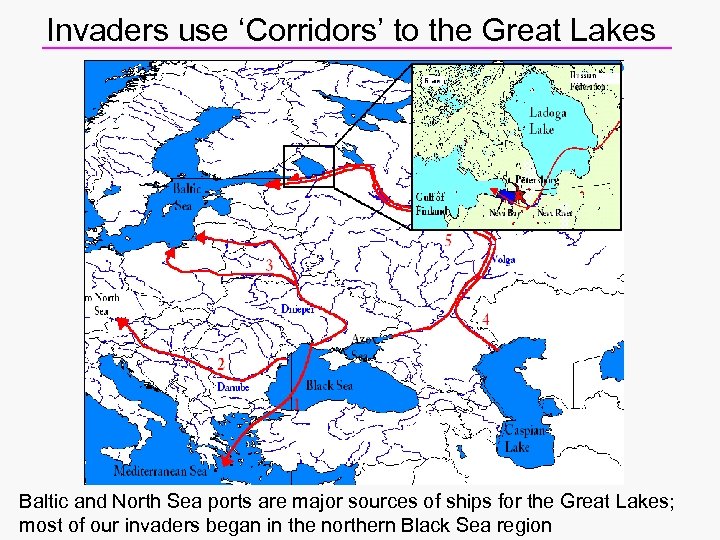
Invaders use ‘Corridors’ to the Great Lakes Baltic and North Sea ports are major sources of ships for the Great Lakes; most of our invaders began in the northern Black Sea region
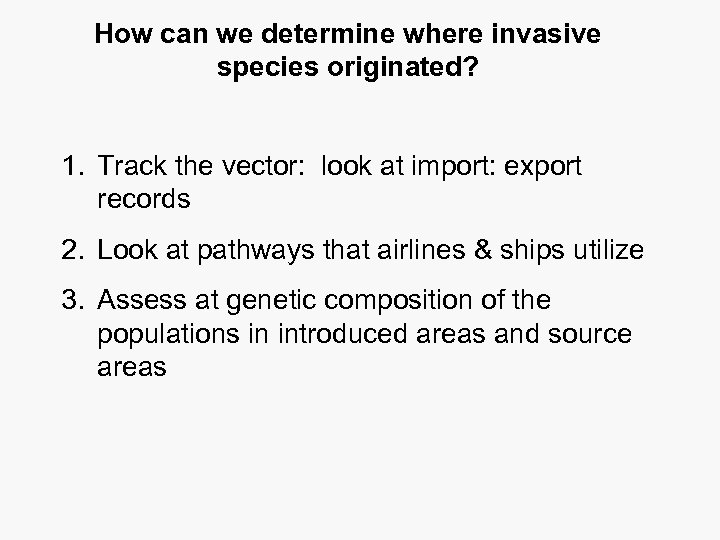
How can we determine where invasive species originated? 1. Track the vector: look at import: export records 2. Look at pathways that airlines & ships utilize 3. Assess at genetic composition of the populations in introduced areas and source areas
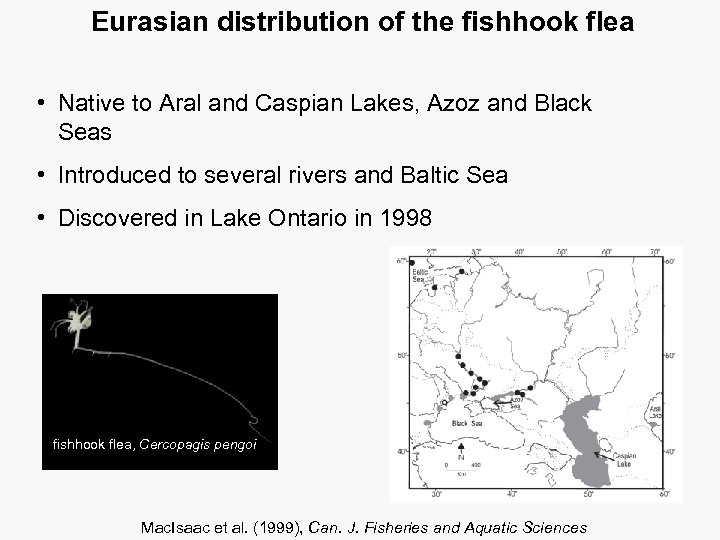
Eurasian distribution of the fishhook flea • Native to Aral and Caspian Lakes, Azoz and Black Seas • Introduced to several rivers and Baltic Sea • Discovered in Lake Ontario in 1998 fishhook flea, Cercopagis pengoi Mac. Isaac et al. (1999), Can. J. Fisheries and Aquatic Sciences
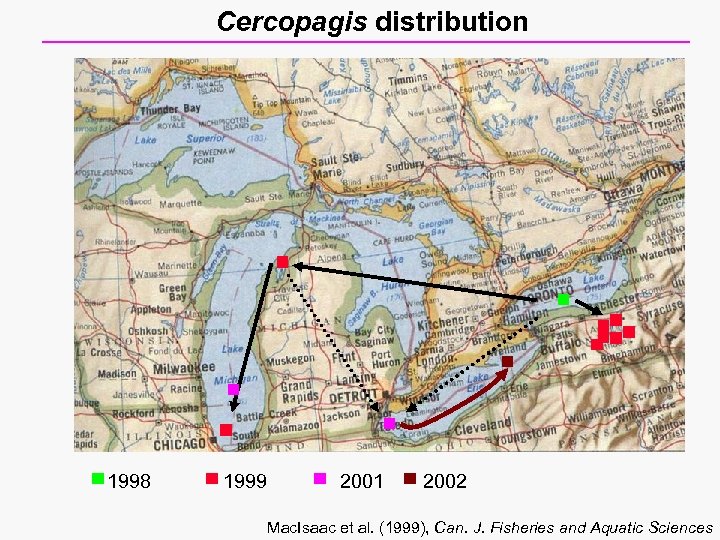
Cercopagis distribution 1998 1999 2001 2002 Mac. Isaac et al. (1999), Can. J. Fisheries and Aquatic Sciences
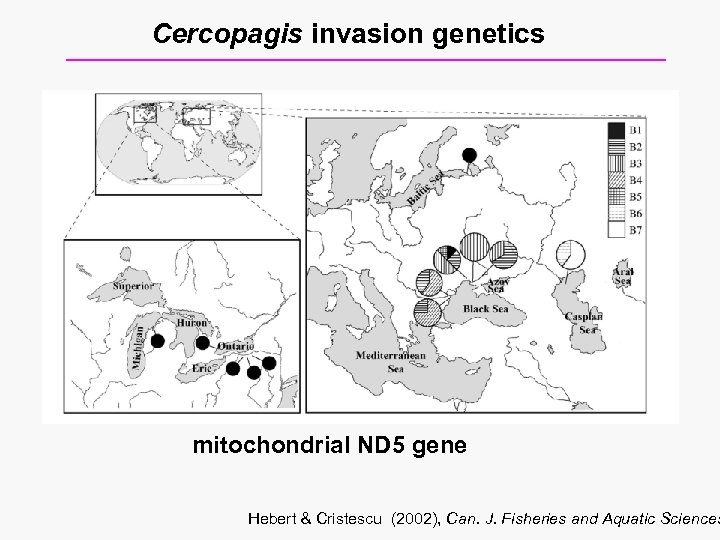
Cercopagis invasion genetics mitochondrial ND 5 gene Hebert & Cristescu (2002), Can. J. Fisheries and Aquatic Sciences
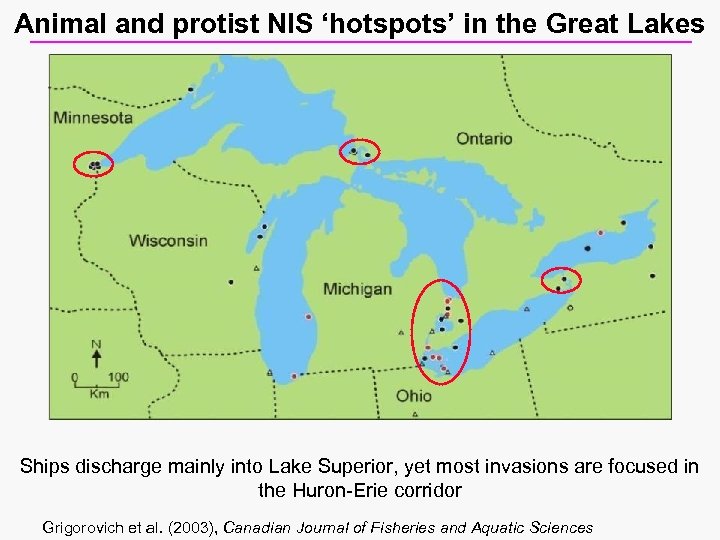
Animal and protist NIS ‘hotspots’ in the Great Lakes Ships discharge mainly into Lake Superior, yet most invasions are focused in the Huron-Erie corridor Grigorovich et al. (2003), Canadian Journal of Fisheries and Aquatic Sciences
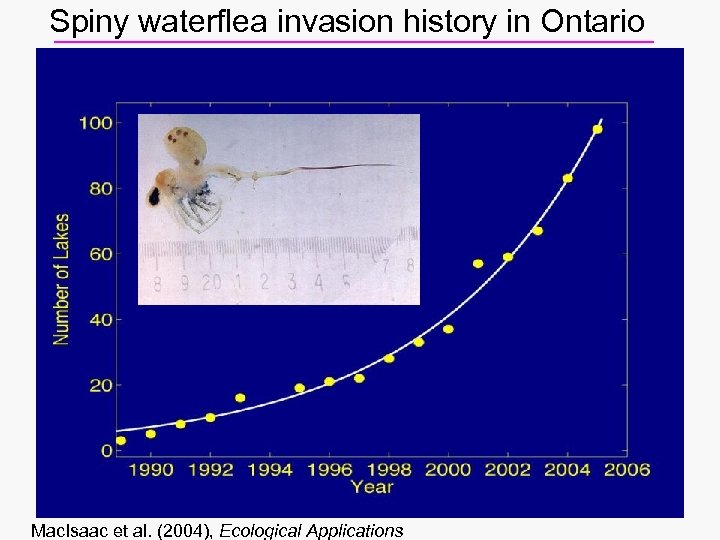
Spiny waterflea invasion history in Ontario Year Mac. Isaac et al. (2004), Ecological Applications
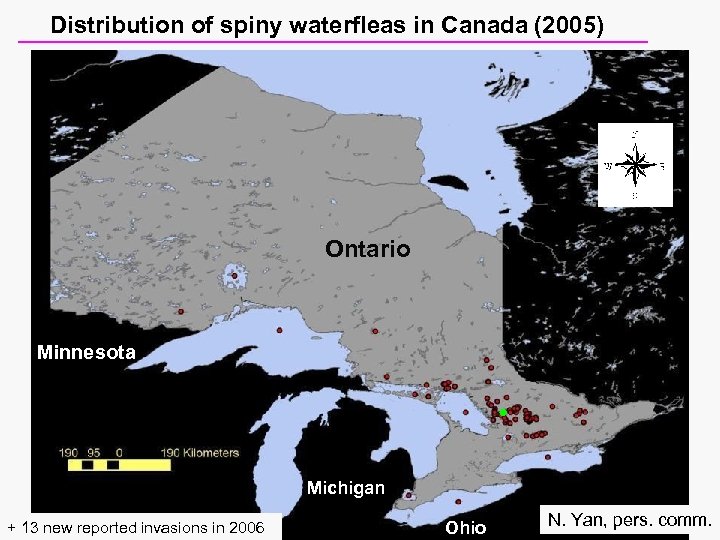
Distribution of spiny waterfleas in Canada (2005) Ontario Minnesota Michigan + 13 new reported invasions in 2006 Ohio N. Yan, pers. comm.
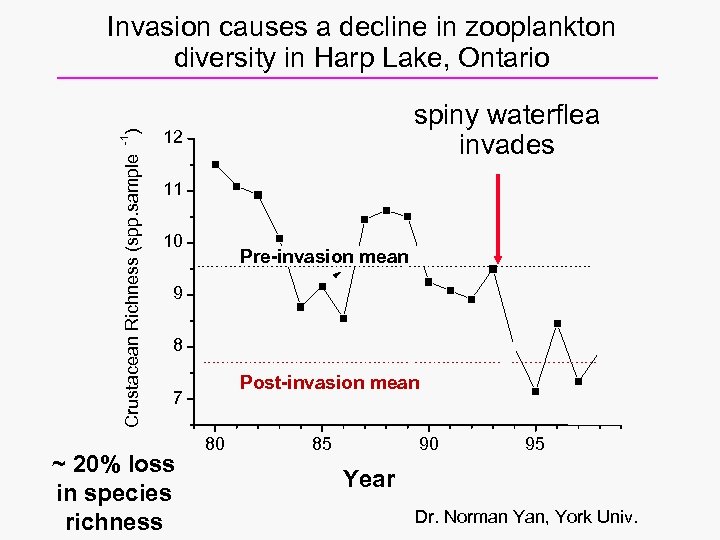
Crustacean Richness (spp. sample -1 ) Invasion causes a decline in zooplankton diversity in Harp Lake, Ontario spiny waterflea invades 12 11 10 Pre-invasion mean 9 8 Post-invasion mean 7 ~ 20% loss in species richness 80 85 90 95 Year Dr. Norman Yan, York Univ.
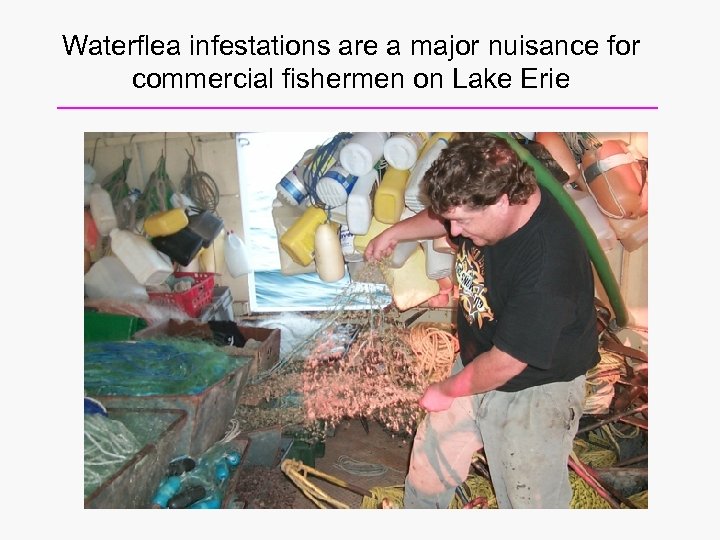
Waterflea infestations are a major nuisance for commercial fishermen on Lake Erie
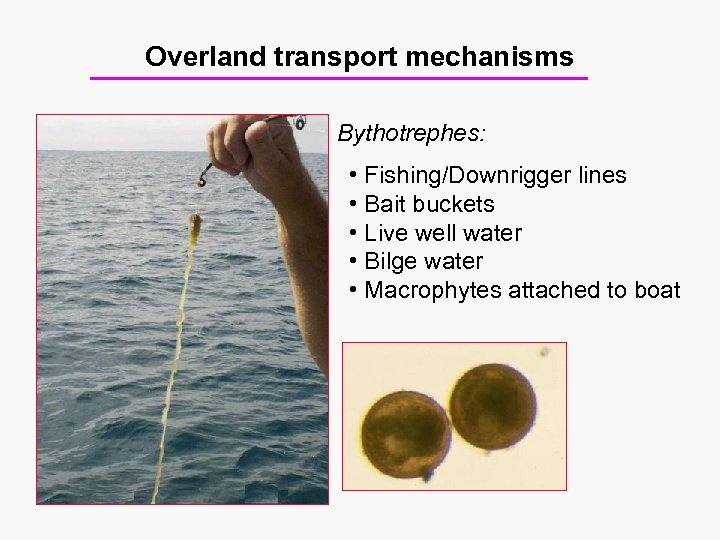
Overland transport mechanisms Bythotrephes: • Fishing/Downrigger lines • Bait buckets • Live well water • Bilge water • Macrophytes attached to boat
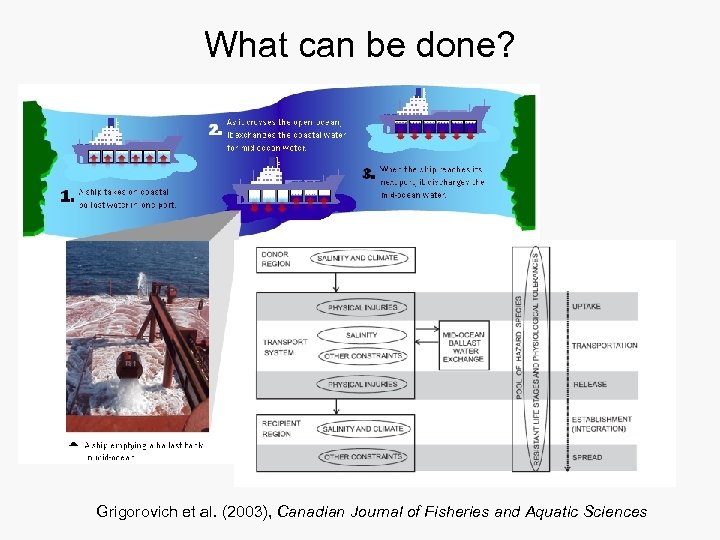
What can be done? Grigorovich et al. (2003), Canadian Journal of Fisheries and Aquatic Sciences
Скачать презентацию Invasive Species as a global threat to biodiversity
394bc777c1983e65eb07f4c11c004bdc.ppt