 Скачать презентацию Introductory COBIT Presentation Overview of IT Governance and
44435165ff4717dfb201f55a446b86be.ppt
- Количество слайдов: 42



Introductory COBIT Presentation Overview of IT Governance and the COBIT Framework © 2007 IT Governance Institute. All rights reserved. 1
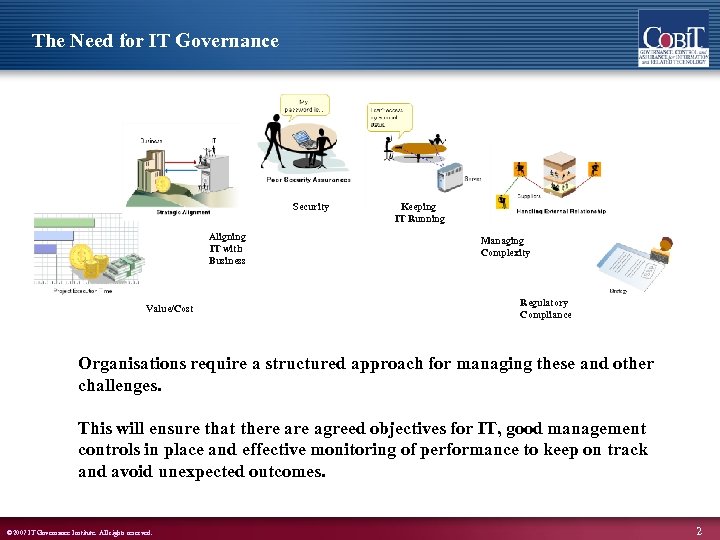
The Need for IT Governance Security Aligning IT with Business Value/Cost Keeping IT Running Managing Complexity Regulatory Compliance Organisations require a structured approach for managing these and other challenges. This will ensure that there agreed objectives for IT, good management controls in place and effective monitoring of performance to keep on track and avoid unexpected outcomes. © 2007 IT Governance Institute. All rights reserved. 2
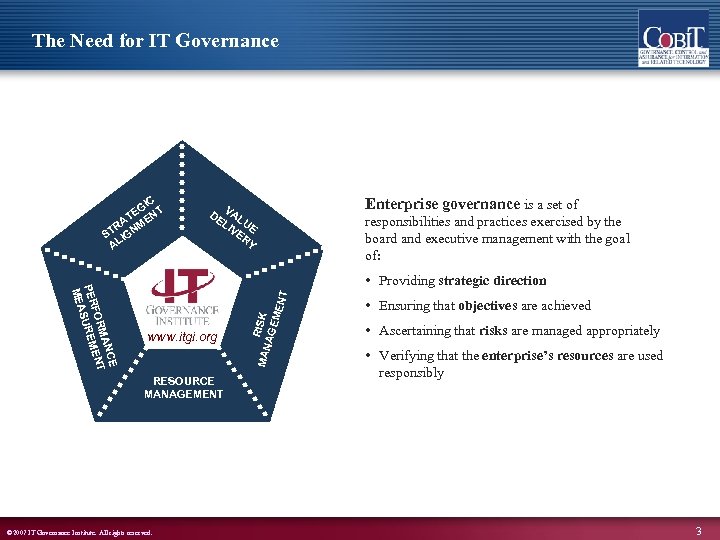
The Need for IT Governance IC EG NT AT E TR GNM S I AL Enterprise governance is a set of DE VAL LI UE VE RY responsibilities and practices exercised by the board and executive management with the goal of: T www. itgi. org RESOURCE MANAGEMENT © 2007 IT Governance Institute. All rights reserved. MAN RISK AGE MEN CE MAN NT E FOR PER SUREM MEA • Providing strategic direction • Ensuring that objectives are achieved • Ascertaining that risks are managed appropriately • Verifying that the enterprise’s resources are used responsibly 3
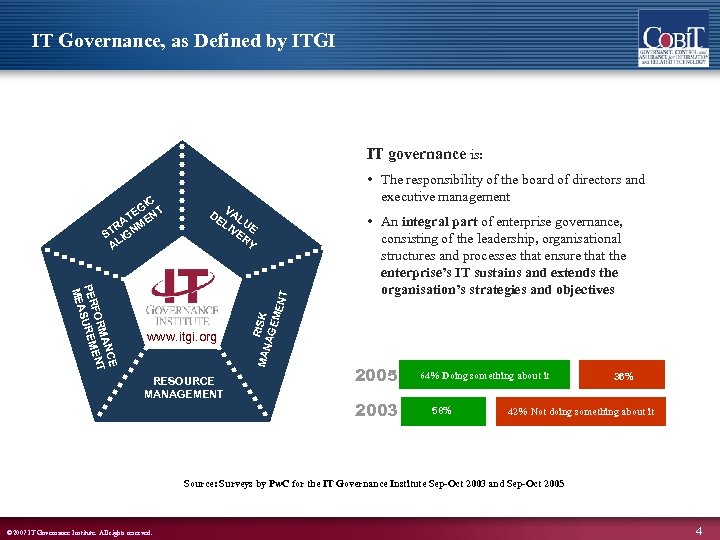
IT Governance, as Defined by ITGI IT governance is: DE VAL LI UE VE RY www. itgi. org RESOURCE MANAGEMENT MAN RISK AGE MEN CE MAN NT E FOR PER SUREM MEA T IC EG NT AT E TR GNM S I AL • The responsibility of the board of directors and executive management • An integral part of enterprise governance, consisting of the leadership, organisational structures and processes that ensure that the enterprise’s IT sustains and extends the organisation’s strategies and objectives 2005 2003 64% Doing something about it 58% 36% 42% Not doing something about it Source: Surveys by Pw. C for the IT Governance Institute Sep-Oct 2003 and Sep-Oct 2005 © 2007 IT Governance Institute. All rights reserved. 4
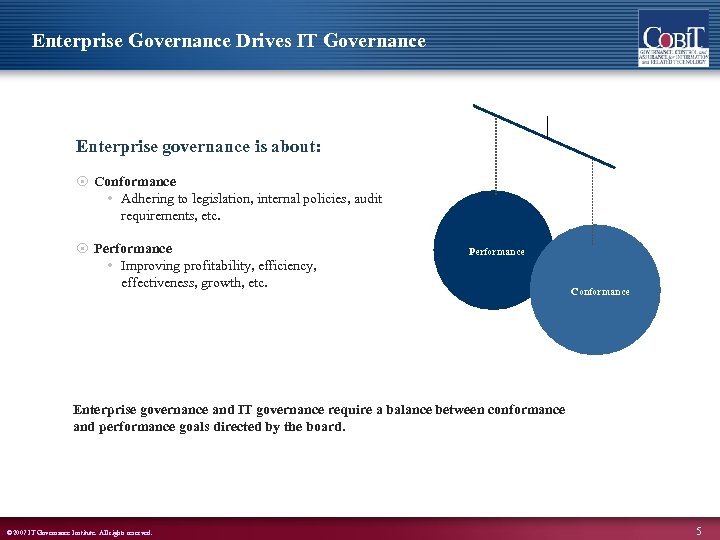
Enterprise Governance Drives IT Governance Enterprise governance is about: ¤ Conformance • Adhering to legislation, internal policies, audit requirements, etc. ¤ Performance • Improving profitability, efficiency, effectiveness, growth, etc. Performance Conformance Enterprise governance and IT governance require a balance between conformance and performance goals directed by the board. © 2007 IT Governance Institute. All rights reserved. 5
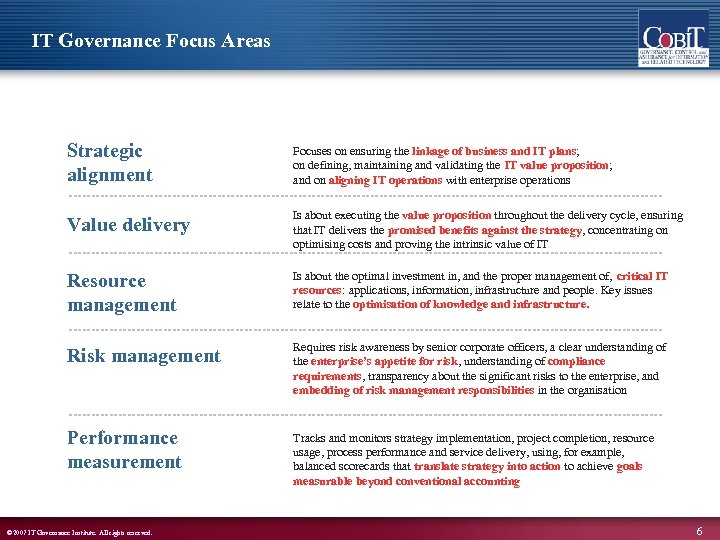
IT Governance Focus Areas Strategic alignment Focuses on ensuring the linkage of business and IT plans; on defining, maintaining and validating the IT value proposition; and on aligning IT operations with enterprise operations Value delivery Is about executing the value proposition throughout the delivery cycle, ensuring that IT delivers the promised benefits against the strategy, concentrating on optimising costs and proving the intrinsic value of IT Resource management Is about the optimal investment in, and the proper management of, critical IT resources: applications, information, infrastructure and people. Key issues relate to the optimisation of knowledge and infrastructure. Risk management Requires risk awareness by senior corporate officers, a clear understanding of the enterprise’s appetite for risk, understanding of compliance requirements, transparency about the significant risks to the enterprise, and embedding of risk management responsibilities in the organisation Performance measurement Tracks and monitors strategy implementation, project completion, resource usage, process performance and service delivery, using, for example, balanced scorecards that translate strategy into action to achieve goals measurable beyond conventional accounting © 2007 IT Governance Institute. All rights reserved. 6
Making IT Governance Work To make an IT governance implementation project successful: ¤ Make IT governance a workable solution—able to deal with the challenges and pitfalls presented by IT. ¤ Focus as much on improving performance and enabling competitive advantage as preventing problems. ¤ Make IT governance a shared responsibility between the business (customer) and the IT service provider, with the full commitment and direction of the board. ¤ Align IT governance within a wider enterprise governance scheme. ¤ Boards and executive management need to extend enterprise governance to include IT, provide the necessary leadership and organisational structures, and insist on well-managed and properly controlled processes. © 2007 IT Governance Institute. All rights reserved. 7
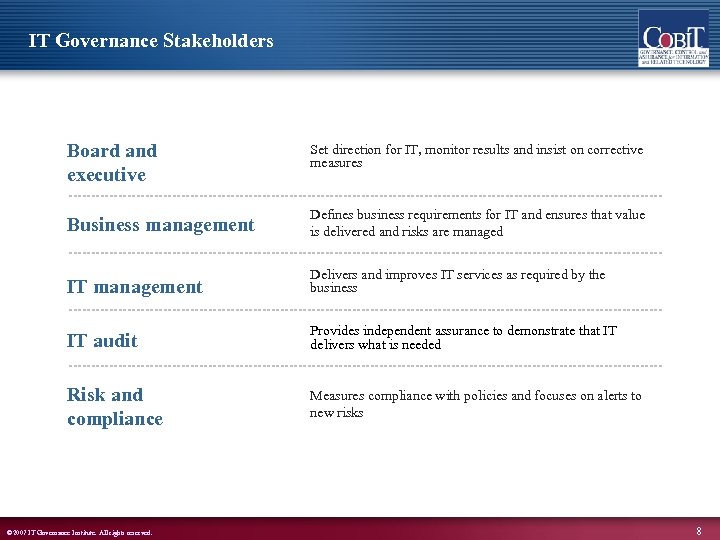
IT Governance Stakeholders Board and executive Set direction for IT, monitor results and insist on corrective measures Business management Defines business requirements for IT and ensures that value is delivered and risks are managed IT management Delivers and improves IT services as required by the business IT audit Provides independent assurance to demonstrate that IT delivers what is needed Risk and compliance Measures compliance with policies and focuses on alerts to new risks © 2007 IT Governance Institute. All rights reserved. 8
COBIT Provides a Framework for IT Governance COBIT helps bridge the gaps between business risks, control needs and technical issues. It provides good practices across a domain and process framework and presents activities in a manageable and logical structure. COBIT: ¤ Starts from business requirements ¤ Is process-oriented, organising IT activities into a generally accepted process model ¤ Identifies the major IT resources to be leveraged ¤ Defines the management control objectives to be considered ¤ Incorporates major international standards ¤ Has become the de facto standard for overall control of IT IT resources need to be managed by a set of naturally grouped processes. COBIT provides a framework that achieves this objective. © 2007 IT Governance Institute. All rights reserved. 9
How Does COBIT Help Implement Effective IT Governance? COBIT brings the following advantages to an IT governance implementation effort: ¤ Enables mapping of IT goals to business goals and vice versa ¤ Better alignment, based on a business focus ¤ A view of what IT does that is understandable to management ¤ Clear ownership and responsibilities based on process orientation ¤ General acceptability with third parties and regulators ¤ Shared understanding amongst all stakeholders, based on a common language ¤ Fulfilment of the COSO requirements for the IT control environment © 2007 IT Governance Institute. All rights reserved. 10
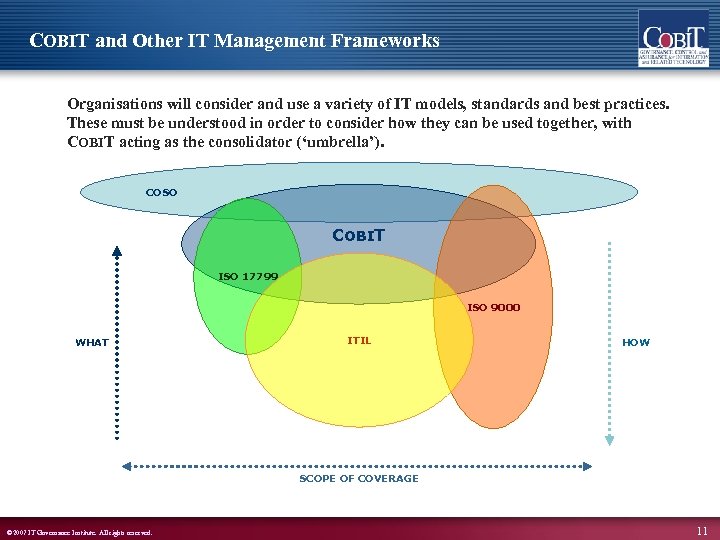
COBIT and Other IT Management Frameworks Organisations will consider and use a variety of IT models, standards and best practices. These must be understood in order to consider how they can be used together, with COBIT acting as the consolidator (‘umbrella’). COSO COBIT ISO 17799 ISO 9000 WHAT ITIL HOW SCOPE OF COVERAGE © 2007 IT Governance Institute. All rights reserved. 11
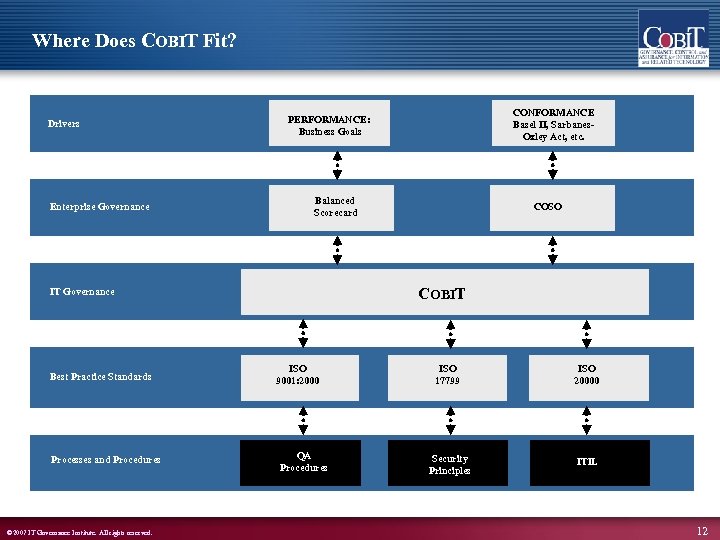
Where Does COBIT Fit? Drivers Enterprise Governance Balanced Scorecard Processes and Procedures © 2007 IT Governance Institute. All rights reserved. COSO COBIT IT Governance Best Practice Standards CONFORMANCE Basel II, Sarbanes. Oxley Act, etc. PERFORMANCE: Business Goals ISO 9001: 2000 QA Procedures ISO 17799 ISO 20000 Security Principles ITIL 12
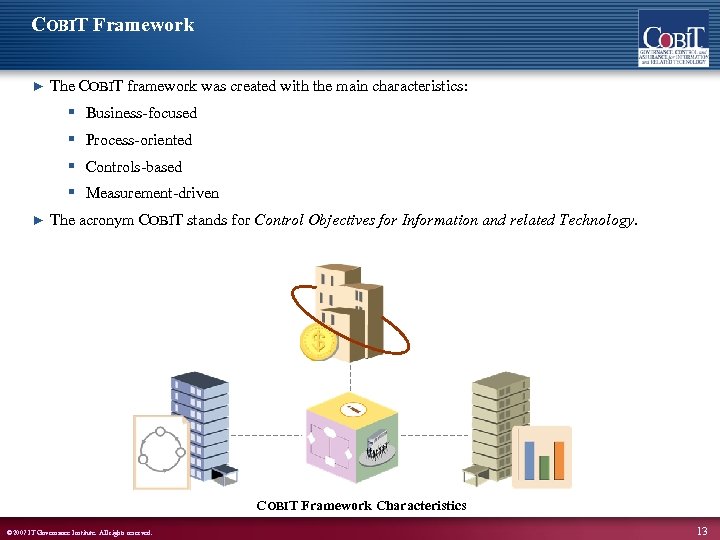
COBIT Framework ► The COBIT framework was created with the main characteristics: § Business-focused § Process-oriented § Controls-based § Measurement-driven ► The acronym COBIT stands for Control Objectives for Information and related Technology. COBIT Framework Characteristics © 2007 IT Governance Institute. All rights reserved. 13
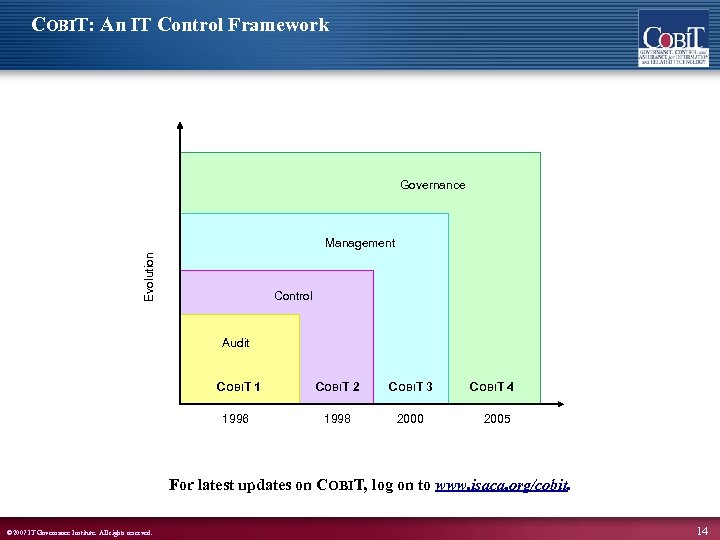
COBIT: An IT Control Framework Governance Evolution Management Control Audit COBIT 1 COBIT 2 COBIT 3 1996 1998 2000 COBIT 4 2005 For latest updates on COBIT, log on to www. isaca. org/cobit. © 2007 IT Governance Institute. All rights reserved. 14
COBIT: Value and Limitations COBIT: ► Has internationally accepted good practices ► Is management-oriented ► Is supported by tools and training ► Is freely downloadable ► Allows the knowledge of expert volunteers to be shared and leveraged ► Continually evolves ► Is maintained by a reputable not-for-profit organisation ► Maps 100 percent to COSO ► Maps strongly to all major, related standards ► Is a reference, not an ‘off-the-shelf’ cure Enterprises still need to analyse control requirements and customise COBIT based on their: ► Value drivers ► Risk profile ► IT infrastructure, organisation and project portfolio © 2007 IT Governance Institute. All rights reserved. 15
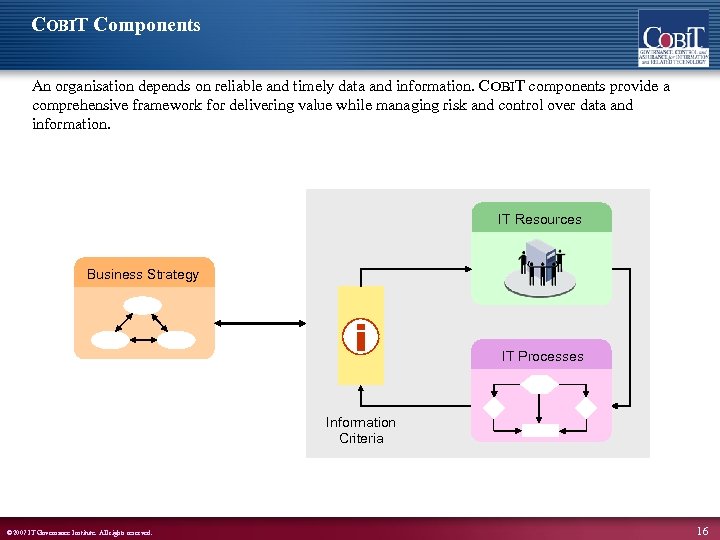
COBIT Components An organisation depends on reliable and timely data and information. COBIT components provide a comprehensive framework for delivering value while managing risk and control over data and information. IT Resources Business Strategy IT Processes Information Criteria © 2007 IT Governance Institute. All rights reserved. 16
COBIT: Advantages Some of the advantages of adopting COBIT are: ► COBIT is aligned with other standards and good practices and should be used together with them. ► COBIT’s framework and supporting best practices provide a well-managed and flexible IT environment in an organisation. ► COBIT provides a control environment that is responsive to business needs and serves management and audit functions in terms of their control responsibilities. ► COBIT provides tools to help manage IT activities. © 2007 IT Governance Institute. All rights reserved. 17
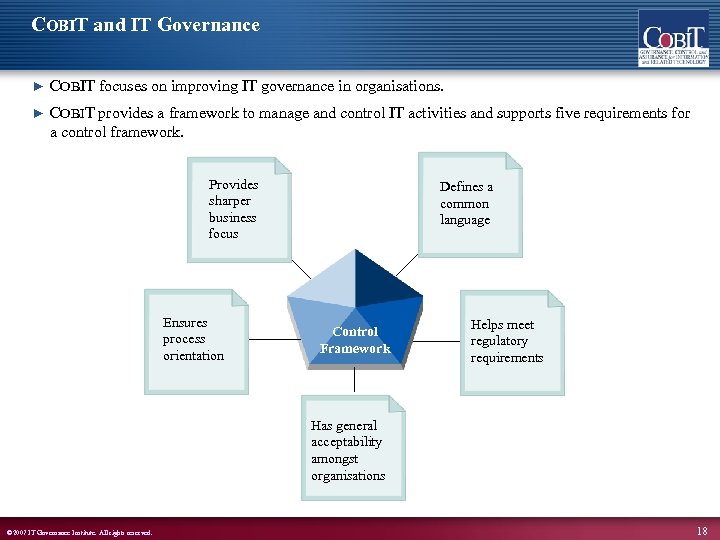
COBIT and IT Governance ► COBIT focuses on improving IT governance in organisations. ► COBIT provides a framework to manage and control IT activities and supports five requirements for a control framework. Provides sharper business focus Ensures process orientation Defines a common language Control Framework Helps meet regulatory requirements Has general acceptability amongst organisations © 2007 IT Governance Institute. All rights reserved. 18
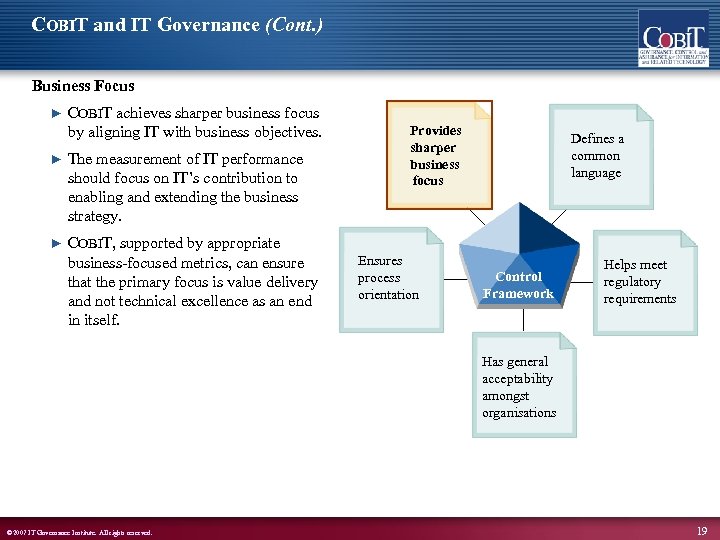
COBIT and IT Governance (Cont. ) Business Focus ► COBIT achieves sharper business focus by aligning IT with business objectives. ► The measurement of IT performance should focus on IT’s contribution to enabling and extending the business strategy. ► COBIT, supported by appropriate business-focused metrics, can ensure that the primary focus is value delivery and not technical excellence as an end in itself. Provides sharper business focus Ensures process orientation Defines a common language Control Framework Helps meet regulatory requirements Has general acceptability amongst organisations © 2007 IT Governance Institute. All rights reserved. 19
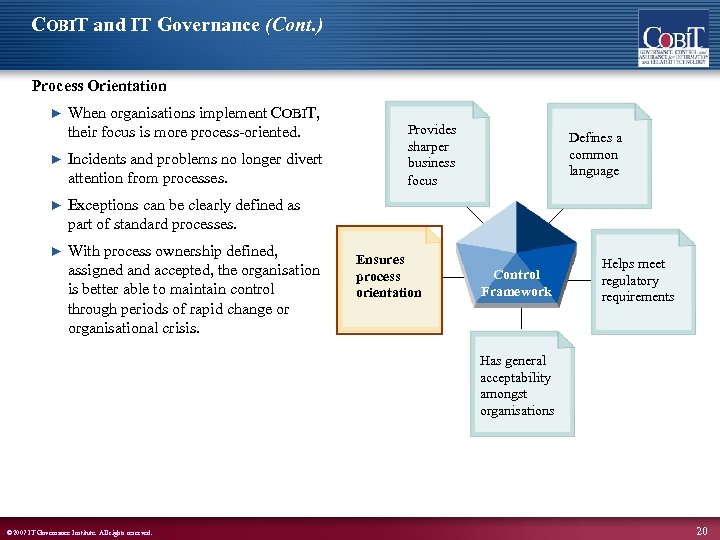
COBIT and IT Governance (Cont. ) Process Orientation ► When organisations implement COBIT, their focus is more process-oriented. ► Incidents and problems no longer divert attention from processes. ► With process ownership defined, assigned and accepted, the organisation is better able to maintain control through periods of rapid change or organisational crisis. Defines a common language Exceptions can be clearly defined as part of standard processes. ► Provides sharper business focus Ensures process orientation Control Framework Helps meet regulatory requirements Has general acceptability amongst organisations © 2007 IT Governance Institute. All rights reserved. 20
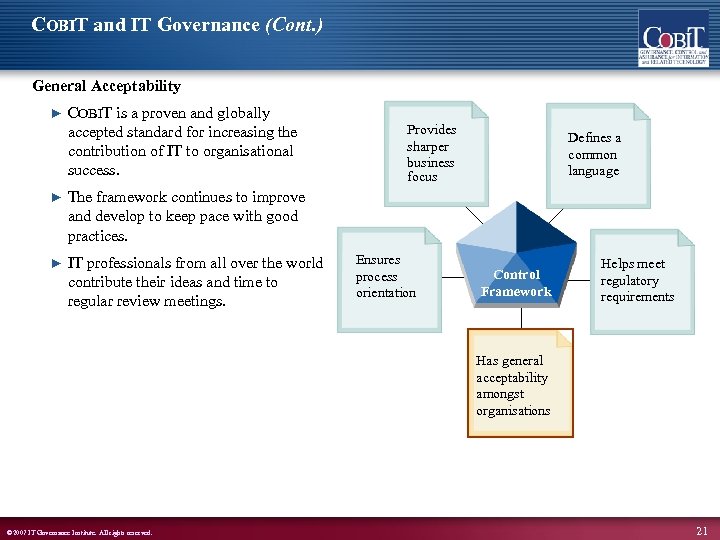
COBIT and IT Governance (Cont. ) General Acceptability ► COBIT is a proven and globally accepted standard for increasing the contribution of IT to organisational success. ► IT professionals from all over the world contribute their ideas and time to regular review meetings. Defines a common language The framework continues to improve and develop to keep pace with good practices. ► Provides sharper business focus Ensures process orientation Control Framework Helps meet regulatory requirements Has general acceptability amongst organisations © 2007 IT Governance Institute. All rights reserved. 21
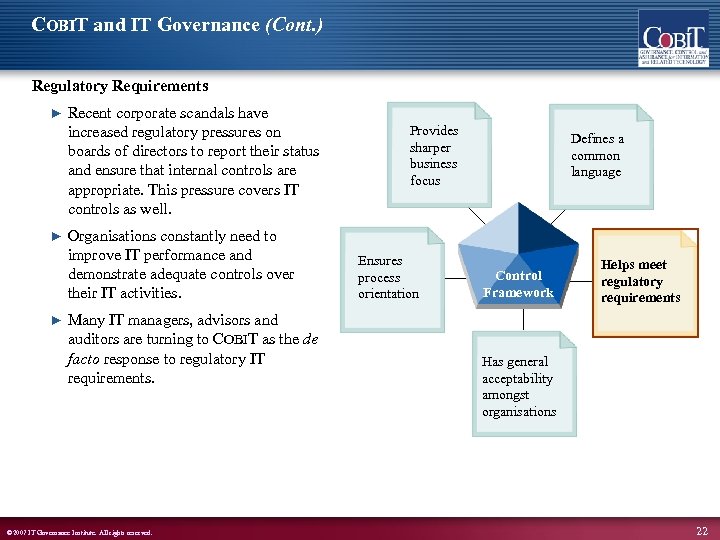
COBIT and IT Governance (Cont. ) Regulatory Requirements ► ► ► Recent corporate scandals have increased regulatory pressures on boards of directors to report their status and ensure that internal controls are appropriate. This pressure covers IT controls as well. Organisations constantly need to improve IT performance and demonstrate adequate controls over their IT activities. Many IT managers, advisors and auditors are turning to COBIT as the de facto response to regulatory IT requirements. © 2007 IT Governance Institute. All rights reserved. Provides sharper business focus Ensures process orientation Defines a common language Control Framework Helps meet regulatory requirements Has general acceptability amongst organisations 22
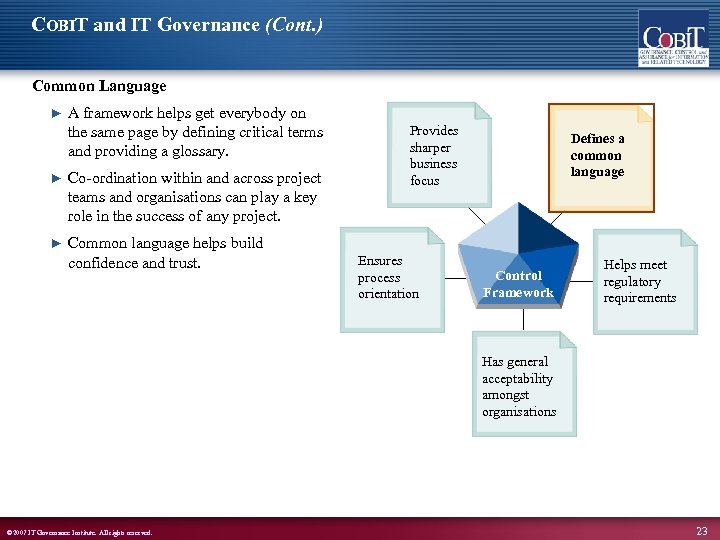
COBIT and IT Governance (Cont. ) Common Language ► A framework helps get everybody on the same page by defining critical terms and providing a glossary. ► Co-ordination within and across project teams and organisations can play a key role in the success of any project. ► Common language helps build confidence and trust. Provides sharper business focus Ensures process orientation Defines a common language Control Framework Helps meet regulatory requirements Has general acceptability amongst organisations © 2007 IT Governance Institute. All rights reserved. 23
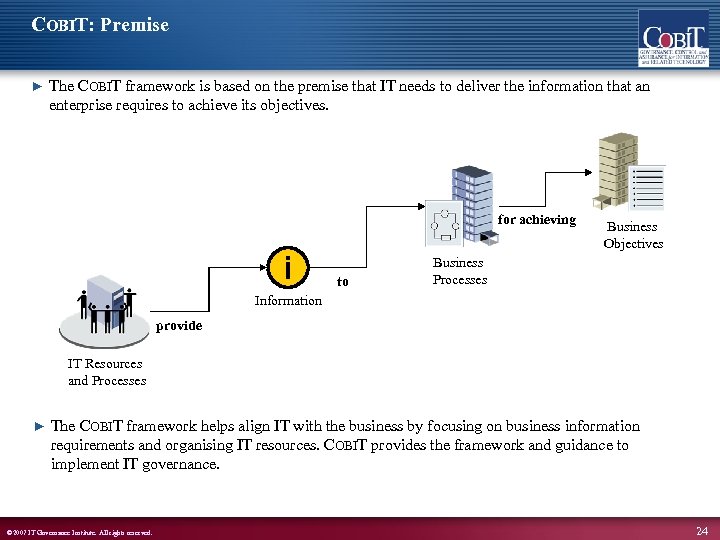
COBIT: Premise ► The COBIT framework is based on the premise that IT needs to deliver the information that an enterprise requires to achieve its objectives. for achieving i to Business Objectives Business Processes Information provide IT Resources and Processes ► The COBIT framework helps align IT with the business by focusing on business information requirements and organising IT resources. COBIT provides the framework and guidance to implement IT governance. © 2007 IT Governance Institute. All rights reserved. 24
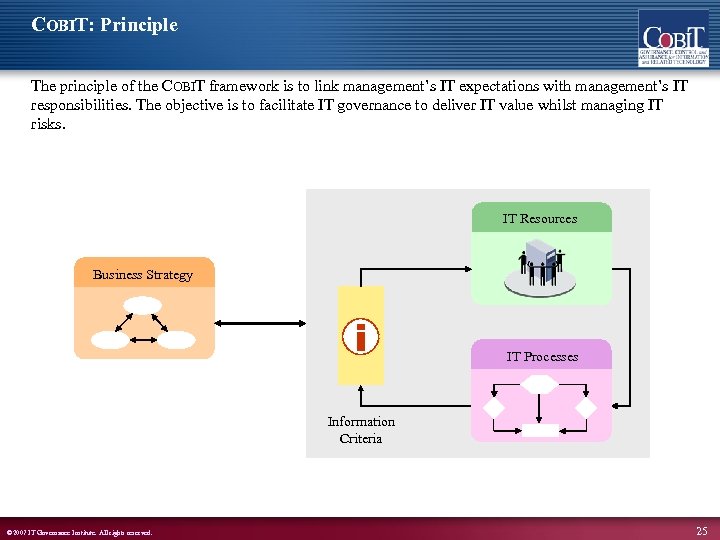
COBIT: Principle The principle of the COBIT framework is to link management’s IT expectations with management’s IT responsibilities. The objective is to facilitate IT governance to deliver IT value whilst managing IT risks. IT Resources Business Strategy IT Processes Information Criteria © 2007 IT Governance Institute. All rights reserved. 25
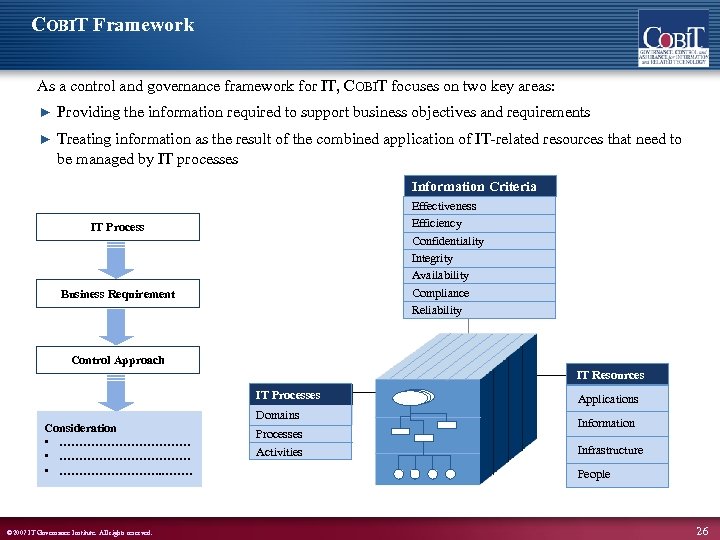
COBIT Framework As a control and governance framework for IT, COBIT focuses on two key areas: ► Providing the information required to support business objectives and requirements ► Treating information as the result of the combined application of IT-related resources that need to be managed by IT processes Information Criteria Effectiveness Efficiency Confidentiality Integrity Availability Compliance Reliability IT Process Business Requirement Control Approach IT Resources IT Processes Consideration • …………………………… • …………. . © 2007 IT Governance Institute. All rights reserved. Domains Processes Activities Applications Information Infrastructure People 26
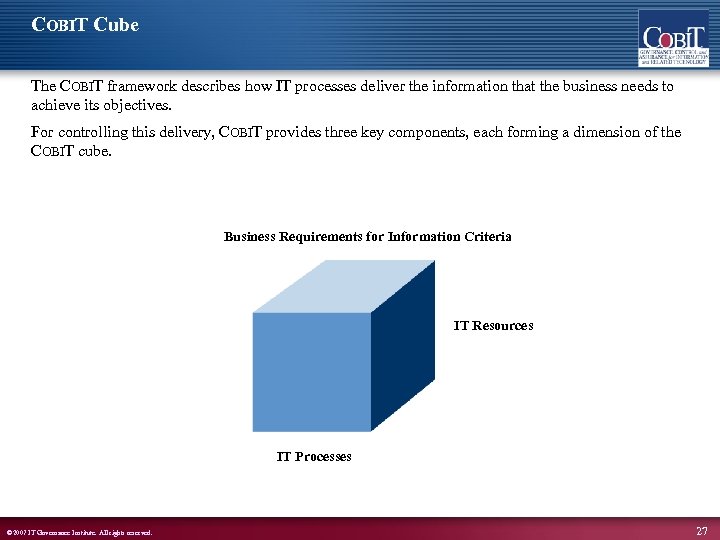
COBIT Cube The COBIT framework describes how IT processes deliver the information that the business needs to achieve its objectives. For controlling this delivery, COBIT provides three key components, each forming a dimension of the COBIT cube. Business Requirements for Information Criteria IT Resources IT Processes © 2007 IT Governance Institute. All rights reserved. 27
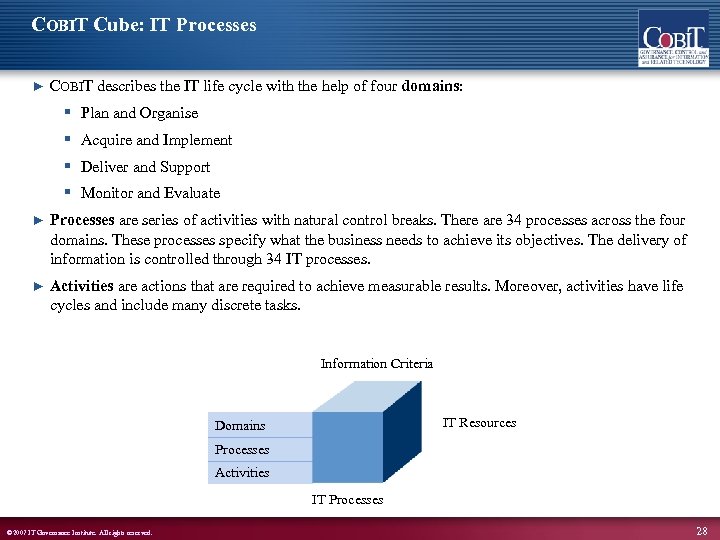
COBIT Cube: IT Processes ► COBIT describes the IT life cycle with the help of four domains: § Plan and Organise § Acquire and Implement § Deliver and Support § Monitor and Evaluate ► Processes are series of activities with natural control breaks. There are 34 processes across the four domains. These processes specify what the business needs to achieve its objectives. The delivery of information is controlled through 34 IT processes. ► Activities are actions that are required to achieve measurable results. Moreover, activities have life cycles and include many discrete tasks. Information Criteria IT Resources Domains Processes Activities IT Processes © 2007 IT Governance Institute. All rights reserved. 28
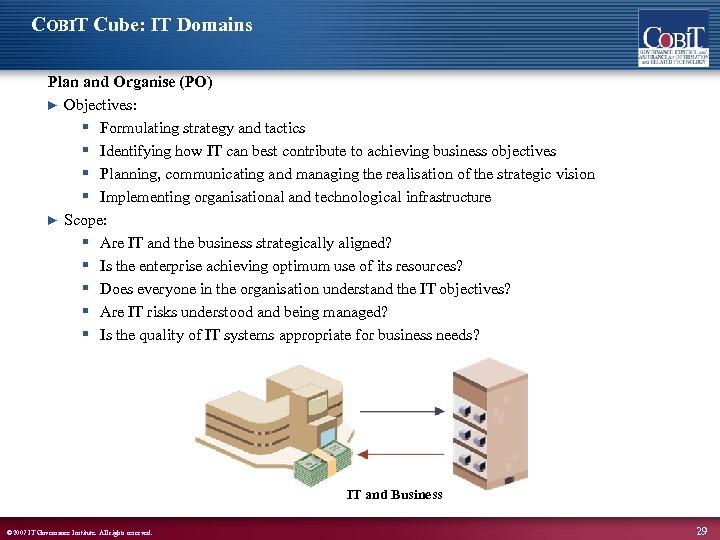
COBIT Cube: IT Domains Plan and Organise (PO) ► Objectives: § Formulating strategy and tactics § Identifying how IT can best contribute to achieving business objectives § Planning, communicating and managing the realisation of the strategic vision § Implementing organisational and technological infrastructure ► Scope: § Are IT and the business strategically aligned? § Is the enterprise achieving optimum use of its resources? § Does everyone in the organisation understand the IT objectives? § Are IT risks understood and being managed? § Is the quality of IT systems appropriate for business needs? IT and Business © 2007 IT Governance Institute. All rights reserved. 29
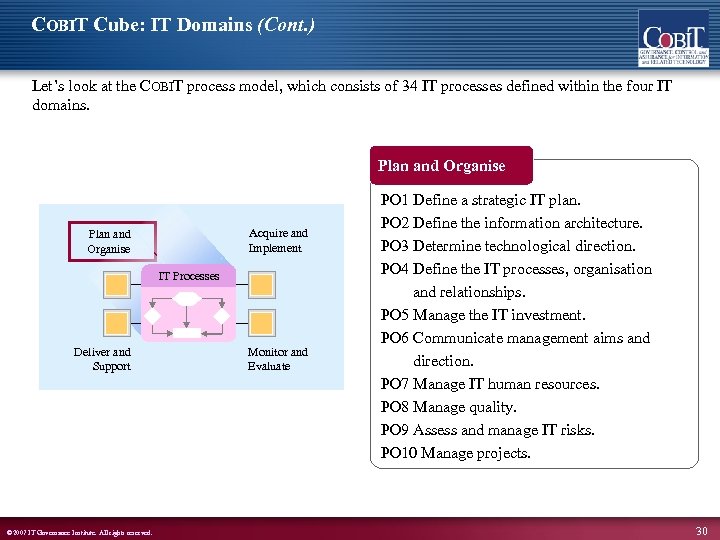
COBIT Cube: IT Domains (Cont. ) Let’s look at the COBIT process model, which consists of 34 IT processes defined within the four IT domains. Plan and Organise Acquire and Implement Plan and Organise IT Processes Deliver and Support © 2007 IT Governance Institute. All rights reserved. Monitor and Evaluate PO 1 Define a strategic IT plan. PO 2 Define the information architecture. PO 3 Determine technological direction. PO 4 Define the IT processes, organisation and relationships. PO 5 Manage the IT investment. PO 6 Communicate management aims and direction. PO 7 Manage IT human resources. PO 8 Manage quality. PO 9 Assess and manage IT risks. PO 10 Manage projects. 30
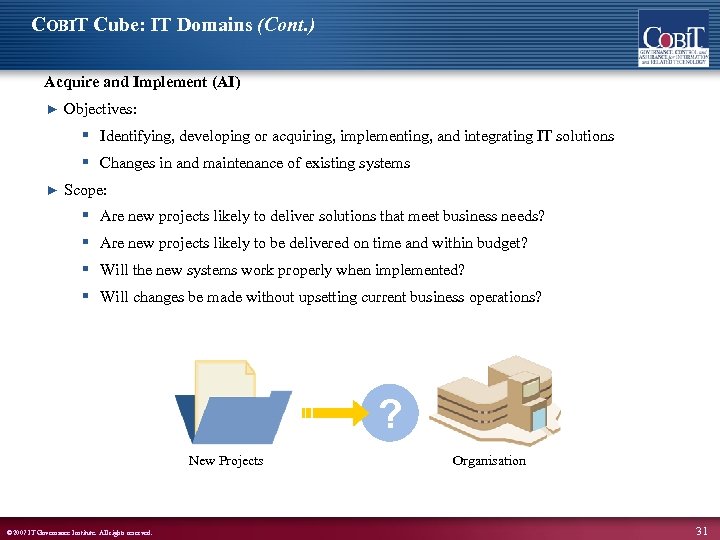
COBIT Cube: IT Domains (Cont. ) Acquire and Implement (AI) ► Objectives: § Identifying, developing or acquiring, implementing, and integrating IT solutions § Changes in and maintenance of existing systems ► Scope: § Are new projects likely to deliver solutions that meet business needs? § Are new projects likely to be delivered on time and within budget? § Will the new systems work properly when implemented? § Will changes be made without upsetting current business operations? ? New Projects © 2007 IT Governance Institute. All rights reserved. Organisation 31
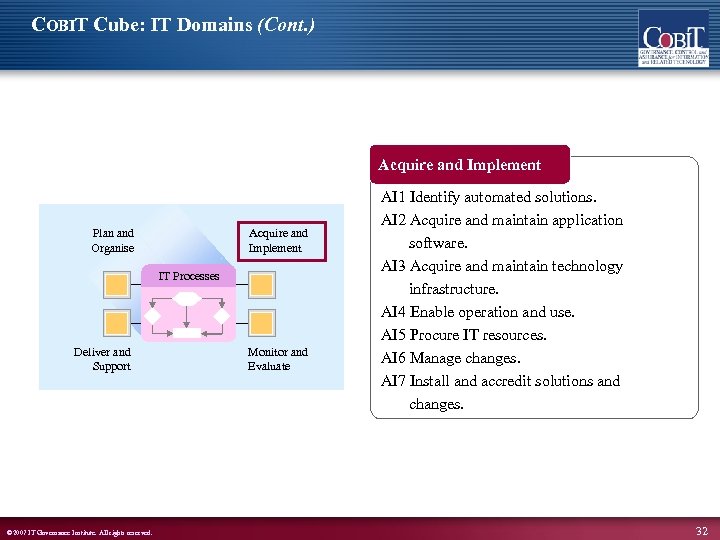
COBIT Cube: IT Domains (Cont. ) Acquire and Implement Plan and Organise Acquire and Implement IT Processes Deliver and Support © 2007 IT Governance Institute. All rights reserved. Monitor and Evaluate AI 1 Identify automated solutions. AI 2 Acquire and maintain application software. AI 3 Acquire and maintain technology infrastructure. AI 4 Enable operation and use. AI 5 Procure IT resources. AI 6 Manage changes. AI 7 Install and accredit solutions and changes. 32
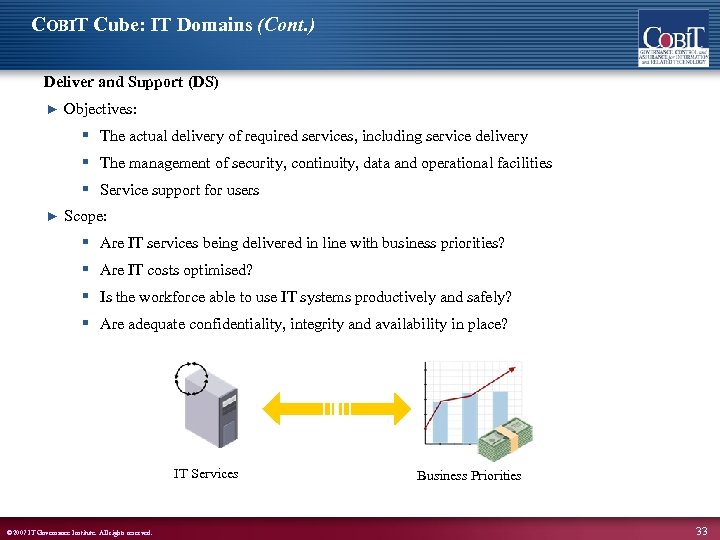
COBIT Cube: IT Domains (Cont. ) Deliver and Support (DS) ► Objectives: § The actual delivery of required services, including service delivery § The management of security, continuity, data and operational facilities § Service support for users ► Scope: § Are IT services being delivered in line with business priorities? § Are IT costs optimised? § Is the workforce able to use IT systems productively and safely? § Are adequate confidentiality, integrity and availability in place? IT Services © 2007 IT Governance Institute. All rights reserved. Business Priorities 33
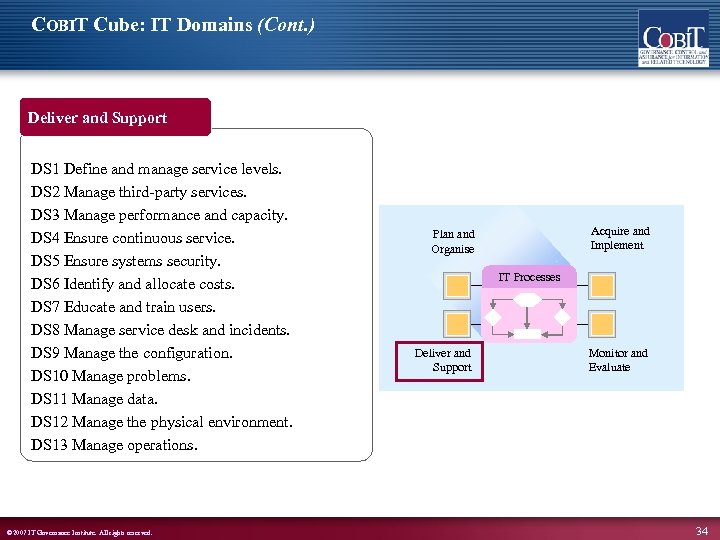
COBIT Cube: IT Domains (Cont. ) Deliver and Support DS 1 Define and manage service levels. DS 2 Manage third-party services. DS 3 Manage performance and capacity. DS 4 Ensure continuous service. DS 5 Ensure systems security. DS 6 Identify and allocate costs. DS 7 Educate and train users. DS 8 Manage service desk and incidents. DS 9 Manage the configuration. DS 10 Manage problems. DS 11 Manage data. DS 12 Manage the physical environment. DS 13 Manage operations. © 2007 IT Governance Institute. All rights reserved. Acquire and Implement Plan and Organise IT Processes Deliver and Support Monitor and Evaluate 34
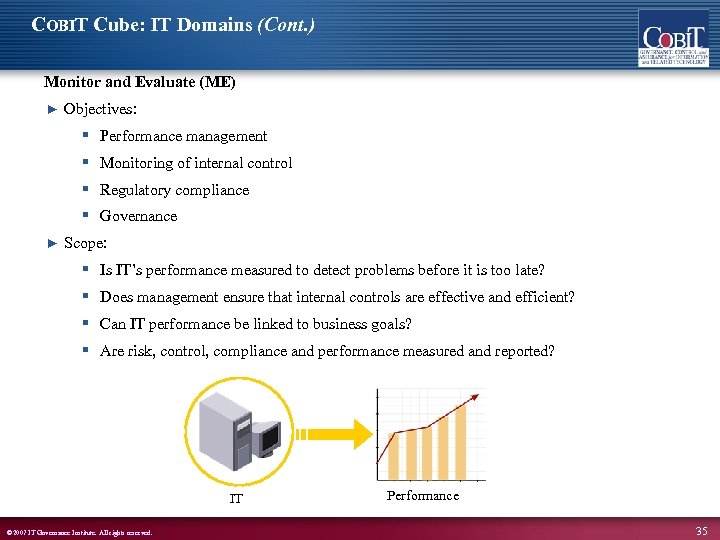
COBIT Cube: IT Domains (Cont. ) Monitor and Evaluate (ME) ► Objectives: § Performance management § Monitoring of internal control § Regulatory compliance § Governance ► Scope: § Is IT’s performance measured to detect problems before it is too late? § Does management ensure that internal controls are effective and efficient? § Can IT performance be linked to business goals? § Are risk, control, compliance and performance measured and reported? IT © 2007 IT Governance Institute. All rights reserved. Performance 35
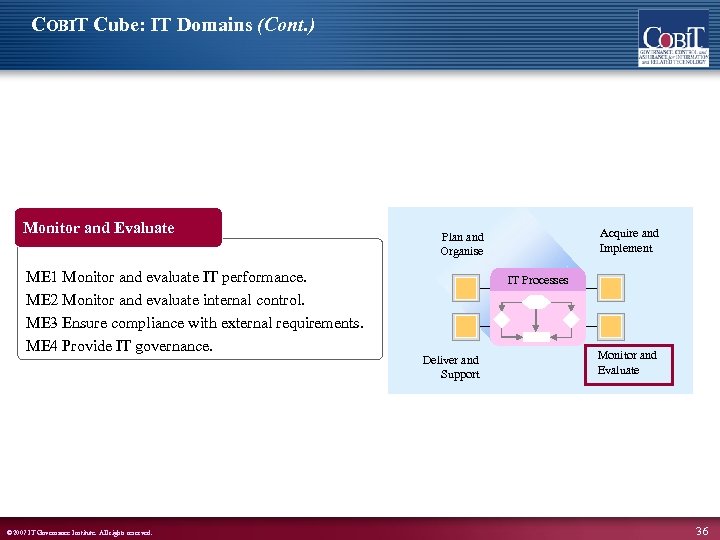
COBIT Cube: IT Domains (Cont. ) Monitor and Evaluate ME 1 Monitor and evaluate IT performance. ME 2 Monitor and evaluate internal control. ME 3 Ensure compliance with external requirements. ME 4 Provide IT governance. © 2007 IT Governance Institute. All rights reserved. Acquire and Implement Plan and Organise IT Processes Deliver and Support Monitor and Evaluate 36
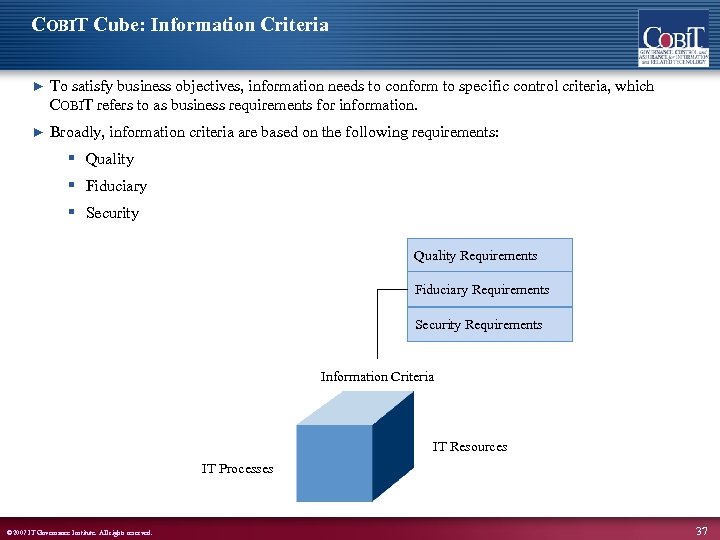
COBIT Cube: Information Criteria ► To satisfy business objectives, information needs to conform to specific control criteria, which COBIT refers to as business requirements for information. ► Broadly, information criteria are based on the following requirements: § Quality § Fiduciary § Security Quality Requirements Fiduciary Requirements Security Requirements Information Criteria IT Resources IT Processes © 2007 IT Governance Institute. All rights reserved. 37
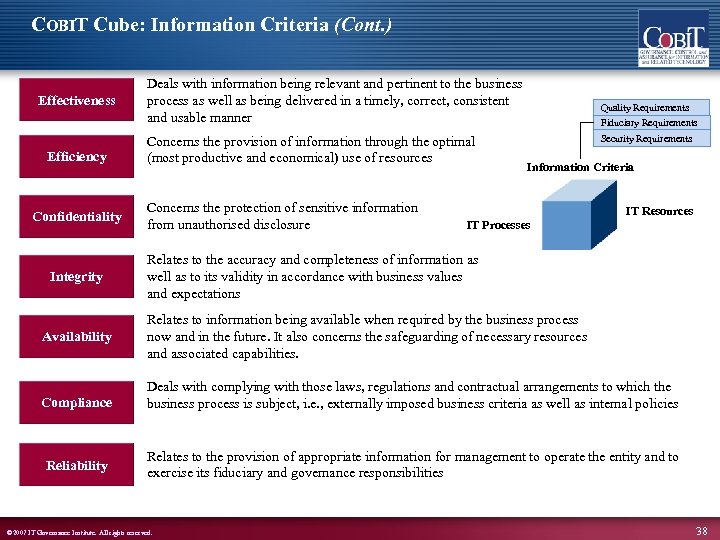
COBIT Cube: Information Criteria (Cont. ) Effectiveness Efficiency Confidentiality Integrity Availability Compliance Reliability Deals with information being relevant and pertinent to the business process as well as being delivered in a timely, correct, consistent and usable manner Concerns the provision of information through the optimal (most productive and economical) use of resources Concerns the protection of sensitive information from unauthorised disclosure Quality Requirements Fiduciary Requirements Security Requirements Information Criteria IT Resources IT Processes Relates to the accuracy and completeness of information as well as to its validity in accordance with business values and expectations Relates to information being available when required by the business process now and in the future. It also concerns the safeguarding of necessary resources and associated capabilities. Deals with complying with those laws, regulations and contractual arrangements to which the business process is subject, i. e. , externally imposed business criteria as well as internal policies Relates to the provision of appropriate information for management to operate the entity and to exercise its fiduciary and governance responsibilities © 2007 IT Governance Institute. All rights reserved. 38
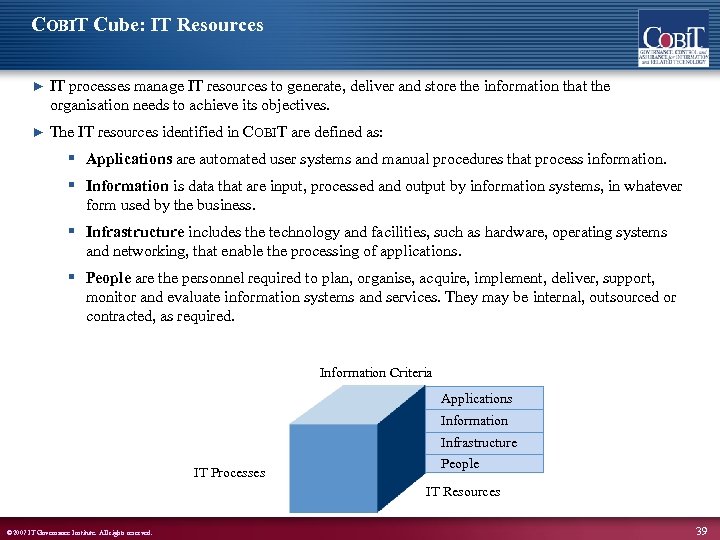
COBIT Cube: IT Resources ► IT processes manage IT resources to generate, deliver and store the information that the organisation needs to achieve its objectives. ► The IT resources identified in COBIT are defined as: § Applications are automated user systems and manual procedures that process information. § Information is data that are input, processed and output by information systems, in whatever form used by the business. § Infrastructure includes the technology and facilities, such as hardware, operating systems and networking, that enable the processing of applications. § People are the personnel required to plan, organise, acquire, implement, deliver, support, monitor and evaluate information systems and services. They may be internal, outsourced or contracted, as required. Information Criteria Applications Information IT Processes Infrastructure People IT Resources © 2007 IT Governance Institute. All rights reserved. 39
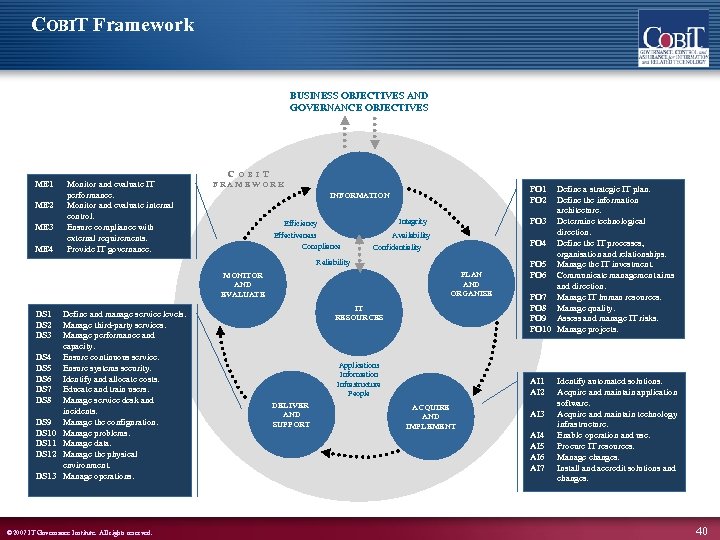
COBIT Framework BUSINESS OBJECTIVES AND GOVERNANCE OBJECTIVES C ME 1 ME 2 ME 3 ME 4 Monitor and evaluate IT performance. Monitor and evaluate internal control. Ensure compliance with external requirements. Provide IT governance. O B I T FRAMEWORK PO 1 PO 2 INFORMATION Integrity Efficiency Effectiveness Compliance Availability Confidentiality Reliability PLAN AND ORGANISE MONITOR AND EVALUATE DS 1 DS 2 DS 3 DS 4 DS 5 DS 6 DS 7 DS 8 DS 9 DS 10 DS 11 DS 12 DS 13 Define and manage service levels. Manage third-party services. Manage performance and capacity. Ensure continuous service. Ensure systems security. Identify and allocate costs. Educate and train users. Manage service desk and incidents. Manage the configuration. Manage problems. Manage data. Manage the physical environment. Manage operations. © 2007 IT Governance Institute. All rights reserved. IT RESOURCES Applications Information Infrastructure People DELIVER AND SUPPORT Define a strategic IT plan. Define the information architecture. PO 3 Determine technological direction. PO 4 Define the IT processes, organisation and relationships. PO 5 Manage the IT investment. PO 6 Communicate management aims and direction. PO 7 Manage IT human resources. PO 8 Manage quality. PO 9 Assess and manage IT risks. PO 10 Manage projects. AI 1 AI 2 ACQUIRE AND IMPLEMENT AI 3 AI 4 AI 5 AI 6 AI 7 Identify automated solutions. Acquire and maintain application software. Acquire and maintain technology infrastructure. Enable operation and use. Procure IT resources. Manage changes. Install and accredit solutions and changes. 40
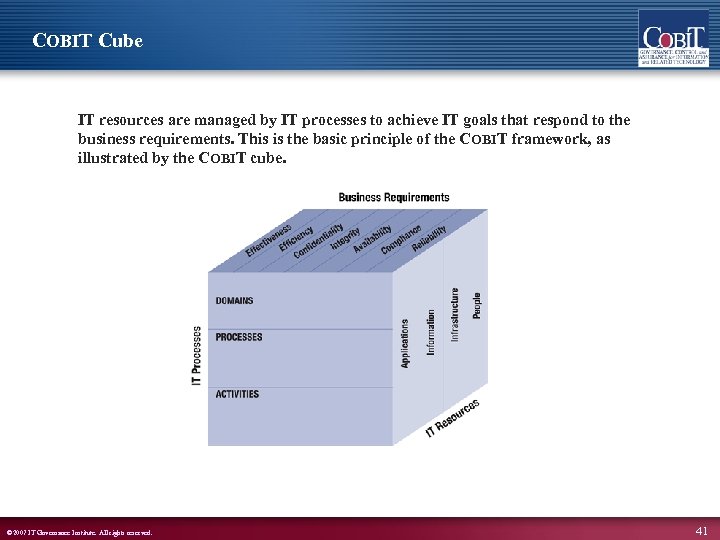
COBIT Cube IT resources are managed by IT processes to achieve IT goals that respond to the business requirements. This is the basic principle of the COBIT framework, as illustrated by the COBIT cube. © 2007 IT Governance Institute. All rights reserved. 41
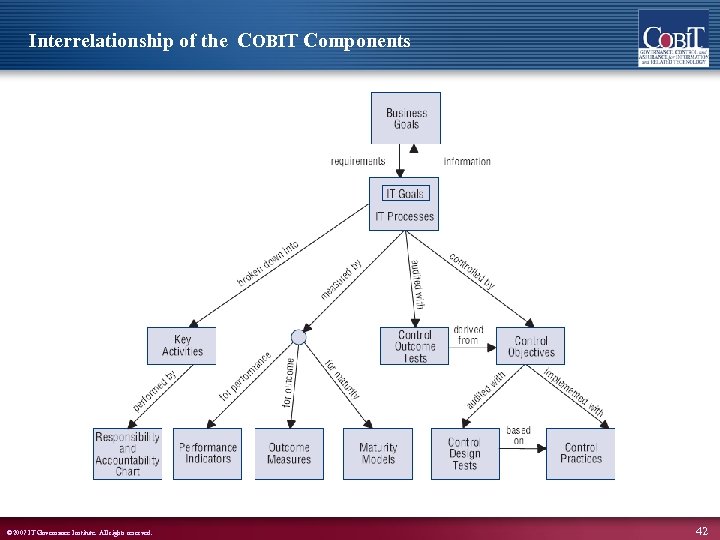
Interrelationship of the COBIT Components © 2007 IT Governance Institute. All rights reserved. 42
Скачать презентацию Introductory COBIT Presentation Overview of IT Governance and
44435165ff4717dfb201f55a446b86be.ppt