


 Скачать презентацию Introductory Chemistry 3 rd Edition Nivaldo Tro Chapter
680b68c9a3abd7f477d90ff868d909da.ppt
- Количество слайдов: 87
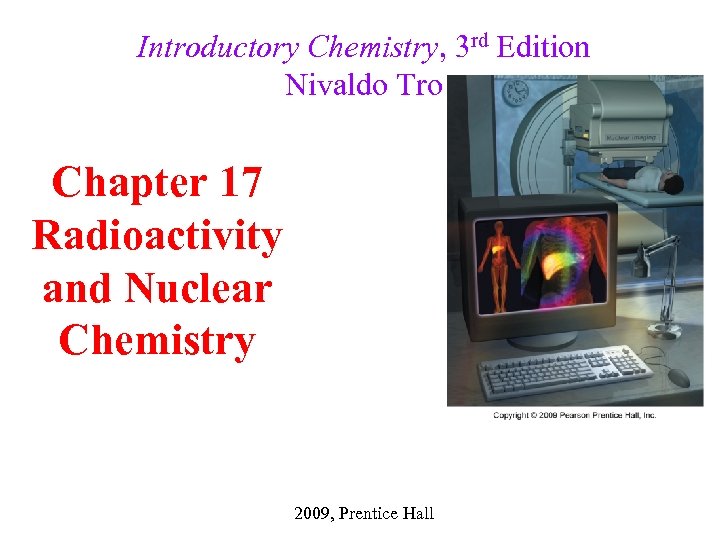 Introductory Chemistry, 3 rd Edition Nivaldo Tro Chapter 17 Radioactivity and Nuclear Chemistry 2009, Prentice Hall
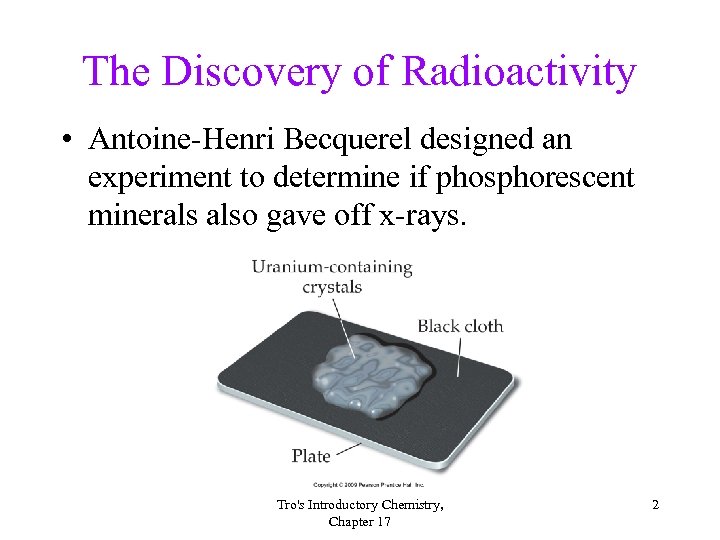 The Discovery of Radioactivity • Antoine-Henri Becquerel designed an experiment to determine if phosphorescent minerals also gave off x-rays. Tro's Introductory Chemistry, Chapter 17 2
 The Discovery of Radioactivity, Continued • Bequerel discovered that certain minerals were constantly producing penetrating energy rays he called uranic rays. ü Like x-rays. ü But not related to fluorescence. • Bequerel determined that: ü All the minerals that produced these rays contained uranium. ü The rays were produced even though the mineral was not exposed to outside energy. • Energy apparently being produced from nothing? Tro's Introductory Chemistry, Chapter 17 3
 The Curies • Marie Curie used an electroscope to detect the radiation of uranic rays in samples. • By carefully separating minerals into their components, she discovered new elements by detecting the radiation they emitted. üRadium named for its green phosphorescence. üPolonium named for her homeland. • Since the radiation was no longer just emitted from of uranium, she renamed it radioactivity. Tro's Introductory Chemistry, Chapter 17 4
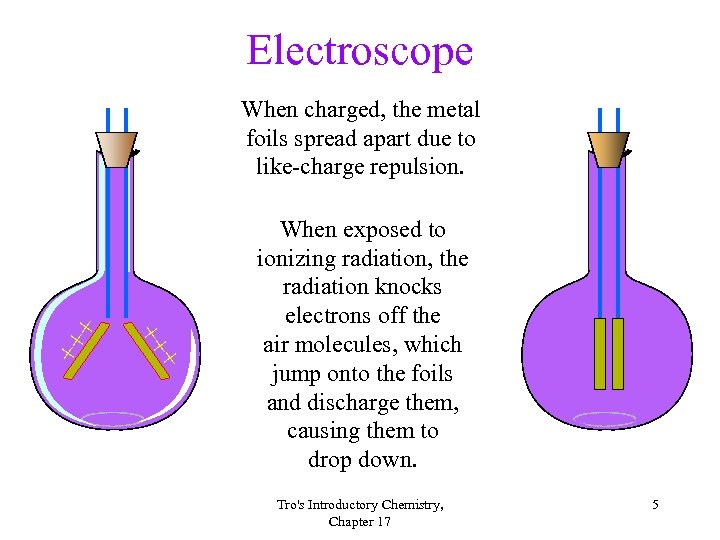 Electroscope ++ + When charged, the metal foils spread apart due to like-charge repulsion. When exposed to ionizing radiation, the radiation knocks electrons off the air molecules, which jump onto the foils and discharge them, causing them to drop down. Tro's Introductory Chemistry, Chapter 17 5
 Properties of Radioactivity • Radioactive rays can ionize matter. üCause uncharged matter to become charged. üBasis of Geiger counter and electroscope. • Radioactive rays have high energy. • Radioactive rays can penetrate matter. • Radioactive rays cause phosphorescent chemicals to glow. üBasis of scintillation counter. Tro's Introductory Chemistry, Chapter 17 6
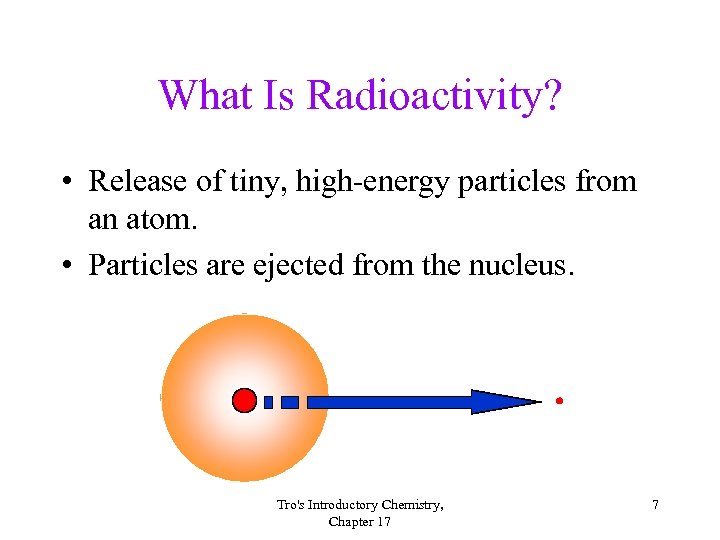 What Is Radioactivity? • Release of tiny, high-energy particles from an atom. • Particles are ejected from the nucleus. Tro's Introductory Chemistry, Chapter 17 7
 Types of Radioactive Rays • Rutherford discovered there were three types of radioactivity: 1. Alpha rays ( ): üHave a charge of +2 c. u. and a mass of 4 amu. üWhat we now know to be helium nucleus. 2. Beta rays ( ): üHave a charge of -1 c. u. and negligible mass. üElectron-like. 3. Gamma rays (g): üForm of light energy (not particle like and ). Tro's Introductory Chemistry, Chapter 17 8
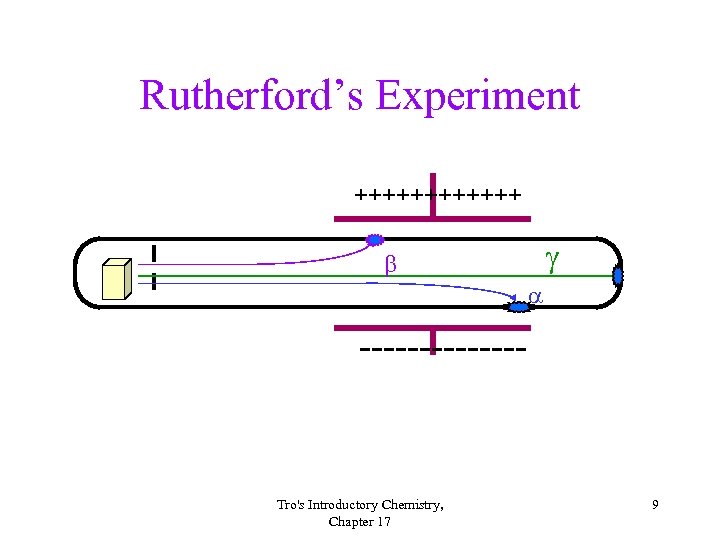 Rutherford’s Experiment ++++++ g ------- Tro's Introductory Chemistry, Chapter 17 9
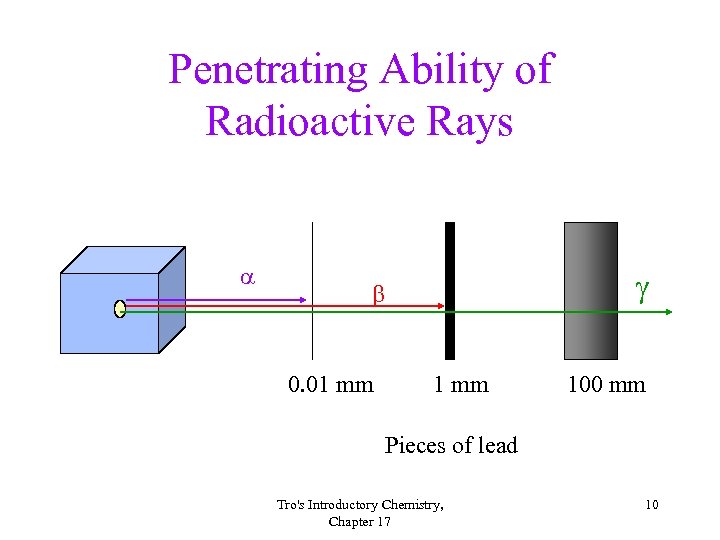 Penetrating Ability of Radioactive Rays g 0. 01 mm 100 mm Pieces of lead Tro's Introductory Chemistry, Chapter 17 10
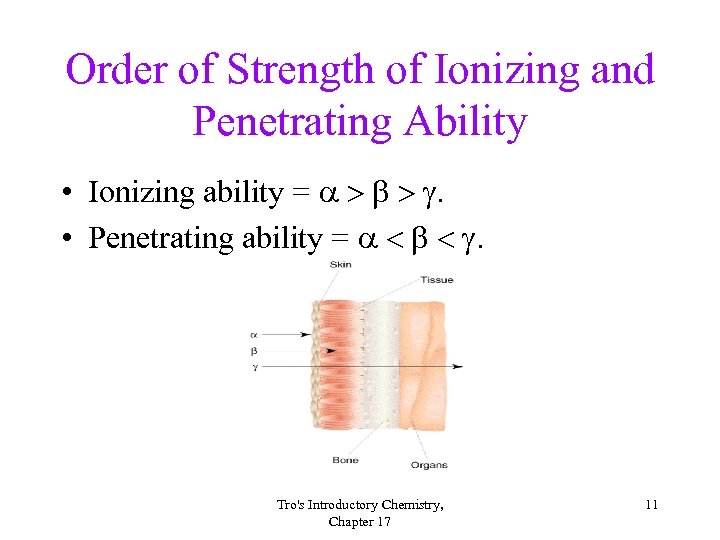 Order of Strength of Ionizing and Penetrating Ability • Ionizing ability = > > g. • Penetrating ability = < < g. Tro's Introductory Chemistry, Chapter 17 11
 Facts About the Nucleus • Very small volume compared to volume of the atom. • Essentially entire mass of atom. • Very dense. • Composed of protons and neutrons that are tightly held together. üNucleons. Tro's Introductory Chemistry, Chapter 17 12
 Facts About the Nucleus, Continued • Every atom of an element has the same number of protons; equal to the atomic number (Z). • Atoms of the same elements can have different numbers of neutrons. üIsotopes. üDifferent atomic masses. • Isotopes are identified by their mass number (A). üMass number = number of protons + neutrons. Tro's Introductory Chemistry, Chapter 17 13
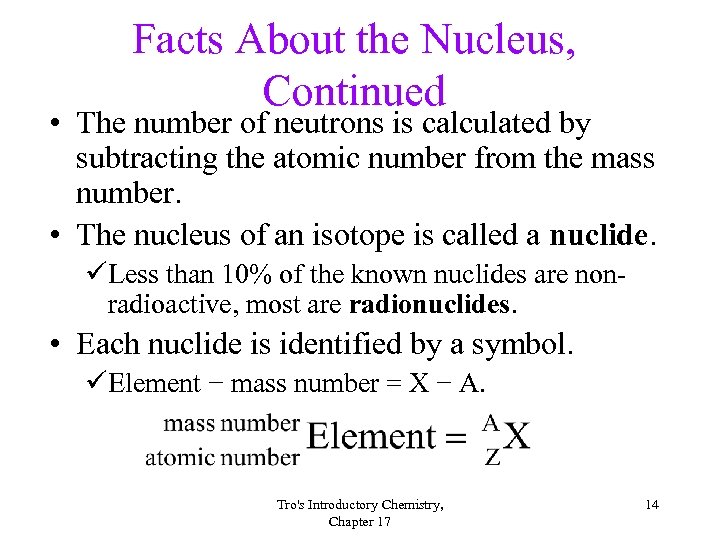 Facts About the Nucleus, Continued • The number of neutrons is calculated by subtracting the atomic number from the mass number. • The nucleus of an isotope is called a nuclide. üLess than 10% of the known nuclides are nonradioactive, most are radionuclides. • Each nuclide is identified by a symbol. üElement − mass number = X − A. Tro's Introductory Chemistry, Chapter 17 14
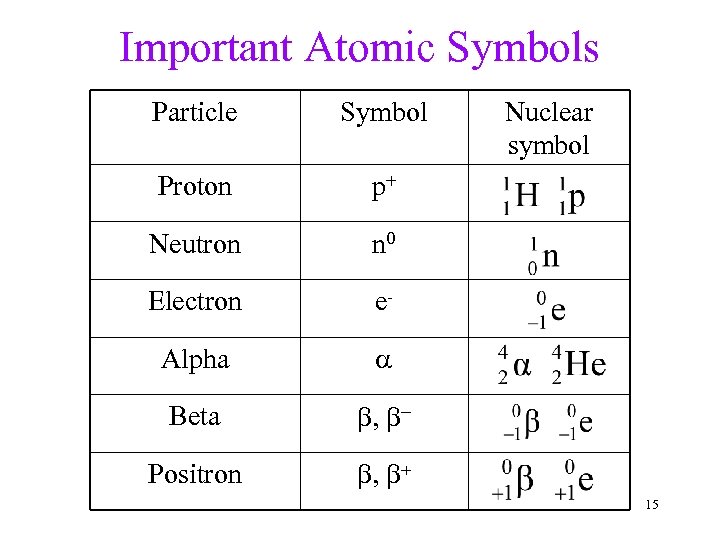 Important Atomic Symbols Particle Symbol Proton p+ Neutron n 0 Electron e- Alpha Beta , - Positron Nuclear symbol , + 15
 Radioactivity • Radioactive nuclei spontaneously decompose into smaller nuclei. ü Radioactive decay. ü We say that radioactive nuclei are unstable. • The parent nuclide is the nucleus that is undergoing radioactive decay; the daughter nuclide are the new nuclei that are made. • Decomposing involves the nuclide emitting a particle and/or energy. • All nuclides with 84 or more protons are radioactive. Tro's Introductory Chemistry, Chapter 17 16
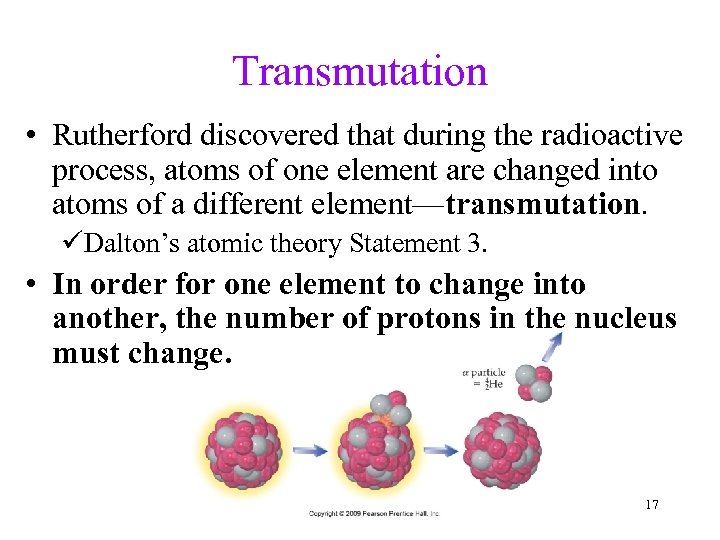 Transmutation • Rutherford discovered that during the radioactive process, atoms of one element are changed into atoms of a different element—transmutation. üDalton’s atomic theory Statement 3. • In order for one element to change into another, the number of protons in the nucleus must change. 17
 Chemical Processes vs. Nuclear Processes • Chemical reactions involve changes in the electronic structure of the atom. üAtoms gain, lose, or share electrons. üNo change in the nuclei occurs. • Nuclear reactions involve changes in the structure of the nucleus. üWhen the number of protons in the nucleus changes, the atom becomes a different element. Tro's Introductory Chemistry, Chapter 17 18
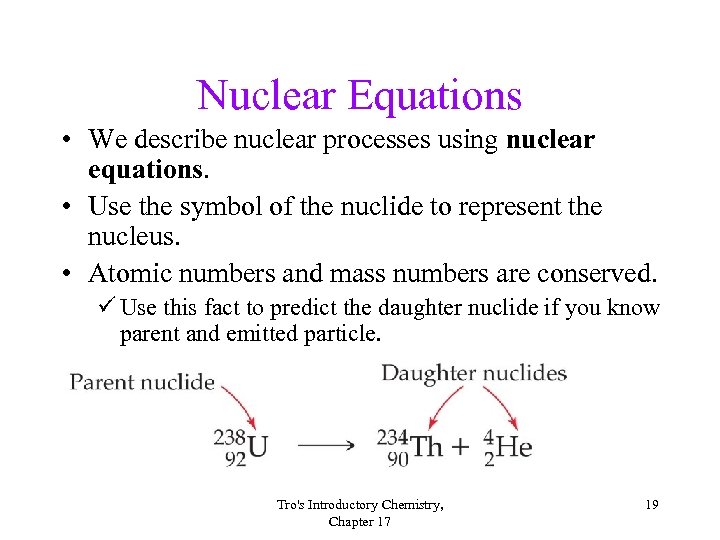 Nuclear Equations • We describe nuclear processes using nuclear equations. • Use the symbol of the nuclide to represent the nucleus. • Atomic numbers and mass numbers are conserved. ü Use this fact to predict the daughter nuclide if you know parent and emitted particle. Tro's Introductory Chemistry, Chapter 17 19
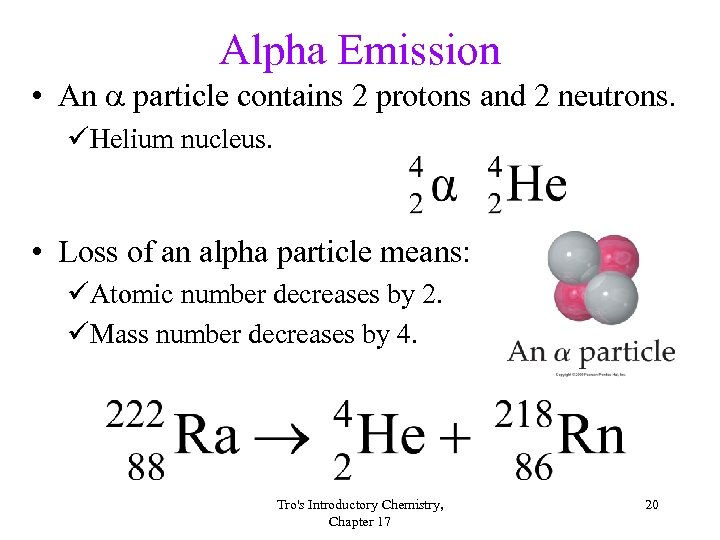 Alpha Emission • An particle contains 2 protons and 2 neutrons. üHelium nucleus. • Loss of an alpha particle means: üAtomic number decreases by 2. üMass number decreases by 4. Tro's Introductory Chemistry, Chapter 17 20
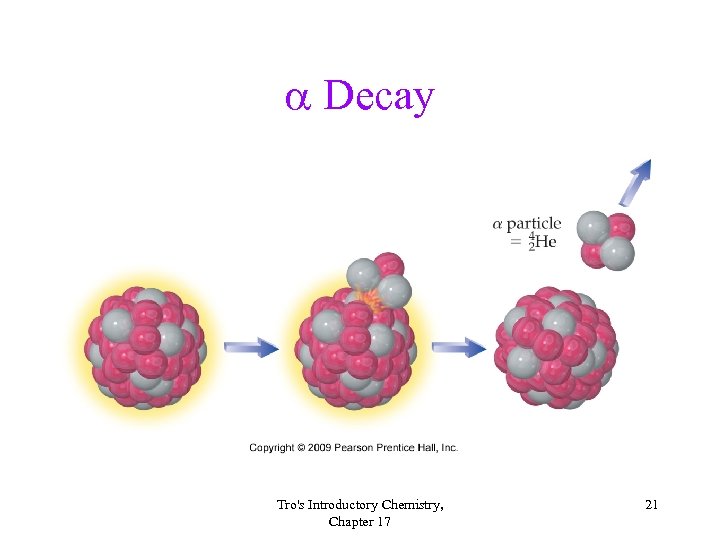 Decay Tro's Introductory Chemistry, Chapter 17 21
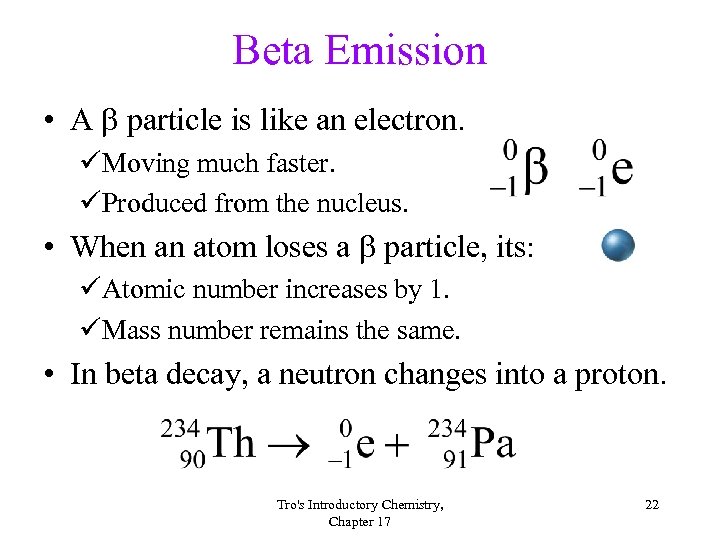 Beta Emission • A particle is like an electron. üMoving much faster. üProduced from the nucleus. • When an atom loses a particle, its: üAtomic number increases by 1. üMass number remains the same. • In beta decay, a neutron changes into a proton. Tro's Introductory Chemistry, Chapter 17 22
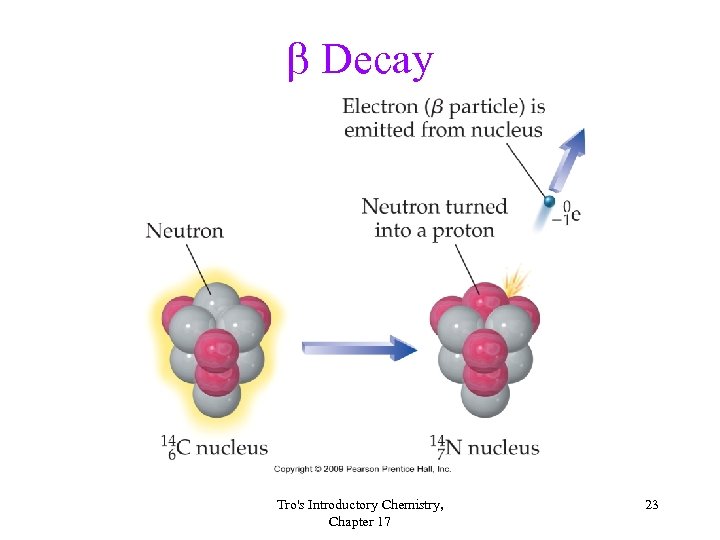 Decay Tro's Introductory Chemistry, Chapter 17 23
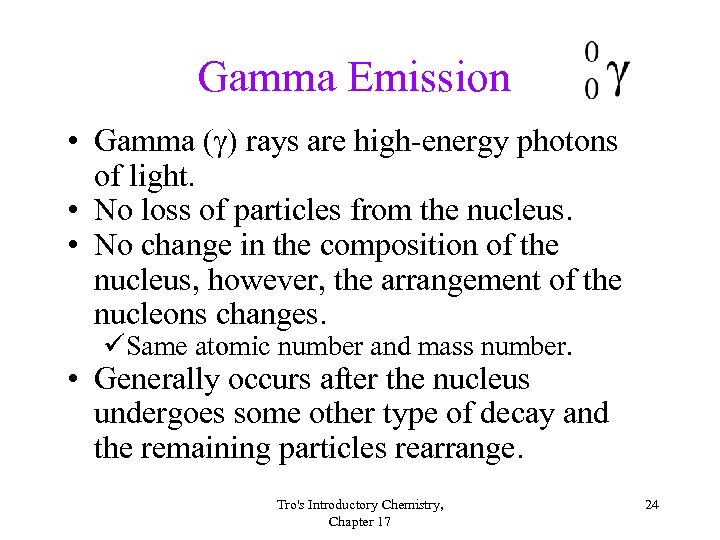 Gamma Emission • Gamma (g) rays are high-energy photons of light. • No loss of particles from the nucleus. • No change in the composition of the nucleus, however, the arrangement of the nucleons changes. üSame atomic number and mass number. • Generally occurs after the nucleus undergoes some other type of decay and the remaining particles rearrange. Tro's Introductory Chemistry, Chapter 17 24
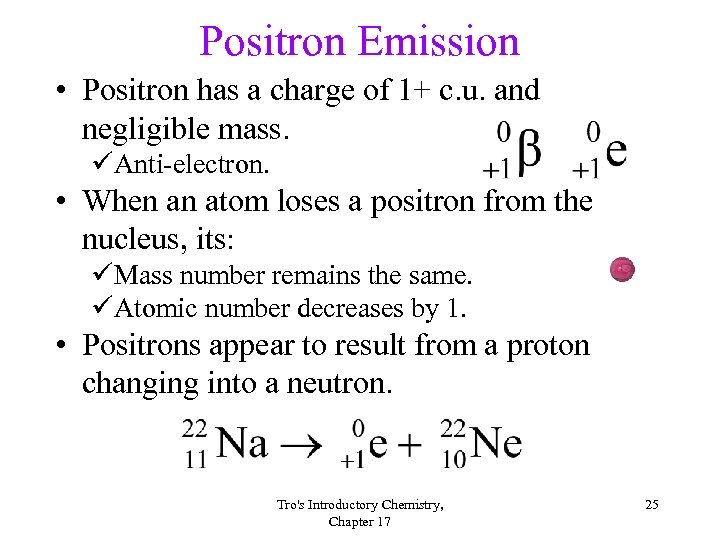 Positron Emission • Positron has a charge of 1+ c. u. and negligible mass. üAnti-electron. • When an atom loses a positron from the nucleus, its: üMass number remains the same. üAtomic number decreases by 1. • Positrons appear to result from a proton changing into a neutron. Tro's Introductory Chemistry, Chapter 17 25
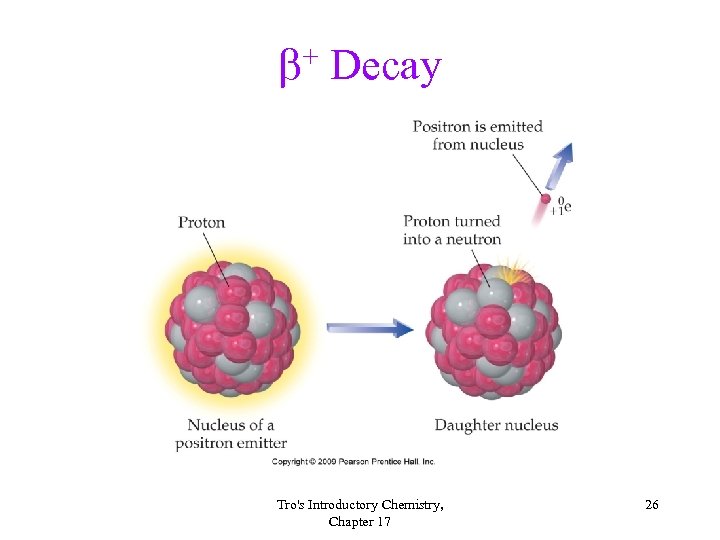 + Decay Tro's Introductory Chemistry, Chapter 17 26
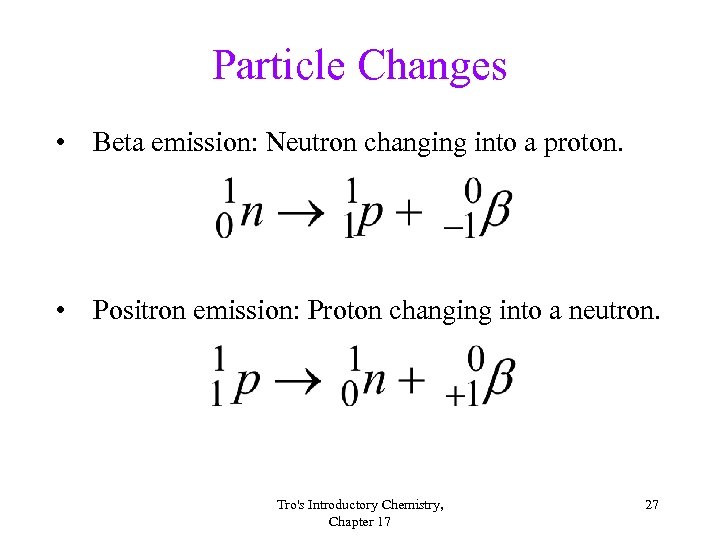 Particle Changes • Beta emission: Neutron changing into a proton. • Positron emission: Proton changing into a neutron. Tro's Introductory Chemistry, Chapter 17 27
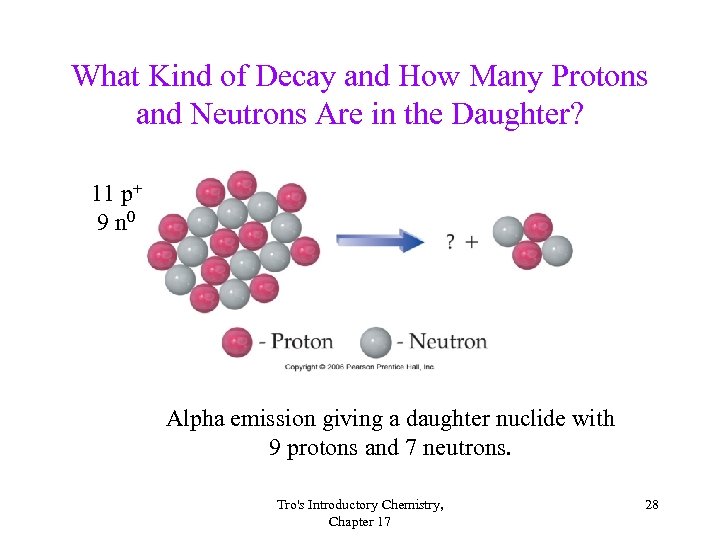 What Kind of Decay and How Many Protons and Neutrons Are in the Daughter? 11 p+ 9 n 0 Alpha emission giving a daughter nuclide with 9 protons and 7 neutrons. Tro's Introductory Chemistry, Chapter 17 28
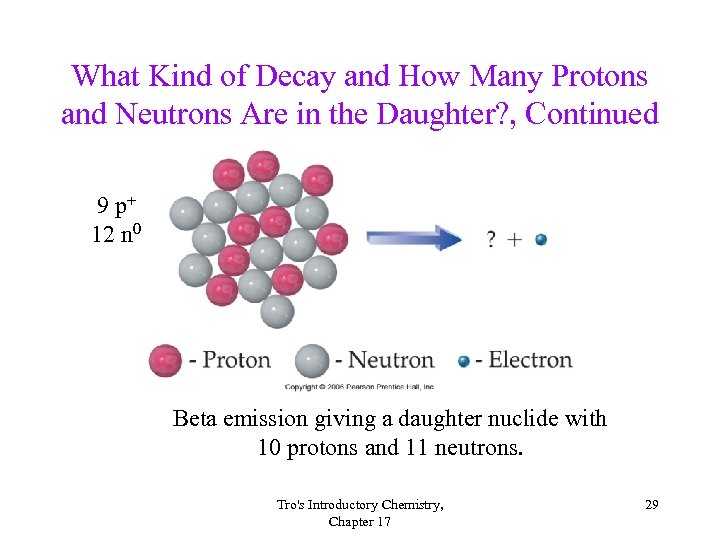 What Kind of Decay and How Many Protons and Neutrons Are in the Daughter? , Continued 9 p+ 12 n 0 Beta emission giving a daughter nuclide with 10 protons and 11 neutrons. Tro's Introductory Chemistry, Chapter 17 29
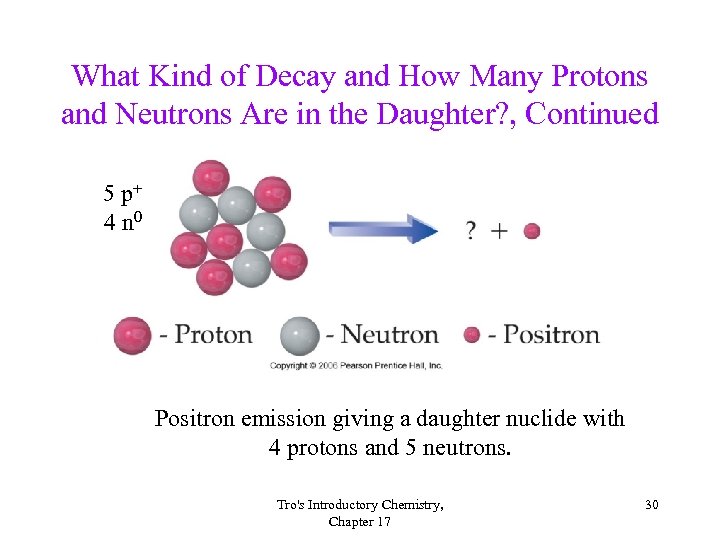 What Kind of Decay and How Many Protons and Neutrons Are in the Daughter? , Continued 5 p+ 4 n 0 Positron emission giving a daughter nuclide with 4 protons and 5 neutrons. Tro's Introductory Chemistry, Chapter 17 30
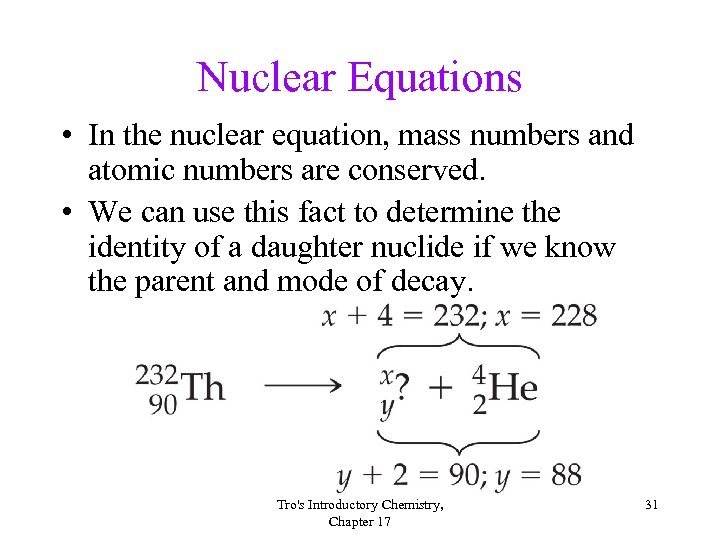 Nuclear Equations • In the nuclear equation, mass numbers and atomic numbers are conserved. • We can use this fact to determine the identity of a daughter nuclide if we know the parent and mode of decay. Tro's Introductory Chemistry, Chapter 17 31
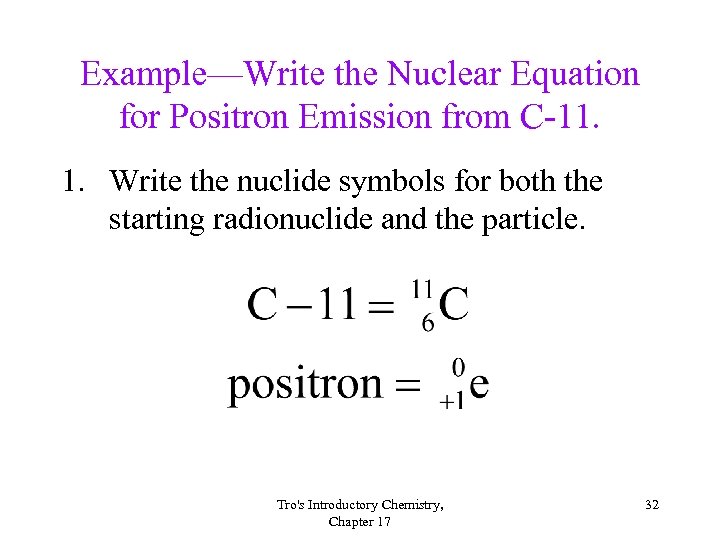 Example—Write the Nuclear Equation for Positron Emission from C-11. 1. Write the nuclide symbols for both the starting radionuclide and the particle. Tro's Introductory Chemistry, Chapter 17 32
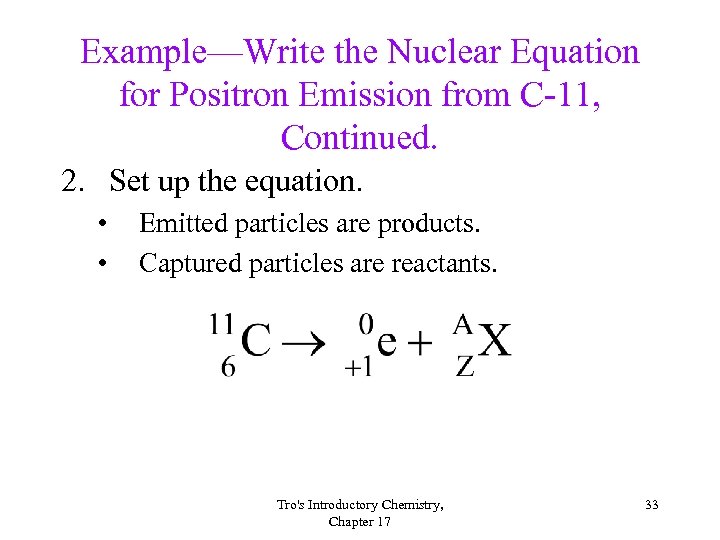 Example—Write the Nuclear Equation for Positron Emission from C-11, Continued. 2. Set up the equation. • • Emitted particles are products. Captured particles are reactants. Tro's Introductory Chemistry, Chapter 17 33
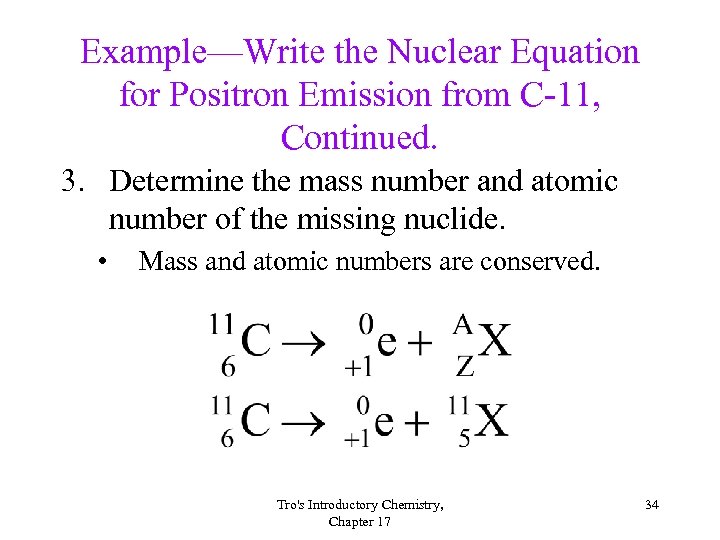 Example—Write the Nuclear Equation for Positron Emission from C-11, Continued. 3. Determine the mass number and atomic number of the missing nuclide. • Mass and atomic numbers are conserved. Tro's Introductory Chemistry, Chapter 17 34
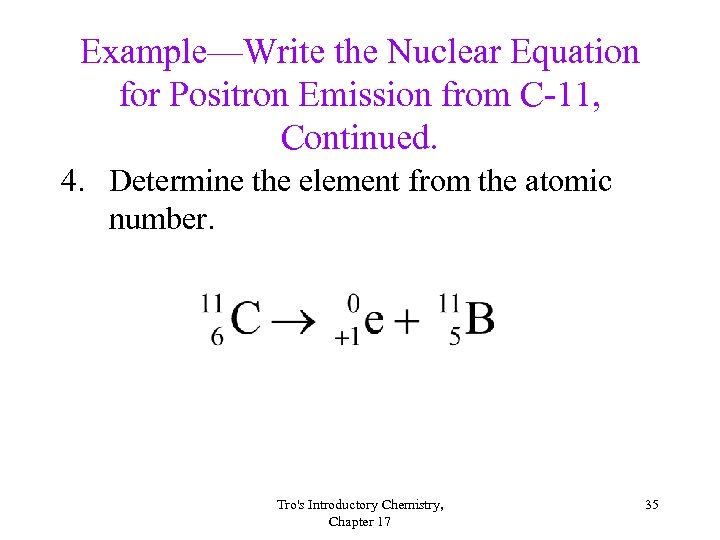 Example—Write the Nuclear Equation for Positron Emission from C-11, Continued. 4. Determine the element from the atomic number. Tro's Introductory Chemistry, Chapter 17 35
 Practice—Write a Nuclear Equation for Each of the Following: • Alpha emission from Th-238. • Beta emission from Ne-24. • Positron emission from N-13. Tro's Introductory Chemistry, Chapter 17 36
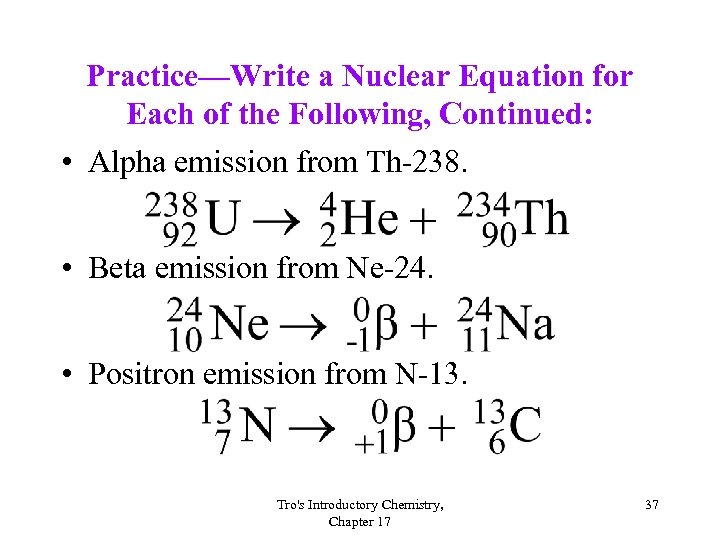 Practice—Write a Nuclear Equation for Each of the Following, Continued: • Alpha emission from Th-238. • Beta emission from Ne-24. • Positron emission from N-13. Tro's Introductory Chemistry, Chapter 17 37
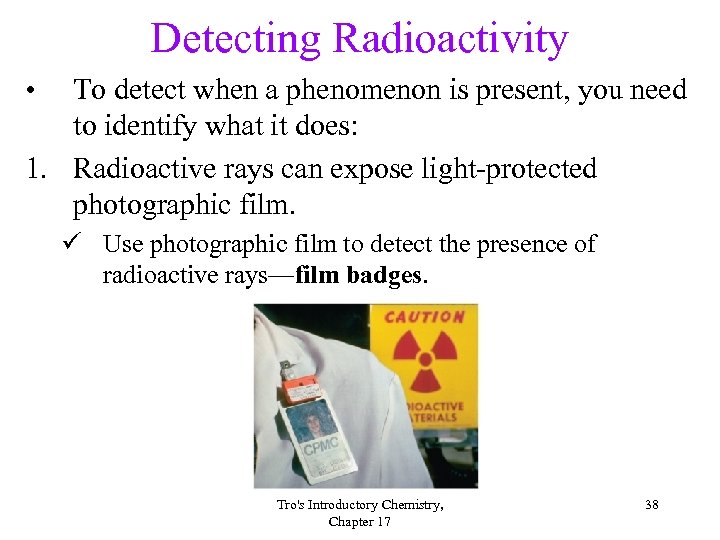 Detecting Radioactivity • To detect when a phenomenon is present, you need to identify what it does: 1. Radioactive rays can expose light-protected photographic film. ü Use photographic film to detect the presence of radioactive rays—film badges. Tro's Introductory Chemistry, Chapter 17 38
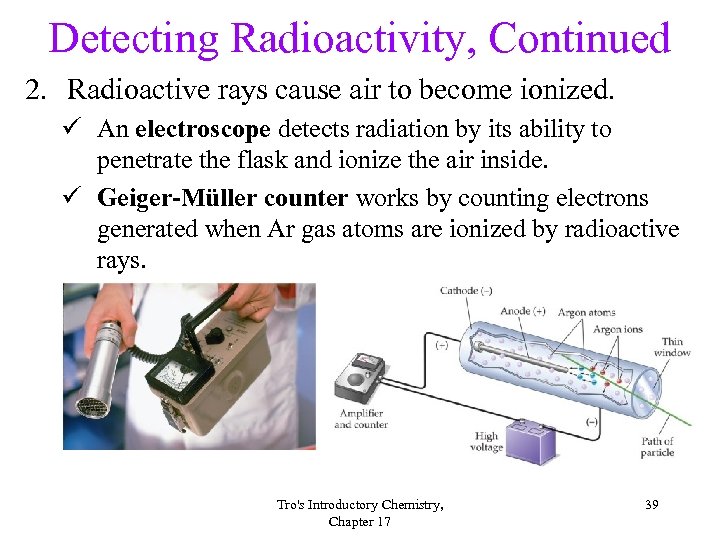 Detecting Radioactivity, Continued 2. Radioactive rays cause air to become ionized. ü An electroscope detects radiation by its ability to penetrate the flask and ionize the air inside. ü Geiger-Müller counter works by counting electrons generated when Ar gas atoms are ionized by radioactive rays. Tro's Introductory Chemistry, Chapter 17 39
 Detecting Radioactivity, Continued 3. Radioactive rays cause certain chemicals to give off a flash of light when they strike the chemical. ü A scintillation counter is able to count the number of flashes per minute. Tro's Introductory Chemistry, Chapter 17 40
 Natural Radioactivity • There are small amounts of radioactive minerals in the air, ground, and water. • It’s even in the food you eat! • The radiation you are exposed to from natural sources is called background radiation. Tro's Introductory Chemistry, Chapter 17 41
 Half-Life • Each radioactive isotope decays at a unique rate. üSome fast, some slow. üNot all the atoms of an isotope change simultaneously. üRate is a measure of how many of them change in a given period of time. üMeasured in counts per minute, or grams per time. • The length of time it takes for half of the parent nuclides in a sample to undergo radioactive decay is called the half-life. Tro's Introductory Chemistry, Chapter 17 42
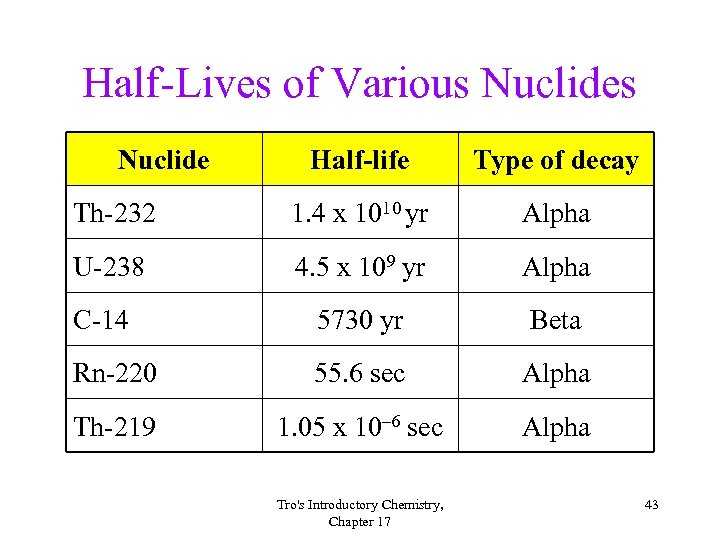 Half-Lives of Various Nuclide Half-life Type of decay Th-232 1. 4 x 10¹⁰ yr Alpha U-238 4. 5 x 10⁹ yr Alpha C-14 5730 yr Beta Rn-220 55. 6 sec Alpha Th-219 1. 05 x 10– 6 sec Alpha Tro's Introductory Chemistry, Chapter 17 43
 How “Hot” Is It? • When we speak of a sample being hot, we are referring to the number of decays we get per minute. • For samples with equal numbers of radioactive atoms, the sample with the shorter half-life will be hotter. üThat is, more atoms will change in a given period of time. Tro's Introductory Chemistry, Chapter 17 44
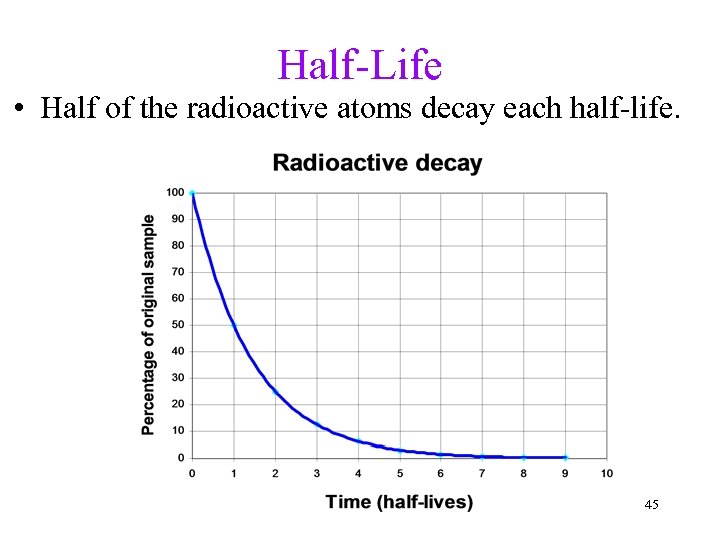 Half-Life • Half of the radioactive atoms decay each half-life. 45
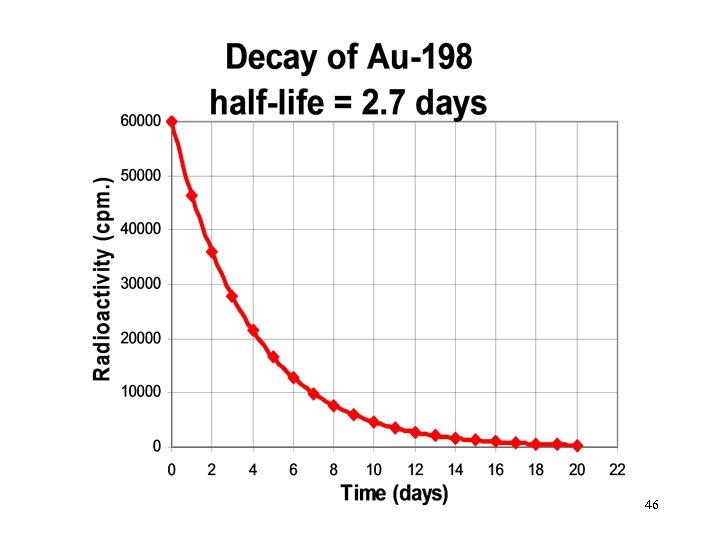 46
46
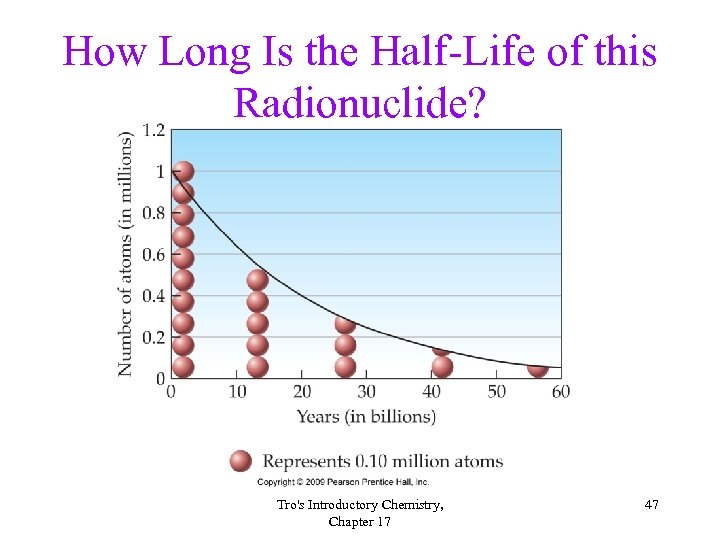 How Long Is the Half-Life of this Radionuclide? Tro's Introductory Chemistry, Chapter 17 47
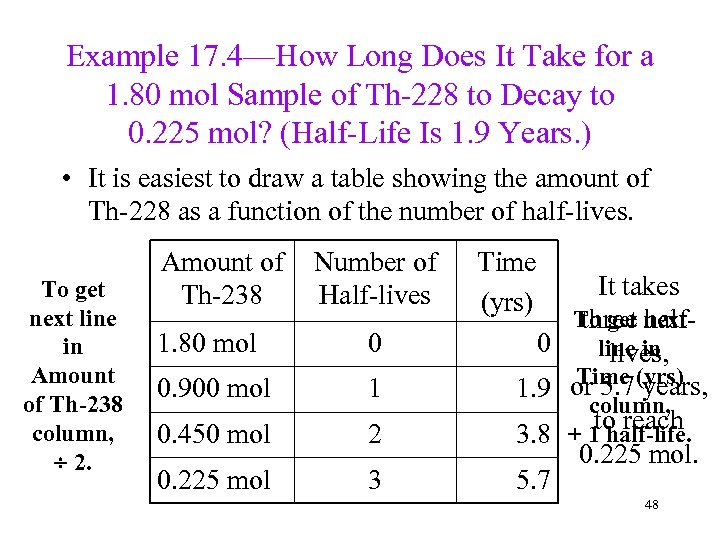 Example 17. 4—How Long Does It Take for a 1. 80 mol Sample of Th-228 to Decay to 0. 225 mol? (Half-Life Is 1. 9 Years. ) • It is easiest to draw a table showing the amount of Th-228 as a function of the number of half-lives. To get next line in Amount of Th-238 column, 2. Amount of Th-238 Number of Half-lives 1. 80 mol 0 0. 900 mol 1 0. 450 mol 2 0. 225 mol 3 Time (yrs) It takes To get next three half 0 line in lives, Time years, 1. 9 or 5. 7(yrs) column, half-life. 3. 8 + 1 to reach 0. 225 mol. 5. 7 48
 Practice—Radon-222 Is a Gas that Is Suspected of Causing Lung Cancer as It Leaks into Houses. It Is Produced by Uranium Decay. Assuming No Loss or Gain from Leakage, if There Is 1024 g of Rn-222 in the House Today, How Much Will There be in 5. 4 Weeks? ( Rn-222 Half-Life Is 3. 8 Days. ) Tro's Introductory Chemistry, Chapter 17 49
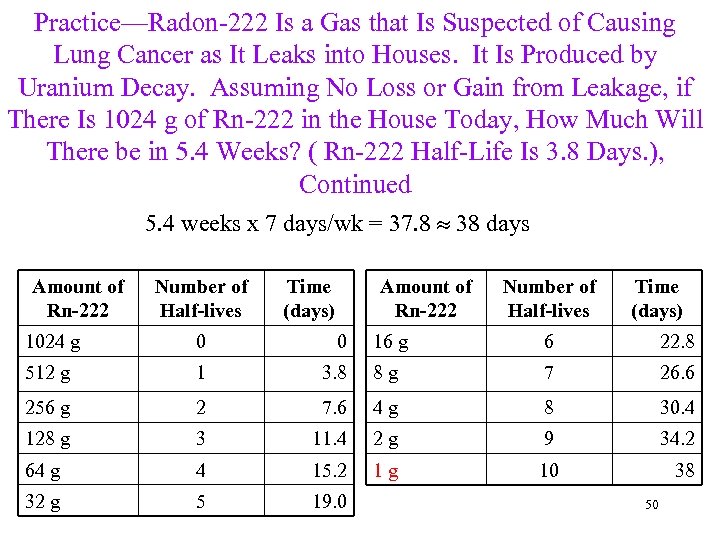 Practice—Radon-222 Is a Gas that Is Suspected of Causing Lung Cancer as It Leaks into Houses. It Is Produced by Uranium Decay. Assuming No Loss or Gain from Leakage, if There Is 1024 g of Rn-222 in the House Today, How Much Will There be in 5. 4 Weeks? ( Rn-222 Half-Life Is 3. 8 Days. ), Continued 5. 4 weeks x 7 days/wk = 37. 8 38 days Amount of Rn-222 Number of Half-lives Time (days) Amount of Rn-222 1024 g 0 0 512 g 1 256 g Number of Half-lives Time (days) 16 g 6 22. 8 3. 8 8 g 7 26. 6 2 7. 6 4 g 8 30. 4 128 g 3 11. 4 2 g 9 34. 2 64 g 4 15. 2 1 g 10 38 32 g 5 19. 0 50
 Practice—How Long Is the Half-Life of an Isotope if a Sample of the Isotope that Registers 60, 000 cpm on the Geiger Counter Decays to 15, 000 cpm After 150 Minutes? Tro's Introductory Chemistry, Chapter 17 51
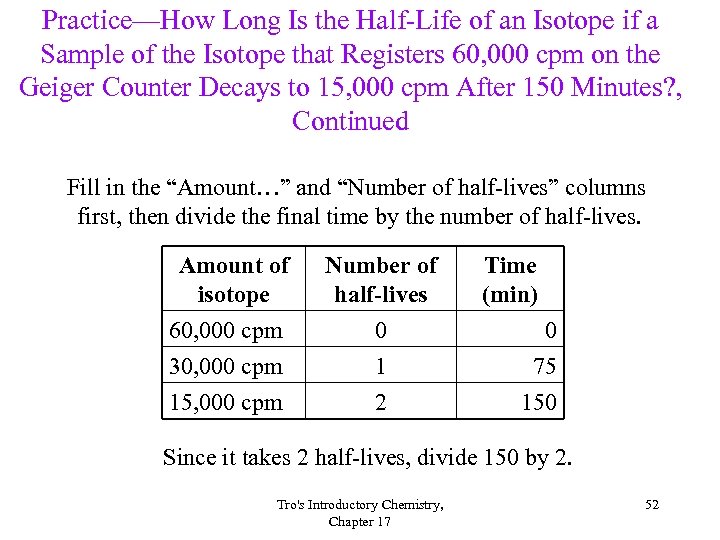 Practice—How Long Is the Half-Life of an Isotope if a Sample of the Isotope that Registers 60, 000 cpm on the Geiger Counter Decays to 15, 000 cpm After 150 Minutes? , Continued Fill in the “Amount…” and “Number of half-lives” columns first, then divide the final time by the number of half-lives. Amount of isotope 60, 000 cpm 30, 000 cpm 15, 000 cpm Number of half-lives 0 1 2 Time (min) 0 75 150 Since it takes 2 half-lives, divide 150 by 2. Tro's Introductory Chemistry, Chapter 17 52
 Decay Series • In nature, often one radioactive nuclide changes in another radioactive nuclide. ü Daughter nuclide is also radioactive. • • All of the radioactive nuclides that are produced one after the other until a stable nuclide is made is called a decay series. To determine the stable nuclide at the end of the series without writing it all out: 1. 2. 3. Count the number of and decays. From the mass nunmber, subtract 4 for each decay. From the atomic number, subtract 2 for each decay and add 1 for each . Tro's Introductory Chemistry, Chapter 17 55
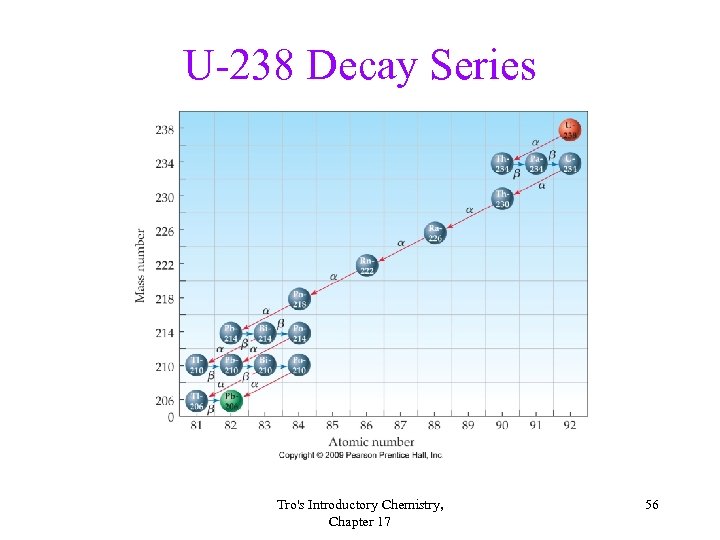 U-238 Decay Series Tro's Introductory Chemistry, Chapter 17 56
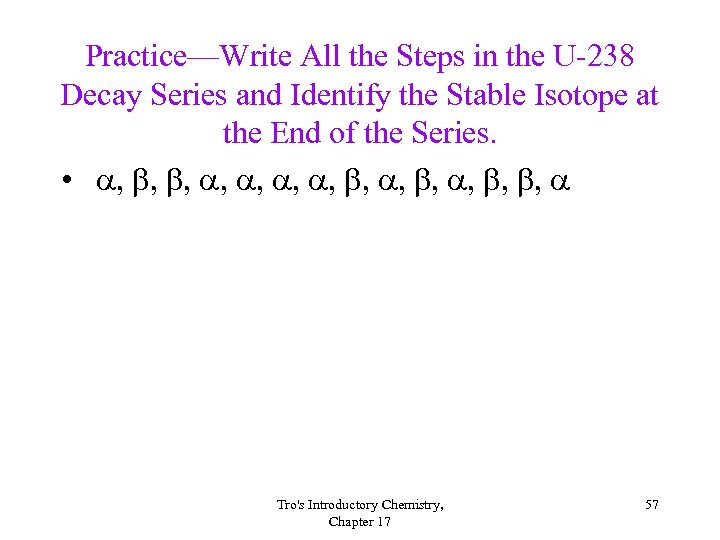 Practice—Write All the Steps in the U-238 Decay Series and Identify the Stable Isotope at the End of the Series. • , , , , Tro's Introductory Chemistry, Chapter 17 57
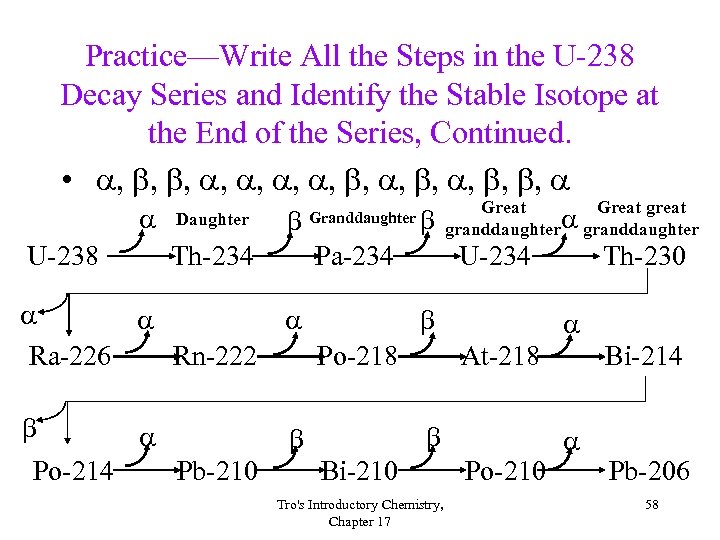 Practice—Write All the Steps in the U-238 Decay Series and Identify the Stable Isotope at the End of the Series, Continued. • , , , , U-238 Daughter Th-234 Granddaughter Pa-234 Great great granddaughter U-234 Th-230 Ra-226 Rn-222 Po-218 At-218 Bi-214 Po-214 Pb-210 Bi-210 Tro's Introductory Chemistry, Chapter 17 Po-210 Pb-206 58
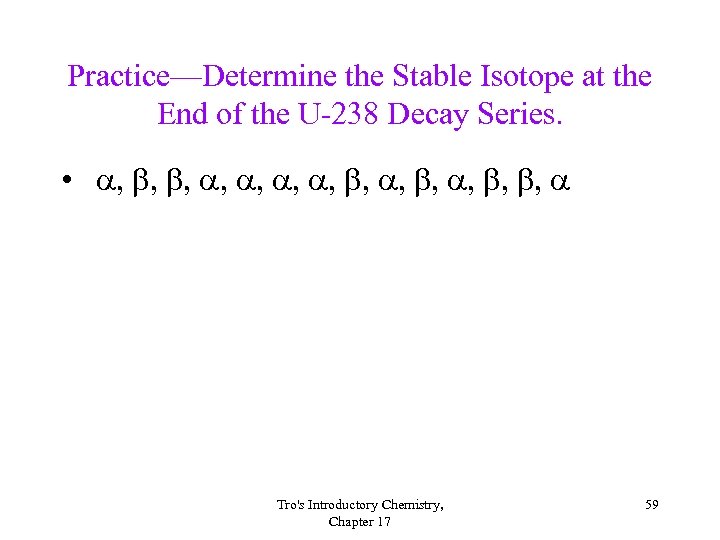 Practice—Determine the Stable Isotope at the End of the U-238 Decay Series. • , , , , Tro's Introductory Chemistry, Chapter 17 59
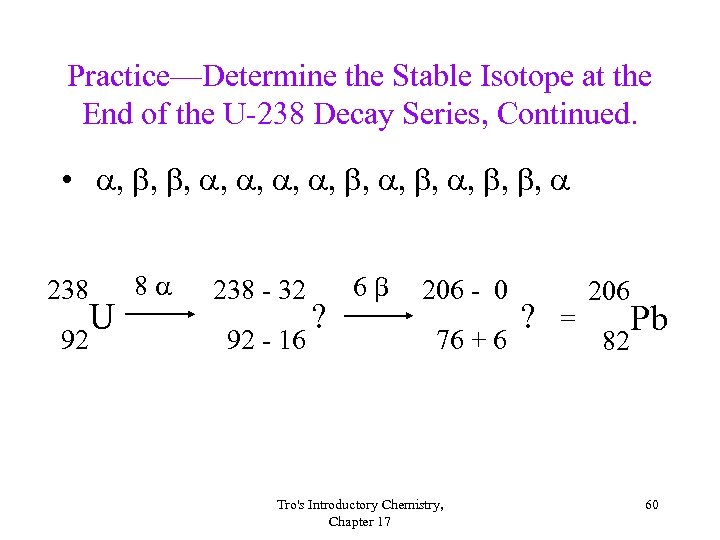 Practice—Determine the Stable Isotope at the End of the U-238 Decay Series, Continued. • , , , , 238 U 92 8 238 - 32 92 - 16 ? 6 206 - 0 76 + 6 Tro's Introductory Chemistry, Chapter 17 ? = 206 Pb 82 60
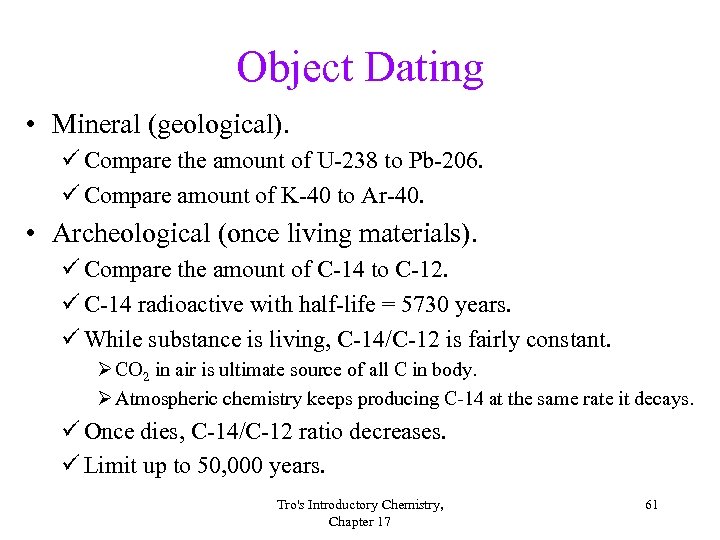 Object Dating • Mineral (geological). ü Compare the amount of U-238 to Pb-206. ü Compare amount of K-40 to Ar-40. • Archeological (once living materials). ü Compare the amount of C-14 to C-12. ü C-14 radioactive with half-life = 5730 years. ü While substance is living, C-14/C-12 is fairly constant. Ø CO 2 in air is ultimate source of all C in body. Ø Atmospheric chemistry keeps producing C-14 at the same rate it decays. ü Once dies, C-14/C-12 ratio decreases. ü Limit up to 50, 000 years. Tro's Introductory Chemistry, Chapter 17 61
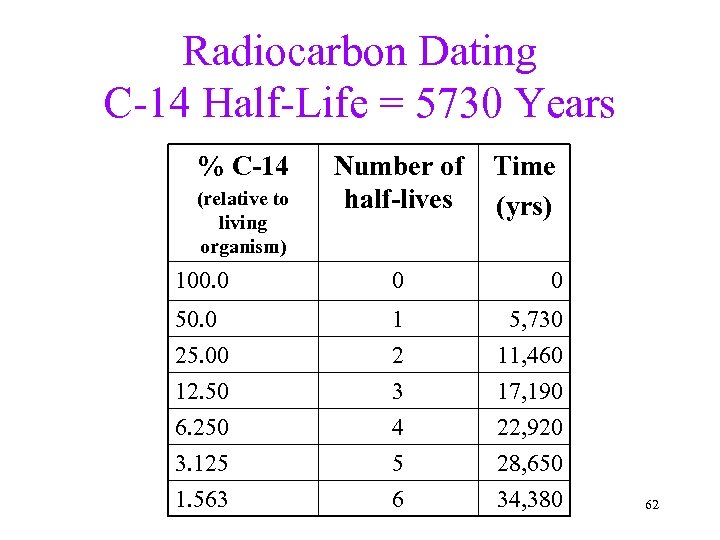 Radiocarbon Dating C-14 Half-Life = 5730 Years % C-14 (relative to living organism) Number of half-lives Time (yrs) 100. 0 0 0 50. 0 25. 00 12. 50 6. 250 3. 125 1. 563 1 2 3 4 5 6 5, 730 11, 460 17, 190 22, 920 28, 650 34, 380 62
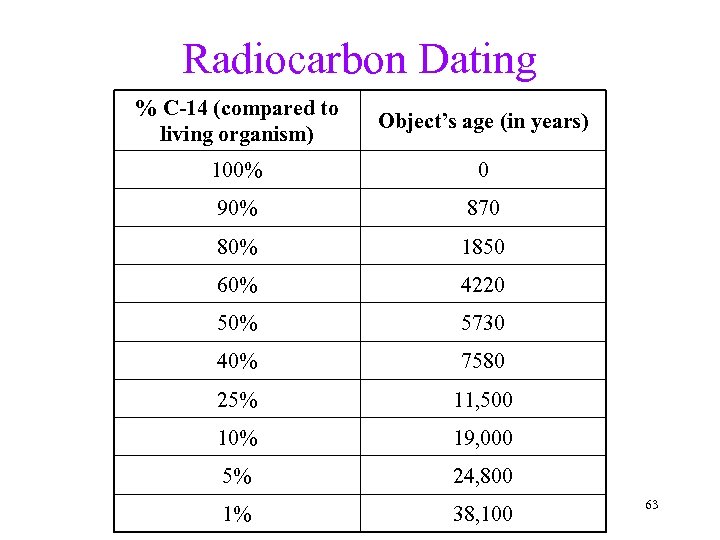 Radiocarbon Dating % C-14 (compared to living organism) Object’s age (in years) 100% 0 90% 870 80% 1850 60% 4220 50% 5730 40% 7580 25% 11, 500 10% 19, 000 5% 24, 800 1% 38, 100 63
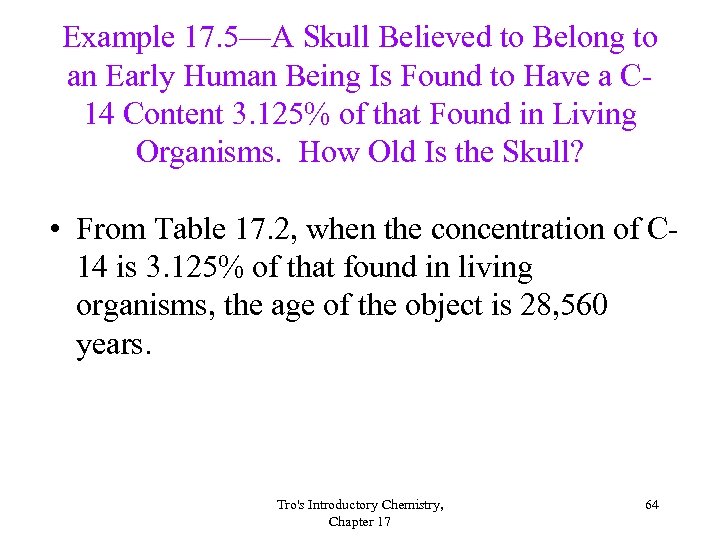 Example 17. 5—A Skull Believed to Belong to an Early Human Being Is Found to Have a C 14 Content 3. 125% of that Found in Living Organisms. How Old Is the Skull? • From Table 17. 2, when the concentration of C 14 is 3. 125% of that found in living organisms, the age of the object is 28, 560 years. Tro's Introductory Chemistry, Chapter 17 64
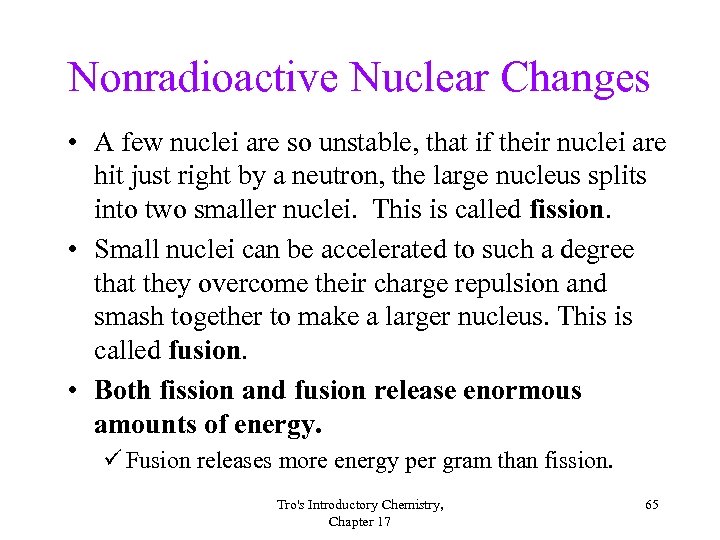 Nonradioactive Nuclear Changes • A few nuclei are so unstable, that if their nuclei are hit just right by a neutron, the large nucleus splits into two smaller nuclei. This is called fission. • Small nuclei can be accelerated to such a degree that they overcome their charge repulsion and smash together to make a larger nucleus. This is called fusion. • Both fission and fusion release enormous amounts of energy. ü Fusion releases more energy per gram than fission. Tro's Introductory Chemistry, Chapter 17 65
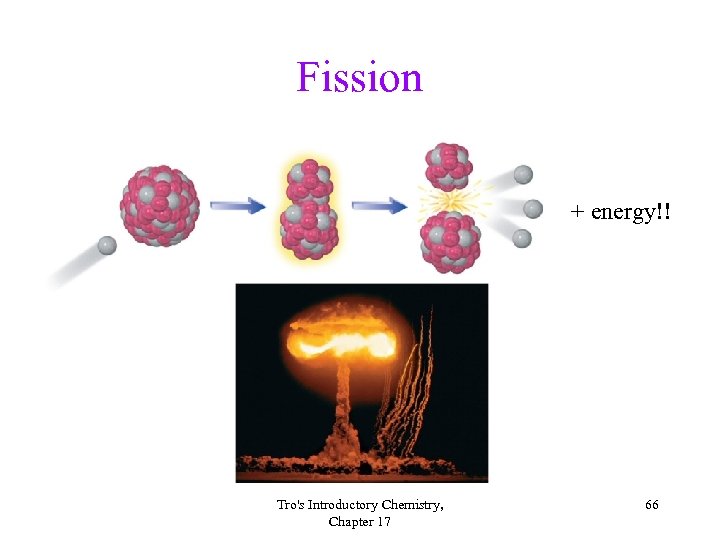 Fission + energy!! Tro's Introductory Chemistry, Chapter 17 66
 Fission Chain Reaction • A chain reaction occurs when a reactant in the process is also a product of the process. üIn the fission process it is the neutrons. üSo you only need a small amount of neutrons to start the chain. • Many of the neutrons produced in the fission are either ejected from the uranium before they hit another U-235 or are absorbed by the surrounding U-238. • Minimum amount of fissionable isotope needed to sustain the chain reaction is called the critical mass. Tro's Introductory Chemistry, Chapter 17 67
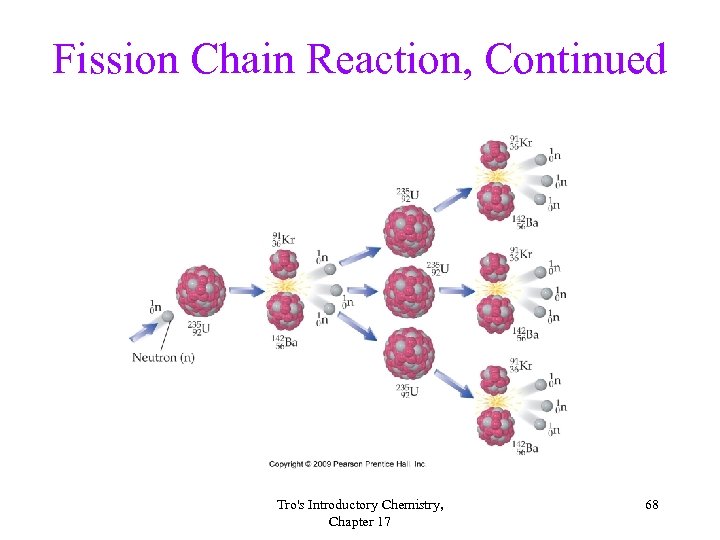 Fission Chain Reaction, Continued Tro's Introductory Chemistry, Chapter 17 68
 Fissionable Material • Fissionable isotopes include U-235, Pu-239, and Pu-240. • Natural uranium is less than 1% U-235. üThe rest is mostly U-238. üNot enough U-235 to sustain chain reaction. • To produce fissionable uranium the natural uranium must be enriched in U-235: üTo about 7% for “weapons grade. ” üTo about 3% for “reactor grade. ” Tro's Introductory Chemistry, Chapter 17 69
 Nuclear Power • Nuclear reactors use fission to generate electricity. üAbout 20% of U. S. electricity. üThe fission of U-235 produces heat. • The heat boils water, turning it to steam. • The steam turns a turbine, generating electricity. Tro's Introductory Chemistry, Chapter 17 70
 Nuclear Power Plants vs. Coal-Burning Power Plants • Use about 50 kg of fuel to generate enough electricity for 1 million people. • No air pollution. • Use about 2 million kg of fuel to generate enough electricity for 1 million people. • Produces NO 2 and SOx that add to acid rain. • Produces CO 2 that adds to the greenhouse effect. Tro's Introductory Chemistry, Chapter 17 71
 Nuclear Power Plants—Core • The fissionable material is stored in long tubes, called fuel rods, arranged in a matrix. üSubcritical. • Between the fuel rods are control rods made of neutron absorbing material. üB and/or Cd. üNeutrons needed to sustain the chain reaction. • The rods are placed in a material to slow down the ejected neutrons, called a moderator. üAllows chain reaction to occur below critical mass. Tro's Introductory Chemistry, Chapter 17 72
 Pressurized Light Water Reactor (PLWR) • Design used in U. S. (GE, Westinghouse). • Water is both the coolant and moderator. • Water in core kept under pressure to keep it from boiling. • Fuel is enriched uranium. üSubcritical. • Containment dome of concrete. Tro's Introductory Chemistry, Chapter 17 73
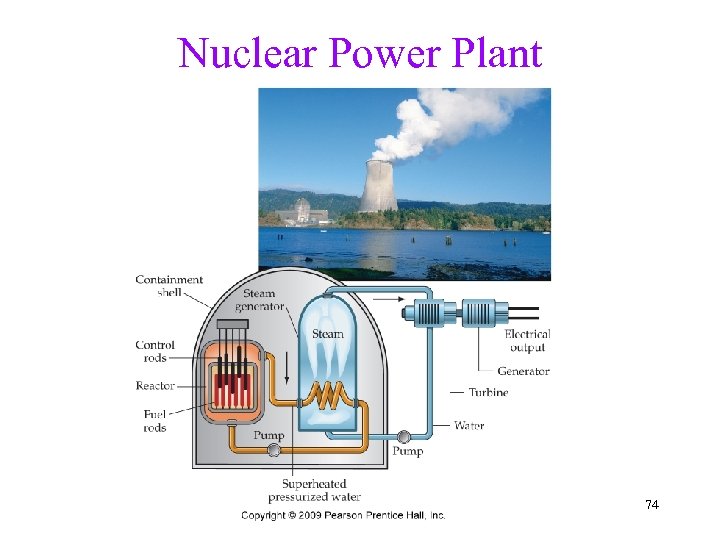 Nuclear Power Plant 74
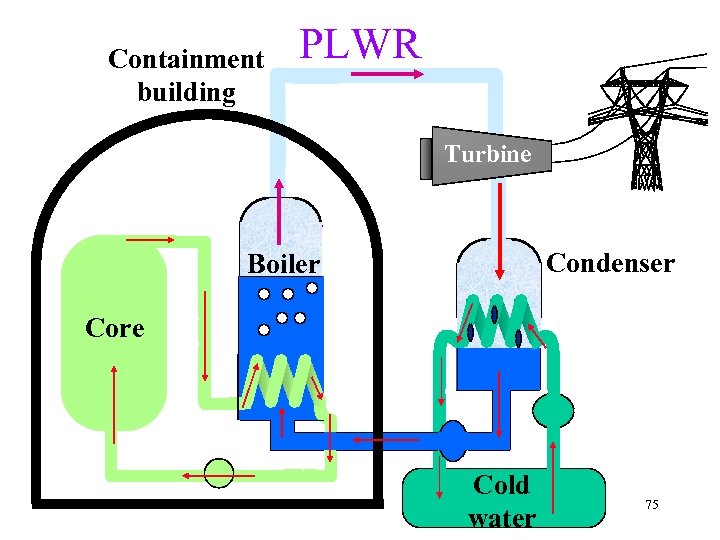 Containment building PLWR Turbine Condenser Boiler Core Cold water 75
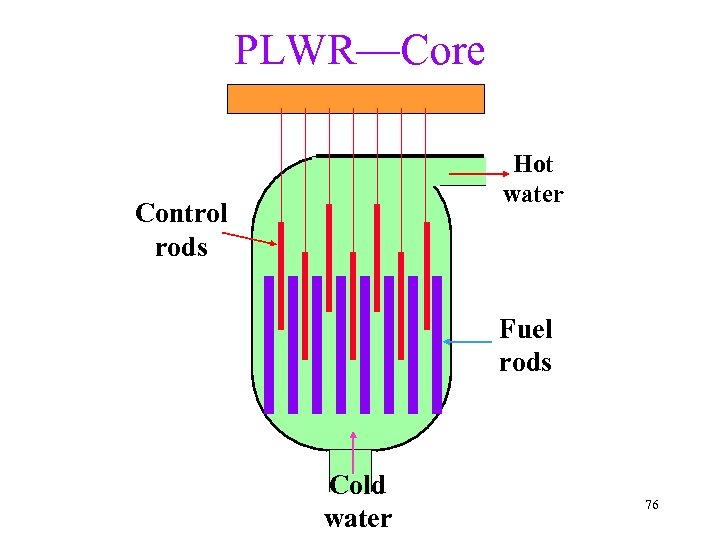 PLWR—Core Hot water Control rods Fuel rods Cold water 76
 Concerns About Nuclear Power • Core melt-down. ü Water loss from core, heat melts core. ü China syndrome. ü Chernobyl. • Waste disposal. ü Waste highly radioactive. ü Reprocessing, underground storage? ü Federal High Level Radioactive Waste Storage Facility at Yucca Mountain, Nevada. Ø Delay in opening, 2017? • Transporting waste. • How do we deal with nuclear power plants that are no longer safe to operate? Tro's Introductory Chemistry, Chapter 17 77
 Nuclear Fusion • Fusion is the combining of light nuclei to make a heavier one. • The sun uses the fusion of hydrogen isotopes to make helium as a power source. • Requires high input of energy to initiate the process. ü Because need to overcome repulsion of positive nuclei. • Produces 10 x the energy per gram as fission. • No radioactive byproducts. • Unfortunately, the only currently working application is the H-bomb. Tro's Introductory Chemistry, Chapter 17 78
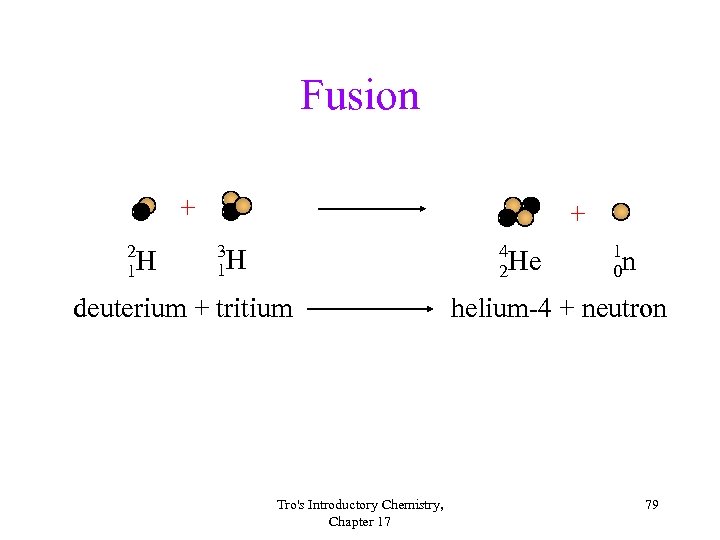 Fusion + 2 1 H + 3 1 H 4 2 He deuterium + tritium Tro's Introductory Chemistry, Chapter 17 1 0 n helium-4 + neutron 79
 Biological Effects of Radiation • Radiation is high energy, energy enough to knock electrons from molecules and break bonds. üIonizing radiation. • Energy transferred to cells can damage biological molecules and cause malfunction of the cell. Tro's Introductory Chemistry, Chapter 17 80
 Acute Effects of Radiation • High levels of radiation over a short period of time kill large numbers of cells. üFrom a nuclear blast or exposed reactor core. • Causes weakened immune system and lower ability to absorb nutrients from food. üMay result in death, usually from infection. Tro's Introductory Chemistry, Chapter 17 81
 Chronic Effects • Low doses of radiation over a period of time show an increased risk for the development of cancer. ü Radiation damages DNA that may not get repaired properly. • Low doses over time may damage reproductive organs, which may lead to sterilization. • Damage to reproductive cells may lead to a genetic defect in offspring. Tro's Introductory Chemistry, Chapter 17 82
 Factors that Determine Biological Effects of Radiation 1. The more energy the radiation has, the larger its effect. 2. The better the radiation penetrates human tissue, the deeper the potential effect. ü Gamma >> beta > alpha. 3. The more ionizing the radiation, the greater the effect of the radiation. ü Alpha > beta > gamma. 4. The radioactive half-life of the radionuclide. 5. The biological half-life of the element. 6. The physical state Tro's the radioactive material. of Introductory Chemistry, Chapter 17 83
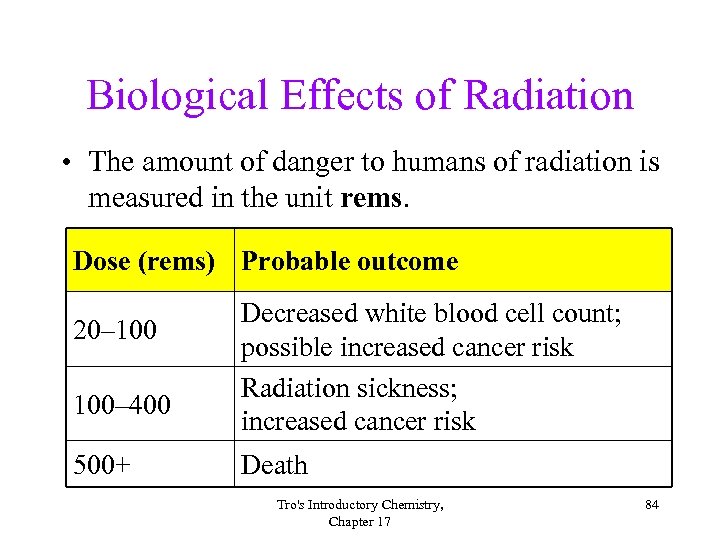 Biological Effects of Radiation • The amount of danger to humans of radiation is measured in the unit rems. Dose (rems) Probable outcome 20– 100– 400 500+ Decreased white blood cell count; possible increased cancer risk Radiation sickness; increased cancer risk Death Tro's Introductory Chemistry, Chapter 17 84
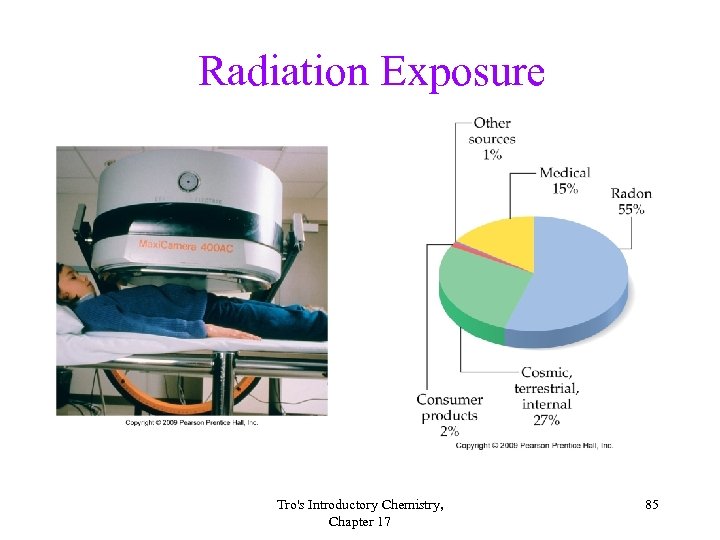 Radiation Exposure Tro's Introductory Chemistry, Chapter 17 85
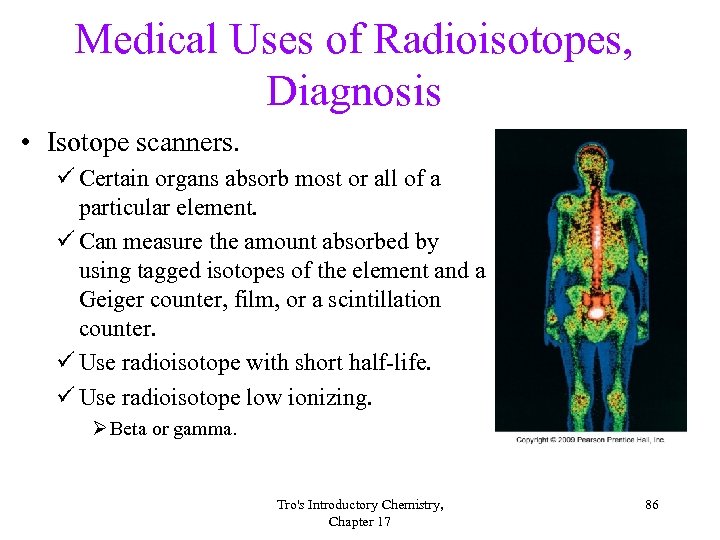 Medical Uses of Radioisotopes, Diagnosis • Isotope scanners. ü Certain organs absorb most or all of a particular element. ü Can measure the amount absorbed by using tagged isotopes of the element and a Geiger counter, film, or a scintillation counter. ü Use radioisotope with short half-life. ü Use radioisotope low ionizing. Ø Beta or gamma. Tro's Introductory Chemistry, Chapter 17 86
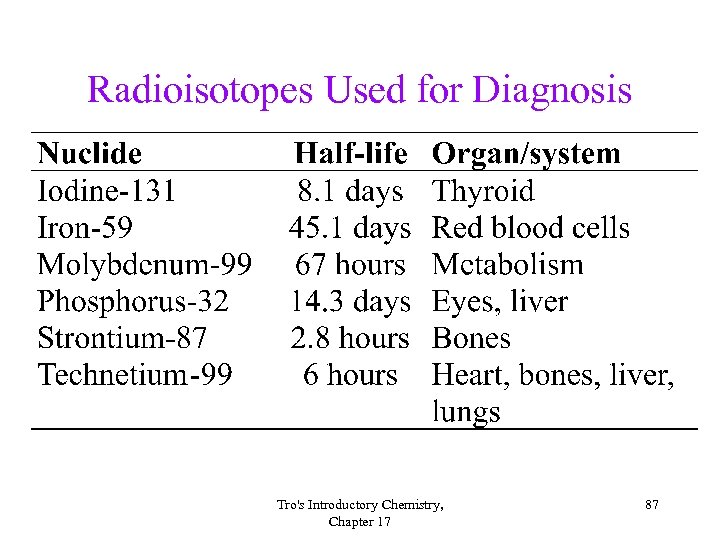 Radioisotopes Used for Diagnosis Tro's Introductory Chemistry, Chapter 17 87
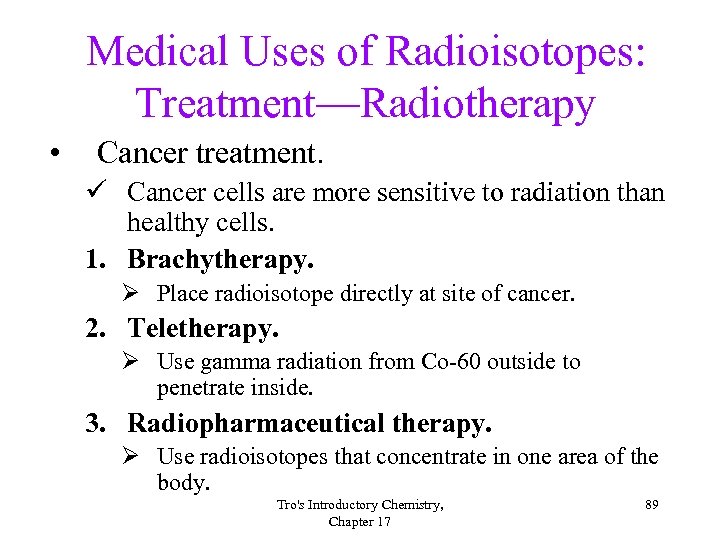 Medical Uses of Radioisotopes: Treatment—Radiotherapy • Cancer treatment. ü Cancer cells are more sensitive to radiation than healthy cells. 1. Brachytherapy. Ø Place radioisotope directly at site of cancer. 2. Teletherapy. Ø Use gamma radiation from Co-60 outside to penetrate inside. 3. Radiopharmaceutical therapy. Ø Use radioisotopes that concentrate in one area of the body. Tro's Introductory Chemistry, Chapter 17 89
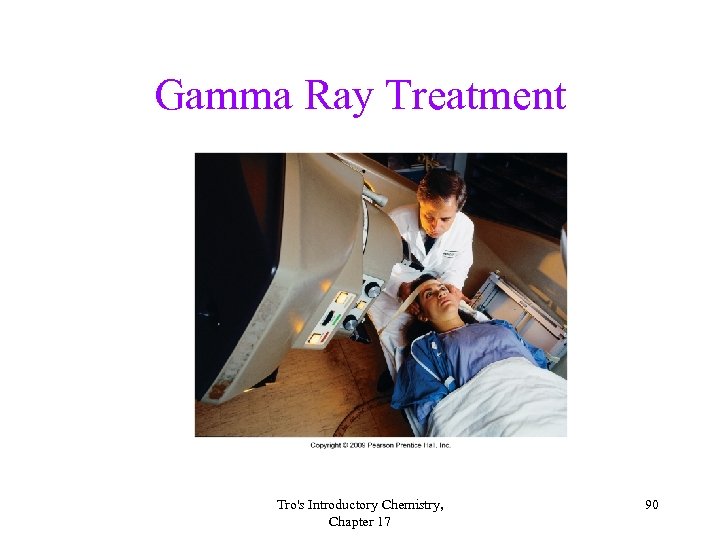 Gamma Ray Treatment Tro's Introductory Chemistry, Chapter 17 90