


 Скачать презентацию Introductions Patricia K Keul ESPCC Director Janice
b521cd187245259177a5c7c6e5bcd082.ppt
- Количество слайдов: 35
 Introductions Patricia K. Keul – ESPCC Director Janice Moore – Certification Consultant- Seacrest, LLC Leon Gross, Ph. D. – Psychometric Consultant-Seacrest, LLC ESPC Council Sue Killam, Louisiana Tommy Cox, North Carolina Macey Chovaz, Wisconsin Cherene Caraco, North Carolina Karen Flippo, ICI, Boston Jeffery Tamburo, New York Wendy Parent, Ph. D, Kansas Kenji Kellen, North Carolina Mindy Oppenheim, California (consumer ) 3/16/2018
 Certified Employment Support Professional First in the Nation! Patricia K. Keul, ESPCC Director Janice Moore, Seacrest, LLC Leon Gross, Ph. D, Seacrest, LLC 3/16/2018
 Starting a Certification Program Define certification and accreditation Project overview Governance requirements Role Delineation Study (RDS) Specific project components and timeline How you can be involved? 3/16/2018
 What is Certification? Process by which individuals demonstrate required knowledge and skill Tool for identifying minimally competent individuals Usually voluntary, non-governmental (vs. licensure) voluntary Time-limited Independent of a specific class, course, or other Independent education/training program (vs. certificate programs) Primary focus on assessment All professional certification programs have the same basic key components, regardless of the profession/industry 3/16/2018
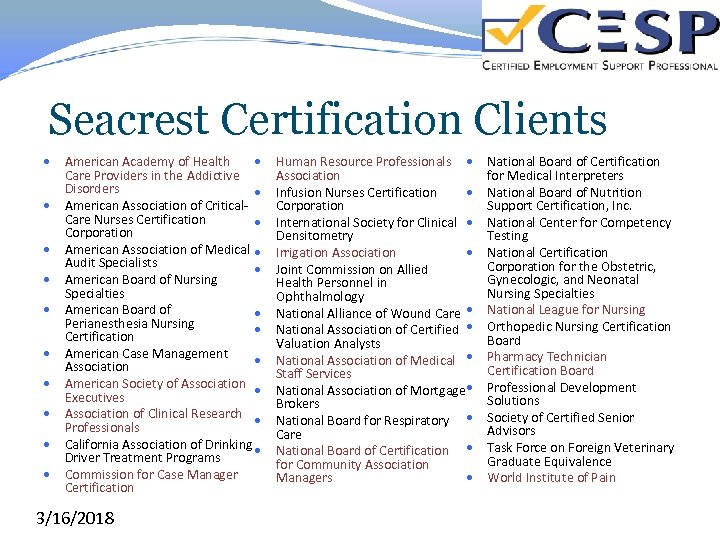 Seacrest Certification Clients American Academy of Health Care Providers in the Addictive Disorders American Association of Critical. Care Nurses Certification Corporation American Association of Medical Audit Specialists American Board of Nursing Specialties American Board of Perianesthesia Nursing Certification American Case Management Association American Society of Association Executives Association of Clinical Research Professionals California Association of Drinking Driver Treatment Programs Commission for Case Manager Certification 3/16/2018 Human Resource Professionals Association Infusion Nurses Certification Corporation International Society for Clinical Densitometry Irrigation Association Joint Commission on Allied Health Personnel in Ophthalmology National Alliance of Wound Care National Association of Certified Valuation Analysts National Association of Medical Staff Services National Association of Mortgage Brokers National Board for Respiratory Care National Board of Certification for Community Association Managers National Board of Certification for Medical Interpreters National Board of Nutrition Support Certification, Inc. National Center for Competency Testing National Certification Corporation for the Obstetric, Gynecologic, and Neonatal Nursing Specialties National League for Nursing Orthopedic Nursing Certification Board Pharmacy Technician Certification Board Professional Development Solutions Society of Certified Senior Advisors Task Force on Foreign Veterinary Graduate Equivalence World Institute of Pain
 The Value of Certification Provides recognition and increased credibility for employment support professionals Supports and encourages continued professional development Provides a way for employment support professionals to demonstrate their commitment to supported employment May create job advancement or increased earnings advancement opportunities Increased safety (disciplinary process) and industry standards Helps employers and customers identify qualified employment identify support professionals 3/16/2018
 What is Accreditation? Third party Recognition granted to a certification program by a nongovernmental agency after verification that it has met predetermined standards Time limited Usually voluntary 3/16/2018
 Accreditation Standards The ESPCC program will seek accreditation from the National Commission for Certifying Agencies (NCCA) Accreditation standards represent the minimum requirements for a quality certification program quality Consistent with certification industry best practice Objective, third party recognition Objective Increased credibility Potential competitive advantage 3/16/2018
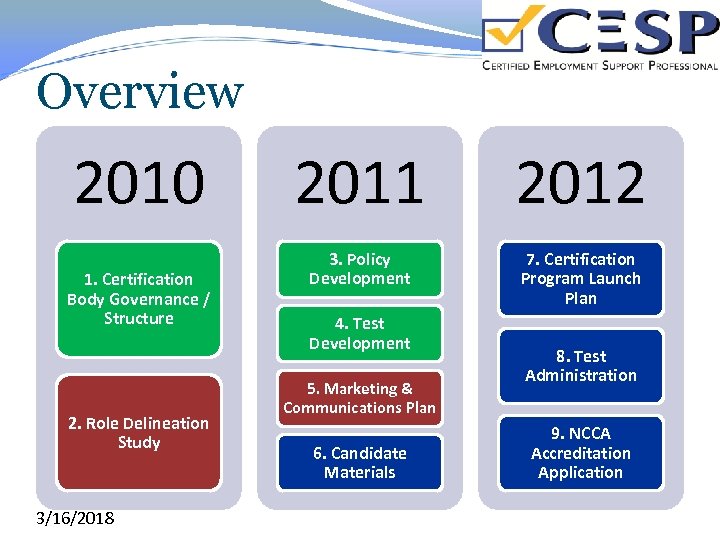 Overview 2010 1. Certification Body Governance / Structure 2. Role Delineation Study 3/16/2018 2011 2012 3. Policy Development 7. Certification Program Launch Plan 4. Test Development 5. Marketing & Communications Plan 6. Candidate Materials 8. Test Administration 9. NCCA Accreditation Application
 Governance & Structure Many certification programs start within, or with significant support from, a parent association (in this case, APSE) Industry best practices & accreditation standards dictate the need for the certification program to operate independently from the parent association Volunteer certification board will include representation from all relevant interests/stakeholders- our ESPC Council 3/16/2018
 Certification Board Essentials Autonomy and independence Ability to make all essential certification decisions Includes Public Member/consumer and ESP certified individuals No involvement in education / training- no endorsement of any specific training program or organization CESP Council Members Sue Killam, Louisiana Tommy Cox, North Carolina Macey Chovaz, Wisconsin Cherene Caraco, North Carolina Karen Flippo, ICI_ Boston Jeffery Tamburo, New York Wendy Parent, Ph. D, Kansas Kenji Kellen, North Carolina Mindy Oppenheim, California (consumer) 3/16/2018
 Role Delineation Study (RDS) Outcome: Clear definition of the roles and responsibilities of employment support professionals Identification of the skills and knowledge required for successful professional performance Built on existing resources Research based (via online survey tool) Input from Subject Matter Experts (SMEs) at all stages of development Serves as the foundation for the exam Opportunity to collect valuable demographic data 3/16/2018
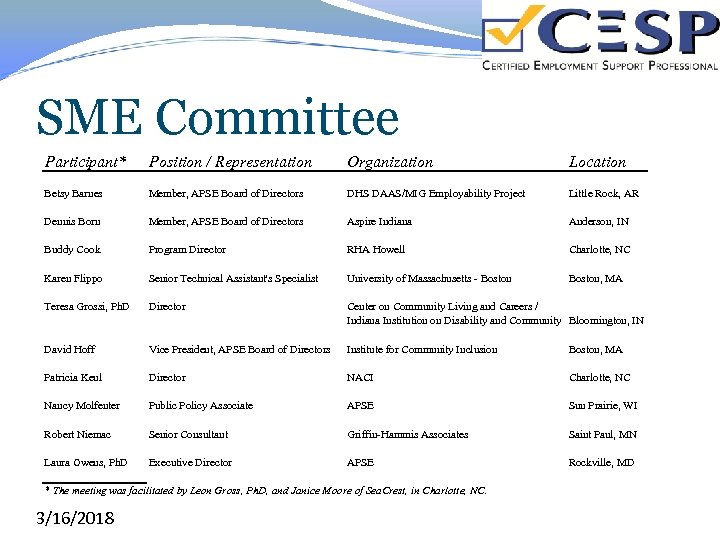 SME Committee Participant* Position / Representation Organization Location Betsy Barnes Member, APSE Board of Directors DHS DAAS/MIG Employability Project Little Rock, AR Dennis Born Member, APSE Board of Directors Aspire Indiana Anderson, IN Buddy Cook Program Director RHA Howell Charlotte, NC Karen Flippo Senior Technical Assistant's Specialist University of Massachusetts - Boston, MA Teresa Grossi, Ph. D Director Center on Community Living and Careers / Indiana Institution on Disability and Community Bloomington, IN David Hoff Vice President, APSE Board of Directors Institute for Community Inclusion Boston, MA Patricia Keul Director NACI Charlotte, NC Nancy Molfenter Public Policy Associate APSE Sun Prairie, WI Robert Niemac Senior Consultant Griffin-Hammis Associates Saint Paul, MN Laura Owens, Ph. D Executive Director APSE Rockville, MD * The meeting was facilitated by Leon Gross, Ph. D, and Janice Moore of Sea. Crest, in Charlotte, NC. 3/16/2018
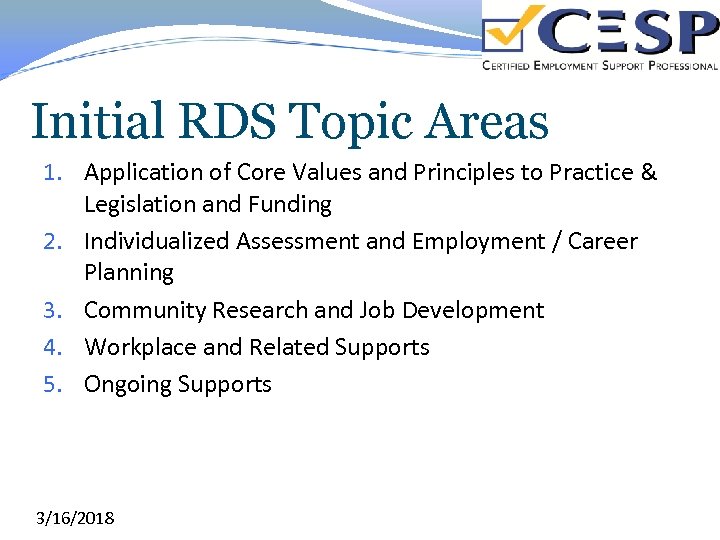 Initial RDS Topic Areas 1. Application of Core Values and Principles to Practice & Legislation and Funding 2. Individualized Assessment and Employment / Career Planning 3. Community Research and Job Development 4. Workplace and Related Supports 5. Ongoing Supports 3/16/2018
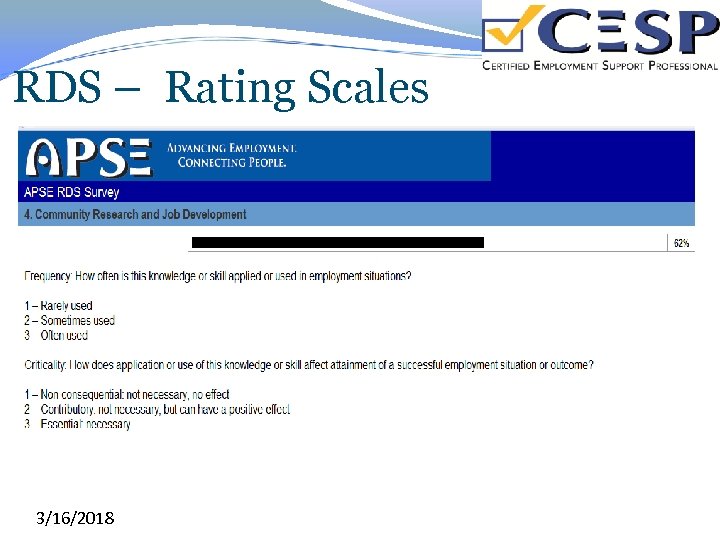 RDS – Rating Scales 3/16/2018
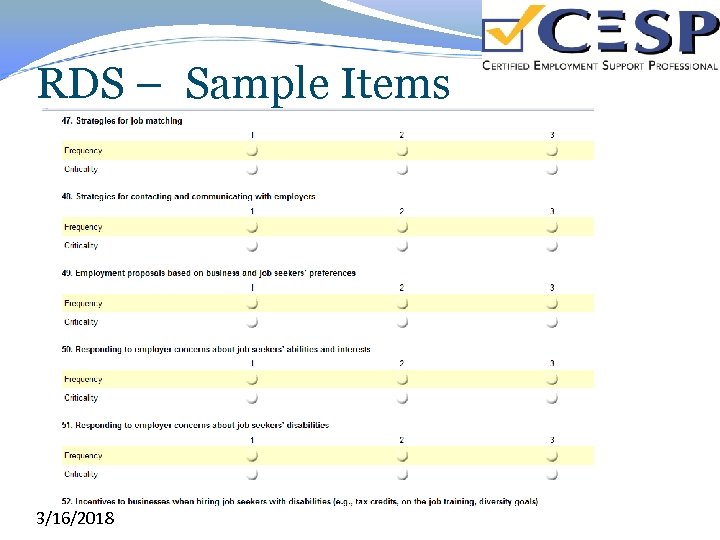 RDS – Sample Items 3/16/2018
 Cool Things We Learned from the RDS Items with high frequency ratings generally had high criticality ratings high frequency high criticality 588 completed surveys (65% from APSE members) 588 15% response rate from total APSE members (2, 500 members) Average 48 39% bachelor’s degree bachelor’s 40% master’s degree master’s 45% work in an urban environment urban 44 of the 50 states represented 44 67% have primary job responsibility in community employment services primary job responsibility 13 average years of experience in community employment services 13 average years of experience Largest concentration of services is provided for clients with intellectual disabilities (56%) 3/16/2018
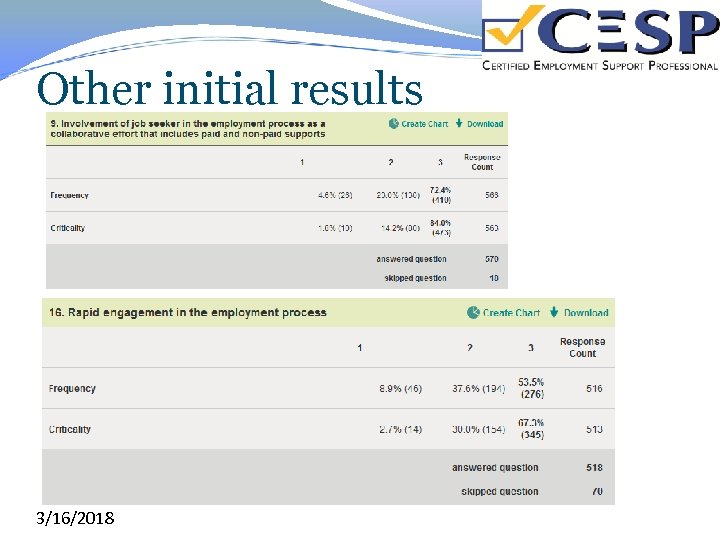 Other initial results 3/16/2018
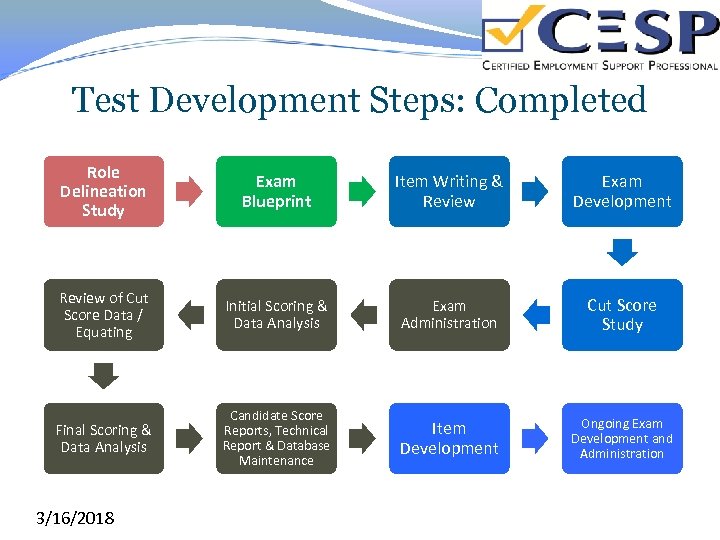 Test Development Steps: Completed Role Delineation Study Exam Blueprint Item Writing & Review Exam Development Review of Cut Score Data / Equating Initial Scoring & Data Analysis Exam Administration Cut Score Study Final Scoring & Data Analysis Candidate Score Reports, Technical Report & Database Maintenance Item Development Ongoing Exam Development and Administration 3/16/2018
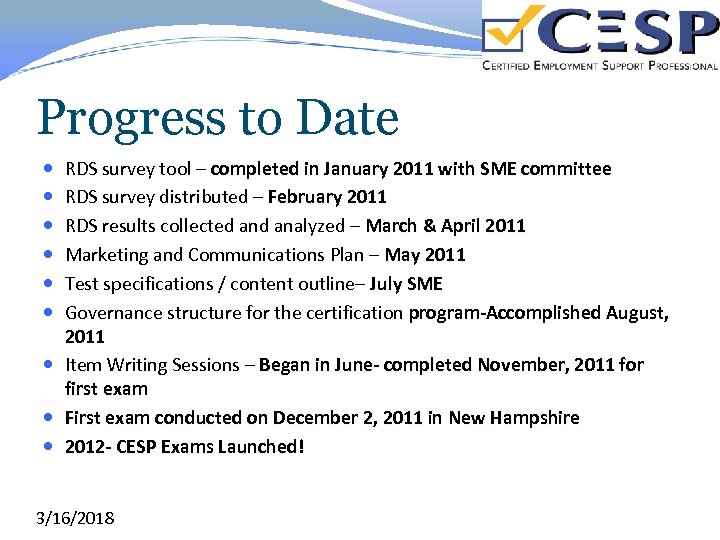 Progress to Date RDS survey tool – completed in January 2011 with SME committee RDS survey distributed – February 2011 RDS results collected analyzed – March & April 2011 Marketing and Communications Plan – May 2011 Test specifications / content outline– July SME Governance structure for the certification program-Accomplished August, 2011 Item Writing Sessions – Began in June- completed November, 2011 for first exam First exam conducted on December 2, 2011 in New Hampshire 2012 - CESP Exams Launched! 3/16/2018
 Marketing ESPCC • ESP certification program purpose • Who are the potential certification candidates? — — — — Direct service/front line Employers, managers, supervisors Residential service workers School to work transition specialists Mental health professional Social workers/human services Other? 3/16/2018
 2012 : Next Steps Conduct the CESP examination to up to 500 test takers Refine the business model and determine rates for recertification Publish the test blueprint so that training organizations may develop curriculum to prepare test takers Submit the NCCA Accreditation application * ( late 2012 to early 2013) 3/16/2018
 Sponsoring the CESP Exam in 2012 How can state agencies, state APSE chapters and others set up and fund the CESP examination sessions? 3/16/2018
 Sponsoring the CESP Exam Offering the examination at professional conferences and/or state meetings will enable employment services professionals to take the examination while attending your conference or event saving them time and money- for test takers and draw more people to your conference. Sponsoring the total cost or at least part of the cost will give your state a cadre of credentialed CESPs- and will encourage professional development across your state’s ESPs. 3/16/2018
 CESP Exam Logistics The exam administration takes one half day to administer & requires. 1. A large room with lecture style tables- test takers sit – arm’s length apart. 2. Access to nearby restrooms 3. Quiet, climate controlled setting- proctor from ESPC C present at all times! 4. Freedom from distraction for 4 hours 5. Area to register test takers & check credentials at sign- in. 6. Coffee & tea and water would be Nice to have 3/16/2018
 Suggested Sponsors State and federal agencies, APSE chapters and other organizations can contract with ESPCC to conduct a total of one or more CESP examination sessions in one state or region at discounted rates. State agencies that may help you to sponsor the CESP examination may include : • Vocational Rehabilitation, • State Developmental Disabilities Councils, • Mental Health State Agencies • Developmental Disabilities State Agencies • State Medicaid Infrastructure Grant program, • APSE State Chapters • Larger Community Rehab. Providers or a group of CRPs 3/16/2018
 CESP Exam Costs Cost at APSE Conference: $189. 00 person- if not from sponsored state $100. 00 person – if from one of the sponsoring states: Indiana Wisconsin Arkansas Minnesota New Hampshire 3/16/2018
 CESP Exam Costs We can & will negotiate with your state, group or agency- for large groups of test takers Large Group/State or Regional Exam Session: New 2012 Approved Sponsorship Rates: 50 people X $100 = $5, 000 + $4, 000 administrative cost. = $9, 000 100 people X $100 = $10, 000 + $4, 000 = $14, 000 150 people X $100 = $15, 000 + $4, 000 = $19, 000 3/16/2018
 CESP Exam Costs Your options: • Agencies pay the total cost for all test takers up to maximum total • Some agencies ask states ask test takers to pay part of the fee- but must still contract with ESPCC for the total cost of the contract in advance • Some agencies or states “pool” resources to bring the CESP exam to one region- and 2 to 4 neighboring states pay for part of the total contract • We can do 2 test sessions on consecutive days during one trip to your state or region. 3/16/2018
 CESP Exam Sponsorship. One Total Cost, Several Ways to Fund Your options: 1. State agencies or organizations contract to pay the total cost for all test takers (50 to 150 test takers ) 2. Some agencies ask states ask the test takers to pay part of the feebut must still contract with ESPCC for the total cost of the contract in advance. 3. Some agencies or states “pool” resources to bring the CESP exam to one region- and 2 to 4 neighboring states pay for part of the total contract. 4. We can do 2 test sessions on consecutive days during one trip to your state or region ( 75 test takers in one session, 75 test takers in second test session on next day of the trip. ) 3/16/2018
 How to Study for the CESP Exam? Visit the APSE web site: www. APSE. org to get the test blue print. Study the 80 items listed on the test blueprint & candidate handbook. Read and or attend nationally recognized training materials Focus on the five domain areas of the CESP exam: 1. 2. 3. 4. 5. Application of Core Values and Principles to Practice & Legislation and Funding Individualized Assessment and Employment / Career Planning Community Research and Job Development Workplace and Related Supports Ongoing Support • ESPCC recognizes that there are many valuable training programs across the country that may prepare professionals to pass the ESPCC examination. ESPCC does not endorse specific training programs, and ESPCC does not engage in education or training programs. 3/16/2018
 Eligibility Standards? Applicants for certification must meet all of the following requirements before they take the exam: Education Requirement High school diploma, GED or equivalent Experience Requirement Each applicant must meet one of the following requirements: 1 year of employment services professional (ESP) work experience as defined below, which may include up to a maximum of 3 months of internship or practicum time OR 9 months of ESP work experience with training component as defined in the candidate handbook. Code of Conduct Each applicant must agree to and sign the Code of Conduct 3/16/2018
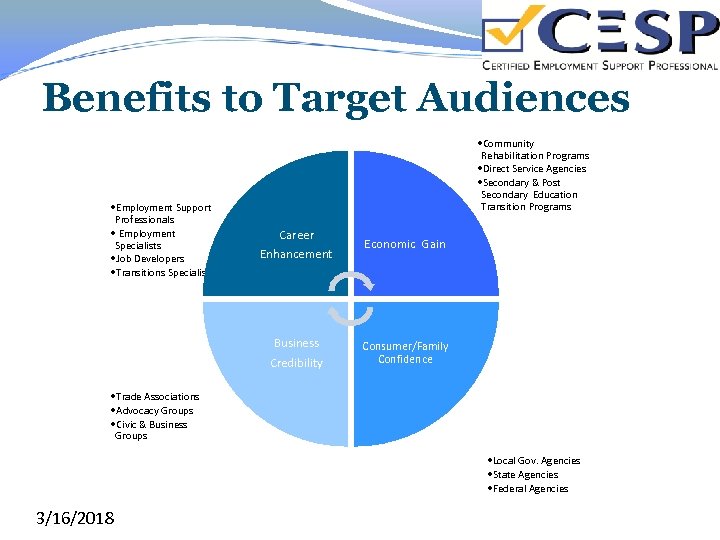 Benefits to Target Audiences • Employment Support Professionals • Employment Specialists • Job Developers • Transitions Specialists • Community Rehabilitation Programs • Direct Service Agencies • Secondary & Post Secondary Education Transition Programs Career Enhancement Economic Gain Business Credibility Consumer/Family Confidence • Trade Associations • Advocacy Groups • Civic & Business Groups • Local Gov. Agencies • State Agencies • Federal Agencies 3/16/2018
 Benefits of CESP Credential CESP certification opens the door to: • Improved professional advancement & job opportunities; • Increased income opportunities. • Enhanced credibility with employers For provider agencies and Community Rehabilitation Programs (CRPs): Sponsoring staff to earn their CESP credentials, or hiring CESP-certified professionals, increases your credibility with community business leaders and opens the door to new employment opportunities for people with disabilities. Supporting CESP certification for your staff: • Increases your marketing edge with employers & businesses • Assures the public and consumers of your commitment to best practices • Validates your commitment to ethical and safety standards 3/16/2018
 Thanks for your time and interest Stay tuned as ESPCC develops! Pat Keul ESPCC Director 704 -534 -1943 pat@apse. com APSE 301 -279 -0060 3/16/2018 Janice Moore Seacrest Consulting 877 -619 -9885 x 702 jmoore@seacrestcompany. com Leon Gross, Ph. D. Seacrest Consulting 877 -619 -9885 lgross 28202@gmail. com