 Скачать презентацию Introduction to z OS Basics Chapter 16 Topics in
68276f8a7ecd8c564da96f3db583710e.ppt
- Количество слайдов: 46



Introduction to z/OS Basics Chapter 16: Topics in z/OS System Programming © 2006 IBM Corporation
Chapter 16 System Programming Objectives § In this chapter you will learn to: – Discuss the responsibilities of a z/OS system programmer – Explain system libraries, their use, and methods for managing their content – Configure consoles – IPL a system 2 © 2006 IBM Corporation
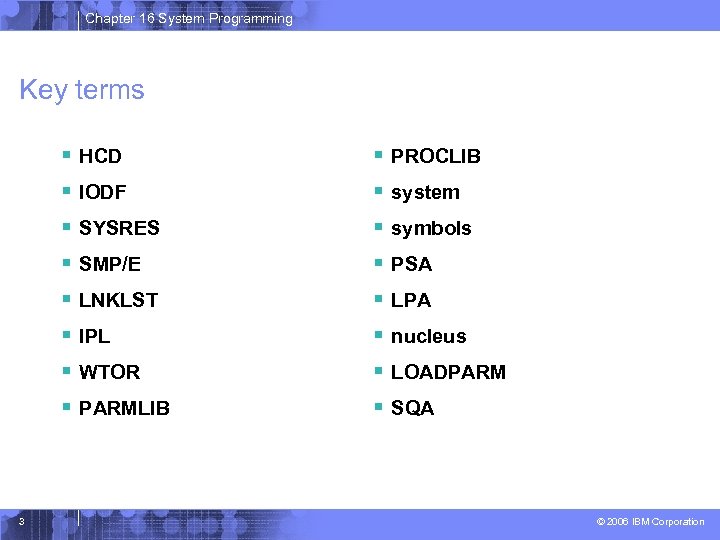
Chapter 16 System Programming Key terms § HCD § IODF § system § SYSRES § symbols § SMP/E § PSA § LNKLST § LPA § IPL § nucleus § WTOR § LOADPARM § PARMLIB 3 § PROCLIB § SQA © 2006 IBM Corporation
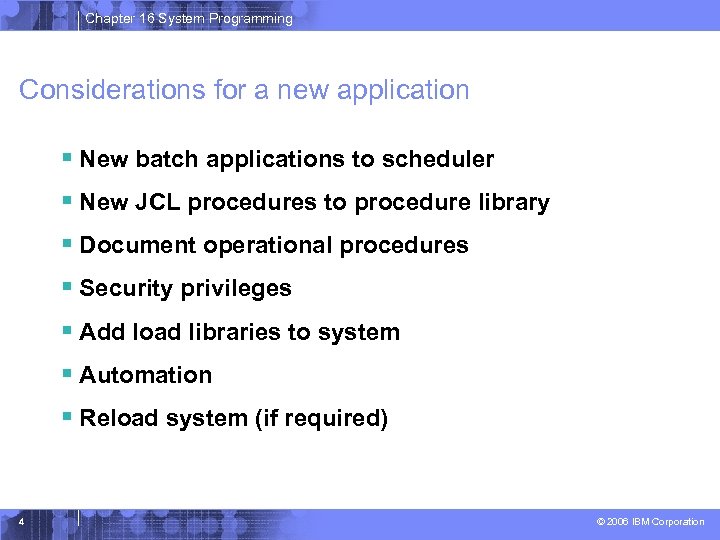
Chapter 16 System Programming Considerations for a new application § New batch applications to scheduler § New JCL procedures to procedure library § Document operational procedures § Security privileges § Add load libraries to system § Automation § Reload system (if required) 4 © 2006 IBM Corporation
Chapter 16 System Programming What is systems programming? § A systems programmer installs, customizes and maintains the operating system § To do this they need knowledge of – Hardware • Storage • Processor – Software • System libraries and data sets – Current customization 5 © 2006 IBM Corporation
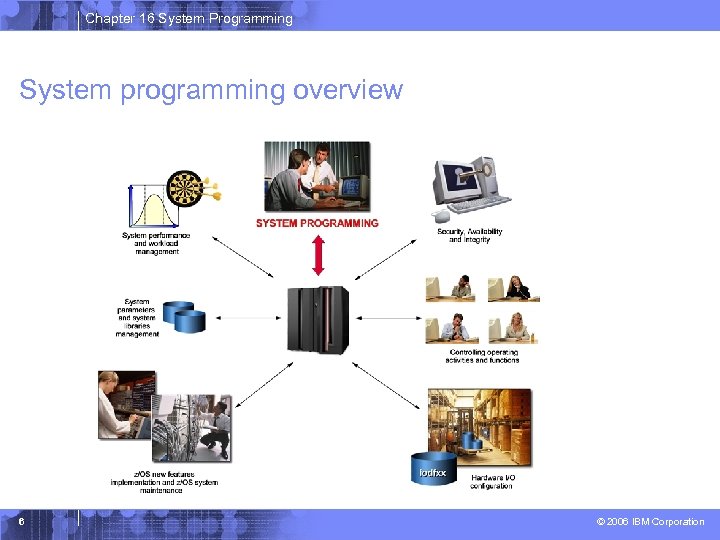
Chapter 16 System Programming System programming overview 6 © 2006 IBM Corporation
Chapter 16 System Programming z/OS operational system administration is: § Software installation and maintenance § Customize parameters § System libraries for software § System data sets § z/OS system address spaces and subsystems § Real and virtual storage 7 © 2006 IBM Corporation
Chapter 16 System Programming z/OS Workload Manager § Workload manager (WLM) is an address space which manages the tasks running on the system § Uses an installation-defined policy to determine relative priority of competing workloads § WLM can also be used to manage hardware resources 8 © 2006 IBM Corporation
Chapter 16 System Programming System performance § System tuning is constant and iterative § Only a real problem when resources are constrained § WLM is one component § Can only manage what is set up § Initial set up of initiators and other resources plays a great part 9 © 2006 IBM Corporation
Chapter 16 System Programming Job flow § Job entry subsystem (JES) controls job flow § Receives jobs into system § Initiates the job § Controls initial output processing 10 © 2006 IBM Corporation
Chapter 16 System Programming I/O device management § Input/output device configuration must be defined to both hardware and software § HCD is used to build an I/O definition file § This definition can be activated to both software and hardware dynamically § Sometimes major changes require an IPL of software or POR of hardware 11 © 2006 IBM Corporation
Chapter 16 System Programming Security § Protection of data against unauthorized disclosure, transfer, modification or destruction § Systems programmer installs and maintains the security system 12 © 2006 IBM Corporation
Chapter 16 System Programming Integrity § Designed, implemented and maintained to protect against unauthorized access § Unauthorized software must not be able to access authorized states § Unauthorized software must not be able to bypass system security such as RACF 13 © 2006 IBM Corporation
Chapter 16 System Programming Availability § System availability is designed to be very high § Many systems require 24 hour 7 day operation 14 © 2006 IBM Corporation
Chapter 16 System Programming Change control § I/T organizations achieve their goals through disciplined change management processes and policy enforcement § These goals include: – High service availability – Increased security – Audit readiness – Cost savings 15 © 2006 IBM Corporation
Chapter 16 System Programming z/OS operation § This is the day to day management of the operating environment both software and hardware § Operator interaction is message and command based § Automated processing of the messages and commands is available and operators now manage by exception 16 © 2006 IBM Corporation
Chapter 16 System Programming z/OS Production Control § Build batch schedules § Promote programs to production § Investigate batch failures 17 © 2006 IBM Corporation
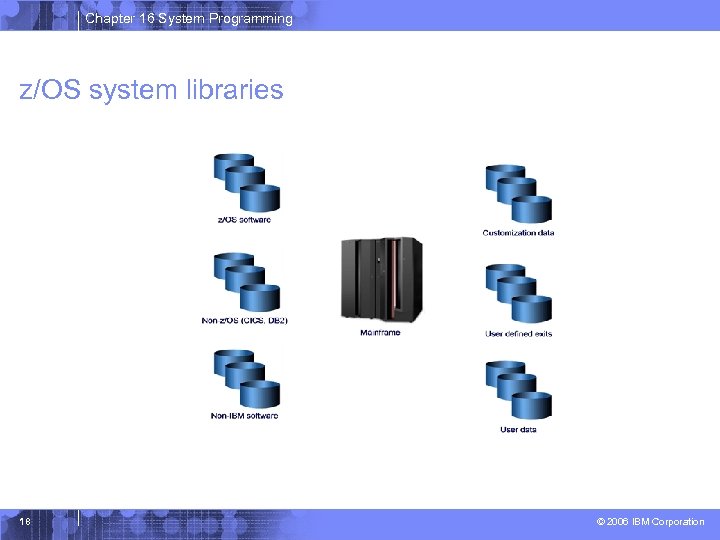
Chapter 16 System Programming z/OS system libraries 18 © 2006 IBM Corporation
Chapter 16 System Programming Types of data § z/OS software on SYSRES volumes § Non-z/OS software e. g. CICS § Non-IBM software § Customization data – parmlib, IODF § User exits § User data – often the largest pool of volumes 19 © 2006 IBM Corporation
Chapter 16 System Programming z/OS system libraries § These are the most important system libraries – SYS 1. LINKLIB prime system software library – SYS 1. LPALIB system subroutines – SYS 1. NUCLEUS basic supervisor modules – SYS 1. PROCLIB system procedure JCL – SYS 1. PARMLIB control parameters 20 © 2006 IBM Corporation
Chapter 16 System Programming SYS 1. LINKLIB § SYS 1. LINKLIB is the main software library § LNKLST concatenation is a group of system and user-defined libraries which form part of the system search order for load modules § Not all on one volume 21 © 2006 IBM Corporation
Chapter 16 System Programming System search order for programs § Programs (load modules) must be in central storage and therefore in the virtual storage of the address space before they can run § System has a defined search order for a newly requested program 22 © 2006 IBM Corporation
Chapter 16 System Programming Search order for programs 1. STEPLIB if present 2. JOBLIB if present and no STEPLIB 3. Link Pack Area (LPA) 1. Dynamic LPA modules 2. Fixed LPA 3. Modified LPA 4. Pageable LPA 4. Linklist 23 © 2006 IBM Corporation
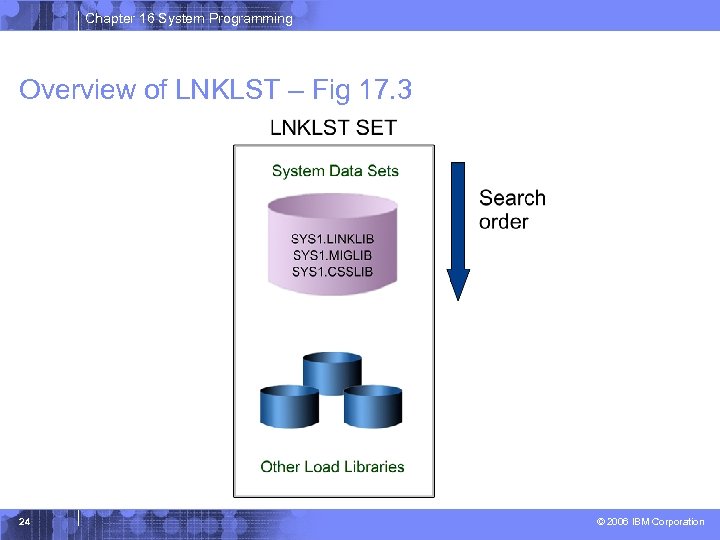
Chapter 16 System Programming Overview of LNKLST – Fig 17. 3 24 © 2006 IBM Corporation
Chapter 16 System Programming Using PROGxx to define LNKLST § A LNKLST set is an ordered list of datasets for processing as the LNKLST concatenation § The PROGxx member may be used to define other lists as well as the linklist § The linklist must be: – Defined – Have libraries added – Activated 25 © 2006 IBM Corporation
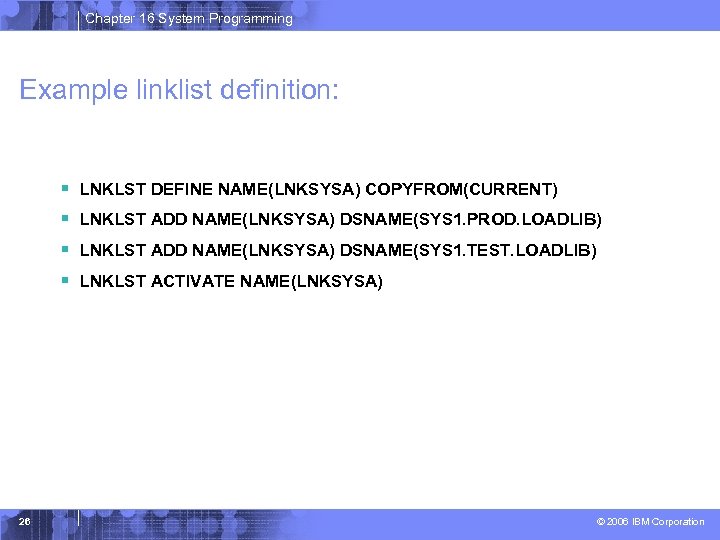
Chapter 16 System Programming Example linklist definition: § LNKLST DEFINE NAME(LNKSYSA) COPYFROM(CURRENT) § LNKLST ADD NAME(LNKSYSA) DSNAME(SYS 1. PROD. LOADLIB) § LNKLST ADD NAME(LNKSYSA) DSNAME(SYS 1. TEST. LOADLIB) § LNKLST ACTIVATE NAME(LNKSYSA) 26 © 2006 IBM Corporation
Chapter 16 System Programming LLA and VLF § Library Look. Aside is an address space which maintains a copy of the directories of selected libraries to improve performance § By default, LLA always caches the linklist directories § Virtual Lookaside Facility is another address space which caches the most popular modules which reduces fetch time § VLF can also cache other data objects such as RACF tables to improve response 27 © 2006 IBM Corporation
Chapter 16 System Programming Libraries and members at IPL time § An number of libraries must be present for the system to load at IPL time – SYS 1. PARMLIB contains the required definitions – SYSn. IPLPARM searched for LOADxx – SYS 1. LPALIB – SYS 1. PROCLIB – SYS 1. NUCLEUS 28 © 2006 IBM Corporation

Chapter 16 System Programming LOADxx § LOADPARM defines the address of the IODF and the suffix of the LOADxx member § At IPL the system searches for LOADxx in: – SYS 0. IPLPARM – SYS 9. IPLPARM on IODF volume – SYS 1. PARMLIB on the IPL volume 29 © 2006 IBM Corporation
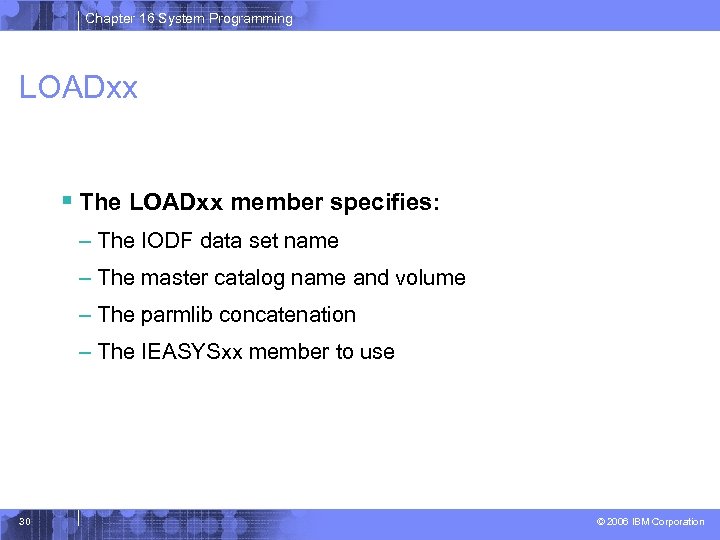
Chapter 16 System Programming LOADxx § The LOADxx member specifies: – The IODF data set name – The master catalog name and volume – The parmlib concatenation – The IEASYSxx member to use 30 © 2006 IBM Corporation
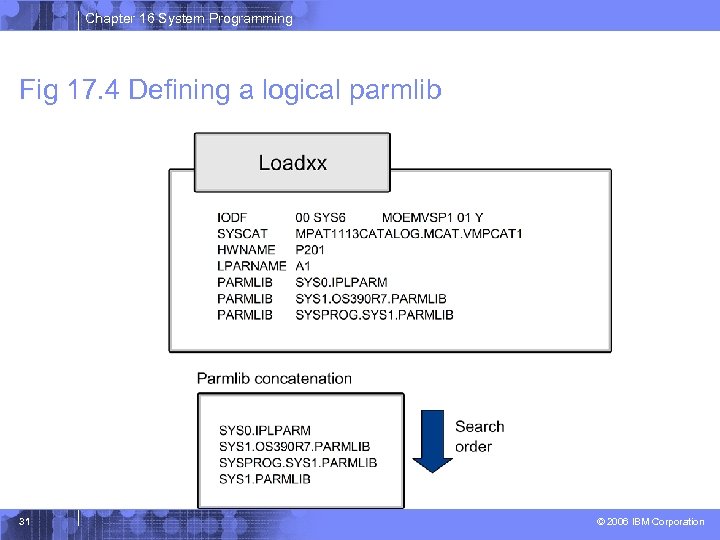
Chapter 16 System Programming Fig 17. 4 Defining a logical parmlib 31 © 2006 IBM Corporation
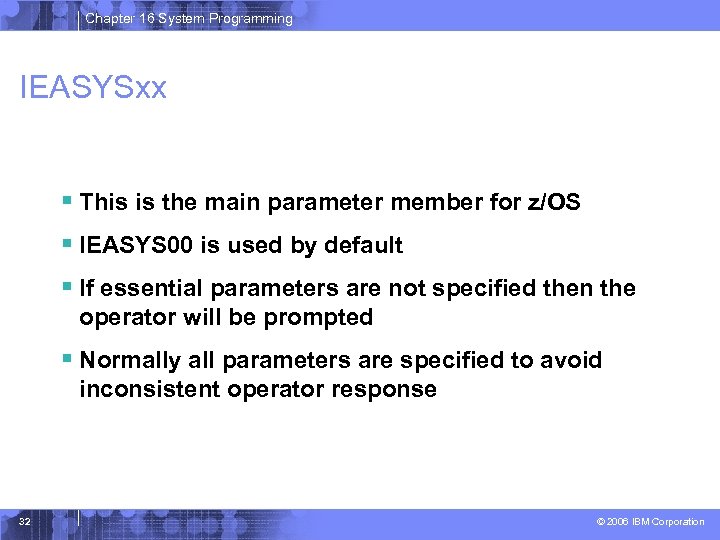
Chapter 16 System Programming IEASYSxx § This is the main parameter member for z/OS § IEASYS 00 is used by default § If essential parameters are not specified then the operator will be prompted § Normally all parameters are specified to avoid inconsistent operator response 32 © 2006 IBM Corporation
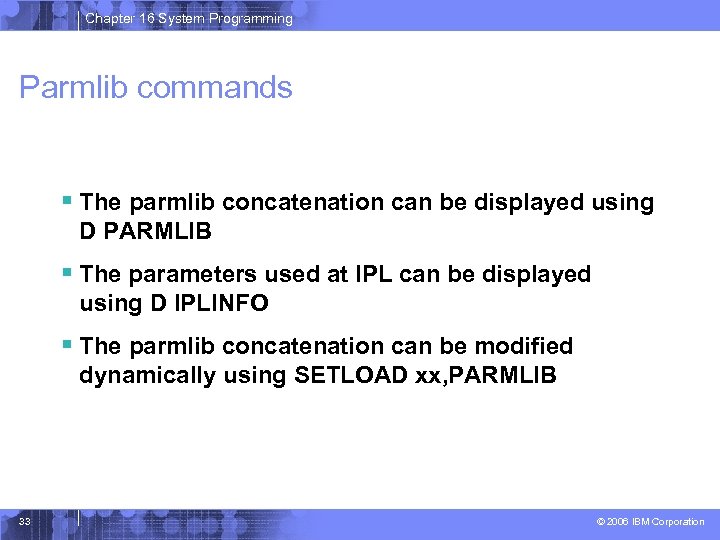
Chapter 16 System Programming Parmlib commands § The parmlib concatenation can be displayed using D PARMLIB § The parameters used at IPL can be displayed using D IPLINFO § The parmlib concatenation can be modified dynamically using SETLOAD xx, PARMLIB 33 © 2006 IBM Corporation
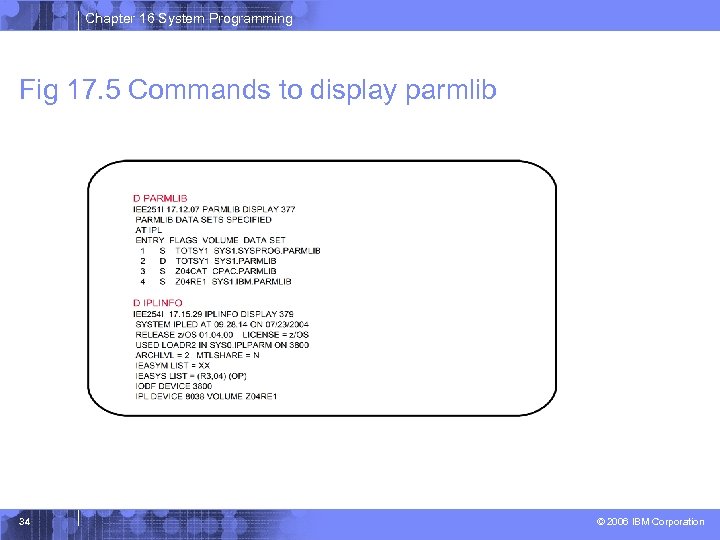
Chapter 16 System Programming Fig 17. 5 Commands to display parmlib 34 © 2006 IBM Corporation
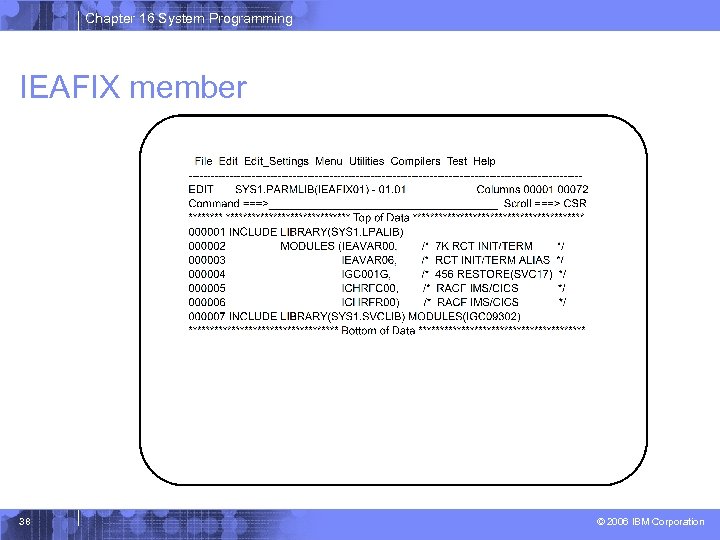
Chapter 16 System Programming SYS 1. LPALIB § The Link Pack Area (LPA) is built at IPL time from the modules defined in the LPALSTxx member of parmlib. § SYS 1. LPALIB is always the first library used unless overridden by a SYSLIB statement § Modules are loaded into common storage at IPL time and so are available to all address spaces 35 © 2006 IBM Corporation
Chapter 16 System Programming SYS 1. LPALIB § Fixed LPA comprises those modules defined in IEAFIXxx that are fixed in central storage § Pageable LPA comprises most other modules whose pages are eligible to be stolen § Modified LPA has modules which are temporary replacements for PLPA modules and is searched first. 36 © 2006 IBM Corporation
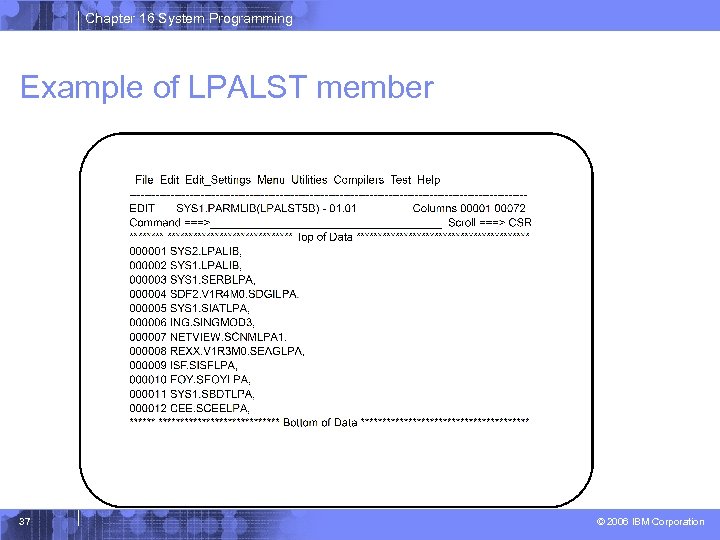
Chapter 16 System Programming Example of LPALST member 37 © 2006 IBM Corporation
Chapter 16 System Programming IEAFIX member 38 © 2006 IBM Corporation
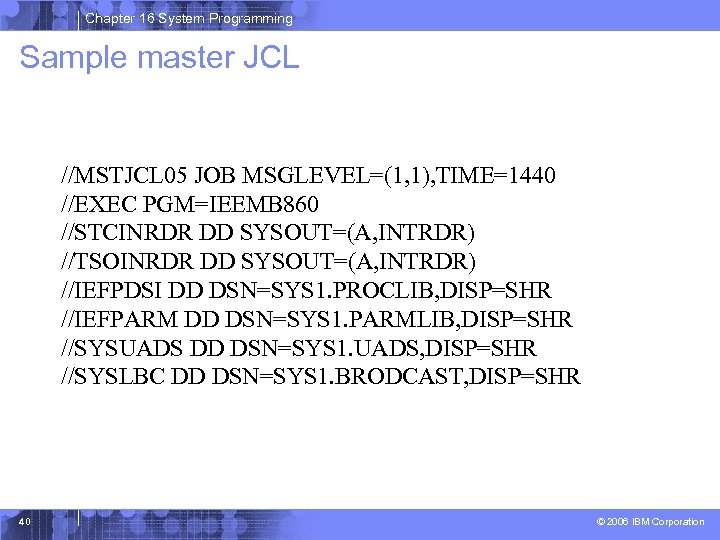
Chapter 16 System Programming SYS 1. PROCLIB § When the system is first IPL’d either the MSTJCL 00 load module or MSTJCLxx in SYS 1. PARMLIB is used to provide the JCL for the master scheduler § This JCL at a minimum points to SYS 1. PROCLIB to provide the JCL procedures for the required tasks to run the system 39 © 2006 IBM Corporation
Chapter 16 System Programming Sample master JCL //MSTJCL 05 JOB MSGLEVEL=(1, 1), TIME=1440 //EXEC PGM=IEEMB 860 //STCINRDR DD SYSOUT=(A, INTRDR) //TSOINRDR DD SYSOUT=(A, INTRDR) //IEFPDSI DD DSN=SYS 1. PROCLIB, DISP=SHR //IEFPARM DD DSN=SYS 1. PARMLIB, DISP=SHR //SYSUADS DD DSN=SYS 1. UADS, DISP=SHR //SYSLBC DD DSN=SYS 1. BRODCAST, DISP=SHR 40 © 2006 IBM Corporation
Chapter 16 System Programming A job’s procedure library § The JES cataloged procedure in SYS 1. PARMLIB contains lists of procedure libraries to be searched for JCL procedures § JCLLIB may also be used to specify a private library to be searched first 41 © 2006 IBM Corporation
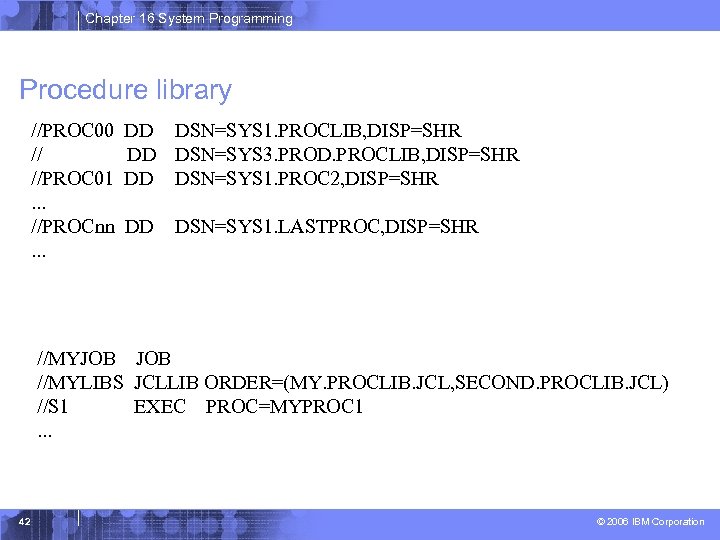
Chapter 16 System Programming Procedure library //PROC 00 // //PROC 01. . . //PROCnn. . . DD DSN=SYS 1. PROCLIB, DISP=SHR DD DSN=SYS 3. PROD. PROCLIB, DISP=SHR DD DSN=SYS 1. PROC 2, DISP=SHR DD DSN=SYS 1. LASTPROC, DISP=SHR //MYJOB //MYLIBS JCLLIB ORDER=(MY. PROCLIB. JCL, SECOND. PROCLIB. JCL) //S 1 EXEC PROC=MYPROC 1. . . 42 © 2006 IBM Corporation
Chapter 16 System Programming System symbols § System symbols allow the use of a shared parmlib by two or more systems § Each symbol has a name which can be used in various places and then substituted at IPL time § Major uses are indirect cataloging and substituting system specific datasets such as the page data sets 43 © 2006 IBM Corporation
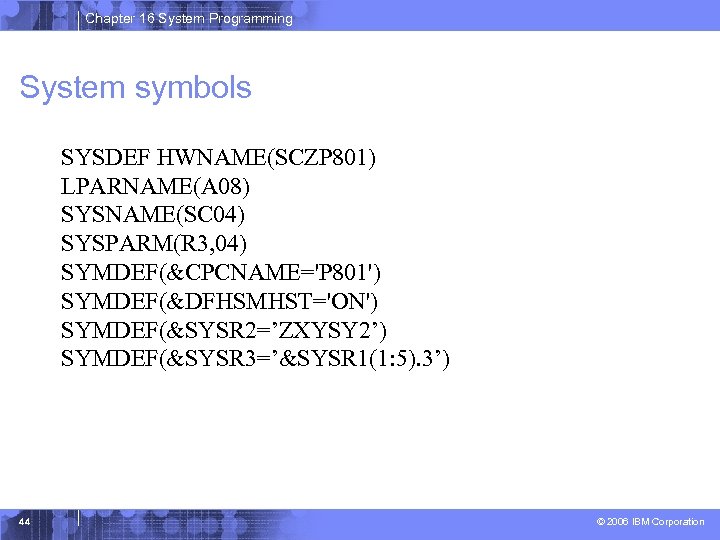
Chapter 16 System Programming System symbols SYSDEF HWNAME(SCZP 801) LPARNAME(A 08) SYSNAME(SC 04) SYSPARM(R 3, 04) SYMDEF(&CPCNAME='P 801') SYMDEF(&DFHSMHST='ON') SYMDEF(&SYSR 2=’ZXYSY 2’) SYMDEF(&SYSR 3=’&SYSR 1(1: 5). 3’) 44 © 2006 IBM Corporation
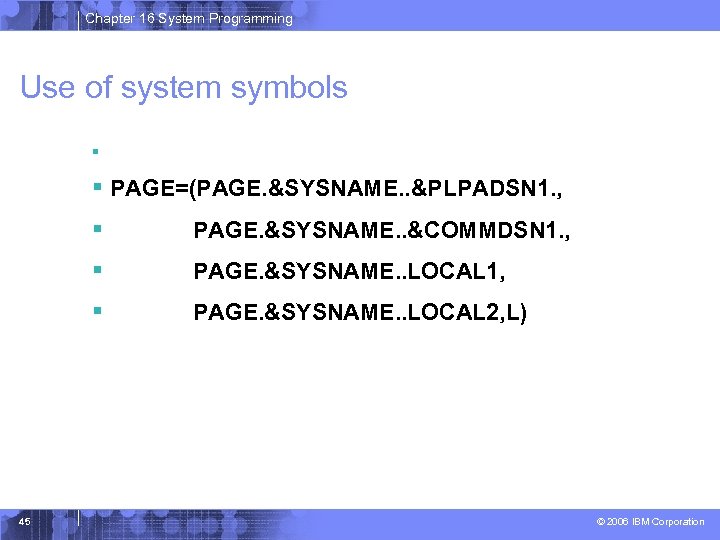
Chapter 16 System Programming Use of system symbols § § PAGE=(PAGE. &SYSNAME. . &PLPADSN 1. , § § PAGE. &SYSNAME. . LOCAL 1, § 45 PAGE. &SYSNAME. . &COMMDSN 1. , PAGE. &SYSNAME. . LOCAL 2, L) © 2006 IBM Corporation
Chapter 16 System Programming Summary § The role of the system programmer is to install customize and maintain the operating system and must be aware of: – z/OS operational system administration – Workload management – System performance – Job flow – I/O device management – Security/integrity/availability – z/OS Operation – Change management 46 © 2006 IBM Corporation
Скачать презентацию Introduction to z OS Basics Chapter 16 Topics in
68276f8a7ecd8c564da96f3db583710e.ppt