


 Скачать презентацию Introduction to Yield Information and Methods 1 and
d70153b2a79d62dd9b0ccb895279f74f.ppt
- Количество слайдов: 23
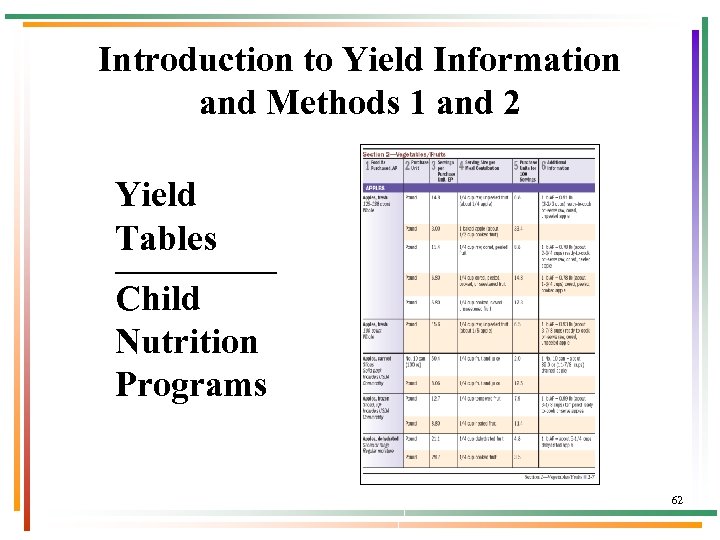 Introduction to Yield Information and Methods 1 and 2 Yield Tables _____ Child Nutrition Programs 62
 How Are the Foods Listed and Grouped? Milk, Section 4 M/MA, Section 1 V/F, Section 2 G/B, Section 3 Other Foods, Section 5: These foods do not contribute to the meal patterns. 63
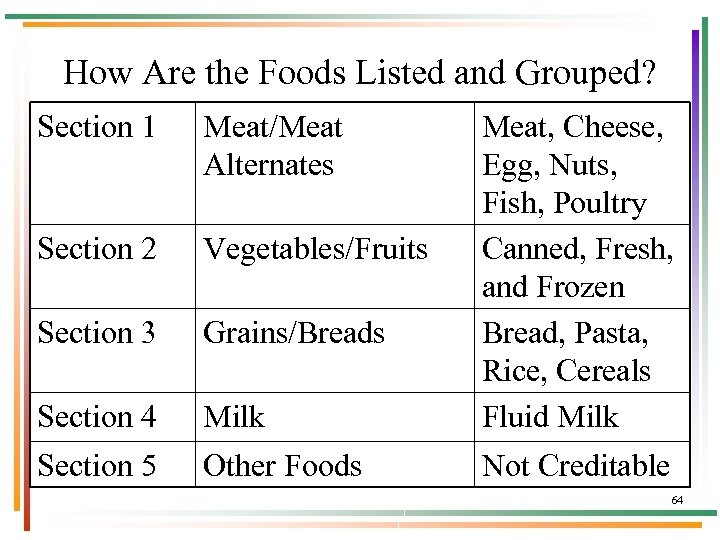 How Are the Foods Listed and Grouped? Section 1 Meat/Meat Alternates Section 2 Vegetables/Fruits Section 3 Grains/Breads Section 4 Milk Meat, Cheese, Egg, Nuts, Fish, Poultry Canned, Fresh, and Frozen Bread, Pasta, Rice, Cereals Fluid Milk Section 5 Other Foods Not Creditable 64
 Important Points About Yield Information § Yield information represents average yields based on research conducted by USDA. § Yield information is meant to be a planning, purchasing, and production tool and is based on careful portioning and weighing. § Variance in actual and projected yields on some local products may legitimately exist and be documented based on procedures set by the State agency. 65
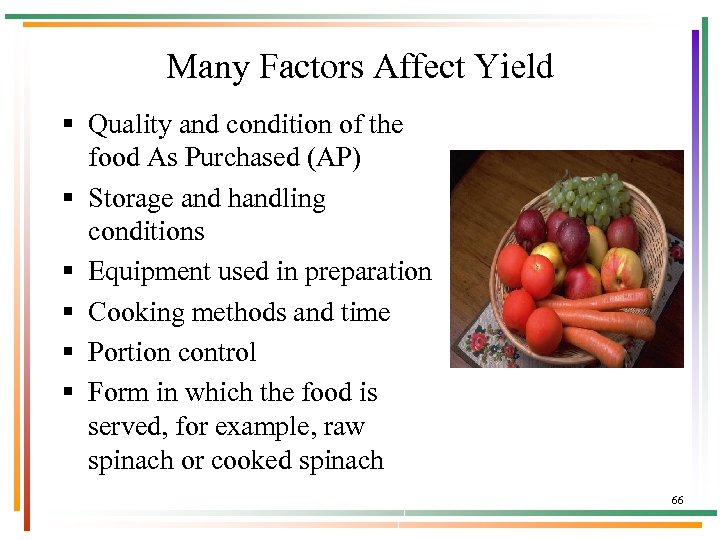 Many Factors Affect Yield § Quality and condition of the food As Purchased (AP) § Storage and handling conditions § Equipment used in preparation § Cooking methods and time § Portion control § Form in which the food is served, for example, raw spinach or cooked spinach 66
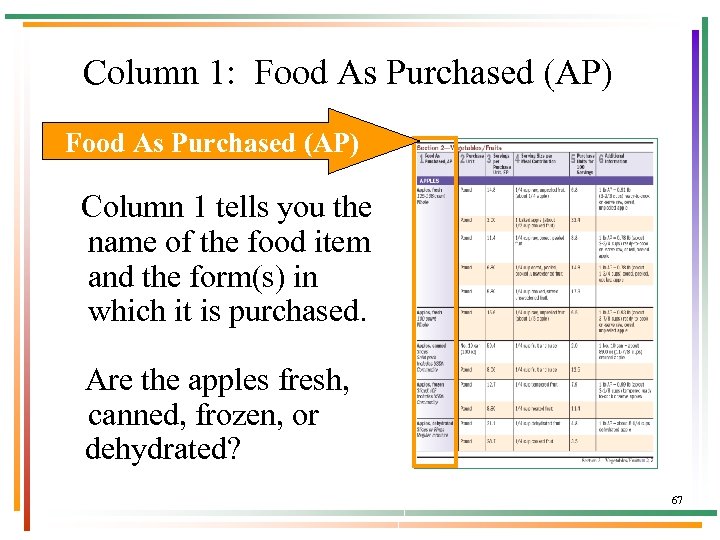 Column 1: Food As Purchased (AP) Column 1 tells you the name of the food item and the form(s) in which it is purchased. Are the apples fresh, canned, frozen, or dehydrated? 67
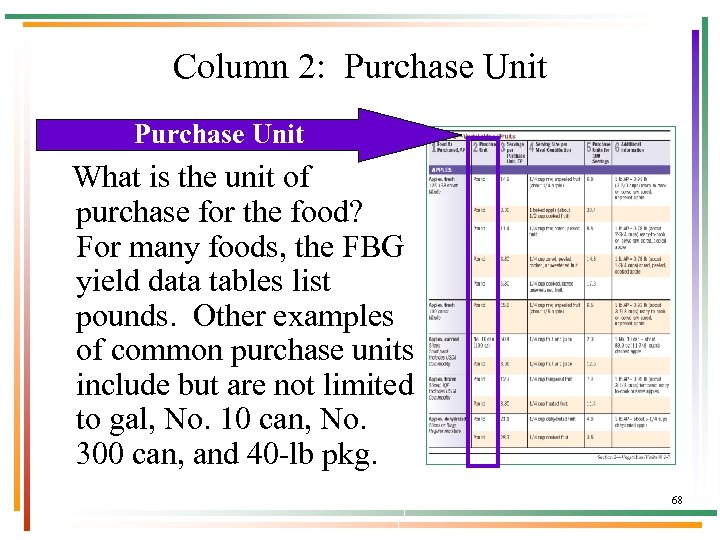 Column 2: Purchase Unit What is the unit of purchase for the food? For many foods, the FBG yield data tables list pounds. Other examples of common purchase units include but are not limited to gal, No. 10 can, No. 300 can, and 40 -lb pkg. 68
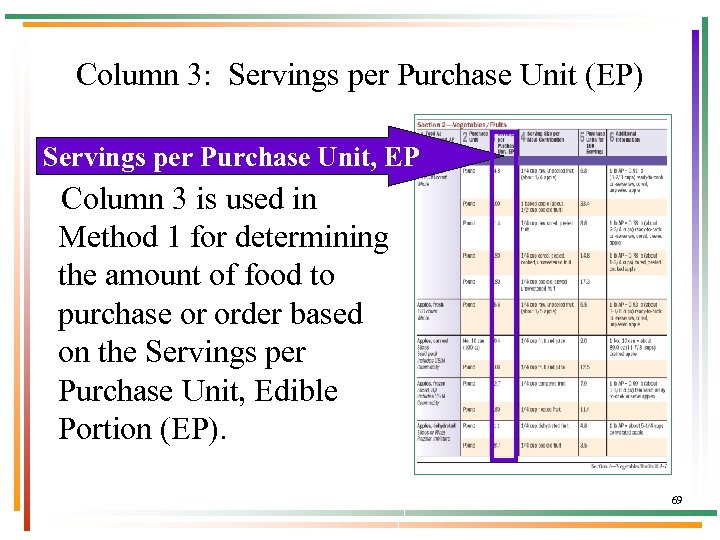 Column 3: Servings per Purchase Unit (EP) Servings per Purchase Unit, EP Column 3 is used in Method 1 for determining the amount of food to purchase or order based on the Servings per Purchase Unit, Edible Portion (EP). 69
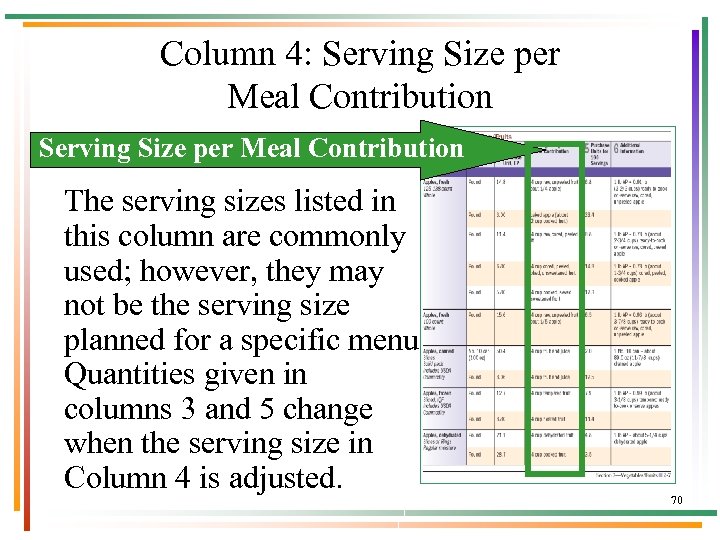 Column 4: Serving Size per Meal Contribution The serving sizes listed in this column are commonly used; however, they may not be the serving size planned for a specific menu. Quantities given in columns 3 and 5 change when the serving size in Column 4 is adjusted. 70
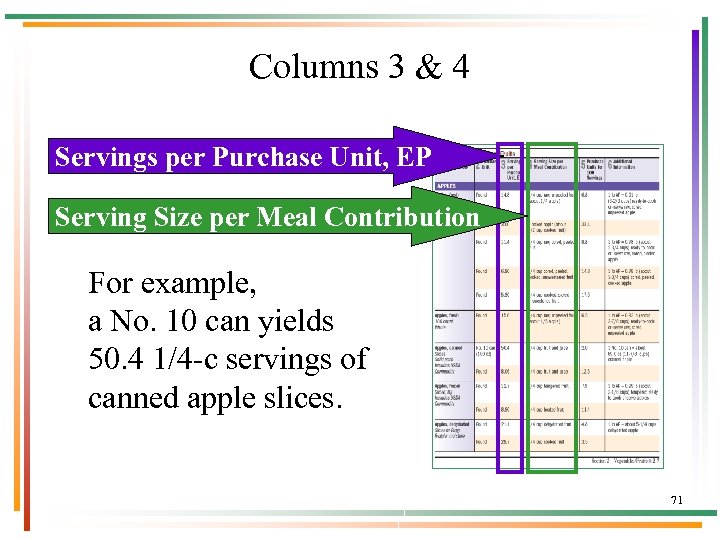 Columns 3 & 4 Servings per Purchase Unit, EP Serving Size per Meal Contribution For example, a No. 10 can yields 50. 4 1/4 -c servings of canned apple slices. 71
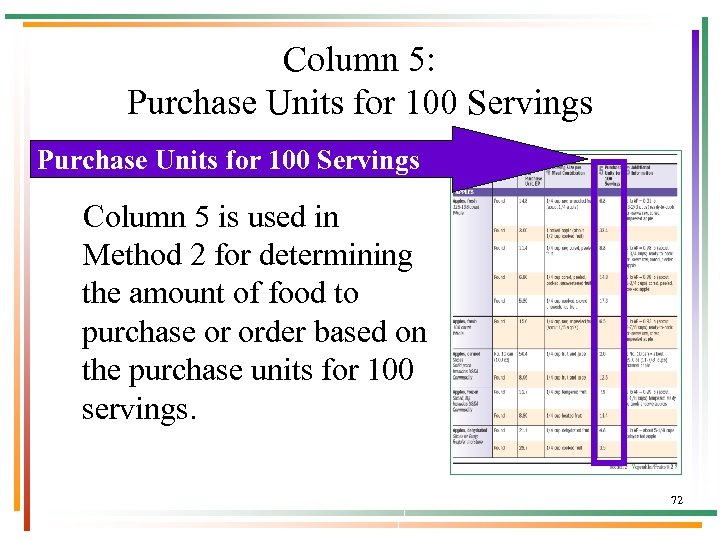 Column 5: Purchase Units for 100 Servings Column 5 is used in Method 2 for determining the amount of food to purchase or order based on the purchase units for 100 servings. 72
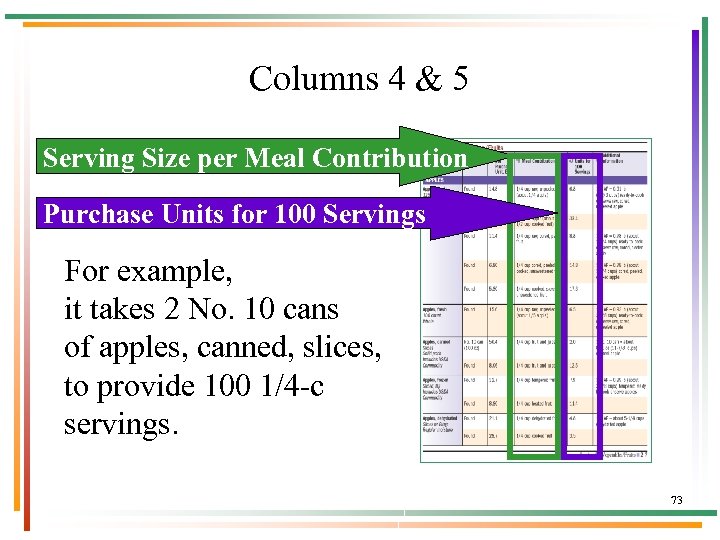 Columns 4 & 5 Serving Size per Meal Contribution Purchase Units for 100 Servings For example, it takes 2 No. 10 cans of apples, canned, slices, to provide 100 1/4 -c servings. 73
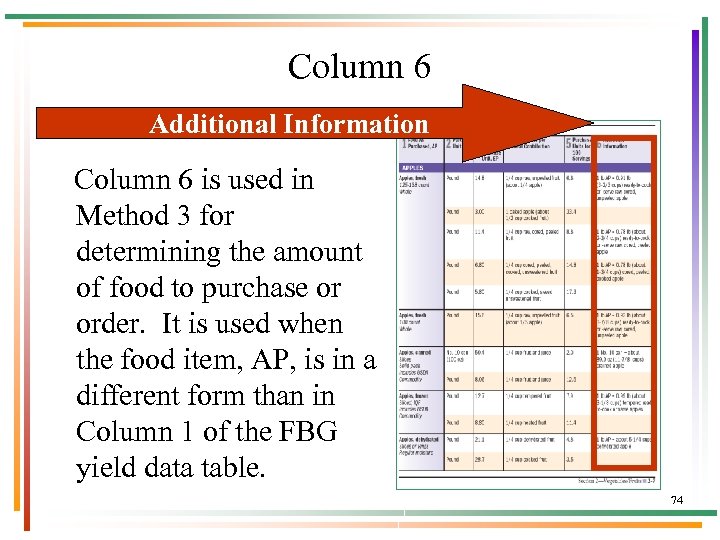 Column 6 Additional Information Column 6 is used in Method 3 for determining the amount of food to purchase or order. It is used when the food item, AP, is in a different form than in Column 1 of the FBG yield data table. 74
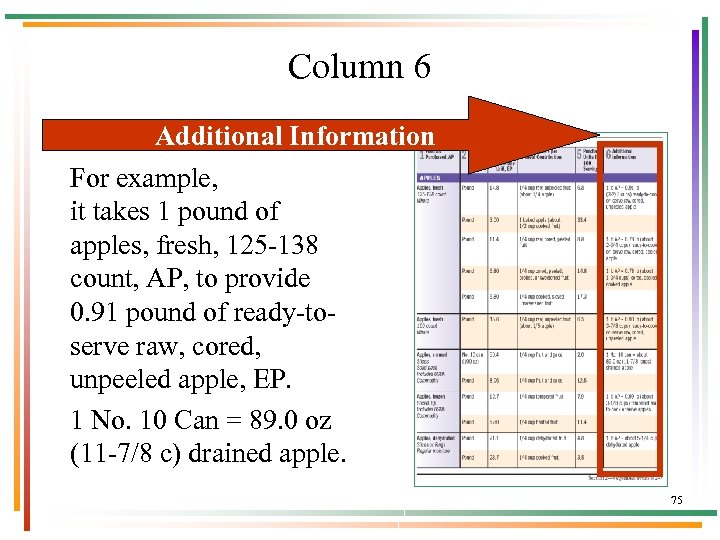 Column 6 Additional Information For example, it takes 1 pound of apples, fresh, 125 -138 count, AP, to provide 0. 91 pound of ready-toserve raw, cored, unpeeled apple, EP. 1 No. 10 Can = 89. 0 oz (11 -7/8 c) drained apple. 75
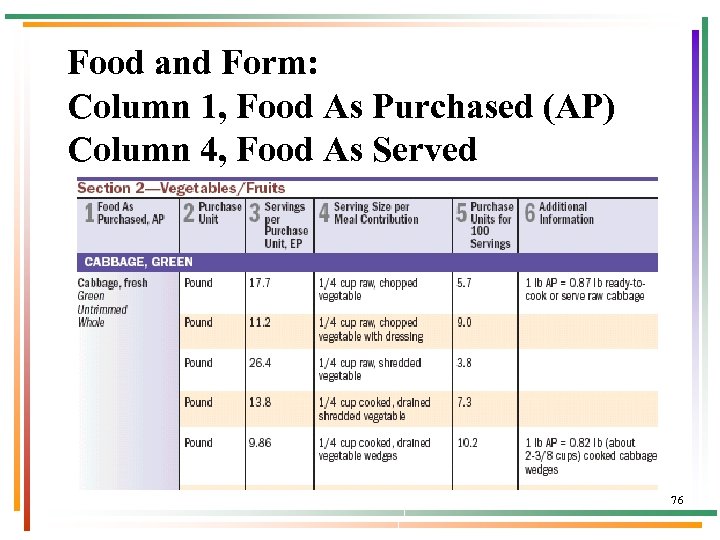 Food and Form: Column 1, Food As Purchased (AP) Column 4, Food As Served 76
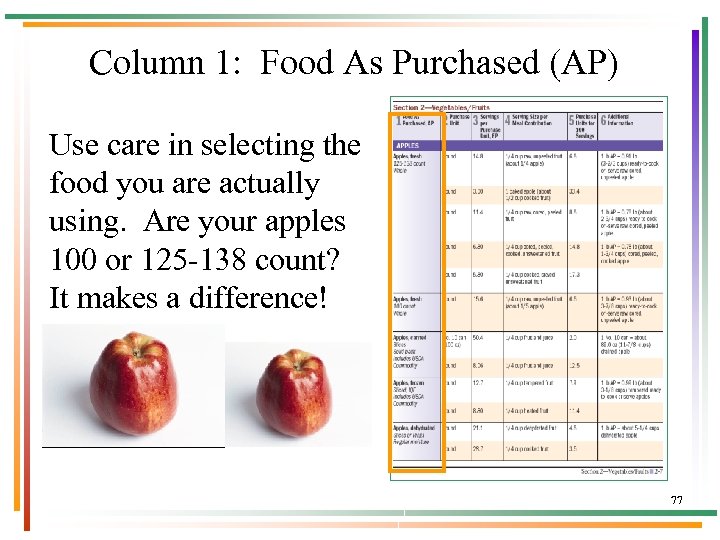 Column 1: Food As Purchased (AP) Use care in selecting the food you are actually using. Are your apples 100 or 125 -138 count? It makes a difference! 77
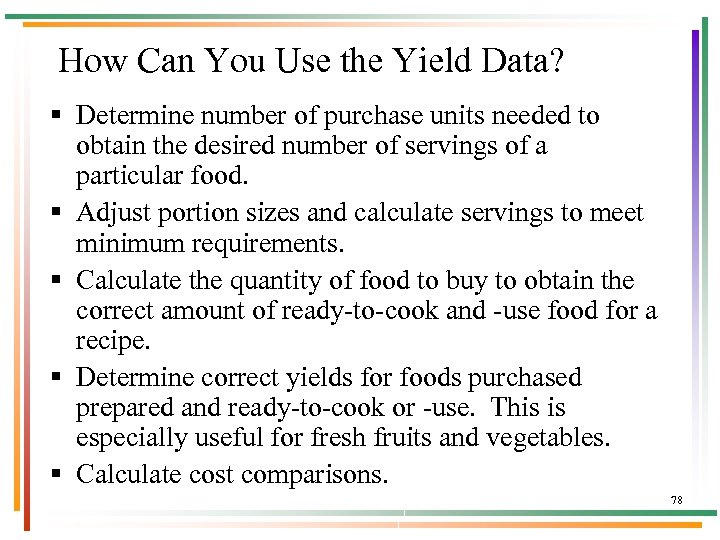 How Can You Use the Yield Data? § Determine number of purchase units needed to obtain the desired number of servings of a particular food. § Adjust portion sizes and calculate servings to meet minimum requirements. § Calculate the quantity of food to buy to obtain the correct amount of ready-to-cook and -use food for a recipe. § Determine correct yields for foods purchased prepared and ready-to-cook or -use. This is especially useful for fresh fruits and vegetables. § Calculate cost comparisons. 78
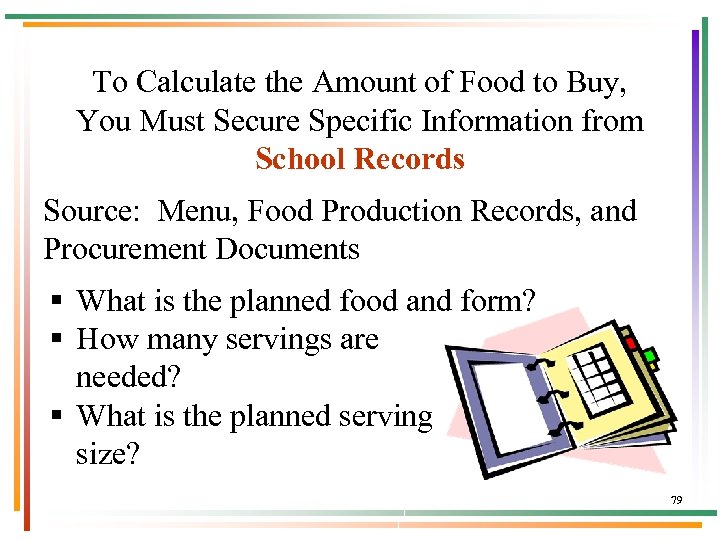 To Calculate the Amount of Food to Buy, You Must Secure Specific Information from School Records Source: Menu, Food Production Records, and Procurement Documents § What is the planned food and form? § How many servings are needed? § What is the planned serving size? 79
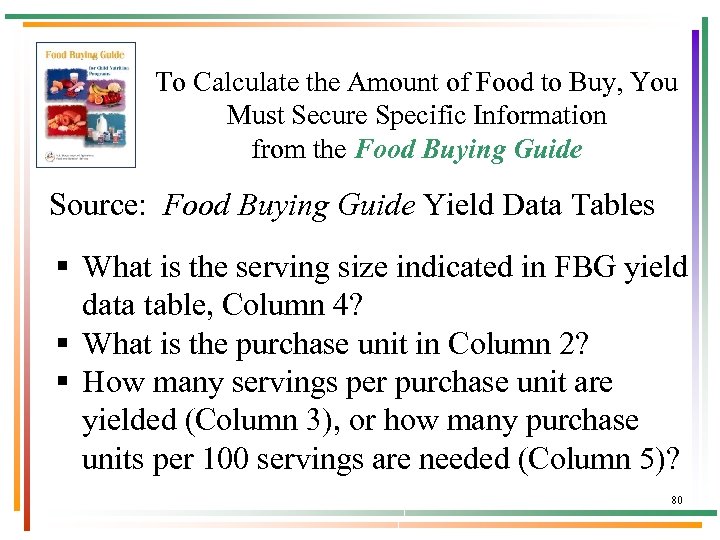 To Calculate the Amount of Food to Buy, You Must Secure Specific Information from the Food Buying Guide Source: Food Buying Guide Yield Data Tables § What is the serving size indicated in FBG yield data table, Column 4? § What is the purchase unit in Column 2? § How many servings per purchase unit are yielded (Column 3), or how many purchase units per 100 servings are needed (Column 5)? 80
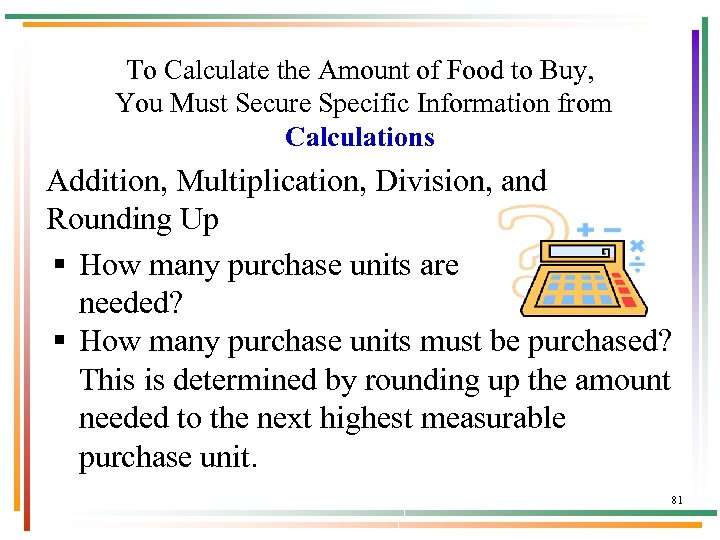 To Calculate the Amount of Food to Buy, You Must Secure Specific Information from Calculations Addition, Multiplication, Division, and Rounding Up § How many purchase units are needed? § How many purchase units must be purchased? This is determined by rounding up the amount needed to the next highest measurable purchase unit. 81
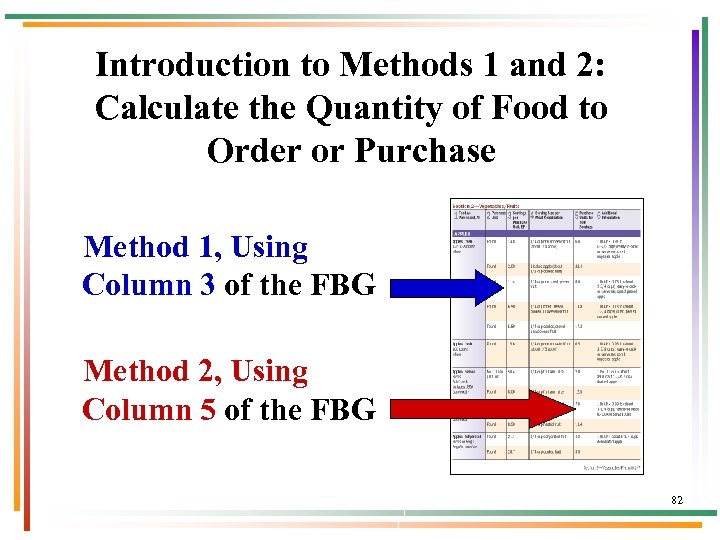 Introduction to Methods 1 and 2: Calculate the Quantity of Food to Order or Purchase Method 1, Using Column 3 of the FBG Method 2, Using Column 5 of the FBG 82
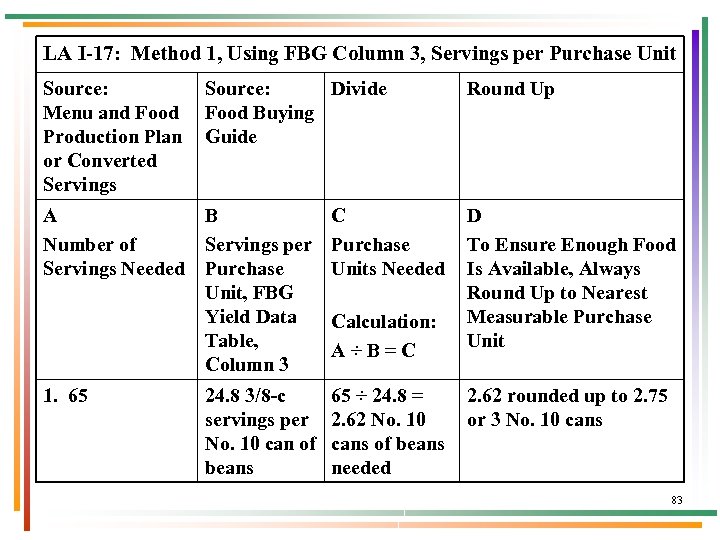 LA I-17: Method 1, Using FBG Column 3, Servings per Purchase Unit Source: Menu and Food Production Plan or Converted Servings Source: Divide Food Buying Guide Round Up A Number of Servings Needed B Servings per Purchase Unit, FBG Yield Data Table, Column 3 C Purchase Units Needed D To Ensure Enough Food Is Available, Always Round Up to Nearest Measurable Purchase Unit 24. 8 3/8 -c servings per No. 10 can of beans 65 ÷ 24. 8 = 2. 62 No. 10 cans of beans needed 1. 65 Calculation: A÷B=C 2. 62 rounded up to 2. 75 or 3 No. 10 cans 83
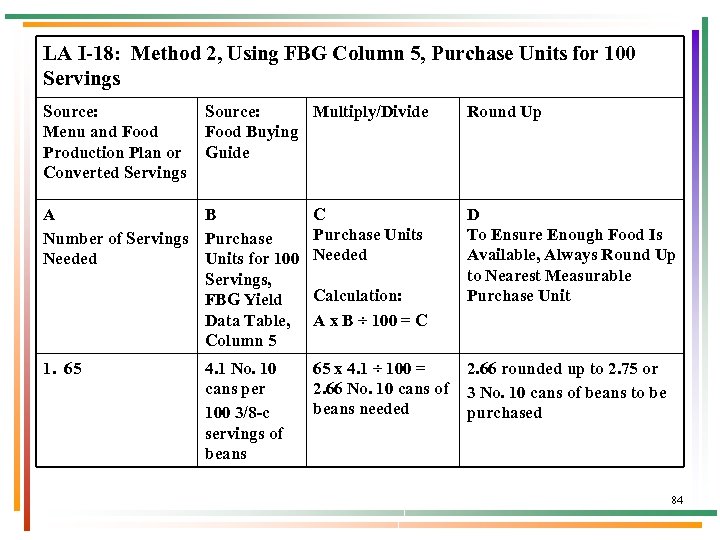 LA I-18: Method 2, Using FBG Column 5, Purchase Units for 100 Servings Source: Menu and Food Production Plan or Converted Servings Source: Multiply/Divide Food Buying Guide A B Number of Servings Purchase Needed Units for 100 Servings, FBG Yield Data Table, Column 5 C Purchase Units Needed 1. 65 65 x 4. 1 ÷ 100 = 2. 66 No. 10 cans of beans needed 4. 1 No. 10 cans per 100 3/8 -c servings of beans Calculation: A x B ÷ 100 = C Round Up D To Ensure Enough Food Is Available, Always Round Up to Nearest Measurable Purchase Unit 2. 66 rounded up to 2. 75 or 3 No. 10 cans of beans to be purchased 84