 Скачать презентацию Introduction to XMPP Joe Hildebrand Presentation_ID 2008
2324a9654162ae800e26f82ce30e71a4.ppt
- Количество слайдов: 23



Introduction to XMPP Joe Hildebrand Presentation_ID © 2008 Cisco Systems, Inc. All rights reserved. Cisco Confidential 1
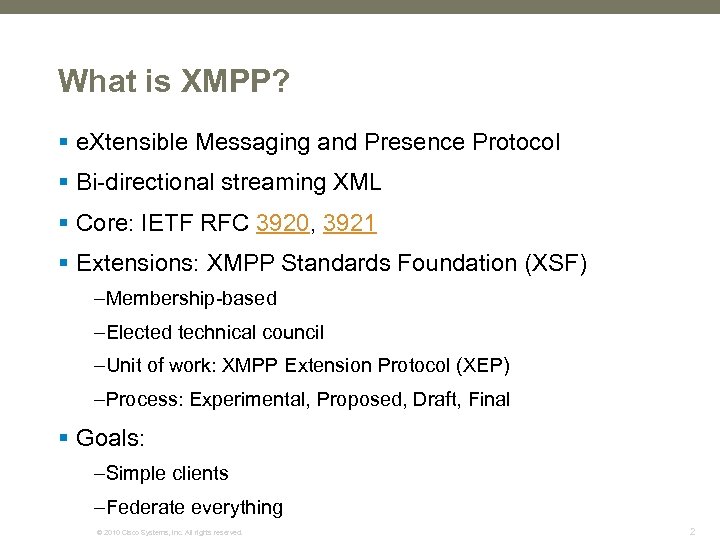
What is XMPP? § e. Xtensible Messaging and Presence Protocol § Bi-directional streaming XML § Core: IETF RFC 3920, 3921 § Extensions: XMPP Standards Foundation (XSF) –Membership-based –Elected technical council –Unit of work: XMPP Extension Protocol (XEP) –Process: Experimental, Proposed, Draft, Final § Goals: –Simple clients –Federate everything © 2010 Cisco Systems, Inc. All rights reserved. 2
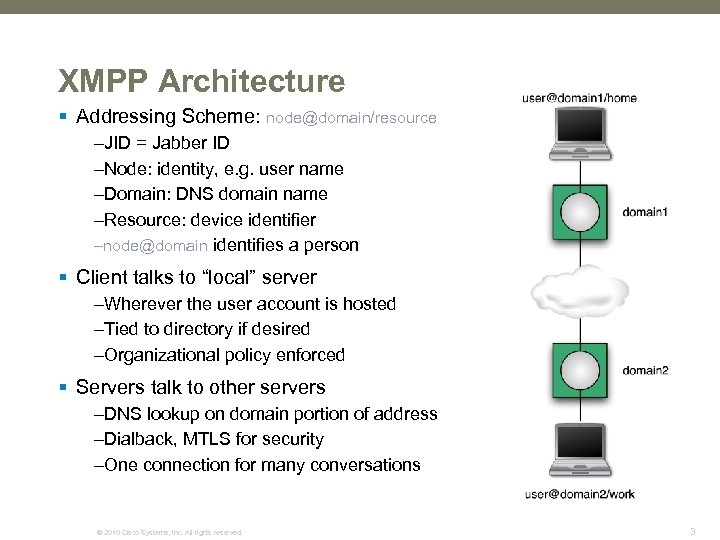
XMPP Architecture § Addressing Scheme: node@domain/resource –JID = Jabber ID –Node: identity, e. g. user name –Domain: DNS domain name –Resource: device identifier –node@domain identifies a person § Client talks to “local” server –Wherever the user account is hosted –Tied to directory if desired –Organizational policy enforced § Servers talk to other servers –DNS lookup on domain portion of address –Dialback, MTLS for security –One connection for many conversations © 2010 Cisco Systems, Inc. All rights reserved. 3
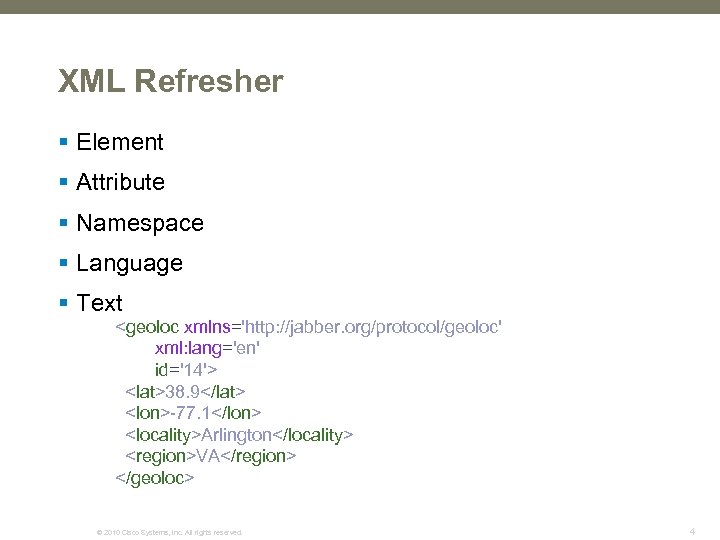
XML Refresher § Element § Attribute § Namespace § Language § Text <geoloc xmlns='http: //jabber. org/protocol/geoloc' xml: lang='en' id='14'> <lat>38. 9</lat> <lon>-77. 1</lon> <locality>Arlington</locality> <region>VA</region> </geoloc> © 2010 Cisco Systems, Inc. All rights reserved. 4
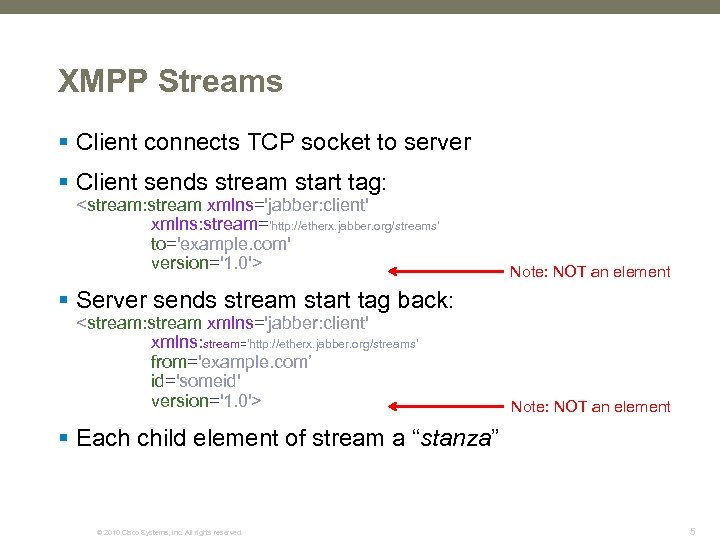
XMPP Streams § Client connects TCP socket to server § Client sends stream start tag: <stream: stream xmlns='jabber: client' xmlns: stream='http: //etherx. jabber. org/streams' to='example. com' version='1. 0'> Note: NOT an element § Server sends stream start tag back: <stream: stream xmlns='jabber: client' xmlns: stream='http: //etherx. jabber. org/streams' from='example. com’ id='someid' version='1. 0'> Note: NOT an element § Each child element of stream a “stanza” © 2010 Cisco Systems, Inc. All rights reserved. 5
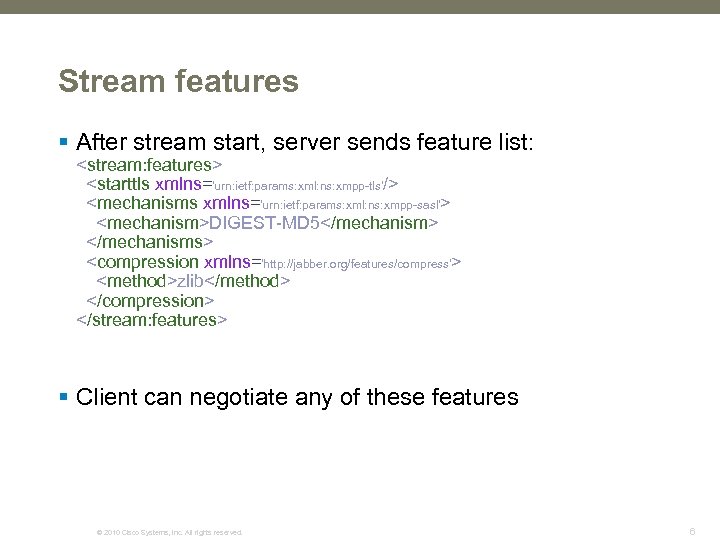
Stream features § After stream start, server sends feature list: <stream: features> <starttls xmlns='urn: ietf: params: xml: ns: xmpp-tls'/> <mechanisms xmlns='urn: ietf: params: xml: ns: xmpp-sasl'> <mechanism>DIGEST-MD 5</mechanism> </mechanisms> <compression xmlns='http: //jabber. org/features/compress'> <method>zlib</method> </compression> </stream: features> § Client can negotiate any of these features © 2010 Cisco Systems, Inc. All rights reserved. 6
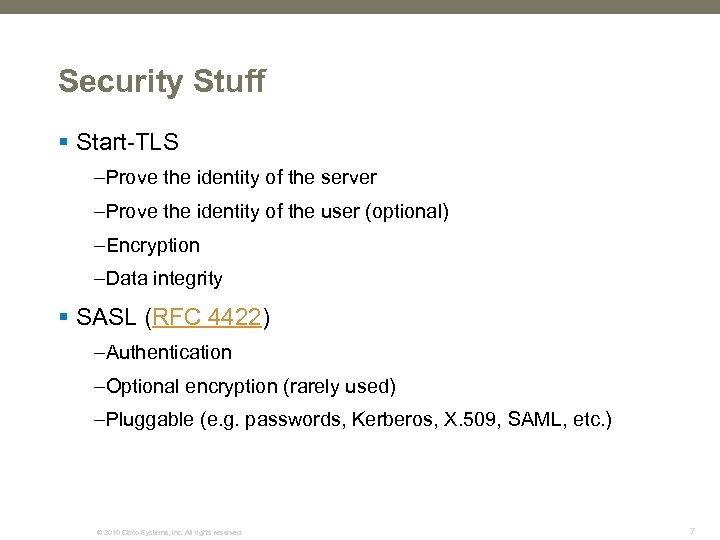
Security Stuff § Start-TLS –Prove the identity of the server –Prove the identity of the user (optional) –Encryption –Data integrity § SASL (RFC 4422) –Authentication –Optional encryption (rarely used) –Pluggable (e. g. passwords, Kerberos, X. 509, SAML, etc. ) © 2010 Cisco Systems, Inc. All rights reserved. 7
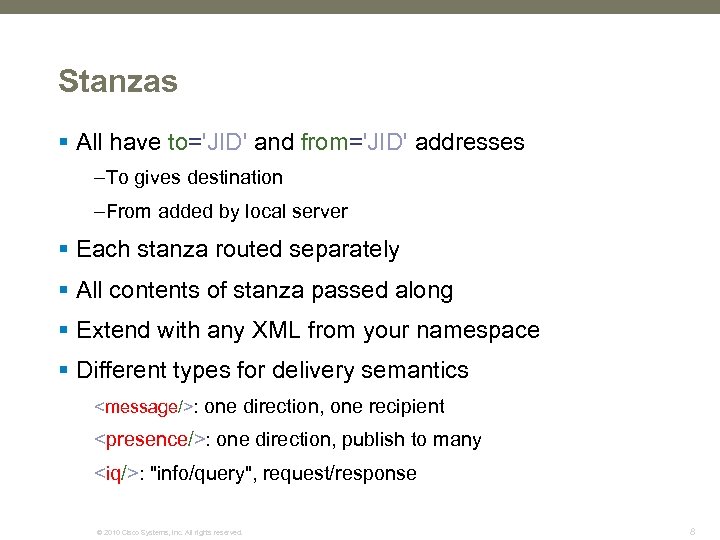
Stanzas § All have to='JID' and from='JID' addresses –To gives destination –From added by local server § Each stanza routed separately § All contents of stanza passed along § Extend with any XML from your namespace § Different types for delivery semantics <message/>: one direction, one recipient <presence/>: one direction, publish to many <iq/>: "info/query", request/response © 2010 Cisco Systems, Inc. All rights reserved. 8
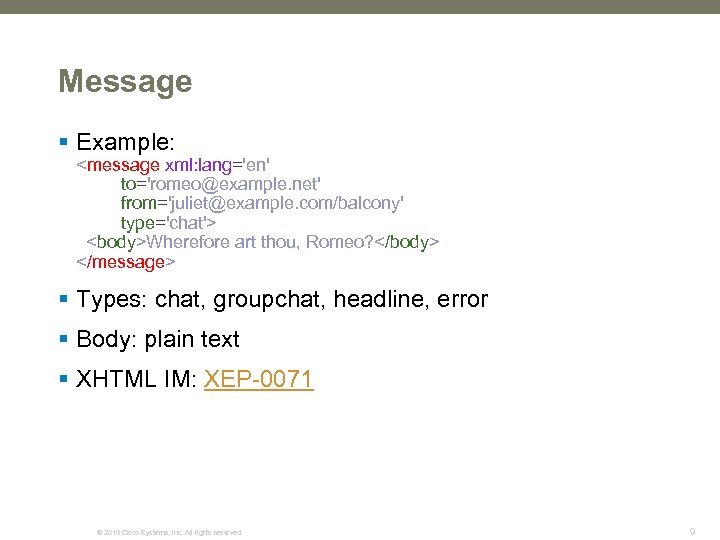
Message § Example: <message xml: lang='en' to='romeo@example. net' from='juliet@example. com/balcony' type='chat'> <body>Wherefore art thou, Romeo? </body> </message> § Types: chat, groupchat, headline, error § Body: plain text § XHTML IM: XEP-0071 © 2010 Cisco Systems, Inc. All rights reserved. 9
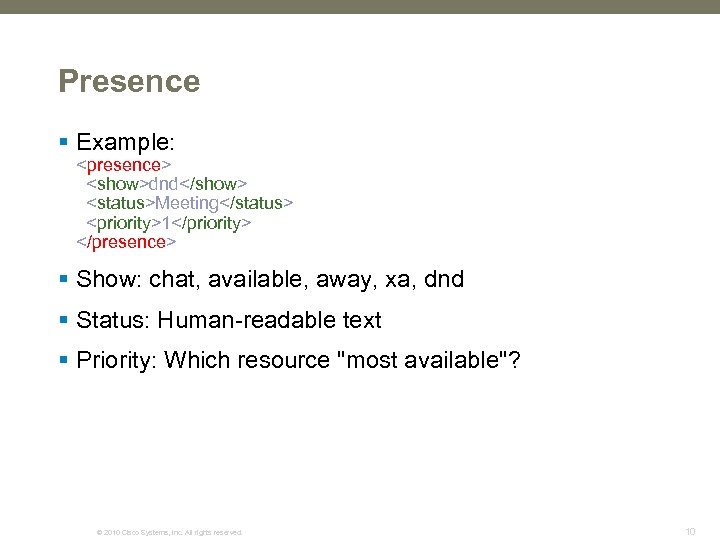
Presence § Example: <presence> <show>dnd</show> <status>Meeting</status> <priority>1</priority> </presence> § Show: chat, available, away, xa, dnd § Status: Human-readable text § Priority: Which resource "most available"? © 2010 Cisco Systems, Inc. All rights reserved. 10
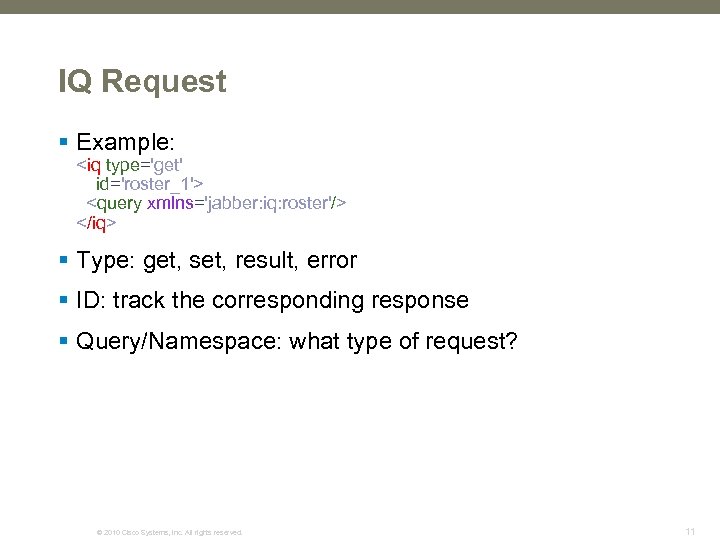
IQ Request § Example: <iq type='get' id='roster_1'> <query xmlns='jabber: iq: roster'/> </iq> § Type: get, set, result, error § ID: track the corresponding response § Query/Namespace: what type of request? © 2010 Cisco Systems, Inc. All rights reserved. 11
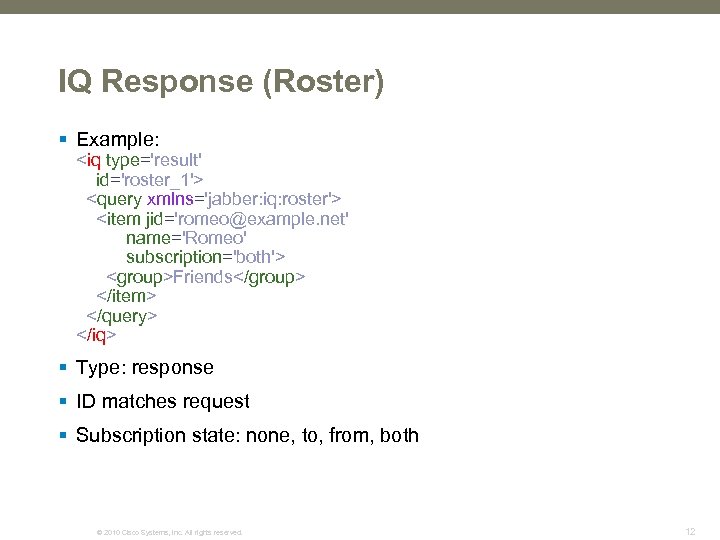
IQ Response (Roster) § Example: <iq type='result' id='roster_1'> <query xmlns='jabber: iq: roster'> <item jid='romeo@example. net' name='Romeo' subscription='both'> <group>Friends</group> </item> </query> </iq> § Type: response § ID matches request § Subscription state: none, to, from, both © 2010 Cisco Systems, Inc. All rights reserved. 12
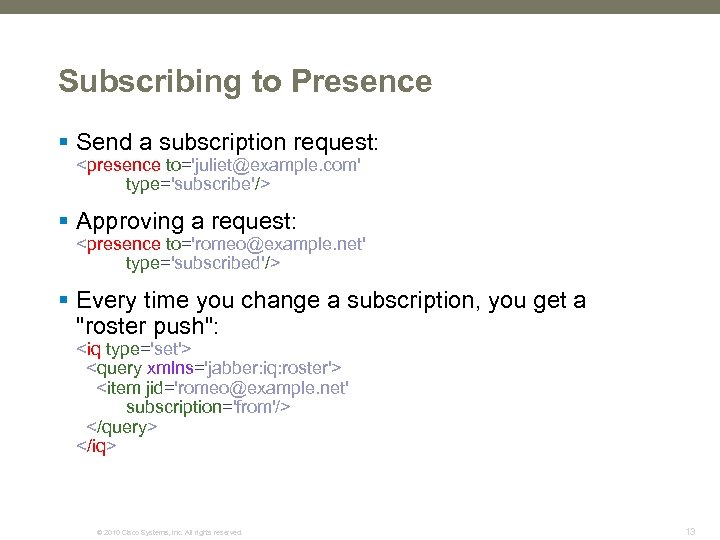
Subscribing to Presence § Send a subscription request: <presence to='juliet@example. com' type='subscribe'/> § Approving a request: <presence to='romeo@example. net' type='subscribed'/> § Every time you change a subscription, you get a "roster push": <iq type='set'> <query xmlns='jabber: iq: roster'> <item jid='romeo@example. net' subscription='from'/> </query> </iq> © 2010 Cisco Systems, Inc. All rights reserved. 13
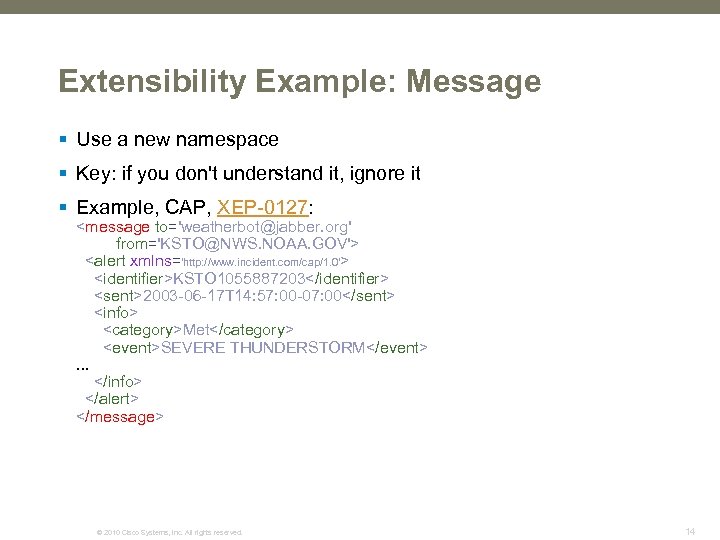
Extensibility Example: Message § Use a new namespace § Key: if you don't understand it, ignore it § Example, CAP, XEP-0127: <message to='weatherbot@jabber. org' from='KSTO@NWS. NOAA. GOV'> <alert xmlns='http: //www. incident. com/cap/1. 0'> <identifier>KSTO 1055887203</identifier> <sent>2003 -06 -17 T 14: 57: 00 -07: 00</sent> <info> <category>Met</category> <event>SEVERE THUNDERSTORM</event>. . . </info> </alert> </message> © 2010 Cisco Systems, Inc. All rights reserved. 14
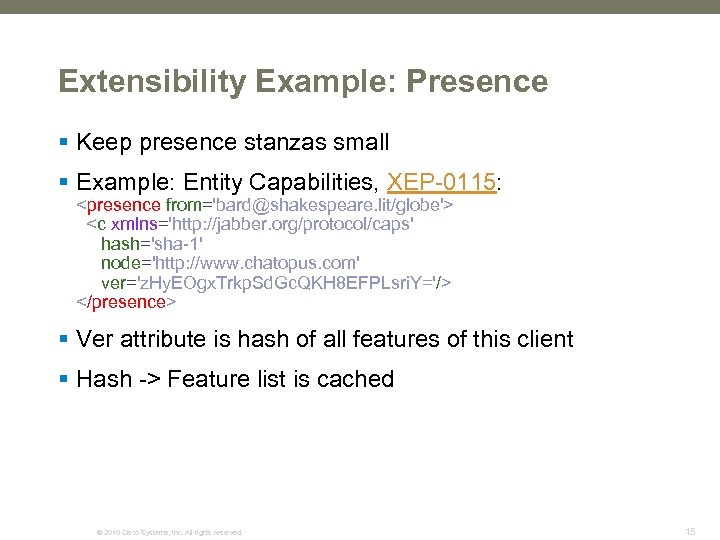
Extensibility Example: Presence § Keep presence stanzas small § Example: Entity Capabilities, XEP-0115: <presence from='bard@shakespeare. lit/globe'> <c xmlns='http: //jabber. org/protocol/caps' hash='sha-1' node='http: //www. chatopus. com' ver='z. Hy. EOgx. Trkp. Sd. Gc. QKH 8 EFPLsri. Y='/> </presence> § Ver attribute is hash of all features of this client § Hash -> Feature list is cached © 2010 Cisco Systems, Inc. All rights reserved. 15
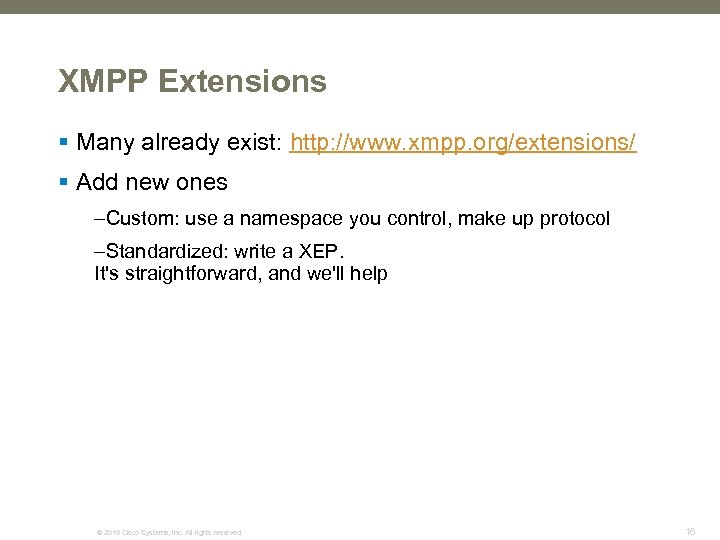
XMPP Extensions § Many already exist: http: //www. xmpp. org/extensions/ § Add new ones –Custom: use a namespace you control, make up protocol –Standardized: write a XEP. It's straightforward, and we'll help © 2010 Cisco Systems, Inc. All rights reserved. 16
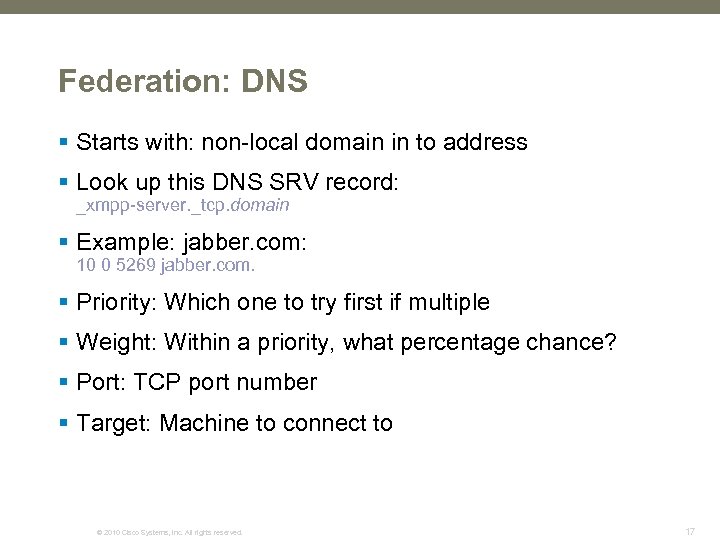
Federation: DNS § Starts with: non-local domain in to address § Look up this DNS SRV record: _xmpp-server. _tcp. domain § Example: jabber. com: 10 0 5269 jabber. com. § Priority: Which one to try first if multiple § Weight: Within a priority, what percentage chance? § Port: TCP port number § Target: Machine to connect to © 2010 Cisco Systems, Inc. All rights reserved. 17
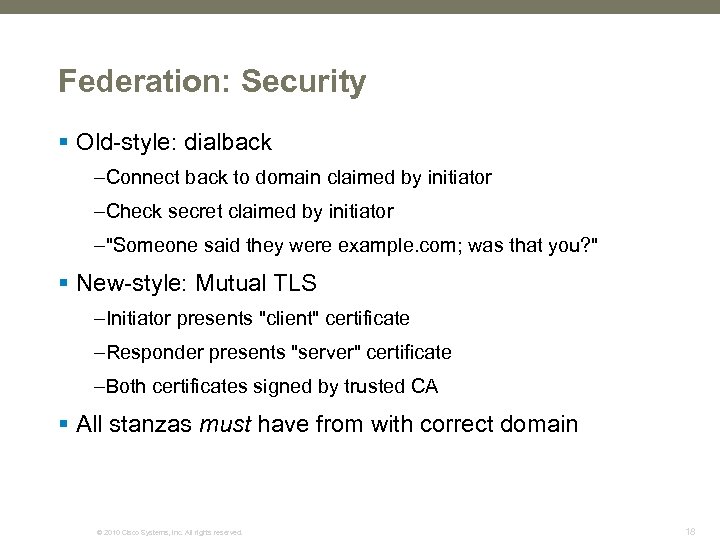
Federation: Security § Old-style: dialback –Connect back to domain claimed by initiator –Check secret claimed by initiator –"Someone said they were example. com; was that you? " § New-style: Mutual TLS –Initiator presents "client" certificate –Responder presents "server" certificate –Both certificates signed by trusted CA § All stanzas must have from with correct domain © 2010 Cisco Systems, Inc. All rights reserved. 18
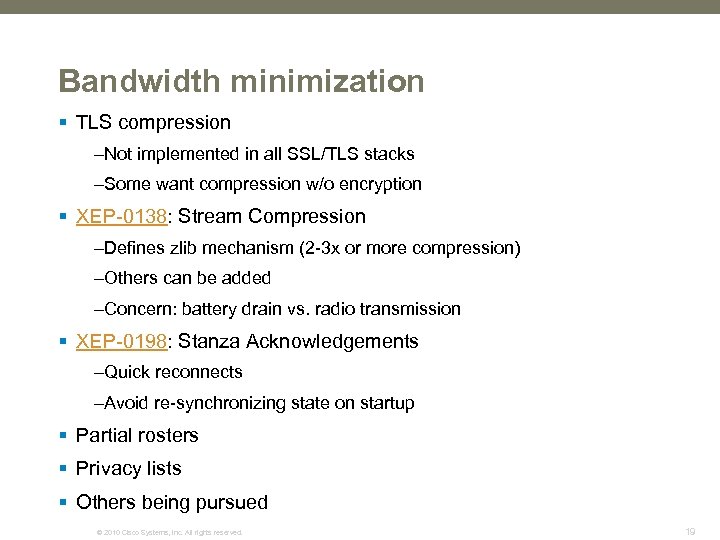
Bandwidth minimization § TLS compression –Not implemented in all SSL/TLS stacks –Some want compression w/o encryption § XEP-0138: Stream Compression –Defines zlib mechanism (2 -3 x or more compression) –Others can be added –Concern: battery drain vs. radio transmission § XEP-0198: Stanza Acknowledgements –Quick reconnects –Avoid re-synchronizing state on startup § Partial rosters § Privacy lists § Others being pursued © 2010 Cisco Systems, Inc. All rights reserved. 19
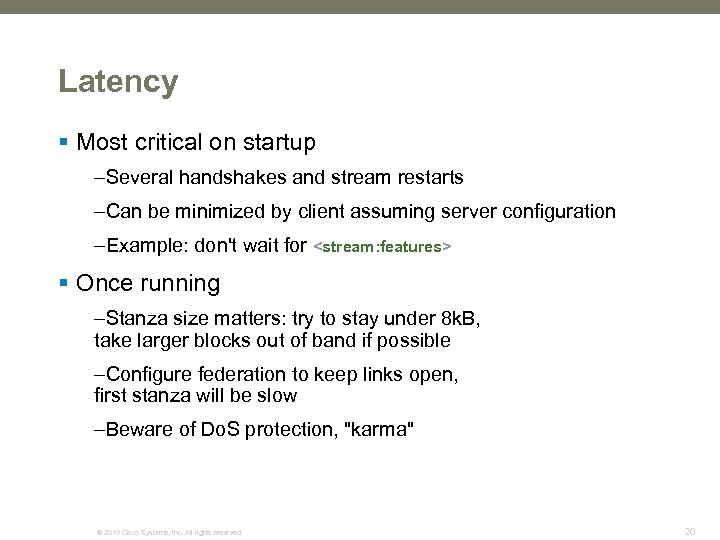
Latency § Most critical on startup –Several handshakes and stream restarts –Can be minimized by client assuming server configuration –Example: don't wait for <stream: features> § Once running –Stanza size matters: try to stay under 8 k. B, take larger blocks out of band if possible –Configure federation to keep links open, first stanza will be slow –Beware of Do. S protection, "karma" © 2010 Cisco Systems, Inc. All rights reserved. 20
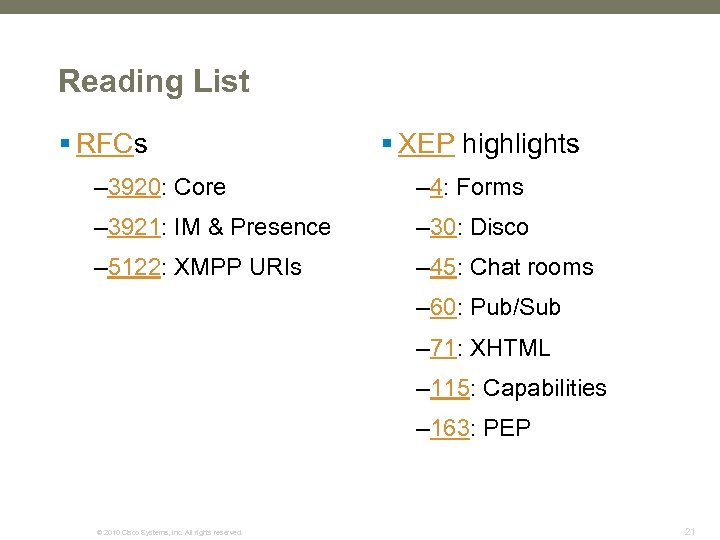
Reading List § RFCs § XEP highlights – 3920: Core – 4: Forms – 3921: IM & Presence – 30: Disco – 5122: XMPP URIs – 45: Chat rooms – 60: Pub/Sub – 71: XHTML – 115: Capabilities – 163: PEP © 2010 Cisco Systems, Inc. All rights reserved. 21

Q and A © 2010 Cisco Systems, Inc. All rights reserved. 22
© 2010 Cisco Systems, Inc. All rights reserved. 23
Скачать презентацию Introduction to XMPP Joe Hildebrand Presentation_ID 2008
2324a9654162ae800e26f82ce30e71a4.ppt