


 Скачать презентацию Introduction to x DSL Part III Yaakov J
491f00f48fd9f1ed7fd1342fc9a77c06.ppt
- Количество слайдов: 62
 Introduction to x. DSL Part III Yaakov J. Stein Chief Scientist RAD Data Communications Stein Intro x. DSL 3. 1
 Introduction to x. DSL I Background history, theoretical limitations, applications II Modems line codes, duplexing, equalization, error correcting codes, trellis codes III x. DSL - What is x? x=I, A, S, V - specific DSL technologies competitive technologies Stein Intro x. DSL 3. 2
 Quick recap Lecture 1 How did we get to where we want to go? How far can we go? Lecture 2 How can we get there? Lecture 3 How can we get there? What do we do when we get there? Stein Intro x. DSL 3. 3
 Quick Review DSL leaves concept of using 4 KHz analog line Use UTP as general transmission line Rate limited by l l l line loss thermal noise NEXT crosstalk FEXT crosstalk RF ingress (AM broadcast, ham, etc. ) misc (splices, bridged taps, echo, filters, sync) Stein Intro x. DSL 3. 4
 Introduction to x. DSL III Applications Deployment topologies IDSL HDSL, HDSL 2, SDSL ADSL, G. lite VDSL competitors (cable modems, wireless) HPNA Stein Intro x. DSL 3. 5
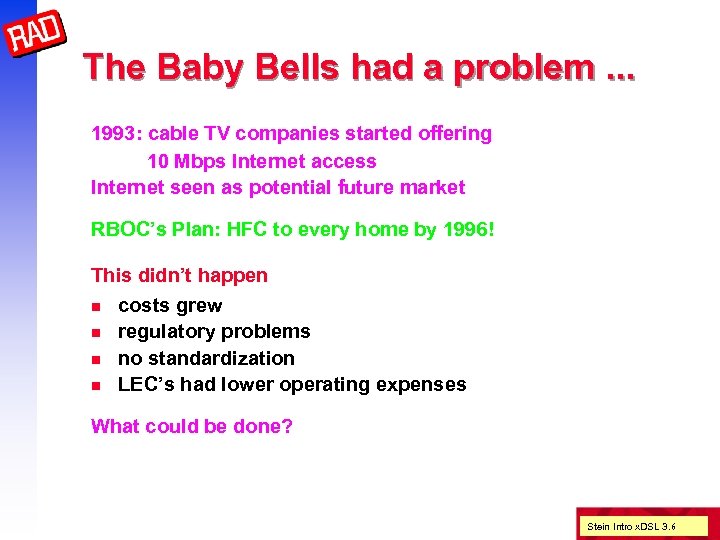 The Baby Bells had a problem. . . 1993: cable TV companies started offering 10 Mbps Internet access Internet seen as potential future market RBOC’s Plan: HFC to every home by 1996! This didn’t happen n n costs grew regulatory problems no standardization LEC’s had lower operating expenses What could be done? Stein Intro x. DSL 3. 6
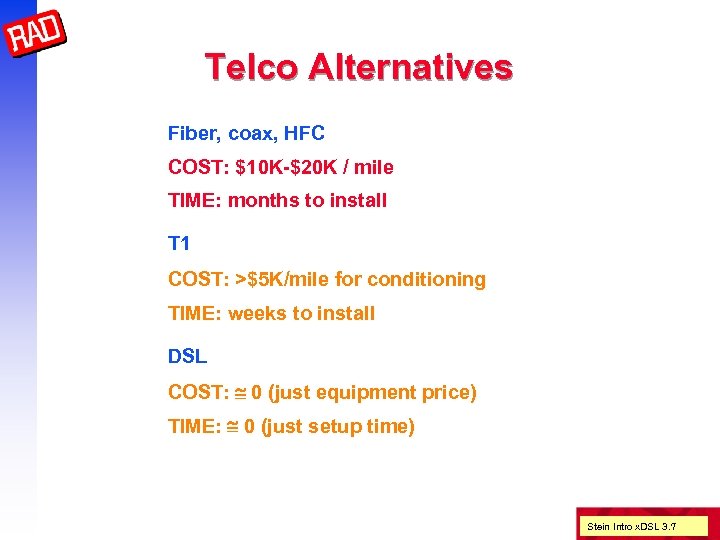 Telco Alternatives Fiber, coax, HFC COST: $10 K-$20 K / mile TIME: months to install T 1 COST: >$5 K/mile for conditioning TIME: weeks to install DSL COST: @ 0 (just equipment price) TIME: @ 0 (just setup time) Stein Intro x. DSL 3. 7
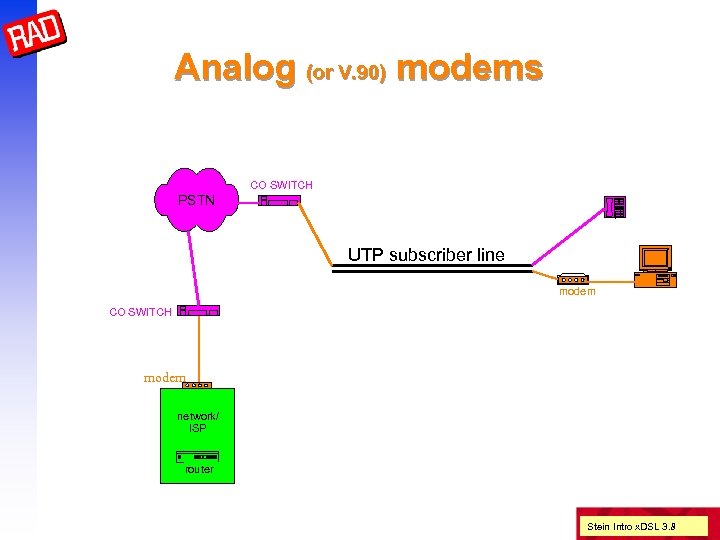 Analog (or V. 90) modems CO SWITCH PSTN UTP subscriber line modem CO SWITCH modem network/ ISP router Stein Intro x. DSL 3. 8
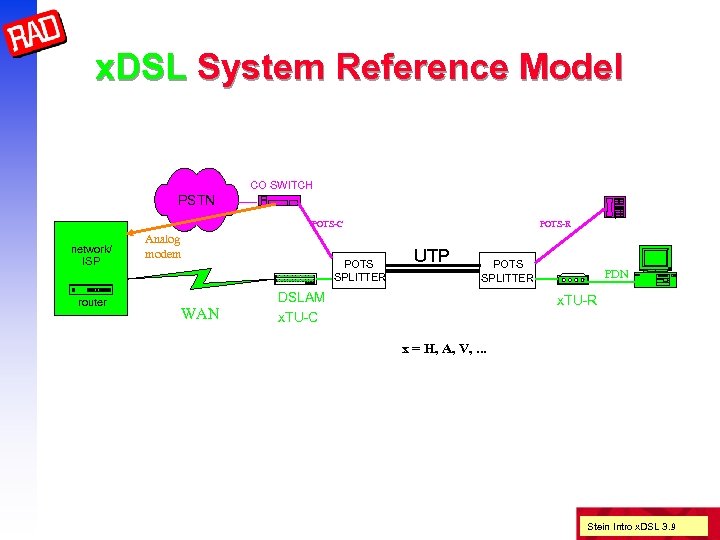 x. DSL System Reference Model CO SWITCH PSTN POTS-C network/ ISP router Analog modem POTS SPLITTER WAN POTS-R UTP POTS SPLITTER DSLAM x. TU-C PDN x. TU-R x = H, A, V, . . . Stein Intro x. DSL 3. 9
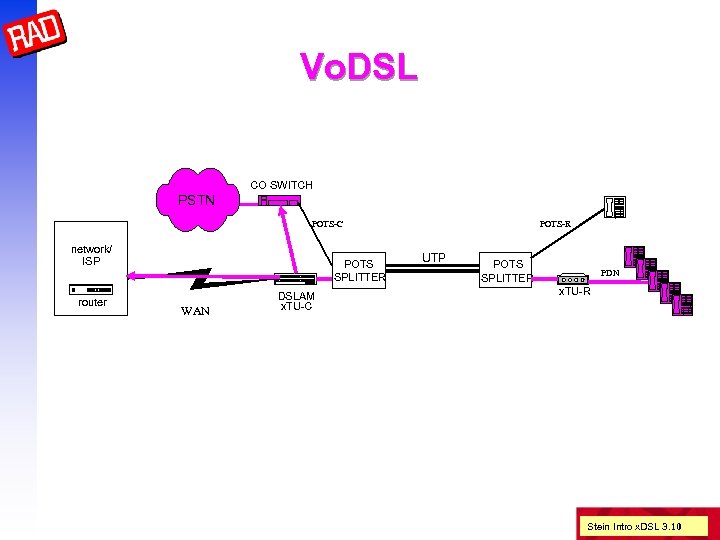 Vo. DSL CO SWITCH PSTN POTS-C network/ ISP router POTS SPLITTER WAN DSLAM x. TU-C POTS-R UTP POTS SPLITTER PDN x. TU-R Stein Intro x. DSL 3. 10
 Network Reference Model PDN (Premises Distribution Network) is ethernet or USB WAN is typically ATM or FDDI (even though FDDI is LAN protocol) Internet is TCP/IP HDSL connects to DACS and to CSU Many interconnect possibilities (may impact modem design) full STM, full ATM, full packet network, packet-ATM-packet, etc. Example, FR WAN, ATM over UTP, Ethenet PDN Modems should be cell pumps, not bit pumps (also need CIF protocol to tunnel ATM through Ethernet) Stein Intro x. DSL 3. 11
 Splitter separates POTS from DSL signals n n n Must guarantee lifeline POTS services! Hence usually passive filter Must block impulse noise (e. g. ring) from phone into DSL ADSLforum/T 1 E 1. 4 specify that splitter be separate from modem No interface specification yet (can’t buy splitter and modem from different vendors) Splitter requires installation n Costly technician visit is the major impediment to deployment n G. lite is splitterless ADSL Stein Intro x. DSL 3. 12
 x. DSL - Maximum Reach Stein Intro x. DSL 3. 13
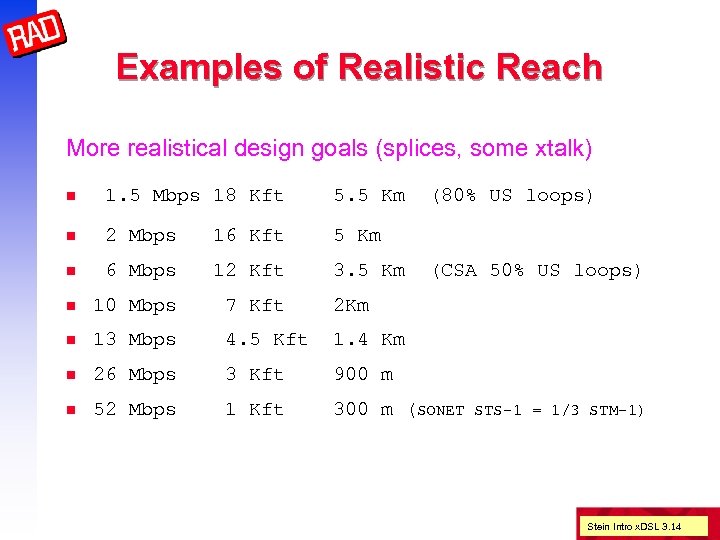 Examples of Realistic Reach More realistical design goals (splices, some xtalk) n 1. 5 Mbps 18 Kft 5. 5 Km (80% US loops) n 2 Mbps 16 Kft 5 Km n 6 Mbps 12 Kft 3. 5 Km n 10 Mbps 7 Kft 2 Km n 13 Mbps 4. 5 Kft 1. 4 Km n 26 Mbps 3 Kft 900 m n 52 Mbps 1 Kft 300 m (SONET (CSA 50% US loops) STS-1 = 1/3 STM-1) Stein Intro x. DSL 3. 14
 x. DSL flavors Stein Intro x. DSL 3. 15
 x. DSL flavors Stein Intro x. DSL 3. 16
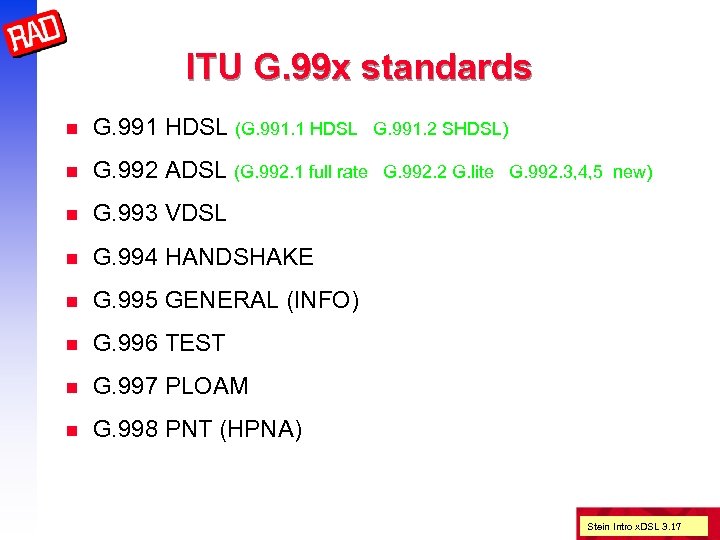 ITU G. 99 x standards n G. 991 HDSL (G. 991. 1 HDSL n G. 992 ADSL (G. 992. 1 full rate n G. 993 VDSL n G. 994 HANDSHAKE n G. 995 GENERAL (INFO) n G. 996 TEST n G. 997 PLOAM n G. 998 PNT (HPNA) G. 991. 2 SHDSL) G. 992. 2 G. lite G. 992. 3, 4, 5 new) Stein Intro x. DSL 3. 17
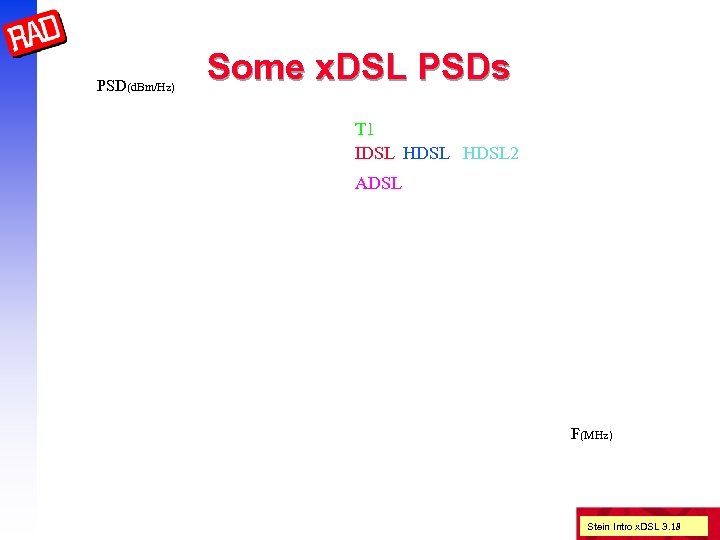 PSD(d. Bm/Hz) Some x. DSL PSDs T 1 IDSL HDSL 2 ADSL F(MHz) Stein Intro x. DSL 3. 18
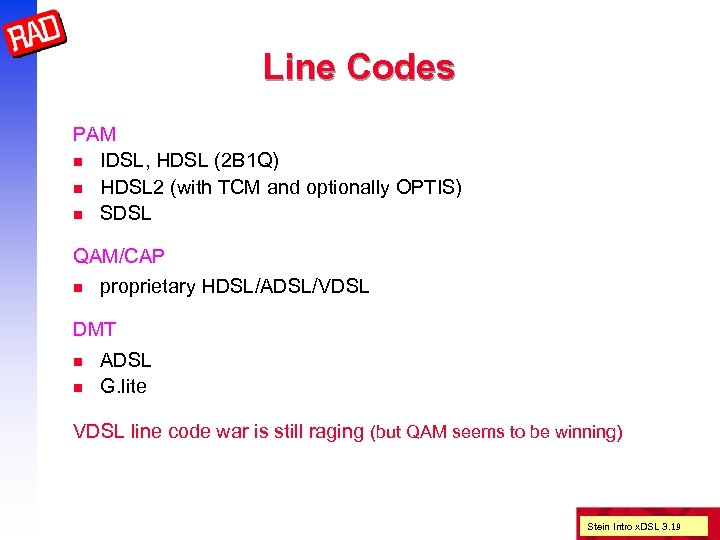 Line Codes PAM n IDSL, HDSL (2 B 1 Q) n HDSL 2 (with TCM and optionally OPTIS) n SDSL QAM/CAP n proprietary HDSL/ADSL/VDSL DMT n n ADSL G. lite VDSL line code war is still raging (but QAM seems to be winning) Stein Intro x. DSL 3. 19
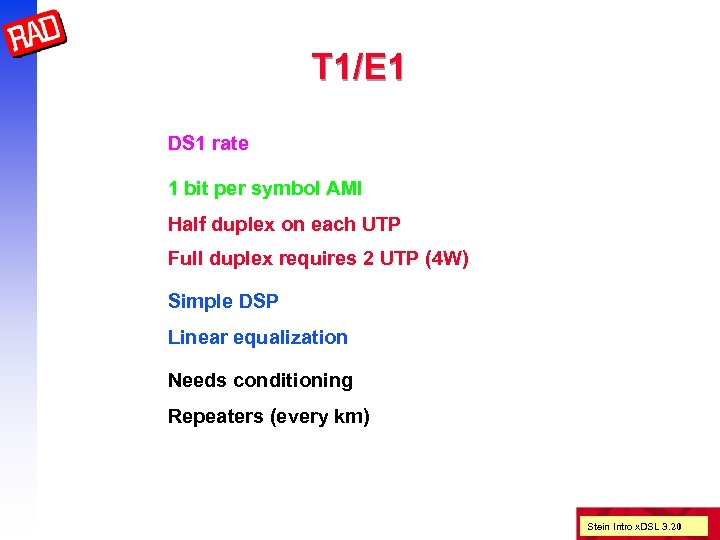 T 1/E 1 DS 1 rate 1 bit per symbol AMI Half duplex on each UTP Full duplex requires 2 UTP (4 W) Simple DSP Linear equalization Needs conditioning Repeaters (every km) Stein Intro x. DSL 3. 20
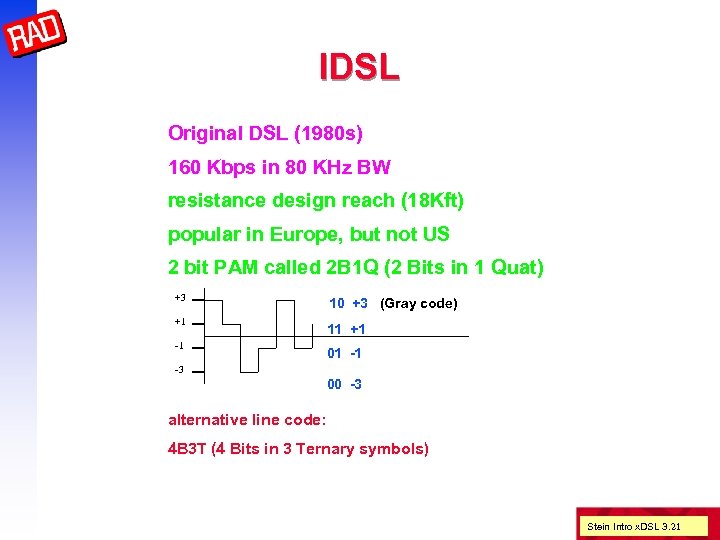 IDSL Original DSL (1980 s) 160 Kbps in 80 KHz BW resistance design reach (18 Kft) popular in Europe, but not US 2 bit PAM called 2 B 1 Q (2 Bits in 1 Quat) +3 +1 -1 10 +3 (Gray code) 11 +1 01 -1 -3 00 -3 alternative line code: 4 B 3 T (4 Bits in 3 Ternary symbols) Stein Intro x. DSL 3. 21
 HDSL Replace T 1/E 1 DS 1 service Use 2 B 1 Q line code, DFE Full duplex on each pair with echo cancellation Full CSA without conditioning/repeaters more complex DSP (250 MIPS) ANSI: 2 pairs for T 1 (each 784 Kbps) ETSI: 1, 2, 3 or 4 pairs Most mature of DSL technologies Stein Intro x. DSL 3. 22
 HDSL vs T 1(AMI) T 1 HDSL Stein Intro x. DSL 3. 23
 HDSL - continued HDSL is repeaterless T 1/E 1 Major application - multiline POTS Reach is CSA (less than ADSL!) Can add doublers to extend range Other applications: n PBX extension n digital local loop n campus networks n Internet Stein Intro x. DSL 3. 24
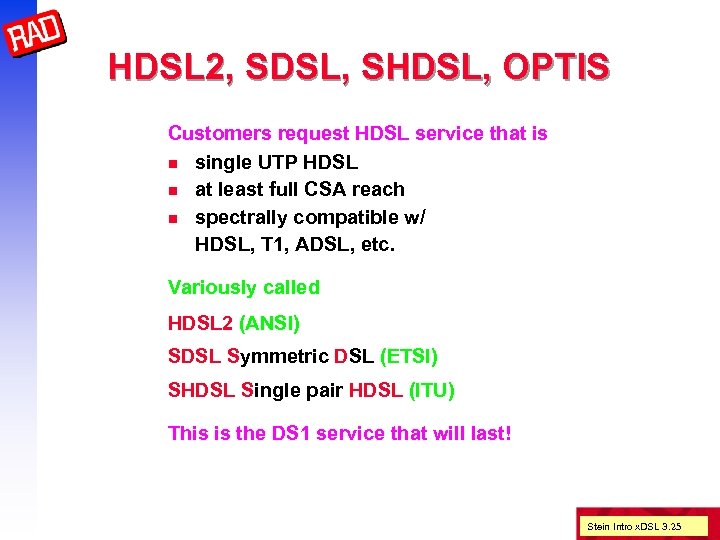 HDSL 2, SDSL, SHDSL, OPTIS Customers request HDSL service that is n single UTP HDSL n at least full CSA reach n spectrally compatible w/ HDSL, T 1, ADSL, etc. Variously called HDSL 2 (ANSI) SDSL Symmetric DSL (ETSI) SHDSL Single pair HDSL (ITU) This is the DS 1 service that will last! Stein Intro x. DSL 3. 25
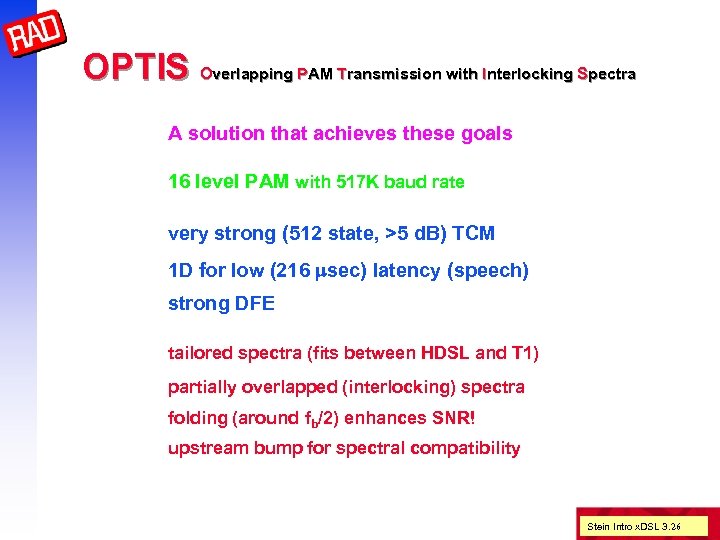 OPTIS Overlapping PAM Transmission with Interlocking Spectra A solution that achieves these goals 16 level PAM with 517 K baud rate very strong (512 state, >5 d. B) TCM 1 D for low (216 msec) latency (speech) strong DFE tailored spectra (fits between HDSL and T 1) partially overlapped (interlocking) spectra folding (around fb/2) enhances SNR! upstream bump for spectral compatibility Stein Intro x. DSL 3. 26
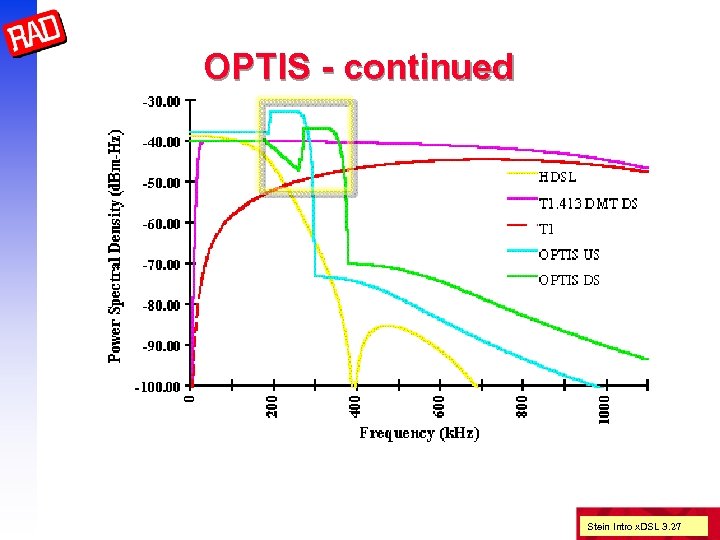 OPTIS - continued Stein Intro x. DSL 3. 27
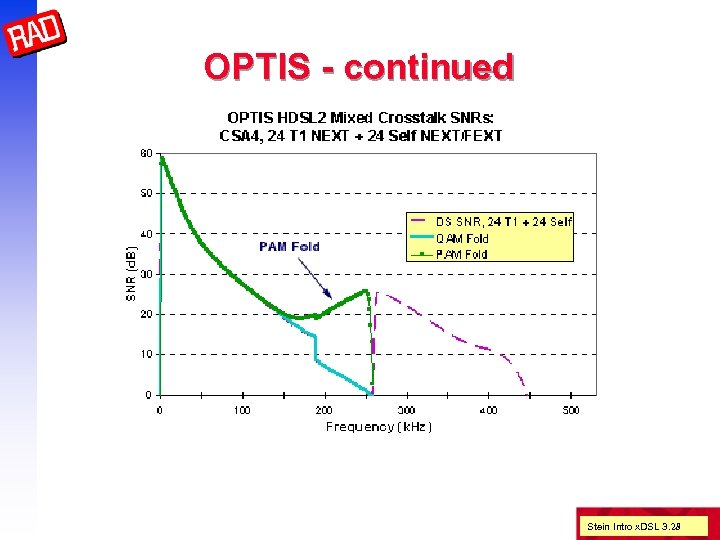 OPTIS - continued Stein Intro x. DSL 3. 28
 ADSL Asymmetric - high rate DS lower rate US Originally designed for video on demand Almost retired due to lack of interest …but then came the Internet Studies show DS: US should be about 10: 1 full rate ADSL 512 -640 kbps US, 6 -8 Mbps DS G. lite 512 Kbps US, 1. 5 Mbps DS ADSL could mean All Data Subscribers Living Stein Intro x. DSL 3. 29
 Why asymmetry? NEXT is the worst interferer stops HDSL from achieving higher rates FEXT much less (attenuated by line) FDD eliminates NEXT All modems must transmit in the SAME direction A reversal would bring all ADSL modems down Upstream(US) at lower frequencies and power density Downstream (DS) at high frequencies and power Stein Intro x. DSL 3. 30
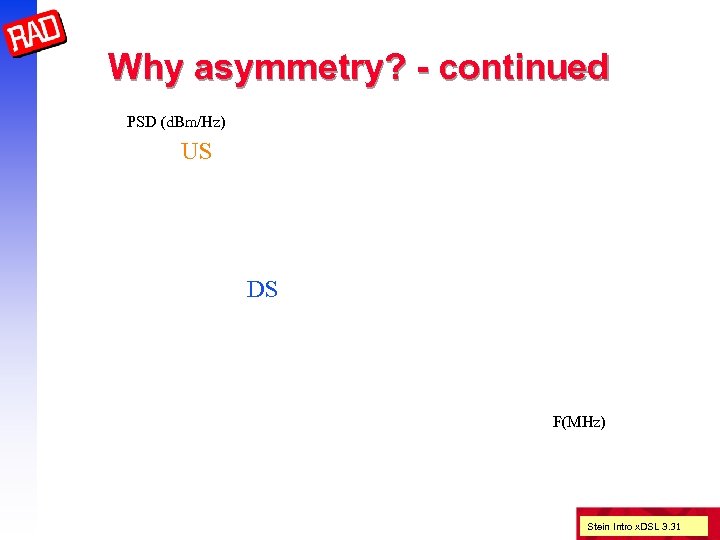 Why asymmetry? - continued PSD (d. Bm/Hz) US DS F(MHz) Stein Intro x. DSL 3. 31
 Echo cancelled ADSL FDD gives sweet low frequencies to US only and the sharp filters enhance ISI By overlapping DS on US we can use low frequencies and so increase reach Power spectral density chart Stein Intro x. DSL 3. 32
 ADSL - continued ADSL system design criterion BER 10 -12 (1 error every 2 days at 6 Mbps) Raw modem can not attain this low a BER! For video on demand: n RS and interleaving can deliver (error bursts of 500 msec) n but add 17 msec delay For Internet: n TCP can deliver n high raw delay problematic So standard defines TWO framers fast (noninterleaved ) and slow (interleaved) buffers Stein Intro x. DSL 3. 33
 ADSL standard ITU (G. dmt) G. 992. 1, ANSI T 1. 413 i 2 standard First ADSL data implementations were CAP Standard is DMT allows approaching water pouring capacity DMT is robust DMT requires more complex processing DMT may require more power Stein Intro x. DSL 3. 34
 DMT Discrete Multitone is a form of FDM (Frequency Domain Multiplexing) Discrete Multitone is a form of MCM (Multi. Carrier Modulation) It uses many different carriers, each modulated QAM Each tone is narrow n n low baud rate (long frame) channel characteristics are constant over tone Number of bits per tone chosen according to water pouring Put more bits where SNR is good Stein Intro x. DSL 3. 35
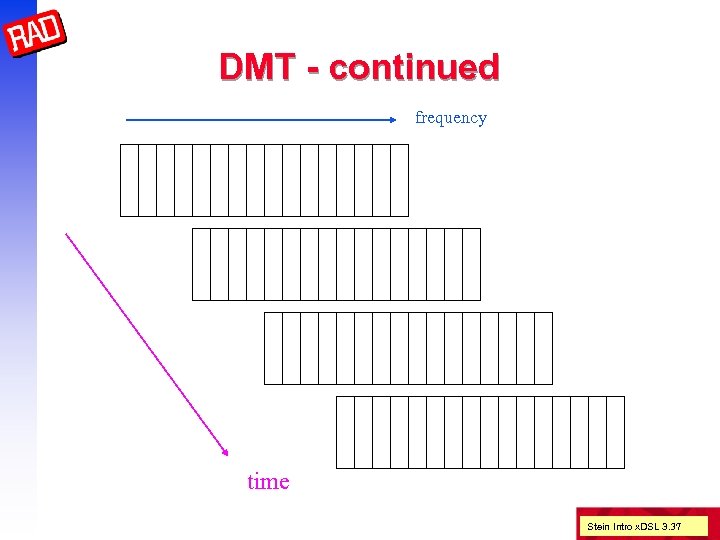
 DMT - continued DMT is OFDM (Orthogonalized FDM) n n n Carrier spacing is precisely baud rate Center of tone is precisely the zero of all other sincs ICI minimized ISI minimized by having a long interframe guard time DMT modem can be efficiently implemented using FFT DFT is mathematically equivalent to a bank of filters Filtering is equivalent to cyclic convolution So use cyclic prefix rather than guard time Stein Intro x. DSL 3. 36
 DMT - continued frequency time Stein Intro x. DSL 3. 37
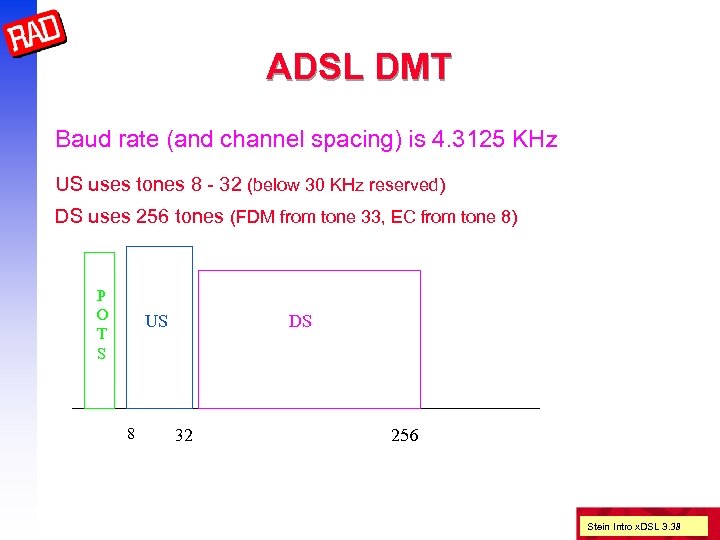 ADSL DMT Baud rate (and channel spacing) is 4. 3125 KHz US uses tones 8 - 32 (below 30 KHz reserved) DS uses 256 tones (FDM from tone 33, EC from tone 8) P O T S US 8 DS 32 256 Stein Intro x. DSL 3. 38
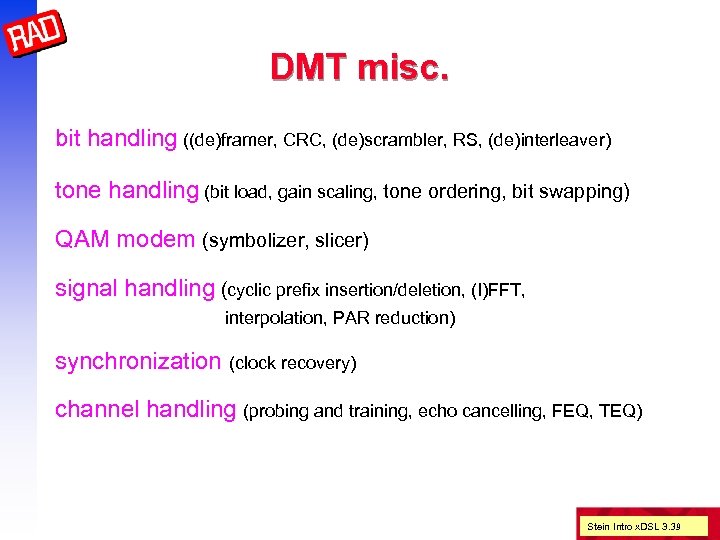 DMT misc. bit handling ((de)framer, CRC, (de)scrambler, RS, (de)interleaver) tone handling (bit load, gain scaling, tone ordering, bit swapping) QAM modem (symbolizer, slicer) signal handling (cyclic prefix insertion/deletion, (I)FFT, interpolation, PAR reduction) synchronization (clock recovery) channel handling (probing and training, echo cancelling, FEQ, TEQ) Stein Intro x. DSL 3. 39
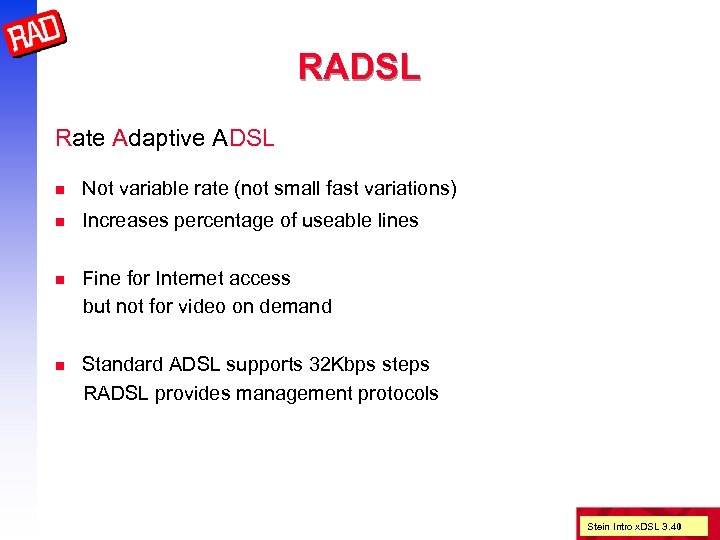 RADSL Rate Adaptive ADSL n Not variable rate (not small fast variations) n Increases percentage of useable lines n Fine for Internet access but not for video on demand n Standard ADSL supports 32 Kbps steps RADSL provides management protocols Stein Intro x. DSL 3. 40
 G. lite ITU (G. lite) G. 992. 2, UAWG ADSL compatible DMT compatible using only 128 tones 512 Kbps US / 1. 5 Mbps DS Still much faster than V. 34 or V. 90 modems No splitter required! Certain features removed for simplicity simpler implementation (only 500 MIPS < 2000 MIPS for full rate) Stein Intro x. DSL 3. 41
 New ADSLs ITU has continued development of G. dmt. bis, G. lite. bis Should become G. 992. 3, G. 992. 4, G. 992. 5 ADSL 2 Longer reach with higher rate (1. 5 Km @ 12 Mbps) 4 D 16 -TCM constellations, Stronger RS FEC Lower framing overhead (programmable 4 -32 Kbps overhead) Power cutback standby mode Algo improvements (e. g. real-time tone re-ordering, relocatable pilot tone) ADSL+ Uses more BW for higher bitrates for short reaches double BW (512 bins) - double speed (24 Mbps!) Annex J Symmetric 3 Mbps Stein Intro x. DSL 3. 42
 VDSL Optical network expanding (getting closer to subscriber) Optical Network Unit ONU at curb or basement cabinet FTTC (curb), FTTB (building) These scenarios usually dictates low power Rates can be very high since required reach is minimal! Proposed standard has multiple rates and reaches Stein Intro x. DSL 3. 43
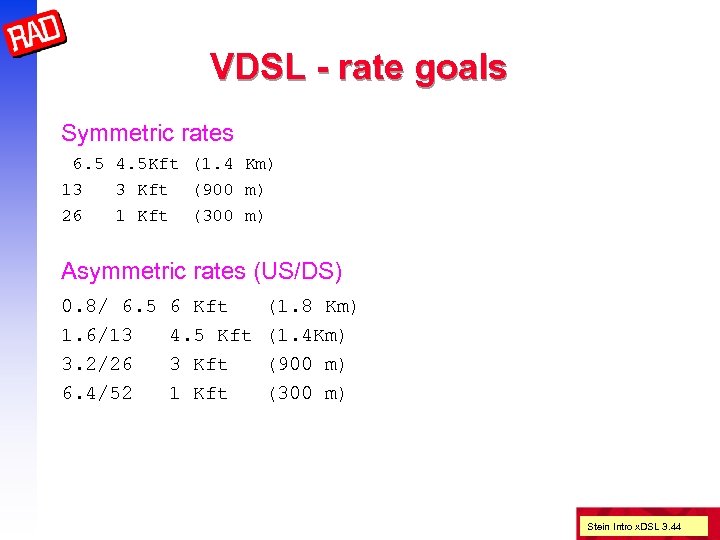 VDSL - rate goals Symmetric rates 6. 5 4. 5 Kft (1. 4 Km) 13 3 Kft (900 m) 26 1 Kft (300 m) Asymmetric rates (US/DS) 0. 8/ 6. 5 1. 6/13 3. 2/26 6. 4/52 6 Kft 4. 5 Kft 3 Kft 1 Kft (1. 8 Km) (1. 4 Km) (900 m) (300 m) Stein Intro x. DSL 3. 44
 VDSL - Power issues Basic template is -60 d. Bm/Hz from 1. 1 MHz to 20 MHz Notches reduce certain frequencies to -80 d. Bm/Hz Power boost on increase power to -50 d. Bm/Hz Power back-off reduces VTU-R power so that won’t block another user ADSL compatibility off use spectrum down to 300 KHz Stein Intro x. DSL 3. 45
 VDSL - duplexing In Japan and campus applications can operate TDD (ping pong) SDMT Synchronous DMT (2 KHz frame can be heard in adjacent pairs or hearing aids) Rest of world PSTN only FDD is allowed Can divide US and DS into 2 areas (e. g. ADSL) or more Need guard frequencies because of clock master/slave problems Zipper - large number of interleaved frequency regions (even on a bin by bin basis) Stein Intro x. DSL 3. 46
 VDSL line code wars VDSL Alliance DMT VDSL Coalition QAM MORE LESS robust to noise power capacity spectral compatibility IPR complex expensive A/D bits With no complexity constraints probably equivalent Stein Intro x. DSL 3. 47
 T 1 E 1. 4 draft T 1. 424 T 1 E 1. 4 has released a 3 -part “trial use” draft standard n Part 1 Common Specifications n Part 2 Single Carrier Modulation n Part 3 Multicarrier Modulation Objective tests have been specified (VDSL Olympics) – Test definition may determine results • SCM is NOT spectrally compatible with ADSL • Present SCM implementations are more mature – the tests should be of technology, not products • MCM may be more robust in certain noise settings The trials should be finished by July-August 2003 – ITU and IEEE are waiting for the results Stein Intro x. DSL 3. 48
 G. 994. 1 (G. hs) Handshaking Universal flexible method for initialization Includes n n tone negotiation for capability identification common mode identification exchange of nonstandard information line probing (line code dependent) Currently integral part of ADSL and G. lite Anticipated that future ITU DSL modems will support as well Stein Intro x. DSL 3. 49
 G. 997 (PLOAM) Physical Layer Operation Administration and Maintenance Includes n physical layer management (SNMP based) n configuration, fault and performance administration n 4 management interfaces n optional OAM channel n far end management Currently integral part of G. 992 (ADSL) family Anticipated that future ITU DSL modems will support as well Stein Intro x. DSL 3. 50
 G. 996. 1 (G. test) Universal testing procedure for x. DSL modems Finds margins in presence of n POTS signaling n impulse noise n cross-talk from other services n geographical position dependent test loops and wiring models Currently integral part of G. 992 (ADSL) family Anticipated that future ITU DSL modems will support as well Stein Intro x. DSL 3. 51
 G. bond ISDN defined BONDING of 2 B channels to one 128 Kbps line G. 991. 2 (SHDSL) Annex E has physical layer bonding ITU G. bond objectives: (1 be higher layer agnostic (2 be backward compatible with the present 2 -wire G. shdsl Annex E solution (3 different rates on different pairs (4 be applicable to all DSL families, not just SHDSL (5 have low latency and overhead (to support TDM( (6 support dynamic addition and removal of pairs If succeeds no need for layer 2+ aggregation protocols )ATM-IMA, MLFR, MLPPP, 802. 3 ad etc) with high overhead, high latency, same rates for each pair , no dynamic addition/deletion support , etc. Stein Intro x. DSL 3. 52
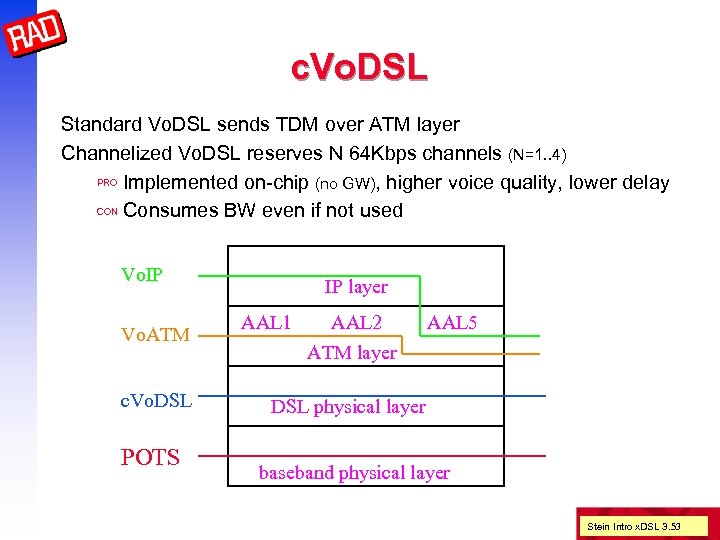 c. Vo. DSL Standard Vo. DSL sends TDM over ATM layer Channelized Vo. DSL reserves N 64 Kbps channels (N=1. . 4) PRO Implemented on-chip (no GW), higher voice quality, lower delay CON Consumes BW even if not used Vo. IP Vo. ATM c. Vo. DSL POTS IP layer AAL 1 AAL 2 ATM layer AAL 5 DSL physical layer baseband physical layer Stein Intro x. DSL 3. 53
 Competitors and non-DSL technologies Stein Intro x. DSL 3. 54
 G. 998 (G. pnt, HPNA) n Studies show that about 50% of US homes have a PC 30% have Internet access, 20% have more than one PC! n Average consumer has trouble with cabling Home. PNA de facto industry standard for home networking n n Computers, peripherals interconnect (and connect to Internet? ) using internal phone wiring (user side of splitter) Does not interrupt lifeline POTS services Does not require costly or messy LAN wiring of the home Presently 1 Mbps, soon 10 Mbps, eventually 100 Mbps! Stein Intro x. DSL 3. 55
 HPNA n HPNA 1. 0 (98 Q 3) has average data rate 1. 0432 Mbps n Line code is PPM (pulse position modulation) Each pulse is 4 cycles at 7. 5 MHz (shaped) time between pulses 3. 27 msec < t < 6. 07 msec Can co-exist with full-rate ADSL and G. lite n n n n HPNA 2. 0 (ITU G. pnt) 10 - 32 Mbps QAM line code HPNA 3. 0 up to 100 Mbps Specification not yet finalized Stein Intro x. DSL 3. 56
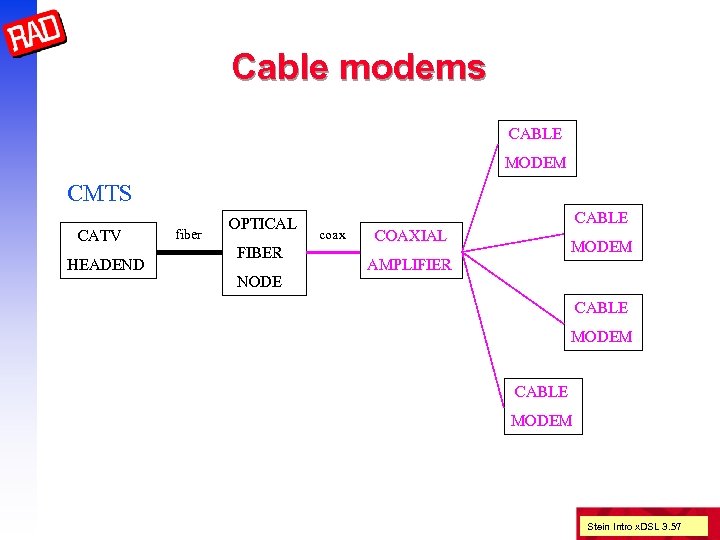 Cable modems CABLE MODEM CMTS CATV HEADEND fiber OPTICAL FIBER NODE CABLE coax COAXIAL MODEM AMPLIFIER CABLE MODEM Stein Intro x. DSL 3. 57
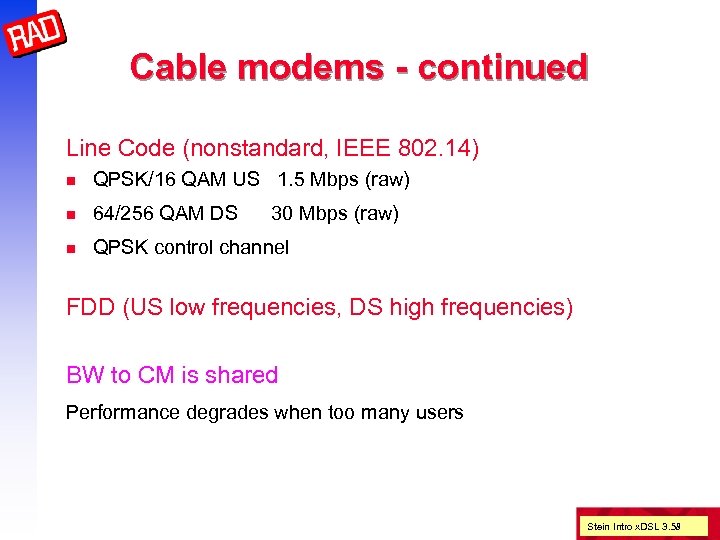 Cable modems - continued Line Code (nonstandard, IEEE 802. 14) n QPSK/16 QAM US 1. 5 Mbps (raw) n 64/256 QAM DS n QPSK control channel 30 Mbps (raw) FDD (US low frequencies, DS high frequencies) BW to CM is shared Performance degrades when too many users Stein Intro x. DSL 3. 58
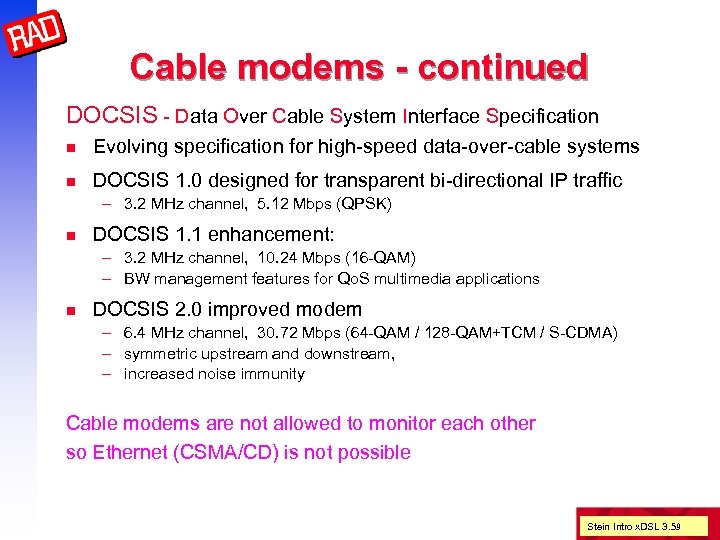 Cable modems - continued DOCSIS - Data Over Cable System Interface Specification n Evolving specification for high-speed data-over-cable systems n DOCSIS 1. 0 designed for transparent bi-directional IP traffic – 3. 2 MHz channel, 5. 12 Mbps (QPSK) n DOCSIS 1. 1 enhancement: – 3. 2 MHz channel, 10. 24 Mbps (16 -QAM) – BW management features for Qo. S multimedia applications n DOCSIS 2. 0 improved modem – 6. 4 MHz channel, 30. 72 Mbps (64 -QAM / 128 -QAM+TCM / S-CDMA) – symmetric upstream and downstream, – increased noise immunity Cable modems are not allowed to monitor each other so Ethernet (CSMA/CD) is not possible Stein Intro x. DSL 3. 59
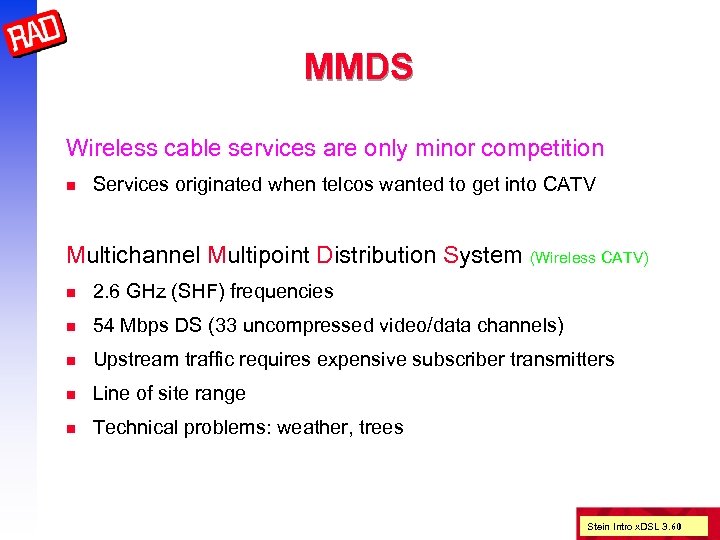 MMDS Wireless cable services are only minor competition n Services originated when telcos wanted to get into CATV Multichannel Multipoint Distribution System (Wireless CATV) n 2. 6 GHz (SHF) frequencies n 54 Mbps DS (33 uncompressed video/data channels) n Upstream traffic requires expensive subscriber transmitters n Line of site range n Technical problems: weather, trees Stein Intro x. DSL 3. 60
 LMDS Local Multipoint Distribution System (Cellular TV) n 28 GHz frequency n short-distance version of MMDS n uses small cells n small cell size requires many transmission antennas n most suitable for business LAN extension Stein Intro x. DSL 3. 61
 DBS Direct Broadcast Satellite Geosynchronous satellites already used for digital TV n POTS return connection n High powered transmitter return connection n Significant propagation delay Low earth orbit (LEO) satellites n Minimal delays n Lower power uplink transmitters n Too expensive for residential use Stein Intro x. DSL 3. 62