


 Скачать презентацию Introduction to the Tools for Reasoning Power point
b2bac14d34d6a996579c32ad373dc4fd.ppt
- Количество слайдов: 12
 Introduction to the Tools for Reasoning Power point presentation given to teachers during professional development workshop , Alan Berkowitz 1, Brad Blank 2, Aubrey Cano 3, Bess Caplan 1, Beth Covitt 4, Katherine Emery 3, Kristin Gunckel 5, La. Tisha Hammond 6, Bill Hoyt 7, Nicole La. Due 8, John Moore 2, Tamara Newcomer 1, Tom Noel 2, Lisa Pitot 2, Jen Schuttlefield 9, Sara Syswerda 8, Dave Swartz 2, Ray Tschillard 10, Andrew Warnock and Ali Whitmer 6. Cary Institute 1, Colorado State Univ. 2, U. C. Santa Barbara 3, Univ. Montana 4, Univ. of Arizona 5, Georgetown Univ. 6, Univ. Northern Colorado 7, Michigan State Univ. 8, Univ. Wisconsin 9, Poudre Learning Center 10 Culturally relevant ecology, learning progressions and environmental literacy Long Term Ecological Research Math Science Partnership May 2012 Disclaimer: This research is supported by a grant from the National Science Foundation: Targeted Partnership: Culturally relevant ecology, learning progressions and environmental literacy (NSF-0832173). Any opinions, findings, and conclusions or recommendations expressed in this material are those of the author(s) and do not necessarily reflect the views of the National Science Foundation.
 Introduction to Water Tools for Reasoning
 What Are Tools For Reasoning? • Form similar to a graphic organizer • Intended to scaffold development of scientific accounts • Address specific LP-related challenges students encounter, e. g. … – Considering likelihood of multiple/diverse pathways of water – Attending to driving forces and constraining factors for moving water
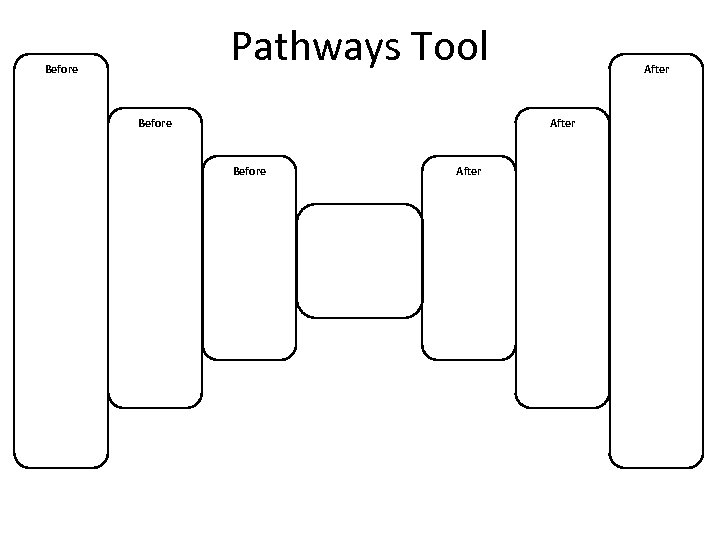 Pathways Tool Before After
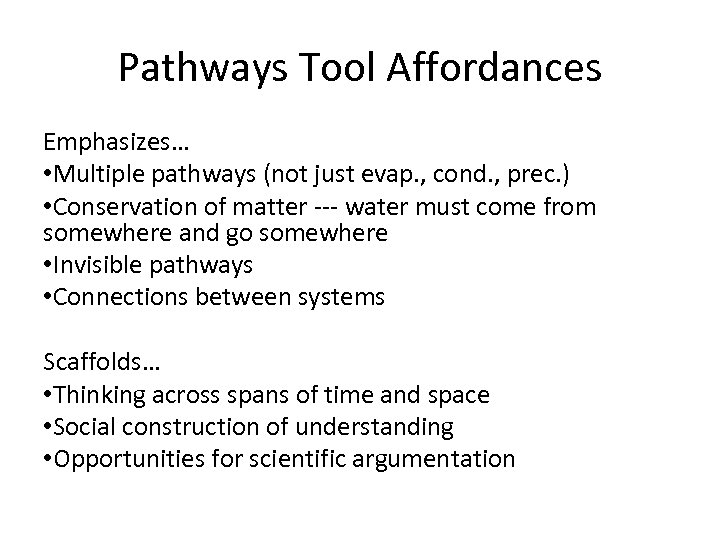 Pathways Tool Affordances Emphasizes… • Multiple pathways (not just evap. , cond. , prec. ) • Conservation of matter --- water must come from somewhere and go somewhere • Invisible pathways • Connections between systems Scaffolds… • Thinking across spans of time and space • Social construction of understanding • Opportunities for scientific argumentation
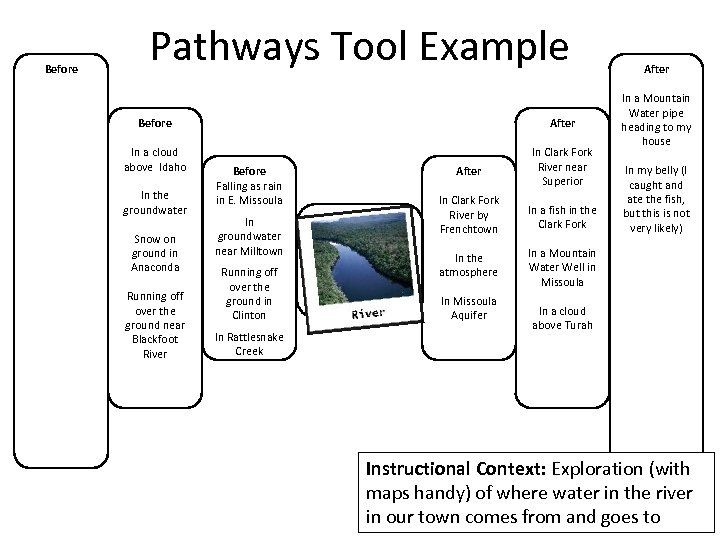 Before Pathways Tool Example Before After In a cloud above Idaho After In Clark Fork River near Superior In Clark Fork River by Frenchtown In a fish in the Clark Fork In the atmosphere After In a Mountain Water pipe heading to my house In a Mountain Water Well in Missoula In the groundwater Snow on ground in Anaconda Running off over the ground near Blackfoot River Before Falling as rain in E. Missoula In groundwater near Milltown Running off over the ground in Clinton In Rattlesnake Creek In Missoula Aquifer In my belly (I caught and ate the fish, but this is not very likely) In a cloud above Turah Instructional Context: Exploration (with maps handy) of where water in the river in our town comes from and goes to
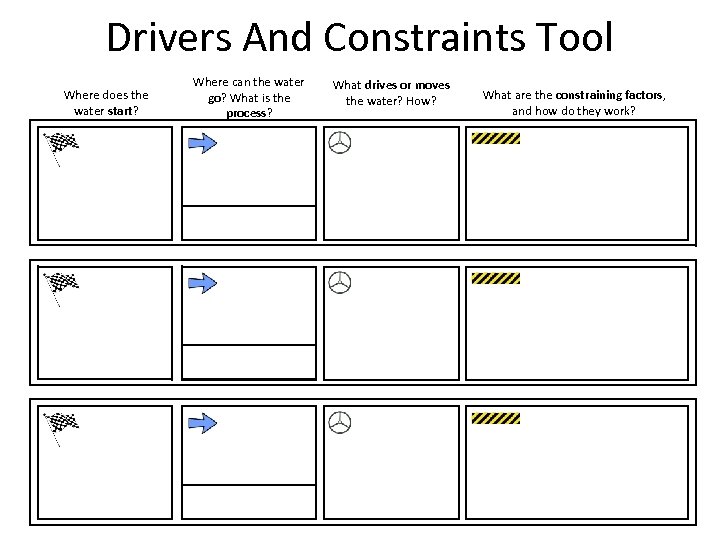 Drivers And Constraints Tool Where does the water start? Where can the water go? What is the process? What drives or moves the water? How? What are the constraining factors, and how do they work?
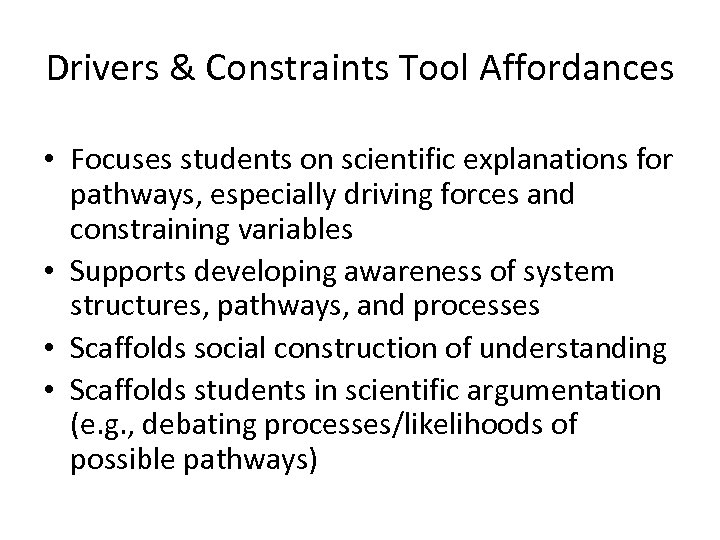 Drivers & Constraints Tool Affordances • Focuses students on scientific explanations for pathways, especially driving forces and constraining variables • Supports developing awareness of system structures, pathways, and processes • Scaffolds social construction of understanding • Scaffolds students in scientific argumentation (e. g. , debating processes/likelihoods of possible pathways)
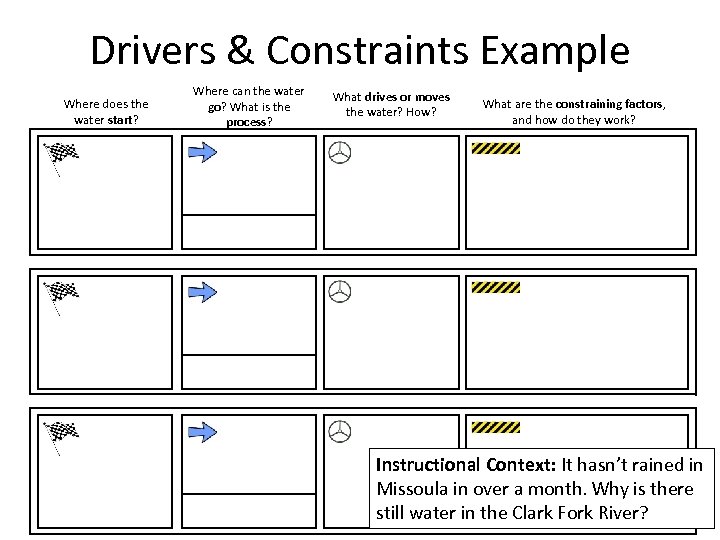 Drivers & Constraints Example Where does the water start? Where can the water go? What is the process? What drives or moves the water? How? What are the constraining factors, and how do they work? Instructional Context: It hasn’t rained in Missoula in over a month. Why is there still water in the Clark Fork River?
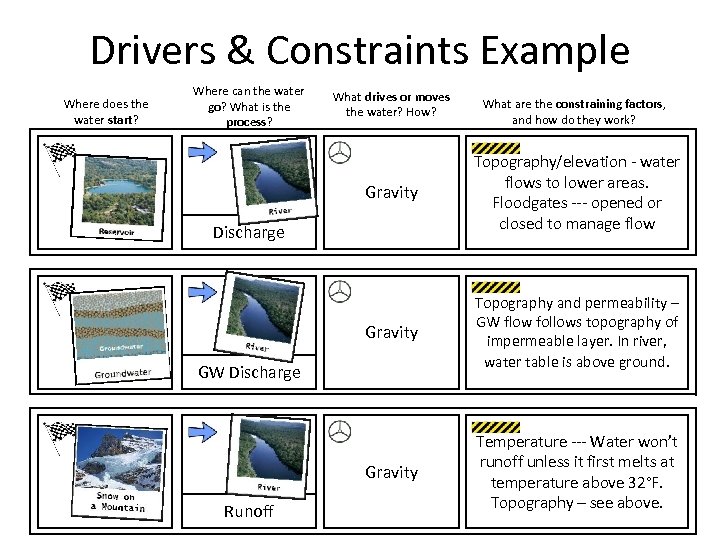 Drivers & Constraints Example Where does the water start? Where can the water go? What is the process? What drives or moves the water? How? What are the constraining factors, and how do they work? Gravity Topography/elevation - water flows to lower areas. Floodgates --- opened or closed to manage flow Gravity Topography and permeability – GW flow follows topography of impermeable layer. In river, water table is above ground. Gravity Temperature --- Water won’t runoff unless it first melts at temperature above 32°F. Topography – see above. Discharge GW Discharge Runoff
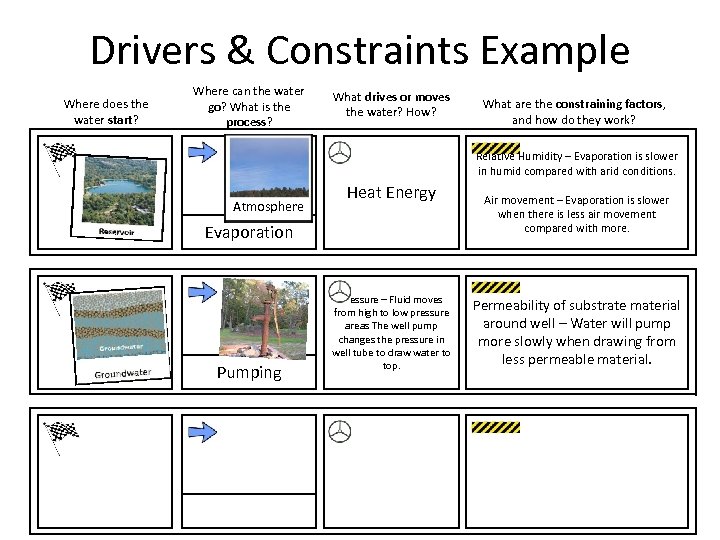 Drivers & Constraints Example Where does the water start? Where can the water go? What is the process? What drives or moves the water? How? What are the constraining factors, and how do they work? Relative Humidity – Evaporation is slower in humid compared with arid conditions. Atmosphere Heat Energy Evaporation Pumping Pressure – Fluid moves from high to low pressure areas The well pump changes the pressure in well tube to draw water to top. Air movement – Evaporation is slower when there is less air movement compared with more. Permeability of substrate material around well – Water will pump more slowly when drawing from less permeable material.
 How can you use the tools? • For eliciting and responding to students’ ideas • For supporting student-centered discussion and argumentation about water systems • Drivers & Constraints Tool helps focus lessons on causal explanations (how & why)