


 Скачать презентацию Introduction to the Theory of Constraints Ing J
e5f604abad7a6fc60fe0d8b768f3b598.ppt
- Количество слайдов: 90
 Introduction to the Theory of Constraints Ing. J. Skorkovský, CSc. Department of Corporate Economy Faculty of Economics and Administration MASARYK UNIVERSITY BRNO Czech Republic 1
 Introduction n Theory of Constraints - TOC) was formulated approximately in 1980 in the USA. Some important roots of this theory were connected to the ideas incorporated in programs for planning and production control (Optimized Production Technology) 2
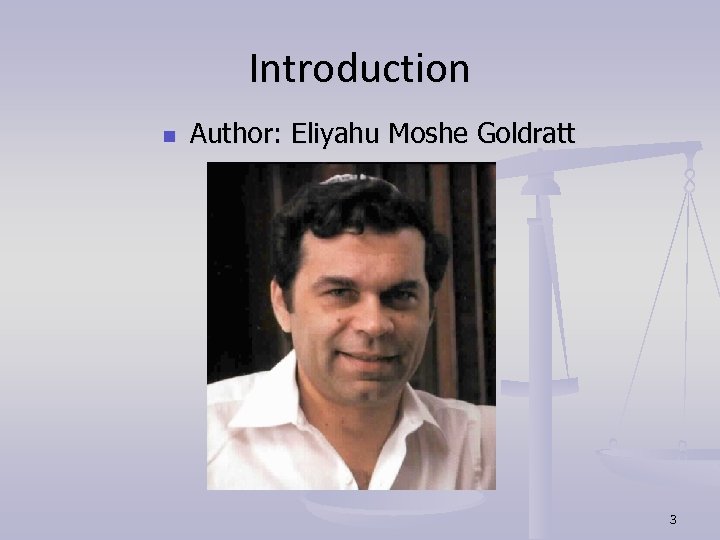 Introduction n Author: Eliyahu Moshe Goldratt 3
 The Goal by Eliyahu Goldratt n The goal of a manufacturing company? 4
 Introduction -novels TOC has became popular particularly thanks to the novels : n The Goal - A Process of Ongoing Improvement n It´s Not Luck n The Race n The Critical Chain n The Haystack Syndrome n Necessary But Not Sufficient n Late night discussion n TOC was together with TQM (Total Quality Management ) and JIT (Just-In-Time) classified as one of the most important managerial methods of the last two decades of the twentieth century. 5
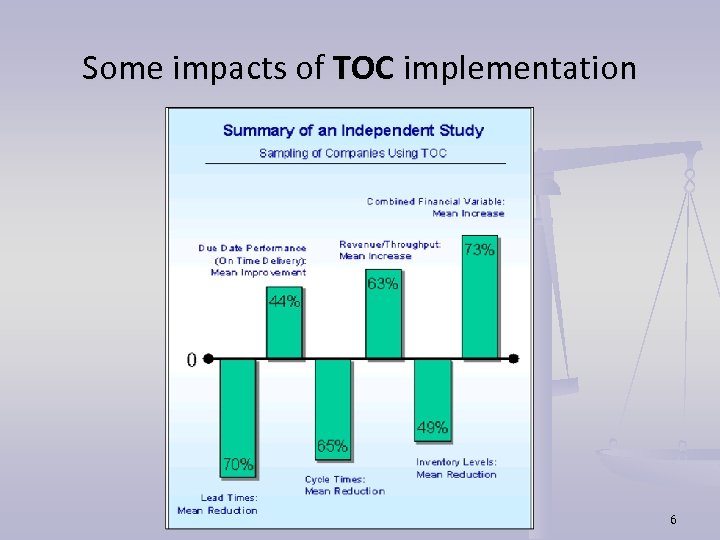 Some impacts of TOC implementation 6
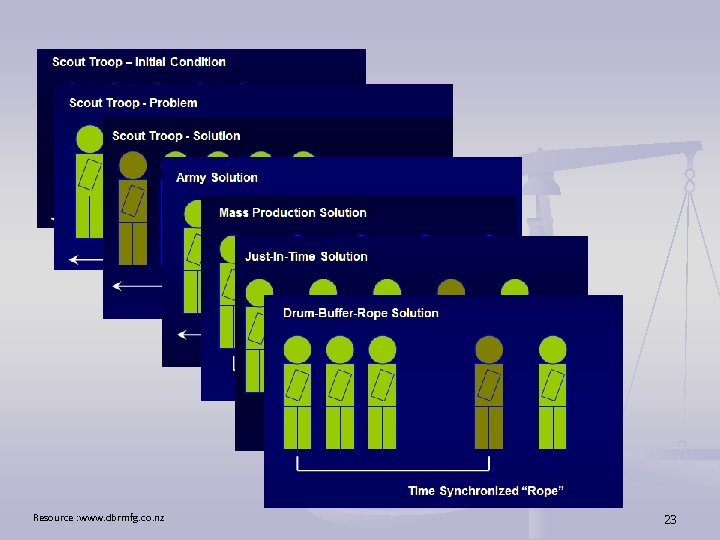
 Some impacts of TOC implementation Ford Motor – Electronics Div. Revenue: $3, 000, 000 Number of employees: 15, 000 Implementation Date: 1991 TOC Applications: DBR Comment: Drum-Buffer-Rope 7
 Some impacts of TOC implementation IMPLEMENTATION RESULTS Inventory Decrease: Reduced 100 million dollars (50%) On-time performance: From 89% - to 98% Lead times: From 6. 4 days with JIT to 2. 6 days Cost efficiency: Reduced floor space by 57% Quality: Reduced quality defects by 50% 8
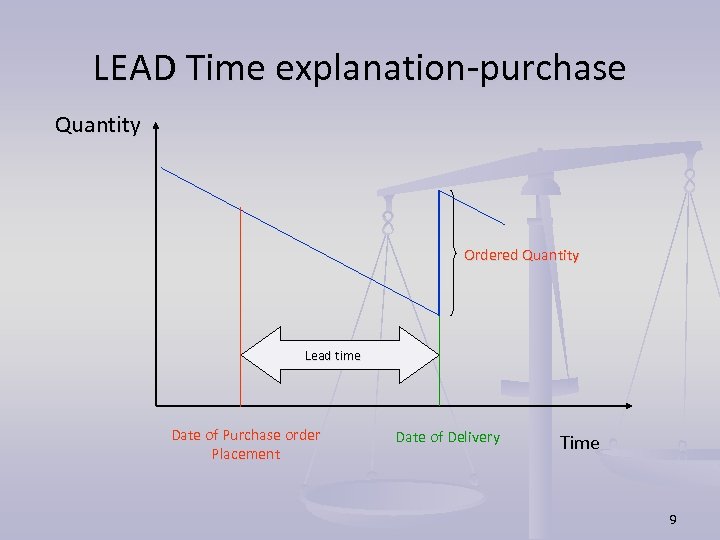 LEAD Time explanation-purchase Quantity Ordered Quantity Lead time Date of Purchase order Placement Date of Delivery Time 9
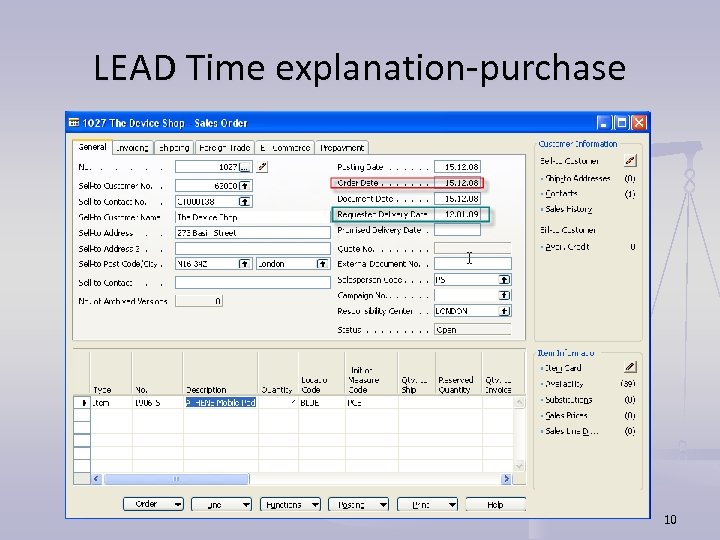 LEAD Time explanation-purchase 10
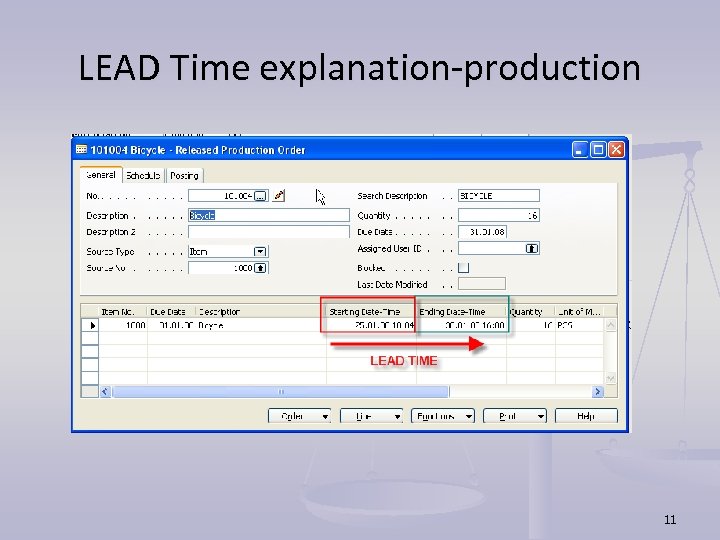 LEAD Time explanation-production 11
 Some impacts of TOC implementation Mc. Donagh Furniture Ltd Revenue: $8, 000 Number of employees: 100 Implementation Date: 2000 TOC Applications: DBR 12
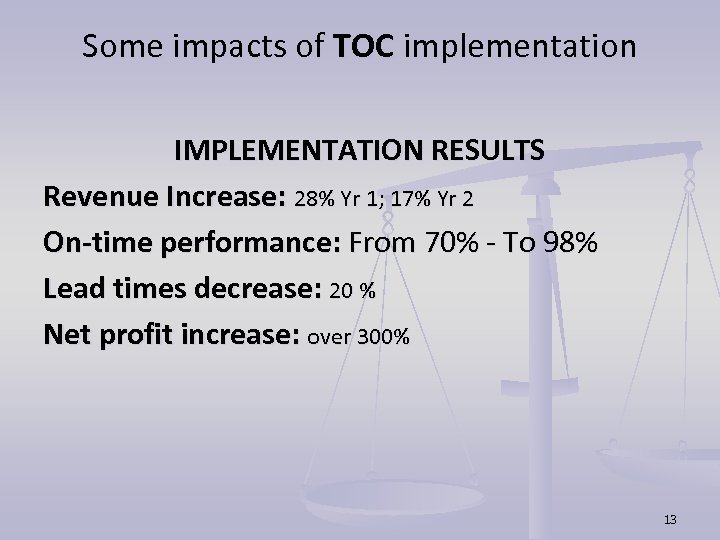 Some impacts of TOC implementation IMPLEMENTATION RESULTS Revenue Increase: 28% Yr 1; 17% Yr 2 On-time performance: From 70% - To 98% Lead times decrease: 20 % Net profit increase: over 300% 13
 Some impacts of TOC implementation Some other companies using TOC applications: n BOEING –maintenance departments n MOTOROLA -research n GENERAL MOTORS n LOCKHEAD MARTIN (F 22) n BAE SYSTEMS n ……… 14
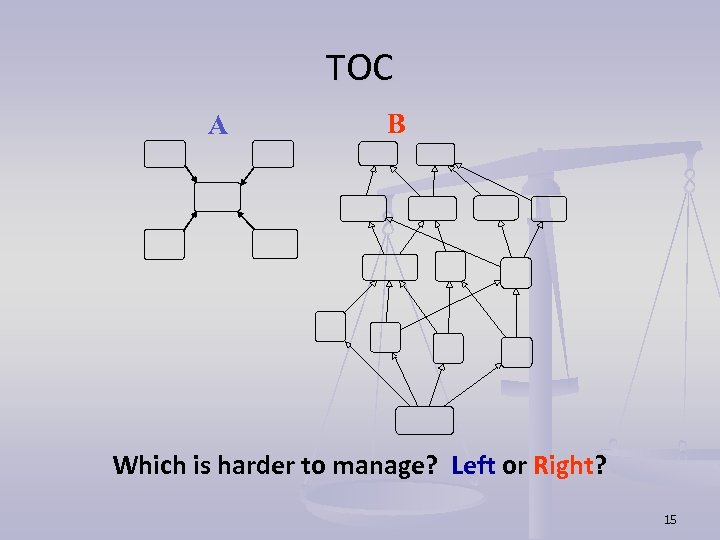 TOC A B Which is harder to manage? Left or Right? 15
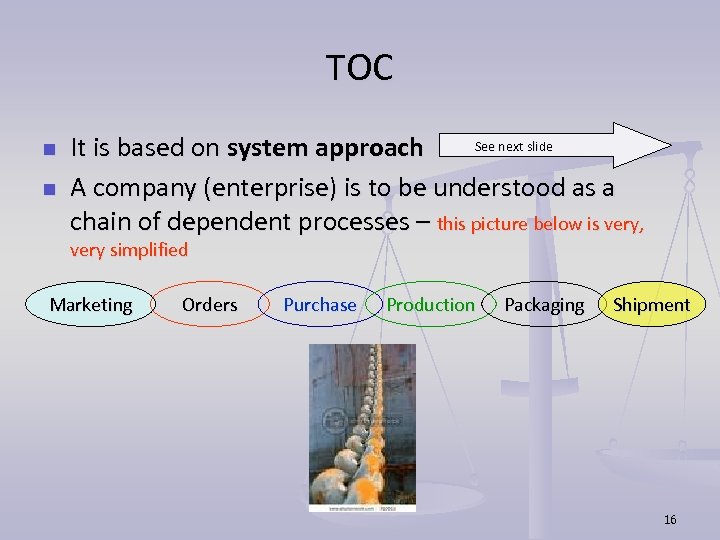 TOC n n See next slide It is based on system approach A company (enterprise) is to be understood as a chain of dependent processes – this picture below is very, very simplified Marketing Orders Purchase Production Packaging Shipment 16
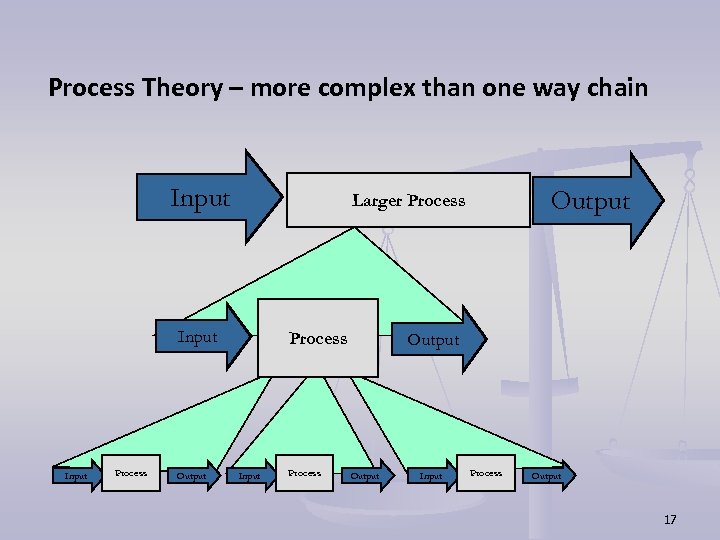 Process Theory – more complex than one way chain Input Process Output Larger Process Input Process Output 17
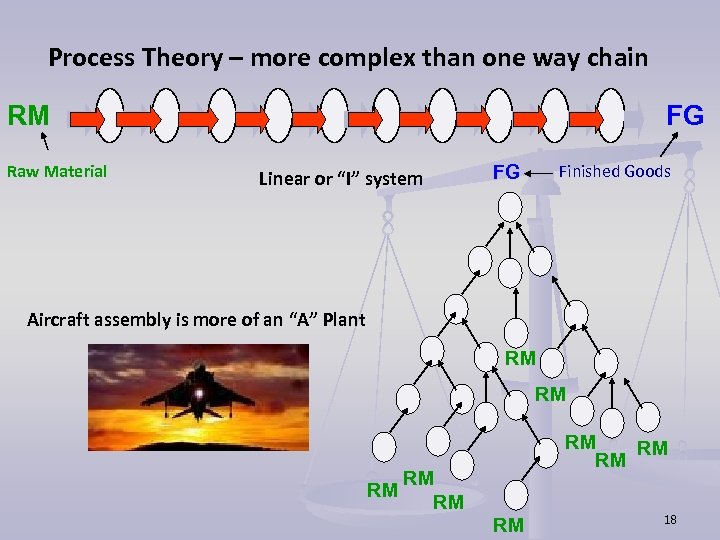 Process Theory – more complex than one way chain RM Raw Material FG Linear or “I” system Finished Goods FG Aircraft assembly is more of an “A” Plant RM RM RM 18
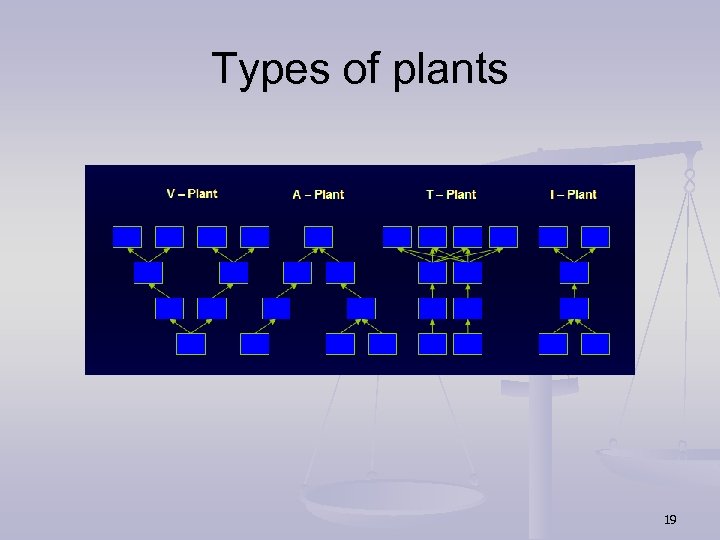 Types of plants 19
 TOC – system approach n n Organizations / Systems exist for a purpose That purpose is better achieved by cooperation of multiple, independent elements linked together Each Inter-linked event depends in some detail upon the other links. The system owner determines purpose 20
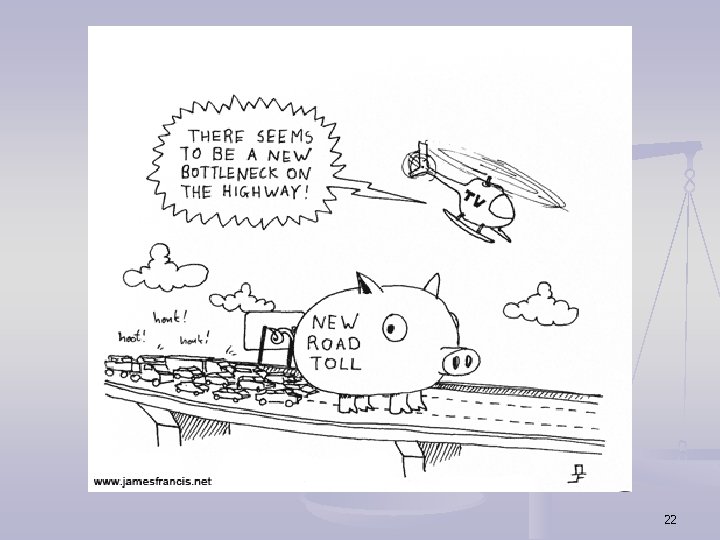
 TOC n n Most real systems could be seen in such a way, that there are only a few or better only one element (factor), which is the key point, where and only there all possible managerial methods have to be focused in order to control whole system „Every system is based on inherent simplicity”. This element in TOC is called Constraint of the system = bottleneck Bottleneck: Any resource whose capacity is equal to or less than the demand placed upon it. Inherent : základní, podstatná. neodmyslitelná…. 21
 22
22
 Resource : www. dbrmfg. co. nz 23
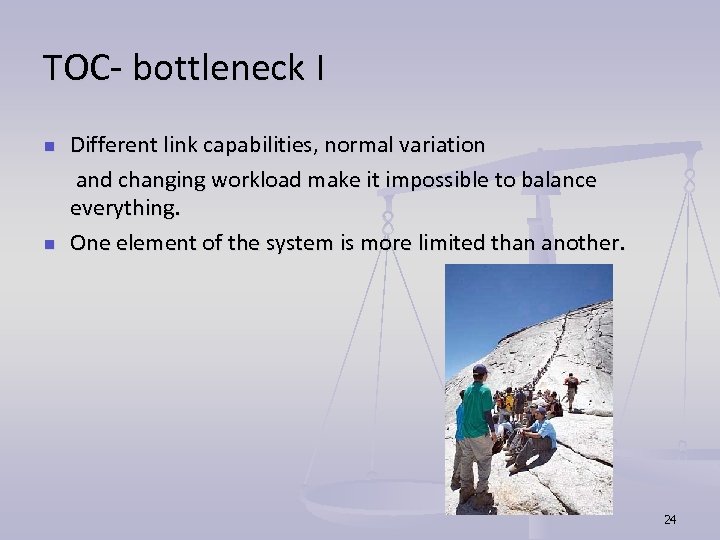 TOC- bottleneck I Different link capabilities, normal variation and changing workload make it impossible to balance everything. n One element of the system is more limited than another. n 24
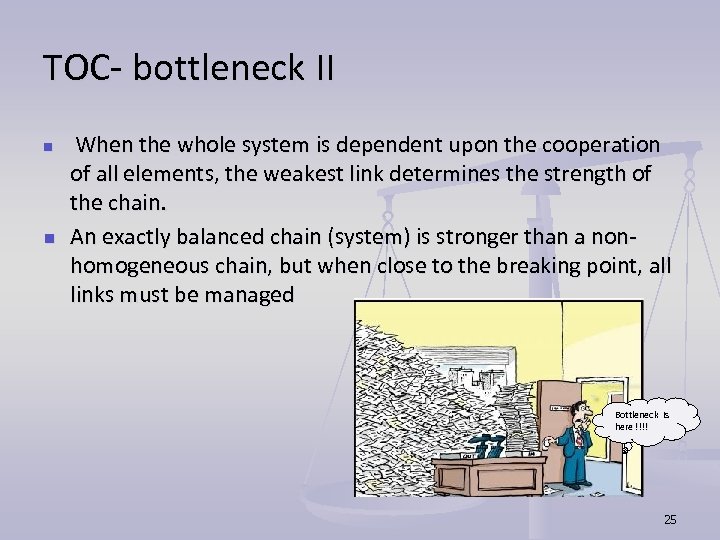 TOC- bottleneck II n n When the whole system is dependent upon the cooperation of all elements, the weakest link determines the strength of the chain. An exactly balanced chain (system) is stronger than a nonhomogeneous chain, but when close to the breaking point, all links must be managed Bottleneck is here !!!! 25
 TOC n n Why constraint ? Constraint prevents to reach the goal (make money now and in the future) n The TOC goal : „Make money now and in the future“ Every system has at least one such a constraint. The system without such a bottlenecks would reach the predefined business plans in infinite volumes. n 26
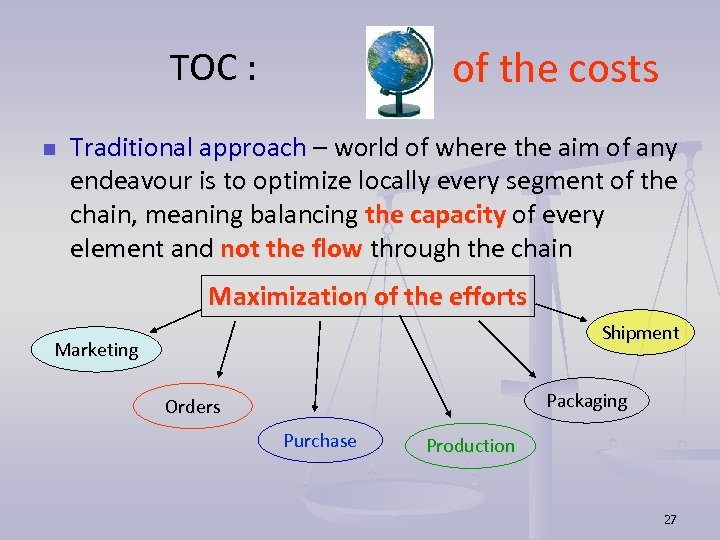 of the costs TOC : n Traditional approach – world of where the aim of any endeavour is to optimize locally every segment of the chain, meaning balancing the capacity of every element and not the flow through the chain Maximization of the efforts Shipment Marketing Packaging Orders Purchase Production 27
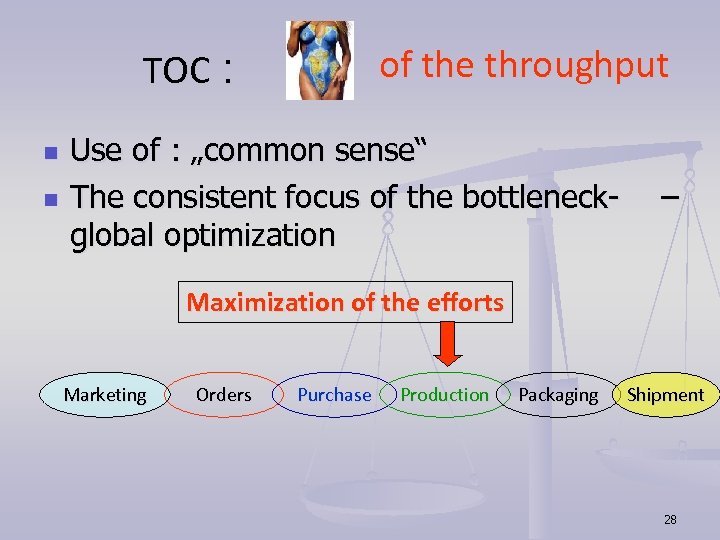 of the throughput TOC : n n Use of : „common sense“ The consistent focus of the bottleneckglobal optimization – Maximization of the efforts Marketing Orders Purchase Production Packaging Shipment 28
 TOC 29
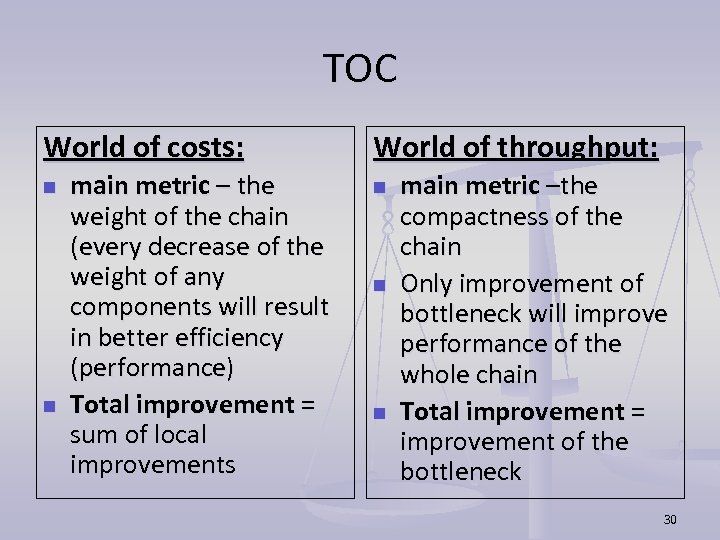 TOC World of costs: n n main metric – the weight of the chain (every decrease of the weight of any components will result in better efficiency (performance) Total improvement = sum of local improvements World of throughput: n n n main metric –the compactness of the chain Only improvement of bottleneck will improve performance of the whole chain Total improvement = improvement of the bottleneck 30
 Life show n http: //www. tocca. com. au/ 31
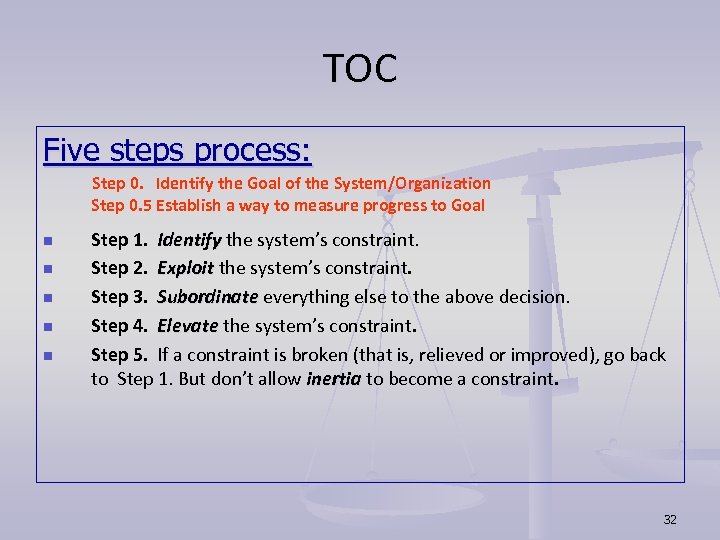 TOC Five steps process: Step 0. Identify the Goal of the System/Organization Step 0. 5 Establish a way to measure progress to Goal n n n Step 1. Identify the system’s constraint. Identify Step 2. Exploit the system’s constraint. Exploit Step 3. Subordinate everything else to the above decision. Subordinate Step 4. Elevate the system’s constraint. Elevate Step 5. If a constraint is broken (that is, relieved or improved), go back to Step 1. But don’t allow inertia to become a constraint. inertia 32
 TOC n n n * „Cost Accounting is enemy number one of productivity“. * Impact on the behaviour of the people and they habits of finding and improvements of local elements having reason in optimising of these particles. New metrics were introduced – already presented Eric Noreen, Debra Smith and James t. Mackey 33
 Definition (TOC metric) - summary n Throughput (T): The rate at which the system generates money through sales. n n Note that the money is generated through sales and not production because if you produce something and don’t sell it, you have not really had throughput. (You’ve just put it into inventory). Inventory (I): All the money that the system has invested in purchasing things, which it intends to sell. n Operational Expense (OE): All the money the system spends in order to turn Inventory into Throughput. See classification of OE later in this show 34
 TOC metrics more in detail (T) n throughput is the rate at which a system achieves its goal. Often this is monetary revenue and is in contrast to output, which is inventory that may be sold or stored in a warehouse. In this case throughput is measured by revenue received (or not) at the point of sale— exactly the right 35
 TOC metrics more in detail (OE) n n n n n Operating expenses includes e. g. : accounting expenses license fees maintenance and repairs, such as snow removal, trash removal, janitorial service, pest control, and lawn care advertising office expenses supplies attorney fees and legal fees utilities, such as telephone 36
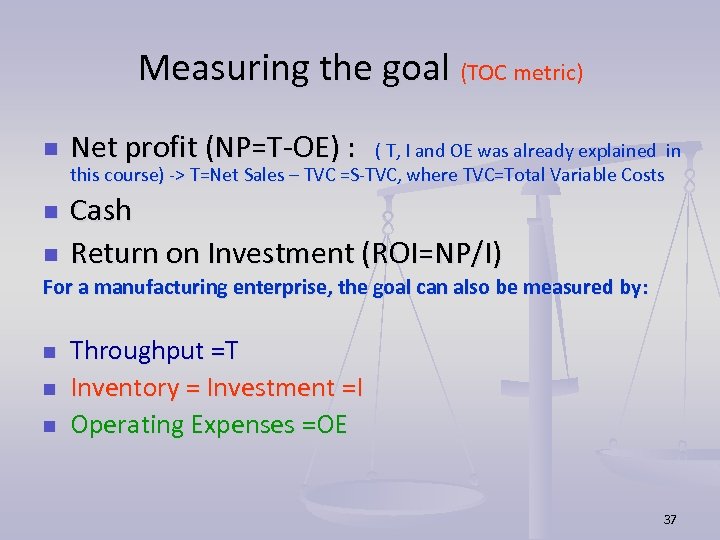 Measuring the goal (TOC metric) n n Net profit (NP=T-OE) : ( T, I and OE was already explained in this course) -> T=Net Sales – TVC =S-TVC, where TVC=Total Variable Costs Cash Return on Investment (ROI=NP/I) n For a manufacturing enterprise, the goal can also be measured by : n n n Throughput =T Inventory = Investment =I Operating Expenses =OE 37
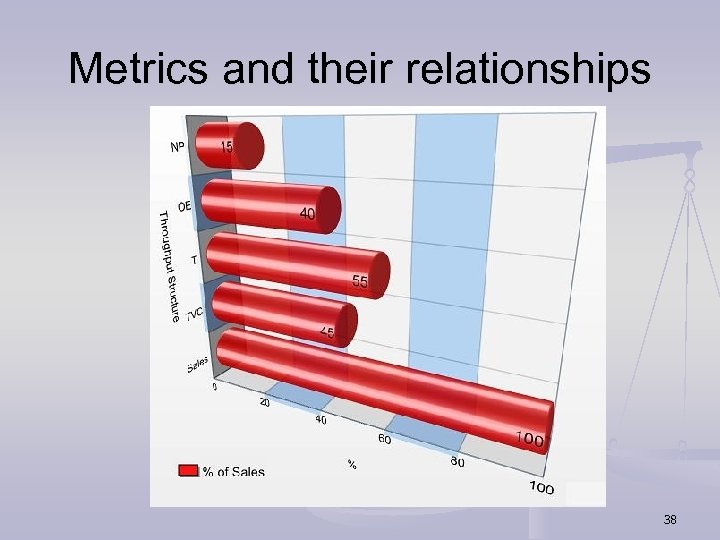 Metrics and their relationships 38
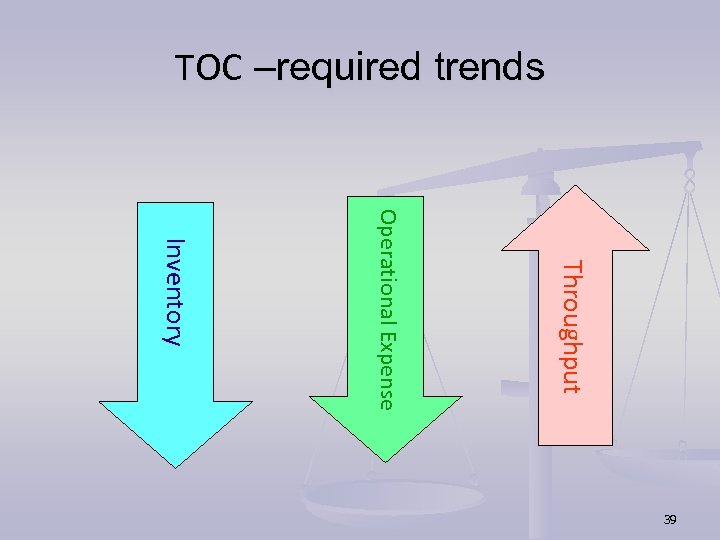 TOC –required trends Throughput Operational Expense Inventory 39
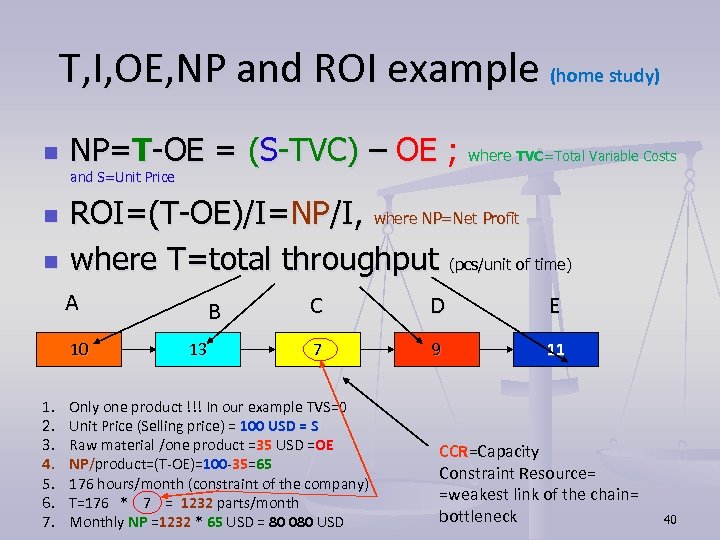 T, I, OE, NP and ROI example (home study) n NP=T-OE = (S-TVC) – OE ; where TVC=Total Variable Costs and S=Unit Price n n ROI=(T-OE)/I=NP/I, where NP=Net Profit where T=total throughput (pcs/unit of time) A 10 1. 2. 3. 4. 5. 6. 7. B 13 C D E 7 9 11 Only one product !!! In our example TVS=0 Unit Price (Selling price) = 100 USD = S Raw material /one product =35 USD =OE NP/product=(T-OE)=100 -35=65 176 hours/month (constraint of the company) T=176 * 7 = 1232 parts/month Monthly NP =1232 * 65 USD = 80 080 USD CCR=Capacity Constraint Resource= =weakest link of the chain= bottleneck 40
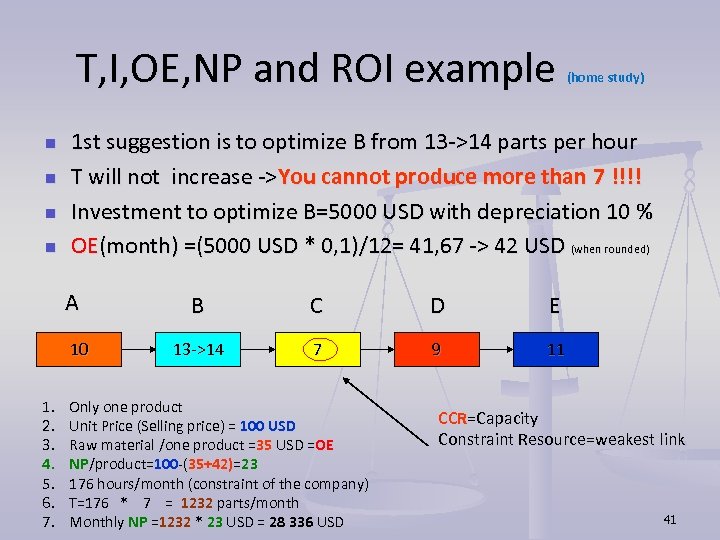 T, I, OE, NP and ROI example (home study) n n 1 st suggestion is to optimize B from 13 ->14 parts per hour T will not increase ->You cannot produce more than 7 !!!! Investment to optimize B=5000 USD with depreciation 10 % OE(month) =(5000 USD * 0, 1)/12= 41, 67 -> 42 USD (when rounded) A 10 1. 2. 3. 4. 5. 6. 7. B C D E 13 ->14 7 9 11 Only one product Unit Price (Selling price) = 100 USD Raw material /one product =35 USD =OE NP/product=100 -(35+42)=23 176 hours/month (constraint of the company) T=176 * 7 = 1232 parts/month Monthly NP =1232 * 23 USD = 28 336 USD CCR=Capacity Constraint Resource=weakest link 41
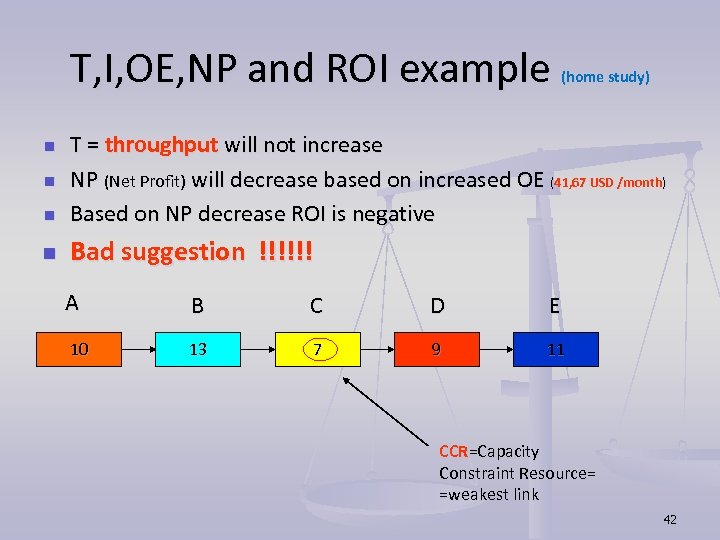 T, I, OE, NP and ROI example (home study) n T = throughput will not increase NP (Net Profit) will decrease based on increased OE (41, 67 USD /month) Based on NP decrease ROI is negative n Bad suggestion !!!!!! n n A B C D E 10 13 7 9 11 CCR=Capacity Constraint Resource= =weakest link 42
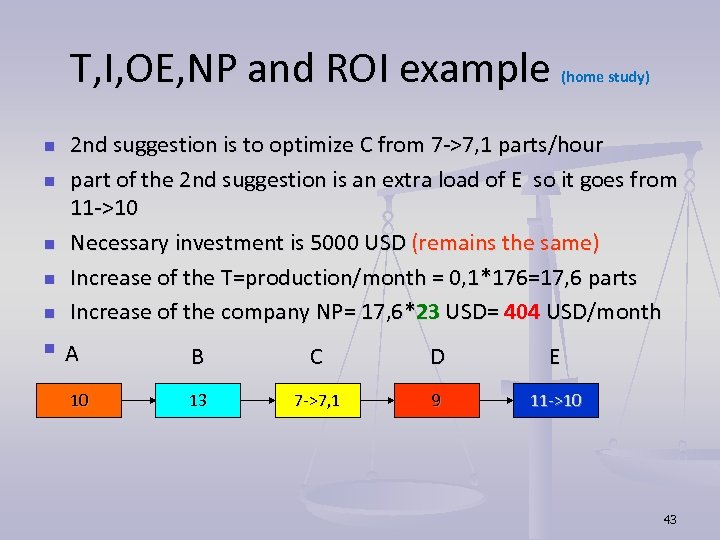 T, I, OE, NP and ROI example (home study) n n n 2 nd suggestion is to optimize C from 7 ->7, 1 parts/hour part of the 2 nd suggestion is an extra load of E so it goes from 11 ->10 Necessary investment is 5000 USD (remains the same) Increase of the T=production/month = 0, 1*176=17, 6 parts Increase of the company NP= 17, 6*23 USD= 404 USD/month A B C D E 10 13 7 ->7, 1 9 11 ->10 43
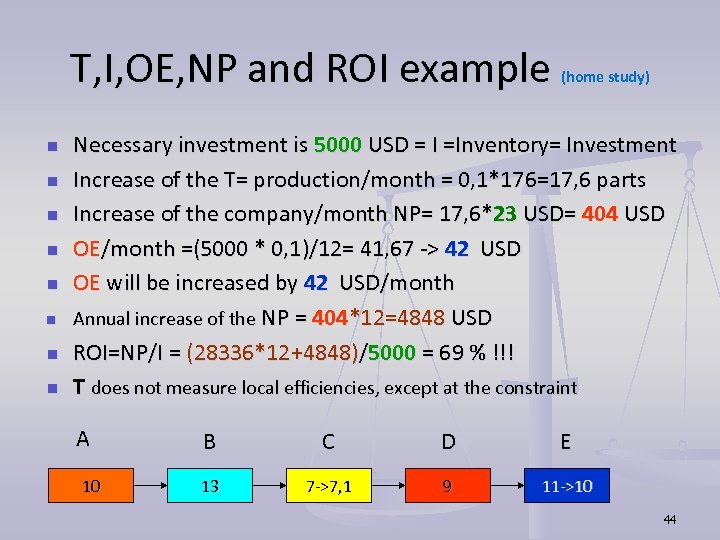 T, I, OE, NP and ROI example (home study) n n n n Necessary investment is 5000 USD = I =Inventory= Investment Increase of the T= production/month = 0, 1*176=17, 6 parts Increase of the company/month NP= 17, 6*23 USD= 404 USD OE/month =(5000 * 0, 1)/12= 41, 67 -> 42 USD OE will be increased by 42 USD/month Annual increase of the NP = 404*12=4848 USD ROI=NP/I = (28336*12+4848)/5000 = 69 % !!! T does not measure local efficiencies, except at the constraint A B C D E 10 13 7 ->7, 1 9 11 ->10 44
 Implementation of TOC is complicated switchover process n n it represents challenging adventure, where the invested efforts are often not predictable it requires cooperation, coordination and use of well informed and trained teams on both sides. you will certainly overcame natural resistance against changes and persuade distressed and indolent people no one is willing to change anything 45
 Implementation of TOC is complicated switchover process n n n try to find somebody who could accept changes you must persuade these guys, that the suggesting changes are in fact their idea and without their creativity TOC would be only toothless beast. but how to achieve it ? ? 46
 Implementation of TOC is complicated switchover process n n Socratic teaching – proving the logic by use of dialog Buy-in approach – initiator of the changes must have interpersonal and communication talents in order to persuade the targets and squeeze from the people their best ideas. 47
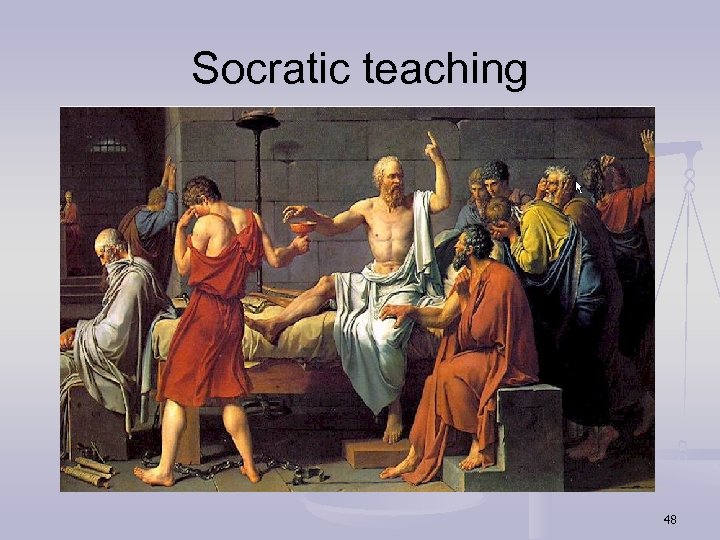 Socratic teaching 48
 Implementation of TOC is complicated switchover process We have to find out the answers to these questions: 1. What to change? 2. To what to change to ? 3. How to make the change happen? 49
 Implementation of TOC is complicated switchover process What to change? n Objectives : Situation assessment, description of “current reality, ” and identification of the core problem or conflict and assumptions that sustain it. Diagnosis, systemic root cause analysis. n But at any time you will meet enemies – the ones who hate any changes n Layers of resistance: Lack of agreement on the problem 50
 RESISTANCE 51
 Implementation of TOC is complicated switchover process To what to change? n n Objectives : Verbalization of vision/solution, description of strategy to attain the desired state, and avoidance of undesirable side effects. Prescription, decision-making, and solution development. Layers of resistance: n n Lack of agreement on a possible direction for a solution Lack of agreement that the solution will truly address the problem Concern that the solution will lead to new undesirable side effects (“Yes, but…”) Or you will get even worse reaction („NO, because…“) 52
 Thinking Process Tools n n n n offer the answers to three TOC questions about changes help to clear away every layers of resistance visualisation of the thinking process verbalization of the thinking process use of casual logic (cause ->effect) use of sufficiency logic - „IF - AND - THEN“ use of necessity logic - „IN ORDER TO - THEN - BECAUSE“ 53
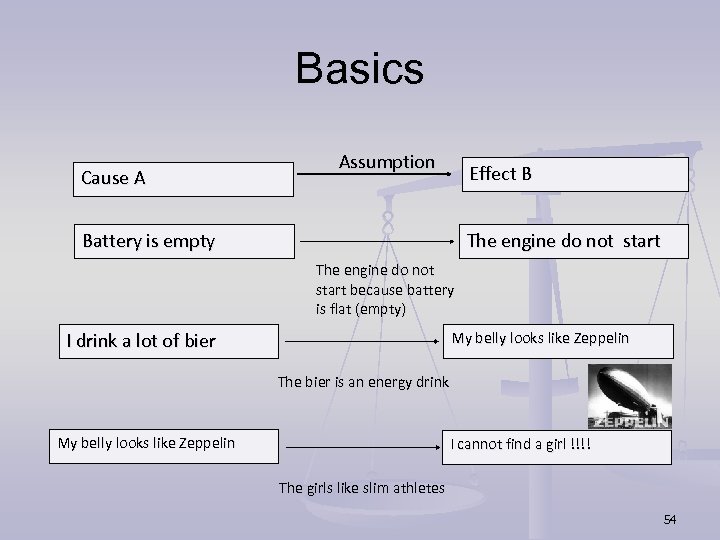 Basics Cause A Assumption Effect B Battery is empty The engine do not start because battery is flat (empty) I drink a lot of bier My belly looks like Zeppelin The bier is an energy drink My belly looks like Zeppelin I cannot find a girl !!!! The girls like slim athletes 54
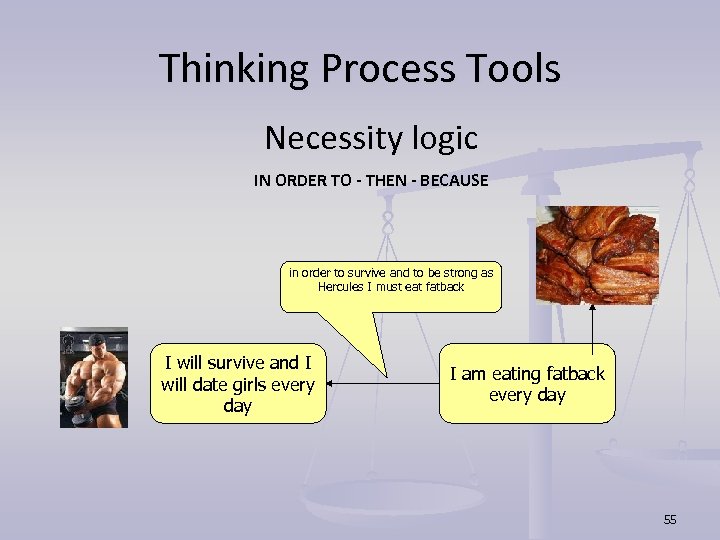 Thinking Process Tools Necessity logic IN ORDER TO - THEN - BECAUSE in order to survive and to be strong as Hercules I must eat fatback I will survive and I will date girls every day I am eating fatback every day 55
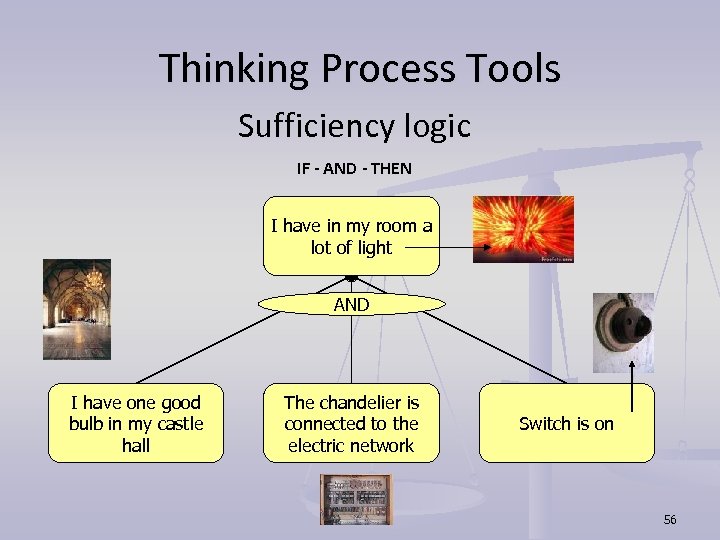 Thinking Process Tools Sufficiency logic IF - AND - THEN I have in my room a lot of light AND I have one good bulb in my castle hall The chandelier is connected to the electric network Switch is on 56
 We have to solve the crucial question: what is a core problem (what should be changed) Ø Ø Ø A tool for solving such a task : Current Reality Tree Why to change something and what is something (core problem=constraint, bottleneck) Summary of all Undesirable Effects (UDE) and their layout based on casual logic - sufficiency logic Core Problem – common cause of all UDE 57
 UDE examples n n n From the book “It’s Not Luck“, some examples of the UDEs are: Production and distribution do not improve fast/significantly enough Engineering is unable to deliver new products fast and reliably enough. Companies don’t come up with sufficient innovative ideas in marketing. In more and more cases the price the market is willing to pay doesn’t leave enough margin. There is unprecedented pressure to take actions that will increase sales Competition is fiercer than ever. In advanced material industries there is a need to launch new products at an unprecedented rate. In advanced material industries the constant introduction of new products confuses and spoils the market. Sales people are overloaded. There is increasing pressure to reduce prices. 58
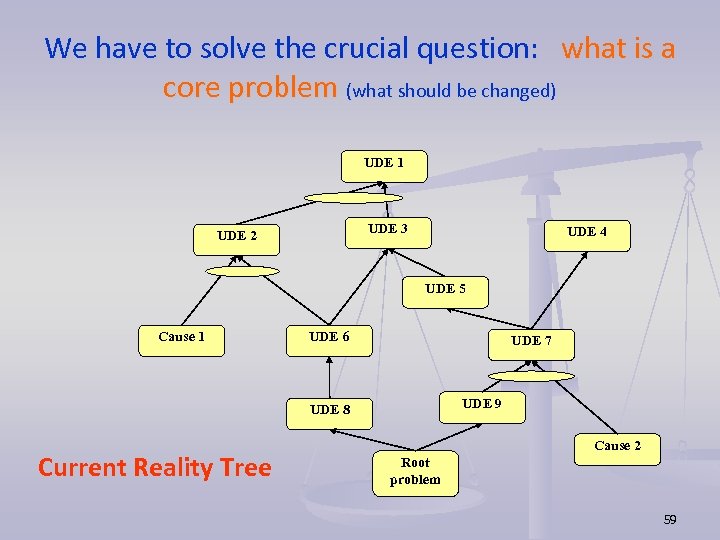 We have to solve the crucial question: what is a core problem (what should be changed) UDE 1 UDE 3 UDE 2 UDE 4 UDE 5 Cause 1 UDE 6 UDE 7 UDE 9 UDE 8 Current Reality Tree Cause 2 Root problem 59
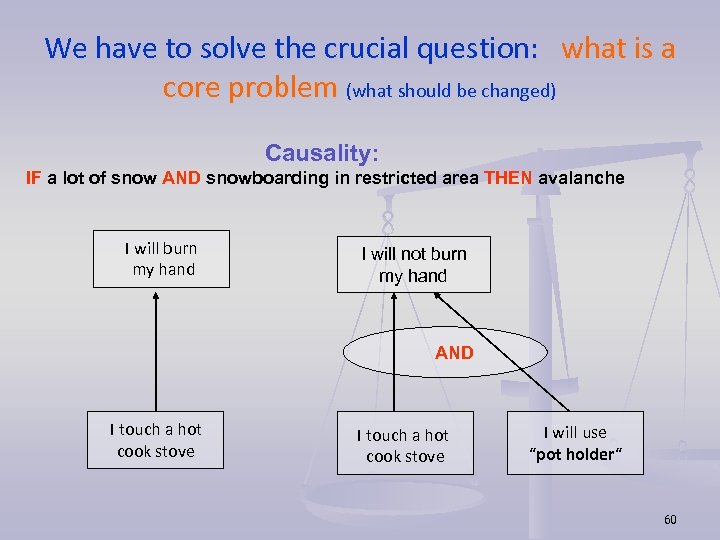 We have to solve the crucial question: what is a core problem (what should be changed) Causality: IF a lot of snow AND snowboarding in restricted area THEN avalanche I will burn my hand I will not burn my hand AND I touch a hot cook stove I will use “pot holder“ 60
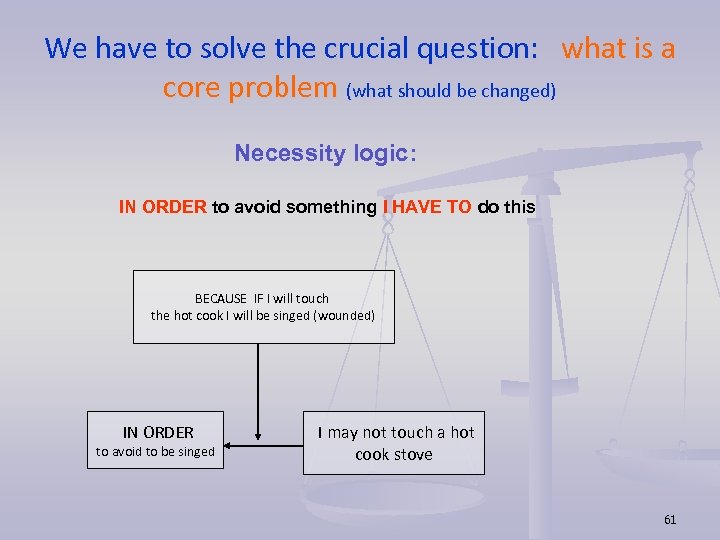 We have to solve the crucial question: what is a core problem (what should be changed) Necessity logic: IN ORDER to avoid something I HAVE TO do this BECAUSE IF I will touch the hot cook I will be singed (wounded) IN ORDER to avoid to be singed I may not touch a hot cook stove 61
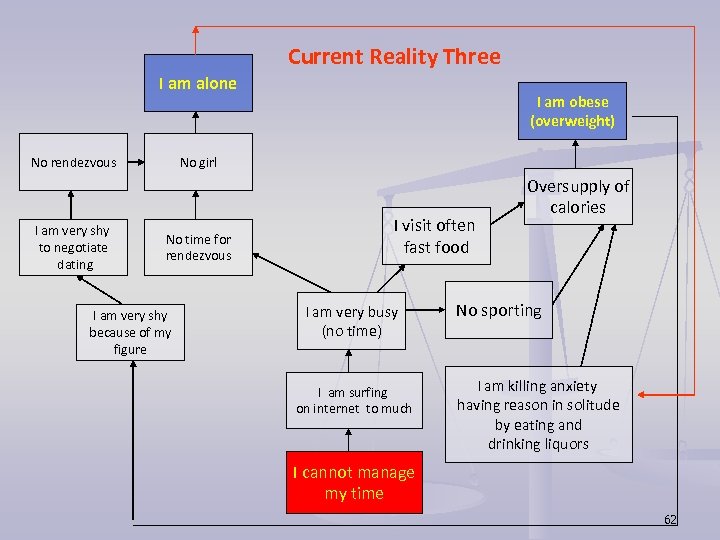 Current Reality Three I am alone No rendezvous I am very shy to negotiate dating I am obese (overweight) No girl No time for rendezvous I am very shy because of my figure I visit often fast food I am very busy (no time) I am surfing on internet to much Oversupply of calories No sporting I am killing anxiety having reason in solitude by eating and drinking liquors I cannot manage my time 62
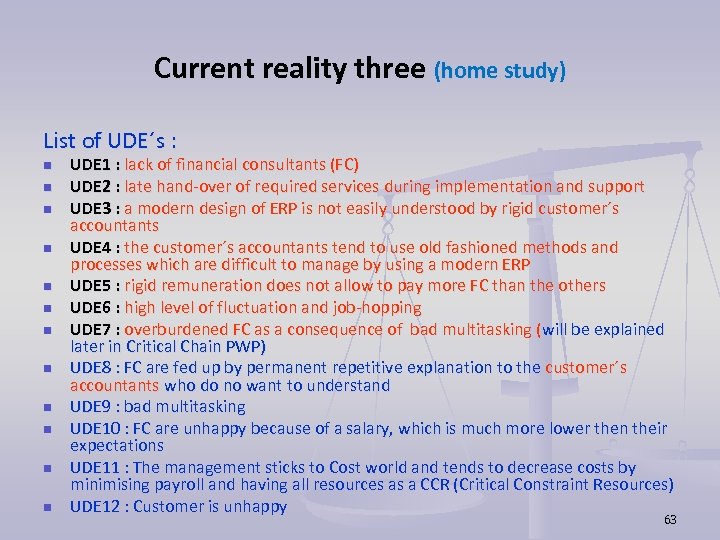 Current reality three (home study) List of UDE´s : n n n UDE 1 : lack of financial consultants (FC) UDE 2 : late hand-over of required services during implementation and support UDE 3 : a modern design of ERP is not easily understood by rigid customer´s accountants UDE 4 : the customer´s accountants tend to use old fashioned methods and processes which are difficult to manage by using a modern ERP UDE 5 : rigid remuneration does not allow to pay more FC than the others UDE 6 : high level of fluctuation and job-hopping UDE 7 : overburdened FC as a consequence of bad multitasking (will be explained later in Critical Chain PWP) UDE 8 : FC are fed up by permanent repetitive explanation to the customer´s accountants who do no want to understand UDE 9 : bad multitasking UDE 10 : FC are unhappy because of a salary, which is much more lower then their expectations UDE 11 : The management sticks to Cost world and tends to decrease costs by minimising payroll and having all resources as a CCR (Critical Constraint Resources) UDE 12 : Customer is unhappy 63
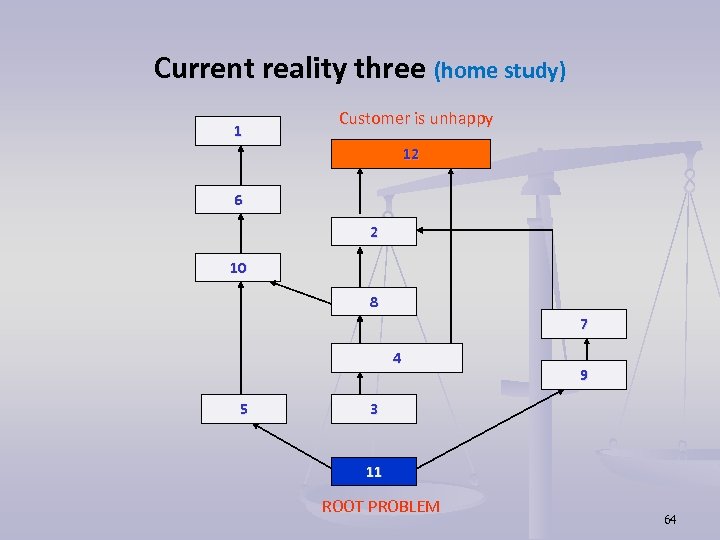 Current reality three (home study) 1 Customer is unhappy 12 6 2 10 8 7 4 5 9 3 11 ROOT PROBLEM 64
 We have to solve another crucial question: the direction of solving a core problem What is the main reason (injection) supporting the change ! Evaporating Cloud Tree Ø the change without any compromise - basic and starting impulse for the change use of „necessity logic“ – common goal, necessary condition to reach this goals, what have to be done and where is a conflict Ø „well thought out from the scratch“ of the problem, Ø Ø disclosure (findings)and verbal definition of hidden assumptions Win-Win solution of the whole conflict = injection !!! 65
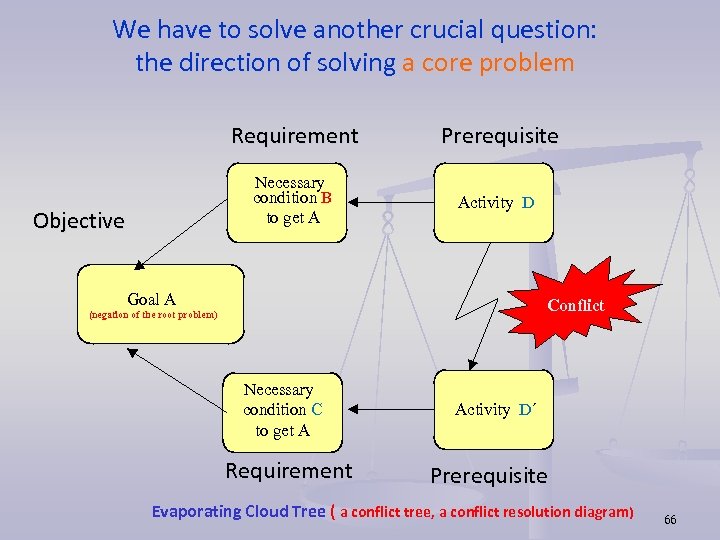 We have to solve another crucial question: the direction of solving a core problem Requirement Necessary condition B to get A Objective Prerequisite Activity D Goal A Conflict (negation of the root problem) Necessary condition C to get A Requirement Activity D´ Prerequisite Evaporating Cloud Tree ( a conflict tree, a conflict resolution diagram) 66
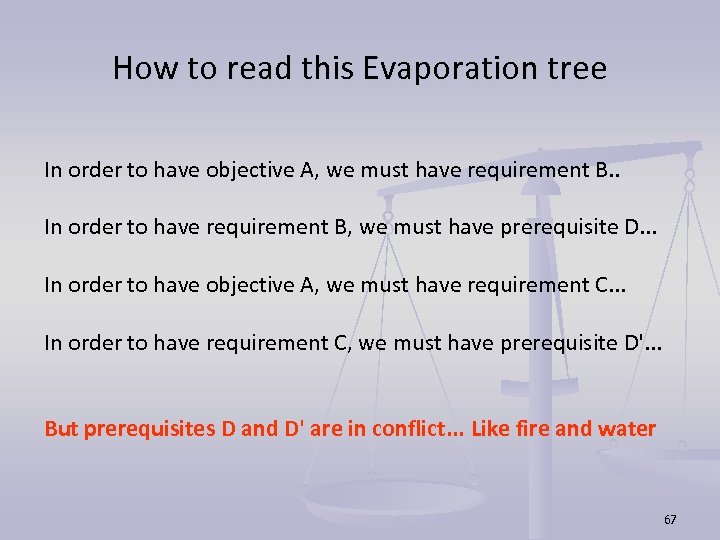 How to read this Evaporation tree In order to have objective A, we must have requirement B. . In order to have requirement B, we must have prerequisite D. . . In order to have objective A, we must have requirement C. . . In order to have requirement C, we must have prerequisite D'. . . But prerequisites D and D' are in conflict. . . Like fire and water 67
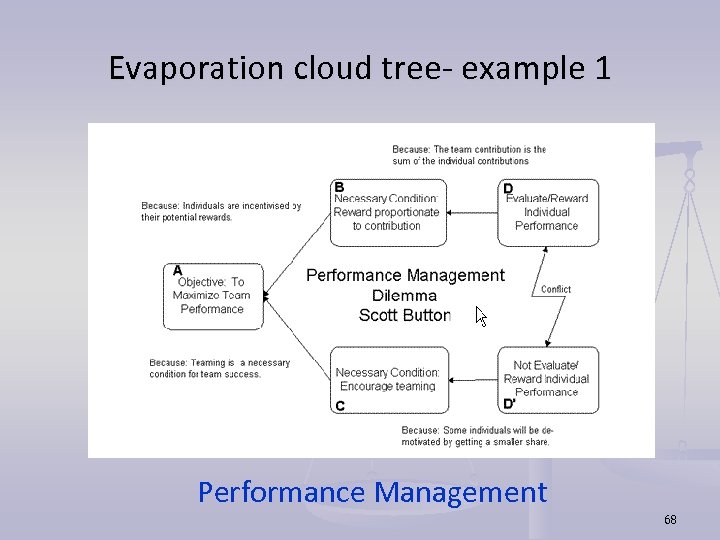 Evaporation cloud tree- example 1 Performance Management 68
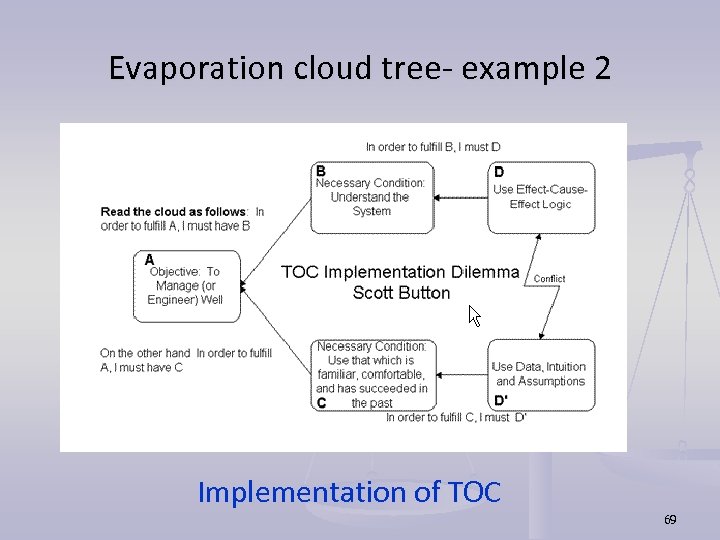 Evaporation cloud tree- example 2 Implementation of TOC 69
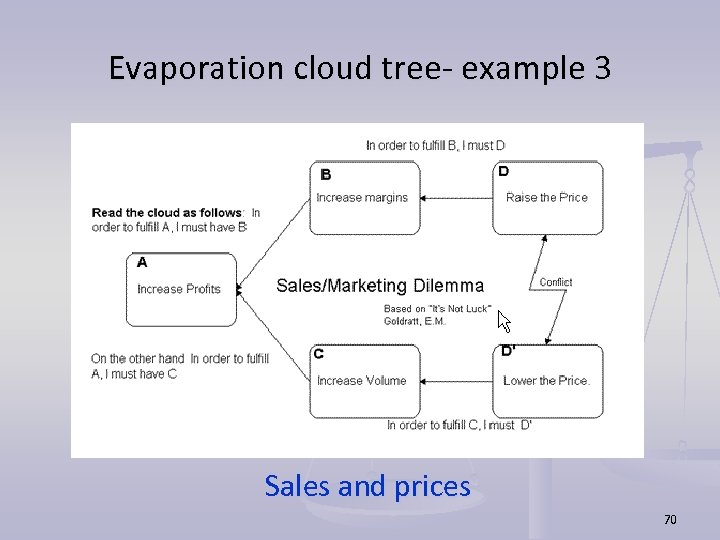 Evaporation cloud tree- example 3 Sales and prices 70
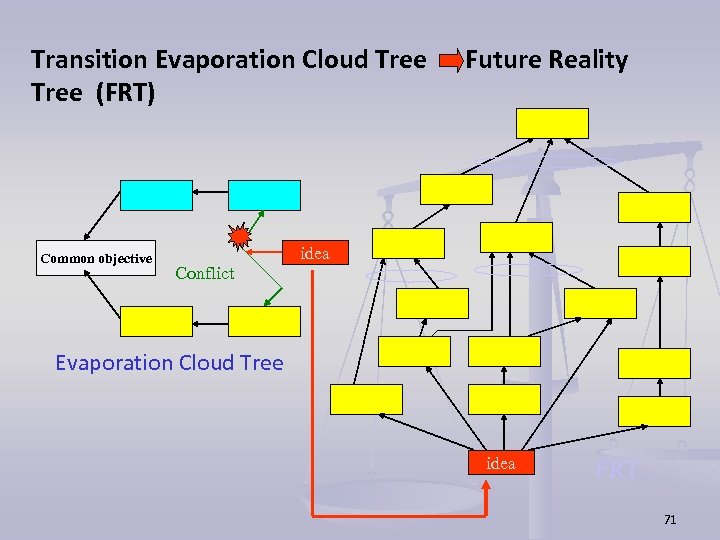 Transition Evaporation Cloud Tree Future Reality Tree (FRT) Common objective idea Conflict Evaporation Cloud Tree idea FRT 71
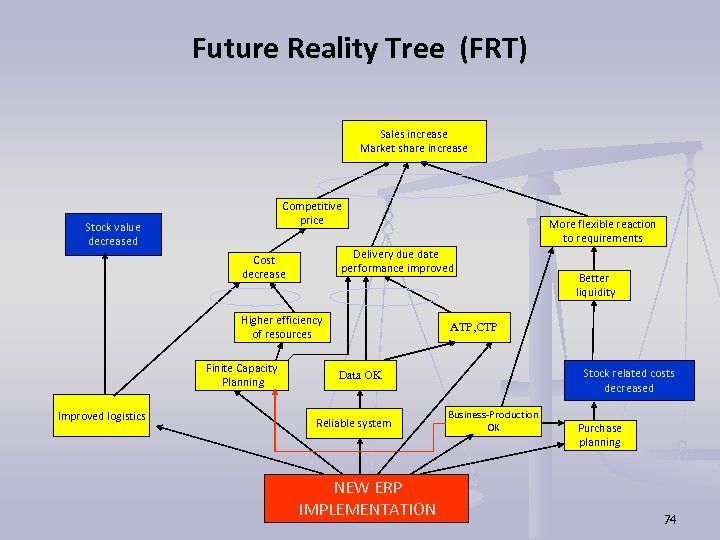
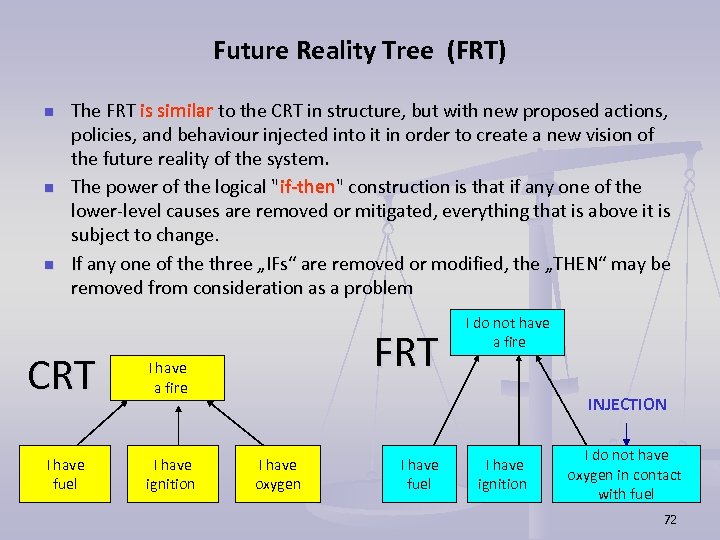 Future Reality Tree (FRT) n n n The FRT is similar to the CRT in structure, but with new proposed actions, policies, and behaviour injected into it in order to create a new vision of the future reality of the system. The power of the logical "if-then" construction is that if any one of the lower-level causes are removed or mitigated, everything that is above it is subject to change. If any one of the three „IFs“ are removed or modified, the „THEN“ may be removed from consideration as a problem CRT I have fuel FRT I have a fire I have ignition I do not have a fire INJECTION I have oxygen I have fuel I have ignition I do not have oxygen in contact with fuel 72
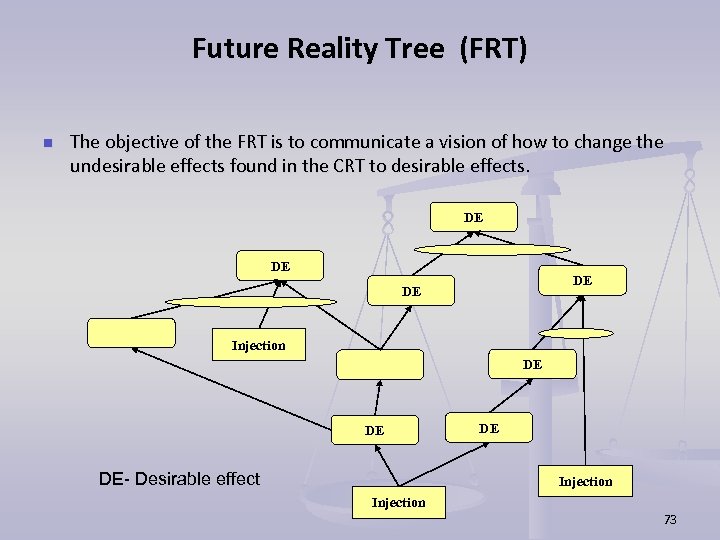 Future Reality Tree (FRT) n The objective of the FRT is to communicate a vision of how to change the undesirable effects found in the CRT to desirable effects. DE DE DE Injection DE DE DE- Desirable effect DE Injection 73
 Future Reality Tree (FRT) Sales increase Market share increase Competitive price Stock value decreased Delivery due date performance improved Cost decrease Higher efficiency of resources Finite Capacity Planning Improved logistics More flexible reaction to requirements Better liquidity ATP, CTP Stock related costs decreased Data OK Reliable system NEW ERP IMPLEMENTATION Business-Production OK Purchase planning 74
 YES, this could be managed BUT…… Negative Branch Reservations (NBR): Ø Ø use of sufficiency logic – by taking into consideration objections of other involved persons these objections were related to possible undesirable impacts of the injection (solution) implementation NBR is often a part of the FRT (Future Reality Tree) Evaporation Cloud Tree, FRT and NBR enable to answer the second question : To What To change ? 75
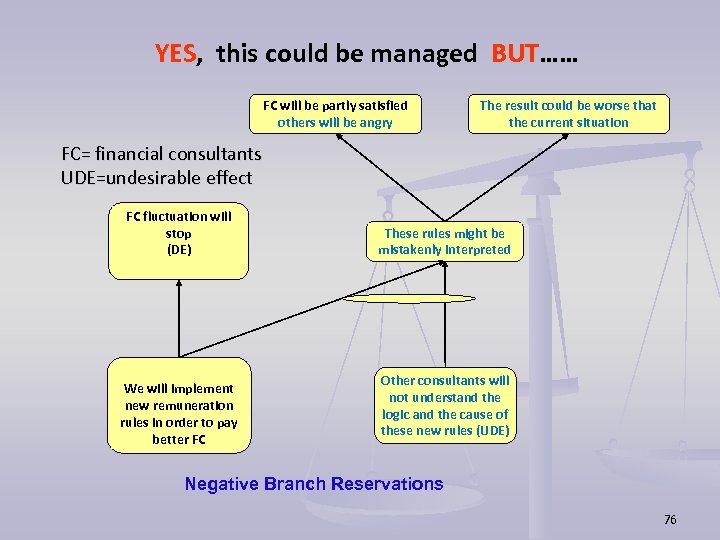 YES, this could be managed BUT…… FC will be partly satisfied others will be angry The result could be worse that the current situation FC= financial consultants UDE=undesirable effect FC fluctuation will stop (DE) We will implement new remuneration rules in order to pay better FC These rules might be mistakenly interpreted Other consultants will not understand the logic and the cause of these new rules (UDE) Negative Branch Reservations 76
 We cannot implement it, because…. . (Prerequisite Tree): use of necessity logic – identification of obstacles Ø use of the human ability to invent any reason WHY IT IS NOT FEASIBLE Ø setup of the necessary intermediate objectives Ø setup of the schedule for change process Ø 77
 We cannot implement it, because…. . (Prerequisite Tree): n n n The pre-requisite tree ought to be considered the most important tree in the Thinking Process suite. It is the tree that allows us to overcome the obstacles that stop us from implementing our plan. It is also the tree that in fact becomes the implementation plan (it is very, very close to project management practice !!!!) And it is the tree to which timelines, responsibilities, and accountabilities can be assigned to. The pre-requisite tree occupies the position of “plan” amongst the Thinking Process tools. 78
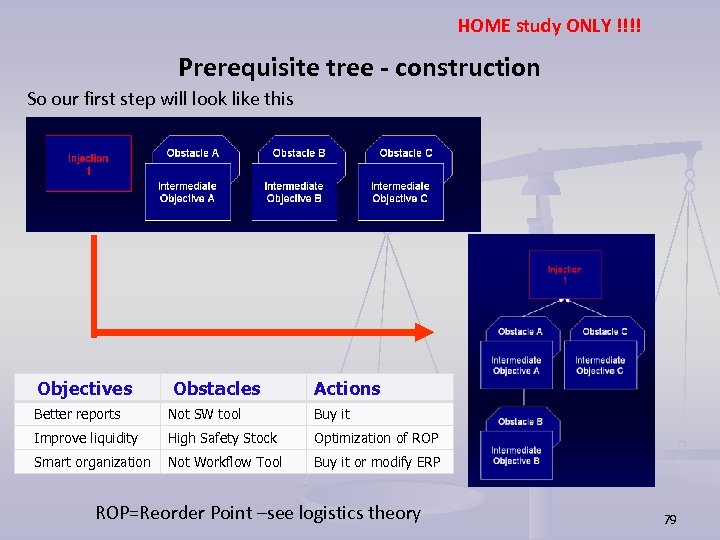 HOME study ONLY !!!! Prerequisite tree - construction So our first step will look like this Objectives Obstacles Actions Better reports Not SW tool Buy it Improve liquidity High Safety Stock Optimization of ROP Smart organization Not Workflow Tool Buy it or modify ERP ROP=Reorder Point –see logistics theory 79
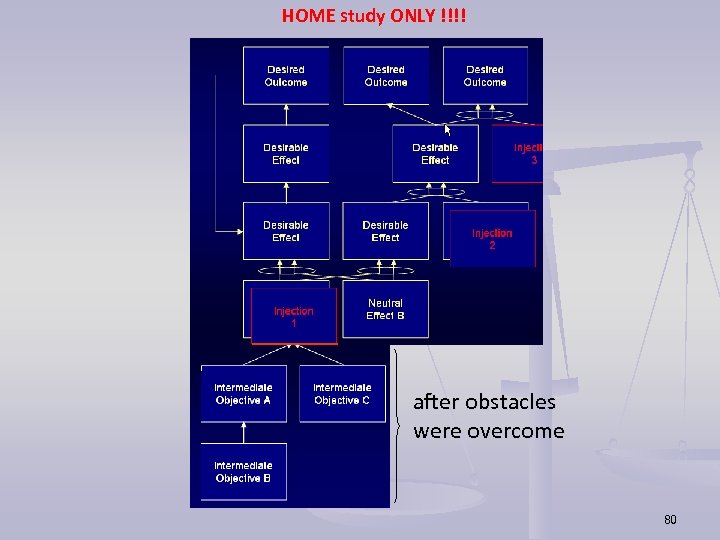 HOME study ONLY !!!! after obstacles were overcome 80
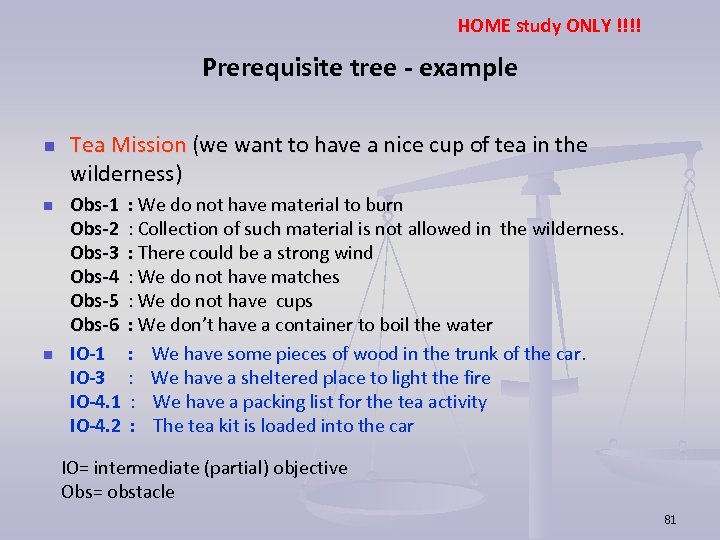 HOME study ONLY !!!! Prerequisite tree - example n n n Tea Mission (we want to have a nice cup of tea in the wilderness) Obs-1 : We do not have material to burn Obs-2 : Collection of such material is not allowed in the wilderness. Obs-3 : There could be a strong wind Obs-4 : We do not have matches Obs-5 : We do not have cups Obs-6 : We don’t have a container to boil the water IO-1 : We have some pieces of wood in the trunk of the car. IO-3 : We have a sheltered place to light the fire IO-4. 1 : We have a packing list for the tea activity IO-4. 2 : The tea kit is loaded into the car IO= intermediate (partial) objective Obs= obstacle 81
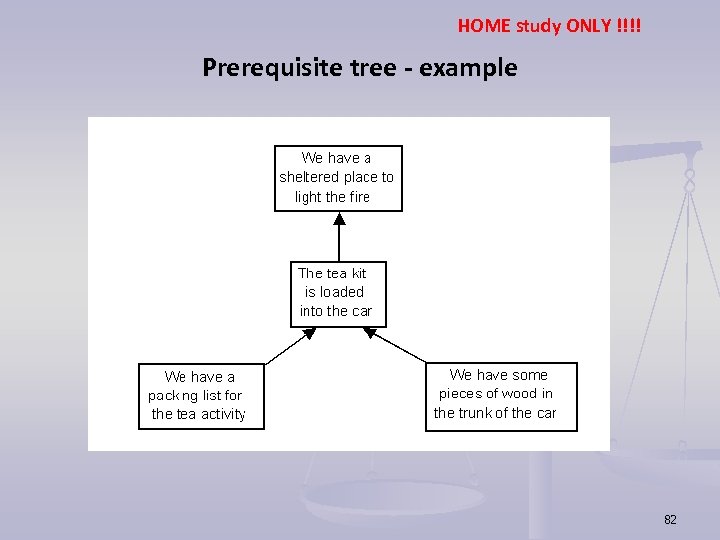 HOME study ONLY !!!! Prerequisite tree - example 82
 HOME study ONLY !!!! We cannot implement it, because…. . Ø Ø (Transition Tree): detailed schedule of change implementation process what actions have to be taken in order to reach intermediate objectives using sufficiency logic (IFTHEN-ELSE) 83
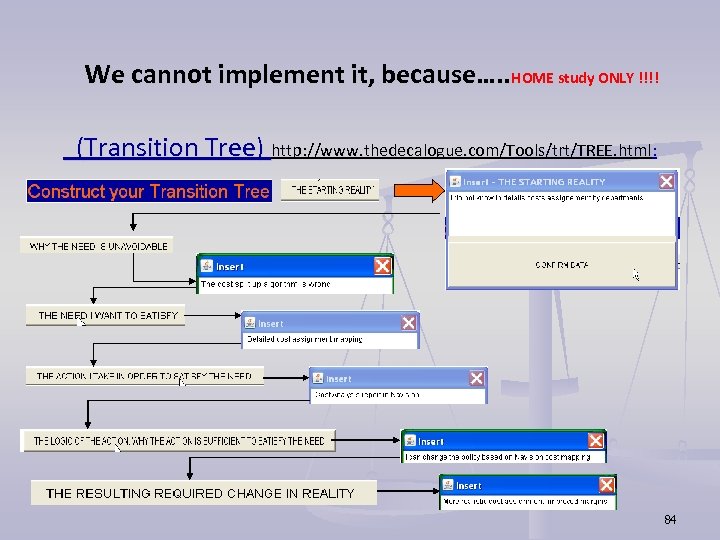 We cannot implement it, because…. . HOME study ONLY !!!! (Transition Tree) http: //www. thedecalogue. com/Tools/trt/TREE. html: 84
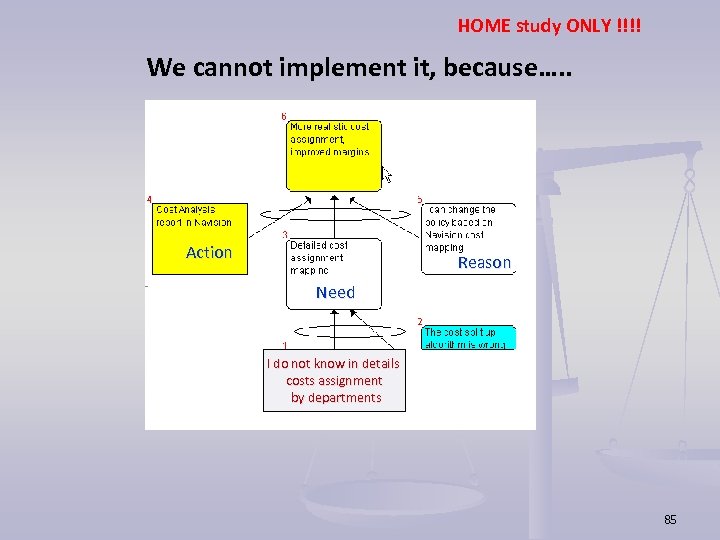 HOME study ONLY !!!! We cannot implement it, because…. . Action Reason Need I do not know in details costs assignment by departments 85
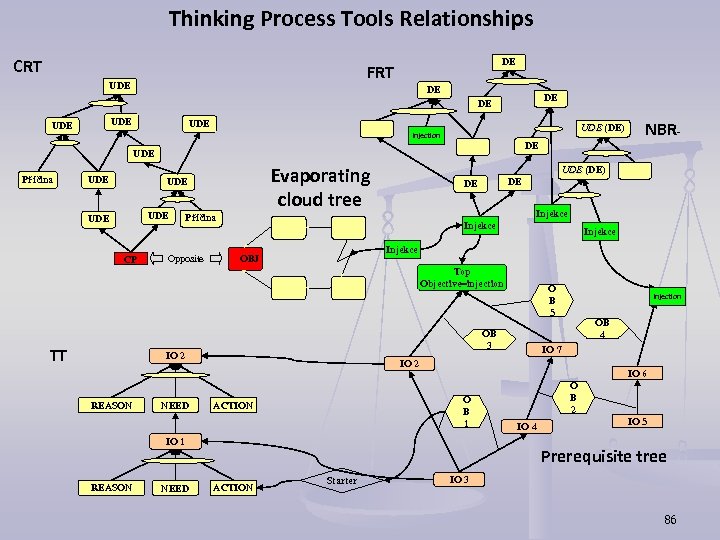 Thinking Process Tools Relationships CRT DE FRT UDE DE UDE UDE (DE) Injection DE UDE Příčina UDE Evaporating cloud tree UDE UDE CP UDE (DE) Injekce Příčina Opposite DE DE Injekce OBJ Top Objective=injection TT NEED Injection OB 4 IO 7 IO 2 IO 6 O B 1 ACTION IO 1 REASON O B 5 OB 3 IO 2 REASON NBR- O B 2 IO 4 IO 5 Prerequisite tree ACTION Starter IO 3 86
 Not for MPH-AOMA Additional metrics of TOC (appendix 1) n n n Inventory dollar days (IDD) A measure of the effectiveness of a supply chain – i. e. , did it do things that it shouldn’t have done and as a result is the supply chain holding inventory of products the customer doesn’t want? IDD accounts for two things: 1. the time from when a unit is placed in stock until it is actually needed by a customer; and, 2. the monetary value of the inventory being held. IDD is calculated by multiplying the monetary value of each inventory unit on hand by the number of days since that inventory entered the responsibility of that link. The system should strive for the minimum IDDs necessary to reliability maintain zero throughput dollar days. NOTE: The resulting unit of measure is "dollar-days". It is neither monetary nor time based. Attempts to compare dollar-days to other monetary measures are invalid. IDDs can be compared only to other IDD levels. 87
 Not for MPH-AOMA Additional metrics of TOC (appendix 2) n n n Throughput dollar days (TDD) A measure of the reliability of a supply chain. TDD considers two things: 1. the monetary value of the things a link is committed to deliver but does not; and, 2. the number of days by which the link misses its commitment to deliver. TDD is the summation of the commitments not delivered on time during the chosen time period. The TDD value of individual missed commitments is calculated by multiplying the dollar value of the end product times the number of days the commitment is/was overdue. The system should strive for zero throughput dollar-days. NOTE: The unit of measure "dollar-days" is neither monetary nor time based. Attempts to compare dollar-days to other monetary measures are invalid. TDD levels can be compared only to other TDD levels. 88
 Literature Goldratt, E. , M. : n The Goal n The Race n The Critical Chain n Necessary But Not Sufficient n The Haystack Syndrome n It is Not Luck 89
 Internet n n n n www. goldratt. cz www. goldratt. com www. toc-goldratt. com www. focusedperformance. com www. tocca. com. au http: //www. dbrmfg. co. nz/ - A guide to implement the Theory of constraints n www. ciras. iastate. ecu/toc/ http: //www. ciras. iastate. edu/library/toc/measurements. asp n ……. . . n 90