


 Скачать презентацию Introduction to the Mole and Molar Mass
39960523aadd2340586718c48b6dd5a7.ppt
- Количество слайдов: 108
 Introduction to the Mole and Molar Mass
 Purpose At the completion of this unit students will • Have a conceptual understanding of the mole as the method of “counting” items and finding the mass of items that can’t be seen. • Be able to calculate the number of items (molecules, atoms, ions, and formula units) if given the number of moles. • Be able to calculate the number of moles if given the number of items. • Be able to calculate the mass of a sample if given the number of moles in a sample. • Be able to calculate the number of moles in a sample if given the mass of a sample. • Be able to prepare a sample containing a given number of moles. • Be able to determine the molar mass of a compound.
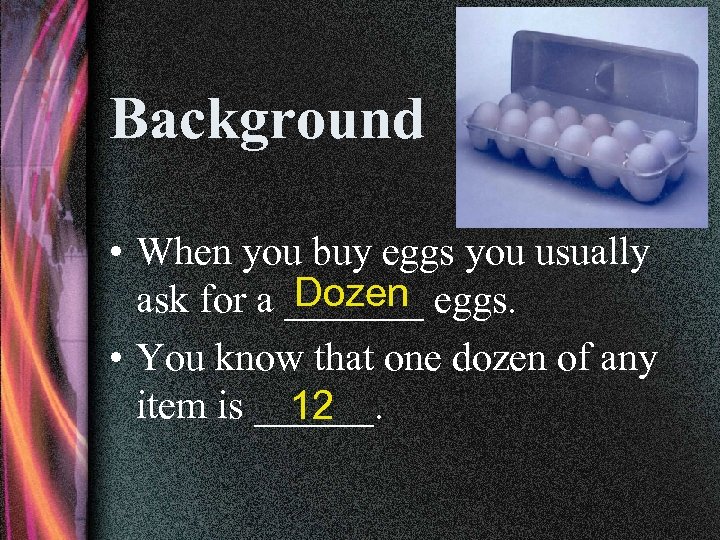 Background • When you buy eggs you usually Dozen ask for a _______ eggs. • You know that one dozen of any item is ______. 12
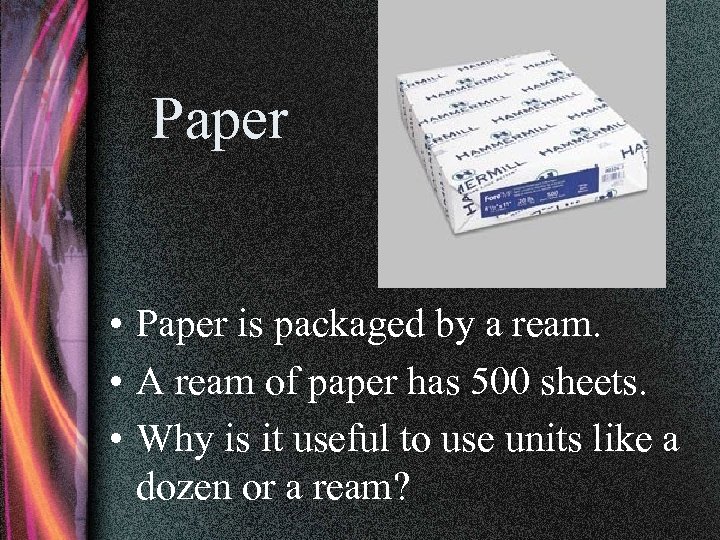 Paper • Paper is packaged by a ream. • A ream of paper has 500 sheets. • Why is it useful to use units like a dozen or a ream?
 • What determines how many items should make up a particular unit?
 • If you were asked to design a new unit to count something, what would you consider when choosing how many items should be included in your new counting unit?
 ANALYSIS AND INTERPRETATION • As you know, a dozen represents 12 items. • What if I decided to make a new counting unit? I called this unit a DART. Each dart is • _____ items. 4 1 Dart = 4 items, just like 1 Dozen = 12 items
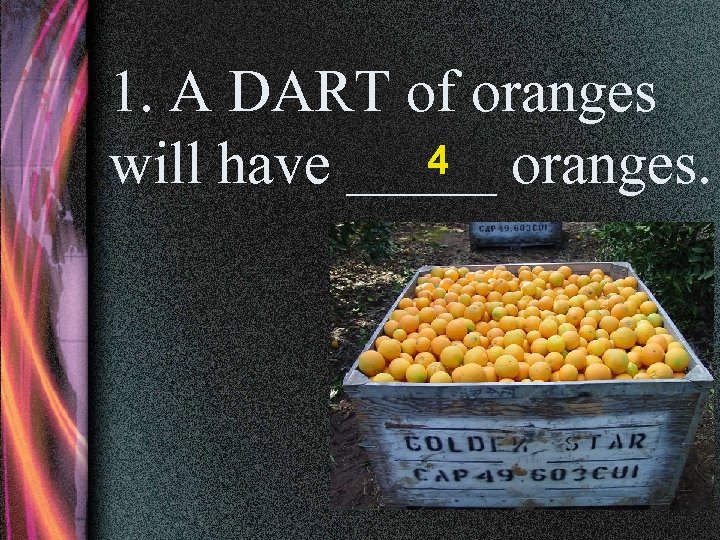 1. A DART of oranges 4 will have _____ oranges.
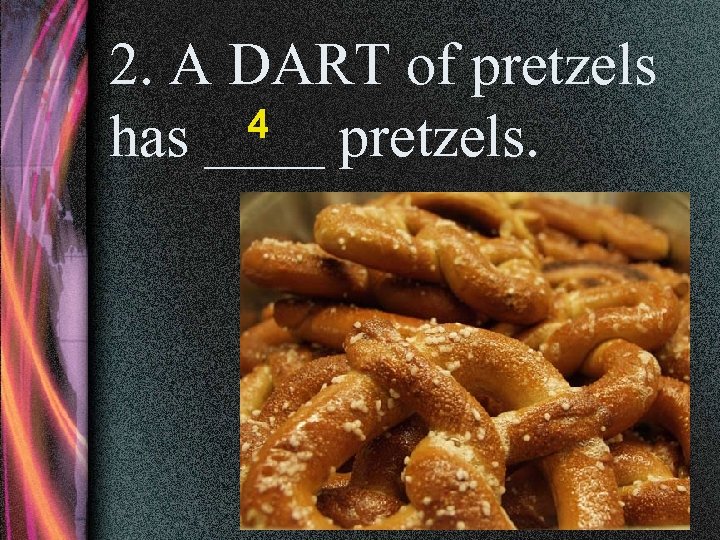 2. A DART of pretzels 4 has ____ pretzels.
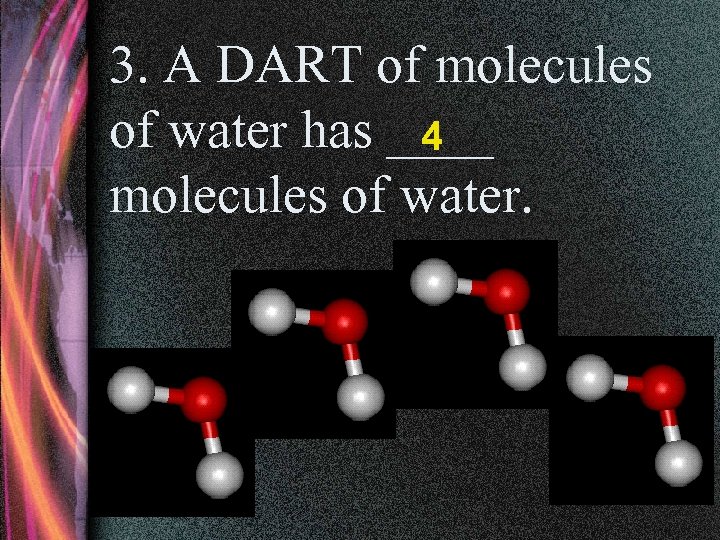 3. A DART of molecules of water has ____ 4 molecules of water.
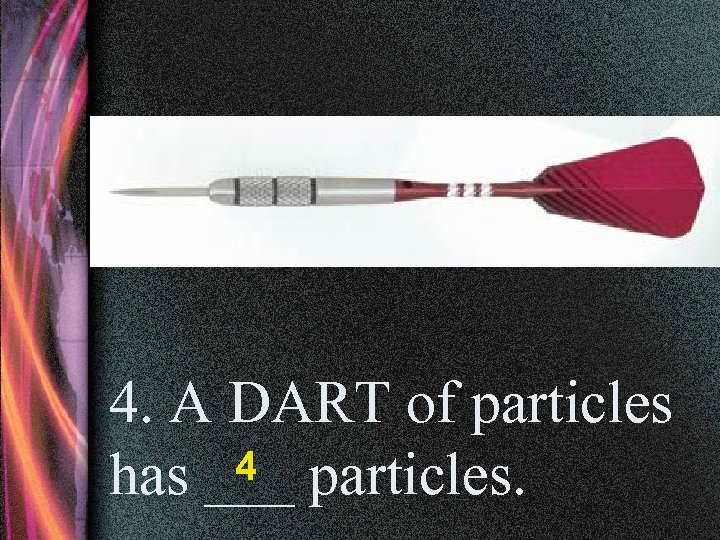 4. A DART of particles 4 has ___ particles.
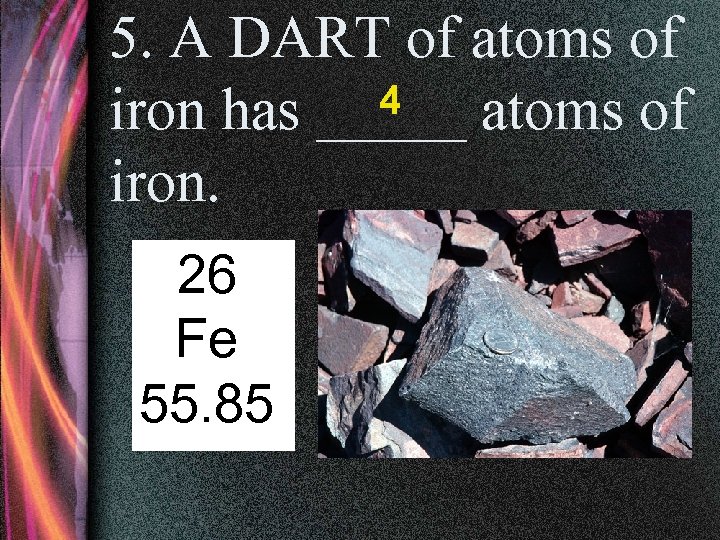 5. A DART of atoms of 4 iron has _____ atoms of iron. 26 Fe 55. 85
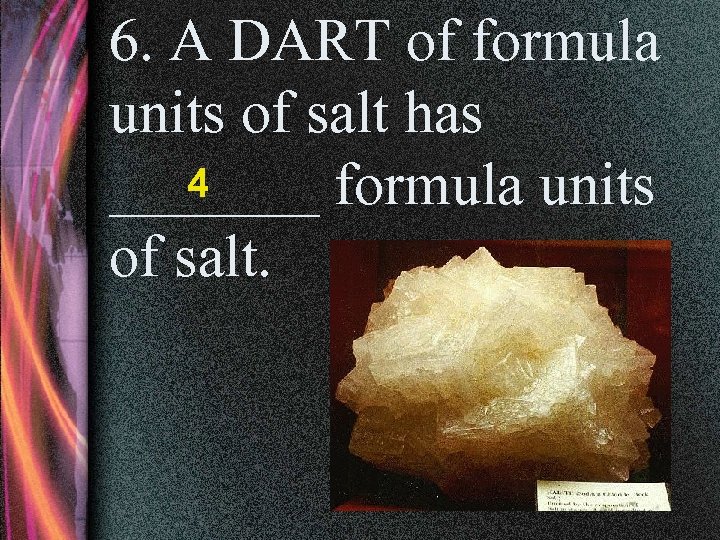 6. A DART of formula units of salt has 4 _______ formula units of salt.
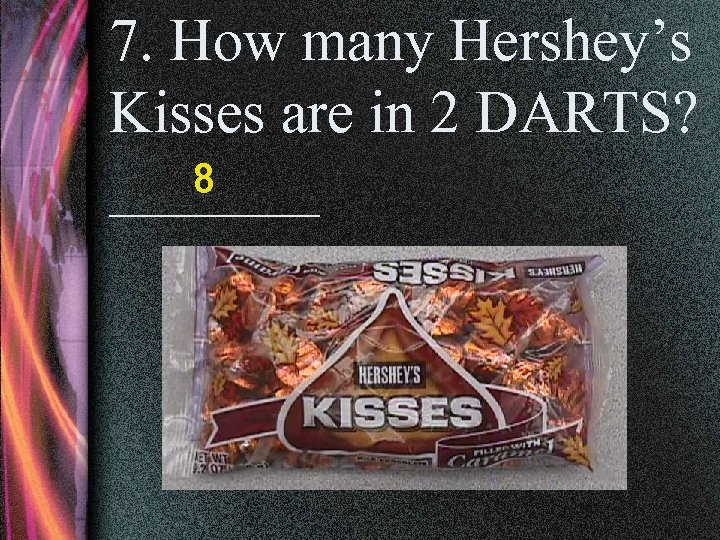 7. How many Hershey’s Kisses are in 2 DARTS? 8 _______
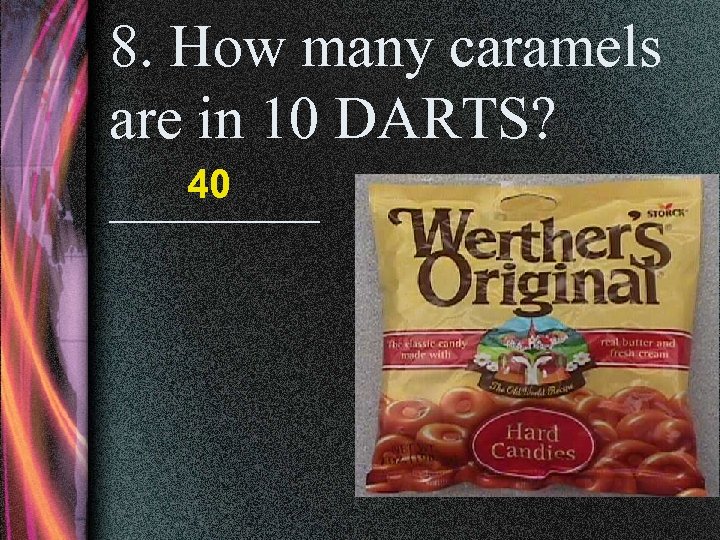 8. How many caramels are in 10 DARTS? 40 _______
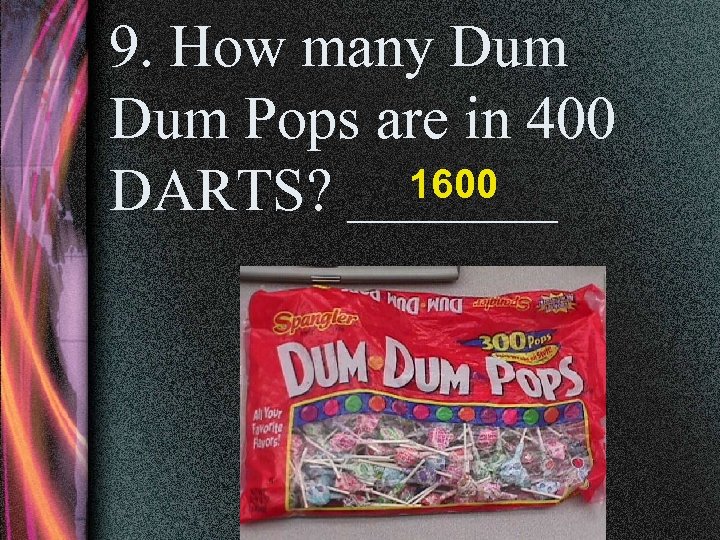 9. How many Dum Pops are in 400 1600 DARTS? _______
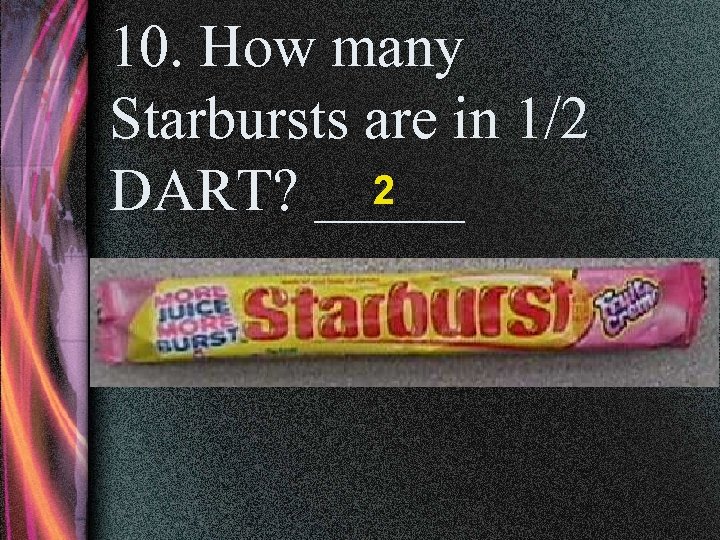 10. How many Starbursts are in 1/2 2 DART? _____
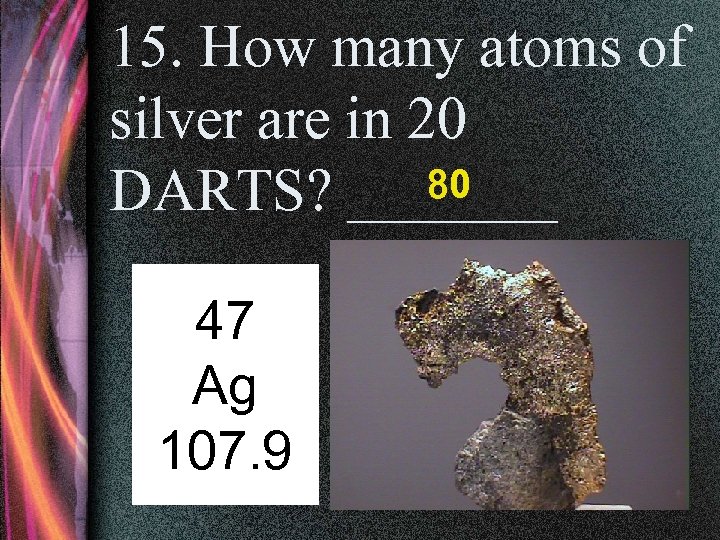 15. How many atoms of silver are in 20 80 DARTS? _______ 47 Ag 107. 9
 Write the directions for finding the number of items if given the number of DARTS
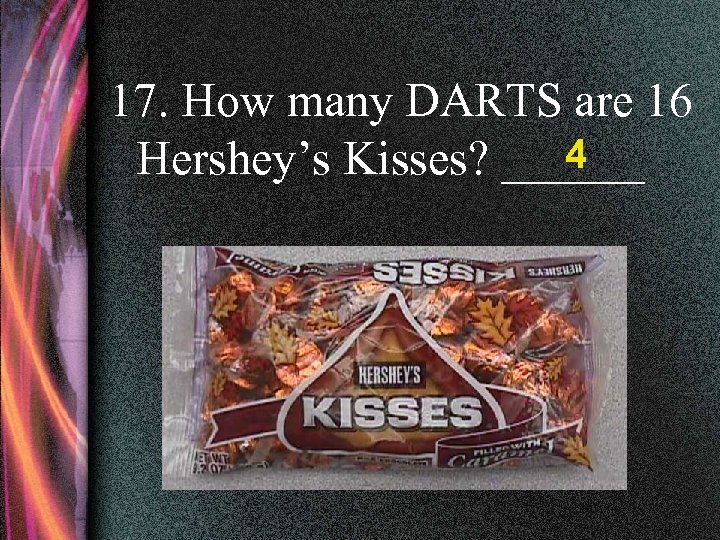 17. How many DARTS are 16 4 Hershey’s Kisses? ______
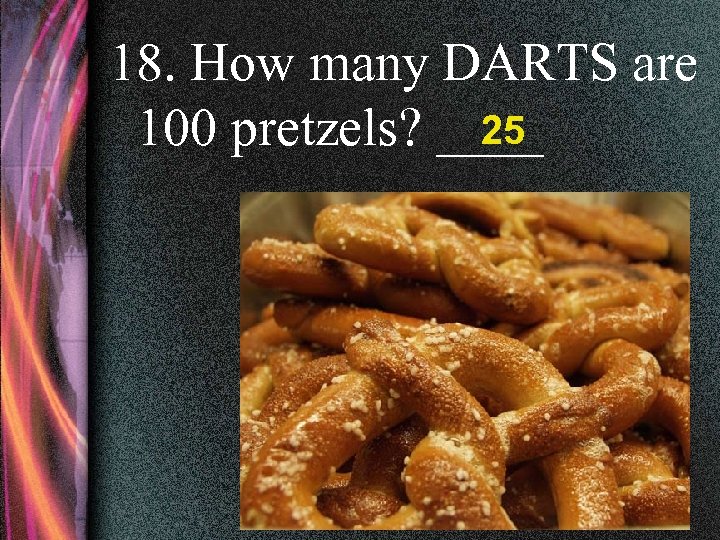 18. How many DARTS are 25 100 pretzels? ____
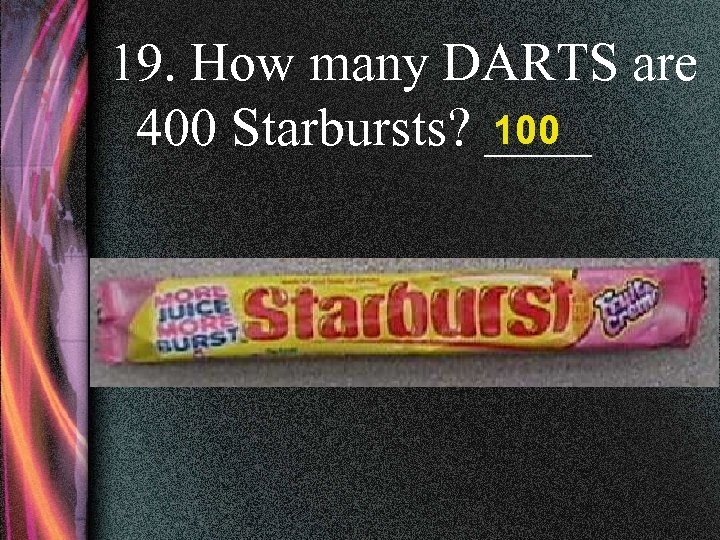 19. How many DARTS are 100 400 Starbursts? ____
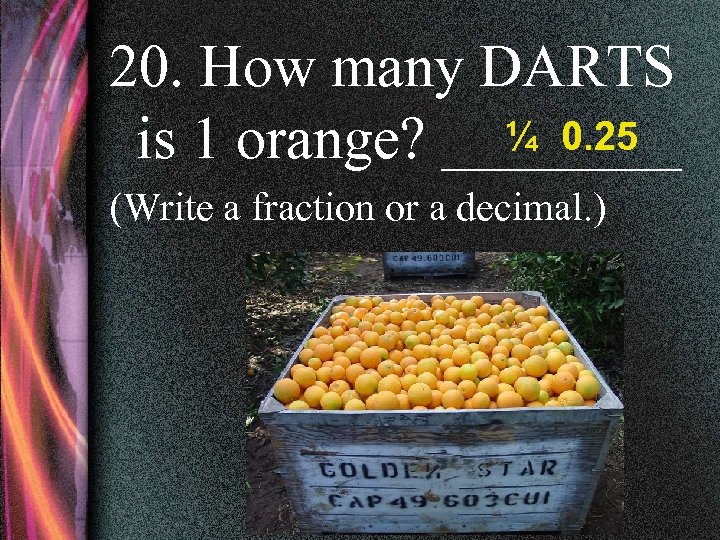 20. How many DARTS ¼ 0. 25 is 1 orange? ____ (Write a fraction or a decimal. )
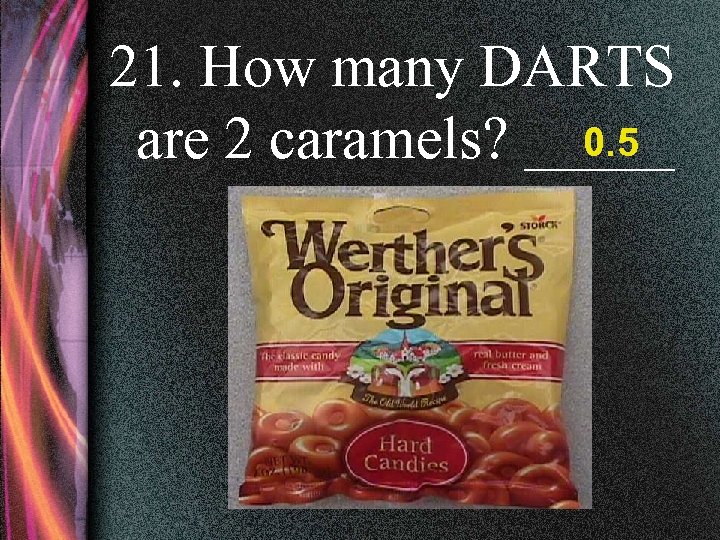 21. How many DARTS 0. 5 are 2 caramels? _____
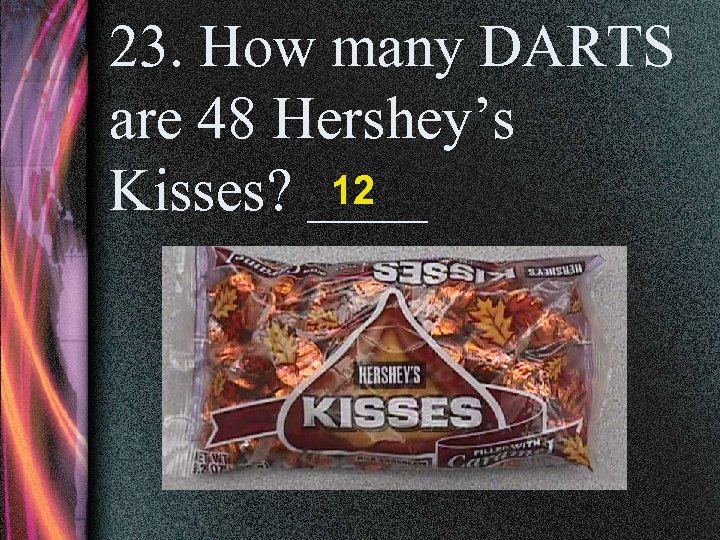 23. How many DARTS are 48 Hershey’s 12 Kisses? ____
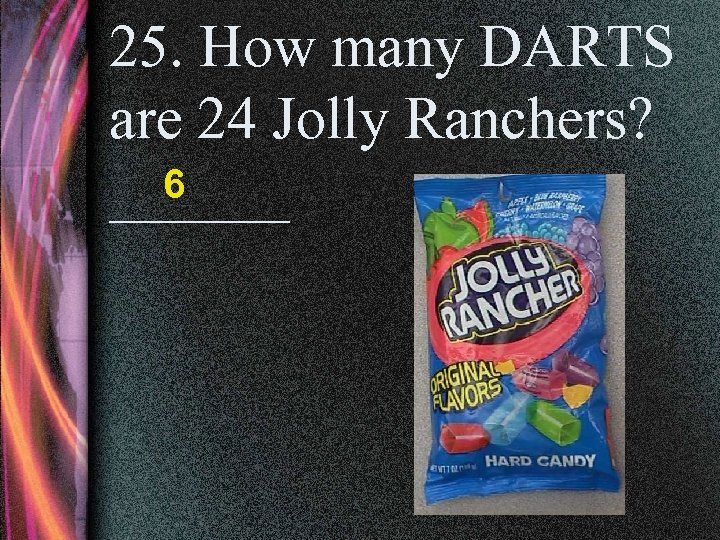 25. How many DARTS are 24 Jolly Ranchers? 6 ______
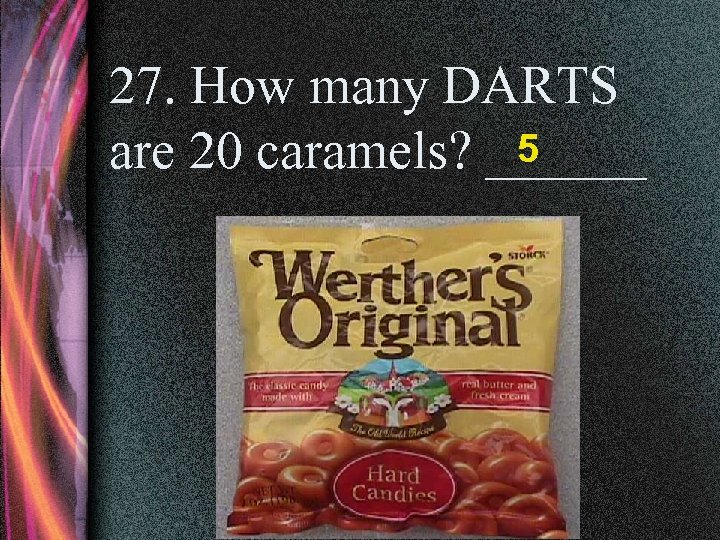 27. How many DARTS 5 are 20 caramels? ______
 Write your own directions for finding the number of DARTS given the number of pieces
 DARTS • DART of molecules of water would be too small to see. • Scientists had to select a bigger unit for counting molecules of substances. • The unit scientists use is called a MOLE.
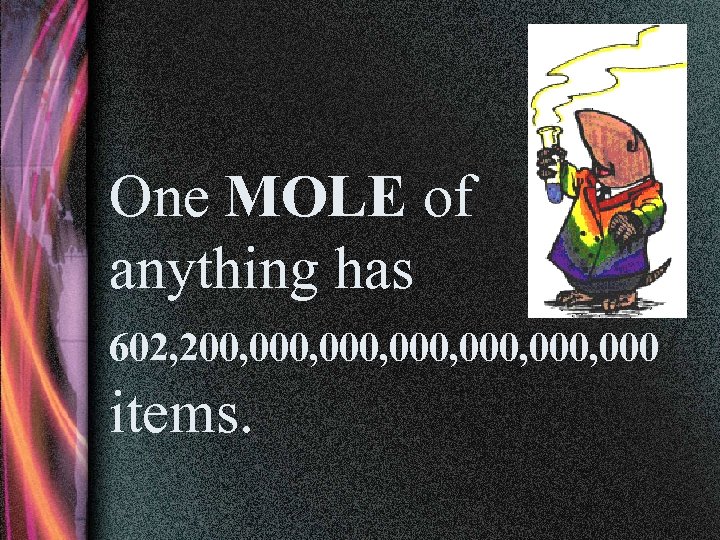 One MOLE of anything has 602, 200, 000, 000 items.
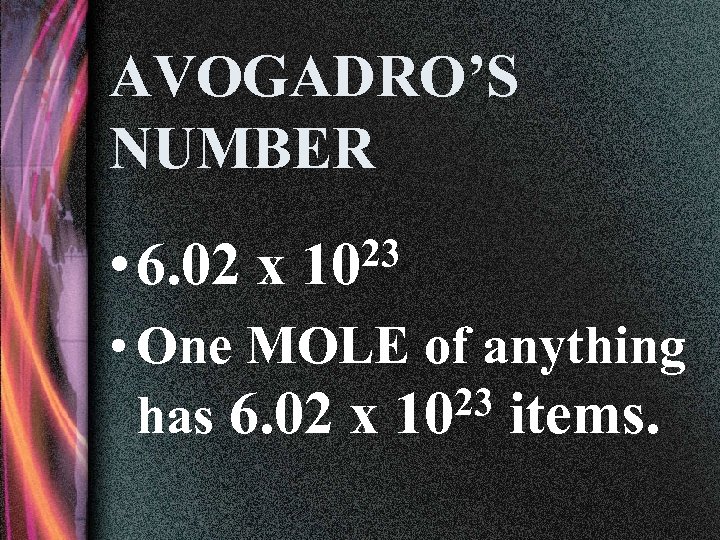 AVOGADRO’S NUMBER • 6. 02 x 23 10 • One MOLE of anything 23 items. has 6. 02 x 10
 A. What is the Mole? • A counting number (like a dozen) • Avogadro’s number (NA) • 1 mol = 6. 02 1023 items A large amount!!!!
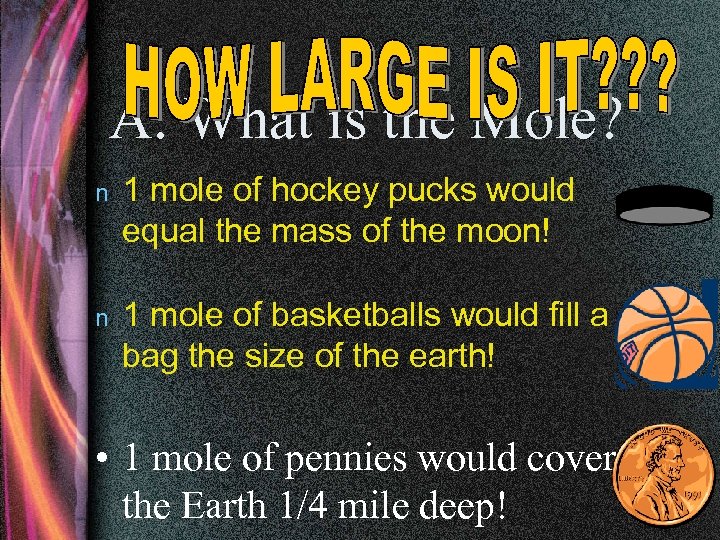 A. What is the Mole? n 1 mole of hockey pucks would equal the mass of the moon! n 1 mole of basketballs would fill a bag the size of the earth! • 1 mole of pennies would cover the Earth 1/4 mile deep!
 28. How many Hershey’s Kisses make up 1 MOLE? 6. 02 x 1023
 A mole of Caramels is 6. 02 x 10 _____ 23 caramels.
 A mole of Jolly 6. 02 x 10 Ranchers is ______ 23 Jolly Ranchers
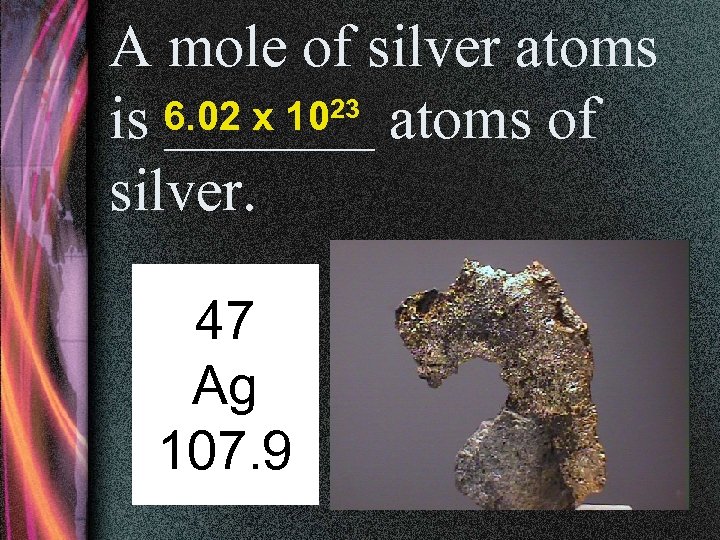 A mole of silver atoms 6. 02 x 1023 atoms of is _______ silver. 47 Ag 107. 9
![29. How many caramels make up 10 MOLES? 10 [6. 02 x 1023] 60.](https://present5.com/presentation/39960523aadd2340586718c48b6dd5a7/image-38.jpg "29. How many caramels make up 10 MOLES? 10 [6. 02 x 1023] 60.") 29. How many caramels make up 10 MOLES? 10 [6. 02 x 1023] 60. 2 x Which 6. 02 x 23 10 is 24 10
29. How many caramels make up 10 MOLES? 10 [6. 02 x 1023] 60. 2 x Which 6. 02 x 23 10 is 24 10
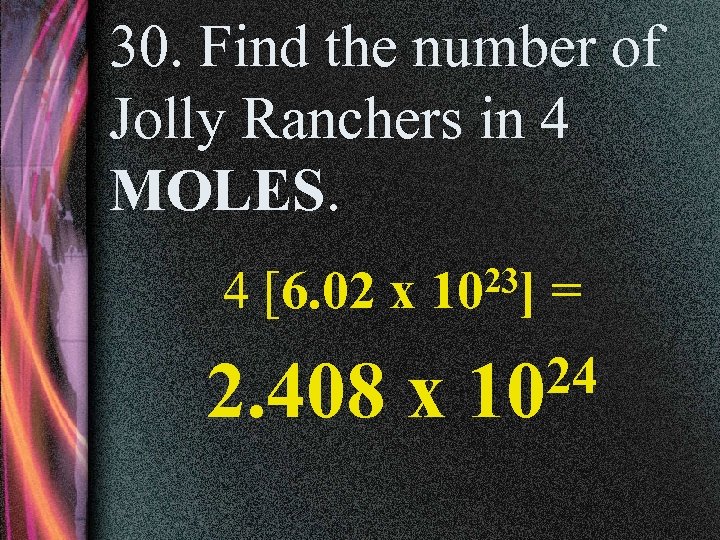 30. Find the number of Jolly Ranchers in 4 MOLES. 4 [6. 02 x 23] 10 2. 408 x = 24 10
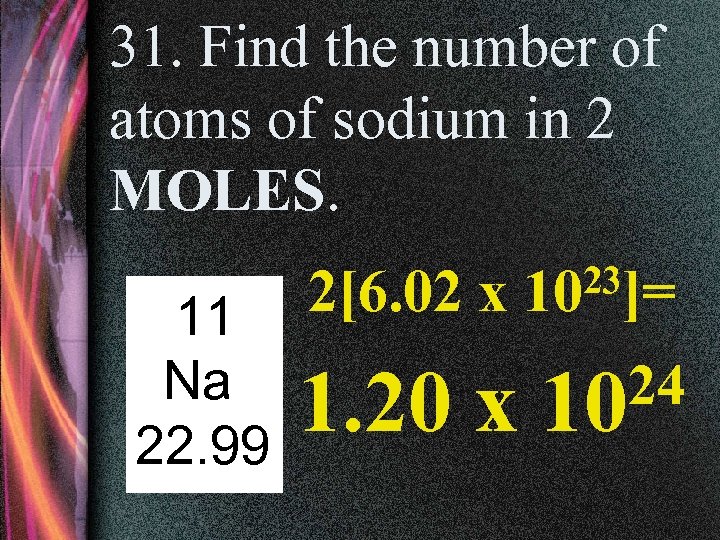 31. Find the number of atoms of sodium in 2 MOLES. 11 Na 22. 99 2[6. 02 x 23]= 10 1. 20 x 24 10
![32. Find the number of molecules of water in 6 MOLES. 23]= 6[6. 02](https://present5.com/presentation/39960523aadd2340586718c48b6dd5a7/image-41.jpg "32. Find the number of molecules of water in 6 MOLES. 23]= 6[6. 02") 32. Find the number of molecules of water in 6 MOLES. 23]= 6[6. 02 x 10 3. 61 x 24 10
32. Find the number of molecules of water in 6 MOLES. 23]= 6[6. 02 x 10 3. 61 x 24 10
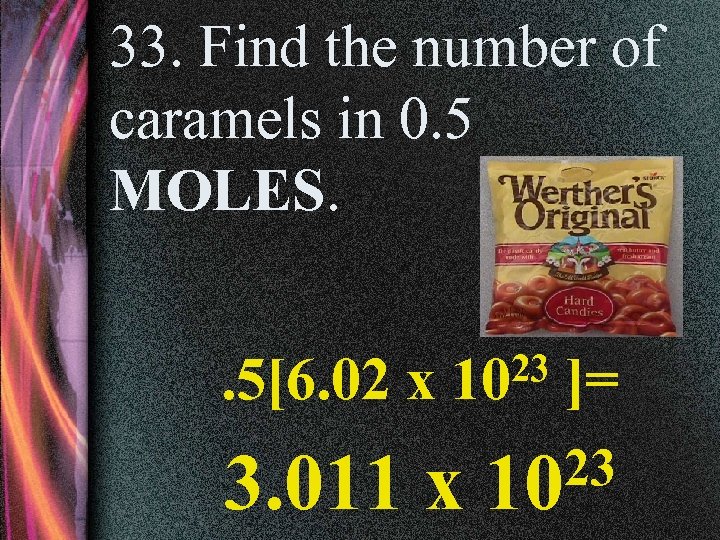 33. Find the number of caramels in 0. 5 MOLES. . 5[6. 02 x 23 10 3. 011 x ]= 23 10
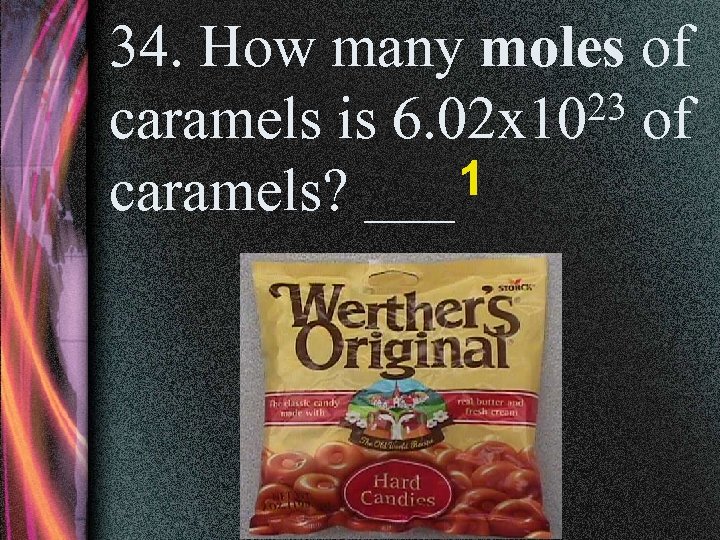 34. How many moles of 23 of caramels is 6. 02 x 10 1 caramels? ___
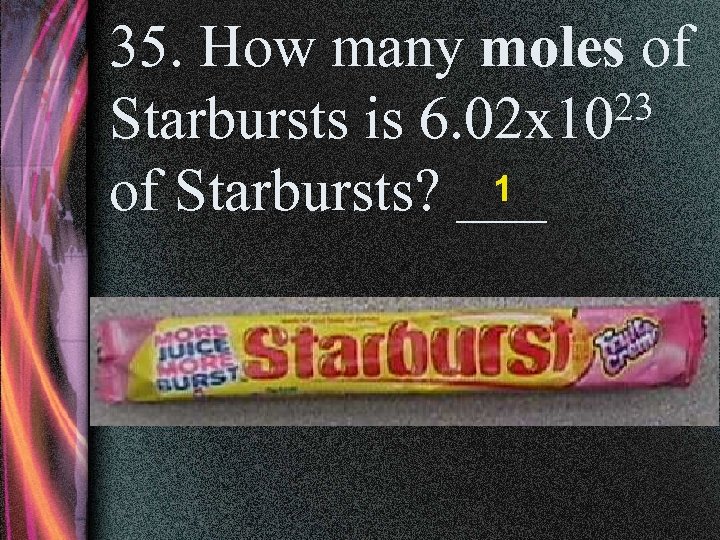 35. How many moles of 23 Starbursts is 6. 02 x 10 1 of Starbursts? ___
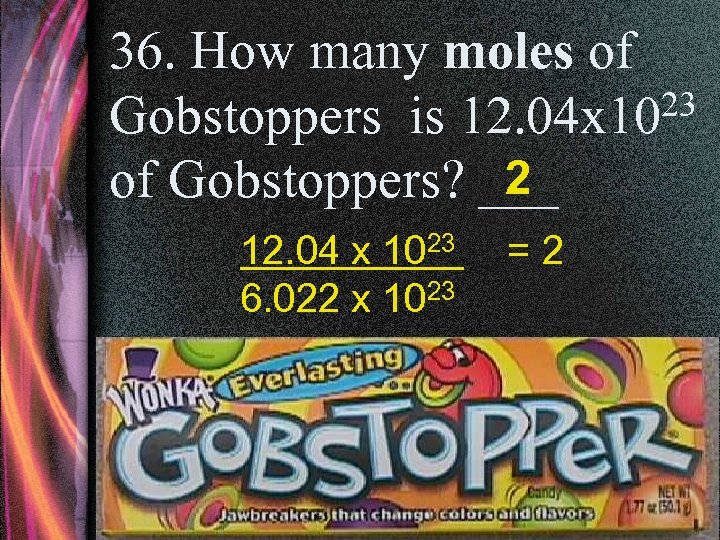 36. How many moles of 23 Gobstoppers is 12. 04 x 10 2 of Gobstoppers? ___ 12. 04 x 1023 6. 022 x 1023 =2
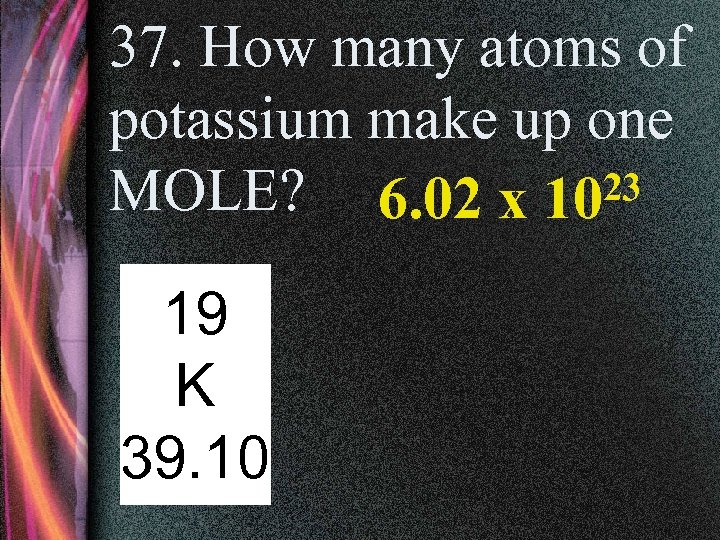 37. How many atoms of potassium make up one MOLE? 6. 02 x 1023 19 K 39. 10
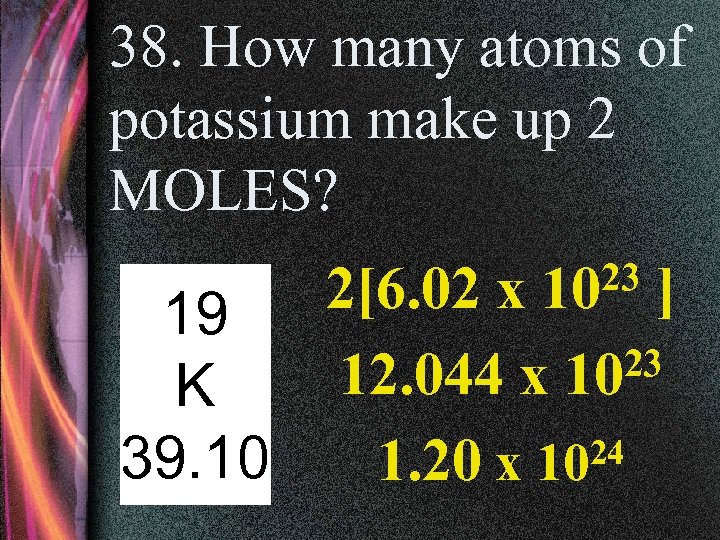 38. How many atoms of potassium make up 2 MOLES? 23 10 2[6. 02 x ] 19 23 12. 044 x 10 K 24 39. 10 1. 20 x 10
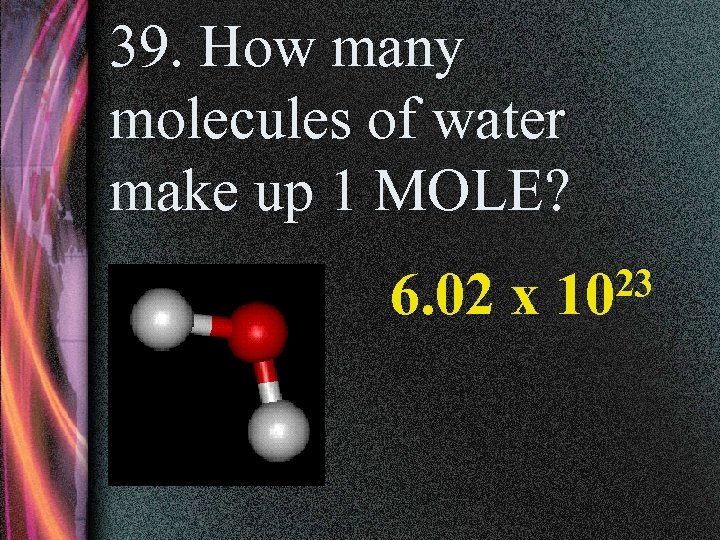 39. How many molecules of water make up 1 MOLE? 6. 02 x 23 10
![40. How many molecules of water make up 5 MOLES? 23 ]= 5[6. 02](https://present5.com/presentation/39960523aadd2340586718c48b6dd5a7/image-49.jpg "40. How many molecules of water make up 5 MOLES? 23 ]= 5[6. 02") 40. How many molecules of water make up 5 MOLES? 23 ]= 5[6. 02 x 10 24 3. 01 x 10
40. How many molecules of water make up 5 MOLES? 23 ]= 5[6. 02 x 10 24 3. 01 x 10
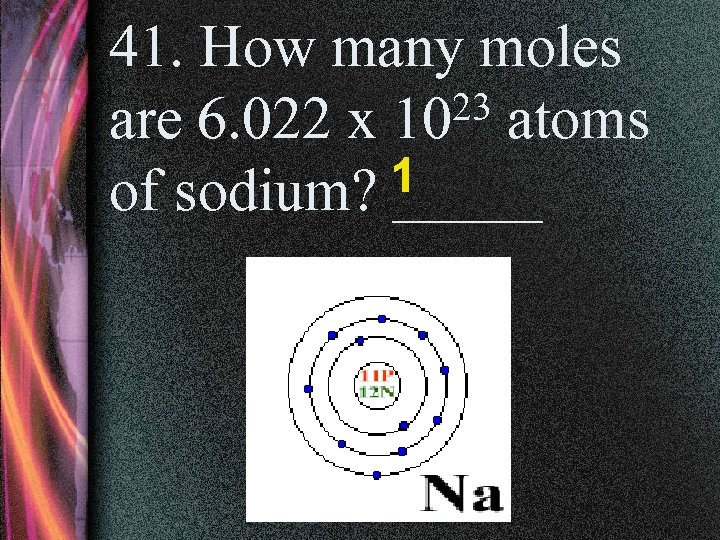 41. How many moles 23 atoms are 6. 022 x 10 1 of sodium? _____
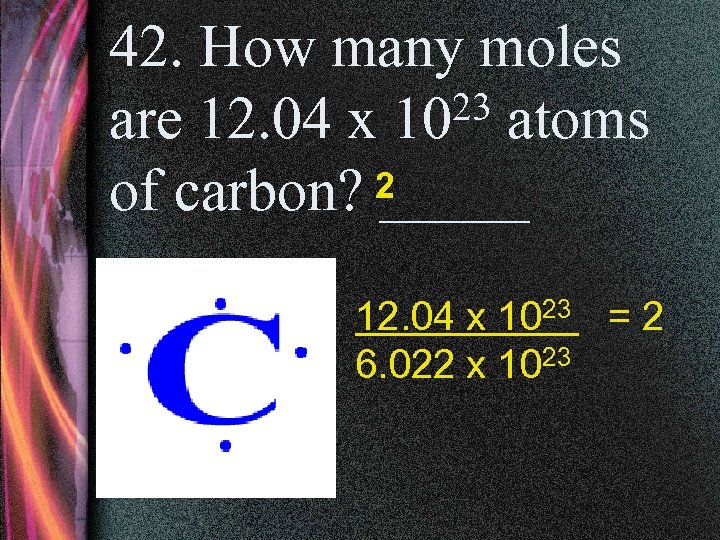 42. How many moles 23 atoms are 12. 04 x 10 of carbon? 2 _____ 12. 04 x 1023 = 2 6. 022 x 1023
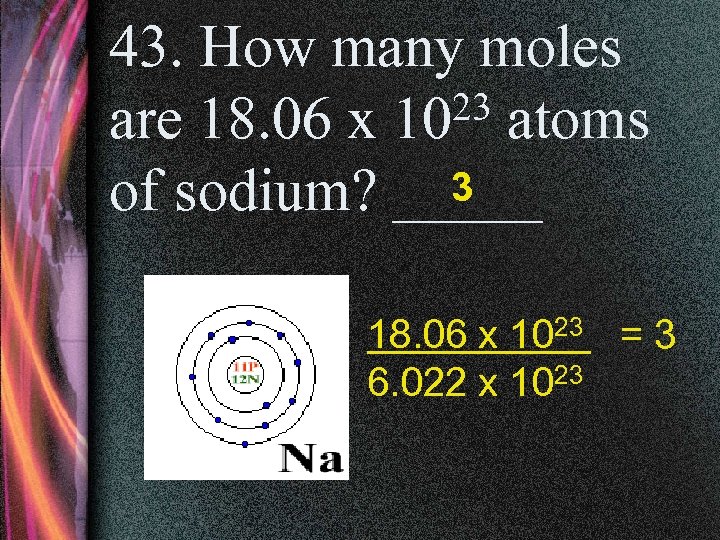 43. How many moles 23 atoms are 18. 06 x 10 3 of sodium? _____ 18. 06 x 1023 = 3 6. 022 x 1023
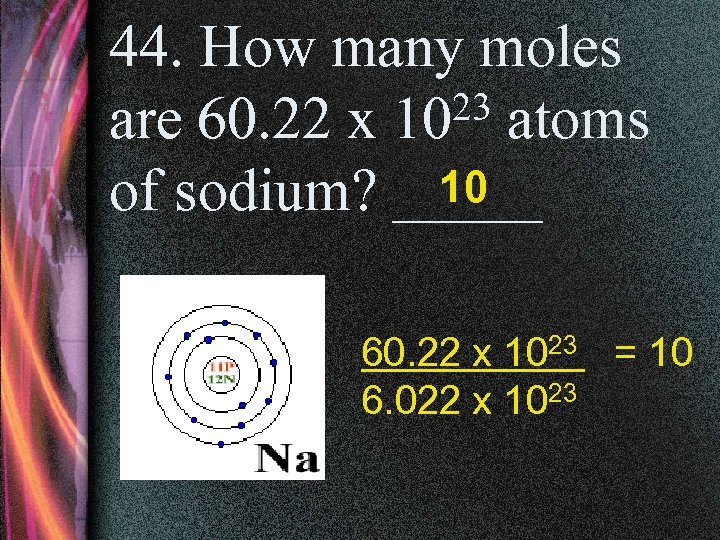 44. How many moles 23 atoms are 60. 22 x 10 10 of sodium? _____ 60. 22 x 1023 = 10 6. 022 x 1023
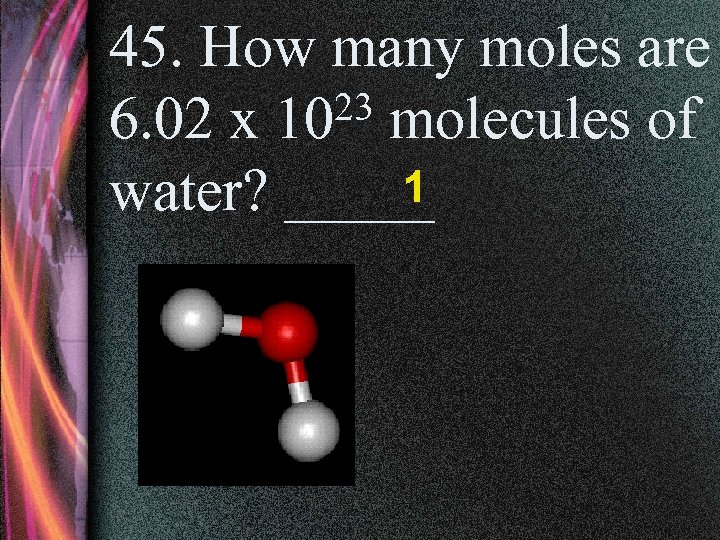 45. How many moles are 23 molecules of 6. 02 x 10 1 water? _____
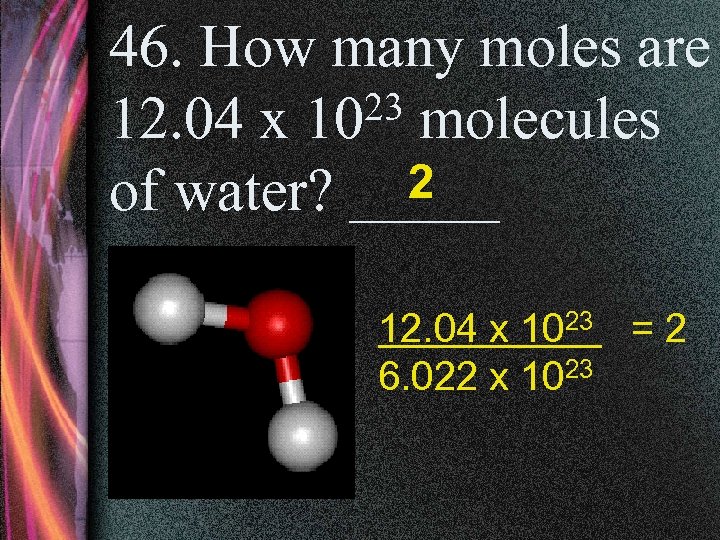 46. How many moles are 23 molecules 12. 04 x 10 2 of water? _____ 12. 04 x 1023 = 2 6. 022 x 1023
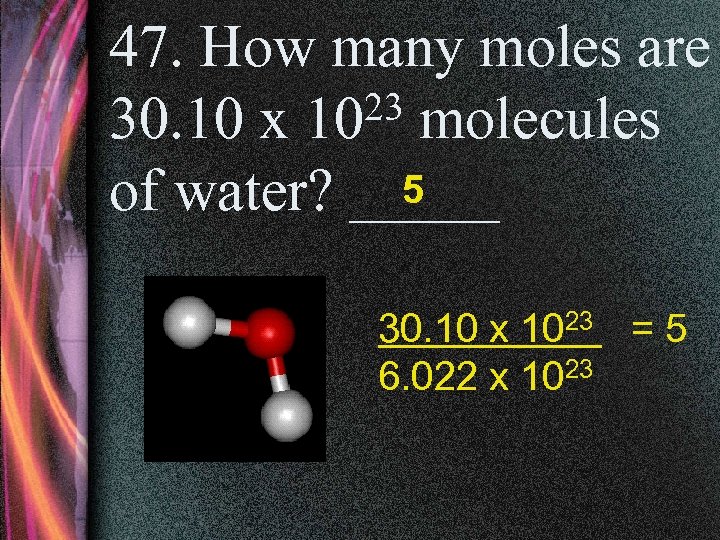 47. How many moles are 23 molecules 30. 10 x 10 5 of water? _____ 30. 10 x 1023 = 5 6. 022 x 1023
 Part 2
 Molar Mass • Scientists use the Periodic Table to determine the mass of a mole of atom of an element. • For example, a mole of carbon (C) atoms would have a mass of 12. 01 g.
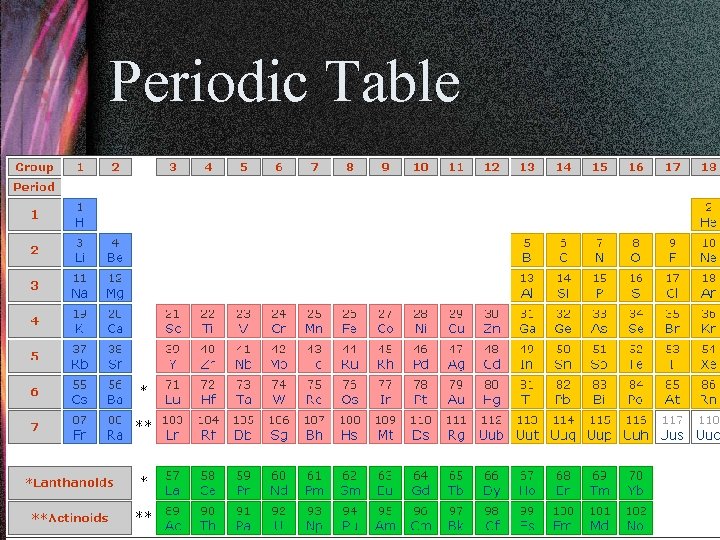 Periodic Table
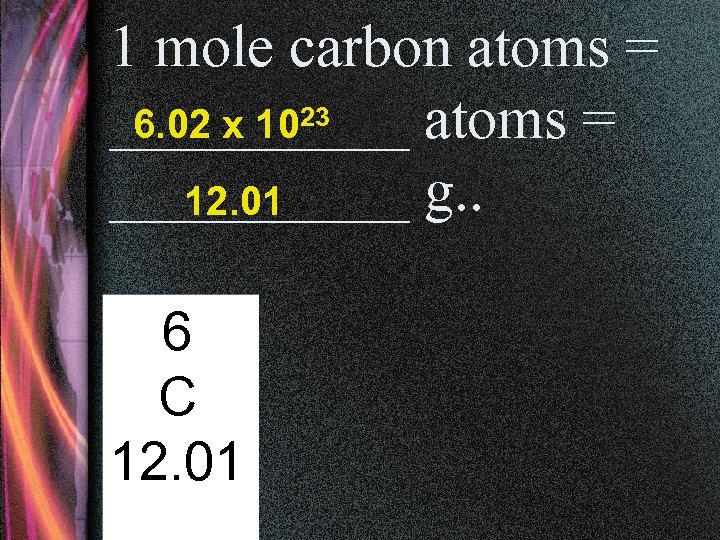 1 mole carbon atoms = _____ atoms = 6. 02 x 1023 _____ g. . 12. 01 6 C 12. 01
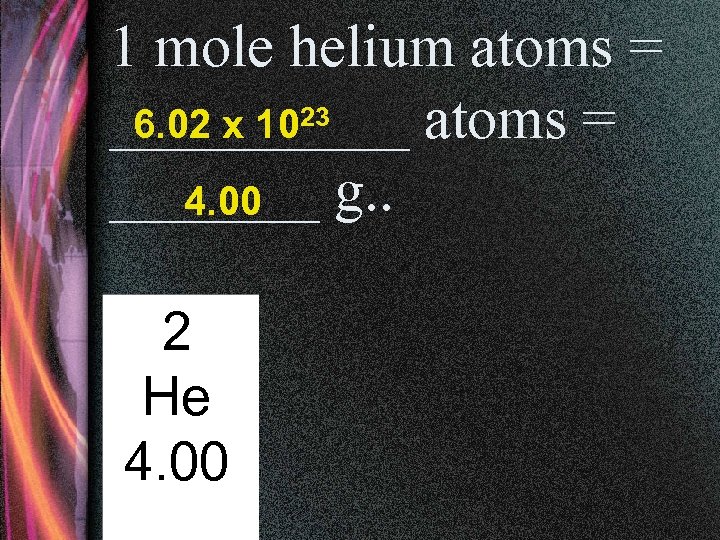 1 mole helium atoms = _____ atoms = 6. 02 x 1023 _______ g. . 4. 00 2 He 4. 00
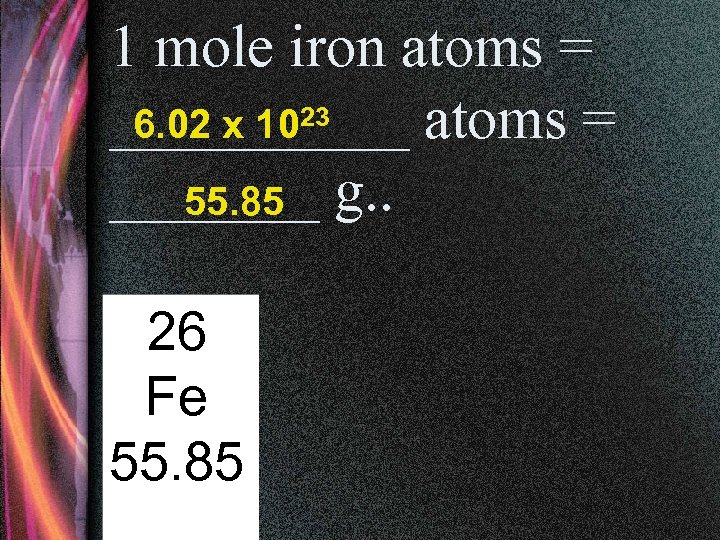 1 mole iron atoms = _____ atoms = 6. 02 x 1023 _______ g. . 55. 85 26 Fe 55. 85
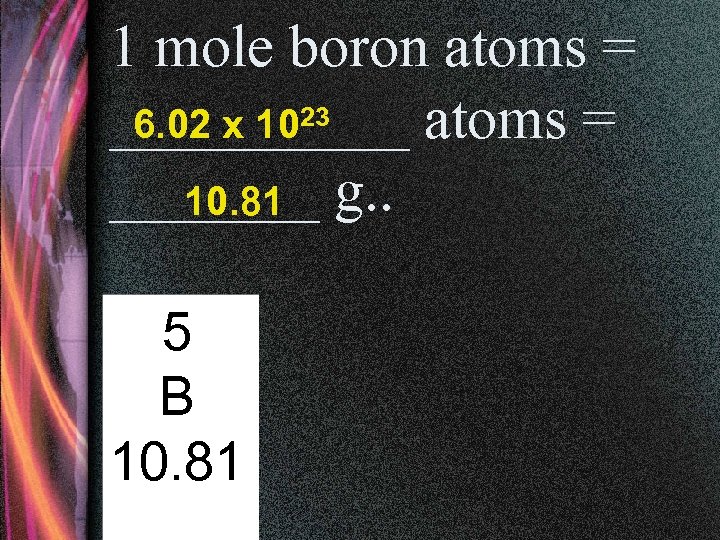 1 mole boron atoms = _____ atoms = 6. 02 x 1023 _______ g. . 10. 81 5 B 10. 81
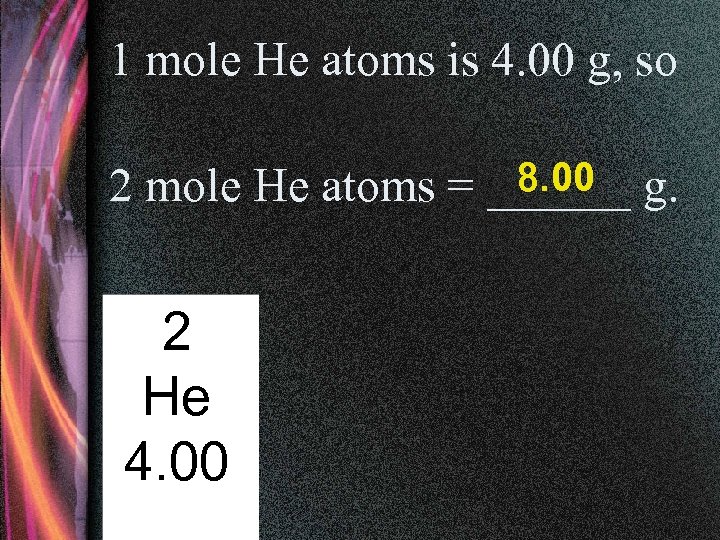 1 mole He atoms is 4. 00 g, so 8. 00 2 mole He atoms = ______ g. 2 He 4. 00
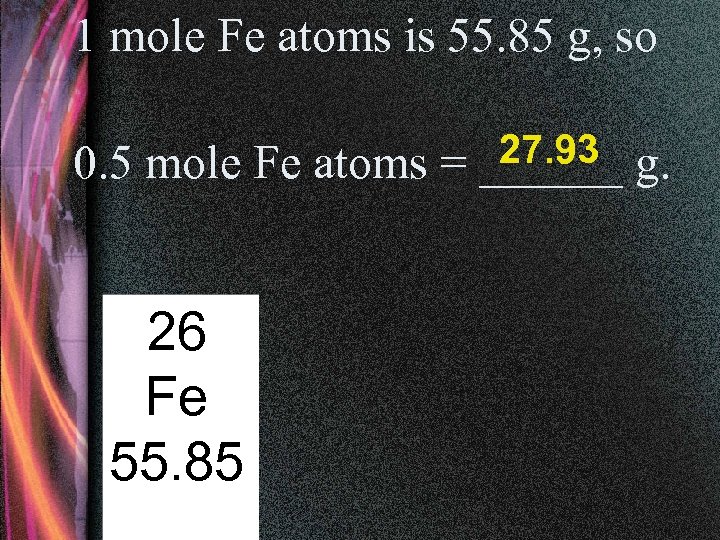 1 mole Fe atoms is 55. 85 g, so 0. 5 mole Fe atoms = 26 Fe 55. 85 27. 93 ______ g.
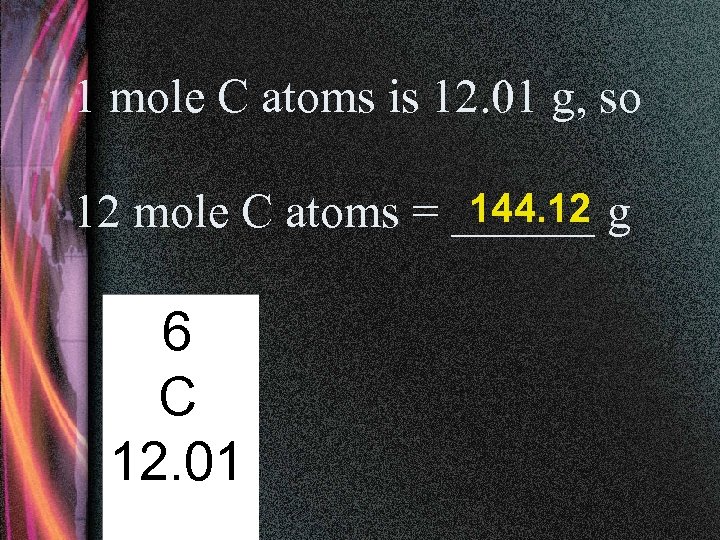 1 mole C atoms is 12. 01 g, so 144. 12 12 mole C atoms = ______ g 6 C 12. 01
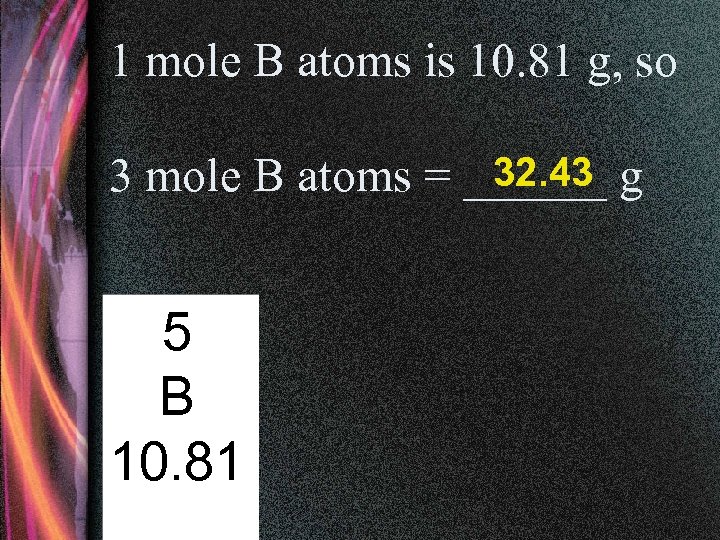 1 mole B atoms is 10. 81 g, so 32. 43 3 mole B atoms = ______ g 5 B 10. 81
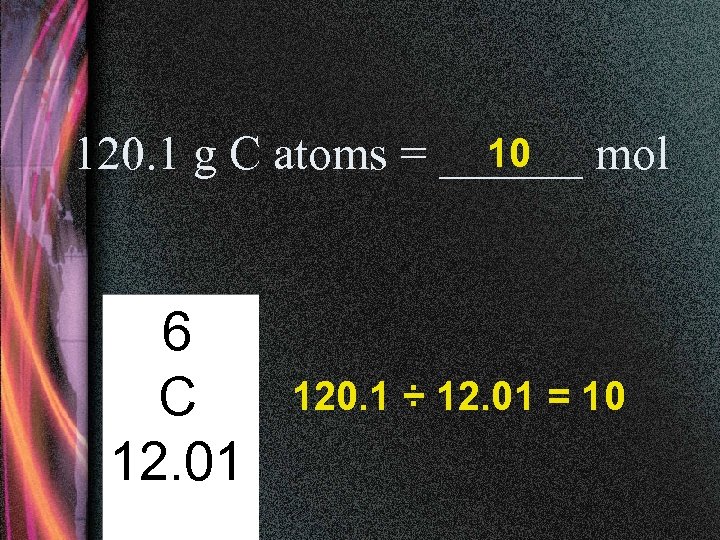 10 120. 1 g C atoms = ______ mol 6 C 12. 01 120. 1 ÷ 12. 01 = 10
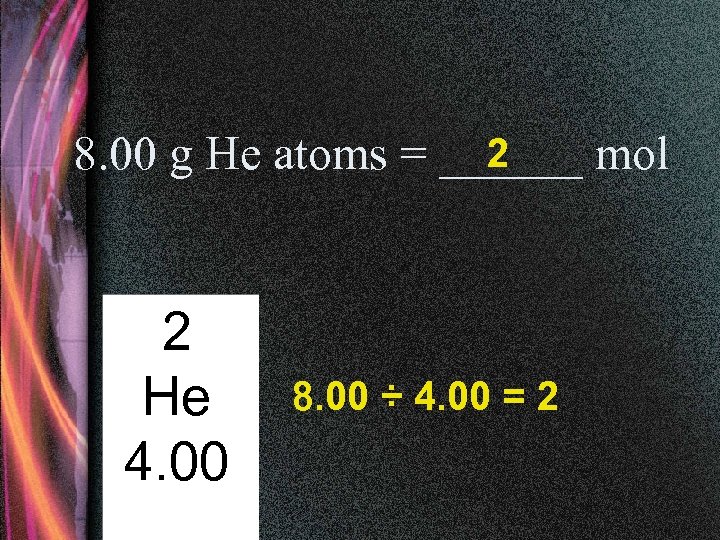 2 8. 00 g He atoms = ______ mol 2 He 4. 00 8. 00 ÷ 4. 00 = 2
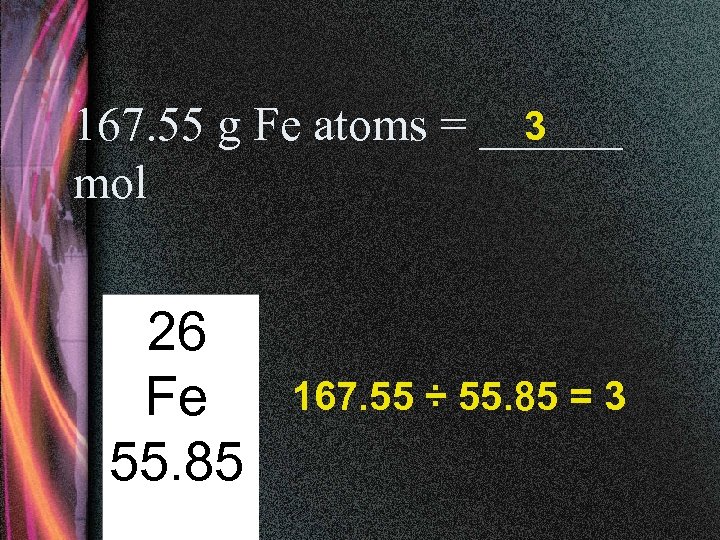 3 167. 55 g Fe atoms = ______ mol 26 Fe 55. 85 167. 55 ÷ 55. 85 = 3
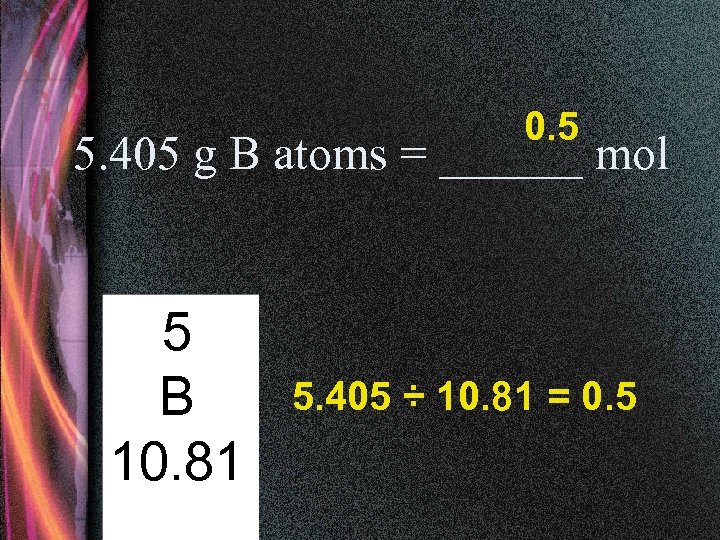 0. 5 5. 405 g B atoms = ______ mol 5 B 10. 81 5. 405 ÷ 10. 81 = 0. 5

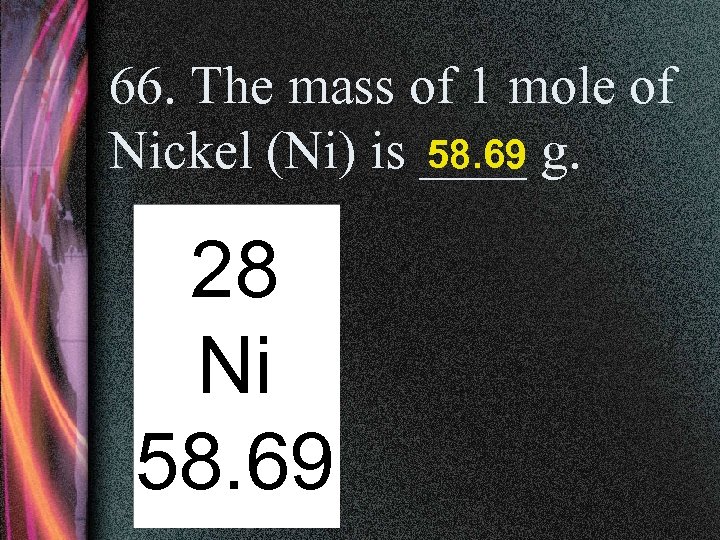 66. The mass of 1 mole of Nickel (Ni) is ____ g. 58. 69 28 Ni 58. 69
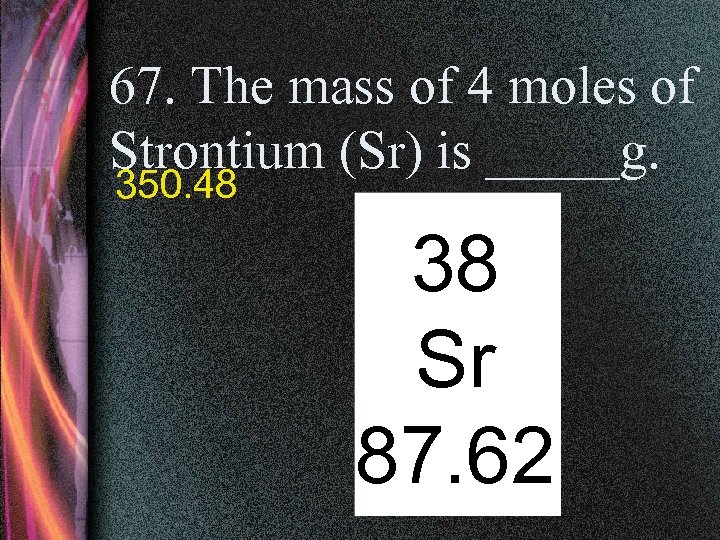 67. The mass of 4 moles of Strontium (Sr) is _____g. 350. 48 38 Sr 87. 62
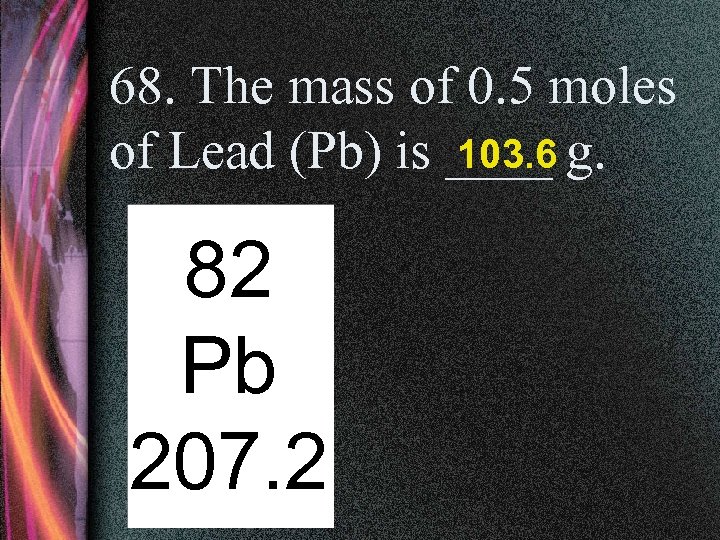 68. The mass of 0. 5 moles of Lead (Pb) is ____ g. 103. 6 82 Pb 207. 2
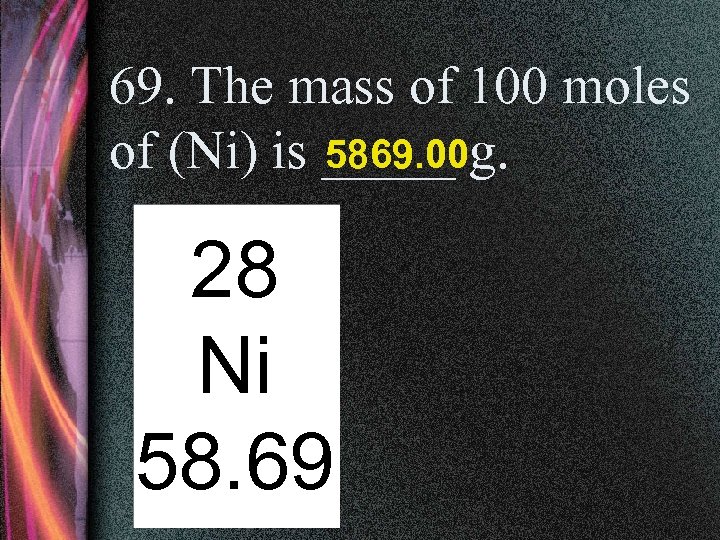 69. The mass of 100 moles of (Ni) is _____ g. 5869. 00 28 Ni 58. 69
 Molar Mass • Scientists also use the Periodic Table to determine the molar mass (formula weight) of compounds. • The molar mass of the compound is the sum of the molar masses of the elements that make up the compound.
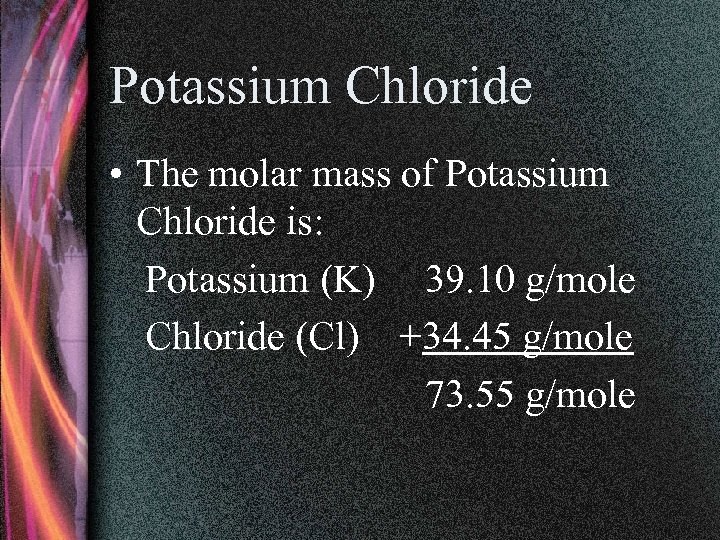 Potassium Chloride • The molar mass of Potassium Chloride is: Potassium (K) 39. 10 g/mole Chloride (Cl) +34. 45 g/mole 73. 55 g/mole
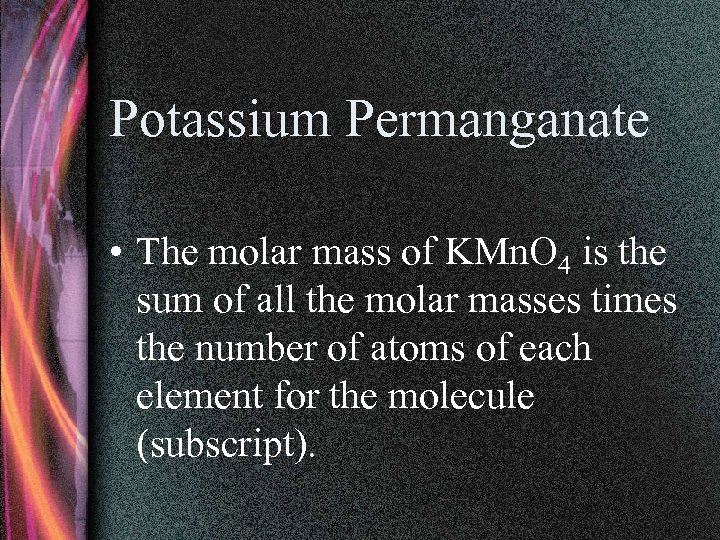 Potassium Permanganate • The molar mass of KMn. O 4 is the sum of all the molar masses times the number of atoms of each element for the molecule (subscript).
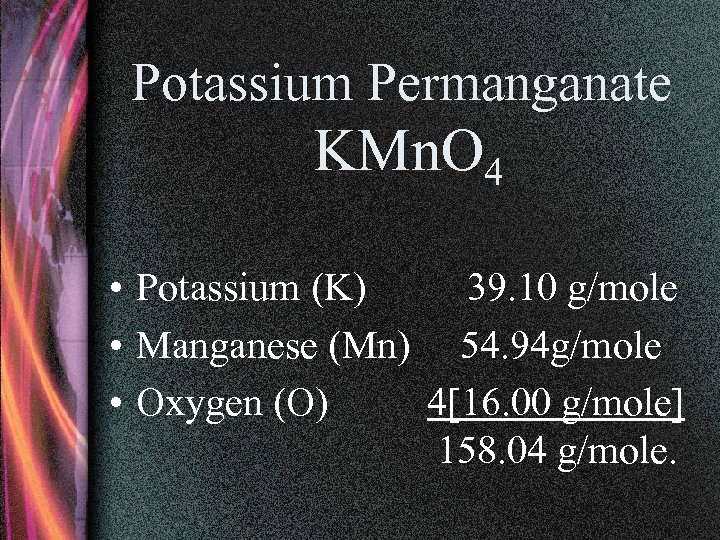 Potassium Permanganate KMn. O 4 • Potassium (K) 39. 10 g/mole • Manganese (Mn) 54. 94 g/mole • Oxygen (O) 4[16. 00 g/mole] 158. 04 g/mole.
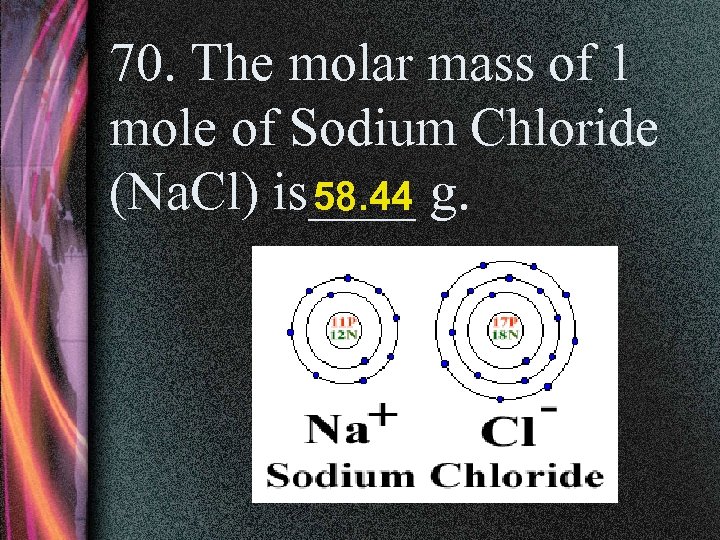 70. The molar mass of 1 mole of Sodium Chloride (Na. Cl) is____ g. 58. 44
 71. The molar mass of 1 mole of Lead Iodide 461. 0 (Pb. I 2) is _____ g.
 72. The mass of 100 moles of Nickel Sulfide 9076. 00 (Ni. S) is ____ g.
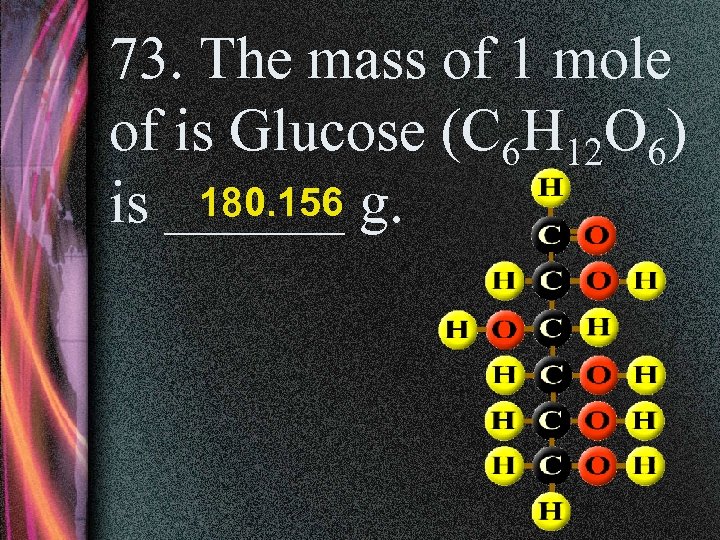 73. The mass of 1 mole of is Glucose (C 6 H 12 O 6) 180. 156 is ______ g.
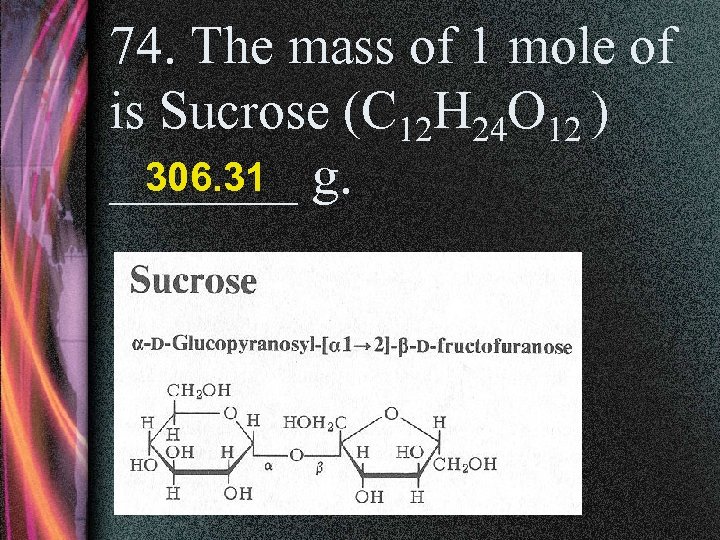 74. The mass of 1 mole of is Sucrose (C 12 H 24 O 12 ) 306. 31 _______ g.
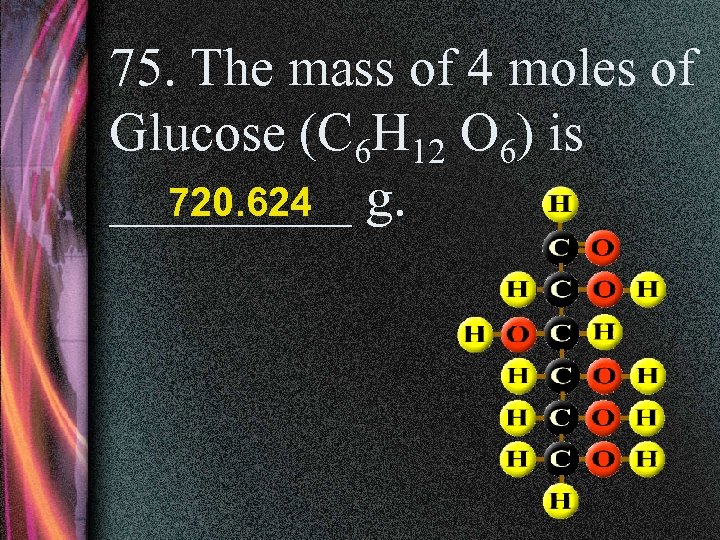 75. The mass of 4 moles of Glucose (C 6 H 12 O 6) is _____ g. 720. 624
 Mole Conversions • In chemistry, the mole is the standard measurement of amount. • However, balances DO NOT give readings in moles. Balances give readings in grams. • So the problem is that, while we compare amounts of one substance to another using moles, we must also use grams, since this is the information we get from balances.
 There are three steps to converting grams of a substance to moles. 1. Determine how many grams are given in the problem. 2. Calculate the molar mass of the substance. 3. Divide step one by step two.
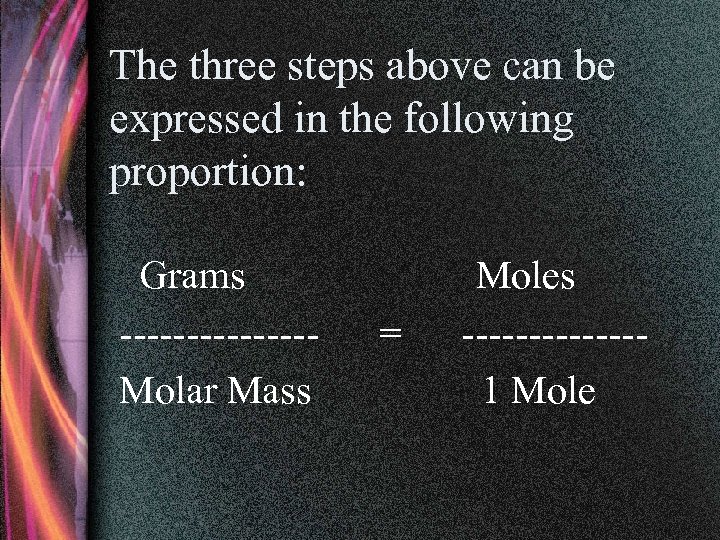 The three steps above can be expressed in the following proportion: Grams -------Molar Mass = Moles -------1 Mole
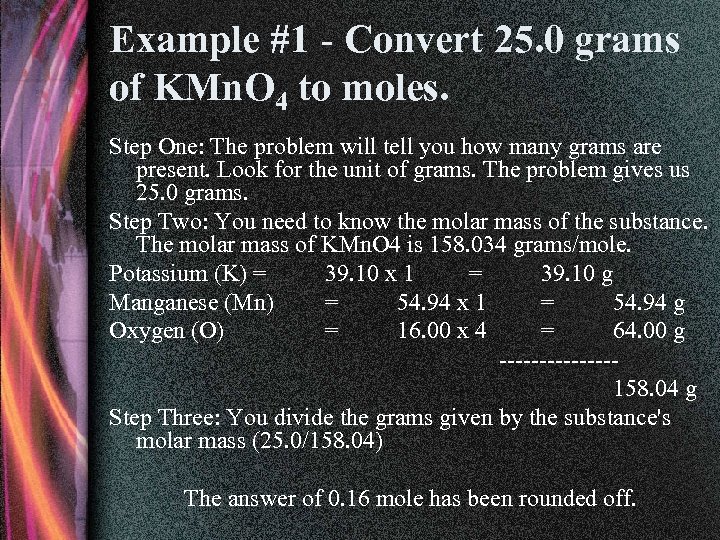 Example #1 - Convert 25. 0 grams of KMn. O 4 to moles. Step One: The problem will tell you how many grams are present. Look for the unit of grams. The problem gives us 25. 0 grams. Step Two: You need to know the molar mass of the substance. The molar mass of KMn. O 4 is 158. 034 grams/mole. Potassium (K) = 39. 10 x 1 = 39. 10 g Manganese (Mn) = 54. 94 x 1 = 54. 94 g Oxygen (O) = 16. 00 x 4 = 64. 00 g -------158. 04 g Step Three: You divide the grams given by the substance's molar mass (25. 0/158. 04) The answer of 0. 16 mole has been rounded off.
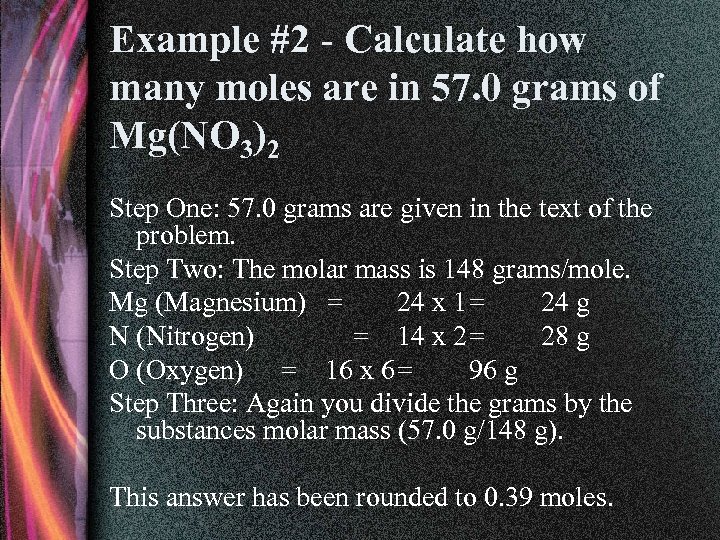 Example #2 - Calculate how many moles are in 57. 0 grams of Mg(NO 3)2 Step One: 57. 0 grams are given in the text of the problem. Step Two: The molar mass is 148 grams/mole. Mg (Magnesium) = 24 x 1= 24 g N (Nitrogen) = 14 x 2= 28 g O (Oxygen) = 16 x 6= 96 g Step Three: Again you divide the grams by the substances molar mass (57. 0 g/148 g). This answer has been rounded to 0. 39 moles.
 Practice Problems
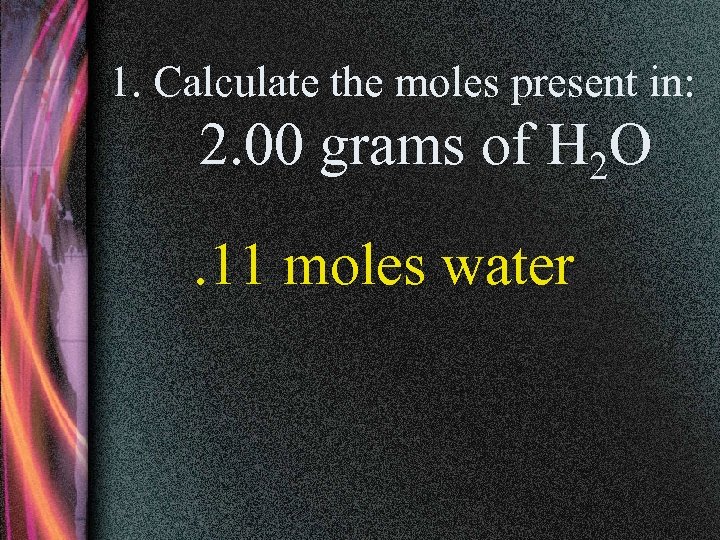 1. Calculate the moles present in: 2. 00 grams of H 2 O. 11 moles water
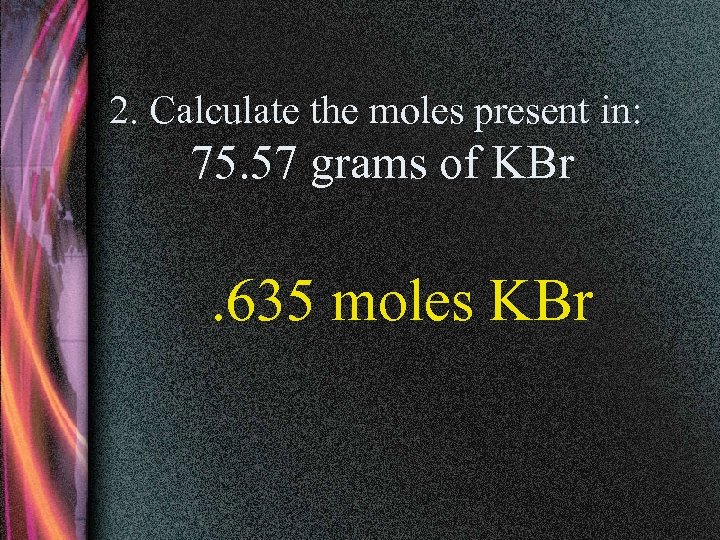 2. Calculate the moles present in: 75. 57 grams of KBr . 635 moles KBr
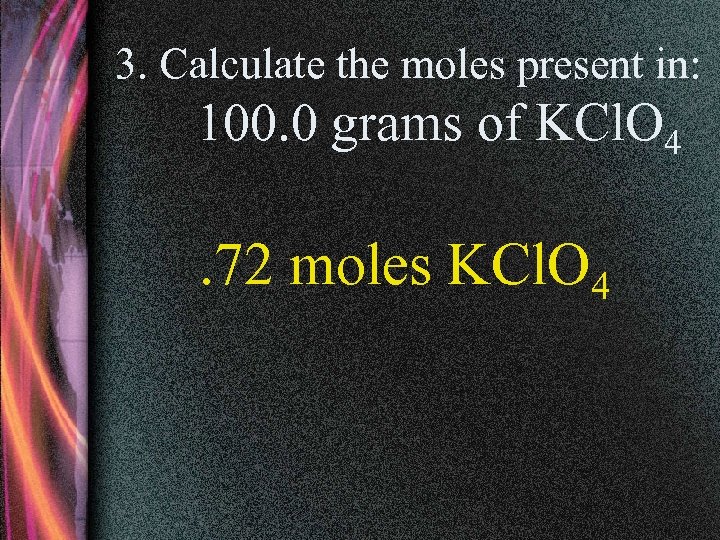 3. Calculate the moles present in: 100. 0 grams of KCl. O 4 . 72 moles KCl. O 4
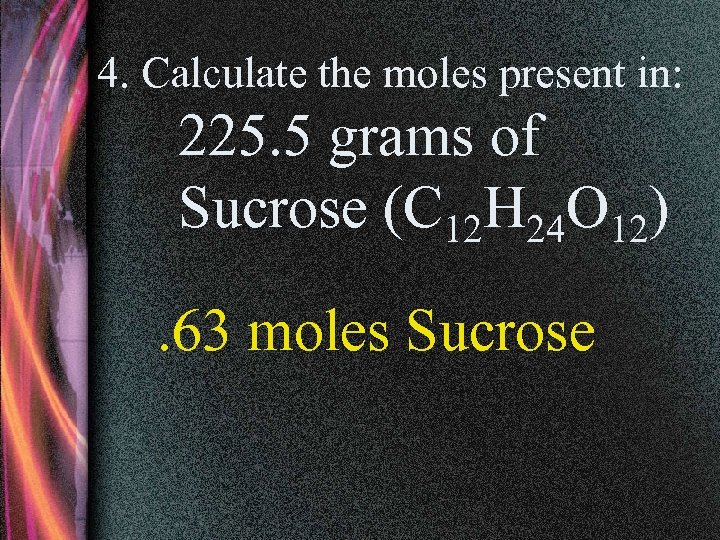 4. Calculate the moles present in: 225. 5 grams of Sucrose (C 12 H 24 O 12). 63 moles Sucrose
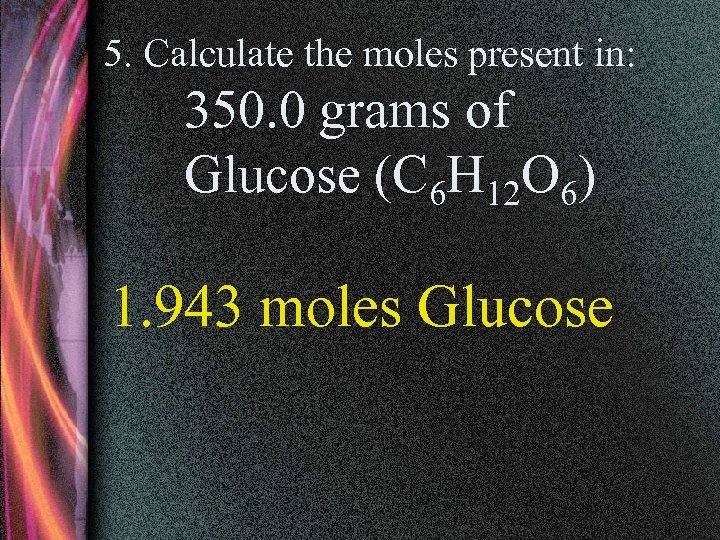 5. Calculate the moles present in: 350. 0 grams of Glucose (C 6 H 12 O 6) 1. 943 moles Glucose
 Homework
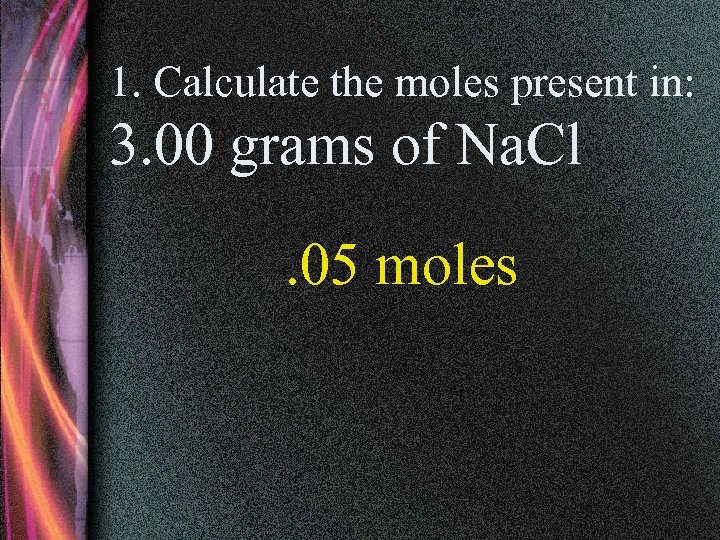 1. Calculate the moles present in: 3. 00 grams of Na. Cl. 05 moles
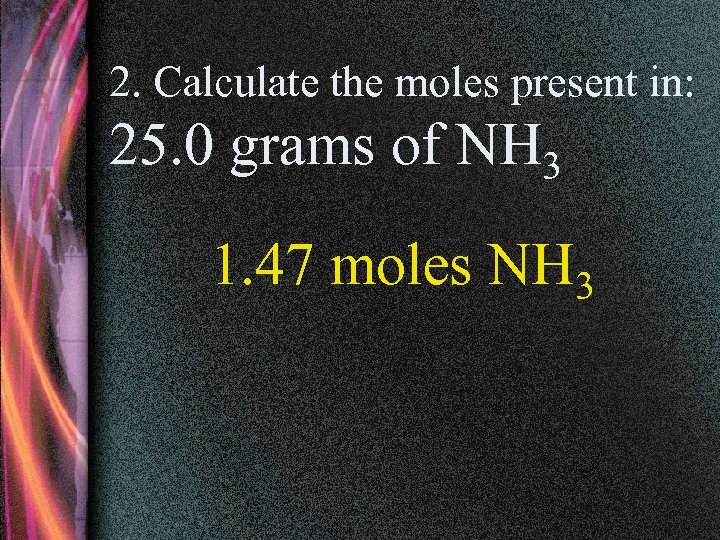 2. Calculate the moles present in: 25. 0 grams of NH 3 1. 47 moles NH 3
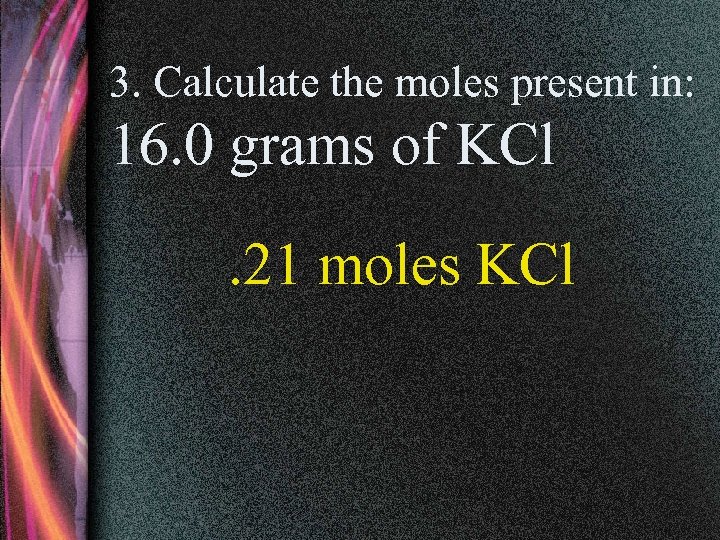 3. Calculate the moles present in: 16. 0 grams of KCl. 21 moles KCl
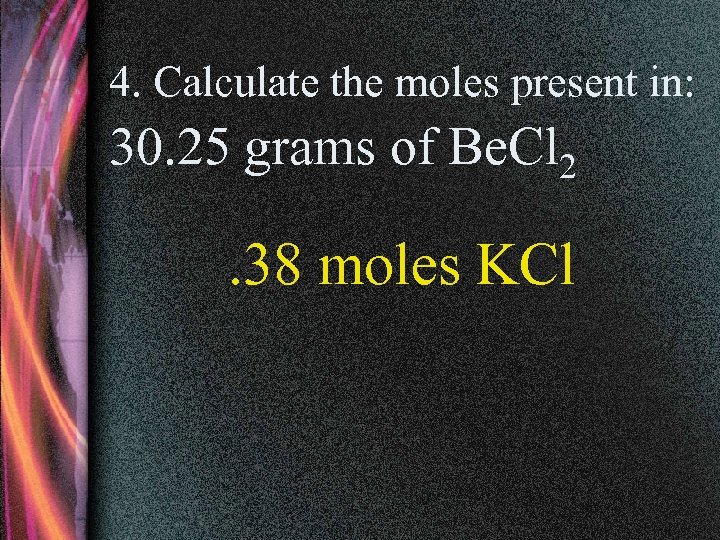 4. Calculate the moles present in: 30. 25 grams of Be. Cl 2 . 38 moles KCl
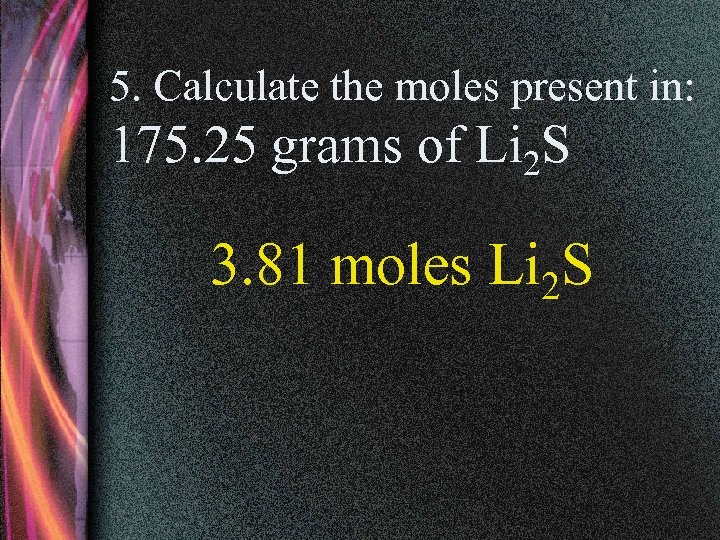 5. Calculate the moles present in: 175. 25 grams of Li 2 S 3. 81 moles Li 2 S
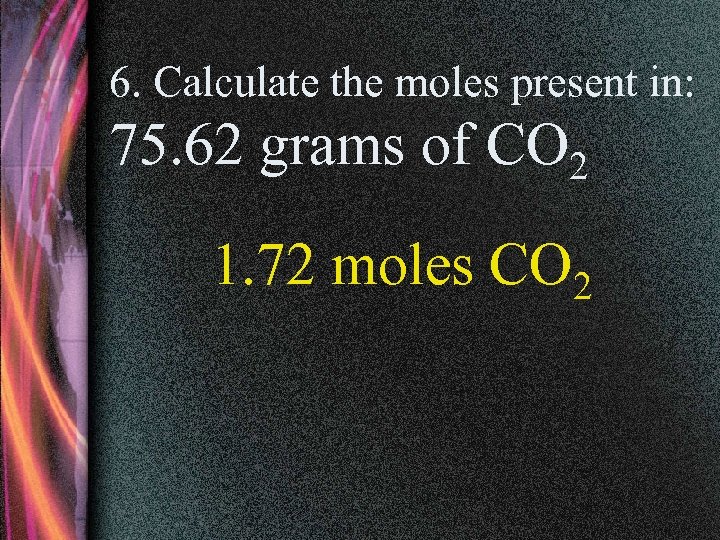 6. Calculate the moles present in: 75. 62 grams of CO 2 1. 72 moles CO 2
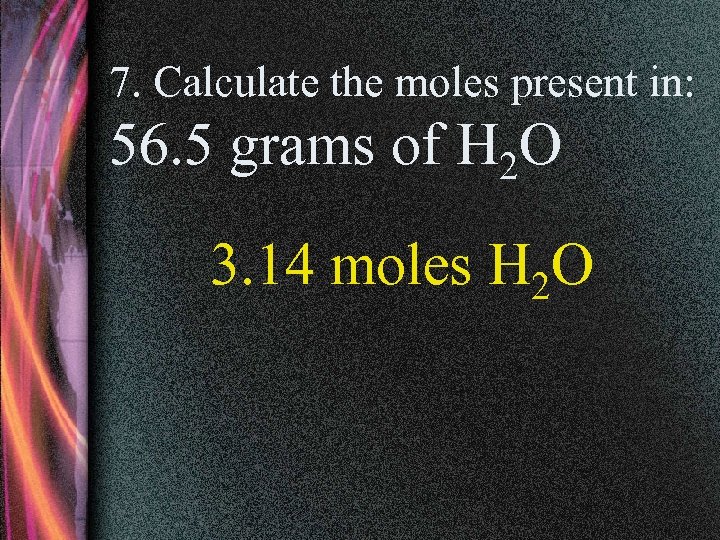 7. Calculate the moles present in: 56. 5 grams of H 2 O 3. 14 moles H 2 O
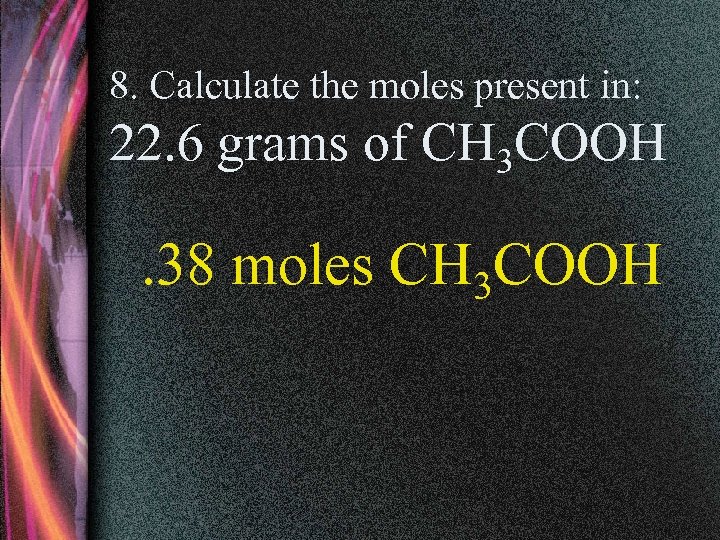 8. Calculate the moles present in: 22. 6 grams of CH 3 COOH . 38 moles CH 3 COOH
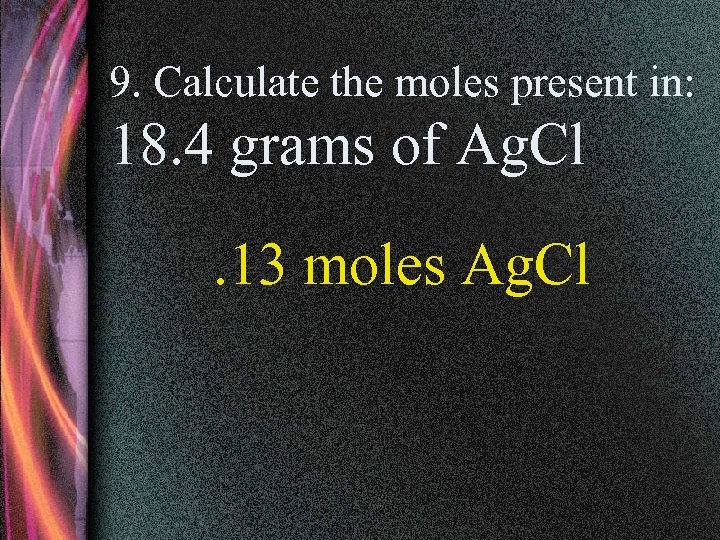 9. Calculate the moles present in: 18. 4 grams of Ag. Cl. 13 moles Ag. Cl
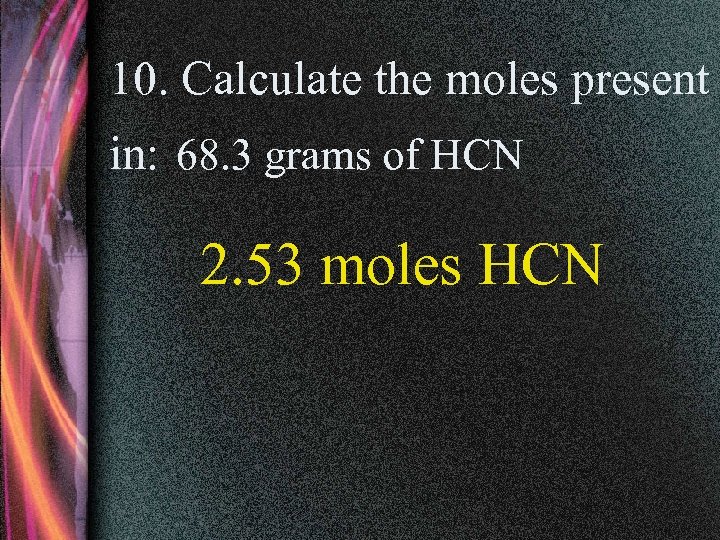 10. Calculate the moles present in: 68. 3 grams of HCN 2. 53 moles HCN