


 Скачать презентацию Introduction to the International Function Point Users Group
654b8f2fc272943e06044dacda42cee1.ppt
- Количество слайдов: 52
 Introduction to the International Function Point Users Group (IFPUG) 1 © Copyright 1999. International Function Point User Group 1999
 Introduction to the International Function Point Users Group (IFPUG) Credits: We would like to thank the following individuals and companies for their contributions to this presentation: 2 Mick Burn-Murdoch - Software Measurement Services, Ltd. Carol Dekkers - Quality Plus Technologies, Inc. Sheila Dennis - DFAS David Garmus - David Consulting Group Scott Goldfarb - Q/P Management Group, Inc. Cindy Woodrow - First Citizens Bank © Copyright 1999. International Function Point User Group 1999
 Agenda • Introduction • Why use Function Points – Managing Your Software – Managing Your Organization – Function Points vs. Lines of Code • • • 3 How to Count Function Points IFPUG History IFPUG Structure IFPUG Committees and Affiliates How Can Your Organization Benefit from IFPUG Questions © Copyright 1999. International Function Point User Group 1999
 IFPUG Mission Statement • The mission of the International Function Point Users Group is to be a recognized leader in promoting and encouraging the effective management of application software development and maintenance activities through the use of Function Point Analysis and other software measurement techniques. • The International Function Point Users Group serves to facilitate the exchange of knowledge and ideas for improved software measurement techniques and seeks to provide a composite environment that stimulates the personal and professional development of its members. Taken from Vision Plan 2005 IFPUG’s strategic plan 4 © Copyright 1999. International Function Point User Group 1999
 Objectives of Function Point Analysis • Measures software by quantifying the functionality requested by and provided to the customer based primarily on logical design • Measures software development and maintenance independently of technology used for implementation • Measures software development and maintenance consistently across all projects and organizations 5 © Copyright 1999. International Function Point User Group 1999
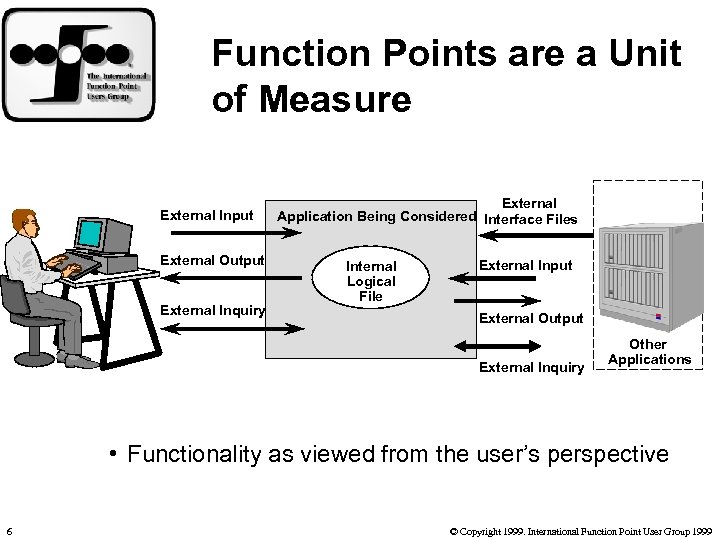 Function Points are a Unit of Measure External Input External Output External Inquiry External Application Being Considered Interface Files Internal Logical File External Input External Output External Inquiry Other Applications • Functionality as viewed from the user’s perspective 6 © Copyright 1999. International Function Point User Group 1999
 Why Use Function Points • Managing Your Software 7 © Copyright 1999. International Function Point User Group 1999
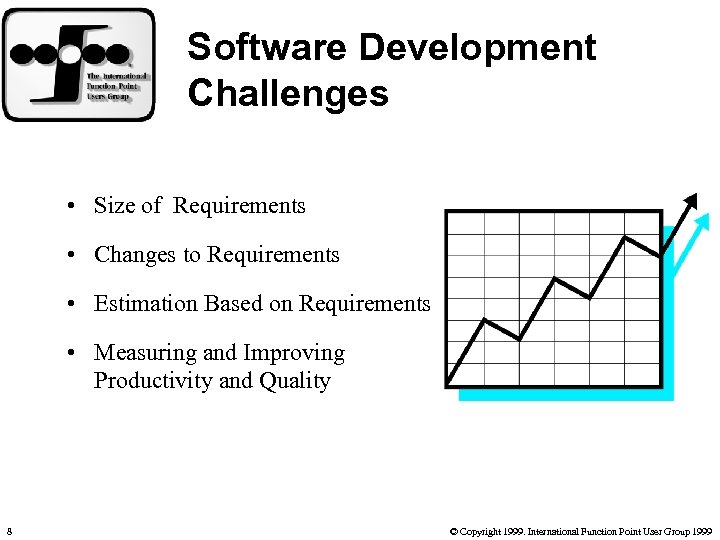 Software Development Challenges • Size of Requirements • Changes to Requirements • Estimation Based on Requirements • Measuring and Improving Productivity and Quality 8 © Copyright 1999. International Function Point User Group 1999
 Size of Requirements • Requirements – Complete – Business Terms – Mutual Understanding – Document Assumptions – Size 9 © Copyright 1999. International Function Point User Group 1999
 Changes to Requirements • Changes to Requirements – Change Inevitable – Trade-offs – Customer Definition of Quality – Size 10 © Copyright 1999. International Function Point User Group 1999
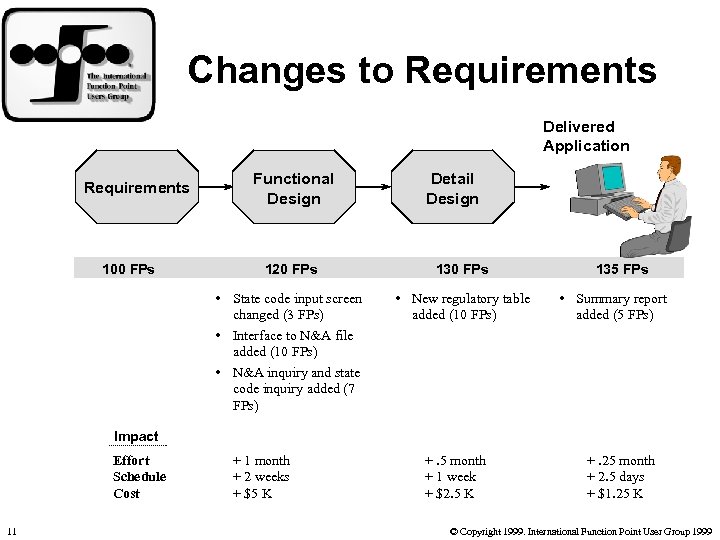 Changes to Requirements Delivered Application Requirements 100 FPs Functional Design Detail Design 120 FPs 130 FPs • State code input screen changed (3 FPs) • Interface to N&A file added (10 FPs) • N&A inquiry and state code inquiry added (7 FPs) • New regulatory table added (10 FPs) 135 FPs • Summary report added (5 FPs) Impact Effort Schedule Cost 11 + 1 month + 2 weeks + $5 K +. 5 month + 1 week + $2. 5 K +. 25 month + 2. 5 days + $1. 25 K © Copyright 1999. International Function Point User Group 1999
 Estimation Based on Requirements • Estimation Based on Requirements – Multiple Models – Weighted Inputs: • Language • Skills • Methodology • Risk Factors • Size – Historical Base 12 © Copyright 1999. International Function Point User Group 1999
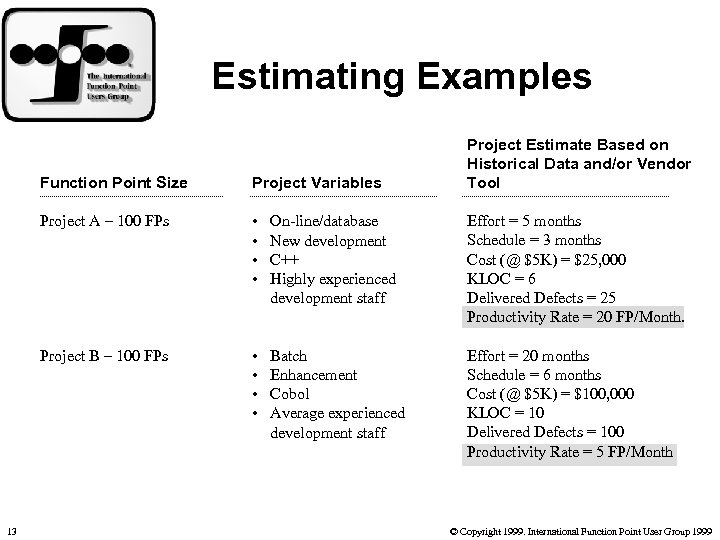 Estimating Examples Project Estimate Based on Historical Data and/or Vendor Tool Function Point Size Project A – 100 FPs • • On-line/database New development C++ Highly experienced development staff Effort = 5 months Schedule = 3 months Cost (@ $5 K) = $25, 000 KLOC = 6 Delivered Defects = 25 Productivity Rate = 20 FP/Month. Project B – 100 FPs 13 Project Variables • • Batch Enhancement Cobol Average experienced development staff Effort = 20 months Schedule = 6 months Cost (@ $5 K) = $100, 000 KLOC = 10 Delivered Defects = 100 Productivity Rate = 5 FP/Month © Copyright 1999. International Function Point User Group 1999
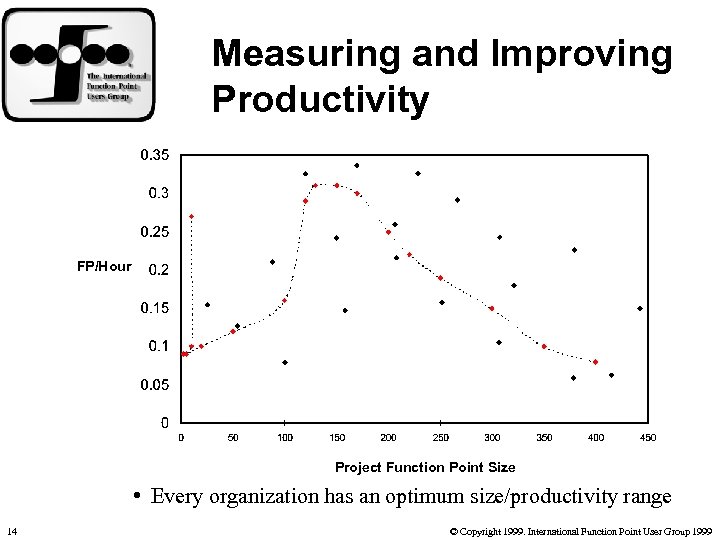 Measuring and Improving Productivity FP/Hour Project Function Point Size • Every organization has an optimum size/productivity range 14 © Copyright 1999. International Function Point User Group 1999
 Why Use Function Points • Managing Your Organization 15 © Copyright 1999. International Function Point User Group 1999
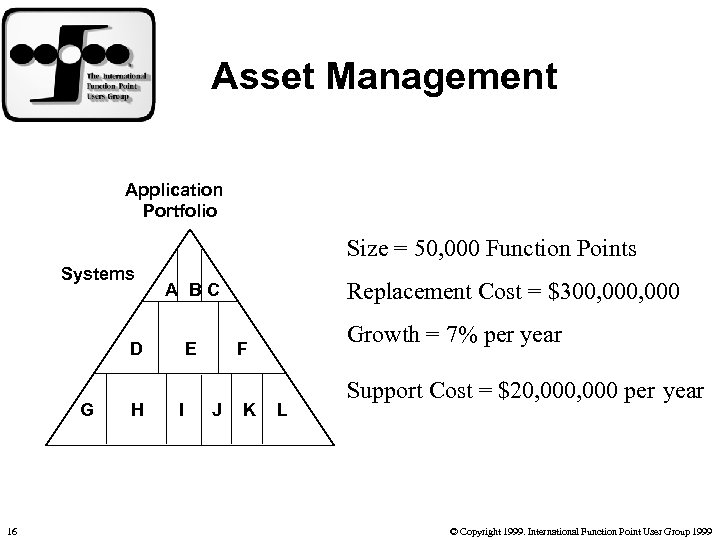 Asset Management Application Portfolio Size = 50, 000 Function Points Systems D G 16 H Replacement Cost = $300, 000 A BC E I Growth = 7% per year F J K L Support Cost = $20, 000 per year © Copyright 1999. International Function Point User Group 1999
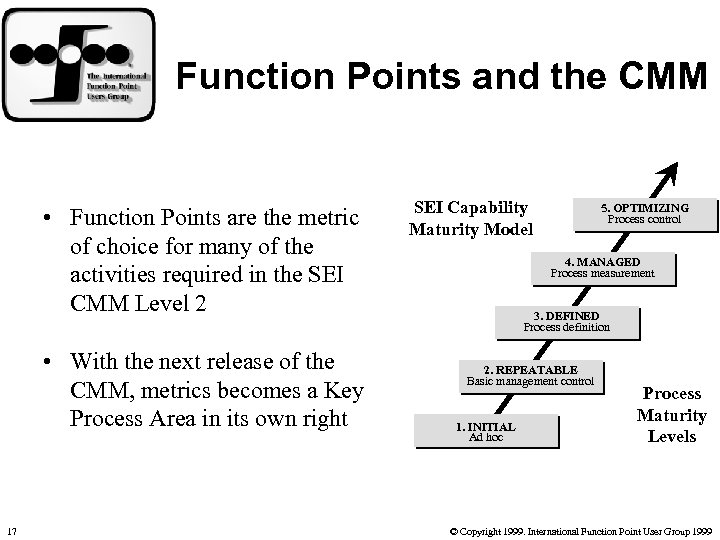 Function Points and the CMM • Function Points are the metric of choice for many of the activities required in the SEI CMM Level 2 • With the next release of the CMM, metrics becomes a Key Process Area in its own right 17 SEI Capability Maturity Model 5. OPTIMIZING Process control 4. MANAGED Process measurement 3. DEFINED Process definition 2. REPEATABLE Basic management control 1. INITIAL Ad hoc Process Maturity Levels © Copyright 1999. International Function Point User Group 1999
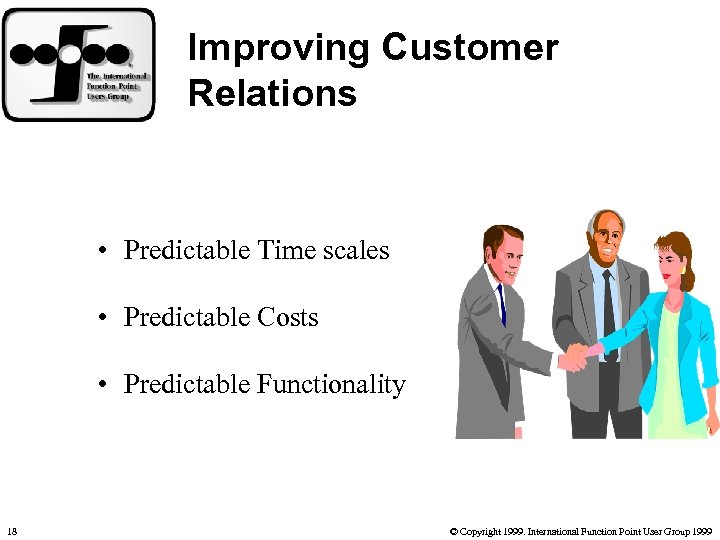 Improving Customer Relations • Predictable Time scales • Predictable Costs • Predictable Functionality 18 © Copyright 1999. International Function Point User Group 1999
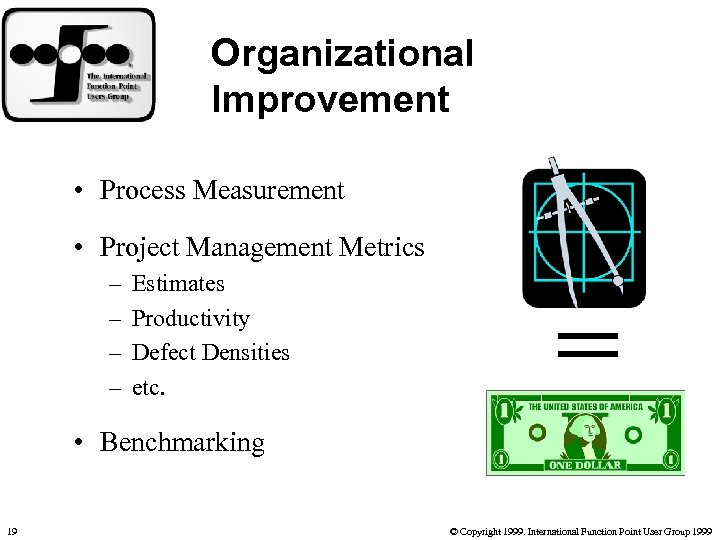 Organizational Improvement • Process Measurement • Project Management Metrics – – Estimates Productivity Defect Densities etc. • Benchmarking 19 © Copyright 1999. International Function Point User Group 1999
 Why Use Function Points • Function Points vs. Lines of Code 20 © Copyright 1999. International Function Point User Group 1999
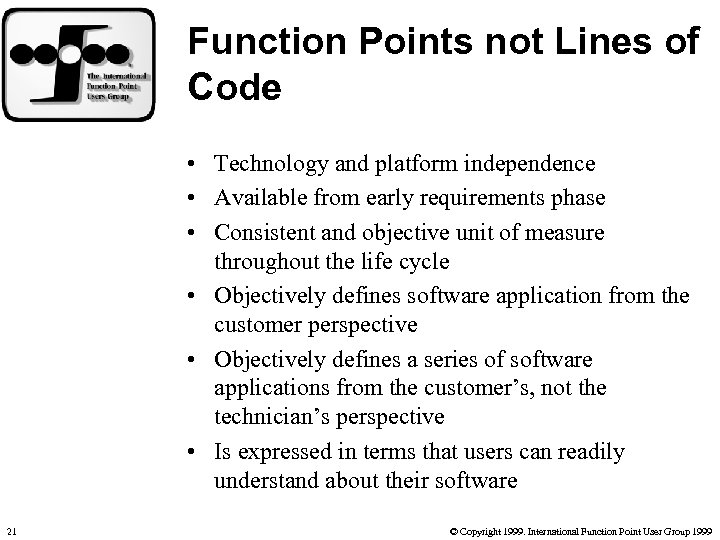 Function Points not Lines of Code • Technology and platform independence • Available from early requirements phase • Consistent and objective unit of measure throughout the life cycle • Objectively defines software application from the customer perspective • Objectively defines a series of software applications from the customer’s, not the technician’s perspective • Is expressed in terms that users can readily understand about their software 21 © Copyright 1999. International Function Point User Group 1999
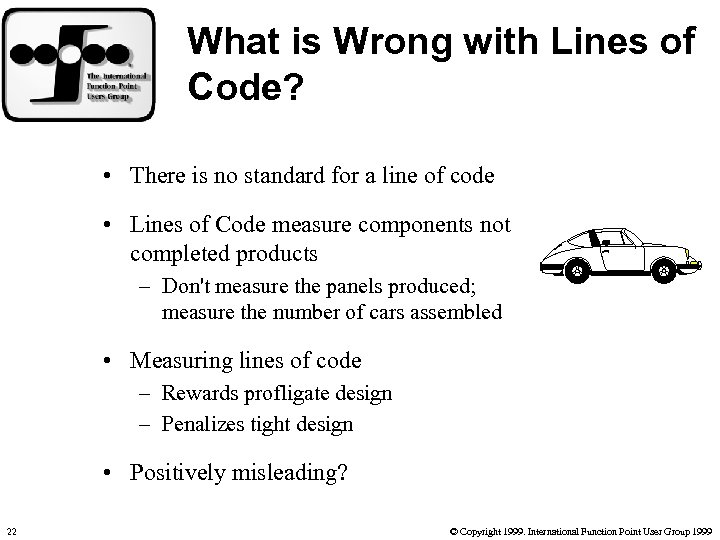 What is Wrong with Lines of Code? • There is no standard for a line of code • Lines of Code measure components not completed products – Don't measure the panels produced; measure the number of cars assembled • Measuring lines of code – Rewards profligate design – Penalizes tight design • Positively misleading? 22 © Copyright 1999. International Function Point User Group 1999
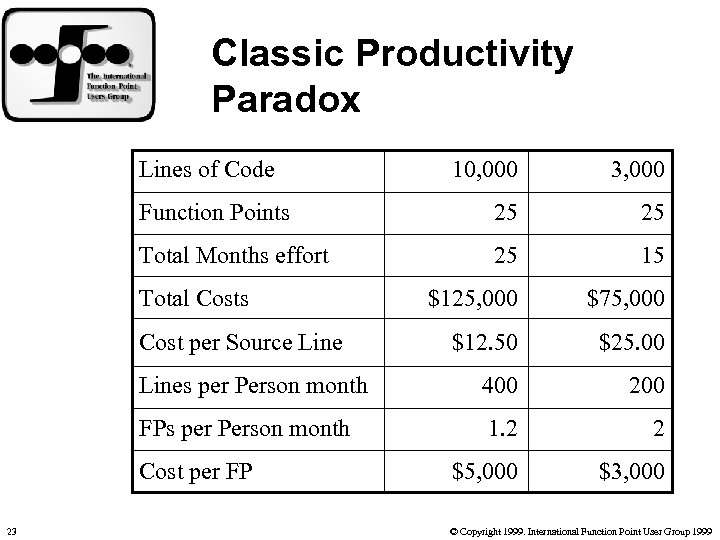 Classic Productivity Paradox Lines of Code 10, 000 3, 000 Function Points 25 25 Total Months effort 25 15 $125, 000 $75, 000 $12. 50 $25. 00 Lines per Person month 400 200 FPs per Person month 1. 2 2 $5, 000 $3, 000 Total Costs Cost per Source Line Cost per FP 23 © Copyright 1999. International Function Point User Group 1999
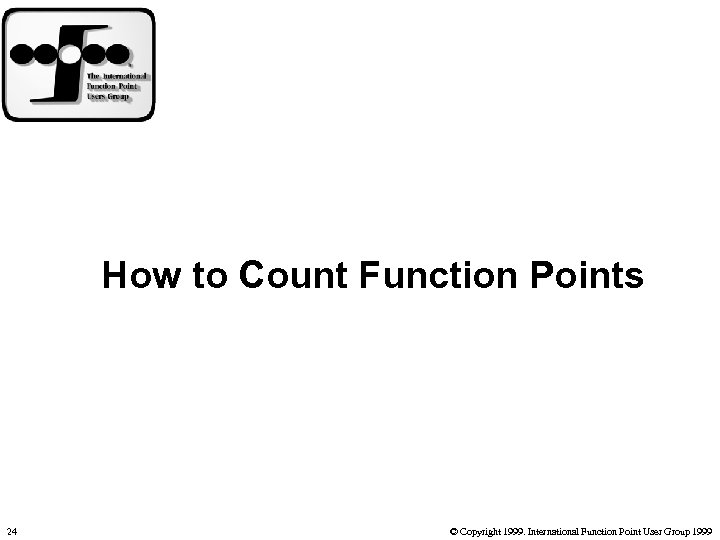 How to Count Function Points 24 © Copyright 1999. International Function Point User Group 1999
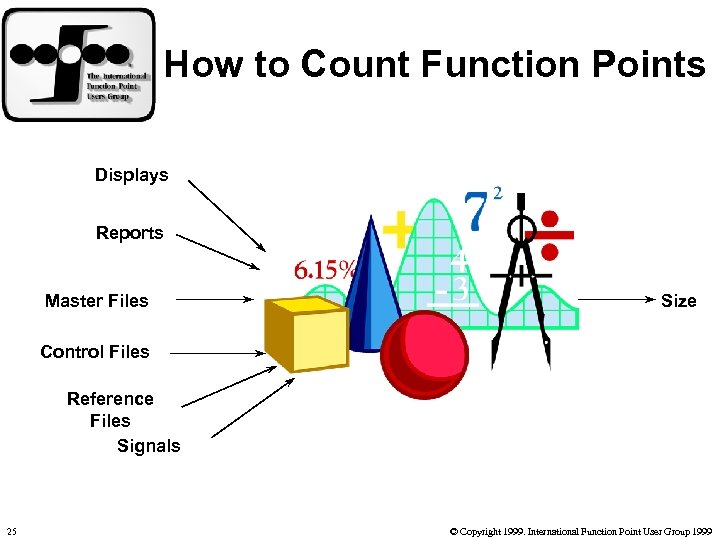 How to Count Function Points Displays Reports Master Files Size Control Files Reference Files Signals 25 © Copyright 1999. International Function Point User Group 1999
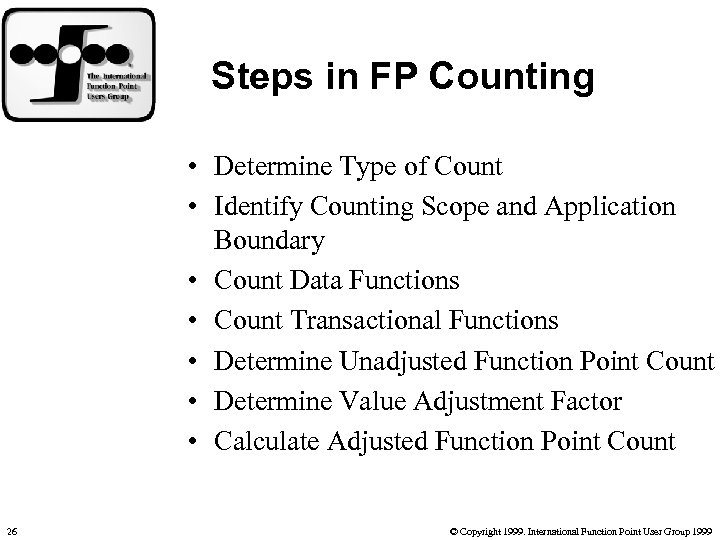 Steps in FP Counting • Determine Type of Count • Identify Counting Scope and Application Boundary • Count Data Functions • Count Transactional Functions • Determine Unadjusted Function Point Count • Determine Value Adjustment Factor • Calculate Adjusted Function Point Count 26 © Copyright 1999. International Function Point User Group 1999
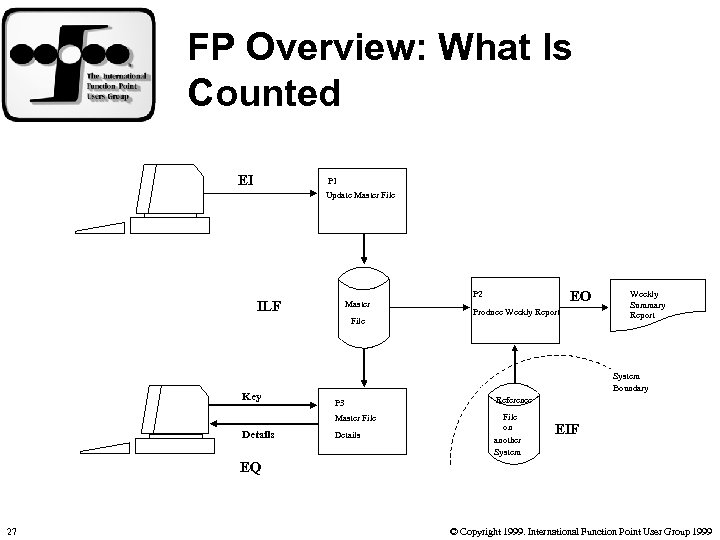 FP Overview: What Is Counted EI P 1 Update Master File Key EO P 2 ILF Produce Weekly Report System Boundary P 3 Reference Master File Details Weekly Summary Report File on another System Details EIF EQ 27 © Copyright 1999. International Function Point User Group 1999
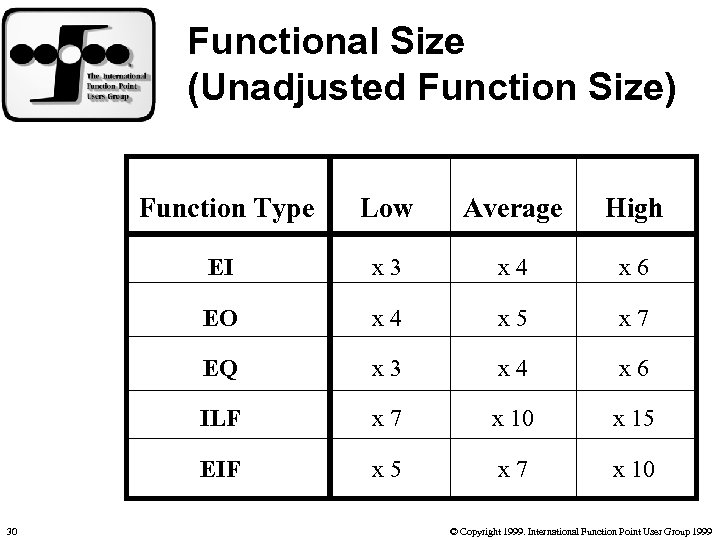 Functional Size (Unadjusted Function Size) Function Type Average High EI x 3 x 4 x 6 EO x 4 x 5 x 7 EQ x 3 x 4 x 6 ILF x 7 x 10 x 15 EIF 30 Low x 5 x 7 x 10 © Copyright 1999. International Function Point User Group 1999
 Value Adjustment Factor • Based on 14 General System Characteristics (User Business Constraints Independent of Technology) – Examples: data communications, response times, end user efficiency, multiple sites and flexibility • Adjusts FP count by up to + / - 35% 31 © Copyright 1999. International Function Point User Group 1999
 IFPUG History 32 © Copyright 1999. International Function Point User Group 1999
 History - Early Days 1979 1984 First formal Function Point Guidelines 1986 IFPUG elects first Board of Directors 1990 Function Point as Assets Manual 1991 Certification for training materials IFPUG Hotline established 1993 33 Function Points introduced by Alan Albrecht Certified Practitioners Participation in ISO/IEC © Copyright 1999. International Function Point User Group 1999
 History - Modern 1994 1995 Guidelines to Software Measurement IFPUG Home Page Introduced 1996 Case Study 3 released 1997 10 th Anniversary Celebration! 1999 34 CPM release 4. 0 Participation in International Software Benchmarking Standards Group (ISBSG) CPM release 4. 1 © Copyright 1999. International Function Point User Group 1999
 IFPUG Structure 35 © Copyright 1999. International Function Point User Group 1999
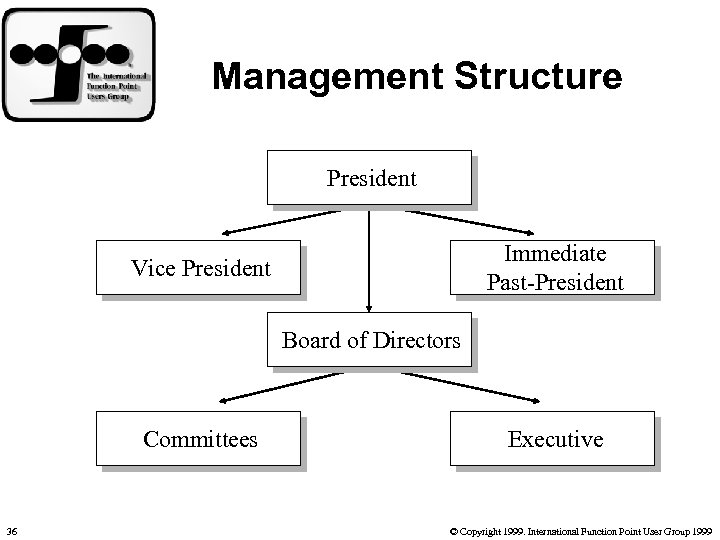 Management Structure President Immediate Past-President Vice President Board of Directors Committees 36 Executive © Copyright 1999. International Function Point User Group 1999
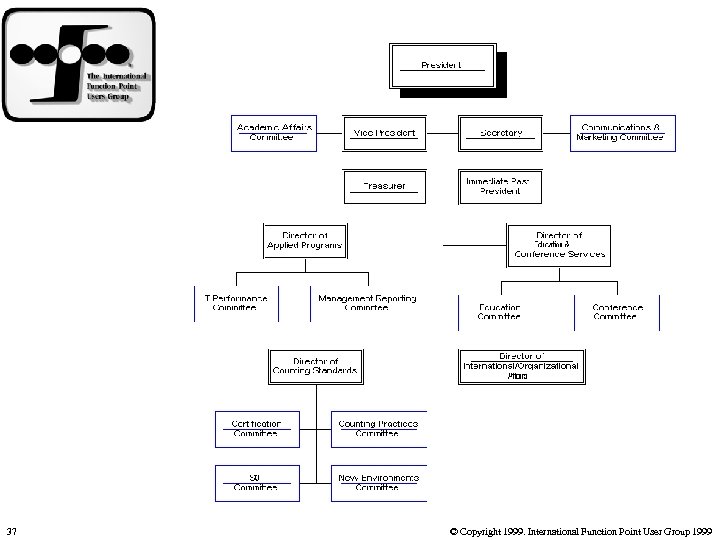 37 © Copyright 1999. International Function Point User Group 1999
 IFPUG Committees and Affiliates 38 © Copyright 1999. International Function Point User Group 1999
 IFPUG Committees • • • 39 Academic Affairs Communications and Marketing IT Performance Committee Management Reporting Education Services Counting Practices New Environments Conference Certification International Standards Organization © Copyright 1999. International Function Point User Group 1999
 Academic Affairs • Increase academic awareness of software measurement and Function Point Analysis • Support and promote graduate studies regarding FPA 40 © Copyright 1999. International Function Point User Group 1999
 Communications and Marketing • Metric. Views • Metrics Source • Monthly E-mail Update • Road show • Website 41 © Copyright 1999. International Function Point User Group 1999
 IT Performance • Database of measurements from organizations worldwide • Compare against your organization’s results 42 © Copyright 1999. International Function Point User Group 1999
 Management Reporting • Management reporting workshops • Publications to assist in using FP metrics for management reporting • Published Guidelines to Software Measurement 43 © Copyright 1999. International Function Point User Group 1999
 Education Services • Basic Training • Advanced Practices • Management Courses 44 © Copyright 1999. International Function Point User Group 1999
 Counting Practices • Publish Counting Practices Manual • Update Counting Practices Manual • Make Rulings on areas of Ambiguity 45 © Copyright 1999. International Function Point User Group 1999
 New Environments • Links to new development techniques – – Investigate Hypothesize Test link Promulgate • For Example OO 46 © Copyright 1999. International Function Point User Group 1999
 Conference • Presentations from Industry “Gurus” • Presentations from Practitioners • Networking opportunity • Workshops 47 © Copyright 1999. International Function Point User Group 1999
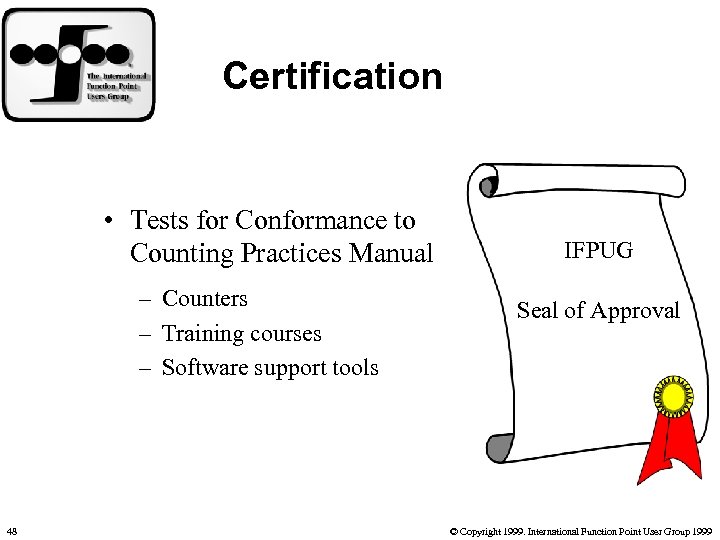 Certification • Tests for Conformance to Counting Practices Manual – Counters – Training courses – Software support tools 48 IFPUG Seal of Approval © Copyright 1999. International Function Point User Group 1999
 ISO • Represent IFPUG at ISO working group meetings • Review developing ISO standards 49 © Copyright 1999. International Function Point User Group 1999
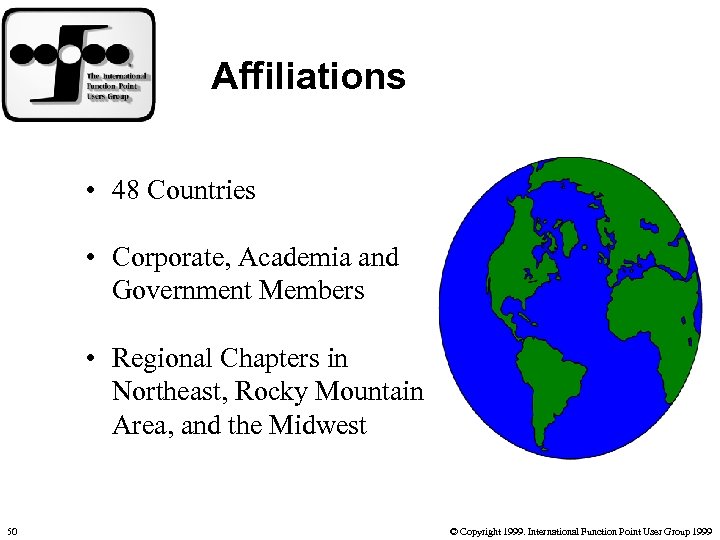 Affiliations • 48 Countries • Corporate, Academia and Government Members • Regional Chapters in Northeast, Rocky Mountain Area, and the Midwest 50 © Copyright 1999. International Function Point User Group 1999
 How Can Your Organization Benefit from IFPUG? 51 © Copyright 1999. International Function Point User Group 1999
 IFPUG Benefits • Free copies of IFPUG standards manuals • Case Studies at member discounted rates • Member directory • Publications Metric. Views, Metrics Source • IFPUG E-Mail List Serve & Private Home Page • Reduced rates for conference & workshops • Ability to participate on Committees • Networking, Professional Development 52 © Copyright 1999. International Function Point User Group 1999
 How to Contact Us International Function Point Users Group 5008 -28 Pine Creek Drive Westerville, OH 43081 -4899 Phone: Fax: E-mail: Web: 53 (614) 895 -7130 (614) 895 -3466 ifpug@ifpug. org www. ifpug. org © Copyright 1999. International Function Point User Group 1999
 How May We Help You? • Questions? ? • Comments!!! • Suggestions!? !? !? 54 © Copyright 1999. International Function Point User Group 1999