Скачать презентацию Introduction to the EU ETS Giedre Kaminskaite-Salters Senior
170fbf66e05b8b2238d37e912a57f6e0.ppt
- Количество слайдов: 22
 Introduction to the EU ETS Giedre Kaminskaite-Salters Senior Adviser on Climate and Clean Energy 18 November 2008
 Contents 1. 2. 3. 4. 5. What is the EU ETS? Global carbon market: an overview Linking EU ETS with the global carbon market EU ETS: teething problems Revised EU ETS in Phase III
 1. What is the EU ETS?
 What is the EU ETS? • EU ETS – the cornerstone of EU climate change policy – World’s single largest carbon market and greatest source of demand for carbon credits – Accounts for 67% (volume) and 81% (value) of global carbon market – Founded by Directive 2003/87/EC, “the EU ETS Directive” – Imposes emission caps on installations regulated by the Directive – the so-called “cap-and-trade” scheme – Regulated sectors are: power generation, cement, glass, ceramics, pulp, paper and steel production (approx. 40% of the EU’s emissions) – ‘Operator’ of installation is required to hold a permit and surrender enough allowances to meet the installation’s emissions at the end of each year
 What is the EU ETS? (part 2) Background to EU ETS: • EU founded the ETS in order to realise its commitments under the Kyoto Protocol • Kyoto Protocol set out targets for all developed countries that have ratified it to reduce emissions of the “basket” of greenhouse gases (GHG) Concept of “compliance” - Kyoto vs the EU ETS: • Kyoto Protocol is negotiated between governments imposing targets on a country’s total emissions • EU ETS is a scheme that works at company level based on the EU ETS Directive as implemented by national legislation
 What is the EU ETS? (part 3) • Kyoto Protocol applies during 2008 -2012 (the “first commitment period”) – but what will follow? • By contrast, EU ETS operates in phases – New rules and caps apply phase by phase: • Phase 1: 2005 -2007 - “learning by doing” • Phase 2: 2008 -2012 - current phase • Phase 3: 2013 -2020 - rules currently under review (discussed later)
 2. Global carbon market: an overview
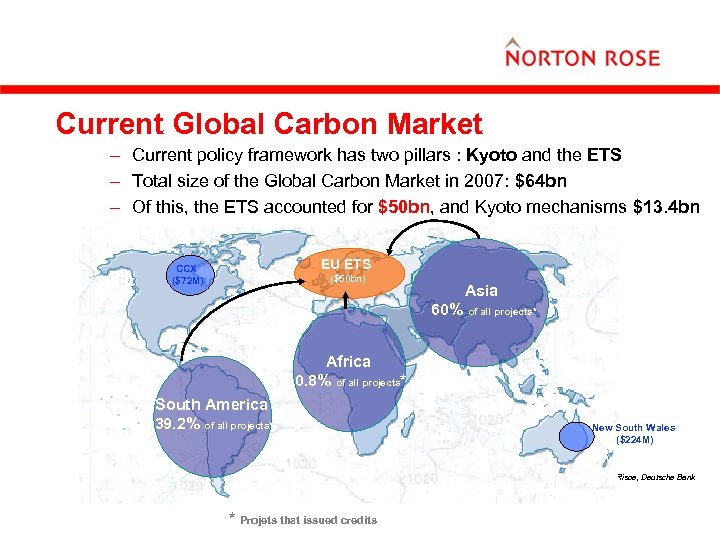 Current Global Carbon Market – Current policy framework has two pillars : Kyoto and the ETS – Total size of the Global Carbon Market in 2007: $64 bn – Of this, the ETS accounted for $50 bn, and Kyoto mechanisms $13. 4 bn EU ETS CCX ($72 M) ($50 bn) Asia 60% of all projects* Africa 0. 8% of all projects* South America 39. 2% of all projects* New South Wales ($224 M) Source: World Bank, Unep Risoe, Deutsche Bank * Projets that issued credits
 3. Linking EU ETS with the global carbon market
 Linking with international Kyoto carbon market mechanisms Carbon allowances traded in the EU ETS: • EUA = EU Allowance, allocated by the EU states to installations covered by the EU ETS • Certified Emission Reductions (CER) issued on the basis of UN Clean Development Mechanism (CDM) projects that reduce GHG emissions in developing countries • Emission Reduction Units (ERU) issued on the basis of UN Joint Implementation (JI) projects that reduce GHG emissions in transition economies • Using the Linking Directive, EU ETS installations may surrender a CERs/ERUs up to a certain limit in order to satisfy part of their EU ETS compliance obligations, in additions to EUAs
 4. EU ETS: teething problems
 EU ETS: teething problems • • In Phases 1 and 2, each MS issued its own National Allocation Plan (NAP) for each phase, and allocations occurred at national level Majority of allowances were given away for free (rather than auctioned) Problems – 27 separate systems in different MS, each with its own set of rules and procedures – lack of harmonisation – Haphazard implementation – Windfall profits due to free allocation Negative impacts on: carbon prices, volatility in the market and emission reductions
 5. Revised EU ETS in Phase III
 The “climate change package” • 23 January 2008: the Commission published a package of legislation which will govern the EU climate change policy going forward • One of the proposals = a revised EU ETS Directive • “Trialogue” currently in place; expect decision by the end of December 2008
 Revised EU ETS: the proposals • • Harmonisation of allocation rules Increased auctioning of allowances (100% for the power sector) A downward trajectory in emission reductions of 1. 74% per annum from 2012 to 2020 compared with 2005 levels New rules for the use of Kyoto credits (CERs and ERUs) in the scheme, depending on the outcome of the international negotiations Inclusion of new gases (perfluorocarbons and nitrous oxide) Inclusion of new manufacturing activities (e. g. production of aluminium) Inclusion of new sectors, namely: – Aviation – Carbon capture and storage (CCS) – Forestry? – Shipping?
 Aviation in the New EU ETS • • Proposal published 20 December 2006; amends the EU ETS; political agreement almost finalised All flights leaving the EU and landing in the EU covered from 2012 Special aviation allowances issued Overall target: 97% of average 2004 -2006 emissions in 2012 and 95% from 2013 onwards 15% auctioning from 2012 Access to Kyoto credits (up to 15% of compliance) Emission reduction targets, auctioning levels and access to Kyoto credits subject to change as part of general review of the EU ETS
 Shipping in the new EU ETS • Currently outside the scope of the EU ETS • Commission Proposal also does not cover shipping, but states as follows: • “The emissions trading system should only be extended to emissions which are capable of being monitored, reported and verified with the same level of accuracy as applies under the monitoring, reporting and verification requirements currently applicable under the Directive. This is the case for shipping, which is not included in this proposal but might be included at a later stage following a full fledged dedicated impact assessment. ”
 Shipping in the new EU ETS (Part 2) • • 7 October 2008: European Parliament Environment Cmt vote on the revised EU ETS: “the Commission should, as soon as possible, propose appropriate amendments, accompanied by an impact assessment with a view to incorporating the shipping sector into the Community scheme by 2013” EU Commission maintains that an international sectoral deal led by the IMP would be best, but there are signals that the Commission is looking into regulation with the expectation that the IMO process will ultimately fail
 UK regulatory changes • Climate Change Bill: amendment accepted by the Government in the House of Commons, requiring the Climate Change Committee to include aviation and shipping emissions when setting carbon budgets (28 October 2008) • However, no policy proposals as to how emission reductions would be achieved
 Many thanks! giedre. kaminskaite-salters@nortonrose. com
 Presentation disclaimers 1 No individual who is a member, partner, shareholder, employee or consultant of, in or to any constituent part of Norton Rose Group (whether or not such individual is described as a “partner”) accepts or assumes responsibility, or has any liability, to any person in respect of this presentation. 2 Any reference to a partner means a member of Norton Rose LLP or a consultant or employee of Norton Rose LLP or one of its affiliates with equivalent standing and qualifications. 3 This presentation contains information confidential to Norton Rose Group. Copyright in the materials is owned by Norton Rose Group and the materials should not be copied or disclosed to any other person without the express authorisation of Norton Rose. 4 This presentation is not intended to give legal advice and, accordingly, it should not be relied upon. It should not be regarded as a comprehensive statement of the law and practice in this area. Readers must take specific legal advice on any particular matter which concerns them. If you require any advice or information, please speak to your usual contact at Norton Rose Group.