


 Скачать презентацию Introduction to the Environment Useful reading Environmental Science
a42e559fb48d61ef7b89a05466edb168.ppt
- Количество слайдов: 22
 Introduction to the Environment Useful reading: Environmental Science, 8 th Edition, Daniel D. Chiras, Jones & Barllett Pub. Environmental Science, systems and solutions, 3 th Edition, Michael M. Mc. Kinney and Robert M. Schoch. Introduction to the Environmental Studies, Turk
 Syllabus Week 1: Environmental problems Week 2: main environmental concepts and science Week 3: Life cycle systems theories, Jens and Species Week 4: Ecosystems and Landscape Week 5: Biodiversity Week 6: Natural resources, water and soil Week 7: Natural resources, energy Week 8: Environmental Hazards, Air Pollution Week 9: Climate Change and Ozone Depletion Week 10: Environmental Hazards, Water Pollution Week 11: Solid and Hazardous Waste Week 12 : Human population growth and poverty Week 13: Environmental Economy Week 14: Sustainability Principles week 15: Research presentations
 Environmental Problems 4. 7. 1388
 Main Causes of Environmental Problems Population Growth Wasteful and unsustainable resources use Poverty Failure to include the harmful environmental cost of goods and service in their market prices Insufficient knowledge on nature works
 Main Subjects Acid deposition Air pollution Climate change Developmental problems for environment Drinking water pollution Environmental disasters Environmental effects and toxicology Environmental impact of volcanic eruption Environmental effects of warfare Eutrophication Floods Global warming and the greenhouse effect Groundwater pollution Heavy metals Irrigation water pollution Legionella Matter cycles and pollution Odour Ozone toxicology environmental effects Water pollution
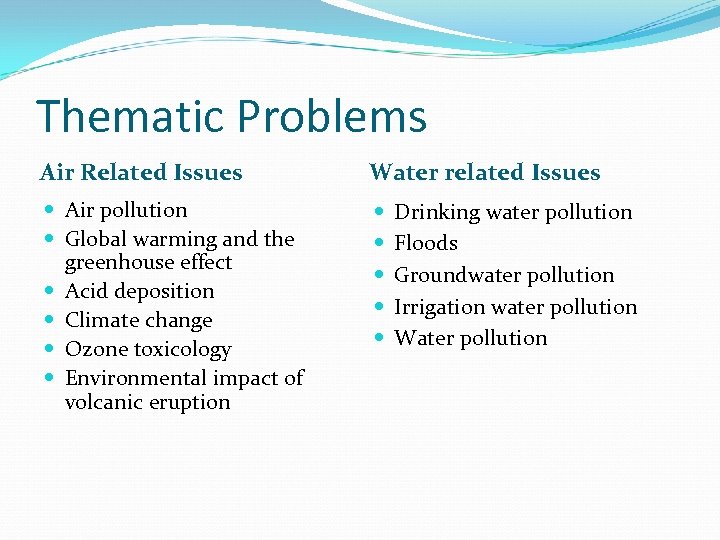 Thematic Problems Air Related Issues Water related Issues Air pollution Global warming and the greenhouse effect Acid deposition Climate change Ozone toxicology Environmental impact of volcanic eruption Drinking water pollution Floods Groundwater pollution Irrigation water pollution Water pollution
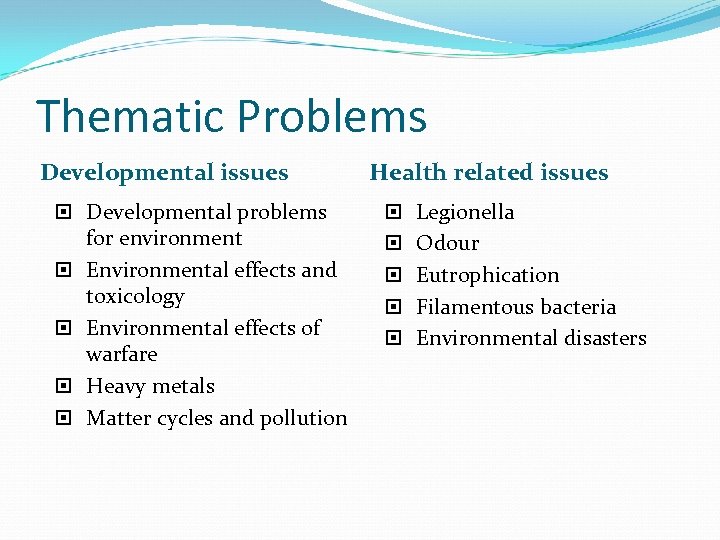 Thematic Problems Developmental issues Developmental problems for environment Environmental effects and toxicology Environmental effects of warfare Heavy metals Matter cycles and pollution Health related issues Legionella Odour Eutrophication Filamentous bacteria Environmental disasters
 Air pollution means the presence of one or more unwanted substances in air. Air pollutants have a negative impacts on humans, animals and plants, and on air quality. The most frequently present categories of air pollutants are sulphur oxides, nitrogen oxides, Volatile Organic Compounds (VOC) and small dust particles (aerosols). Air pollution can be divided in categories according to the source it is derived from: - Biological air pollution, such as pollens, small insects and microrganisms (bacteria, fungi, yeasts and algae) - Physical air pollution, such as sound, smell, thermal pollution and radioactive radiation - Chemical air pollution, such as ozone, aerosols and
 Air pollution undergoes a number of processes: - Emission (contaminants are released into the air) - Transport (contaminants are transported to different locations through air) - Exchange (compounds react with other compounds in air) - Distribution (contaminants are distributed in air) - Emission (contaminants maintain in a certain area) - Deposition (contaminants are deposited in a certain area, on the soil or on objects)
 Air pollution may causes: Acid deposition Eutrophication Smog is a combination of the woods smoke and fog. (summer smog and winter smog) Ozone loss Green House Effects
 Acid deposition It is a general name for a number of phenomena, namely acid rain, acid fog and acid mist and implies both wet and dry (gaseous) precipitation It causes: Chocking plant leave pores (forest loss) Corroding stone and brick walls of buildings and monuments Corroding paper and rubber objects Altering soil chemistry (soil acidification, loss of plant nutrients) Altering the chemical balance of lakes and streams Disrupting fish gill operation (fish deaths) Deteriorating human breathing disorder (asthma, bronchitis, lung oedema)
 Global warming and the greenhouse effect Svante Arrhenius (1859 -1927) in 1896 claimed that fossil fuel combustion may result in enhanced global warming. His main finding: There is a relation between atmospheric carbon dioxide concentrations and temperature. The average surface temperature of the earth is about 15 C (natural greenhouse effect) because of the infrared absorption capacity of water vapor and carbon dioxide. A doubling of the CO 2 concentration would lead to a 5 C temperature rise.
 Global warming Theories Gilbert Plass in 1955: CO 2 has an atmospheric lifetime of approximately 10 years and the ocean could never be the complete sink for all atmospheric CO 2. Increasing the amount of atmospheric carbon dioxide resulted in more absorption of infrared radiation. Water vapor absorbed totally different types of radiation than carbon dioxide. Adding more carbon dioxide to the atmosphere would intercept infrared radiation that is otherwise lost to space, warming the earth.
 Global warming Theories Stephen Schneider had first predicted global warming in 1976. In 1988 it was finally acknowledged that climate was warmer than any period since 1880. The greenhouse effect theory was named and Intergovernmental Panel on Climate Change (IPCC) was founded by the UNEP and the WMO. The IPCC released climate change reports in 1992 and 1996, and the latest revised version in 2001. From 1998 onwards the terminology on the greenhouse effect started to change as a result of media influences. The greenhouse effect as a term was used fewer and people started to refer to theory as either global warming or climate change. In 1998 the Kyoto Protocol (ratified 2001) was negotiated in Kyoto, Japan. It requires participating countries to reduce their anthropogenic greenhouse gas emissions (CO 2, CH 4, N 2 O, HFCs, PFCs, and SF 6) by at least 5% below 1990 levels in the commitment period 2008 to 2012.
 Drinking water pollution Definition, sources and purification of drinking water Endangering quality of drinking water by: Contamination by coliform bacteria indicates that pathogens (disease-causing microorganisms) may enter to the subsurface water Yeasts and viruses such as Giardia or Cryptosporidium in surface water may cause gastrointestinal symptoms and diarrhoeal diseases respectively nitrate contamination cause cyanosis Lead contamination causes lead posioning Legionella bacteria grows at 30 -40 c water and cause Legionella and Pontiac fever
 Main Concepts
 Main concepts Element ( )ﻋﻨﺼﺮ is a fundamental substance that cannot broken down into simpler substances by chemical means. Matter ( )ﻣﺎﺩﻩ is any thing that has mass and taken up space and composed of one element. Compound ( )ﺗﺮکیﺐ is combinations of two or more different elements held together in fixed proportions. Atom is the most smallest of matter in which an element can be divided and still retain its chemical properties. Molecule is a combination of two or more atoms of the same or different elements held together by forces called chemical bonds. Chemical formula is used to show the number of each type of atom or ion in the compound.
 Ecosystem Ecology comes from oikos (living space) and logos (the science of) used by Ernst Haeckel in 1869 Organisms is a living substance on surface layer of earth (biosphere), air (atmosphere), land( lithosphere), , and water (hydrosphere) The ecosystem is composed of various of inputs, processes or stores and outputs. It should maintains its dynamic equilibrium.
 Ecosystem definitions A. G. Tansly definition: A particular category of physical systems consisting of organisms and inorganic components in a relatively stable equilibrium, open and in various kinds and sizes ﻭﺿﻌیﺖ ﺧﺎﺻی ﺍﺯ ﺳیﺴﺘﻤﻬﺎی ﻓیﺰیکی ﻣﺸﺘﻤﻞ ﺑﺮ ﺍﺭگﺎﻧﻬﺎی ﺯﻧﺪﻩ ﻭ ﻣﻮﺍﺩ ﻏیﺮ ﺯﻧﺪﻩ ﺍﺳﺖ کﻪ ﺑﺼﻮﺭﺕ ﺑﺎﺯ ﻭ ﺩﺭ ﺍﻧﺪﺍﺯﻩ ﻭ ﺍﺷکﺎﻝ ﻣﺘﻔﺎﻭﺕ پﺎیﺪﺍﺭی ﺧﻮﺩ ﺭﺍ . ﺑﺼﻮﺭﺕ ﻧﺴﺒی ﺑﺮﻗﺮﺍﺭ ﻣیﺴﺎﺯﺩ I. G Simmons definition: A unit of space-time containing living organisms interacting with each others and with their abiotic environment by the interchange of energy and materials یک ﻣﺠﻤﻮﻋﻪ یکپﺎﺭچﻪ چﻬﺎﺭ ﺑﻌﺪی ﻓﻀﺎ-ﺯﻣﺎﻧی ﻣﺸﺘﻤﻞ ﺑﺮ ﺍﺭگﺎﻧیﺰﻣﻬﺎی ﺯﻧﺪﻩ ﺍﺳﺖ کﻪ ﺩﺭ ﺗﻌﺎﻣﻞ ﺑﺎ یکﺪیگﺮ ﻭ ﺑﺎ ﻣﺤیﻂ ﺍﺑیﻮﺗیک پیﺮﺍﻣﻮﻧی ﺍﻧﺮژی ﻭ
 Environmetal Damages and Valuation
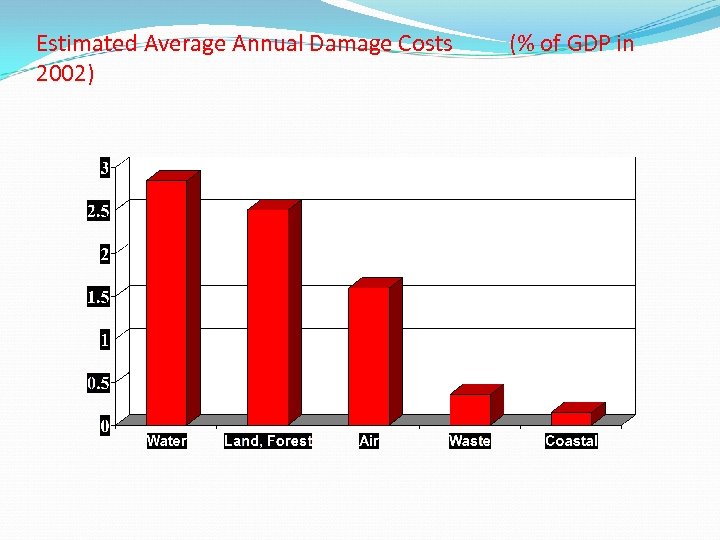 Estimated Average Annual Damage Costs 2002) (% of GDP in
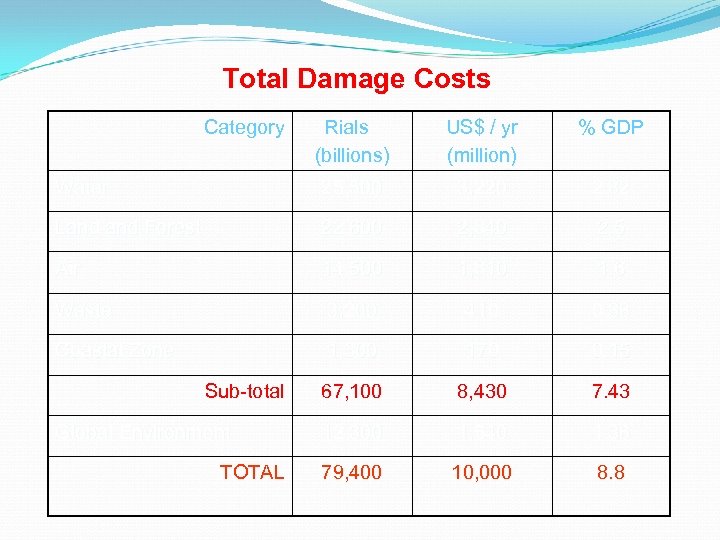 Total Damage Costs Category Rials (billions) US$ / yr (million) % GDP Water 25, 500 3, 220 2. 82 Land Forest 22, 600 2, 840 2. 5 Air 14, 500 1, 810 1. 6 Waste 3, 200 410 0. 36 Coastal Zone 1, 300 170 0. 15 67, 100 8, 430 7. 43 12, 300 1, 540 1. 36 79, 400 10, 000 8. 8 Sub-total Global Environment TOTAL