


 Скачать презентацию Introduction to the Earth System Modeling Framework Data
24805aba962142f827b970821e05813c.ppt
- Количество слайдов: 137
 Introduction to the Earth System Modeling Framework Data Assimilation Cecelia De. Luca cdeluca@ucar. du Nancy Collins nancy@ucar. edu Jon Wolfe jwolfe@ucar. edu January 18 -19, 2005 Climate Weather
 Goals of this Tutorial 1. To give future ESMF users an understanding of the background, goals, and scope of the ESMF project 2. To review the status of the ESMF software implementation and current application adoption efforts 3. To outline the overall design and principles underlying the ESMF software 4. To describe the major classes and functions of ESMF in sufficient detail to give future users an understanding of how ESMF could be utilized in their own codes 5. To describe in steps how a user code prepares for using ESMF, incorporates ESMF, and runs under ESMF 6. To identify ESMF resources available to users such as documentation, mailing lists, and support staff 7. To define what is required for ESMF compliance 8. To examine and work with code examples in order to demonstrate ESMF adoption and use 2
 Specific Topics • • Standard behaviors and interfaces across ESMF Bottom-up and top-down approaches to adoption What it means to become an ESMF Component Defining hierarchical applications with Gridded Components and Coupler Components Creating and manipulating State, Field and Grid classes Setting up applications for sequential or concurrent execution Why there is an ESMF Virtual Machine How to use ESMF utilities such as Time Manager, Log. Err, and Configuration Attributes 3
 ESMF Website http: //www. esmf. ucar. edu See this site for downloads, documentation, references, repositories, meeting schedules, test archives, and just about anything else you need to know about ESMF. References to ESMF documentation in this tutorial correspond to the documentation releases with ESMF Version 2. 1. 0. 4
 1 BACKGROUND, GOALS, AND SCOPE • • • 5 Overview ESMF and the Community The ESMF Organization Goals and Rationale for Adoption Exercises
 Motivation In climate research and NWP. . . increased emphasis on detailed representation of individual physical processes; requires many teams of specialists to contribute components to an overall modeling system In computing technology. . . increase in hardware and software complexity in highperformance computing, as we shift toward the use of scalable computing architectures In software … development of frameworks, such as FMS, GEMS, CCA and WRF, that encourage software reuse and interoperability The ESMF is a focused community effort to tame the complexity of models and the computing environment. It leverages, unifies and extends existing software 6 frameworks, creating new opportunities for scientific contribution
 Background NASA’s Earth Science Technology Office proposed the creation of an Earth System Modeling Framework (ESMF) in the September 2000 NASA Cooperative Agreement Notice (CAN): “Increasing Interoperability and Performance of Grand Challenge Applications in the Earth, Space, Life and Microgravity Sciences” A large, interagency collaboration with roots in the Common Modeling Infrastructure Working Group proposed three interlinked projects to develop and deploy the ESMF, which were all funded: 7 Part I: Core ESMF Development (PI: Killeen, NCAR) Part II: Modeling Applications (PI: Marshall, MIT) Part III: Data Assimilation Applications (PI: da Silva,
 NASA CAN ESMF Project Description GOALS: To increase software reuse, interoperability, ease of use and performance portability in climate, weather, and data assimilation applications PRODUCTS: • Core framework: Software for coupling geophysical components and utilities for building components • Applications: Deployment of the ESMF in 15 of the nation’s leading climate and weather models, assembly of 8 new science-motivated applications Reuse Interoperability Ease of Performance METRICS: Adoption 15 applications use ESMF component coupling services and 3+ utilities 8 8 new applications comprised of never-before coupled components 2 codes adopt ESMF with < 2% lines of code changed, or within 120 FTEhours RESOURCES and TIMELINE: $9. 8 M over 3 years No more than 10% overhead in time to solution, no degradation in scaling
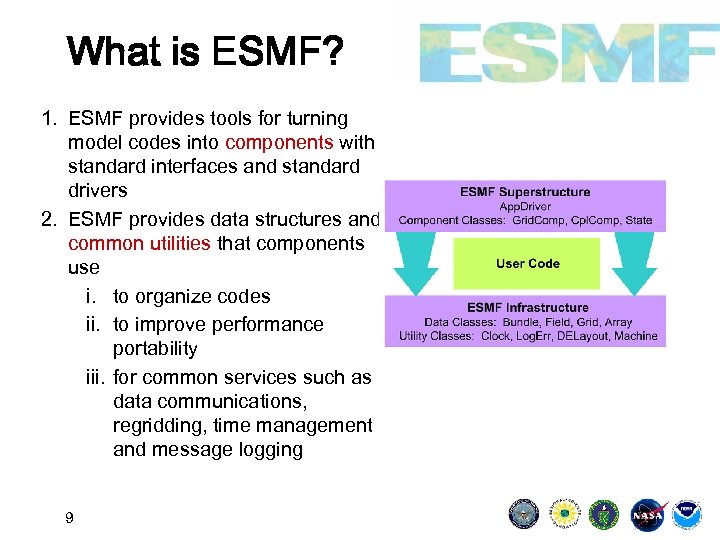 What is ESMF? 1. ESMF provides tools for turning model codes into components with standard interfaces and standard drivers 2. ESMF provides data structures and common utilities that components use i. to organize codes ii. to improve performance portability iii. for common services such as data communications, regridding, time management and message logging 9
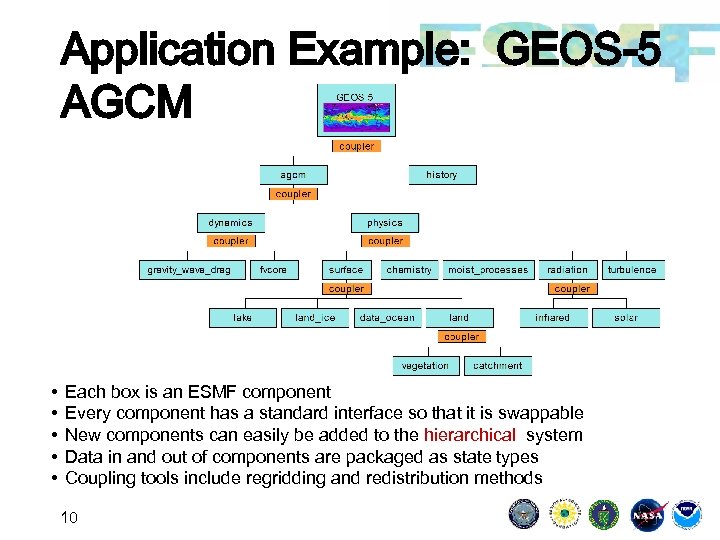 Application Example: GEOS-5 AGCM • • • Each box is an ESMF component Every component has a standard interface so that it is swappable New components can easily be added to the hierarchical system Data in and out of components are packaged as state types Coupling tools include regridding and redistribution methods 10
 1 BACKGROUND, GOALS, AND SCOPE • • • 11 Overview ESMF and the Community The ESMF Organization Goals and Rationale for Adoption Exercises
 ESMF is a Community Effort • Collaborators and customers include: ◦ NSF NCAR ◦ NOAA GFDL, NOAA NCEP ◦ DOE LANL, DOE ANL ◦ NASA GMAO, NASA Land Information Systems, NASA GISS ◦ Do. D Navy, Air Force, and Army (new) ◦ University of Michigan, UCLA, MIT • Users define development priorities • Users actively test and evaluate the framework design and implementation • ~15% of ESMF source code is from user contributions (IO from WRF, resource file manager from GMAO, regridding from Los Alamos) 12
 Open Source Development • Open source license (GPL) • Open source environment (Source. Forge) • Open repositories: web-browsable CVS repositories accessible from the ESMF website ◦ for source code ◦ for contributions (currently porting contributions and performance testing) • Open development priorities and schedule: priorities set based on user meetings, telecons, and mailing list discussions, webbrowsable task lists • Open testing: 1000+ tests are bundled with the ESMF distribution and can be run by users • Open port status: results of nightly tests on many platforms are web-browsable • Open metrics: test coverage, lines of code, requirements status are updated regularly and are web-browsable 13
 Open Source Constraints • ESMF does not allow unmoderated check-ins to its main source CVS repository (though there is minimal check-in oversight for the contributions repository) • ESMF has a co-located, line managed Core Team whose members are dedicated to framework implementation and support – it does not rely on volunteer labor • ESMF actively sets priorities based on user needs and feedback • ESMF requires that contributions follow project conventions and standards for code and documentation • The above are necessary releases and meetings ESMF schedules regular for development to proceed at the pace desired by sponsors and users, and to provide the level of quality and customer support necessary for codes in this domain 14
 Related Projects • PRISM is an ongoing European Earth • CCA is creating a minimal interface and sets of tools for linking high performance system modeling infrastructure project components. CCA can be used to • Involves current state-of-the-art implement frameworks and standards atmosphere, ocean, sea-ice, developed in specific domains (such as atmospheric chemistry, land-surface ESMF). and ocean-biogeochemistry models • Collaborators include LANL, LLNL, • 22 partners: leading climate ORNL, Sandia, University of Tennessee, and many more. Ongoing ESMF researchers and computer vendors, collaboration with CCA/LANL on language includes MPI, KNMI, UK Met Office, interoperability. CERFACS, ECMWF, DMI • ESMF is working with PRISM to merge • Working prototype demonstrating CCA/ESMF interoperability, to be frameworks and develop common presented at SC 2003. conventions 15 For joint use with PRISM, ESMF developed a component database to store component import/export fields and component descriptions
 1 BACKGROUND, GOALS, AND SCOPE • • • 16 Overview ESMF and the Community The ESMF Organization Goals and Rationale for Adoption Exercises
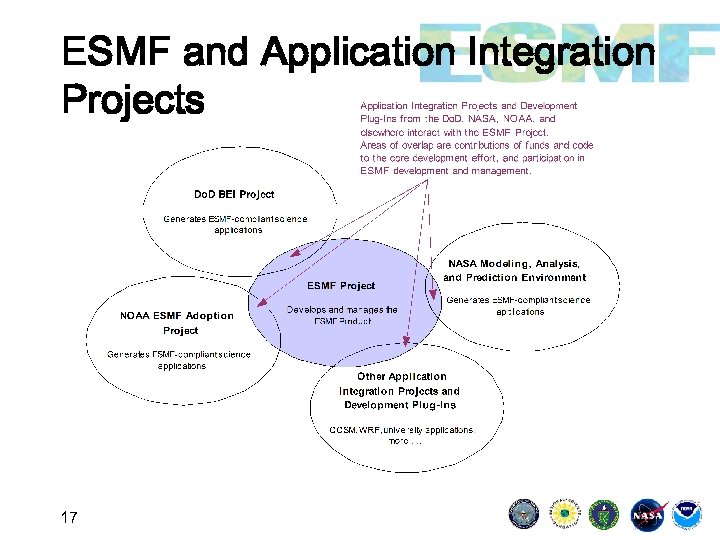 ESMF and Application Integration Projects 17
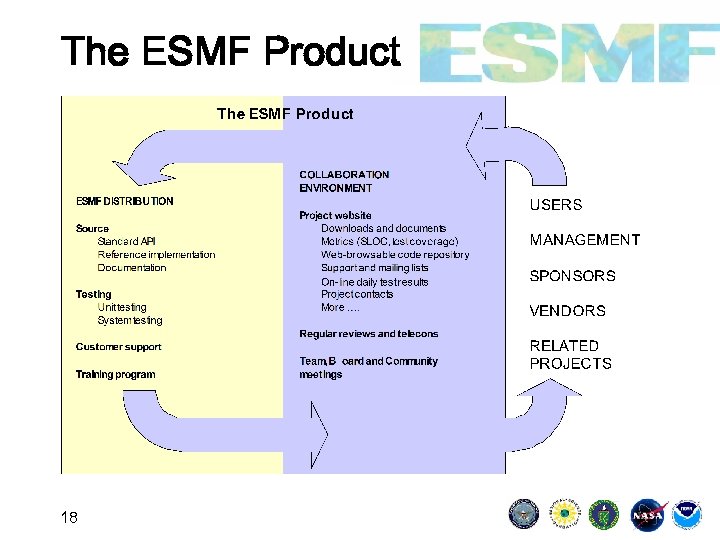 The ESMF Product 18
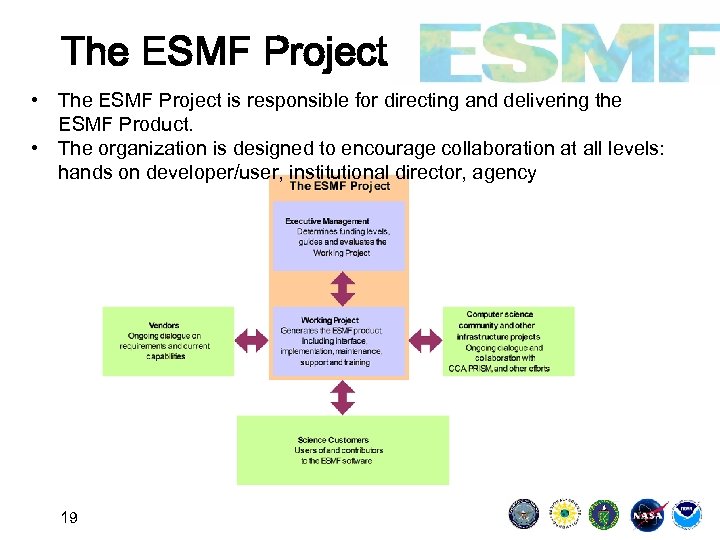 The ESMF Project • The ESMF Project is responsible for directing and delivering the ESMF Product. • The organization is designed to encourage collaboration at all levels: hands on developer/user, institutional director, agency 19
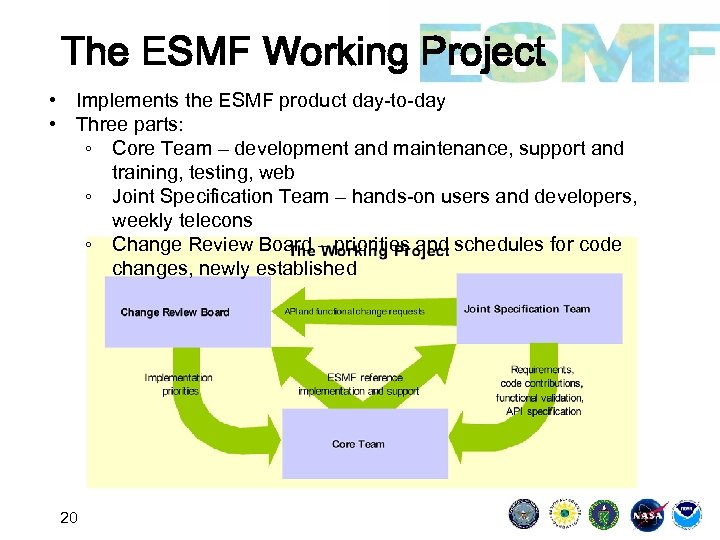 The ESMF Working Project • Implements the ESMF product day-to-day • Three parts: ◦ Core Team – development and maintenance, support and training, testing, web ◦ Joint Specification Team – hands-on users and developers, weekly telecons ◦ Change Review Board – priorities and schedules for code changes, newly established 20
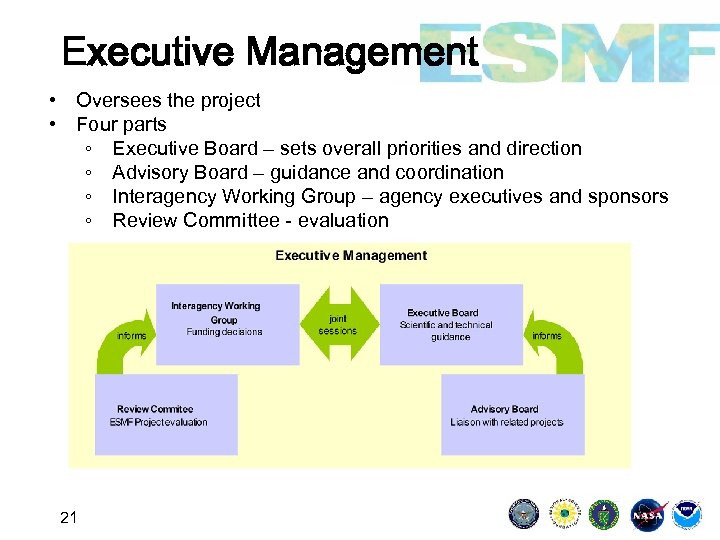 Executive Management • Oversees the project • Four parts ◦ Executive Board – sets overall priorities and direction ◦ Advisory Board – guidance and coordination ◦ Interagency Working Group – agency executives and sponsors ◦ Review Committee - evaluation 21
 More Information For more on the ESMF organization, see the ESMF Draft Project Plan on the ESMF website: http: //www. esmf. ucar. edu > Publications & Talks 22
 1 BACKGROUND, GOALS, AND SCOPE • • • 23 Overview ESMF and the Community The ESMF Organization Goals and Rationale for Adoption Exercises
 ESMF Goals 1. Increase scientific productivity by making modeling and analysis software components much easier to build, combine, and exchange, and by enabling modelers to take full advantage of high-end computers. 2. Unify the national and international Earth system modeling community through a common modeling paradigm and regular interactions at all levels. 24
 Why Should I Adopt ESMF If I Already Have a Working Model? • There is an emerging pool of other ESMF-based science components that you will be able to interoperate with to create applications - a framework for interoperability is only as valuable as the set of groups that use it, and ESMF has a broad customer base. • It will reduce the amount of infrastructure code that you need to maintain and write, and allow you to focus more resources on science development. • ESMF provides solutions to two of the hardest problems in model development: structuring large, multi-component applications so that they are easy to use and extend, and achieving performance portability on a wide variety of parallel architectures. • It may be better software (better features, better performance portability, better tested, better documented and better funded into the future) than the infrastructure software that you are currently using. • 25 Community development and use means that the ESMF software is
 1 BACKGROUND, GOALS, AND SCOPE • • • 26 Overview ESMF and the Community The ESMF Organization Goals and Rationale for Adoption Exercises
 Exercises 1. Sketch a diagram of the major components in your application and how they are connected. 2. Introduction of tutorial participants. 27
 Application Diagram 28
 2 STATUS OF DEVELOPMENT AND APPLICATIONS • • • 29 Development Status and Priorities Performance NASA CAN ESMF Project Status BEI Codes Exercises
 ESMF Development Status • Overall architecture is well-defined and well-accepted • Components and low-level communications stable • Logically rectangular grids with regular and arbitrary distributions implemented • On-line parallel regridding (bilinear, 1 st order conservative) completed and optimized • Other parallel methods, e. g. halo, redistribution, low-level comms implemented • Utilities such as time manager, logging, and configuration manager usable and adding features • Virtual machine with uniform interface to shared / distributed memory implemented, hooks for load balancing implemented 30
 ESMF Platform Support • • • IBM AIX (32 and 64 bit addressing) SGI IRIX 64 (32 and 64 bit addressing) SGI Altix (64 bit addressing) Cray X 1 (64 bit addressing) Compaq OSF 1 (64 bit addressing) Linux Intel (32 and 64 bit addressing, with mpich and lam) Linux PGI (32 bit addressing, with mpich) Linux NAG (32 bit addressing, with mpich) Linux Absoft (32 bit addressing, with mpich) Linux Lahey (32 bit addressing, with mpich) Mac OS X with xlf (32 bit addressing, with lam) 31
 ESMF Distribution Summary • • • Fortran interfaces and complete documentation Many C++ interfaces, no manuals yet Serial or parallel execution (mpiuni stub library) Sequential or concurrent execution SPMD support 32
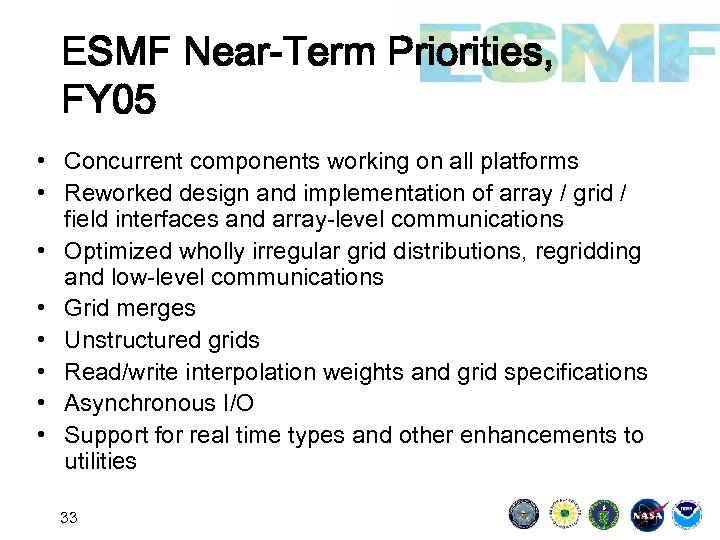 ESMF Near-Term Priorities, FY 05 • Concurrent components working on all platforms • Reworked design and implementation of array / grid / field interfaces and array-level communications • Optimized wholly irregular grid distributions, regridding and low-level communications • Grid merges • Unstructured grids • Read/write interpolation weights and grid specifications • Asynchronous I/O • Support for real time types and other enhancements to utilities 33
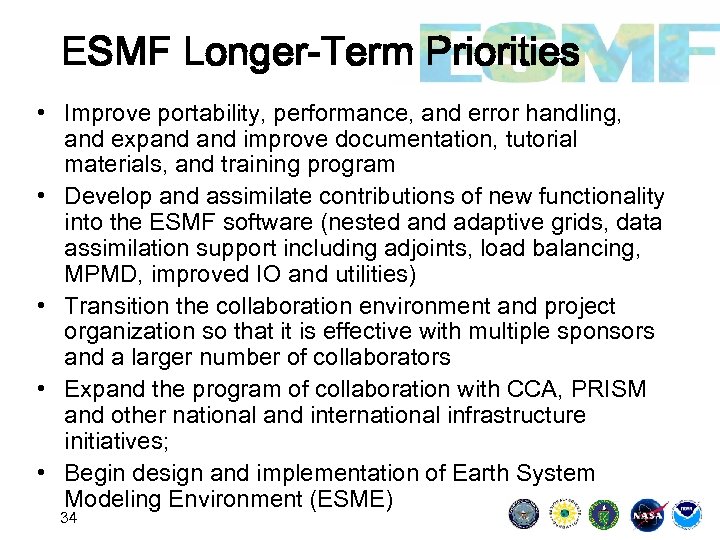 ESMF Longer-Term Priorities • Improve portability, performance, and error handling, and expand improve documentation, tutorial materials, and training program • Develop and assimilate contributions of new functionality into the ESMF software (nested and adaptive grids, data assimilation support including adjoints, load balancing, MPMD, improved IO and utilities) • Transition the collaboration environment and project organization so that it is effective with multiple sponsors and a larger number of collaborators • Expand the program of collaboration with CCA, PRISM and other national and international infrastructure initiatives; • Begin design and implementation of Earth System Modeling Environment (ESME) 34
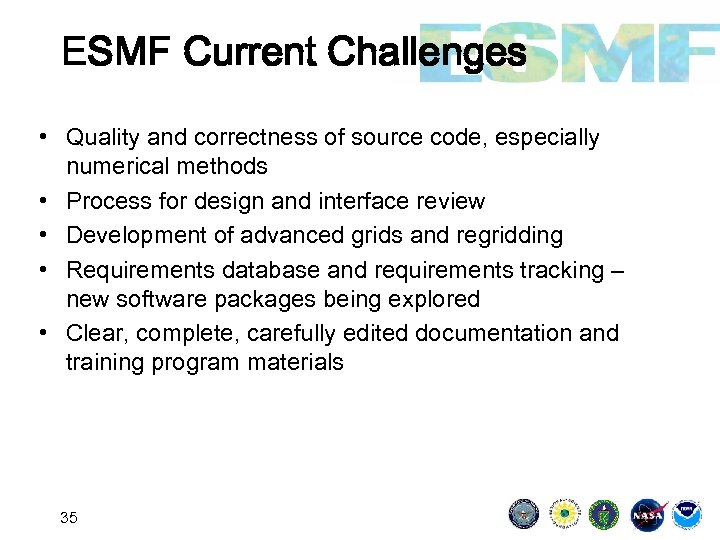 ESMF Current Challenges • Quality and correctness of source code, especially numerical methods • Process for design and interface review • Development of advanced grids and regridding • Requirements database and requirements tracking – new software packages being explored • Clear, complete, carefully edited documentation and training program materials 35
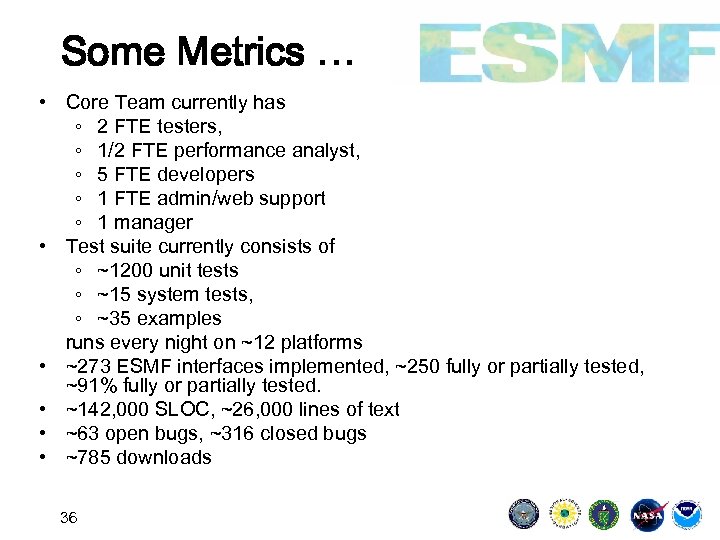 Some Metrics … • Core Team currently has ◦ 2 FTE testers, ◦ 1/2 FTE performance analyst, ◦ 5 FTE developers ◦ 1 FTE admin/web support ◦ 1 manager • Test suite currently consists of ◦ ~1200 unit tests ◦ ~15 system tests, ◦ ~35 examples runs every night on ~12 platforms • ~273 ESMF interfaces implemented, ~250 fully or partially tested, ~91% fully or partially tested. • ~142, 000 SLOC, ~26, 000 lines of text • ~63 open bugs, ~316 closed bugs • ~785 downloads 36
 More Information For more on scheduling and releases, see the on -line listing: http: //www. esmf. ucar. edu > Development Tasks are on the ESMF Source. Forge site, under ESMF Core Tasks. 37
 2 STATUS OF DEVELOPMENT AND APPLICATIONS • • • 38 Development Status and Priorities Performance NASA CAN ESMF Project Status BEI Codes Exercises
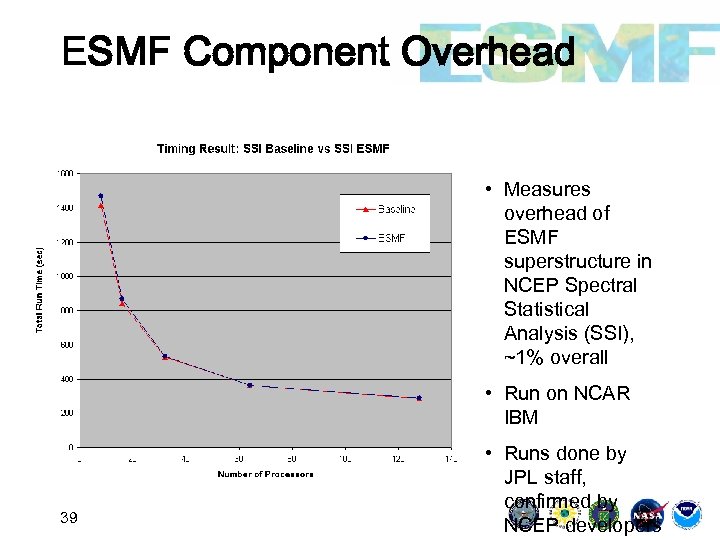 ESMF Component Overhead • Measures overhead of ESMF superstructure in NCEP Spectral Statistical Analysis (SSI), ~1% overall • Run on NCAR IBM 39 • Runs done by JPL staff, confirmed by NCEP developers
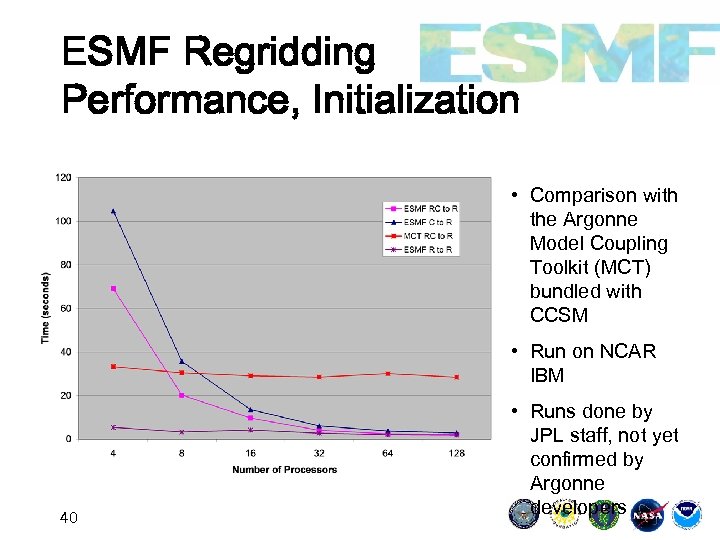 ESMF Regridding Performance, Initialization • Comparison with the Argonne Model Coupling Toolkit (MCT) bundled with CCSM • Run on NCAR IBM 40 • Runs done by JPL staff, not yet confirmed by Argonne developers
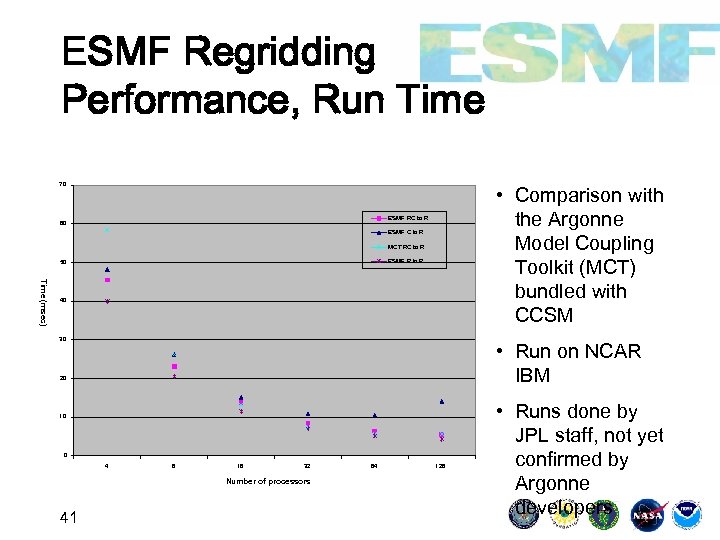 ESMF Regridding Performance, Run Time Figure 2. Regrid Run Time Comparison between ESMF and MCT 70 • Comparison with the Argonne Model Coupling Toolkit (MCT) bundled with CCSM ESMF RC to R 60 ESMF C to R MCT RC to R ESMF R to R 50 Time (msec) 40 30 • Run on NCAR IBM 20 10 0 4 8 16 32 Number of processors 41 64 128 • Runs done by JPL staff, not yet confirmed by Argonne developers
 2 STATUS OF DEVELOPMENT AND APPLICATIONS • • • 42 Development Status and Priorities Performance NASA CAN ESMF Project Status BEI Codes Exercises
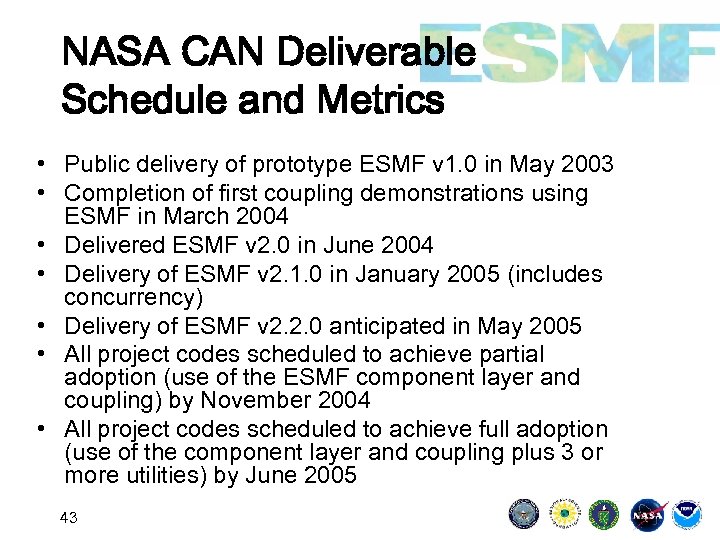 NASA CAN Deliverable Schedule and Metrics • Public delivery of prototype ESMF v 1. 0 in May 2003 • Completion of first coupling demonstrations using ESMF in March 2004 • Delivered ESMF v 2. 0 in June 2004 • Delivery of ESMF v 2. 1. 0 in January 2005 (includes concurrency) • Delivery of ESMF v 2. 2. 0 anticipated in May 2005 • All project codes scheduled to achieve partial adoption (use of the ESMF component layer and coupling) by November 2004 • All project codes scheduled to achieve full adoption (use of the component layer and coupling plus 3 or more utilities) by June 2005 43
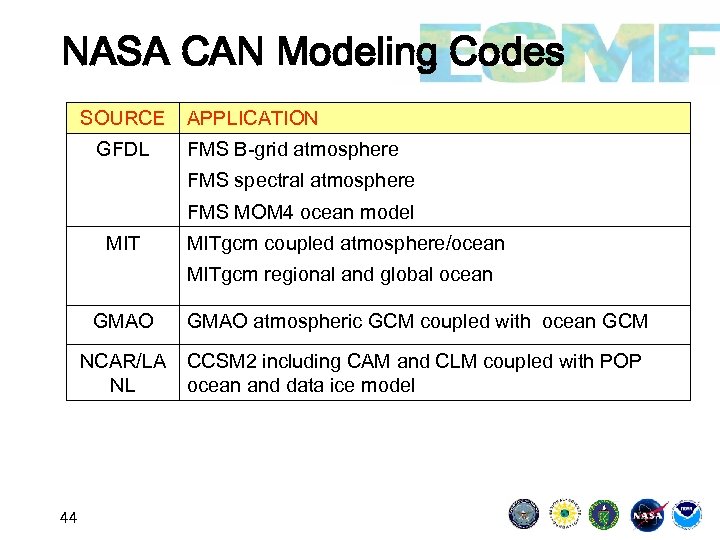 NASA CAN Modeling Codes SOURCE GFDL APPLICATION FMS B-grid atmosphere FMS spectral atmosphere FMS MOM 4 ocean model MITgcm coupled atmosphere/ocean MITgcm regional and global ocean GMAO NCAR/LA NL 44 GMAO atmospheric GCM coupled with ocean GCM CCSM 2 including CAM and CLM coupled with POP ocean and data ice model
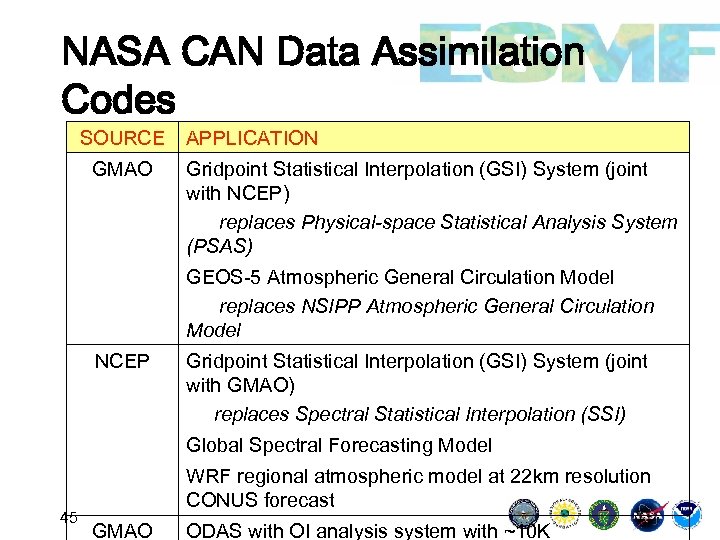 NASA CAN Data Assimilation Codes SOURCE GMAO APPLICATION Gridpoint Statistical Interpolation (GSI) System (joint with NCEP) replaces Physical-space Statistical Analysis System (PSAS) GEOS-5 Atmospheric General Circulation Model replaces NSIPP Atmospheric General Circulation Model NCEP Gridpoint Statistical Interpolation (GSI) System (joint with GMAO) replaces Spectral Statistical Interpolation (SSI) Global Spectral Forecasting Model 45 WRF regional atmospheric model at 22 km resolution CONUS forecast GMAO ODAS with OI analysis system with ~10 K
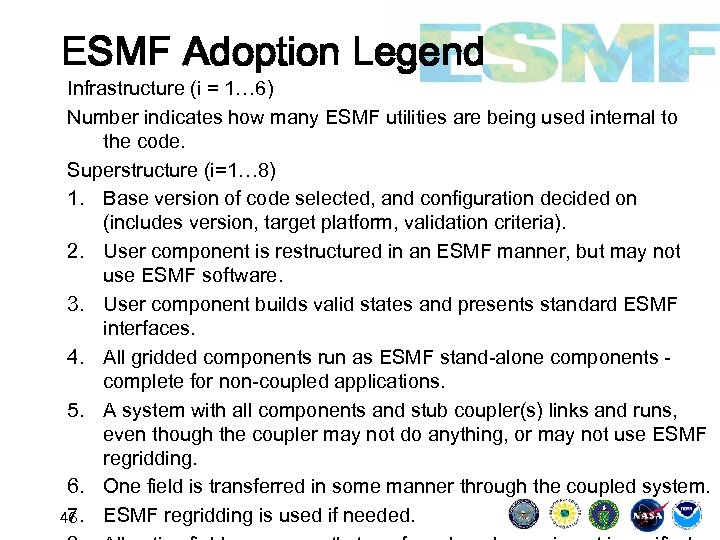 ESMF Adoption Legend Infrastructure (i = 1… 6) Number indicates how many ESMF utilities are being used internal to the code. Superstructure (i=1… 8) 1. Base version of code selected, and configuration decided on (includes version, target platform, validation criteria). 2. User component is restructured in an ESMF manner, but may not use ESMF software. 3. User component builds valid states and presents standard ESMF interfaces. 4. All gridded components run as ESMF stand-alone components complete for non-coupled applications. 5. A system with all components and stub coupler(s) links and runs, even though the coupler may not do anything, or may not use ESMF regridding. 6. One field is transferred in some manner through the coupled system. 7. ESMF regridding is used if needed. 46
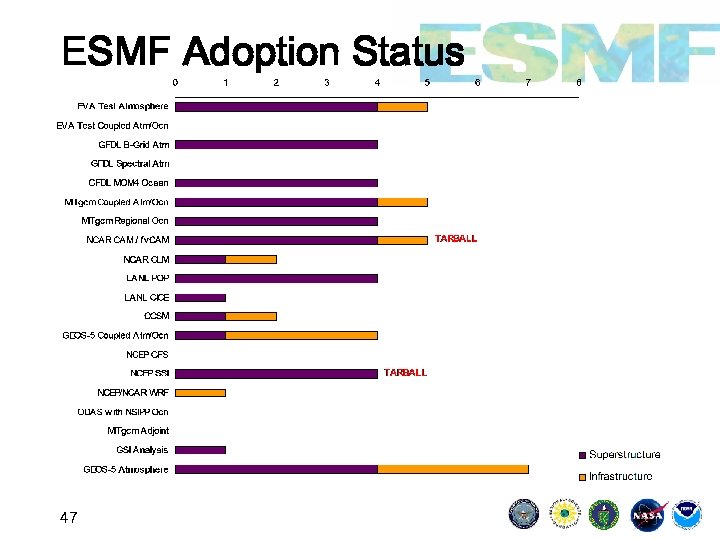 ESMF Adoption Status 47
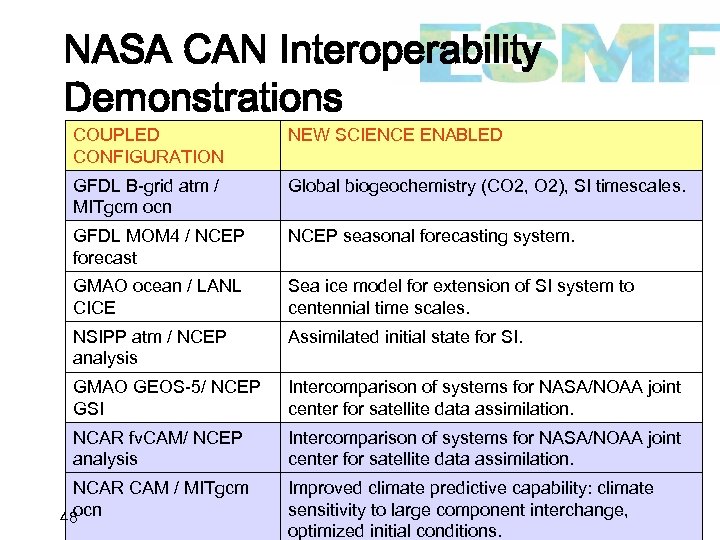 NASA CAN Interoperability Demonstrations COUPLED CONFIGURATION NEW SCIENCE ENABLED GFDL B-grid atm / MITgcm ocn Global biogeochemistry (CO 2, O 2), SI timescales. GFDL MOM 4 / NCEP forecast NCEP seasonal forecasting system. GMAO ocean / LANL CICE Sea ice model for extension of SI system to centennial time scales. NSIPP atm / NCEP analysis Assimilated initial state for SI. GMAO GEOS-5/ NCEP GSI Intercomparison of systems for NASA/NOAA joint center for satellite data assimilation. NCAR fv. CAM/ NCEP analysis Intercomparison of systems for NASA/NOAA joint center for satellite data assimilation. NCAR CAM / MITgcm ocn 48 Improved climate predictive capability: climate sensitivity to large component interchange, optimized initial conditions.
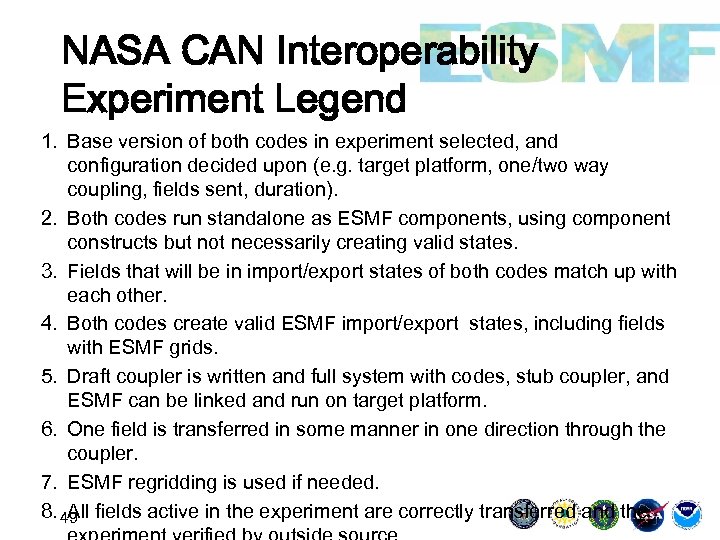 NASA CAN Interoperability Experiment Legend 1. Base version of both codes in experiment selected, and configuration decided upon (e. g. target platform, one/two way coupling, fields sent, duration). 2. Both codes run standalone as ESMF components, using component constructs but not necessarily creating valid states. 3. Fields that will be in import/export states of both codes match up with each other. 4. Both codes create valid ESMF import/export states, including fields with ESMF grids. 5. Draft coupler is written and full system with codes, stub coupler, and ESMF can be linked and run on target platform. 6. One field is transferred in some manner in one direction through the coupler. 7. ESMF regridding is used if needed. 8. 49 fields active in the experiment are correctly transferred and the All
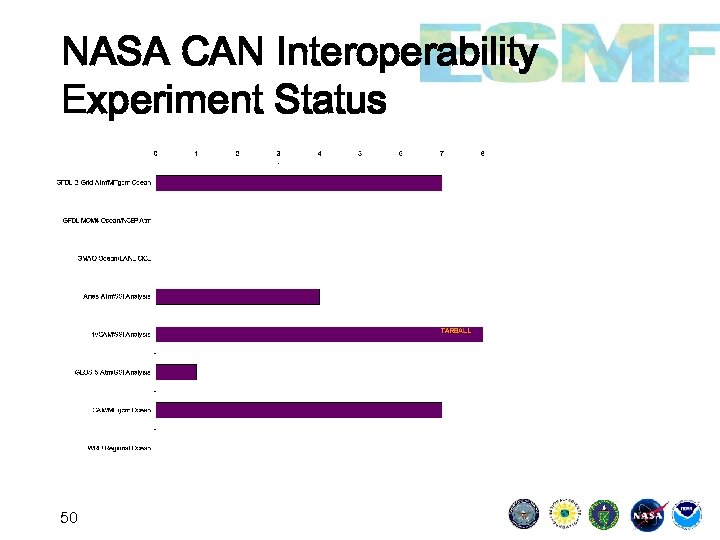 NASA CAN Interoperability Experiment Status 50
 2 STATUS OF DEVELOPMENT AND APPLICATIONS • • • 51 Development Status and Priorities Performance NASA CAN ESMF Project Status BEI Codes Exercises
 Select BEI Modeling Codes SOURCE APPLICATION Navy Hybrid Coordinate Ocean Model (HYCOM) Navy Coastal Ocean Model (NCOM) Navy Layered Ocean Model (NLOM) Coupled Ocean Atmosphere Mesoscale Prediction System (COAMPS) Global and regional Wave Model (WAM) Advanced Circulation coastal and estuarine model (ADCIRC) Air Force HAF Kinematic Solar Wind Global Assimilation of Ionospheric Measurements (GAIM) 52
 2 STATUS OF DEVELOPMENT AND APPLICATIONS • • • 53 Development Status and Priorities Performance NASA CAN ESMF Project Status BEI Codes Exercises
 Exercises 1. Locate on the ESMF website: • The Reference Manual, User’s Guide and Developer’s Guide • The Project Plan • The current task list • The modules in the contributions repository • The weekly regression test schedule • Known bugs from the last public release • The % of public interfaces tested • The schedule of Early Adopter (Users Group) meetings • The ESMF Support Policy 54
 3 DESIGN AND PRINCIPLES OF ESMF • Computational Characteristics of Weather and Climate • Design Strategies • Parallel Computing Definitions • Framework-Wide Behavior • Required Methods • Class Structure • Exercises 55
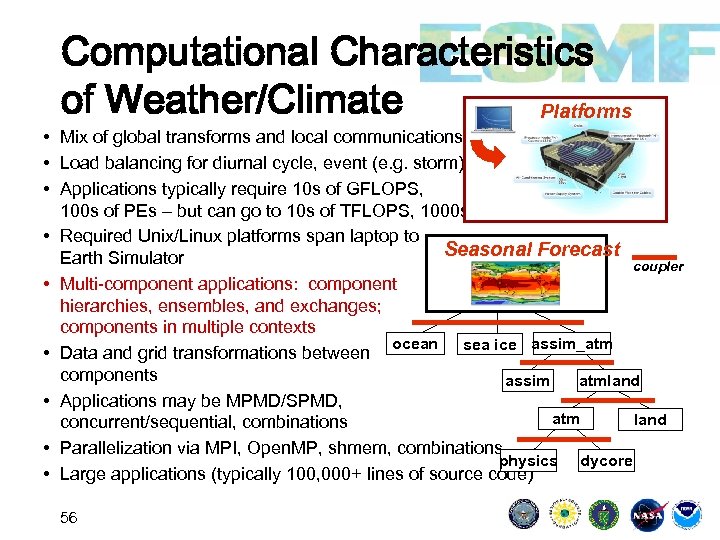 Computational Characteristics of Weather/Climate Platforms • Mix of global transforms and local communications • Load balancing for diurnal cycle, event (e. g. storm) tracking • Applications typically require 10 s of GFLOPS, 100 s of PEs – but can go to 10 s of TFLOPS, 1000 s of PEs • Required Unix/Linux platforms span laptop to Seasonal Forecast Earth Simulator coupler • Multi-component applications: component hierarchies, ensembles, and exchanges; components in multiple contexts ocean sea ice assim_atm • Data and grid transformations between components assim atmland • Applications may be MPMD/SPMD, atm land concurrent/sequential, combinations • Parallelization via MPI, Open. MP, shmem, combinations physics dycore • Large applications (typically 100, 000+ lines of source code) 56
 3 DESIGN AND PRINCIPLES OF ESMF • Computational Characteristics of Weather and Climate • Design Strategies • Parallel Computing Definitions • Framework-Wide Behavior • Required Methods • Class Structure • Exercises 57
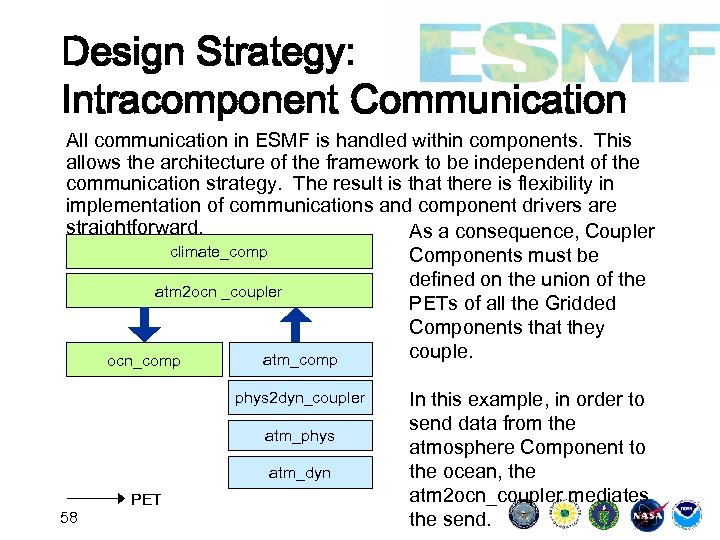 Design Strategy: Intracomponent Communication All communication in ESMF is handled within components. This allows the architecture of the framework to be independent of the communication strategy. The result is that there is flexibility in implementation of communications and component drivers are straightforward. As a consequence, Coupler climate_comp Components must be defined on the union of the atm 2 ocn _coupler PETs of all the Gridded Components that they couple. atm_comp ocn_comp phys 2 dyn_coupler atm_phys atm_dyn PET 58 In this example, in order to send data from the atmosphere Component to the ocean, the atm 2 ocn_coupler mediates the send.
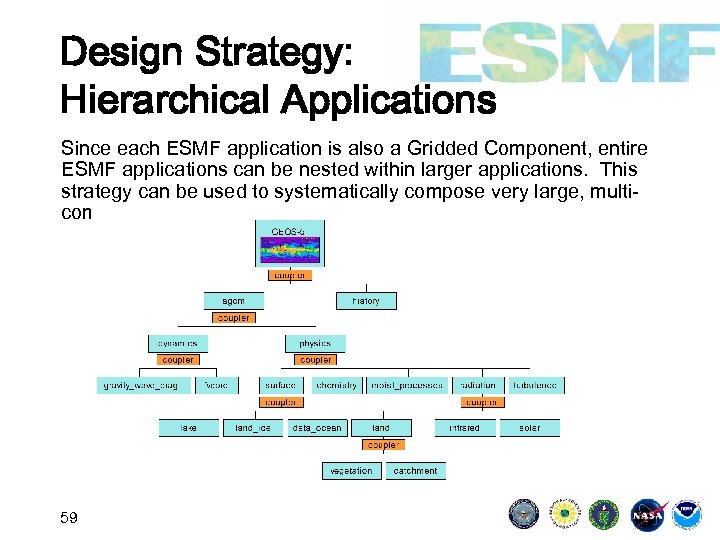 Design Strategy: Hierarchical Applications Since each ESMF application is also a Gridded Component, entire ESMF applications can be nested within larger applications. This strategy can be used to systematically compose very large, multicomponent codes. 59
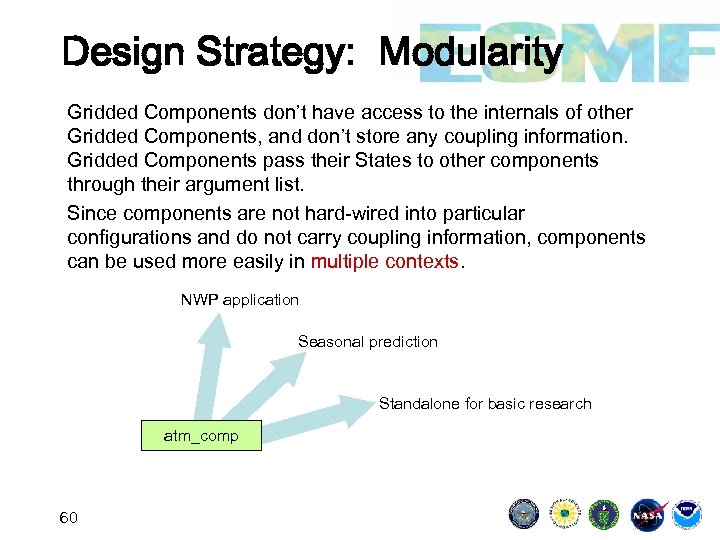 Design Strategy: Modularity Gridded Components don’t have access to the internals of other Gridded Components, and don’t store any coupling information. Gridded Components pass their States to other components through their argument list. Since components are not hard-wired into particular configurations and do not carry coupling information, components can be used more easily in multiple contexts. NWP application Seasonal prediction Standalone for basic research atm_comp 60
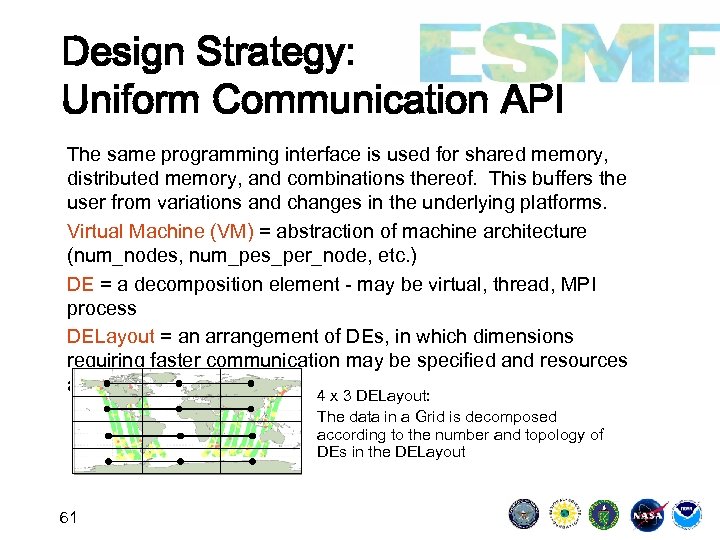 Design Strategy: Uniform Communication API The same programming interface is used for shared memory, distributed memory, and combinations thereof. This buffers the user from variations and changes in the underlying platforms. Virtual Machine (VM) = abstraction of machine architecture (num_nodes, num_pes_per_node, etc. ) DE = a decomposition element - may be virtual, thread, MPI process DELayout = an arrangement of DEs, in which dimensions requiring faster communication may be specified and resources arranged accordingly 4 x 3 DELayout: The data in a Grid is decomposed according to the number and topology of DEs in the DELayout 61
 3 DESIGN AND PRINCIPLES OF ESMF • Computational Characteristics of Weather and Climate • Design Strategies • Parallel Computing Definitions • Framework-Wide Behavior • Required Methods • Class Structure • Exercises 62
 Elements of Parallelism • Decomposition Element (DE) ◦ In ESMF a decomposition is represented as a set of Decomposition Elements (DEs). ◦ A decomposition that has four pieces in the x direction and three pieces in the y direction would be 4 x 3 DEs ◦ A DE is not tied to a particular chunk of data ◦ A DE is not tied to a particular processor or other compute resource ◦ Sets of DEs are represented by the DELayout class • Persistent Execution Thread (PET) ◦ Path for executing an instruction sequence ◦ Sets of PETs are represented by the Virtual Machine (VM) class • Processing Element (PE) ◦ The smallest physical processing unit available on a particular hardware platform 63
 Modes of Parallelism • Serial vs parallel ◦ Serial code runs on one Persistent Execution Thread (PET) ◦ Parallel code runs on multiple PETs • Sequential vs concurrent ◦ In sequential mode components run one after the other on the same set of PETs ◦ In concurrent mode components run at the same time on different sets of PETs • SPMD vs MPMD ◦ In Single Program Multiple Datastream (SPMD) mode the same program runs across all PETs in the application - components may run sequentially or concurrently. ◦ In Multiple Program Multiple Datastream (MPMD) mode the application consists of separate programs launched as separate executables - components may run concurrently or sequentially, but in this mode almost always run concurrently 64
 Local vs Global • Global means across the whole object or the whole application, depending on the context • Local must be qualified in ESMF ◦ PE local? ◦ PET local? ◦ DE local? 65
 3 DESIGN AND PRINCIPLES OF ESMF • Computational Characteristics of Weather and Climate • Design Strategies • Parallel Computing Definitions • Framework-Wide Behavior • Required Methods • Class Structure • Exercises 66
 Framework-Wide Behavior ESMF has a set of interfaces and behaviors that hold across the entire framework. This consistency helps make the framework easier to learn and understand. For more information, see Sections 6 -8 in the Reference Manual. 67
 Classes and Objects in ESMF • The ESMF Application Programming Interface (API) is based on the object-oriented programming notion of a class. A class is a software construct that’s used for grouping a set of related variables together with the subroutines and functions that operate on them. We use classes in ESMF because they help to organize the code, and often make it easier to maintain and understand. • A particular instance of a class is called an object. For example, Field is an ESMF class. An actual Field called temperature is an object. 68
 Classes and Fortran • The Fortran interface is implemented so that the variables associated with a class are stored in a derived type. For example, an ESMF_Field derived type stores the data array, grid information, and metadata associated with a physical field. • The derived type for each class is stored in a Fortran module, and the operations associated with each class are defined as module procedures. We use the Fortran features of generic functions and optional arguments extensively to simplify our interfaces. 69
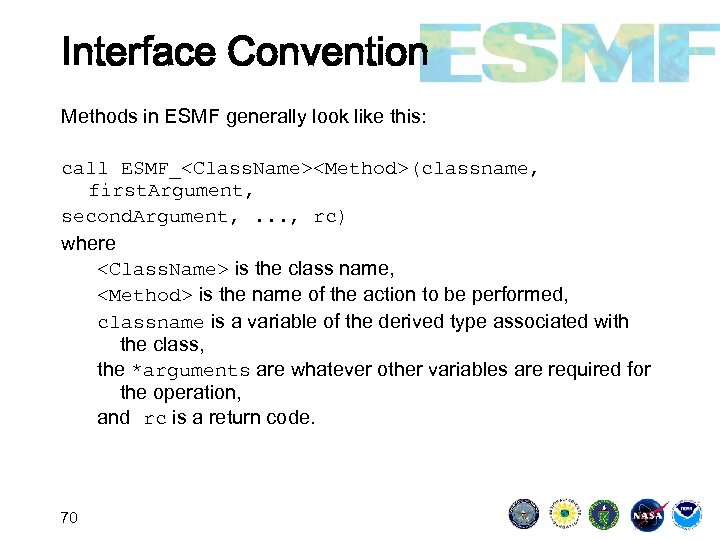 Interface Convention Methods in ESMF generally look like this: call ESMF_
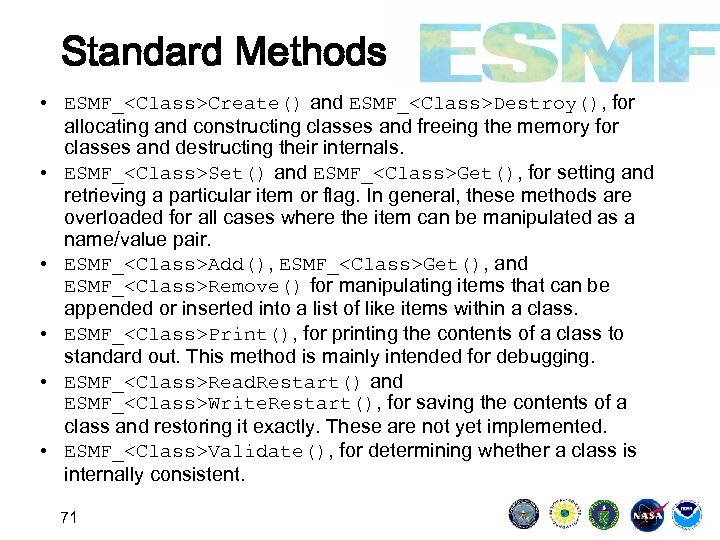 Standard Methods • ESMF_
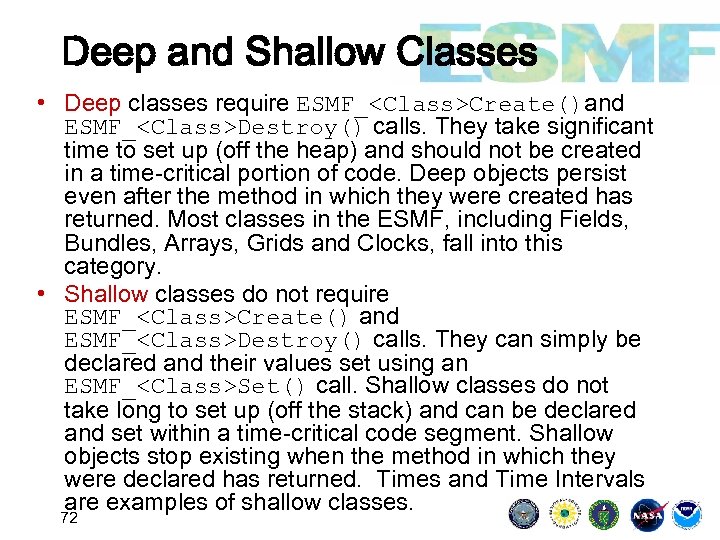 Deep and Shallow Classes • Deep classes require ESMF_
 3 DESIGN AND PRINCIPLES OF ESMF • Computational Characteristics of Weather and Climate • Design Strategies • Parallel Computing Definitions • Framework-Wide Behavior • Required Methods • Class Structure • Exercises 73
 Required Calls • The modules for ESMF are bundled together and can be accessed with a single USE statement, USE ESMF_Mod. • ESMF_Initialize() and ESMF_Finalize() are required methods that must bracket the use of ESMF within an application. They manage the resources required to run ESMF and shut it down gracefully. 74
 Initialize, Run, and Finalize • ESMF_
 Set. Services • Every ESMF_
 Set. Services (cont. ) • The set services subroutine name is not predefined (it does not need to be “Set. Services” - it is set by the component writer. • The names of the initialize, run, and finalize user-code subroutines do not need to be public - in fact it is far better for them to be private to lower the chances of public symbol clashes between different components. • Within the set services routine, the user can also register a private data block by calling the ESMF_
 3 DESIGN AND PRINCIPLES OF ESMF • Computational Characteristics of Weather and Climate • Design Strategies • Parallel Computing Definitions • Framework-Wide Behavior • Required Methods • Class Structure • Exercises 78
 ESMF Class Structure Grid. Comp Land, ocean, atm, … model State Data imported or exported Cpl. Comp Xfers between Grid. Comps Superstructure Bundle Collection of fields Field Physical field, e. g. pressure Regrid Infrastructure Computes interp weights Grid Log. Rect, Unstruct, etc. Array Hybrid F 90/C++ arrays Phys. Grid Math description Dist. Grid decomposition DELayout Communications F 90 Route Stores comm paths Utilities Virtual Machine, Time. Mgr, Log. Err, IO, Config. Attr, Base etc. Data 79 C++ Communications
 Current Class Hierarchy 80
 Planned Changes 81
 3 DESIGN AND PRINCIPLES OF ESMF • Computational Characteristics of Weather and Climate • Design Strategies • Parallel Computing Definitions • Framework-Wide Behavior • Required Methods • Class Structure • Exercises 82
 Exercises 1. Download ESMF. 2. Compile. (Specific instructions given during class. ) 83
 4 CLASSES AND FUNCTIONS • • 84 ESMF Superstructure Classes ESMF Infrastructure Classes: Data Structures ESMF Infrastructure Classes: Utilities Exercises
 ESMF Superstructure Classes See Sections 12 -16 in the Reference Manual. • Gridded Component ◦ Models, data assimilation systems - “real code” • Coupler Component ◦ Data transformations and transfers between Gridded Components • State – Packages of data sent between Components • Application Driver – Generic driver 85
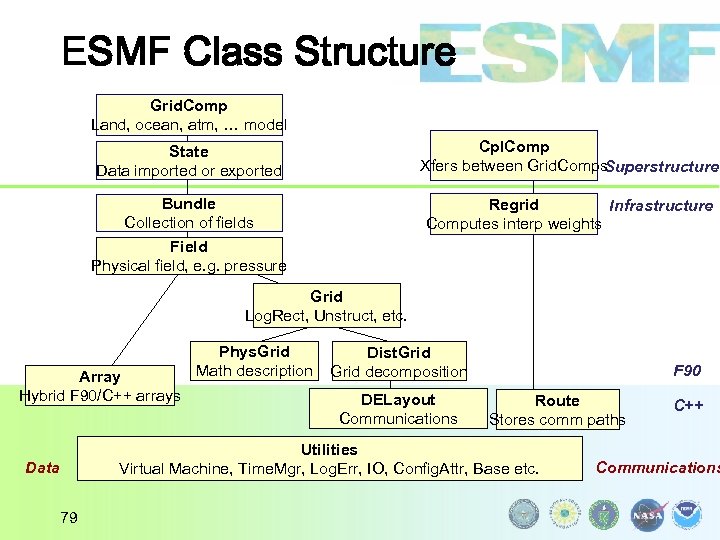
 ESMF Components • An ESMF component has two parts, one that is supplied by the ESMF and one that is supplied by the user. The part that is supplied by the framework is an ESMF derived type that is either a Gridded Component (Grid. Comp) or a Coupler Component (Cpl. Comp). • A Gridded Component typically represents a physical domain in which data is associated with one or more grids - for example, a sea ice model. • A Coupler Component arranges and executes data transformations and transfers between one or more Gridded Components. • Gridded Components and Coupler Components have standard methods, which include initialize, run, and finalize. These methods can be multi-phase. 86
 ESMF Components (cont. ) • The second part of an ESMF component is user code, such as a model or data assimilation system. Users set entry points within their code so that it is callable by the framework. In practice, setting entry points means that within user code there are calls to ESMF methods that associate the name of a Fortran subroutine with a corresponding standard ESMF operation. • EXAMPLE A user-written initialization routine called pop. Ocean. Init might be associated with the standard initialize routine of an ESMF Gridded Component named “POP” that represents an ocean model. 87
 ESMF Gridded Components • Gridded Components are models, data assimilation systems, diagnostics, etc. • Gridded Components can be nested • Gridded Components can be run as ensembles • Depending on how the current code is structured, may be possible to wrap without structural changes • Or might use ESMF conversion as a reason to make structural changes! • States for import/export • Sequential and concurrent modes of execution possible • Registration routine (Set. Services) to associate user code routines with standard ESMF intialize/run/finalize methods 88
 ESMF Coupler Components • Coupler Components perform the transformations and transfers between Gridded Components • States for import/export • Not automatic - must to be customized for each new configuration • Expected to be thin, however - making use of the transformation routines in ESMF 89
 ESMF States • All data passed between Components is in the form of States and States only • Description/reference to other ESMF data objects • Data is referenced so does not need to be duplicated • Can be Bundles, Fields, Arrays, States, or nameplaceholders 90
 Application Driver • Small, generic program that contains the “main” for an ESMF application. 91
 4 CLASSES AND FUNCTIONS • • 92 ESMF Superstructure Classes ESMF Infrastructure Classes: Data Structures ESMF Infrastructure Classes: Utilities Exercises
 ESMF Infrastructure Data Classes Model data is contained in a hierarchy of multi-use classes. The user can reference a Fortran array to an Array or Field, or retrieve a Fortran array out of an Array or Field. • Array – holds a Fortran array (with other info, such as halo size) • Field – holds an Array, an associated Grid, and metadata • Bundle – collection of Fields on the same Grid bundled together for convenience, data locality, latency reduction during communications Supporting these data classes is the Grid class, which represents a numerical grid 93
 Grids See Section 25 in the Reference Manual for interfaces and examples. • The ESMF Grid class represents all aspects of the computational domain and its decomposition in a parallelprocessing environment It has methods to internally generate a variety of simple grids • The ability to read in more complicated grids provided by a user is not yet implemented • ESMF Grids are currently assumed to be two-dimensional, logically-rectangular horizontal grids, with an optional vertical grid whose coordinates are independent of those of the horizontal grid • Each Grid is assigned a staggering in its create method call, which helps define the Grid according to typical Arakawa nomenclature. 94
 Arrays • • See Section 22 in the Reference Manual for interfaces and examples. The Array class represents a multidimensional array. An Array can be real, integer, or logical, and can possess up to seven dimensions. The Array can be strided. The first dimension specified is always the one which varies fastest in linearized memory. Arrays can be created, destroyed, copied, and indexed. Communication methods, such as redistribution and halo, are also defined. 95
 Fields See Section 20 in the Reference Manual for interfaces and examples. • A Field represents a scalar physical field, such as temperature. • ESMF does not currently support vector fields, so the components of a vector field must be stored as separate Field objects. • The ESMF Field class contains the discretized field data, a reference to its associated grid, and metadata. • The Field class provides methods for initialization, setting and retrieving data values, I/O, general data redistribution and regridding, standard communication methods such as gather and scatter, and manipulation of attributes. 96
 Bundles See Section 18 in the Reference Manual for interfaces and examples. • The Bundle class represents “bundles” of Fields that are discretized on the same Grid and distributed in the same manner. • Fields within a Bundle may be located at different locations relative to the vertices of their common Grid. • The Fields in a Bundle may be of different dimensions, as long as the Grid dimensions that are distributed are the same. • In the future Bundles will serve as a mechanism for performance optimization. ESMF will take advantage of the similarities of the Fields within a Bundle in order to implement collective communication, IO, and regridding. 97
 ESMF Communications See Section 27 in the Reference Manual for a summary of communications methods. • Halo ◦ Updates edge data for consistency between partitions • Redistribution ◦ No interpolation, only changes how the data is decomposed • Regrid ◦ Based on SCRIP package from Los Alamos ◦ Methods include bilinear, conservative • Bundle, Field, Array-level interfaces 98
 ESMF Data. Map Classes These classes give the user a systematic way of expressing interleaving and memory layout, also hierarchically (partially implemented, rework expected) • Array. Data. Map – relation of array to decomposition and grid, row / column major order, complex type interleave • Field. Data. Map – interleave of vector components • Bundle. Data. Map – interleave of Fields in a Bundle 99
 4 CLASSES AND FUNCTIONS • • 100 ESMF Superstructure Classes ESMF Infrastructure Classes: Data Structures ESMF Infrastructure Classes: Utilities Exercises
 ESMF Utilities • • Time Manager Configuration Attributes (replaces namelists) Message logging Communication libraries Regridding library (parallelized, on-line SCRIP) IO (barely implemented) Performance profiling (not implemented yet, may simply use Tau) 101
 Time Manager See Sections 32 -37 in the Reference Manual for more information. Time manager classes are: • Calendar • Clock • Time Interval • Alarm These can be used independent of other classes in ESMF. 102
 Calendar A Calendar can be used to keep track of the date as an ESMF Gridded Component advances in time. Standard calendars (such as Gregorian and 360 -day) and user-specified calendars are supported. Calendars can be queried for quantities such as seconds per day, days per month, and days per year. Supported calendars are: • Gregorian The standard Gregorian calendar, proleptic to 3/1/4800. • no-leap The Gregorian calendar with no leap years. • Julian Day A Julian days calendar. • 360 -day A 30 -day-per-month, 12 -month-per-year calendar. • no calendar Tracks only elapsed model time in seconds. 103
 Clock and Alarm Clocks collect the parameters and methods used for model time advancement into a convenient package. A Clock can be queried for quantities such as start time, stop time, current time, and time step. Clock methods include incrementing the current time, and determining if it is time to stop. Alarms identify unique or periodic events by “ringing” returning a true value - at specified times. For example, an Alarm might be set to ring on the day of the year when leaves start falling from the trees in a climate model. 104
 Time and Time Interval A Time represents a time instant in a particular calendar, such as November 28, 1964, at 7: 31 pm EST in the Gregorian calendar. The Time class can be used to represent the start and stop time of a time integration. Time Intervals represent a period of time, such as 300 milliseconds. Time steps can be represented using Time Intervals. 105
 Clock Creation and Timestepping See Section 36. 2 in the Reference Manual for examples and interfaces. 106
 Config Attributes See Section 38 in the Reference Manual for interfaces and examples. • ESMF Configuration Management is based on NASA DAO’s Inpak 90 package, a Fortran 90 collection of routines/functions for accessing Resource Files in ASCII format. • The package is optimized for minimizing formatted I/O, performing all of its string operations in memory using Fortran intrinsic functions. 107
 Log. Err See Section 39 in the Reference Manual for interfaces and examples. • The Log class consists of a variety of methods for writing error, warning, and informational messages to files. • A default Log is created at ESMF initialization. Other Logs can be created later in the code by the user. • A set of standard return codes and associated messages are provided for error handling. • Log. Err will automatically put timestamps and PET numbers into the Log. 108
 Log. Err Options • Buffering allows for writing to a file immediately or storing entries in a buffer. The buffer will either write when full, or when the user calls an ESMF_Log. Flush() method. • The user has the capability to halt the program on an error or on a warning by using the ESMF_Log. Set() method with the halt property ◦ ESMF_LOG_HALTWARNING - the program will stop on any and all warnings or errors ◦ ESMF_LOG_HALTERROR - the program will only halt on errors ◦ ESMF_LOG_HALTNEVER – the program will run through errors • Single or multi file (per PET) option for writing messages 109
 Virtual Machine (VM) See Section 41 in the Reference Manual for VM interfaces and examples. • VM handles resource allocation • Elements are Persistent Execution Threads or PETs • PETs reflect the physical computer, and are oneto-one with Posix threads or MPI processes • Parent Components assign PETs to child Components • The VM communications layer does simple MPIlike communications between PETs (alternative communication mechanisms are layered 110
 DELayout • See Section 40 in the Reference Manual for interfaces and examples. • Handles decomposition • Elements are Decomposition Elements, or DEs (decomposition that’s 2 pieces in x by 4 pieces in y is a 2 by 4 DELayout) • DELayout maps DEs to PETs, can have more than one DE per PET (for cache blocking, user-managed Open. MP threading) • Simple connectivity or more complex connectivity, with weights between DEs - users specify dimensions where greater connection speed is needed • Array, Field, and Bundle methods perform inter-DE communications 111
 4 CLASSES AND FUNCTIONS • • 112 ESMF Superstructure Classes ESMF Infrastructure Classes: Data Structures ESMF Infrastructure Classes: Utilities Exercises
 Exercises 1. Go to the ESMF main source repository via the website (from Development). 2. Select Browse the CVS Tree. 3. Change directory to esmf, which is the ESMF distribution. 4. Change directory to build_config, to view directories for supported platforms. 5. Return to the next level up by clicking on [cvs]/esmf/build_config. 6. Change directory to src and locate the Infrastructure and Superstructure directories. 7. Note that code is arranged by class within these directories, and that each class has a standard set of subdirectories (doc, examples, include, interface, src, and tests, plus a makefile). This way of browsing the ESMF source code shows all directories, even empty ones. 113
 5 PREPARING FOR AND USING ESMF • Adoption Strategies • Exercises 114
 Adoption Strategies: Top Down 1. Decide how to organize the application as discrete Gridded and Coupler Components. The developer might need to reorganize code so that individual components are cleanly separated and their interactions consist of a minimal number of data exchanges. 2. Divide the code for each component into initialize, run, and finalize methods. These methods can be multi-phase, e. g. , init_1, init_2. 3. Pack any data that will be transferred between components into ESMF Import and Export State data structures. 4. The user must describe the distribution of grids over resources on a parallel computer via the VM and DELayout. 5. Pack time information into ESMF time management data structures. 6. Using code templates provided in the ESMF distribution, create ESMF Gridded and Coupler Components to represent each component in the user code. 7. Write a set services routine that sets ESMF entry points for each user component’s initialize, run, and finalize methods. 8. Run the application using an ESMF Application Driver. 115
 Adoption Strategies: Bottom Up Adoption of infrastructure utilities and data structures can follow many different paths. The calendar management utility is a popular place to start, since there is enough functionality in the ESMF time manager to merit the effort required to integrate it into codes and bundle it with an application. 116
 ESMF Quickstart • • Directory with the shell of an application 2 Gridded Components 1 Coupler Component 1 top-level Gridded Component 1 App. Driver main program 117
 5 PREPARING FOR AND USING ESMF • Adoption Strategies • Exercises 118
 Exercises Following the User’s Guide: • Run unit tests and system tests. • Run examples. • Run demo. 119
 6 RESOURCES • • • 120 Documentation User Support Testing and Validation Pages Mailing Lists Users Meetings Exercises
 Documentation • Users Guide ◦ Installation, quick start and demo, architectural overview, glossary • Reference Manual ◦ Overall framework rules and behavior ◦ Method interfaces, usage, examples, and restrictions ◦ Design and implementation notes • Developers Guide ◦ Documentation and code conventions ◦ Definition of compliance • Requirements Document • Implementation Report ◦ C++/Fortran interoperation strategy • (Draft) Project Plan ◦ Goals, organizational structure, activities 121
 Documentation • Latex and html documents are automatically generated from code and comments in the ESMF source code using the PROTEX tool from NASA • The Reference Manual, Users Guide and Requirements Document are archived with the source code in the main ESMF CVS repository and bundled with each release • These documents can be built by the user with the make utility (latex, latex 2 html, and dvipdf are needed) • Code examples from the documentation, quick start, and demo are regression tested nightly and automatically updated 122
 User Support • ALL requests go through the esmf_support@ucar. edu list so that they can be archived and tracked • Support policy is on the ESMF website • Support archives and bug reports are on the ESMF website see http: //www. esmf. ucar. edu > Development Bug reports are under Bugs and support requests are under Lists. 123
 Testing and Validation Pages • Accessible from the Development link on the ESMF website • Detailed explanations of system tests • Supported platforms and information about each • Links to regression test archives • Weekly regression test schedule 124
 Mailing Lists To Join • esmf_jst@ucar. edu Joint specification team discussion ◦ Release and review notices ◦ Technical discussion ◦ Coordination and planning • esmf_info@ucar. edu General information ◦ Quarterly updates • esmf_community@ucar. edu Community announcements ◦ Annual meeting announcements 125
 Mailing Lists To Write • esmf@ucar. edu Project leads ◦ Non-technical questions ◦ Project information • esmf_support@ucar. edu Technical questions and comments 126
 Users Meetings • Every six weeks ESMF Early Adopters meet at GFDL • Meeting schedule is on the ESMF website http: //www. esmf. ucar. edu > Community 127
 6 RESOURCES • • • 128 Documentation User Support Testing and Validation Pages Mailing Lists Users Meetings Exercises
 Exercises 1. Subscribe to mailing lists. 129
 7 COMPLIANCE • Definitions • Exercises 130
 Compliance • Compliance and adoption are used interchangeably in documents • Definitions result from negotiation with NASA program staff and apply to the ESMF / NASA contractual obligation • Partial compliance and full compliance defined • Partial compliance means use of the superstructure layer ◦ User code structured as discrete components with initialize, run, and finalize methods ◦ Data to be transferred between components packaged as ESMF States ◦ User code wrapped as ESMF Gridded and Coupled Components ◦ Application sequenced using ESMF Application Driver • Full compliance means partial compliance plus using three or more utilities • Full compliance is not appropriate for all codes 131
 Partial Compliance • • In order to achieve partial compliance, a JMC code component must implement, or adopt default implementations, of the complete set of standard ESMF component interface methods including the following capabilities: It must be able to be instantiated in parallel configurations. It must provide implementations of methods for creation, deletion, configuration, initialization, finalization, run, read and write restart, and others as necessary for control by an ESMF application framework. It must provide method implementations to allow it to be queried for its distribution, state (i. e. fields available for export, fields required for import, etc. ), run status and other pertinent information. Communication with other JMC code components must be mediated by an ESMF coupler component using framework communication services, such that neither JMC component needs to maintain information about the specific component that it is being coupled to. 132
 Partial Compliance (cont. ) • Data and information to be exchanged with other JMC code components must be provided through ESMF constructs and utilities (i. e. ESMF state, bundles, elds, time, grid, decomposition, etc. ) These must include pertinent metadata information and provide a standard format for exchanging information. JMC code components must use the public interface methods provided by the ESMF utilities and constructs and not directly manipulate their internal data. • The JMC components must be able to accept ESMF time management information. • Data and information to be exchanged with other JMC code components must be provided through ESMF constructs and utilities (i. e. ESMF state, bundles, elds, grid, etc. ) These must include pertinent metadata information and provide a standard format for exchanging information. JMC code components must use the public interface methods provided by the ESMF utilities and not directly manipulate the internal data of those utilities. 133
 Full Compliance • • A fully compliant JMC code component must satisfy all requirements described for partial compliance. In addition, a fully compliant component must: Extensively use internally three or more utilities from the following set: I/O, parameter specification, log/error, performance profiling, time management, grid communication services. Adopt the standard ESMF grid communication services and constructs internally to the extent necessary to allow interoperability with other compliant weather, climate, and data assimilation components. Adopt design features that eliminate or minimize as much as possible the potential for name space conflicts of variables, methods, etc. between components. Adopt design features that eliminate or minimize as much as possible the potential for I/O conflicts between components during reads/writes of configuration, state, errors, logs, performance analysis, etc. 134
 7 COMPLIANCE • Definitions • Exercises 135
 Exercises 1. Consider what level of compliance is appropriate for your application. 2. Consider whether you would use a top-down or bottom-up strategy for adoption. 136
 8 CODE EXAMPLES • Users discuss adoption of ESMF in their applications with ESMF staff. 137