 Скачать презентацию Introduction to Telecommunications Babak Esfandiari with material by
7c47ffbb30a61c8c87b671b780c285b3.ppt
- Количество слайдов: 21



Introduction to Telecommunications Babak Esfandiari (with material by Roger Impey and Qusay Mahmoud)
Introduction l A distributed systems consists of a collection of computers linked together by a network l Distributed system software enables computers to coordinate activities and share resources (software, hardware, data)
Internetworking l l Network: a set of computers and peripherals (printers, modems, etc. ) connected together by a medium. (direct or indirect connection). Network architecture: – Devices in same room or building (LAN) vs. WAN
Communication Protocols To communicate any two entities requires establishing certain rules that can be expressed by a communication protocol. l syntax l semantics l timing and synchronization
Protocol Stacks The protocol stack separates the communicating application from aspects of communication that are irrelevant to that application. l l The International Standardization Organization (ISO) proposed the Open System Interconnection (OSI) communication model. The Internet does NOT strictly follow the OSI model!
Protocol Stacks (2) l l Each layer presents a set of services for the layer immediately above it and can use the services provided by the layer immediately below it. The services are accessed through service access points (SAP). At each layer, certain control information is attached to the message. This is called a header. data + header = protocol data unit (PDU) – the size of the message passing through the protocol stack increases at each layer!
Protocol Stacks (3) l Message headers may contain info needed for: – – – – Connection control Addressing Segmentation and re-assembly Sequencing Error recovery Flow control Multiplexing
Connection Control l Two fundamental types of protocols: – Connection-less l l l – Each PDU is handled and routed independently The message is called a datagram Many different routing algorithms (static vs adaptive) Connection oriented l a virtual circuit (VC) is maintained for the duration of the communication
Addressing l l Need to indicate the destination of the message Other info: – – Addressing level (e. g. IP address) Mode l l l Unicast Multicast Broadcast
Segmentation and Re-assembly l l Long messages are cut into smaller chunks Header indicates chunk number
Sequencing l l Must maintain chronological sequence of messages to conform to protocol! Header contains sequence number
Error Recovery l l l Can use sequence number to detect loss of message Request for re-send Buffering within “window” of opportunity to limit re-send requests
Flow Control l Producer might be too fast for consumer! Need to tell producer to stop or slow down More generally: congestion control
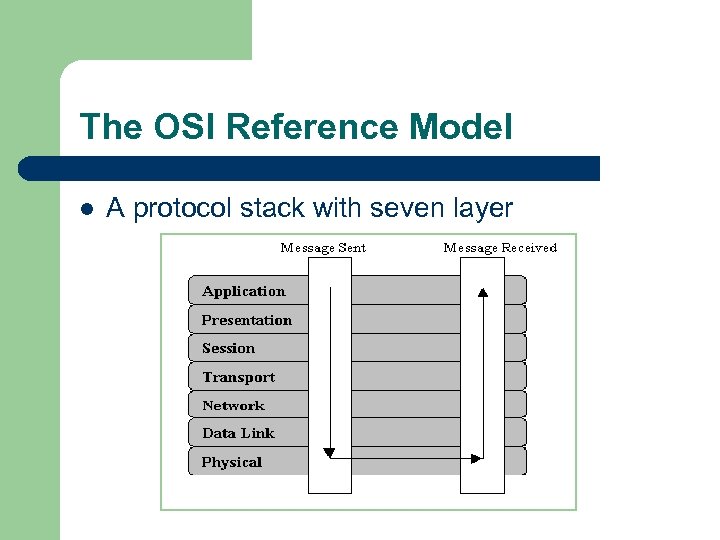
The OSI Reference Model l A protocol stack with seven layer
Internet vs OSI l Driven by Internet Engineering Task Force (IETF) – l l l The Internet addresses layers 3 and up Layers 5, 6 and 7 are collapsed into one Application Layer Network Layer: the Internet Protocol (IP) – l l IETF issues Requests for Comments (RFCs) Routing: RIP, BGP, OSPF… Transport Layer: TCP/IP and UDP/IP Application layer: ftp, smtp, http, snmp…
Naming and Routing l l l To make datagram delivery possible, each computer on the net is assigned a unique address This address could be symbolic (e. g. www. yahoo. com) or numeric IP (216. 32. 74. 50) IP addresses are 32 -bit numeric identifiers containing network and host identifiers The identifiers uniquely identify the network and a host on that network Translation from symbolic names to IP addresses is done through a naming service (DNS)
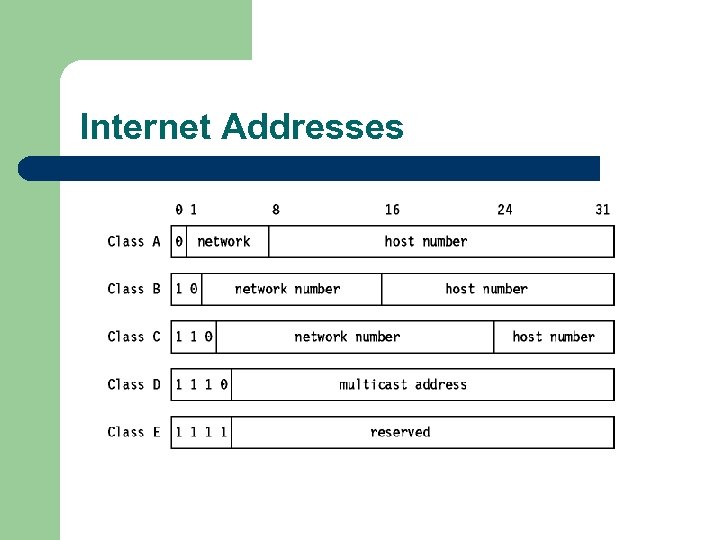
Internet Addresses
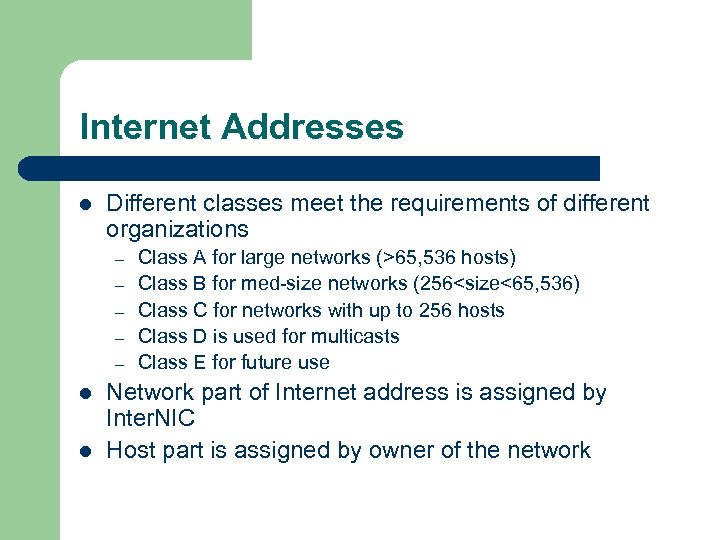
Internet Addresses l Different classes meet the requirements of different organizations – – – l l Class A for large networks (>65, 536 hosts) Class B for med-size networks (256<size<65, 536) Class C for networks with up to 256 hosts Class D is used for multicasts Class E for future use Network part of Internet address is assigned by Inter. NIC Host part is assigned by owner of the network
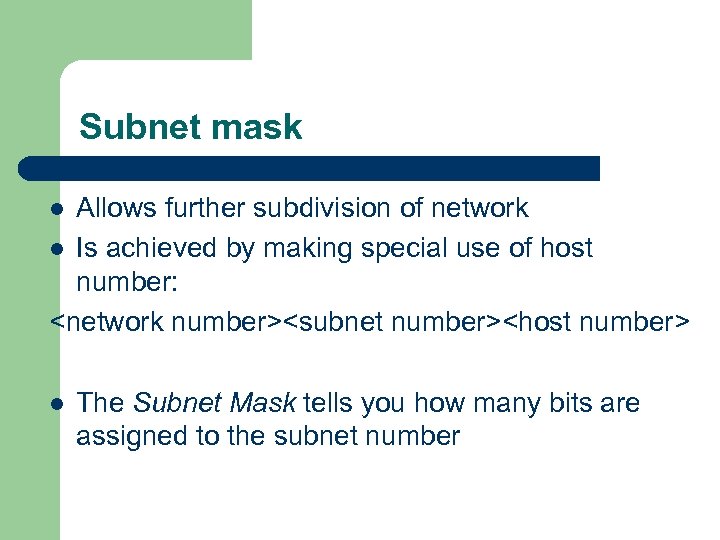
Subnet mask Allows further subdivision of network l Is achieved by making special use of host number: <network number><subnet number><host number> l l The Subnet Mask tells you how many bits are assigned to the subnet number
/etc/host l l Type: cat /etc/host in a Unix system What do you see?
Resolving Internet Addresses l The java. net. Inet. Address class
Скачать презентацию Introduction to Telecommunications Babak Esfandiari with material by
7c47ffbb30a61c8c87b671b780c285b3.ppt