


 Скачать презентацию INTRODUCTION TO T T ELECTRICAL WIRING CODE TTS 171
88042e0f4d4b60fd222a6c60db95c3f0.ppt
- Количество слайдов: 36
 INTRODUCTION TO T&T ELECTRICAL WIRING CODE TTS 171: PART 1: 2002 By GEORGE SAMPSON ELECTRICAL INSPECTOR III GOVERNMENT ELECTRICAL INSPECTORATE
 What is the T&T Wiring Code? • Revised edition of TTS: 26 20 5051978 • REQUIREMENTS FOR THE ELECTRICAL WIRING OF BUILDINGS AND EQUIPMENT • More Comprehensive • Additional technical information.
 WHO BENEFITS? • Electrical Fraternity members and clients AREAS • Designing • Planning • The actual installation of a wiring system
 SCOPE • COVERS: Installations up to 600 volts • NOT COVERED: Installations operated by Authorities for the Generation & Distribution of electrical power such as: § Powergen § Inn. Cogen § T&TEC
 ENFORCEMENT HOW? • The CEI is the authority with jurisdiction • Interpretation • Enforcement of this standard
 CONFLICT • If ever, any conflict arises between TTS 171 and any other standard, the CEI shall be the sole arbitrator and his decision shall be final
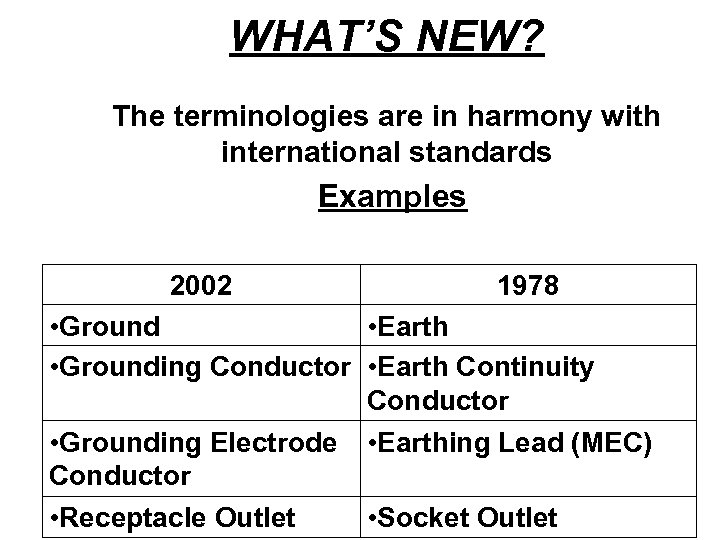 WHAT’S NEW? The terminologies are in harmony with international standards Examples 2002 1978 • Ground • Earth • Grounding Conductor • Earth Continuity Conductor • Grounding Electrode • Earthing Lead (MEC) Conductor • Receptacle Outlet • Socket Outlet
 WHAT’S NEW ? ( Cont’d ) • Ground Fault Circuit Interrupter & Ground Fault Protection of equipment are also new to the list of definitions.
 ANNEX C • Revision of TTS 1978 ( Table 21 ) • Guidelines on sub-circuit requirements for: • Residential • Commercial • Industrial Installations
 • Simple Formulae and Worked Example for voltage drop calculation ( section D. 1. 7. 3) • New • It to this standard was included to assist with the application of the Voltage Drop Tables
 ANNEX E Maximum conductor fill for Conduits & Boxes Consider a practical case: Install the following conductors within a common raceway: • 6 x 1. 5 mm sq. • 8 x 2. 5 mm sq. • 4 x 6. 0 mm sq. • 6 x 4. 0 mm sq.
 Comply with section 6. 2. 7 • A space factor of 40% is not to be exceeded. • The cables are not to be damaged. • No more than two ( 2 ) 90 degrees bends are allowed along the conduit work.
 DISTRIBUTION AND PROTECTION (Section 4. 1. 1) • Every consumer’s installation shall be adequately controlled by a service disconnect. i. e. Main Switch or Circuit Breaker • Does this requirement apply to systems utilizing standby power from a Generator?
 • The CEI requires that all wiring systems are to comply with section 4. 1. 1 whether they utilize a standby Generator or not. • In addition, those with standby power must incorporate suitable Transfer Equipment.
 Why Transfer Equipment? • This is to prevent the inadvertent or accidental interconnection of the normal (T&TEC) and the standby ( Generator) sources of power.
 HIGHLIGHTS FROM OTHER SECTIONS OF THE CODE
 MARKINGS • Section 3. 10. 1 requires each piece of electrical apparatus and material to bear such markings to identify it • To ensure its suitability for the particular application
 Examples of Markings • Manufacturers’ name, trademark, or other recognized symbols of identification • Rated load in amperes • Rated frequency or frequency ranges in hertz • Whether for continuous load or intermittent
 Consequences of failure to conform to technical data • Persons could receive a severe electric shock • Explosion or fire may occur • Serious injury may occur from a fall or flying objects • Electrocution is also a very, very real possibility
 The foregoing are sufficient reasons to be meticulous when selecting equipment and materials.
 GROUNDING ELECTRODE CONDUCTOR & GROUNDING CONDUCTOR
 Why should we give the Grounding Electrode Conductor and the Grounding Conductor the respect they deserve?
 Three basic reasons for grounding • Limits the voltage caused by lightning, or by accidental contact with conductors of higher voltages. • Stabilizes the voltage under normal operating conditions - to maintain the voltage at one level relative to ground so equipment connected to the system is subjected only to that potential difference. • Facilitates the operation of over current devices such as fuses, circuit breakers or relays under ground fault conditions.
 Selection and application of: • The Grounding Electrode Conductor and the Grounding Conductor deserves our keenness attention • Sizes of grounding conductors ( Sec 9. 5 ) See Current Ed. Of NFPA 70 Tables 250 -66 and 250 -122
 APPARATUS IN GARAGES (Section 8. 5) Where motor-driven vehicles are: • Stored • Serviced • Repaired • All apparatus shall, unless of a totally enclosed or flameproof type, be installed at a minimum height of 1200 mm ( 4 ft ) above the general floor level.
 SEGREGATION OF CIRCUITS (Section 5. 23 ) • Lighting and power cables operating at voltages above extra-low ( i. e. exceeding 50 V a. c. or 120 V d. c. whether between conductor or to ground). • Shall not be drawn into the same conduit or duct as cables of extra-low voltage or of radio systems. • Unless the latter are insulated for the higher voltage present.
 Note: Failure to observe these guidelines may result in Electromagnetic Induction (EMI ) and disruption of the extra-low voltage equipment.
 RACEWAY INSTALLATIONS (section 6. 1. 1) • Conduit works shall be completed before any cables are drawn in. • Ends shall be reamed and bushed to avoid abrasion. • Inspection boxes shall remain accessible throughout the life of the installation.
 TESTING AND INSPECTION (Section 10 ) • To determine what malfunctions are possible • To determine what protection is necessary and sufficient • To minimize the ill-effects of such malfunctions
 Section 10. 1. 1 • Requires that every new installation and any alteration to an existing installation shall be inspected and tested to ensure compliance with TTS 171
 Inspection and Testing Involves: • • • Visual examination of workmanship Verification of polarity (I. R. test) Effectiveness of grounding Continuity A verification of polarity shall be made to ensure that all fuses, circuit breakers and single pole control devices, are connected to live conductors only.
 Since ground fault protection relies on operation of fuses or circuit breakers, the resistance or impedance between the electrode and the remote end of every grounding conductor, shall not exceed 1 ohm. • Where metal conduit forms part or whole of the grounding conductor, the above shall also apply.
 Electrical Metallic Tubing ( EMT ) • Shall be protected against any risk of mechanical damage. • Not to be exposed to rain, dripping water, condensation, oil, corrosive substances and hazardous location. • Not bend, as to damage the tubing or to effectively reduce its internal diameter. • Not be buried directly in the ground.
 CONTROL OF MOTORS (Section 8. 12. 2) • Each motor and its control equipment shall have a disconnecting means. For remote disconnecting means: • an additional means of isolation adjacent to the motor shall be installed OR • a lockout device shall be installed adjacent to the motor • The remote means of isolation shall be able to be locked in the off-position.
 Conclusion Section 3. 1. 2 reads in part: • This standard contains minimum provision considered necessary for safety, but is not to be regarded as a design specification or an instruction manual for untrained persons.
 THE END