


 Скачать презентацию Introduction to Supply Chain Management David Simchi-Levi Philip
45fc2c3559fb0d285fcdf25d3b70e580.ppt
- Количество слайдов: 30
 Introduction to Supply Chain Management David Simchi-Levi Philip Kaminsky Edith Simchi-Levi
 What Is A Supply Chain? The system of suppliers, manufacturers, transportation, distributors, and vendors that exists to transform raw materials to final products and supply those products to customers. That portion of the supply chain which comes after the manufacturing process is sometimes known as the distribution network. Mc. Graw-Hill/Irwin © 2003 Simchi-Levi, Kaminsky, Simchi-Levi
 What Is the Goal of Supply Chain Management? Supply chain management is concerned with the efficient integration of suppliers, factories, warehouses and stores so that merchandise is produced and distributed: – In the right quantities – To the right locations – At the right time In order to – Minimize total system cost – Satisfy customer service requirements Mc. Graw-Hill/Irwin © 2003 Simchi-Levi, Kaminsky, Simchi-Levi
 Notice: Who is involved? What is the goal? What level of activities are involved? What do we mean by integration? Mc. Graw-Hill/Irwin © 2003 Simchi-Levi, Kaminsky, Simchi-Levi
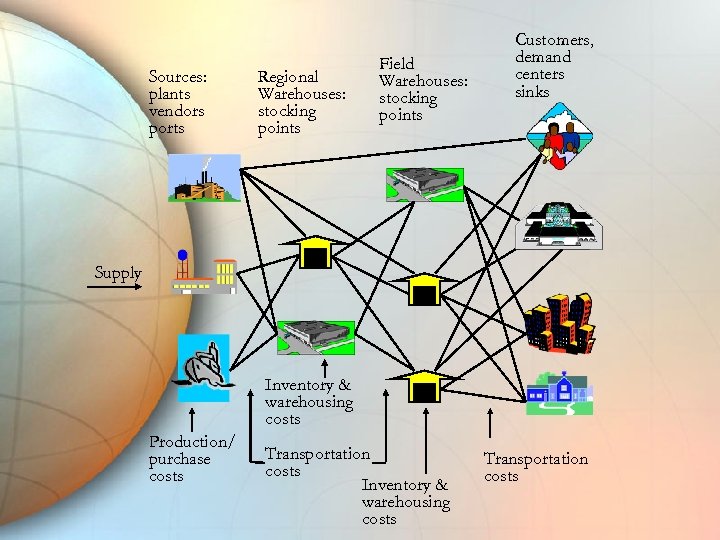 Sources: plants vendors ports Regional Warehouses: stocking points Field Warehouses: stocking points Customers, demand centers sinks Supply Inventory & warehousing costs Production/ purchase costs Transportation costs Inventory & warehousing costs Transportation costs
 Strategies for SCM All of the advanced strategies, techniques, and approaches for Supply Chain Management focus on: –Global Optimization –Managing Uncertainty Mc. Graw-Hill/Irwin © 2003 Simchi-Levi, Kaminsky, Simchi-Levi
 Optimization What is it? Why is it important? What tools and approaches help? Mc. Graw-Hill/Irwin © 2003 Simchi-Levi, Kaminsky, Simchi-Levi
 Tools and Strategies for Optimization Decision Support Systems Inventory Control Network Design for Logistics Cross Docking Mc. Graw-Hill/Irwin © 2003 Simchi-Levi, Kaminsky, Simchi-Levi
 Global Optimization What is it? Why is it different/better than local optimization? What are conflicting supply chain objectives? What tools and approaches help with global optimization? Mc. Graw-Hill/Irwin © 2003 Simchi-Levi, Kaminsky, Simchi-Levi
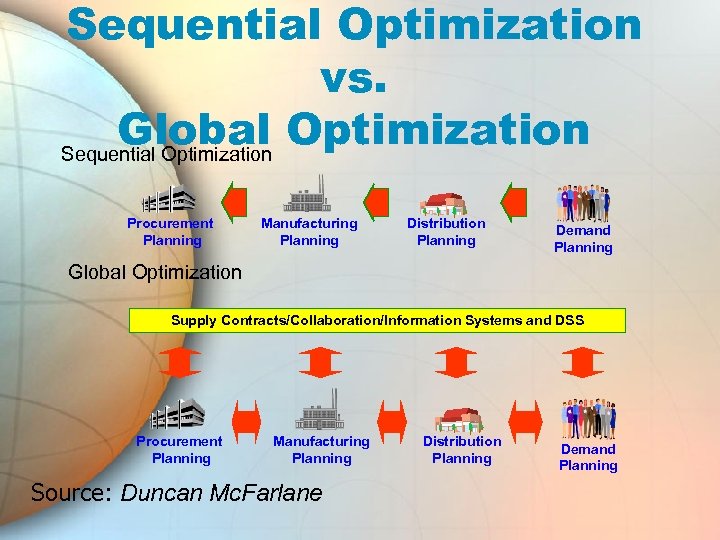 Sequential Optimization vs. Global Optimization Sequential Optimization Procurement Planning Manufacturing Planning Distribution Planning Demand Planning Global Optimization Supply Contracts/Collaboration/Information Systems and DSS Procurement Planning Manufacturing Planning Source: Duncan Mc. Farlane Distribution Planning Demand Planning
 Why is Global Optimization Hard? The supply chain is complex Different facilities have conflicting objectives The supply chain is a dynamic system – The power structure changes The system varies over time Mc. Graw-Hill/Irwin © 2003 Simchi-Levi, Kaminsky, Simchi-Levi
 Conflicting Objectives in the Supply Chain 1. Purchasing • Stable volume requirements • Flexible delivery time • Little variation in mix • Large quantities 2. Manufacturing • Long run production • High quality • High productivity • Low production cost Mc. Graw-Hill/Irwin © 2003 Simchi-Levi, Kaminsky, Simchi-Levi
 Conflicting Objectives in the Supply Chain 3. Warehousing • Low inventory • Reduced transportation costs • Quick replenishment capability 4. Customers • Short order lead time • High in stock • Enormous variety of products • Low prices Mc. Graw-Hill/Irwin © 2003 Simchi-Levi, Kaminsky, Simchi-Levi
 Tools and Approaches for Global Optimization Everything for optimization, plus… Strategic Alliances/Supplier Partnerships Supply Contracts/Incentive Schemes Mc. Graw-Hill/Irwin © 2003 Simchi-Levi, Kaminsky, Simchi-Levi
 Uncertainty What is variation? What is randomness? What tools and approaches help us to deal with these issues? Mc. Graw-Hill/Irwin © 2003 Simchi-Levi, Kaminsky, Simchi-Levi
 Can’t Forecasting Help? Forecasting is always wrong The longer the forecast horizon the worse the forecast End item forecasts are even more wrong Mc. Graw-Hill/Irwin © 2003 Simchi-Levi, Kaminsky, Simchi-Levi
 Why Is Uncertainty Hard to Deal With? Matching supply and demand is difficult. Forecasting doesn’t solve the problem. Inventory and back-order levels typically fluctuate widely across the supply chain. Demand is not the only source of uncertainty: – – – Lead times Yields Transportation times Natural Disasters Component Availability Mc. Graw-Hill/Irwin © 2003 Simchi-Levi, Kaminsky, Simchi-Levi
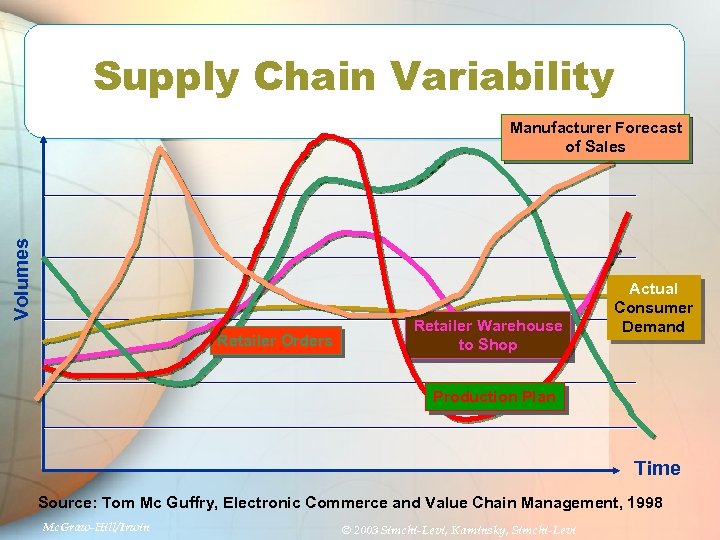 Supply Chain Variability Volumes Manufacturer Forecast of Sales Retailer Orders Retailer Warehouse to Shop Actual Consumer Demand Production Plan Time Source: Tom Mc Guffry, Electronic Commerce and Value Chain Management, 1998 Mc. Graw-Hill/Irwin © 2003 Simchi-Levi, Kaminsky, Simchi-Levi
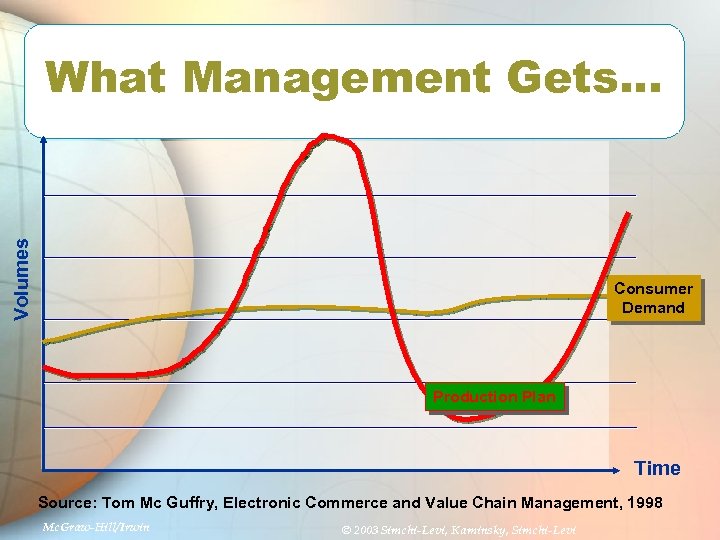 Volumes What Management Gets. . . Consumer Demand Production Plan Time Source: Tom Mc Guffry, Electronic Commerce and Value Chain Management, 1998 Mc. Graw-Hill/Irwin © 2003 Simchi-Levi, Kaminsky, Simchi-Levi
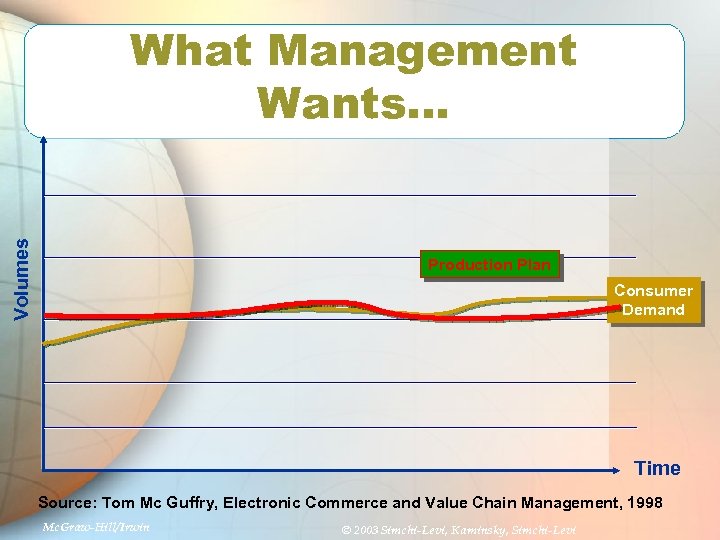 Volumes What Management Wants… Production Plan Consumer Demand Time Source: Tom Mc Guffry, Electronic Commerce and Value Chain Management, 1998 Mc. Graw-Hill/Irwin © 2003 Simchi-Levi, Kaminsky, Simchi-Levi
 Dealing with Uncertainty Pull Systems Risk Pooling Centralization Postponement Strategic Alliances Collaborative Forecasting Mc. Graw-Hill/Irwin © 2003 Simchi-Levi, Kaminsky, Simchi-Levi
 Supply Chain: the Magnitude In 1998, American companies spent $898 billion in supply-related activities (or 10. 6% of gross domestic product). – Transportation 58% – Inventory 38% – Management 4% Third party logistics services grew in 1998 by 15% to nearly $40 billion Mc. Graw-Hill/Irwin © 2003 Simchi-Levi, Kaminsky, Simchi-Levi
 Supply Chain: the Magnitude It is estimated that the grocery industry could save $30 billion (10% of operating cost) by using effective logistics strategies. – A typical box of cereal spends more than three months getting from factory to supermarket. A typical new car spends 15 days traveling from the factory to the dealership, although actual travel time is 5 days. Mc. Graw-Hill/Irwin © 2003 Simchi-Levi, Kaminsky, Simchi-Levi
 Supply Chain: The Magnitude Compaq computer estimates it lost $500 million to $1 billion in sales in 1995 because its laptops and desktops were not available when and where customers were ready to buy them. Boeing aircraft, one of America's leading capital goods producers, was forced to announce write downs of $2. 6 billion in October 1997, due to “Raw material shortages, internal and supplier parts shortages…”. Mc. Graw-Hill/Irwin © 2003 Simchi-Levi, Kaminsky, Simchi-Levi
 Supply Chain: The Potential Procter & Gamble estimates that it saved retail customers $65 million through logistics gains over the past 18 months. “According to P&G, the essence of its approach lies in manufacturers and suppliers working closely together …. jointly creating business plans to eliminate the source of wasteful practices across the entire supply chain”. (Journal of business strategy, Oct. /Nov. 1997) Mc. Graw-Hill/Irwin © 2003 Simchi-Levi, Kaminsky, Simchi-Levi
 Supply Chain: the Potential In 10 years, Wal-Mart transformed itself by changing its logistics system. It has the highest sales per square foot, inventory turnover and operating profit of any discount retailer. Dell Computer has outperformed the competition in terms of shareholder value growth over the eight years period, 1988 -1996, by over 3, 000% (see Anderson and Lee, 1999) using – Direct business model – Build-to-order strategy. Mc. Graw-Hill/Irwin © 2003 Simchi-Levi, Kaminsky, Simchi-Levi
 Supply Chain: The Complexity National Semiconductors: – Production: Produces chips in six different locations: four in the US, one in Britain and one in Israel Chips are shipped to seven assembly locations in Southeast Asia. – Distribution The final product is shipped to hundreds of facilities all over the world 20, 000 different routes 12 different airlines are involved 95% of the products are delivered within 45 days 5% are delivered within 90 days. Mc. Graw-Hill/Irwin © 2003 Simchi-Levi, Kaminsky, Simchi-Levi
 What’s New? Global competition Shorter product life cycle New, low-cost distribution channels More powerful well-informed customers Internet and E-Business strategies Mc. Graw-Hill/Irwin © 2003 Simchi-Levi, Kaminsky, Simchi-Levi
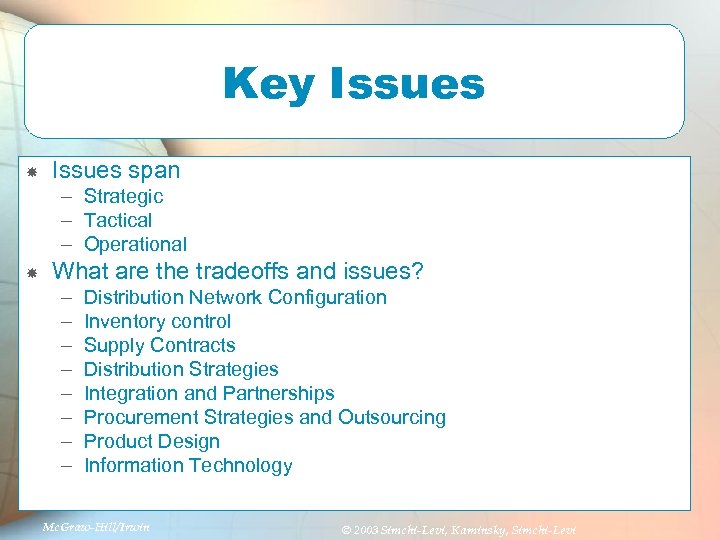 Key Issues span – Strategic – Tactical – Operational What are the tradeoffs and issues? – – – – Distribution Network Configuration Inventory control Supply Contracts Distribution Strategies Integration and Partnerships Procurement Strategies and Outsourcing Product Design Information Technology Mc. Graw-Hill/Irwin © 2003 Simchi-Levi, Kaminsky, Simchi-Levi
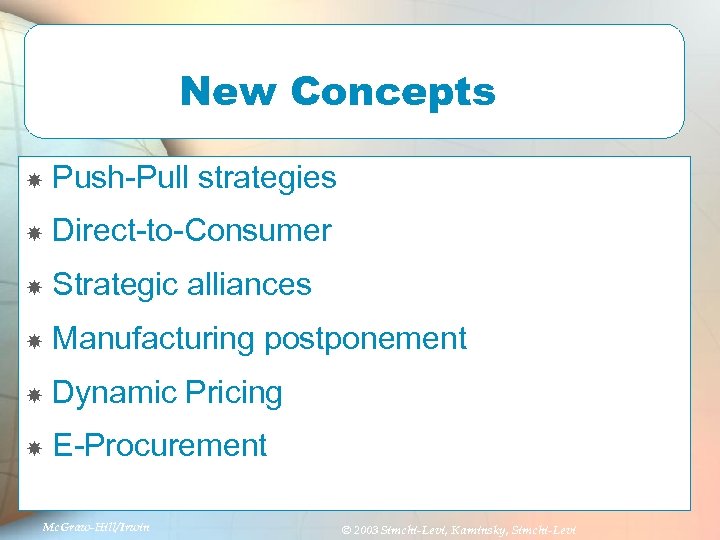 New Concepts Push-Pull strategies Direct-to-Consumer Strategic alliances Manufacturing postponement Dynamic Pricing E-Procurement Mc. Graw-Hill/Irwin © 2003 Simchi-Levi, Kaminsky, Simchi-Levi